Author: Discover Main Feed

  • From Eternity to Book Club: Chapter Three | Cosmic Variance

    Welcome to this week’s installment of the From Eternity to Here book club. Next up is Chapter Three: “The Beginning and End of Time.” Remember that next week we’re doing two chapters at once, Four and Five.

    For those who missed them, here’s the Science Friday discussion, and here’s the Firedoglake book salon with Chad. I should also point to some substantive review/discussions: Wall Street Journal, New Scientist, USA Today, and Overcoming Bias.

    Excerpt:

    For the most part, people interested in statistical mechanics care about experimental situations in laboratories or kitchens here on Earth. In an experiment, we can control the conditions before us; in particular, we can arrange systems so that the entropy is much lower than it could be, and watch what happens. You don’t need to know anything about cosmology and the wider universe to understand how that works.

    But our aims are more grandiose. The arrow of time is much more than a feature of some particular laboratory experiments; it’s a feature of the entire world around us. Conventional statistical mechanics can account for why it’s easy to turn an egg into an omelet, but hard to turn an omelet into an egg. What it can’t account for is why, when we open our refrigerator, we are able to find an egg in the first place. Why are we surrounded by exquisitely ordered objects such as eggs and pianos and science books, rather than by featureless chaos?

    This chapter is a fairly straightforward review of the modern understanding of cosmology, with a particular eye on those issues that will become important later in the book. We zip through the expansion, structure formation, and dark energy. There I got to tell a fun personal story of my wager with Brian Schmidt. At least I think it’s fun — including personal stories is not my natural tendency, but at the right moments it can help to humanize all the forbidding science. Hopefully this was one such moment.

    A few topics go beyond the standard cosmology summary. I discussed the Steady State theory a bit, because it’s a relevant historical example when we will much later turn to the question of what the universe should look like. I also dwell a bit on vacuum fluctuations and dark energy, because those will pay a crucial role in my personal favorite explanation for the arrow of time. And we close the chapter with a very brief overview of the evolution of entropy. It has to be brief, because we haven’t laid nearly enough groundwork to do the job right. This is a conscious choice, which may or may not work: rather than simply progressing on an absolutely logical path from foundations to conclusions, I felt free to mention points that would be important later, on the theory that they would come as less of a shock if we had established some familiarity. Again, hope that worked.

    Tom Levenson, who is an actual writer, advised me to omit “smoking a pipe” from the caption to Figure 7, on the theory that what is shown should not also be told. I left it in anyway. It’s my book!


  • Revisiting the Whirlpool | Bad Astronomy

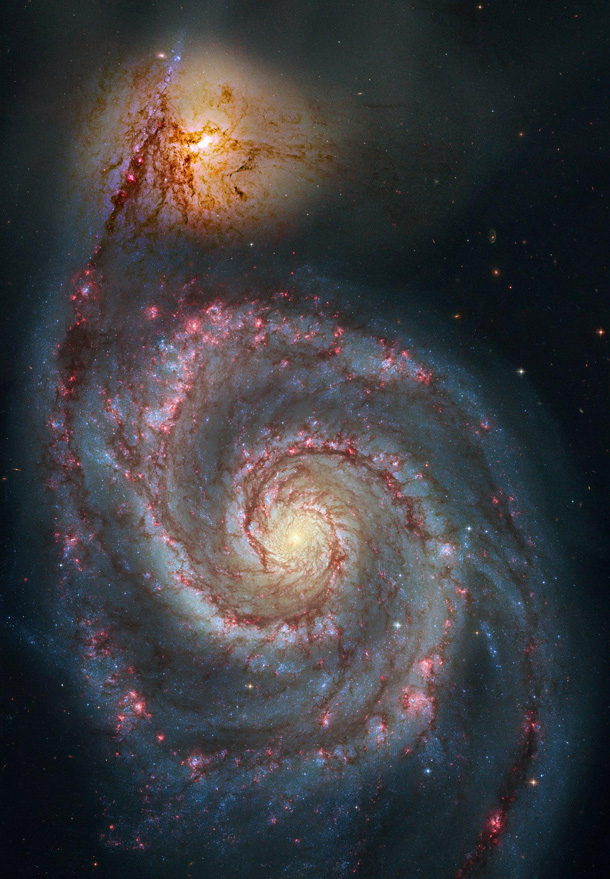
    One of the closest and most spectacular galaxies in the sky is M51, the Whirlpool. A grand design face-on spiral with a small, irregular companion, it’s so bright and big that it’s a favorite target for amateurs. So you just know when you point Hubble at it, what you get is nothing short of jaw-dropping heart-aching beauty.

    Voila:

    [Click to galactify.]

    This image, using the Hubble Advanced Camera for Surveys, was originally released in 2005, but was recently reprocessed by the phenomenal astrophotographer Robert Gendler. And yeah, you absolutely want to click that link to see the work Robert has done. He’s incredible.

    I could go on and on about the galaxy, the glorious spiral arms, the red glow of nebular star birth factories, the odd companion that apparently has drawn out that long tidal tail of stars from the spiral, and so on… but you’ve read that stuff here before.

    Instead, while looking this image up, I found the behind-the-scenes story on how they observed it that I think will interest you, my BABloggees. Extra cool is the page showing the galaxy observations in different colors, and you can see just what a big spiral looks like when you use different filters:

    hst_m51_filters

    You can see the ACS field of view, and the final version on the left. The different observations are listed (each frame is clickable to embiggen on that page, which lets you explore the galaxy on your own). The filters are labeled on the top of each image: B (blue), V (visual, or really yellow), I (near-infrared), and Hα + [NII], the reddish light given off by hot hydrogen clouds laced with nitrogen. That last bit is where stars are being born, and traces the spiral arms very well. The I-band shows very warm dust as well as stars, so it looks smoother since all that stuff is rather smoothly distributed in the galaxy. The B-band has hot stars in it, so again shows where stars are being born; blue stars don’t live very long, and can barely escape their gas cloud nurseries before blowing up as supernovae.

    When you put these all together you get the majesty of a spiral galaxy, a city of stars much like our own Milky Way. I’ve seen M51 myself with binoculars and through countless telescopes at star parties, and while it doesn’t look as glorious as it does here — of course — just knowing what’s going on in the galaxy and what it really does look like through the big guns is enough to thrill. It may look blurry and fuzzy through a small telescope, but our brains are big enough to encompass all those light years, and to understand what it is we’re seeing.


    Image Credit: NASA, Hubble Heritage Team, (STScI/AURA), ESA, S. Beckwith (STScI). Additional Processing: Robert Gendler


  • Why We’re Losing the News | The Intersection

    losing-the-news1As part of a course I’m auditing at the Harvard Kennedy School, I have been reading the teacher’s book: veteran newsman Alex Jones’ Losing the News: The Future of the News That Feeds Democracy. It is quite an amazing, saddening read. The problems with the news industry are not new to me–in fact, they comprise a central component of Unscientific America–but the ways in which they are documented here, in unforgettable narrative (the stories of the decline of papers like the L.A. Times) and ironclad analysis (of the economics of why newspapers are suffering so badly), are superb.

    Jones’ central motif is that there is an “iron core” of real news, reported news, produced by expert journalists each day. It is expensive to produce, it requires long-trained journalists, travel and research budgets, libel insurance, and much else. It has strong standards: objectivity, balance, and so on. It has never been more than, say, 15 percent of the total content of a newspaper, and always surrounded and adorned by softer stuff: opinion, commentary, film reviews, sports, horoscopes, crosswords, etc. But when newspapers were highly profitable, the revenue they generated effectively subsidized this public service aspect of the newspaper business, and the “iron core” was strong.

    Now, though, the “iron core” is no longer so protected, or assured of being subsidized as it once was. Its total size is shrinking, and it is not being replaced, for the most part, on the web–where the content generated is largely commentary and opinion, rather than real news itself, and indeed, feeds off of what’s left of the “iron core.”

    Such is Jones’ thesis, and I found myself wondering exactly where science journalism fits into the “core” argument. I would guess that part of science journalism fits, or would have fit, into the iron core; indeed, it is probably among the parts of the core that is vanishing fastest. But at the same time, science journalism is perhaps a different form of highly subsidized coverage, one that fares even worse than hard news. Call it the “science core.” It is even less protected, I would argue, in the new media context; and it is certainly being no better replaced by the science blogosphere or science on the web.

    What do we do about this situation, either to save the “iron core” or the “science core”? Maybe that’s a topic for another post…or something Jones will get to later in the book. Certainly, the situation does not look good out there, and solutions are few, or maybe nonexistent, for restoring these forms of journalism as they once existed.


  • NCBI ROFL: Snappy answers to stupid questions: an evidence-based framework for responding to peer-review feedback. | Discoblog

    additionalexperiments“BACKGROUND: Authors are inundated with feedback from peer reviewers. Although this feedback is usually helpful, it can also be incomprehensible, rude or plain silly. Inspired by Al Jaffe’s classic comic from Mad Magazine, we sought to develop an evidenced-based framework for providing “snappy answers to stupid questions,” in the hope of aiding emerging academics in responding appropriately to feedback from peer review. METHODS: We solicited, categorized and analyzed examples of silly feedback from peer reviewers using the grounded theory qualitative research paradigm from 50 key informants. The informants represented 15 different professions, 33 institutions and 11 countries… RESULTS: We developed a Scale of Silliness (SOS) and a Scale of Belligerence (SOB) to facilitate the assessment of inadequate peer-review feedback and guide users in preparing suitable responses to it. The SOB score is tempered by users’ current mood, as captured by the Mood Reflective Index (MRI), and dictates the Appropriate Degree of Response (ADR) for the particular situation. CONCLUSION: Designed using the highest quality of (most easily accessible anecdotal) evidence available, this framework may fill a significant gap in the research literature by helping emerging academics respond to silly feedback from peer reviewers. Although use of the framework to its full extent may have negative consequences (e.g., loss of promotion), its therapeutic value cannot be understated.”

    peer review


  • Henrietta Lacks and the Future of Science Books | The Loom

    The Immortal Life of Henrietta Lacks CoverI first met the writer Rebecca Skloot about eight years ago. She had been working on a book for a couple years and running late. The idea was brilliant, though, so I hoped she’d be able to get it done before too long. Many scientists who study human cell biology use a special line of cells known as HeLa. It came from a woman named Henrietta Lacks, who died of cervical cancer in 1951. Skloot was writing about Lacks, her family, and the way her body became dispersed around the world.

    When I would see Skloot again, I’d ask how the book was going. Still going. After a while, I stopped asking, because I know how irritating that question can get when the answer hasn’t budged for a while. When the book was done, it would be done.

    A decade passed before the book was done. When Skloot sent me an advance copy of The Immortal Life of Henrietta Lacks a few months ago, I discovered why it had taken so long. She doggedly pursued the story, reconstructing a fifty-year saga intertwining the experience of a family struggling in Baltimore and the rise of modern biology. It was worth the wait, and I happily provided a blurb–

    “Rebecca Skloot has written a marvelous book so original that it defies easy description. She traces the surreal journey that a tiny patch of cells belonging to Henrietta Lacks’s body took to the forefront of science. At the same time, she tells the story of Lacks and her family—wrestling the storms of the late twentieth century in America—with rich detail, wit, and humanity. The more we read, the more we realize that these are not two separate stories, but one tapestry. It’s part The Wire, part The Lives of the Cell, and all fascinating.”

    Spending a decade working on her book, Skloot became a literary Rip Van Winkle. She started her book back before the rise of blogs, before the annihilation of book reviews in newspapers, before Kindles and Ipads. When Skloot started her book, the book tour was still a relatively common feature of the promotion of a new book. But Skloot discovered that book tours had pretty much evaporated by the time her book was coming out.

    As I’ve published books of my own over the past decade, I’ve watched these same changes accrue, book by book. I’ve tried to take more control over the promotion of my work. I look for ways to spread the word about my books online, not just when they come out, but long afterwards. I am grateful to readers who spread the word further on their own blogs and tweets. But I have to say that publishing books gets more and more nerve-wracking as time goes on. Writing books is a slow process, but the publishing industry is changing fast. I feel as if I am at an archery contest. I take a long, long time to aim at a target, but by the time I let the arrow fly, someone’s moved the target away.

    So I was curious to see how Skloot would contend with the challenge of publishing a book in 2010. Fortunately, she has comet it with great creativity and verve. One of the thing’s she’s done is crowd-source a book tour. She has sent out a call to everyone she knows for help in lining up talks across the US and beyond. I don’t quite know how the whole thing came together, but she is now starting a zillion-city, multi-month tour.

    I offered my help for the Elm City leg of the tour, so let me just take a moment to send out a call to everyone in and around New Haven, Connecticut. Skloot will be talking on Monday, 2/8, at 4 pm at a Morse College Master’s Tea at Yale. Morse College is under renovation this year, so the students are staying at Yale’s Swing Space at 100 Tower Parkway (Map).

    Skloot has also been lining up lots of other opportunities to talk about the book. Today (2/2) is the official date of publication, and the book is #11 on Amazon. That’s a great thing to see (even if Amazon’s on my blacklist at the moment because of their ongoing book-disappearing act). It may be too early to pass final judgment on the book’s commercial success, but I’m impressed so far.

    I think Skloot’s experiences are worth studying, although they are no guarantee for every writer insane enough to write a book about science. For one thing, Skloot has an exceptional subject, which she has written about exceptionally well. What’s more, the odds are getting tougher for all authors. With more and more book titles in competition for the shrinking amount of time people spend reading books, a lot of disappointment is inevitable. Still, it’s a good idea for writers not to become recluses. Sure, spend time in the monastic solitude that books require, but then emerge and engage. You don’t have to tweet with Skloot’s hurricane-scale intensity, but do forge the relationships in which you can support fellow writers, and they can support you.


  • Carnival of Space #139 | Bad Astronomy

    The 139th Carnival of Space is now up at the very energetic Mama Joules blog.

    Haha! You see, that’s a joke, because a Joule is a unit of energy. Haha! Ha! Erg.

    Still, you should go there, read stuff, and learn. That’s what the web is for (despite the spam telling you otherwise).


  • Whales vs. Navy: NOAA May Limit Sonar Tests, but Another Case Heads to Court | 80beats

    submarine

    Whales and the U.S. Navy have tangled repeatedly over the past years over charges that the Navy’s sonar exercises disorient or injure whales and other marine mammals. Now, whales in the Pacific appear to have a new champion: the National Oceanic and Atmospheric Administration, which is considering limiting the Navy’s sonar tests in certain marine mammal “hot spots.”

    The announcement was made in a letter (pdf) from NOAA head Jane Lubchenco to the White House Council on Environmental Quality. NOAA also called for development of a system for estimating the “comprehensive sound budget for the oceans,” which could help reduce human sources of noise — vessel traffic, sonar and construction activities — that degrade the environment in which sound-sensitive species communicate [Los Angeles Times].

    While NOAA’s new investigations into limiting the Navy’s sonar use is good news for whales, it may take years before new rules are issued. And until then, fights will rage on in courts. Back in 2008, a 5-4 vote in the U.S. Supreme Court allowed the Navy to conduct sonar tests in the Pacific Ocean, despite environmental groups fighting to stop the tests. But that wasn’t the end of litigation over this issue. Last week a consortium of environmental groups sued the Navy in U.S. District Court to stop a sonar project on the other side of the country, in the Atlantic Ocean waters off Florida.

    The proposed Undersea Warfare Training Center would cover 500 square nautical miles in an area ideally close to two Navy bases, one in Georgia and another in Florida. However, the range would lie just outside the shallow waters where right whales give birth and nurse their calves each year from mid-November to mid-April [Los Angeles Times]. Right whales are an endangered species numbering only about 350, researchers believe.

    “Right whales shouldn’t be subjected to the threats that accompany this range — ship strikes, entanglement and noise disturbance — in the only place in the world where vulnerable females give birth to and care for their calves,” said Catherine Wannamaker, an attorney with Southern Environmental Law Center [Environmental News Service]. The Pentagon didn’t responded to the lawsuit immediately, but the Navy has previously stated it doesn’t believe the project will cause major environmental harm, and that it would halt construction during the whales’ five-month calving season.

    The Navy’s own environmental impact statement notes that sonar can harm whales, though scientists don’t completely understand the specifics. But the environmental groups say there’s more to this case than sonar: Ship traffic in the calving grounds is of particular concern since data suggests female right whales are struck more often, possibly because they must spend more time at the surface with their calves which have undeveloped lung capacities [Environmental News Service].

    Because of the extra issues besides sonar, and right whales’ status as critically endangered, Wannamaker says this is a different case than the 2008 one that became a Navy victory. In that decision, Chief Justice John Roberts wrote that national security and military training outweighed the concern for the whales in that case, but that they wouldn’t necessarily trump the environmentalists’ arguments in every case.

    Related Content:
    80beats: Navy 1, Whales 0: Supreme Court Allows Navy’s Sonar Exercises
    80beats: Supreme Court Hears the Legal Dispute Between Whales and the Navy
    Reality Base: Whales Battle U.S. Military… and (Probably) Lose
    80beats: Who Would Win in a (Legal) Fight: A Whale or a Battleship?
    DISCOVER: Killing Whales With Sound

    Image: Rialyn Rodrigo/U.S. Navy


  • Will Genetically Modified Eucalyptus Trees Transform Southern Forests? | 80beats

    eucalyptus-treeNow that many U.S. farmers have grown used to genetically modified (GM) soy and corn, the controversy surrounding GM crops may shift over to GM eucalyptus–a fast-growing Australian tree that, in its unmodified strains, dominates the tropical timber industry.

    Two industry giants, International Paper Co. and MeadWestvaco Corp. have formed a biotech venture called ArborGen LLC that is looking to introduce this tree to the southeastern forests of the United States. The company is seeking greater governmental deregulation so it can roll out its plans of replacing native pines in southeastern plantation forests with the genetically engineered eucalyptus, which can survive freezing winter temperatures.

    Unlike the pine trees used in Southern plantations — which have quietly helped displace tobacco in the region’s economy — eucalyptus can deploy a full canopy of leaves within a few years. It is greedy for carbon, and within 27 months can grow to 55 feet in height [The New York Times]. ArborGen points out that the high growth rate will allow the company to grow more wood on less land, which could provide a boost to the region’s timber exports. What’s more, the wood could potentially serve as a biofuel feedstock.

    Critics, however, worry that the plant would grow untrammeled, like a weed gone wild, and would consume whole forests and wipe out native foliage. One of the two species used to breed ArborGen’s hybrids, Eucalyptus grandis, had previously turned invasive in South Africa–raising concerns about this tree turning invasive in the south. ArborGen has received conditional approval from the U.S. Department of Agriculture to expand its experimental eucalyptus operations to 28 sites in seven states, for a total of 330 acres of forest. Given the uncertainty involved, however, the Nature Conservancy has recommended to USDA that ArborGen be allowed fewer acres and trees to flower, and none in Florida, [ecologist Doria Gordon] said. The draft permit approved by USDA would allow flowering in 10 sites across the state [The New York Times]. ArborGen has pointed out that the tree that grew invasive in South Africa was thriving in arid conditions, something that would not happen in Florida due its moist climate.

    ArborGen also says that the GM trees won’t spread because of a genetic tweak that prevents the trees from reproducing. (Similar techniques have been used to make GM plants like corn and soy infertile, a controversial tactic that forces farmers to buy new seeds each year.) In the case of the eucalyptus trees, ArborGen restricts their pollen production with a bacterial gene that produces a toxic enzyme called barnase that slices apart genetic material in a cell, causing death. Through genetic trickery, the enzyme is only produced in the pollen-spreading parts of the tree, destroying its ability to reproduce — at least most of the time [The New York Times].

    It’s not yet clear how the public will feel about GM forests. But scientists note that some trees that have been genetically tweaked to prevent disease have already gained widespread acceptance–like papaya trees in Hawaii that are less susceptible to the ringspot virus, and American chestnuts that resist a deadly fungus. ArborGen’s scientists argue that tweaking eucalyptus trees for commercial reasons isn’t so different from those earlier efforts, and say the trees could eventually play a significant role in biofuel production. Tree geneticist Steve Strauss, who consulted with ArborGen, says: “If we’re going to rely on biofuels as a significant part of a diverse portfolio of renewable technology,” then harvesting trees is the best way to go, he said. “There’s a lot of marginal land that could be used” [The New York Times].

    Related Content:
    80beats: GM Corn & Organ Failure: Lots of Sensationalism, Few Facts
    80beats: GM Corn Leads to Organ Failure!? Not So Fast
    80beats: New Biotech Corn Gives Triple Vitamin Boost; Professors Unmoved
    80beats: Germany Joins the European Mutiny of Genetically Modified Crops
    DISCOVER: “Frankenfoods” That Could Feed the World
    DISCOVER: Genetically Altered Corn, and how GM corn not intended for humans got into the food supply

    Image: iStockphoto


  • Bill Gates gives $10 billion for vaccines! | Bad Astronomy

    Have no doubt, I’m a Mac guy. I don’t drink the Kool Aid, but my time with using PCs is well behind me. But y’know, Bill Gates is still my kinda guy: he and his wife are investing ten billion dollars to get vaccines to kids who need them.

    That’s $10,000,000,000. Holy Haleakala. They think this can save nearly 9 million lives, and I think that’s pretty cool:

    “Vaccines are a miracle,” added Melinda Gates. “With just a few doses, they can prevent deadly diseases for a lifetime. We’ve made vaccines our priority at the Gates Foundation because we’ve seen firsthand their incredible impact on children’s lives.”

    Good on them. Very, very good. This is not only something desperately needed, but the publicity is, haha, a shot in the arm as well.

    And if I may disagree ever-so-slightly with Ms. Gates, I’ll add that vaccines are not a miracle: they are the result of science, of clever people, of medical advances. That fact is lost on a lot of folks, including the antivaxxers. On top of this incredibly generous move, I’d love to see Mr. and Ms. Gates donate some money and effort to a good ad campaign that promotes vaccination and specifically targets the claims of the pro-disease antivax crowd, so that their work will have even more of a sustainable impact. I’m so thrilled they’re doing this, but we also need a national campaign to show people that the antivaxxers are wrong and doing significant damage to the public health.

    Still and all: my congrats to the Bill and Melinda Gates Foundation, and my very sincere and hearty thanks.


  • President Obama’s NASA budget unveiled | Bad Astronomy

    NASA logoAs promised, today President Obama released his planned NASA budget for the year. Not too surprisingly, it’s pretty much as the rumors indicated. There’s a lot to say here, and I have a lot on my mind, so please hear me out.

    The Good News

    The good news for sure is an increase of $6 billion over the next five years. It stresses new technology and innovation (to the tune of over $1.5 billion), which is also good. A lot of NASA’s successes have been from pushing the limits on what can be done. It also stresses Earth science, which isn’t surprising at all; Obama appears to understand the importance of our environmental impact, including global warming. So that’s still good news.

    The very very good news is that half that money — half, folks, 3.2 billion dollars — is going to science. Yeehaw! The release specifically notes telescopes and missions to the Moon and planets. That, my friends, sounds fantastic.

    Bye bye Constellation

    Now to the other aspects of this budget. As I have written before, this new budget axes Constellation:

    NASA’s Constellation program – based largely on existing technologies – was based on a vision of returning astronauts back to the Moon by 2020. However, the program was over budget, behind schedule, and lacking in innovation due to a failure to invest in critical new technologies. Using a broad range of criteria an independent review panel determined that even if fully funded, NASA’s program to repeat many of the achievements of the Apollo era, 50 years later, was the least attractive approach to space exploration as compared to potential alternatives. Furthermore, NASA’s attempts to pursue its moon goals, while inadequate to that task, had drawn funding away from other NASA programs, including robotic space exploration, science, and Earth observations. The President’s Budget cancels Constellation and replaces it with a bold new approach that invests in the building blocks of a more capable approach to space exploration…

    [Emphasis mine.]

    I can’t say I disagree with much that’s written there. A lot of it is based on the conclusions of the Augustine commission, a blue-ribbon panel of experts appointed by Obama to look into NASA’s future plans and make recommendations.

    The Space Station

    The budget calls for extending the International Space Station beyond the 2016 timeline, perhaps for four more years. I would say this is a bad idea, BUT the budget also asks for extending the ISS’s scientific capabilities. I would be happy to see that; ISS is very limited as a science platform. However, the dang thing is already built and in orbit, so it makes sense to spend a little bit more (I was surprised to see only about $180 million for this) to make it useful scientifically. If that becomes the case, then a lot of the issues I have with ISS go away.

    Incidentally, the budget calls for a guaranteed $600 million for the next five Shuttle missions to ISS, even if a launch slips into FY11.

    Back to the Moon?

    So, where does this leave us as far as going back to the Moon? It leaves us delayed, again. That sucks. However, as I have pointed out before, Constellation was already a mess. Behind schedule, over budget, and starved of funding. It was a mandate from the Bush White House, but never got the money it needed from them or Congress to ensure it could be done (this didn’t work when it was attempted from the Bush Sr. White House/Congress either).

    I don’t want a repeat of the Apollo program: a flag-and-footprints mission where we go there, look around, and then come home for another 40 years. I want to go there and stay there. Apollo was done as a race, and the goal of a race is to win. It wasn’t sustainable. We need to be able to figure out how to get there and be there, and that takes more than just big rockets. We need a good plan, and I’m not really sure what we had up until this point is that plan.

    Building a heavy-lift rocket that can take us to the Moon, Mars, and near-Earth asteroids is not really easy. It’s not like we can dust off the old Saturn V plans and start up the factories again. All that tech is gone, superseded, and we might as well start from scratch with an eye toward newer tech. This budget is calling for that, as well as relying heavily on private companies.

    Commercial space

    And about that. I’ll say this again: private companies have not yet put a man in orbit, but Space X, as an example, is close to doing so. Once the Shuttle retires later this year, private companies will be putting humans in space before NASA will have the capability to do so again [UPDATE: please see my comment below; the above statement about companies beating NASA is correct]. I am no fan of paying the Russians or other countries to do this for us, and going the route of civilian space makes sense.

    Now, Space X doesn’t have the heavy lift capacity that an Ares 5 or other planned NASA rocket might have had… but with routine launches to space covered by private companies, NASA can concentrate on what it should: innovation, pushing the limits, paving the road. Once the road is laid, let others use it.

    So I don’t see this as doom and gloom. I see this as 1) putting science and innovation first, and 2) freeing NASA up to do what it does best: explore the boundaries.

    Here’s what I think. Warning: political complaining ahead.

    Remember: the way we’ve been doing things for 40 years has gotten us literally in circles. It’s perhaps long past time to shake things up and try something different. In my previous posts on this (see Related Posts at the bottom), people are complaining that Obama is killing our Moon plans and gutting NASA. That’s simply not true. I think this may very well save NASA and our future manned exploration capabilities, if this is all done correctly.

    As for that, and having said my piece that I think this is a good idea, it may not matter: the other thing to remember is that this must pass Congress first. I honestly don’t think that will happen. For one thing, two many Congresscritters have too big a stake in NASA to let go; if you don’t believe me, read this article where Alabama Congressmen complain about the new budget. When Republicans whine about privatizing something, you know you’re in for a fight, and it’s not like Congressional Democrats haven’t been all that useful in backing up Obama’s plans.

    We’ll see how this goes. If it’s business as usual with Congress, then I suspect it may be a lot like the health care plan all over again: lots of spin and noise, lots of knee-jerk reactions because it’s Obama’s plan, lots of “compromise” that’s really just watering down something to make it worse, and then a budget will be passed that won’t be able to get anything done.

    I’m pretty damn tired of that, and I’m going to do something about it. I’ll write my Congressmen, and I’ll tell them that the time for bending over backwards is long gone. It’s time to grow a spine, time for boldness, time for innovation. Whether people like it or not, this is the new budget being proposed, and if Congress wheedles over it, then yeah, NASA really will be screwed, and we’ll spend the next four decades circling our planet and gazing at the Moon, wondering when we’ll ever go back.

    Perhaps it’s fitting that this news is released on the anniversary of the loss of Columbia — it’s been seven years since that day when the orbiter broke up upon re-entry. A very good case can be made that complacence played a big role in that event. When it comes to space exploration, we must never rest on our laurels, we must never have the arrogance to think we have it all under control, and we must never forget that to explore means to push ahead into unknown territory. That is the lesson of Columbia.

    The Moon, Mars, and all of space await us. This new budget may not be perfect, but I strongly suspect it’s the best we can do, and far, far better than the course we currently have laid out. If we don’t push for this now, we may never go back.

    A ship may be safe in the harbor, but that’s not what ships are for.


    Related posts:
    Give space a chance
    RUMOR: Obama to axe Ares and Constellation
    Apollo 1 redux: The inevitability of disaster


  • I’m Now A Podcast Host: For Point of Inquiry | The Intersection

    I just got the press release by email, so there is no hiding this news any longer. Here it is, from the Center for Inquiry:

    Center for Inquiry Announces Three New Hosts for its Popular Podcast, ‘Point of Inquiry’

    The Center for Inquiry has announced that there will be three new hosts for its popular podcast, Point of Inquiry. Joining the podcast are Chris Mooney, Karen Stollznow, and Robert Price.

    “We are tremendously excited about having Chris Mooney, Karen Stollznow and Robert Price as hosts for our podcast,” said Ronald A. Lindsay, president and CEO of the Center for Inquiry. “All three are smart, articulate, witty individuals, with a depth of knowledge in their respective areas of expertise. We expect the podcasts to be thought-provoking and engaging—an entertaining intellectual feast. Moreover, given the scope of topics to be covered, we anticipate we will be able to broaden the audience for our podcast.”

    Mooney is expected to host about half of the approximately 50 new shows per year, with the balance evenly split between Price and Stollznow. The first episode to feature this new format is scheduled tentatively for February 12.

    The Center for Inquiry launched the weekly podcast in 2006, and it was hosted by CFI Vice President for Outreach D.J. Grothe until his recent departure from CFI to become president of the James Randi Educational Foundation.

    About the hosts:

    Chris Mooney is a 2009-2010 Knight Science Journalism Fellow at MIT and the author of three books, The Republican War on Science, Storm World, and Unscientific America. Mooney maintains a blog hosted by Discover magazine titled “The Intersection” with Sheril Kirshenbaum and serves as a contributing editor for Skeptical Inquirer magazine.

    Robert M. Price is professor of theology and scriptural studies at Coleman Theological Seminary and professor of biblical criticism at the Center for Inquiry Institute. He is a fellow of the Committee for the Scientific Examination of Religion and the Jesus Seminar. Dr. Price is the author of a number of books, including The Reason Driven Life, Deconstructing Jesus, The Incredible Shrinking Son of Man, and The Da Vinci Fraud. He has appeared widely in the media, and was featured prominently in the movie The God Who Wasn’t There. His latest book is Top Secret: The Truth Behind Today’s Pop Mysticisms.

    Karen Stollznow is an author and skeptical investigator with a doctorate in linguistics and a background in history and anthropology. She is an associate researcher at the University of California, Berkeley, and a director of the San Francisco Bay Area Skeptics. A prolific skeptical writer for many sites and publications, she is the “Naked Skeptic” Web columnist for the Committee for Skeptical Inquiry, the “Bad Language” columnist for Skeptic magazine, a frequent contributor to Skeptical Inquirer, and managing editor of CSI’s Scientific Review of Mental Health Practice. Dr. Stollznow is a host of the Monster Talk podcast and writer for the Skepbitch and Skepchick blogs, as well as for the James Randi Educational Foundation’s Swift.

    Point of Inquiry is the premier podcast of the Center for Inquiry, drawing on CFI’s relationship with the leading minds of the day, including Nobel Prize-winning scientists, public intellectuals, prominent authors, and social critics and thinkers. Each episode combines incisive interviews, features, and commentary focusing on issues of science and public policy, pseudoscience and the paranormal, and religion and secularism.

    So what do folks think of that?


  • The Secret to the Sex-less Rotifer’s Success: It’s Blowing in the Wind | 80beats

    RotiferBiologists are a step closer to figuring out the bizarre animals known as bdelloid rotifers, thanks to a new study in Science.

    This group of near-microscopic aquatic organisms has lived for tens of millions of years without sex, can withstand blasts of gamma radiation, and if their habitat dries up they can survive for years in a dessicated state. Two years ago, DISCOVER covered the findings that determined how these all-female invertebrates manage to diversify their genes without sex: Their genome breaks apart when they dry up, and as they reassemble when water returns, they pull in new DNA from a host of other beings. Now, the new study says, drying up is also the key to how rotifers avoid parasites that would normally take advantage of their asexual ways.

    To figure out how rotifers might survive infection, the scientists gave them a parasitic fungus. And they found that bdelloid rotifers can shake the infection by drying out, drifting away and then rehydrating once they land someplace moist but fungus-free. The fungi don’t survive the desiccation, so the longer the bdelloids stay dry, the better off they be [Scientific American]. A control group of rotifers infected by fungus while in water all died within two weeks.

    Normally, a sexually-reproducing parasite has an advantage over its asexual victims. It can evolve faster thanks to the constant shuffle of genes that occurs when males and females mix their DNA, while an asexual population can be too genetically similar: If every individual in a population is genetically identical, then one parasite can wipe them all out [Science News]. But with their apparent incorporation of alien DNA and ability to outlast parasites when times get tough, the rotifers have endured for millions of years.

    Related Content:
    Discoblog: Sexless Sea Creatures Steal Foreign Genes
    Discoblog: Asexual, Tough-As-Hulk Animals Withstand Hulk-Level Radiation
    DISCOVER: The Real Dirty Secret About Sex (Life doesn’t need it, so why do we do it?)

    Image: Kent Loeffer, Kathie T. Hodge, Christopher G. Wilson


  • Obama’s NASA Budget: So Long, Moon Missions; Hello, Private Spaceflight | 80beats

    Ares-I-X-test-flightThe Obama administration’s new budget may come in at a hulking $3.8 trillion, but one thing it doesn’t include is continued funding for the Constellation program. The program, which was intended to continue the work of the aging space shuttles, will get the ax if Congress approves the President’s plan. This also means that NASA would abandon its goal of returning to the moon by 2020.

    Obama’s budget ends work on the shuttle follow-on vehicle, known as Orion, as well as a pair of rockets developed to fly astronauts to the space station, the moon and other destinations in the solar system. “We are proposing canceling the program, not delaying it,” Peter Orszag, director of the Office of Management and Budget, told reporters [Reuters]. The announcement had been some time in coming: The Augustine panel that Obama convened last year to review human spaceflight concluded that Constellation couldn’t succeed without $3 billion in additional annual funding, and rumors broke out last week that the President’s budget would kill the program for good.

    In place of the Constellation program’s Ares rockets and Orion crew capsule, Obama’s plan calls for funneling money to private companies that are jockeying for NASA contracts. The Washington Post reports that the plan would funnel $6 billion to support private space companies developing a vehicle to ferry astronauts back and forth from the International Space Station. Companies expected to seek the new space taxi business include United Launch Alliance, a partnership between Boeing and Lockheed Martin that launches rockets for theUnited States Air Force, and Space Exploration Technologies, a start-up company led by Elon Musk, who founded PayPal [ The New York Times]. The plan would also extend the life of the space station until 2020.

    Commercial Spaceflight Federation president Bretton Alexander was understandably giddy at the prospect of private companies taking center stage. “At a time when job creation is the top priority for our nation, a commercial crew programme will create more jobs per dollar because it leverages millions in private investment and taps the potential of systems that serve both government and private customers,” he said [BBC News].

    However, the White House’s plan to shift to private spaceflight has already ruffled plenty of feathers. Congressional representatives from states with many NASA jobs, like Florida and Texas, have promised to fight the move all the way. Michael Griffin, the previous NASA administrator who served under President George W. Bush, was even more bitter at seeing Obama cut his prized program: “It means that essentially the U.S. has decided that they’re not going to be a significant player in human space flight for the foreseeable future… One day it will be like commercial airline travel, just not yet. It’s like 1920. Lindbergh hasn’t flown the Atlantic, and they’re trying to sell 747s to Pan Am” [Washington Post].

    Some space buffs are also mourning the loss of Constellation’s ambitious goal of reaching the moon by the end of this decade. However, budget director Orszag insisted to reporters that the new plan doesn’t close off the route to human exploration of the moon and the solar system’s planets–it just pushes these efforts back to an unspecified date. Orszag claimed that “advance robotics and other steps that will help to inspire Americans and not just return a man or a woman to the Moon but undertake the longer range research that could succeed in human spaceflight to Mars” [SPACE.com].

    Lost in the furor over Constellation is the fact that Obama’s budget actually increases NASA funding slightly. And as DISCOVER blogger Phil Plait points out at Bad Astronomy, private companies were on track to reach orbit faster than the Constellation program even before this proposed sea change in the government’s approach to spaceflight. Even a fully-funded Constellation program would not have gone back to orbit until at least 2015, leaving a five-year gap after this year’s pending space shuttle retirement with no way for Americans to reach orbit other than hitching a ride with the Russians. NASA had seen lots of infighting over whether Constellation, and especially its Ares rockets, were the right approach. Now it might have to accept losing them for good.

    Related Content:
    Bad Astronomy: Give Space a Chance
    Bad Astronomy: RUMOR: Obama to Axe Constellation And Ares
    80beats: Liftoff! NASA’s New Rocket Takes to the Sky In a Successful Test Flight
    80beats: New NASA Rocket May Not Be “Useful,” White House Panel Says
    80beats: Presidential Panel: Space Travel Plans Are Broken
    DISCOVER: Space Boost, on the potential of private spaceflight

    Image: NASA


  • California Lays Claim to Astronaut Garbage Left Behind on the Moon | Discoblog

    One astronaut’s trash is another state’s treasure. That’s the message from California as the Golden State officially registered a collection of 106 objects left behind on the moon by the Apollo 11 mission as a state historical resource. The collection encompasses about 5,000 pounds of objects, including the bottom stage of the lunar lander and the American flag planted on the moon’s surface by astronauts Neil Armstrong and Buzz Aldrin.

    And it’s not just the tools and the flag–California has also claimed custody of bags of human waste left behind.

    The San Francisco Chronicle reports on the logic behind the unusual decision:

    The first landing on the moon by humans, on July 20, 1969, was “one of the most historical events in the last 100 to 200 years,” said Jay Correia, a historian with the Historical Resources Commission. California had a major role in developing the technology that made the trip to the moon possible.

    The new designations applies to everything left on the moon by Neil Armstrong and Buzz Aldrin. The astronauts jettisoned tools and waste materials to make it easier for their landing module to take off from the moon, and to account for the weight of the moon rocks they’d collected.

    The BBC reports:

    However, the moon’s surface is not included in the designation, because under international law no country or state can make a claim to it. The move aims to protect the site in the face of possible lunar missions in the future by other nations. Several other US states which were involved in the Apollo project are also reportedly seeking to protect the landing site.

    Historians are hopeful that Tranquility Base, where the Eagle lunar module landed in 1969, will eventually be designated a United Nations World Heritage Site.

    Here’s a video that has original footage from the moon landing. So even though news is breaking that the Obama administration’s 2011 NASA budget cancels plans for a 2020 return to the moon, at least you can re-live the moment when man first set foot on the lunar surface, and be comforted by the fact that all the moon junk is in good hands.

    Related Content:
    DISCOVER: Ten Great Views–-and Memories–-From the Moon, a photo gallery of the Apollo mission
    80beats: Obama’s NASA Budget: So Long, Moon Missions; Hello Private Spaceflight
    80beats: 40 Years After Moon Landing, a Question Remains: What Next?
    80beats: 40 Years Later, Remembering the Boldness of Apollo 8
    80beats: Lunar X Prize Competitor Hopes to Send a Rover Back to Tranquility Base

    Video: NASA


  • Terra spots an impact on, um, Terra | Bad Astronomy

    While high over the grasslands of Kazakhstan, the Terra Earth-observing satellite saw something interesting… can you spot it in this image?

    terra_chiyli_lrg

    Not so easy, is it? But if you look just left of center you’ll see this:

    terra_chiyli

    See it there, right in the center? It’s the Chiyli impact crater, an ancient scar from a cosmic collision. The crater is roughly 1.5 km across (about a mile) — about the same size as Meteor Crater in Arizona — meaning the object that created it was something smaller than a football field, moving at perhaps 30 km/sec (20 miles/sec). It hit about 46 million years ago, give or take. Long after the dinosaurs, but long before us, too. Note that it’s a double-rimmed crater too, which sometimes form in large impacts depending on the conditions of the impactor and the ground.

    This is a false-color image, at least part of which is in the infrared; vegetation appears red, water blue, and bare land is “earth tones” (browns and tans). This sort of imagery allows scientists to investigate how vegetation, land, and water change over time.

    terra_chiyli_flippedWhen I first saw this image, I didn’t see it as a crater, but more as a raised annulus, a ring in the ground. I knew immediately that this meant that in the picture, the sunlight was coming up from the bottom, and it turns out that’s correct. It’s a cool and optical illusion; when we see craters illuminated from below, they look like domes, and vice-versa. In the picture here, I flipped the image and now, to me at least, it looks more like the depression that it really is. The wide inner rim is more obvious, too.


    Here’s an even better example:

    Is it a dome… … or a crater?


    It just goes to show you that finding evidence of extra-terrestrial events on Earth can be tough, and even when you find them you can’t rest easy. They’re apt to fool you one way or another.


  • Geoengineering: Are Small Scale Tests Possible? | The Intersection

    Last Friday, my friend and colleague Eli Kintisch of Science magazine had a piece in Slate about the latest in geoengineering research, a field that continues to burgeon. Now, scientists are talking about the possibility of conducting real geoengineering trials, on both the small and the medium scale–right up to the verge of climatic detectability. But as Kintisch reports, while some scientists think there could be a “safe” geoengineering trial, others argue there’s really no such thing. Perturb the planet enough that you see a climatic effect, goes the thinking, and there are going to be a cascade of other consequences.

    The implication of this dispute, writes Kintisch, is disturbing:

    …[the] back-and-forth over which experiments might be best and what sort of political treaties would be necessary raises a distressing possibility: It’s not just that geoengineering tests will be difficult. It’s that the problems they invite would be so diverse—and their results so inconclusive—that we’re likely to skip the testing altogether. If countries are going to hack the stratosphere, they may just do it full-bore in the face of disaster.

    Or, perhaps some rogue countries will do large scale geoengineering tests and defy the rest of the world. As the Russian scientist Yuri A. Izrael has rather ominously written, “Already in the near future, the technological possibilities of a full scale use of [aerosol-based geoengineering] will be studied.”

    Hack the PlanetSpeaking of study, I have a recommendation. Anyone interested in the geoengineering debate ought to click over to Amazon right now and pre-order Kintisch’s forthcoming book, Hack the Planet: Science’s Best Hope–or Worst Nightmare–for Averting Climate Catastrophe. I’ve read an early version and give my full and enthusiastic endorsement. If our society is going to properly weigh the costs and benefits of geoengineering, we need a citizenry literate in and knowledgeable about the issue, and right now, there is no better way to achieve such literacy than to dig into this text….as someone who has followed the geoengineering debate for years now, I can guarantee it.


  • NCBI ROFL: That’s one miraculous conception. | Discoblog

    maryOral conception. Impregnation via the proximal gastrointestinal tract in a patient with an aplastic distal vagina. Case report.

    [Ed. note: There is no abstract, so we’re including most of the original article below. It’s a bit long, but trust us–it’s worth the read!]

    “Case report:
    The patient was a 15-year-old girl employed in a local bar. She was admitted to hospital after a knife fight involving her, a former lover and a new boyfriend. Who stabbed whom was not quite clear but all three participants in the small war were admitted with knife injuries.

    The girl had some minor lacerations of the left hand and a single stab-wound in the upper abdomen. Under general anaesthesia, laparotomy was performed through an upper midline abdominal incision to reveal two holes in the stomach. These two wounds had resulted from the single stab-wound through the abdominal wall. The two defects were repaired in two layers. The stomach was noted empty at the time of surgery and no gastric contents were seen in the abdomen. Nevertheless, the abdominal cavity was lavaged with normal saline before closure. The condition of the patient improved rapidly following routine postoperative care and she was discharged home after 10 days.

    Precisely 278 days later the patient was admitted again to hospital with acute, intermittent abdominal pain. Abdominal examination revealed a term pregnancy with a cephalic fetal presentation. The uterus was contracting regularly and the fetal heart was heard. Inspection of the vulva showed no vagina, only a shallow skin dimple was present below the external urethral meatus and between the labia minora. An emergency lower segment caesarean section was performed under spinal anaesthesia and a live male infant weighing 2800 g was born…

    …While closing the abdominal wall, curiosity could not be contained any longer and the patient was interviewed with the help of a sympathetic nursing sister. The whole story did not become completely clear during that day but, with some subsequent inquiries, the whole saga emerged.

    The patient was well aware of the fact that she had no vagina and she had started oral experiments after disappointing attempts at conventional intercourse. Just before she was stabbed in the abdomen she had practised fellatio with her new boyfriend and was caught in the act by her former lover. The fight with knives ensued. She had never had a period and there was no trace of lochia after the caesarean section. She had been worried about the increase in her abdominal size but could not believe she was pregnant although it had crossed her mind more often as her girth increased and as people around her suggested that she was pregnant. She did recall several episodes of lower abdominal pain during the previous year. The young mother, her family, and the likely father adapted themselves rapidly to the new situation and some cattle changed hands to prove that there were no hard feelings.

    Comments
    A plausible explanation for this pregnancy is that spermatozoa gained access to the reproductive organs via the injured gastrointestinal tract. It is known that spermatozoa do not survive long in an environment with a low pH (Jeffcoate1975), but it is also known that saliva has a high pH and that a starved person does not produce acid under normal circumstances (Bernards & Bouman 1976). It is likely that the patient became pregnant with her first or nearly first ovulation otherwise one would expect that inspissated blood in the uterus and salpinges would have made fertilization difficult. The fact that the son resembled the father excludes an even more miraculous conception.”

    oral
    Thanks to Eric for today’s ROFL!
    Photo: flickr/Randy OHC


  • The woo marches on | Bad Astronomy

    While searching my blog archives for something I wrote on UFOs, I stumbled on an old article: Woo shots, about the antivax movement. It was one of the first times I wrote about the antivaxxers on the blog, and the first time I took them on directly:

    If these people prevail, we are all at risk. If you’re under the age of, say, 40 do you personally remember anyone getting smallpox, or polio?

    No? Guess why.

    That’ll all end if the antivax people have their way. They must be stopped, and being vocal about critical thinking is the only way to do it…. and when it comes to the important stuff, the really important stuff, I’ll take all the help I can get to make sure the word gets out.

    That article was written almost exactly two years ago, and little did I know then that not only would the movement grow stronger, but in the intervening 700 or so days many people — including babies — would die due to the words of those who deny vaccinations to their own children. That’s despite the 60 or so posts I’ve written about this, and the efforts of others like Steve Novella, Orac, Joe Albietz, Rachael Dunlop, and so many others. But it’s on more than individual blogs now: Daily Kos has a lengthy article up today about antivaxxers, and many other weighty websites and even the mainstream media have taken up the issue. I’m very glad to see it.

    When I write about these topics, I get a handful of complaints from readers who think I should stick to astronomy. Well, that’s not going to happen. After these past two years I remain as adamant and as impassioned to spread the word that antivaxxers are dangerous, and their ideas kill. I will continue to write about this health danger, and keep you up to date as much as I can on the latest news on this.

    People are dying, and it’s because of bad thinking. We must stop this, and the first step is to be aware of the problem. I can hope that two years from now I won’t have to write about this any more… but I’m a realist, and I know that this will be a problem for a long, long time to come. It’s up to us to minimize that time. Bad thinking takes lives, but good thinking can save them.

    Think well.


  • Rebecca teaches a low mass star about skepticism | Bad Astronomy

    Well, I assume he’s a low mass star since he was in Red Dwarf. Anyway, Skepchick Rebecca Watson rides in a car with Robert Llewellyn and they talk skepticism and such. It’s an enjoyable video, with some NSFW language.