Author: Discover Main Feed

  • No Shoes, No Problem? Barefoot Runners Put Far Less Stress on Their Feet | 80beats

    running shoesPerhaps the original design is still the best. In this week’s Nature, Harvard’s Daniel Lieberman and his team reported on the impact force of people who are used to running barefoot versus those of us who wear spongy sneakers to protect the bottoms of our feet. Those who ran barefoot (the way humans evolved to run) moved differently, and with far less stress on their feet than the shoe-wearing masses.

    The researchers first traveled to Kenya to watch endurance runners who grew up running sans shoes. The study—the first to test lifelong barefoot runners and not simply people trying it out—found that the barefoot runners landed on the front or middle of their feet. By contrast, runners in shoes typically land on their heels. Lieberman says: “This creates an impact; it’s like someone hitting your heel with a hammer with up to three times your body weight” [BBC News]. In follow-up tests in the United States, the team noted that barefoot runners put, on average, only a third of the initial impact force on their feet than their shod counterparts did.

    In fact, fancy shoes are the only reason this running style is tolerable. The invention of the springy running shoe in the 1970s, the authors write, allowed runners to comfortably land on the heel first before rolling their weight forward on the foot [Science News]. Lieberman worries that since most of us aren’t running in a way for which our physiology evolved, we could be setting ourselves up for more injuries. And he’s not alone. Another recent study by the American Academy of Physical Medicine and Rehabilitation … found that wearing running shoes “increased joint torques at the hip, knee and ankle,” when compared to barefoot running. Even a jog in high heels was better for joints than specialized tennis shoes [Scientific American].

    But before you toss out those overpriced running shoes and start jogging the natural way, consider that the link between shoe-running and injuries is far from proven. Biomechanist Reed Ferber points out that while barefoot runners apply less stress to their feet per stride, they also take shorter steps, meaning many more strides for a runner to finish a marathon. “You could argue that if he’s going to take 7,500 more steps he’s more likely to get an injury,” Ferber says. “But you could also argue that all those steps don’t have that impact peak, so that might be injury protective. So who really knows at this point?” [Science News]

    Related Content:
    80beats: Scientist Smackdown: Are A Sprinter’s Prosthetic Legs An Unfair Advantage?
    80beats: Can “Biological Passports” Save Sports From Doping?
    DISCOVER: Born To Run, on humanity’s long-distance running abilities
    DISCOVER: 20 Things You Didn’t Know About… Sports Technology

    Image: flickr / Rich115

  • Apple’s “iPad” Tablet: It’s Here, It’s Cool, and It’s Slightly Cheaper Than Expected | 80beats

    It has been one of the world’s worst kept secrets, but that hasn’t make the waiting any easier. Now, after years of whispers, rumors, speculation, and leaks, people can finally gawk at Apple’s latest offering–a new device the company refers to as the iPad. The thin and elegant tablet device was officially unveiled today by Apple CEO Steve Jobs in San Fransisco. The iPad “is so much more intimate than a laptop, and it’s so much more capable than a smartphone with its gorgeous screen,” Mr. Jobs crowed. “It’s phenomenal to hold the Internet in your hands” [The New York Times].

    So what exactly is this tablet? The iPad, it seems, looks and acts a lot like a giant iPhone or iPod Touch. You can get your apps, play your games, store your pictures, watch your videos, and browse the Internet–but on a bigger screen and in higher definition. One addition to the tablet is that now you can read books online with Apple’s new iBooks.

    At the launch, Jobs described the iPad as featuring a 9.7-inch, full capacitive multi-touch IPS display that weighs 1.5 pounds and measures just half an inch. “Thinner and lighter than any netbook,” according to Jobs [PCMag]. There’s also an on-screen keyboard for you to jab at. The tablet’s starting price is $499 for a 16 gigabyte device and goes up to $699 for the 64 GB version. If you throw in an extra $130, you’ll get 3G capability. Apple linked up with AT&T for its two 3G data plans: You can choose between paying $14.99 a month for 250 megabytes (which you could burn through pretty quickly by downloading multimedia) or $29.99 for unlimited data. In both cases, you don’t need a contract. All models feature built-in Wi-Fi, Bluetooth, an accelerometer, speaker, and microphone. It is expected to start shipping in March.

    The iPad has a built-in iTunes store, for music playback. It can also do video, naturally, either via iTunes for movies and TV shows, or via third-party apps like YouTube and YouTube HD. The device syncs to Macs and PCs via USB, in much the same manner as the iPhone, so users can transfer content like movies and music from iTunes. According to Jobs, the device gets 10 hours of battery life. “I can take a flight from San Francisco to Tokyo and watch video the whole time.” It also features a month of standby time on a single charge, he said [PCMag].

    But what’s a tablet without the right accessories? There are two docks offered for the device: The first one is a picture dock, so you can watch videos with the device docked upright. The other has a built-in-keyboard that transforms the tablet into a (gasp!) netbook of sorts.

    It is clear one of the main functions of the iPad will be as a reading device. Martin Nisenholtz from the New York Times showed its own app onstage for the iPad, which looks like a larger, lusher version of the one which is now available on the iPhone. “This is the next version of digital journalism,” declares Nisenholtz. We’ll see [Washington Post].

    Related Content:
    80beats: 5 Buzz-Worthy Storylines from the Consumer Electronics Show
    80beats: Steve Jobs Received a Liver Transplant to Treat Resurgent Cancer
    80beats: Sorry, Australian iPhone Users: You’ve Been Rickrolled
    80beats: Amazon’s New Kindle E-Reader Aims to Shake Up Academia and Journalism
    Discoblog: Weird iPhone Apps (our growing compendium of the oddest apps out there)

  • Moving Dinosaurs Into Technicolor | The Loom

    sino220Dinosaurs in color! I’ve got a story tomorrow in The New York Times on scientists who are using the microscopic structure of dinosaur feathers to figure out their colors.

    My new article is just one chapter in a multi-part story. Back in September, I wrote in the Times about how paleontologists developed this method and used it to determine the color of a 47-million-year-old bird feather. On the blog, I promised you here to stay tuned, and now here we are.

    The new paper is important, but, as I note in the article, the scientists analyzed a single sample from each fossil. They didn’t look at a large number of samples from a single specimen. Such an analysis could give a broader picture of the color pattern of a dinosaur.

    Again, you may guess where this is going. And so, again, stay tuned…

    [Update: Times link fixed]


  • Study: Algae Biofuel Production Guzzles Water & Energy | 80beats

    algaeWhen algae is discussed as an alternative source of biofuel, it’s often in tones of breathless excitement; many green tech boosters believe that the slimy goo can be turned into fuel superior to that made from corn, canola, or switch grass.

    You don’t need vast tracts of land to cultivate algae for biofuel, the thinking goes, all you need is the right strain of algae, water, sunlight, and carbon dioxide. Even Exxon and Dow Chemical recently joined the biofuel brigade, and are now investing millions in algae operations.

    But a new study suggests that while algae might produce good fuel, the environmental costs involved in the production would be heavy. A life-cycle assessment published in the journal Environmental Science and Technology argues that algae production consumes more water and energy than other biofuel sources like corn, canola, and switch grass, and also has higher greenhouse gas emissions. While the study’s results are sobering, they’re also being met with harsh criticism from alage-based biofuel companies and their trade group, the Algal Biomass Association.

    The culprit, the researchers say, is fertilizer. Growing algae in open ponds is akin to producing them in a shallow swimming pool, [lead researcher Andres] Clarens said, so all of the nutrients — nitrogen and phosphorus — needed to keep them alive and boost their production come from outside sources [Scientific American]. The researchers point out that corn can draw at least some of its nutrients naturally from the soil, and that process can be amplified by rotating crops, whereas algae production draws all of its fertilizer from external sources. Since the fertilizers dumped into the algae pools usually come from petroleum-based feedstocks, the cultivation process has a large carbon footprint. However, Clarens offers one solution to the fertilizer problem: The algae ponds could be placed near wastewater sources, which the algae could use for nutrients.

    There’s another issue, according to the study. Algae use sunlight and water to convert carbon dioxide into materials that can be easily converted into fuel [Scientific American]. But researchers say that even that CO2 presently comes from external petroleum-based sources, since we don’t yet have a cheap way to trap and transport the CO2 emissions from power plants and factories.

    The research, unsurprisingly, has drawn the ire of biofuel companies who allege the researchers used old and outdated data for the study. In response, Andres Clarens the lead author of the study said he used the most recent data that he could, which was about 10 years old. Algae biofuel companies keep their research a closely guarded secret, he said. He invited companies to share any more recent and relevant data they had with him [The New York Times]. There is now speculation that Clarens may do a follow-up study if the biofuel companies provide him with more recent data.

    Related Content:
    80beats: Could Exxon Go Green? Oil Giant Invests in Algae Biofuel Research
    80beats: Algae Tech’s Latest Goal: Make Ethanol for Bioplastics
    80beats: Forget Biofuel. Is Bioelectricity the Next Big Thing?
    80beats: Algae-Filled Greenhouses Aim to Take in CO2 and Turn out Biofuel
    80beats: Super-Green, Algae-Derived Jet Fuel Passes Tests With Flying Colors
    DISCOVER: The Second Coming of Biofuels

    Image: flickr / Lee Nachtigal

  • RUMOR: Obama to axe Ares and Constellation | Bad Astronomy

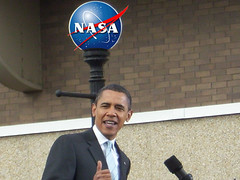
    NASA logo, on its headRumors are flying that in the President’s budget, which will be presented to Congress on Monday, all the money for the Constellation rocket program — and the Ares I and V rockets — will be gone. NASA will still get a full budget and even a slight increase, but the money for the new rocket system will be axed.

    First and foremost, these are rumors. The sources are all anonymous, and all the media are quoting each other. However, given the number of sources and the media involved, it’s probably fair to say these rumors have a good chance of being true.

    So what does this mean?

    To be honest, I’m not sure. It’s a lot to think about, and I’m not an insider expert on NASA. Having said that, here are some thoughts. Consider these mumbling out loud, ruminations to ponder. If I’m wrong, please feel free to comment!

    [Continued after the jump.]

    1) According to the rumors, NASA will drop Ares and look for a different heavy-lift vehicle. That means we aren’t going back to the Moon any time soon. The Orlando Sentinel (linked above) says this:

    “We certainly don’t need to go back to the moon,” said one administration official.

    I disagree with this, strongly. I think we do need to go back. I also think we can do this even in a recession; the money involved is trivial compared to things like the bank bailouts and the two wars we’re fighting. And this will create jobs, high-tech jobs, employing tens of thousands of people.

    And don’t give me any baloney about spending the money here on Earth rather in space. That’s a false dichotomy, and totally wrong.

    2) What do we do in the meantime, with the Shuttle being retired this year and no other way of getting people to space? I hear a lot about private companies, and I think in a few years they’ll be able to do it, but note that not a single private company has put a human in orbit yet, nor have they even launched a rocket capable of doing so yet. To be clear, I think private companies are doing an amazing job so far and may very well be the way we get to space… but we are still years away from that. Once Space X tests its Falcon 9 rocket and it works, I’ll be a lot happier.

    The nearly-completed space station3) According to the rumors, Obama wants to extend the space station’s life to 2020. I’m ambivalent about that, since I don’t think the station serves a very useful purpose except to drain vast amounts of money from NASA. Well, that’s a bit unfair: we’ve learned how to build large structures in space, and there is some scientific use for it, but it’s cost $100+ billion, and that’s a vast sum of cash. That money could have been far better spent by NASA on a different, less expensive design, and other projects (like, say, a return to the Moon).

    4) Just because Obama proposes this, it doesn’t mean Ares is dead. It has to pass Congress, and while Congress likes to starve NASA, they’ve never let it get to the point where it gets manourished. There are NASA centers in several states, and many other companies all over the country that make millions from NASA projects. Congresscritters are unlikely to kill such a machine. I expect a big battle in Congress if all this is true.

    nasa_ares_1x5) I’m not sure I entirely disagree with this decision, if true. Ares is way behind in schedule and way over cost. The test last year of the Ares I-X has been called an outright fraud by many people, including Buzz Aldrin and the Space Frontier Foundation. Developing a better system might be a good idea… but then, that’s why NASA started with Constellation in the first place. Who’s to say they’ll do any better this time?

    6) I’m getting emails snidely attacking Obama for this. I’m not sure that’s warranted. I have not seen the actual budget, so I don’t know how this will play out. Bear in mind before lazily attacking me that I have been clear on how I feel about Obama and NASA in the past.

    I have very mixed feelings over NASA: on one hand, they do some fantastic things with what is really very little money. On the other hand, their seeming lack of ability to get anything done under budget and within schedule is legendary. Those two are related; internal fighting for funds between NASA projects makes it hard to do everything and do it well. If NASA’s budget were increased by about 30% a lot of that would go away. But if these rumors are true, the infighting may very well get worse.

    Conclusion:
    I don’t know what will happen here. Congress will fight canceling Ares, so it may not happen at all. And if it does, with more money going to privatizing space, it may help in the very long run. But it leaves a big gap in the here and now — which, to be fair, is NASA’s fault too; they should’ve been thinking 15 years ago about what to do when the Shuttle retires, especially after Challenger.

    I don’t know enough about what’s really happening in the Ares program right now to know whether it’s a total loss, or whether it’s worth fighting for. I also don’t know if private space companies really can pick up the slack. They think so, and it seems likely, but we have no solid proof yet. That’s still a ways off.

    And finally, space exploration is important. I find it difficult to believe Obama doesn’t know that; he’s proven himself to be both pro-science and understanding of the inspiration it provides. And the rumor is that this year’s budget for NASA actually goes up a little bit, it just cuts Constellation and Ares. But if this really does gut NASA’s future, cutting way back on what they can do, then it’s a mistake.

    We’ll know soon enough. For actual answers, I’ll be curious to see what experts in this field have to say. I imagine they’re sharpening their keyboards even as I write this.


  • Careful… | The Intersection

    I’ve been getting so many great submissions to The Science of Kissing Gallery, why not post one midweek? This fanciful image comes from a reader’s Paper Loop greeting card entitled ‘Hedgehogs.’

    Submit your original photograph or artwork to the gallery here and remember to include relevant links.

    hedgehog kiss

  • Top 100 Stories of 2009: #5: Astronomer Alan Dressler

    Hot on the trail of the first galaxies in the universe

  • Top 100 Stories of 2009: #10: Economist George Loewenstein

    He explains the psychology behind the current financial meltdown—and how we can overcome our dark side.

  • Top 100 Stories of 2009: #26: Biologist J. Craig Venter

    The pioneering scientist/entrepreneur on biology’s next leap: digitally designed life-forms that could produce novel drugs, renewable fuels, and plentiful food for tomorrow’s world.

  • 100,000 against bad libel laws | Bad Astronomy

    libelreformIf you’re a regular reader, you know that the libel laws in the UK are truly awful. Instead of the burden of proof being on the accuser, as it should be, in the UK the burden is on the accused. So if I decide to sue you for something you wrote about me, it’s up to you to prove there was no malicious intent on your part. And it can cost you literally millions of dollars to defend yourself.

    That, to be blunt, sucks. And it’s bad for freedom of expression, because it means that criticism of a claim can be substantially suppressed; who would want to speak out against, say, quacks, if they can sue you and cost you time and money?

    And we know this is the case because skeptic Simon Singh is being sued under these draconian laws by the British Chiropractic Association for saying they happily promote “bogus” therapies. I’ve written about this many times.

    That’s why I’m asking you to go to The Libel Reform Campaign website and sign their petition. They want 100,000 signatures by tomorrow so they can show it to Jack Straw, a Member of Parliament, and get some action started on this. These laws affect everyone on the planet (if you write something on the Internet, it’s entirely possible to be sued in the UK for it; this is called libel tourism and is a serious issue), so it doesn’t matter if you’re a UK citizen or not.

    Please sign the petition. I did. And do it soon, so that we can make an impact on free speech everywhere.


  • Botox: It’s a Miracle Wrinkle Cure *and* a Bioterror Threat! | Discoblog

    vaccine-medicationIt may smooth thousands of pretty brows across the world, but the news that botox could potentially be used as a bio-terror weapon is furrowing plenty of foreheads.

    The beauty drug contains botulinum–a naturally occurring nerve agent secreted by a kind of bacterium called Clostridium botulinum. A speck of this toxin smaller than a grain of sand can kill a 150-pound person–making some security experts worry that a determined terrorist could get his hands on the substance and wreak havoc.

    The Washington Post reports:

    In a project sponsored by the James Martin Center for Nonproliferation Studies, two scientists found that a biologist with a master’s degree and $2,000 worth of equipment could easily make a gram of pure toxin, an amount equal to the weight of a small paper clip but enough, in theory, to kill thousands of people.

    This worry also stems from the discovery of a thriving underground market for Botox in both China and Russia. The Internet is serves as a convenient marketplace, where a network of suppliers and distributors make their goods available to customers who can purchase the drug without prescriptions or identification. Security experts worry that this black market could potentially bring terrorists and the toxins together.

    Experts clarify that Botox itself contains only a minuscule amount of the toxin, so potential terrorists buying off the Internet would have to gather hundreds of vials of the beauty drug at $400 each to get enough to kill a single person. The real concern is that terrorists could get the raw botulinum directly from a shady producer, or that they’ll set up toxin-producing labs of their own.

    Terrorists have long been interested in the toxin. The Japanese doomsday cult Aum Shirinkyo experimented with it and an Al-Qaeda training manual discovered in 2001 talked about using botilinum toxin in terror attacks. But neither group had any success with it.

    The Washington Post adds:

    Aum Shinrikyo managed to cultivate a lethal strain of the toxin-producing bacterium, but stumbled when it tried to convert the poison into an aerosol form. Al-Qaeda’s known bioweapons efforts were hampered by rudimentary lab equipment and limited access to lethal strains.

    First underwear, now Botox–when it comes to terrorists, looks like there really is no telling where the next threat could be coming from.

    Related Content:
    Discoblog: Scared of Botox? Try Facial Flexing
    DISCOVER: Why Darwin Would Have Loved Botox
    DISCOVER: The Physics of…Wrinkles
    DISCOVER: How Terrorism Paranoia Killed 1,600 Americans in 2002
    DISCOVER: The Future of Terrorism

    Image: iStockphoto


  • Teaching in the Face of Budget Cutbacks | Cosmic Variance

    Like most state schools, University of Washington is in the process of absorbing a series of budget cutbacks. These cuts are part of a long trend of reduced state support, as can be seen in this plot dug up by my colleague Gordon Watts, but have been accelerating recently in response to the state’s economic troubles:

    UW budget cuts

    While the University historically has been able to handle the slow erosion of state support in a manner that allowed for continued quality in the educational experiences of our students, the latest cuts are now at a point where they are having a direct impact on the students (beyond the steady increase in tuition and fees, needed to make up for the declining share of state support). As detailed in an article in today’s Seattle Times, class sizes are growing, and students have less direct access to their instructors.

    This quarter, I am living with the “new normal”. Click below the fold if you dare.

    I’m currently teaching a >250 person introductory astronomy course — a class I usually love to teach. However, this is the first time I’ve taught it with reduced staffing. Traditionally, we’ve taught the class with 5 TAs, each of whom would handle 2 sections of 25 students, meeting 2 times a week. During those times the TA’s would clarify information from lecture, introduce supplementary material, and walk the students through labs. This quarter, however, we have 4 TAs, handling more than 60 students each. This may not sound like a huge change, but it has set off a cascading chain of decisions that clearly diminish the student experience, while adding increased challenges for the instructors.

    For example, we do not have the classroom space to allow two large (>30 person) sections to run simultaneously, so the TAs now only meet with their students once a week. The one meeting must be spent working on the labs, so in addition to losing 50% of their contact time with the TAs, the students have lost 100% of their free discussion time. If they’re struggling with the material, their only option is to work it out in office hours. However, many of our students are working to put themselves through school, or have family commitments, or commute long distances, making this a tough option for many of them.

    To increase the students’ interaction with the course in the face of reduced instructional time, and to decrease the workload on the TAs, I’ve also moved a large amount of material on-line. The university has developed a superb suite of tools to help develop on-line material, yet the process remains incredibly time consuming (as you might have guessed by a notable lack of blogging this month). Some aspects of having an on-line component are a net positive. I get many more opportunities to assess student learning, and the students are finally being forced to do the reading in advance of lecture, guaranteeing that they’re making much more sense of my rather high baud rate delivery. However, it’s added a nightmarish degree of overhead on my end, even beyond developing the material. Suddenly, I’m responsible for >250 students’ computer crashes and email failures. In addition, whereas the TA’s were traditionally the primary point of contact for assignments, now I am. This means that instead of 5 people dealing with 50 students’ assignment difficulties, 1 person is dealing with 250 of them.

    I would write more about this, but it appears that the service that handles the on-line labs has just crashed, 45 minutes before a lab is due. I need to go answer the 15 frantic emails I just received while writing this post.


  • Spirit is willing, but the metal is weak | Bad Astronomy

    spiritIn a press conference yesterday, NASA and JPL scientists announced that the Mars rover Spirit is stuck. The little-spaceprobe-that-could has been trapped in the sand near a crater called Troy for almost a year now, and for that time has been doing little or no science; instead, engineers have been trying to figure out how to get the rover unstuck. After all that time, NASA has decided to throw in the towel. Martian winter is coming for Spirit, and they are now focusing on getting it positioned so that it can survive the coming drop in temperature.

    Three notes:

    1) This doesn’t mean Spirit is dead! If they are able to get it set up to survive the winter (mainly by tilting it toward the Sun so the solar panels can collect energy) then once its revived it will still be able to do plenty of science from where it is. After all, it’s a laboratory sitting on another world. I imagine there’s lots of stuff the scientists can do with it.

    2) Emily Lakdawalla, as usual, has the details of all this on The Planetary Society blog, including some evidence-based speculation that it’s NASA calling the shots here and not JPL, which controls the rover.

    3) We have to remember something rather important: when the two rovers (Opportunity is the other, which is still running fine on the other side of the planet) landed on Mars, they had a planned operational lifetime of 90 days.

    That was in January 2004.

    In other words, Spirit has been on Mars for over 2200 days, and even counting when it first got stuck, it still ran well for more than 20 times it’s nominal lifespan. Cars these days have a standard warranty for 7 years; how’d you like yours to run for 140 years?

    So for me, while this news is not great, it has to be put in context: Spirit is one of the most successful NASA missions of all time. And its sister, Opportunity, is still running like a champ. I hope I’ll be doing as well when I’m 1400 years old.

    Image: NASA/JPL-Caltech


  • Taking on “GlacierGate”, The Latest Climate Science Scandal | The Intersection

    My latest blog post for Science Progress is up; it’s about the scientific black-eye known now as “GlacierGate,” in which the IPCC was found to have published plagiarized misinformation about the vulnerability of the Himalayan glaciers to climate change in its Fourth Assessment Report. The content was indefensible; a quick retraction should have occurred. But instead, there was wagon-circling and defensiveness and hence, we have yet another scandal on our hands.

    Here’s a sampling of my take:

    …without exonerating the IPCC in this instance—there is no defense for such shoddy work—let’s attempt to inject a little sanity here. The IPCC goofed, but we should keep matters in perspective. We’re talking about one tiny section of a 938-page report on how climate change will affect different parts of the world. It would be amazing if errors did not slip into such a vast document, whatever the professed peer review standards may be. And the mistake was originally caught not by skeptics, but by scientists, including an IPCC report co-author. In the broadest sense, the scientific process is actually working here, even if the IPCC stumbled in this case.

    Moreover, Himalayan glaciers are retreating, even if they’re not doing so faster than glaciers in other parts of the world, and even if they won’t be gone by 2035. As a team of scientists who exposed the IPCC’s mistake in a letter to the journal Science judiciously put it:

    This was a bad error. It was a really bad paragraph, and poses a legitimate question about how to improve IPCC’s review process. It was not a conspiracy. The error does not compromise the IPCC Fourth Assessment, which for the most part was well reviewed and is highly accurate.

    That’s the true significance of “GlacierGate,” but sure enough, it is being vastly misused in yet another cynical attempt to undermine all of earthly climate science.

    You can read the full blog post here.


  • No Plan | The Intersection

    The latest edition of Ocean and Coastal Management has an article on the world’s most charismatic invertebrate and I am sad to report–as expected–the news is not good:

    Socio-Economic Features Of Sea Cucumber Fisheries
    In Southern Coast Of Kenya

    Jacob Ochiewoa, Maricela de la Torre-Castrob, Charles Muthamaa, Fridah Munyia and J.M. Nthutaa

    A socio-economic assessment was conducted at Vanga, Shimoni, Majoreni and Gazi villages in the Kenyan south coast with focus on the sea cucumber fishing patterns, the social and economic characteristics of the fisher communities, the contribution of sea cucumbers to the local livelihoods, and analysis of the management systems. The results indicate that sea cucumber fishers are mainly men. Fishing is done in sub-tidal areas (3-10 metres deep) and inter-tidal areas depending on the species being targeted. Those who fish in the sub-tidal areas do skin-diving without using SCUBA diving gear. Sea cucumber fishing is heavily done during the north east monsoon season when the sea is calm and water is clear. About 32% of the sea cucumber fishers also collect other marine products such as octopus. The sea cucumbers are sold fresh from the sea to local first level middlemen who process and sell them to the second level middlemen and exporters in Mombasa. The fishers occasionally borrow money from first level middlemen especially when they fail to catch sea cucumbers but this in turn creates conditions of dependence and possible exploitation. Almost all sea cucumber fishers have stated that they are not willing to make sea cucumbers part of their daily diet. The economic value of the product was substantial; the average monthly revenue for dry sea cucumbers in the area was estimated to US$ 8,000. The relative highest profits are derived from juvenile species, thus there is an economic incentive hindering local stocks to reach sexual maturity, which in turn may create a situation in which recruitment success is highly dependent on faraway populations. The present management system falls into general fisheries regulations and was found weak. No specific management plan for sea cucumbers was found.

    In other words, cukes are being collected before they reach sexual maturity and, at present, it appears that fishers have no incentives to harvest local populations sustainably.

    I’ve said it before, I’ll say it again, our oceans are going to hell in a handbasket. The signs of dramatic decline across scales are crystal clear, but we have a habit of ignoring what happens below the surface. So when there’s nothing but jellyfish and algae left, our children may wonder why we knew, yet did nothing. Oh, for the love of sea cucumbers… Surely we can do better!


  • Female Teachers’ Math Anxiety May Give Girls the Arithmetic Jitters | 80beats

    girl-mathDoes your first- or second-grade daughter have trouble with math? Her anxiety could be stemming not just from a genuine fear of number crunching but also, a new study indicates, from an anxious female math teacher.

    The study (pdf) published in the Proceedings of the National Academy of Sciences shows that if a female teacher is anxious about math, she tends to pass on that anxiety to her female students. This can make the female students believe they aren’t hard-wired for math like the boys, and cause them to shy away from fully flexing and developing their mathematical muscles.

    The findings are the product of a year-long study on 17 first-and second-grade teachers and 52 boys and 65 girls who were their students [Science Daily]. Researchers recruited the female teachers from a Midwestern school district and assessed their level of math anxiety. They also gave math tests to 117 of these teachers’ students and jotted down their beliefs about math and gender at the beginning and end of the year. By the end of the year, the more anxious teachers were about their own math skills, the more likely their female students – but not the boys – were to agree that “boys are good at math and girls are good at reading” [AP].

    The girls who bought into the math-is-for-boys notion also scored, on average, almost 5 points lower than the boys on the tests. The researchers noted that the boys weren’t affected by their teachers’ math anxiety like the girls. However, the researchers aren’t sure exactly how the angst was transmitted from teachers to students. Perhaps math-anxious teachers call on girls to solve math problems less frequently; praise boys more effusively; or simply imply that it’s not important for girls to be good at math [Los Angeles Times]. It’s also not clear if a study of male elementary teachers with math phobia would have produced similar results.

    The study suggests that math anxiety could have a long-term effect on girls–as the nervousness could prevent them from picking math and science in high school and may preclude them from having certain careers in engineering, science and technology. It also reveals that there needs to be a fundamental re-thinking of how teachers view the subject, as more than 90 percent of elementary school teachers in the country are women and they are able to get their teaching certificates with very little mathematics preparation, according to the National Survey of Science and Mathematics Education. [Science Daily]. The study’s authors say that teacher training programs should be tweaked to include more math, and that math anxiety among teachers should be openly addressed.

    Related Content:
    DISCOVER: Girls Are Better at Math, But . . .
    DISCOVER: The Myths About Mr. and Ms.
    80beats: Girls and Boys Are Equally Good at Math, Study Finds
    80beats: More Evidence That Girls Kick Ass at Math, Just Like Boys

    Image: iStockphoto


  • Comet Barrage Ignited One Jovian Moon While Leaving Its Twin for Dead | 80beats

    jupiter-moonsWhile Jupiter’s two largest moons, Ganymede and Callisto, are nearly the same size, they’re far from identical twins. Now, in a Nature Geoscience study, Amy Barr and her team might have figured out this tale of two similar moons with very different histories.

    Voyager and Galileo mission images showed Ganymede, seen here on the right, to be a geologically active place, with a surface that scientists think changes through tectonic processes like those that we have here on the Earth. Callisto, seen on the left, looks totally different: Its rock and ice have not mixed in the same way, and it doesn’t seem to have such active geology, despite being approximately the same size as Ganymede. For 30 years, researchers have wondered what process could have got enough heat into Ganymede to drive its geological evolution without setting off Callisto as well [ScienceNOW Daily News].

    Trying to crack the puzzle, Barr turned to comets. Just less than 4 billion years ago, astronomers hypothesize, a wave of comets careened across the solar system during a phase called the late heavy bombardment. Barr’s team of scientists modeled how that comet storm would have affected Jupiter’s satellites. Ganymede, located about 500,000 miles closer to giant Jupiter than Callisto, bore the brunt of its parent’s heavy hands. Jupiter’s extreme gravity (a 150-pound person would weigh 355 pounds on Jupiter) tugged more comets toward Ganymede and caused them to crash at higher speeds than it did for Callisto [Discovery News].

    That was the turning point, Barr says. If all those cosmic snowballs pounded Ganymede with enough energy, the formation of its core and other geological processes could have become self-sustaining. Says Barr: “Impacts during this period melted Ganymede so thoroughly and deeply that the heat could not be quickly removed. All of Ganymede’s rock sank to its center the same way that all the chocolate chips sink to the bottom of a melted carton of ice cream” [SPACE.com].

    Castillo would not have been so lucky. Shortchanged on impact energy, Callisto would not have melted enough to achieve “runaway” heating during separation, leaving it cold and without a core [ScienceNOW Daily News]. Thus, Barr’s team says, the moon has been dead, geologically speaking, ever since.

    Related Content:
    80beats: 400 Years After Galileo Spotted Them, The Moons of Jupiter Are Looking Fly (photo gallery)
    80beats: Saturn and Jupiter’s Moons Battle for Alien-Hunters’ Attention
    80beats: Jupiter Grabbed a Comet for 12 Years, Then Flung It Back Out
    80beats: Mysterious Smash on Jupiter Leaves an Earth-Sized Scar
    DISCOVER: Jupiter, Not Bust chronicles the Galileo probe’s Jupiter observations in 1996

    Image: NASA


  • Moon in the Mirror | Bad Astronomy

    You may know me as a buster of the Moon landing hoax claims, debunking the dumbosity of people who think the Apollo missions were faked.

    But I have been leaked a picture that makes it clear that the truth behind Apollo was far, far bigger than anyone has ever suspected. In fact, it’s a real Thriller.

    Reader Dan Brennan from the Unmanned Space Flight bulletin board sent this picture to me:

    wechoosethemoon_jackson

    It’s a shot from Apollo 11 of Buzz Aldrin in the command module, a screen capture from the amazing (but Flash-heavy) site We Choose the Moon. Before I even read the content of Dan’s email I knew what he wanted to show me. Can you see it? Look just to the right of Buzz, at what should be a gauge on the control panel… but actually shows what looks for all the world (well, all the cis-lunar space) like Michael Jackson!

    In fact, I think it is Michael Jackson.

    jackson_apolloThe evidence is overwhelming. Sure, he looks like he’s wearing an eyepatch, but given his wardrobe choices over the years, is an eyepatch all that unlikely? And look at this picture for comparison — my Photoshop skillz are unmatched (happily for millions of satisfied Adobe customers). The resemblance is too strong to be coincidence.

    So what’s the deal? You might think that Buzz was a fan, so he had a picture of Jackson taped to the console — though Michael was only about 11 when our first mission to the Moon launched, so that’s silly. The gauge in the panel is visible in other images, and you can tell there’s a glass cover on it. That means the face is not taped on, but is in fact a reflection!

    The conclusion is clear. What’s going on here, obviously, is that a time-traveling Michael Jackson stowed away aboard the Apollo 11 capsule to experience the mission for himself.

    I mean, c’mon. How do you think he learned how to moonwalk?

    Shamone!


  • NCBI ROFL: And you thought your carpal tunnel was from typing… | Discoblog

    Monkey-typingThe role of sexual intercourse in the etiology of carpal tunnel syndrome.

    “The etiology of non-occupational carpal tunnel syndrome is not well understood. It is proposed that carpal tunnel syndrome can develop during sexual intercourse when the hands become repeatedly extended while under pressure from the weight of the upper body. Of the eight risk factors associated with non-occupational carpal tunnel syndrome, age, marital status, pregnancy and use of hormonal agents can be explained by changes in the frequency of sexual intercourse. On the other hand, obesity, macromastia and large chest circumference can be explained by the increased pressure imposed on the wrists by the heavier upper body associated with such conditions. The bilaterality of carpal tunnel syndrome can be explained by the fact that both hands are needed to support the upper body during sexual intercourse. A parallel decrease in the frequency of sexual intercourse and the incidence of carpal tunnel syndrome between the sixth and the seventh decades of life suggests a possible cause and effect relationship between sexual intercourse and carpal tunnel syndrome.”

    carpal tunnel

    Image: Wikimedia