Author: Discover Main Feed

  • 5 Buzz-Worthy Storylines from the Consumer Electronics Show | 80beats

    mytouch-ford-topAfter a long weekend of Las Vegas fanboy salivating, another year of the Consumer Electronics Show has come to a close. Here are DISCOVER’s choices for the most important storylines among the flood of gadget-philia emanating from the desert.

    1. OMG, It’s Coming Toward Us!

    Between the unstoppable worldwide phenomenon that is “Avatar” and ESPN rolling out 3D broadcasts for this summer’s FIFA World Cup, 3D is back with a force not seen since the crazes of the 1950s and 80s. The bandwagon has close to universal industry ridership‚ almost every major manufacturer is launching 3D sets at CES this week, the Blu-ray format will support 3D and many gaming consoles should soon follow suit [Popular Mechanics]. But unless you’ve got a big wad of extra cash burning a hole in your pocket, you might want to wait a while before taking the 3D dive, tech experts warn. 3D TVs will come with plenty of sticker shock at first, there won’t be very much content to watch on them… and oh yeah, you’ll still have to wear those stupid glasses.

    2. Tablets: Loading, Please Wait

    Rumors swirled before CES that Microsoft would show off a new tablet-style electronic display. Not wanting to disappoint, Microsoft Chief Executive Steve Ballmer pulled out a tablet midway into his address, demonstrating an H-P device running e-reader software. But it was only a prototype, and it couldn’t be found on the show floor [CNN Money]. Apple, too, is supposed to be developing a tablet, though the timetable for the secretive company remains unclear.

    3. Wireless Power Wows the Crowd

    If you’re among the “it’s 2010 and we shouldn’t need wires anymore” crowd, you may have found yourself giddy with excitement over another of 2010’s hot trends, wireless power. Fulton Innovations garnered particular esteem with its system, ECoupled. ECoupled uses a wireless powering technique called “close proximity coupling,” which uses circuit boards and coils to communicate and transmit energy using magnetic fields. The technology is efficient but only works at close ranges [Forbes]. Another promising system is “Venetial hotel tower” by WiTricity, which operates with “highly coupled magnetic resonance.” As proof that it works, an LCD TV is powered by a coil hidden behind an oil painting located a few feet away [Forbes].

    4. Baby, You Can Interface with my Car

    Ford took best-of-show honors for the automotive category with its redesigned cabin interface. Ford vehicles equipped with MyFord will get two 4.2-inch color LCDs, one mounted in the instrument cluster and one in the center of the dashboard. The instrument cluster display shows vehicle information such as engine speed, temperature, and trip data, and the one in the dashboard shows audio, phone, and navigation information [CNET]. The Fusion Hybrid will be the main testing ground for this new system.

    5. The Swagger Is Back, and so Is the Little Guy

    Last week’s Consumer Electronics Show returned to its usual over-the-top affair in 2010, with endless proclamations of how this year will see the return of the industry’s growth. Humbled no more by the global recession, electronics makers pulled out all the stops [CNN Money]. But it wasn’t all pomp and spectacle by behemoths like Microsoft: Popular Mechanics has the best of the small companies at CES.

    Related Content:
    80beats: 3D-TV Will Kick Off with World Cup Match This Summer
    80beats: America’s Electronic Waste is Polluting the Globe
    The Intersection: Will Avatar Be This Generation’s Star Wars?
    Discoblog: Our collection of weird iPhone apps

    Image: Ford Motor Company

  • The Iron Curtain Kept Invasive Species Out of Eastern Europe | Discoblog

    cold-warThe Cold War didn’t just restrict the movement of people, ideas, and trends in rock n’ roll, according to a new study–it also kept invasive species from moving into Eastern Europe.

    Researchers looked at the number of non-native birds present in both Western and Eastern Europe over the past century. Before the Cold War restricted trade on the continent, Western Europe had 36 alien bird species and Eastern Europe had 11. By the time the Berlin Wall fell and the Iron Curtain crumbled, the number of alien birds in Western Europe had increased to 54, but the number in Eastern Europe had declined to five.

    A National Geographic blog explains:

    “Global trade is a real concern for invasive species, and the lessons we can learn from the Cold War offer a warning flag to developing countries that are now expanding in an international economy,” said Susan Shirley, a research associate in the College of Forestry at Oregon State University.

    Although birds can fly over walls and through no-fly zones, the researchers say they usually stick to their native territories; however, when imported pet birds are released into the wild they can carve out a niche in the new land. The new findings, reported in the journal Biological Conservation, suggest that Eastern Europe may now be filling up with avian aliens. Anybody remember if Pink Floyd released any doves during that concert on the wall?

    Related Content:
    DISCOVER: Humans vs Animals: Our Fiercest Battles With Invasive Species
    Discoblog: Beware the Gray Squirrels! Brits Campaign to Kill All “Alien” Species
    Discoblog: The Humane Way to Kill Invasive Cane Toads: Skull Smashing?
    80beats: Ravenous, Leaping Asian Carp Poised to Invade Great Lakes

    Image: Wikimedia Commons


  • Egypt Finds Tombs of Pyramid Builders, And More Evidence They Were Free Men | 80beats

    PyramidsForget the myths about massive numbers of slaves or Jews building the great pyramids, Egypt’s chief archaeologist argues this week. He says Egyptian researchers have found the tombs of more pyramid builders, and in those tombs more evidence that free men erected these monumental tributes to the ancient pharaohs.

    Zahi Hawass this week unveiled new research on 4,000-year-old tombs found near the pyramids—tombs he says belonged to pyramid builders. Graves of the pyramid builders were first discovered in the area in 1990 when a tourist on horseback stumbled over a wall that later proved to be a tomb [Canadian Press]. These new ones stretch beyond those previously-discovered tombs, and contain a dozen skeletons.

    What matters for the historical interpretation, Hawass stressed, is location, location, location. “These tombs were built beside the king’s pyramid, which indicates that these people were not by any means slaves,” said Mr Hawass. “If they were slaves, they would not have been able to build their tombs beside their king’s” [The Times]. In addition, Hawass says that the walls of the tombs (which the builders probably built for themselves) bear graffiti like “friends of Khufu (a pharaoh).”

    For Egyptologists like Dieter Wildung, a former director of Berlin’s Egyptian Museum, this is more confirmation than surprise. “The myth of the slaves building pyramids is only the stuff of tabloids and Hollywood…. The world simply could not believe the pyramids were build without oppression and forced labour, but out of loyalty to the pharaohs” [Canadian Press], says Wildung. In particular, Egyptian officials like Hawass, who have national pride at stake, have long pushed against the idea slave-built pyramids, saying it undermines the skill involved in their construction, and the sophistication of ancient Egypt’s civilisation [BBC News].

    Actually, the slave myth dates back much further than “tabloids and Hollywood,” to ancient texts. The Greek historian, Herodotus, visited Egypt several thousand years after Khufu’s pyramid was built, he wrote that Khufu forced his people to “labour as slaves for his own advantage” thus prompting the first accounts that the pyramids were built by slaves [The Times]. Legends have also held that Jews worked on the pyramids, and the first century A.D. Jewish historian Josephus includes a mention. But Jews did not arrive in Egypt until long after construction was completed.

    Related Content:
    80beats: X-Rayed Mummies Show That Ancient Egyptians Had Heart Disease
    80beats: 19th Century Mummy Autopsy Flubbed the Cause of Death
    80beats: Egyptian “Scorpion King” Made Medicine from Herbs & Booze 5k Years Ago
    DISCOVER: Pyramid Building Saps the Soul
    Cosmic Variance: Pyramid Schemes

    Image: Wikimedia Commons / Ricardo Liberato


  • Unscientific America Spring Speaking Schedule | The Intersection

    The book isn’t out in paperback until the summer, but I’ve already put 5 spring events on the calendar, so I decided I’d also list them here. Travels will take me to St. Louis, Houston, Bethesda, New Haven, and Lansing. Further details:

    Saturday, January 23
    Keynote Speech, Stem Cell Hope Summit
    6:30 PM–7:30 PM
    Event sponsored by the Missouri Coalition for Lifesaving Cures
    Sheraton St. Louis City Center Hotel & Suites
    400 S. 14th St.
    St. Louis, MO

    Friday, February 5
    Lunch Discussion and Book Signing
    12:30 PM–2:30 PM
    Event sponsored by the Science and Technology Policy Program, James A. Baker III Institute for Public Policy
    Dore Commons
    James A. Baker Hall
    Rice University
    Houston, TX

    Monday, February 8
    Speech at the National Institutes of Health
    10:00 AM–11:00 AM
    National Center for Complementary and Alternative Medicine
    NIH Clinical Research Center
    (Building 10)
    Bethesda, MD

    Monday, February 15
    Speech Before the Yale Political Union
    Details TBA
    New Haven, CT

    Saturday, March 6
    Public Lecture: “Unscientific America: How Scientific Illiteracy Threatens Our Future”
    1:00 PM–2:45 PM
    Michigan Science Teachers Association 57th Annual Conference
    Raddison Hotel, Capital 2
    Lansing, MI

    I think it will be good to be “on the road again”….


  • Study: Cocaine Scrambles Genes’ Behavior in the Brain’s Pleasure Center | 80beats

    cocaineAddiction researchers constantly wade through the ways that drugs like cocaine change your brain, and a new study in Science has pointed to a new epigenetic factor. Cocaine, the researchers say, can scramble the way genes turn on and off in a key brain region associated with pleasure and reward.

    Ian Maze said his team gave one group of mice repeated doses of cocaine and other group repeated doses of saline with just one blast of cocaine at the end to study the differences. The team paid particular attention to a protein called G9a, whose behavior in the nucleus accumbens region of the brain seems to be altered by cocaine use. The role of the protein appears to be to shut down genes that shouldn’t be on. One-time use of cocaine increases levels of G9a. But repeated use works the other way, suppressing the protein and reducing its overall control of gene activation [TIME]. The researchers found that the overactive genes caused brain cells in the region to grow more connections to each other. The growth of such neural connections can reflect learning. But in the case of addiction, that may involve learning to connect a place or a person with the desire for more drugs [TIME].

    G9a changes in the cocaine-addicted mice were persistent, too. Maze showed that even after a week of abstinence, mice given a new dose of cocaine still had elevated levels of gene activation in the nucleus accumbens, meaning G9a levels were still low…. Maze also showed that when he intervened and raised G9a levels, the mice were less attracted to cocaine [TIME].

    Though this was just a rodent study, National Institute on Drug Abuse director Nora Volkow said it could be a crucial piece of the cocaine addiction puzzle. “One of the questions we’ve had all along is, after discontinuing a drug, why do you continue to be addicted? This is one of the mechanisms that probably is responsible for these long-lasting modifications to the way people who are addicted to drugs perceive the world and react to it,” she said [Reuters]. Much more research is necessary, but the research could point the way to the development of addiction medications down the road.

    Related Content:
    80beats: Pepper Spray & Cocaine Could Be a Lethal Combo
    80beats: One-Third of U.S. Cocaine Tainted with Dangerous Livestock Drug
    80beats: Honeybees Get High on Cocaine and Dance, Dance, Dance

    Image: iStockphoto

  • From here to infinity… logarithmically | Bad Astronomy

    Logarithms are cool. Sure, some of you may have flashbacks to middle school and may collapse on the floor twitching upon their mere mention, but seriously, logs are the language of the Universe. Our senses (eyesight and hearing) are sensitive logarithmically, and a lot of ways the world behaves make a lot more sense when you plot them using logs.

    For those of you scratching your heads, a simple way to think of logs is to think factors of ten. Instead of counting like we normally do — 1, 2, 3, 4 and so on — in log space you count by factors of 10: 1, 10, 100, 1000, and so on. There are lots of advantages to this, one being that you can make graphs that show things that are very small and very big on the same plot. Using regular numbers, it would be hard to make a graph showing the size of a human (2 meters tall) and a skyscraper (200 meters tall) on the same plot, but using logarithms, they are only two ticks apart in size. Easy peasy.

    And if you take this idea to the extreme, what do you get? Why, you could get a plot of the whole freaking Universe, from the surface of the Earth out to the fires of the Big Bang itself!

    But who would do such a thing? Astronomers at Princeton, that’s who.

    logmapuniverse

    [Click to exponentiate.]

    That picture is just a small piece of a much larger graphic showing, well, everything. At the bottom is the Earth and at the top is the most distant thing we can see: the cosmic microwave background, the cooling fireball from the Big Bang. Included are planets, asteroids, stars, galaxies, and pretty much everything you can think of, all plotted out for your perusal. The vertical axis represents distance, and the horizontal is cleverly done in Right Ascension, sorta like longitude (East/West) on the sky. That way they get the whole sky — the whole Universe — on one graph.

    I know xkcd did something like this, but I’d love to see this done up as a vastly scrollable webpage with actual images instead of dots, and the objects actually described (rollovers, popups, links, whatever). If done correctly, that would cause a wave of nerdgasms across the web, and not-so-incidentally be an awesome learning tool. Any takers?

    Tip o’ the order of magnitude to Stuart at @astronomyblog.


  • How is the Internet Changing the Way You Think? | Cosmic Variance

    This year’s Edge World Question Center is out, posing the query mentioned in the title. My own answer is kind of lukewarm — the internet did allow me to find my future wife, which certainly changed the way I think about a lot of things, but that’s not the tack I wanted to take for this project. Instead, I’m basically giving credit to you blog readers for keeping me honest. (Among other things.)

    But many of the other answers are fascinating. Just to pick some at semi-random, I enjoyed the responses from Danny Hillis, Anthony Aguirre, Frank Wilczek, Victoria Stodden, Martin Rees, Scott Atran, Lisa Randall, Irene Pepperberg, and Clay Shirky. Keep thinking!

  • Blind Ants, Traffic Jams, and the Pixies | The Loom

    Here’s a talk by Ian Couzin, a scientist who does fascinating studies on crowds and their wisdom. I wrote about Ian a couple years in the New York Times. It’s funny now to actually see him in the virtual flesh. And to hear him talk about how much he loves the Pixies.


  • Orzel Nails It on Science and Religion | The Intersection

    I haven’t blogged on this subject in a while, due to the kinds of comments/blitzkrieg it always evokes. And I’m sure I’ll be accused of “arguing from authority” here, simply because I’m quoting someone I find particularly eloquent and persuasive.

    But so be it: When I saw Chad Orzel’s post last week explaining why it is that science and religion can be compatible, I couldn’t help linking, as it so perfectly summarizes my own view, and in better terms than I myself can probably put it:

    OK, fine, as a formal philosophical matter, I agree that it’s basically impossible to reconcile the religious worldview with the scientific worldview. Of course, as a formal philosophical matter, it’s kind of difficult to show that motion is possible.

    We don’t live in a formal philosophical world, though, and the vast majority of humans are not philosophers (and that’s a good thing, because if we did, it would take forever to get to work in the morning). Humans in the real world happily accept all sorts of logical contradictions that would drive philosophers batty. And that includes accepting both science and religion at the same time.

    So, in my view, it is not in any way an “unconscionable” political statement for professional scientific organizations to state that science and religion are compatible. It’s a statement of fact, an acknowledgment that in the real world, there are numerous examples of people who are both personally religious and successful, even prominent scientists. Guy Consolmagno, George Coyne, Bill Phillips, Francis Collins, and many more.

    How do these people deal with the philosophical contradiction inherent in there beliefs? I have no idea. I don’t really care, either, any more than I care how philosophers resolve Zeno’s paradox. Religious scientists exist, and I can move from one side of the room to the other in finite time. End of debate, let’s talk about something that actually matters.

    There is nothing unconscionable, in my view, in professional organizations stating publicly that these people exist. What would be unconscionable is the reverse–a public statement that science and religion can never be compatible amounts to a denial of the existence of the many men and women who find some way to reconcile science and religion in their own lives. I find that sort of rhetoric deeply insulting even on blogs, let alone from a professional organization.

    Amen amen amen….and now, let the wild ruckus begin.


  • Crafty & Clever Neanderthals Made Jewelry 50,000 Years Ago | 80beats

    neanderthalJewelryThe jewelry in Spain speaks mainly to the brains (of Neanderthals). So says a team of archaeologists this week in the Proceedings of the National Academy of Sciences. Researchers led by João Zilhão have turned up artifacts they believe to be jewelry dating back 50,000 years—a time only Neanderthals and not early humans occupied Europe—suggesting to them that those Neanderthals were capable of the abstract thinking necessary to make symbolic art.

    Zilhão’s team found shells and bones that showed evidence of craftsmanship, the scientists say. First, some of the shells were perforated and could have been strung and worn as a necklace. It’s not out of the question that those holes could be natural, but the team says the finds also appear to have been painted. If the researchers’ analysis is correct, the Neanderthals could have mixed up reddish goethite and hematite, yellow siderite and natrojarosite, black charcoal and sparkly pyrite to create a spectrum of paints [MSNBC].

    Scientists have found similar artifacts in Europe before. But those finds were roughly 40,000 years old – dating to a period where Neanderthals and modern humans would have shared the European continent. This has led other researchers to argue that the purported Neanderthal artifacts represented mindless imitation or were from later periods, but they somehow got mixed into the wrong soil layers of the archaeological digs where they were uncovered [Christian Science Monitor]. The new finds, however, date to a time 10,000 years before our ancestors migrated to the European continent. So if these fragments truly show signs of handiwork, and if the dating is correct, that points to Neanderthals as the creators.

    For Zilhão, this means that Neanderthal mental capacity was closer to that of early humans than we often give them credit for. Objects and compounds like these would have been used to “tell other people who you are,” Dr. Zilhão said. “They are like socially recognizable identity cards.” What’s more, he said, “this is exactly how the same kinds of objects and finds are interpreted in early modern human contexts” [The New York Times].

    That wasn’t Zilhão’s only Neanderthal study this week, either. He published a separate study in PNAS addressing the question DISCOVER posed last month: Did we mate with Neanderthals, or did we murder them? Analyzing the teeth of a 30,000-year-old early human child skeleton, he says that it shows similarities to Neanderthals—similarities that again raise the question of whether and how much early humans and Neanderthals interbred in Europe tens of thousands of years ago.

    Related Content:
    80beats: Did Spear-Throwing Humans Kill Neanderthals?
    80beats: Controversial Study Suggests Early Humans Feasted on Neanderthals
    80beats: Rough Draft of the Neanderthal Genome is Complete
    DISCOVER: Did We Mate with Neanderthals, or Did We Murder Them?
    DISCOVER: Cavemen: They’re Just Like Us

    Image: João Zilhão


  • My God, It’s Full of Blogs | The Loom

    2001-440Time for some livestreaming! At the end of this week I’ll be heading to North Carolina to Scienceonline 2010, a confab about all things scientific on the Tubes. I’m going to be talking in a session on Saturday morning at 10:15 am called “Rebooting Science Journalism In the Age of the Web” along with fellow rebooters Ed Yong, John Timmer, and David Dobbs. You can watch live on UStream and Second Life. Later, our session (and all the others) will end up where everything ends up sooner or later: on YouTube. (More details here.)

    Here’s the official description of our session:

    Are blogs and mainstream media the bitter rivals that stereotypes would have us believe, or do the two sides have common threads and complementary strengths? How will the tools of the Internet change the art of reporting? How will the ongoing changes strengthen writing about science? How might these changes compromise or threaten writing about science? In a world where it’s possible for anyone to write about science, where does that leave professional science journalists? And who actually are these science journalists anyway?

    If you want something to read in advance, Bora Zivkovic, one of the prime movers behind this conference, has kindly organized a veritable banquet of food for thought on this topic. If you’re interested in the experiences and opinions I bring to the discussion, read this. Basically, I find kvetching and yearning for some global system a waste of time. I am interested in people doing new things.

    ScienceOnline has a strong tradition of openness, and so you’re welcome to visit the session wiki and help us formulate the discussion in advance. You can also start a discussion here, which I will track.

    [Image: 2001 Internet Archive]

  • Getting Schooled In Energy | The Intersection

    longhorn logoAs regular Intersection readers know, I’ve long been interested in energy. Today I’m flying to Texas to join Michael Webber’s three day energy technology and policy course at UTAustin. Here is the description:

    Dr. Michael Webber, Assistant Professor of Mechanical Engineering, and Associate Director of the Center for International Energy and Environmental Policy at the University of Texas at Austin, will share his insights and candid views about the best and worst of US energy practice. His fast-paced and information-packed lectures will include real-world examples, entertaining anecdotes, engineering fundamentals, historical perspectives, and an outlook for the future of energy. This crash course is perfect for people who want an energy credential or a graduate class in energy, but only have a few days to spare.

    With lectures covering transportation, biofuels, climate, security, and food, I can’t wait. So expect some energy related posts this week as I have time to blog.


  • Another dose of Martian awesome | Bad Astronomy

    If someone woke me out of a sound sleep and forced me at gunpoint to say which is my favorite camera in the solar system, they’d probably have to shoot me. But I think that HiRISE onboard the Mars Reconnaissance Orbiter would be in the top three. And it’s pictures like this one that put it there:

    hirise_avalanche_big

    [Click to get to greatly embiggened pictures.]

    That is not a closeup of my chin before I shave. It’s Mars, a dune field in the far north; at latitude 83.5° to be precise, less than 400 km (240 miles) from the north pole. The eternal Martian wind blows the heavy sand into dunes, and you can see the hummocks and ripples from this across the image. The sand on Mars is from basalt, which is a darkish gray color. The red comes from much smaller dust particles which settle everywhere.

    But what are those weird tendril thingies?

    In the Martian winter, carbon dioxide freezes out of the air (and you thought it was cold where you are). In the summer, that CO2 sublimates; that is, turns directly from a solid to a gas. When that happens the sand gets disturbed, and falls down the slopes in little channels, which spreads out when it hits the bottom. But this disturbs the red dust, too, which flows with the sand. When it’s all done, you get those feathery tendrils. Note that at the tendril tips, you see blotches of red; that’s probably from the lighter dust billowing a bit before settling down.

    hirise_avalancheNow, you might think I’m making this all up. How do we know this stuff is flowing downhill like that? Ah, because in this picture we’ve caught it in the act! In this image, a closeup of a region just to the left of center of the big image, you can actually see the cloud of dust from an avalanche as it occurs.

    Oh, baby. The cloud is only a few dozen meters across, and can’t be more than a few seconds old.

    I love stuff like this. I tend to think of Mars as a stiff, still, unchanging place, but then HiRISE goes and slaps me in the face with something like this. Mind you, this is an avalanche. On another planet. Caught as it happened.

    Awe. Some.

    We’ve seen this before on Mars, but it’s still shocking and amazing. I can imagine some future settlers on the Red Planet, dealing with the lack of air, bitter cold, dust in all the machinery, radiation hazards from the Sun. And, apparently, they’ll have to dodge landslides too. It’ll be a tough life for sure… but then, I look at pictures like this and think it would be worth it, just to stand on the surface of another world and be able to simply look around.

    If we can see this kind of thing from space, with robotic probes, what will humans see when they go there and can kick over some rocks?


  • The Year in Science 2009 with Lawrence Krauss | The Intersection

    I’ve been meaning to blog this radio segment, on Minnesota Public Radio’s Midmorning program, in which renowned physicist Lawrence Krauss and myself discuss the scientific year in review–with particular emphasis on the changing of the guard in the Obama administration, the climate conundrum, and even the battle over science and religion (where I differ with Krauss maybe 5 %). You can listen here:


  • Quick Reminder: Science Writing Workshop Later This Month | The Loom

    Science grad students can still register for my science writing workshop. Course outline and registration here: http://bit.ly/6lh3B8 It will meet 1/25 and 2/1. The workshop will be at Yale, but non-Yale grad students are welcome to get in touch about attending, too.

  • Interview with new JREF President D.J. Grothe | Bad Astronomy

    phil_dj_carlsagandayD. J. Grothe, the new President of the James Randi Educational Foundation, was interviewed by the folks at Pod Delusion. I’ve embedded the interview below (D. J.’s part starts around the 10:40 mark).

    D. J. is a good guy, and I think the JREF is in excellent hands.

    Tip o’ the electron to Jon Treadway, and James O’Malley for the embed.


  • 5 Questions: The Developing World’s Disease Fighter

    Jose Gomez-Marquez finds new vaccine technologies that work in the lab and in the real world.

  • Tim Minchin’s coming Storm | Bad Astronomy

    If you’re a skeptic, you probably already know about the comedy musician Tim Minchin. He is simply brilliant, writing fantastic music about critical thinking. He was at TAM London and basically owned the place.

    Skepchick Tracy King is overseeing the creation of an animated version of Tim’s absolutely fantastic song “Storm”, about a skeptic at a dinner party who runs into a woman who believes anything as long as it isn’t real. The song is incredible, and the animation looks to be as well: they just released the official trailer.


    It’s notoriously difficult to know if a video will go viral or not, but keep your eyes on this. When it’s finished, it’ll be big.


  • Once Again, Cold Weather Doesn’t Disprove Global Warming | 80beats

    snowstormWhen the Copenhagen climate summit ended in disappointment and finger-pointing, we saw again just how difficult it would be to get the world’s nations on board for an agreement to lower greenhouse emissions and slow global warming. This week brings another reminder of how far away we are from meaningful action: We can’t even get past the difference between weather and climate.

    It’s bitter cold this week, even for January. Beijing had its coldest morning in almost 40 years and its biggest snowfall since 1951. Britain is suffering through its longest cold snap since 1981 [AP]. The southern United States is in the grip of freezing weather; the Midwest has seen dangerously cold wind chills far below zero. Trying to stave off the inevitable “where’s your global warming now” chants, the AP and other news sources rushed to run pieces trying to get across—one more time—that weather isn’t climate. The chants came, inevitably. But despite pundits and columnists who try to conflate the two to take the same old swings at global warming, a single bout of cold weather—or hot, for that matter—doesn’t actually say diddly squat about long-term climate patterns.

    However, if one can set aside for a moment climate politics as usual and this weather-is-climate misunderstanding, the short-term weather patterns at play in our current spell of frigidity are pretty interesting. Whatever happened to this year’s El Niño, for instance? Shorter-term, naturally variable patterns such as El Niño account for seasonal differences — making one winter warmer or colder than another. But it takes a strong El Niño to dominate the pattern of a U.S. winter with unusually warm and dry conditions across the northern tier of the country, and cooler and wetter weather across the south, and the current El Niño is not strong [Discovery News].

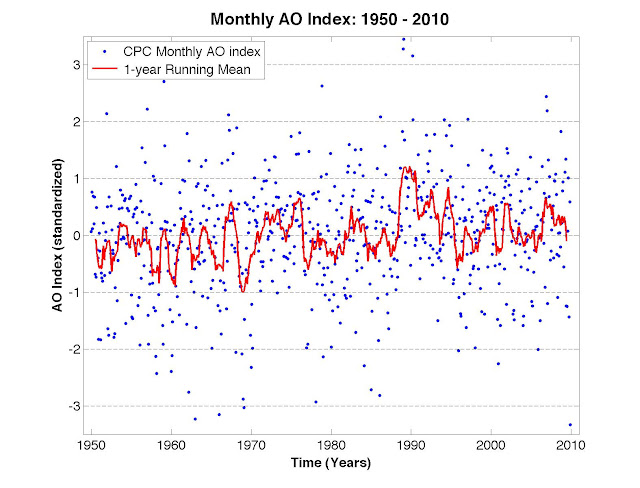
    In addition, there’s the curious case of the current Arctic Oscillation, which is rather out of sorts. Essentially, air pressure is measured at various places across the Arctic and at the middle latitudes of the Northern Hemisphere – about 45 degrees north, roughly the latitude of Milan, Montreal or Vladivostok. The difference between the average readings for the two latitudes gives the state of the Arctic Oscillation index [BBC News]. A positive reading means high pressure in the mid-latitudes and low pressure at the pole; a negative reading means it’s the opposite. And what we see right now is an “extraordinary negative plunge” to levels not seen since at least 1950, Andy Revkin shows at his New York Times blog. What these conditions mean is that cold air spills out of the Arctic down to mid-latitudes, which this time round includes much of Europe, tracts of the US and China [BBC News].

    As you can see in the historical chart of the Arctic Oscillation, it’s a pretty scattershot phenomenon. But it’s an important one, which could help to explain why it’s frigid in the continental United States but unseasonably nice in some far northern locales. In 2001, after analyzing its impact on Northern Hemisphere winters, University of Washington researchers suggested that effects of the Arctic Oscillation on weather patterns “appear to be as far-reaching as those triggered by El Niño in the South Pacific” [Discovery News]. Jack Williams has more about this.

    Related Content:
    80beats: The New Murder-Mystery Game: Who Killed Copenhagen?
    The Intersection: Fox News Presents a Classic “He Said, She Said” on Climate Science
    The Intersection: Sounds Familiar
    The Intersection: How the Global Warming Story Changed, Disastrously, Due to “ClimateGate”
    DISCOVER: The Next Ice Age

    Image: flickr / bsabarnowl