Author: Discover Main Feed

  • In Russia, Apophis impacts YOU! | Bad Astronomy

    Artist drawing of an asteroid entering Earth's atmosphereI don’t spend a lot of time worrying about actual asteroid impacts — I think about them, but the odds of a big impact are too low to panic about. We should be concerned, and absolutely we should take steps in case we find The Big One headed our way. But I sometimes wonder if I should worry more about our reactions to potential impacts. Or, more specifically, Russia’s reaction.

    Apophis is an asteroid, a chunk of rock over 200 meters across orbiting the Sun. The problem is, the orbit of Apophis crosses that of the Earth. If the two are in the same place at the same time, well, bang! It’s big enough to blow up with the force of several of hundred megaton bombs. That’s not enough to wipe out life on Earth, but it’s certainly enough to do a whole lot of damage, and if it happens over a city… well.

    In April 2029 Apophis will pass within a few thousand kilometers of the Earth’s surface. It won’t hit, but Earth’s gravity will change the orbit of the asteroid. If the asteroid passes us at just the right distance — in a region of space a few hundred meters across called the keyhole — it’ll swing back in seven years and hit us.

    We don’t know the exact orbit of Apophis well enough to know for sure how close it’ll pass in 2029; we can only assign probabilities. The odds of it hitting the keyhole are pretty low, though: about one in 250,000 (downgraded from 1:45,000 recently as better orbital determinations were made).

    Enter the Russian space agency. Anatoly Perminov, the head of the agency, was recently quoted in an AP news article that he wants to consider putting together a mission to move it out of the way, making sure it doesn’t hit. I’m all for that! What worries me is this quotation:

    Without mentioning NASA findings [of downgraded odds of an impact], Perminov said that he heard from a scientist that Apophis is getting closer and may hit the planet. “I don’t remember exactly, but it seems to me it could hit the Earth by 2032,” Perminov said.

    Now, I know he’s not an astronomer, but he does run a national space agency. I’d feel a whole lot better about his organizing a meeting to deflect this rock if a) he had the date right (it cannot hit before 2036, and the odds then are very low), and 2) he could actually, y’know, name his source.

    Yikes.

    Now, maybe he was misquoted by the AP. Or maybe it was out of context. And again, I don’t expect the head of the space agency to be on top of every detail; it could simply be an honest mistake with the date. But I am not particularly happy when someone in that position bases a decision at least partly because he heard it from some guy he knows but can’t remember who or when.

    Did I say yikes before? Yeah.

    I do think governments should take this seriously. I also know that as of right now, NASA is not taking this seriously enough. Perhaps if Russia gets this ball rolling, and other countries (like India, China, and Japan) join in, then NASA will be forced to take a better look at this situation. I know I was being a little snarky above (this is a blog, after all), but in the end some good may come of this. We just don’t know enough about asteroids and how to push them out of the way. We need to set up and fly missions to a few near-Earth asteroids to understand them better and add to our knowledge of their composition, structure, and behavior.

    Theory is all well and good, but nothing beats some good practical experience. And while I dread the day when an announcement of a statistically significant likelihood of impact for a rock is announced, I’d be a whole lot happier and more comfortable if we had a dozen missions to asteroids already under our belt when that happens. Even if they got their start with this sketchy quote from the head of the Russian space agency.

    Read more about this on Discover Magazine’s 80 Beats blog.


  • Food Fraud: High Schoolers Use DNA Tests to Expose Fake Caviar | Discoblog

    dna-investigators-webA pair of genetic sleuths from New York City’s Trinity high school discovered a bit of food foul play. Seniors Matt Cost and Brenda Tan collected DNA samples from items around their homes and school, sequenced the fragments and analyzed them with a publicly available database, and found there is little truth in advertising, according to Cosmic Log:

    The real detective work came into play when [they] matched the DNA code against a couple of publicly available databases for animal species. They found out that an expensive brand of sheep’s-milk cheese was actually made from cow’s milk, that “sturgeon caviar” was actually Mississippi paddlefish, and that dog treats supposedly made from venison were actually made from beef.

    The duo also analyzed DNA from a cockroach that looks like a typical American cockroach. However, Cost and Tan found that its genetic information was different from normal and they think their mystery bug may actually be a previously unidentified species.

    For most people in New York City, this will not be a surprise.

    Related Content:
    80beats: DNA Scanner Proves That NYC Sushi Contains Endangered Bluefin Tuna
    80beats: DNA Forensics Traces Sharks Killed for Their Fins
    Discoblog: Small Comfort: Cockroaches, Too, Get Fat on an Unbalanced Diet

    Image: Mark Stoeckle / Rockefeller Univ.


  • Even Nightmares Can Be Beautiful | The Loom

    pretty isopodWhat’s with all the tongue-eating parasites popping up these days?

    At least this one is pretty. (As it should be, given that it’s the winner of the symbiosis-and-parasitism photo contest over at WetPixel.)


  • Russia Is Developing a Secret Plan to Divert a Non-Threatening Asteroid | 80beats

    apophis_orbitYou may remember back in October that NASA scientists downgraded the threat of the asteroid Apophis slamming into the Earth from remote to even more remote. Thanks to refined computation of the object’s motion, astronomers changed their estimate of the chances for a 2036 collision from an already unlikely 1 in 45,000 chance to a further long shot of 1 in 250,000. Well, that wasn’t enough to ease the head of Russia’s space program, Anatoly Perminov, who today said his nation would plan an ambitious space program to spare the Earth from certain doom, and would eventually ask other world powers to join Russia on this quest.

    Without mentioning NASA findings, Perminov said that he heard from a scientist that Apophis is getting closer and may hit the planet. “I don’t remember exactly, but it seems to me it could hit the Earth by 2032,” Perminov said [AP]. Truly, Perminov didn’t remember exactly: Apophis makes a close but harmless pass of our planet in 2029, when it could come within 20,000 miles of Earth, and then swings by again in 2036 (the visit for which NASA downgraded the danger to the remote four-in-a-million).

    Despite his chronological uncertainly, Perminov was certain something must be done. “We are talking about people’s lives,” Perminov was quoted by news agencies as telling the radio station. “Better to spend a few hundred million dollars to create a system for preventing a collision than to wait until it happens and hundreds of thousands of people are killed,” he said [AFP].

    Apophis, discovered in 2004, is almost 900 feet long. NASA originally estimated the chance of a 2029 impact at 2.7 percent—that being before its scientists had the opportunity to refine their math through further observations. They also expect the minuscule probability of 2068 Apophis collision, already listed at just 1 in 330,000, to diminish as they continue to learn about the object’s trajectory.

    Perminov offers no hint as to how Russia plans to deal with Apophis, except to say it would not destroy the asteriod [sic]. “No nuclear explosions (will be carried out), everything (will be done) on the basis of the laws of physics,” he says [USA Today]. Russia is beginning its project in secret, he says, but despite failing to mention NASA’s numbers on the actual threat, he expects space experts from the United States, China, and elsewhere to join in on an international operation to save the planet.

    Related Content:
    80beats: Will NASA’s Next Step Be an Astronaut Rendezvous with an Asteroid?
    80beats: Scientists Pick Up the Pieces (Literally) of an Asteroid Spotted Last October
    DISCOVER: What To Do Before the Asteroid Strikes
    Bad Astronomy: Apophis Danger Downgraded
    Bad Astronomy: We’re All Doomed… Oh Wait, No We’re Not

    Image: UH/IA


  • Why, Oh Why, Did San Francisco’s Famous Sea Lions Disappear? | 80beats

    Sea LionsAfter 20 years in one spot, anyone can get restless. That goes for the famous sea lions of San Francisco’s Pier 39. They swelled to their largest population ever just a couple months ago and then almost totally disappeared this month, baffling local marine experts.

    The animals have been a fixture on Pier 39 since 1990, when a big herring run lured the sea lions into San Francisco Bay. The Marine Mammal Center gets so many questions about the 1,000-pound creatures that the nonprofit staffs a small kiosk on Pier 39; the pier’s insignia includes the silhouette of a sea lion [San Francisco Chronicle]. In October more than 1,700 sea lions laid about on Fisherman’s Wharf. But the exodus began the day after Thanksgiving, and by yesterday only 10 remained hanging out near the docks.

    Jeff Boehm of the Marine Mammal Center said the sea lions probably left in pursuit of a food source, the same reason they would’ve come to Pier 39 in the first place. But Boehm said the fact that so many sea lions stayed for so long is even stranger than their disappearance [AP]. That is, sea lions tend to travel far and wide rather than sticking it out in one place for so long.

    Boehm and other scientists can’t say for sure why the lions picked this particular moment to depart, either. It’s an El Niño year in the Pacific, but the effects have been moderate, San Francisco’s weather has been close to normal, and other animals don’t seem to be affected. The marine scientists aren’t too worried about the sea lions’ welfare, since they’re typically travelers, and Boehm and company say the marine mammals could very well return next year.

    That would be a consolation prize for organizers of the 20th anniversary celebration for Pier 39’s sea lions planned for Jan. 15; they saw their guests of honor bolt at the last minute. “The party will go on nonetheless,” said Sue Muzzin, a spokeswoman for Pier 39. “Well, I think it will” [The New York Times]. There are some people, though, who wouldn’t necessarily complain if the droves of sea lions never return: fisherman. One recently told a local radio station, “They’re cute when they’re in here lying on the docks by Pier 39, but they’re not too cute out in the ocean when they’re stealing your livelihood” [Wired.com].

    Related Content:
    80beats: Who Would Win in a (Legal) Fight: A Whale or a Battleship?
    Discoblog: Sixty Thousand Sturgeon Have a Group Hug in Oregon
    The Intersection: Sea Lions and Dolphins and Polar Bears! Oh, My!
    DISCOVER: Rio, the Logical Sea Lion

    Image: Wiki Commons / Webaware


  • Are humans brighter than the Sun? | Bad Astronomy

    You’re the only star in heaven
    You’re the only star that shines
    You’re the only star in heaven
    Now that only star is mine
    – Frankie Goes to Hollywood

    Snuggler’s lament

    These days of northern winter seem endless. It’s been brutally cold here in Boulder, causing much snuggling at night, both between humans and with Canises Major and Minor. Snuggling is fun, of course, but also useful: body heat shared is body heat doubled.

    After a while it can get too hot, and even Mrs. BA with her ice cold feet will move away to cool off a bit. When that happens, of course, my mind turns to matters scientific. Our bodies generate a lot of heat. And with the Sun making only a desultory appearance every day, I was thinking recently about the energy generated by the Sun, versus that emitted by humans. I remember reading once that if you compare the heat coming a single square centimeter from the Sun to the same area on a human being, you’d find we actually put out more energy! As a skeptic I’m used to analyzing such claims; as a scientist I have the mad math skillz to work out the numbers; and as a communicator, I have the soapbox upon which I can talk about the whole thing.

    So let’s get to it. Are humans more energetic than the Sun?


    Yar, thar be math below, and plenty of it. Be ye fairly warned, says I.

    Glowing places

    As it happens, the math isn’t that hard. Objects that are warm (really, anything warmer than absolute zero) have a characteristic way they emit energy, called black body radiation. Both humans and the Sun are pretty close to being such radiators, and it’s not too bad to just assume they’re blackbodies. There’s a simple equation to calculate the amount of energy emitted per second, called the luminosity:

    Luminosity = area of object x σ x temperature4

    where σ, the Stefan-Boltzmann constant, is just a number (if you wanna check my math, it’s 5.67 x 10⁻⁵ erg cm-2 s-1 K-4, and K is Kelvins, the unit of temperature). That equation makes sense: at a given temperature, a bigger object will emit more energy. And if two objects are the same size, the hotter one will give off more energy (in other words, and to be a bit more vernacular, it’ll be brighter).

    The Sun is big, so even if it were colder than a human it would win that fight! So we want to compare apples to apples here, taking one square centimeter of each and seeing who wins. That means we want the luminosity divided by the area, giving us the energy emitted per square centimeter in one second. Rearranging, we get

    Luminosity / area = σ x temperature4

    Hey, wait a sec! This makes something clear right away: if you want to compare the energy emitted per square centimeter from any two objects, all that matters is their temperatures. The hotter one wins.

    That means the story I read — that humans emit more per square cm than the Sun — is wrong. The Sun is a lot hotter than a human, so it emits vastly more energy than a person does! In fact, it’s the ratio of the temperatures raised to the 4th power. The Sun’s temperature is 5780 Kelvins, and a human is 310 Kelvins. Plugging and chugging shows that the Sun gives off a whopping 121,000 times as much energy per square centimeter as a person does!

    Yegads. And the Sun is a whole lot bigger. If you’re not careful, you may get the impression the Sun gives off quite a bit of energy.

    Pump up the volume

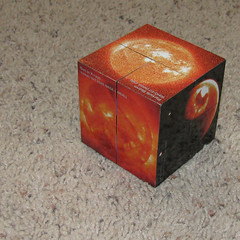
    A cubic Sun.

    Anyway, far be it from me to simply say the story is wrong and drop it. There’s more science here! Instead of using the area, what about the volume? In other words, assume both a human and the Sun have the same temperature throughout (I mean, every chunk of a human is 310K, and the Sun is 5780 K). Would a cubic centimeter of the Sun outshine a cubic centimeter of human?

    This is a little bit tougher to calculate. We need the total luminosity of the Sun and its volume, and the same for a human. For the Sun that bit’s actually easy, since we just use that luminosity equation above (knowing the Sun’s area is 6.1 x 10²² square centimeters, which I leave up to you to calculate if you want). The Sun’s energy emitted per second is then about 4 x 1033 ergs/second, where an erg is just a unit of energy astronomers like to use. It’s a small unit, but 4,000,000,000,000,000,000,000,000,000,000,000 of them is still a lot.

    What about a human? Well, we need the area of a human to plug into the equation to get the luminosity, and we’ll have to estimate that. Let’s use me as an example, and assume I’m a big rectangular solid, like a shoebox (or a monolith). I’m 177 cm tall, about 50 cm across, and about 15 cm deep. That gives me an area of very roughly 25,000 square centimeters. That’s an estimate, but good enough — it won’t matter if I’m off by a factor of two either way.

    Plugging away, I get that my luminosity is then 1.3 x 10¹⁰ ergs/sec. That’s a lot smaller than the Sun. But then, I’m not all that hot*.

    I am your density

    OK, almost there! All we need to do now is divide those numbers by the respective volumes and compare them. The Sun’s volume is 1.4 x 1033 cubic centimeters. That means that each cubic centimeter gives off 4 x 1033 ergs/second / 1.4 x 1033 cc = 2.8 ergs/second/cc. So every second, each cc of the Sun emits 2.8 ergs. OK then. What about me?

    How I know humans and water
    have the same density.

    My volume is easy to estimate: I know humans are the same density as water, which is 1 gram/cc. I also know my mass is about 75,000 grams, so my volume must be 75,000 cc! Easy peasy.

    Finally, dividing my luminosity by my volume yields 170,000 ergs/sec/cc.

    Hey, wait a sec! That means not only am I brighter than the Sun, I’m a lot brighter! About 60,000 times brighter!


    Make a gas of U and ME

    So in that sense, the legend is right. If you want to think of it this way, a cubic centimeter of human gives off a lot more energy than the same volume of the Sun does!

    But hold on there. Is this really a fair statement?

    Well, not really. First, there are a whole lot more cubic centimeters in the Sun (about 1028 times as many, or ten billion billion billion times as many), so when you divide by such a big number the energy per cc for the Sun drops drastically. So even if we say, sure, humans are more luminous per cubic centimeter, it’s best not to get cocky. The Sun can still vaporize us with lots of cubic centimeters left to spare.

    Second, remember the assumption I made, that the Sun has the same temperature everywhere? That’s not even close to being true. In fact, it’s whoppingly untrue. The core of the Sun is 15 million Kelvins hot, so each cc there is blasting out vast amounts of energy: about 5 quadrillion times what a cc of human flesh does. But outside of that region the Sun is much cooler, and each cc doesn’t contribute nearly as much. Over the entire Sun, that dilutes the amount of energy per cc quite a bit. Averaging over the volume of the entire Sun is not a great way to think about it, and makes comparisons difficult, if not really meaningless.

    Like this exercise has any profound, deeper truths to it in the first place. Actually, it’s just an excuse to have some fun and do some mental gymnastics. And, in the end, it really comes down to this: the Sun is bright, and we are not.

    But, you knew that. Of course, some humans are hotter than others. But I’m not sure I can do the math for that.

    Tip o’ the pound of flesh to BABloggee Brad Stacey.


    * You can take my word for it, or ask Mrs. BA. She’ll be honest, but her feet lie!

    Swimmer image from dionhinchcliffe’s Flickr photostream.


  • Fora.tv Interview on ClimateGate, Geoengineering, and Copenhagen | The Intersection

    While in Copenhagen, I spoke with the folks from Fora.tv for a ten minute interview covering a wide range of topics. These included the dysfunctional way in which our culture processes information about science in general, and about climate science in particular; the continuing stream of misinformation about global warming (particularly the bogus claims that we haven’t had any warming in a decade); the increasing allure of the geoengineering option as progress on emission cuts continues to stall; the reasons for heeding climate models, despite their flaws; and the dangerous possibility that the warming we ultimately see could be on the high end of the current projections.

    You can watch it all here, and I have also embedded it below:


  • Top 100 Stories of 2009: #56: Earth-like Storms Mysteriously Appear on Saturn’s Moon Titan

    “For so long, it was cloud-free. Then, all of a sudden, they dramatically appeared.”

  • Top 100 Stories of 2009: #57: Robots Get Off Their Butts & Learn to Walk

    Autonomous machines are getting better at better at the ongoing controlled falling known as “walking” among us humans.

  • Are Digital Strip Searches Coming Soon To Every Airport Near You? | 80beats

    tsa-release-images-400-webThe Christmas Day airplane bombing attempt has renewed the debate over full body scanners at airports. The Transportation Security Administration in recent years has tried out a series of “whole-body imagers” to look for threats that typical metal detectors can’t find. These systems are the only way that smuggled explosives, like the one officials say was brought on the Christmas flight, can be reliably found [Wired.com].

    Privacy advocates are calling the full body scanners a “digital strip search” (take a look at this TSA image of a full body scan and you’ll get the idea). But some security advocates say that either patting down every passenger or taking full body scans are the only options to ensure certain dangerous items are kept off airplanes.

    Right now there are 40 full body scanners in 19 different U.S. airports. Only 6 airports use them for primary screening, the rest are used for follow-up searches. These scanners use millimeter-wave sensors that emit radio frequencies. By measuring the differences in the radiated energy, the scanner produces detailed 3-D images that resembles photo negatives. TSA has also ordered 150 similar scanners, at about $170,000 each, that use backscatter X-ray technology, after the completion of a successful pilot project.

    TSA says privacy concerns are unwarranted since facial features (and other body parts?) are blurred out before the screening officer, who is in a separate room, sees the images. A senior U.S. air security source acknowledged the ongoing controversy over using the high-resolution body scanners that can show breast enhancements, body piercings and genitals. Full-body scanners currently in use in the U.S. have been set on a “politically correct” lower resolution that prevented screeners from seeing the outlines of genitals, the source said [New York Daily News]. Supposedly, the images will be permanently deleted immediately after screening.

    Last June, the House of Representative voted 310 to 118 to oppose the use of full body scanners as a primary means of screening passengers. This doesn’t mean the issue is dead however, as President Obama has ordered a system-wide review on all screening procedures.

    Related Content:
    80beats: Editing Goof Puts TSA Airport Screening Secrets on the Web
    80beats: Computer Glitch Delays Airline Flights Around the Country
    DISCOVER: A Wing and a Prayer: The U.S.’s Crumbling Air-Travel Infrastructure
    80beats: Researcher Discovers Effective Profiling; Says It’s More Trouble Than It’s Worth

    Image: TSA


  • Near the Edge of the Solar System, Voyager 2 Finds Magnetic Fluff | 80beats

    voyager2After three-plus decades of exploring the gas giants, passing the orbit of Pluto, and reaching points beyond, Voyager 2 has found something interesting near the edge of the solar system: surprisingly magnetic fluff. Researchers document their findings in this week’s Nature.

    Of course, this fluff isn’t made from the dust bunnies you find under your bed, the ‘Local Fluff’ (a nickname for the Local Interstellar Cloud) is a vast, wispy cloud of hot hydrogen and helium stretching 30 light-years across [Discovery News]. Astronomers already knew this fluff was out there near the boundary area between our solar system and interstellar space. What surprised them is that the fluff is much more magnetized than they’d expected.

    Voyager 2 isn’t actually in the fluff yet, but it can measure the area’s magnetism by observing how its magnetic field deforms the shape of the heliosphere, that balloon of space created by the solar wind pushing outward from our sun. The magnetic field is not only stronger than anticipated—3.7 to 5.5 microgauss—it’s also tilted off the galactic plane of the Milky Way by about 30 degrees, NASA investigator Merav Opher says. “The tilted field probably is a result from turbulence in the interstellar medium outside our solar system or results from collisions of clouds in the solar system neighborhood,” Opher says [USA Today].

    Magnetism could answer the question of why the “Local Fluff” continues to exist at all. Though it formed from supernova remnants 10 million years ago, exhaust from other supernovae should have destroyed it by now. It would be like expecting a wisp of cigarette smoke to retain its structure in the middle of a tornado; some kind of force would need to be surrounding (or intertwined through) the smoke helping it resist being dispersed. In the case of the wispy Local Fluff, a magnetic field may be helping [Discovery News].

    Next stop for Voyager 2: interstellar space, beyond the influence of the solar wind. By NASA’s calculations, the two voyagers have until about 2025 to keep exploring before their instruments operate no longer.

    Related Content:
    80beats: Voyager 2 Hits the Edge of the Solar System—And Writes Home
    80beats: Solar Winds Drops to Lowest Recorded Level, Probe Finds
    80beats: NASA Spacecraft Will Soon Map the Solar System’s Distant Edge
    The Loom: Astrophilia, a tattooed ode to Voyager 2
    DISCOVER: 20 Things You Didn’t Know About… Aliens, including that the Voyager golden record contains a Bulgarian folk song

    Image: NASA


  • Discover Interview: Miles of Wire, Reams of Print-Outs, and a Giant Discovery

    In her calm, deliberate way, astrophysicist Jocelyn Bell Burnell has always been in the business of changing worlds. Over a storied four-decade career, she has helped expand our understanding of the universe, caused people to rethink how Nobel Prizes are awarded, and used her stature to fight sexism in the world of science.

    Burnell made her first scientific mark in 1968 as Jocelyn Bell, an unknown, 23-year-old doctoral student from Northern Ireland. After months of using the new radio telescope at the University of Cambridge, she came upon inexplicable, metronomically regular radio blips from isolated spots in the sky. Bell and her Ph.D. supervisor, Antony Hewish, concluded that the blips came from hitherto unknown objects, massive yet remarkably small. Because of their pulsed signals, these objects were dubbed pulsars. Soon after, pulsars were identified as rapidly spinning neutron stars, the remnants of supernova explosions; they weigh as much as the sun but are just a dozen miles wide. The discovery was so significant that the Nobel Committee recognized it with a share of the 1974 prize in physics—an honor that was presented to Hewish but not to the young woman who had made the initial observation, Jocelyn Bell. The snub made international news.

    Time magazine hyped it as “A Nobel Scandal?” But Burnell was philosophical. “I believe it would demean Nobel Prizes if they were awarded to research students, except in very exceptional cases,” she later said, “and I do not believe this is one of them…. I am not myself upset about it—after all, I am in good company, am I not?”

  • Top 100 Stories of 2009: #58: Orangutans Use Tool to Lower the Sound of Their Voices

    By putting leaves between their lips, the apes apparently make themselves sound bigger and more threatening.

  • Peek-a-moon | Bad Astronomy

    I don’t have a whole lot to add to this amazing shot from Cassini of Saturn’s moon Rhea reappearing from behind the giant moon Titan:

    cassini_rhea_titan

    [Click to entitanate.]

    Except: coooool. Titan is over three times the size of Rhea, and Rhea was more than twice as far from Cassini when this was taken, making Rhea look even smaller in comparison. Also, check out how the high-altitude haze in Titan’s atmosphere isn’t the same height all the way around the moon. Near the top you can see they poof up higher. If you look closely, can you see the Enterprise?


  • Code Protecting 80 Percent of Cellphone Convos Finally Cracked | 80beats

    cellphonemanAre your phone conversations about to become less secure? A German encryption expert says he’s cracked the two-decade-old algorithm that protects most of the world’s cellphones: GSM (Global System for Mobile communication).

    Karsten Nohl says his intentions were noble; he wanted to show the world that though GSM protects 80 percent of the cellphones in the world, it’s far from invincible. “This shows that existing G.S.M. security is inadequate,” Mr. Nohl, 28, told about 600 people attending the Chaos Communication Congress, a four-day conference of computer hackers that runs through Wednesday in Berlin. “We are trying to push operators to adopt better security measures for mobile phone calls” [The New York Times].

    Nohl and a team of others had been working independently since August to hack the code. Developed in 1988, the system prevents the interception of calls by forcing phones and base stations to change frequencies constantly [The Guardian]. Nohl and the others generated countless random code combinations until they’d completed an encryption code book. As an analogy, think of encryption like a jigsaw puzzle where you have to find one specific puzzle piece. If the puzzle only has 25 pieces, it won’t take you too long to accomplish. That is like a weak encryption algorithm. However, if the puzzle has 10,000 pieces it will take significantly longer [PC World].

    Despite the fact that it took 21 years before someone figured out their jigsaw puzzle, GSM’s creators at the GSM Association aren’t pleased. “We consider this research, which appears to be motivated in part by commercial considerations, to be a long way from being a practical attack on GSM,” said Claire Cranton, a spokeswoman. “To do this while supposedly being concerned about privacy is beyond me” [The Guardian].

    While Nohl claims his works was academic and GSM spokespeople say it’s not a threat, not everyone is convinced it’s so harmless. Law enforcement officials and well-financed cyber criminals have been able to crack GSM encryption for sometime, but the investment was so high that it didn’t pose much of a threat. This new method lowers the price of entry to the point that it is more of an issue, but still not a high risk [PC World].

    Related Content:
    80beats: A Hack of the Drones: Insurgents Spy on Spy Plans with $26 Software
    80beats: Editing Goof Puts TSA Airport Screening Secrets on the Web
    80beats: How to Prevent Heart Hackers from Turning Off Pacemakers
    80beats: Electrical Espionage: Spies Hack Into the U.S. Power Grid

    Image: flickr / Ed Yourdon


  • Specially Modified Music Can Rewire Brain & Alleviate Tinnitus | 80beats

    ear-ipod-webTinnitus, the perceived ringing and buzzing in one’s ears, may not be fully understood, but what is known is that it can severely disrupt a person’s life. Treatment for the condition has been unreliable, but now scientists are reporting a new way to turn down the ringing by turning up music, according to a new study.

    Scientists altered participants’ favourite music to remove notes which matched the frequency of the ringing in their ears. After a year of listening to the modified music, individuals reported a drop in the loudness of their tinnitus [BBC News]. Participants who listened to music in which notes of a different frequency were removed reported no such improvement. The treatment could be a cheap way to help the three percent of the population that suffers from tinnitus, say the researchers, who published their findings in the Proceedings of the National Academy of Sciences.

    The idea is to remove the spectrum of noise linked to tinnitus from the music a person listens to so that the area of the brain associated with that frequency will not be as active. The researchers propose that the therapy might work by re-wiring parts of the auditory cortex that have become over-active to instead tune into surrounding—but different—tones. Another possibility is that with deprivation, these specially tuned auditory neurons would undergo “long-term depression,” causing them to become less active overall [Scientific American]. How ironic that one of the causes of ringing ears may also be the solution.

    Related Content:
    80beats: Clubbers More Likely to Give Cigarettes If You Ask Their Right Ears
    80beats: Stem Cells Could Regenerate Inner Ear Hairs—and Hearing
    80beats: Forget the Hearing Aid: Why Not Regrow Inner Ear Cells?

    Image: flickr / Neil T


  • Free Tropical Vacation! (If You Try an Experimental Diarrhea Drug) | Discoblog

    MexicoBeachIt’s about that time of year when people return home from spending holidays with the family, only to realize they need a vacation to recover from their vacation. Well, if you’re a resident of the U.K. or Germany who’s in good health, between 18 and 64 years old, and can keep a diary for two and a half weeks, your vacation to Mexico or Guatemala could be gratis. Oh, and one more thing: You have to be a guinea pig for a potential diarrhea drug.

    A U.S. vaccine manufacturer called Intercell calls it the “Trek Study.” The company says it needs 1,800 volunteers between now and May to visit these locales, where sun-seeking tourists often get diarrhea. But fear not, travelers: A smaller study Intercell did on Americans showed a 75 percent reduction in diarrhea incidence, so perhaps fewer of you will spend your Caribbean holiday in excruciating, gut-wrenching pain than you normally would.

    From BBC News:

    Intercell’s clinical director, Nigel Thomas, told the UK’s Independent newspaper: “We are looking for people who have already planned to go to Mexico or Guatemala and think this would add another interesting aspect.

    “It is almost like going on a package holiday. They will be met by a concierge who will take them to their hotel and arrange for them to give their first blood sample within 48 hours.”

    Fake leprosy, it seems, isn’t the only way to snag a medical vacation in the tropics.

    Related Content:
    Discoblog: Darwin May’ve Had Cyclical Vomiting Syndrome (It’s as Much Fun as It Sounds)
    80beats: Oh No! No Fresh Salsa Due to Salmonella Outbreak
    DISCOVER: Vital Signs: Fishy Food, on the perils of eating fish in Bora-Bora
    DISCOVER: Megadeath in Mexico

    Image: flickr / lightmatter


  • Halfway to Pluto! | Bad Astronomy

    eso_pluto_surface_300Today, December 29, 2009, the New Horizons Pluto probe crosses an arbitrary but psychologically important line: it is now closer to Pluto than it is to Earth.

    If there were people on board the small interplanetary probe, no doubt they’d be popping champagne. I’m sure that back on Earth, the team behind NH are pretty happy. This probe has a checkered history, having been planned, canceled, re-planned, delayed, on and on. It’s amazing it got to launch at all. But on January 19, 2006 the small, half-ton probe was sent on its way, and on July 14, 2015 it’ll sail past Pluto and its collection of moons, snapping pictures and taking data.

    Today marks the official halfway point, where New Horizons has half its path already behind it. Here’s a plot of its distance to Earth (in blue) and Pluto (red) care of the New Horizons site:

    newhorizons_distance

    Distance in the graph is measured in Astronomical Units (a yardstick used by astronomers for convenience; it’s the distance of the Earth to the Sun, about 150 million km (93 million miles)). The distance to Earth is wiggly because the Earth goes around the Sun as New Horizons moves out, and the distance to Pluto decreases steadily as the spacecraft catches up on its journey. Where the two lines cross is where the distances are equal, and that’s now, today!

    You may be wondering about the timing: New Horizons is halfway in distance to Pluto, but the mission timeline halfway point isn’t until October 16, 2010 (if I’ve done the math correctly). The probe was launched at high speed, slowed down due to the Earth’s and Sun’s gravity, picked up a kick from Jupiter in early 2007, and has been slowing ever since. Since it was moving faster before, it reached the distance halfway point before the schedule halfway point.

    New Horizons is now 16.37 AU – 2.449 billion km, or 1.522 billion miles — from home. But maybe now, home is no longer Earth. Once it crossed that line today, home became deep space. Even Pluto and its moons Charon, Nix, and Hydra are only milestones for it. It won’t be stopping when it gets there; New Horizons will sail on by, continuing into deep space. It’ll become one of several other spacecraft we’ve sent out of the solar system itself, set to wander interstellar space forever.

    That is, unless one day we catch up to them ourselves. I imagine in a few hundred years they’d make fine museum pieces. Or maybe, if poetry still exists in humans all those far-flung centuries from now, we’ll let those probes continue on. I rather like that idea better.

    You can follow the New Horizons probe on Twitter, which is how I found out about this milestone today.

    Art credit: ESO/L. Calçada