Author: Don Weinland

  • China: Revaluing the One-Child Policy

    Amidst talk of an aging society and a depleting demographic dividend, appeals for a reconsideration of China’s One-Child Policy were voiced during the annual meetings of the National People’s Congress and the Chinese People’s Political Consultative Conference held Mar. 3 to 14.

    Zhang Yin, China’s wealthiest woman and member of the Chinese People’s Political Consultative Conference, called for a “gradual release” from the 30 year-old policy, with a three to five year trial period allowing some the right to have a second child before the nation as a whole.

    In an interview with Southern Weekend Zhang said she was one among many who voiced concern over China’s low birth rate and the consequences of an aging society.
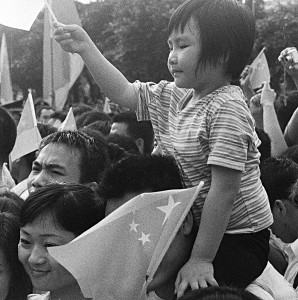
    (photo/Don Weinland)

    (photo/Don Weinland)

    In an open letter issued by the Communist Party’s central committee in September of 1980, the One-Child Policy was suggested in order to relieve the demographic tensions of runaway birth rates.  The letter states that after 30 years of state controlled family planning, “different demographic policies can be adopted.”

    As the policy completes its 30 year course, the future of family planning has become a topic for debate.  Despite a long tradition of large families in China, online opinion concerning a possible “Two-Child Policy” is mixed.

    Blogger You Xin sees the One-Child Policy as inseparable from China’s long-term growth and conservation of resources.

    计划生育是我国的基本国策,人口数量控制在今后很长一段时间内还是要有力执行的。只有将人口总量控制在一个适度范围,面临日益匮乏的资源短缺,我国人均资源量才不会及其匮乏,人民生活水平才会有质的提高。

    Family planning is a fundamental policy in my country.  Population control for a long period of time in the future must be carried out with force.  In the face of daily increasing shortages of resources, only population control on a suitable scale will prevent extreme per capita resource shortages.  Only then can the people’s quality of living be raised.

    You Xin says China’s demographic dividend, the world’s largest group of labor-aged workers largely responsible for powering the country’s manufacturing engine, has not helped develop a white-collared job market suitable for university graduates.

    为什么大学生就业难?并不要找不到工作,而是找不到合适的工作。大学生作为知识分子,当然不愿融入制造业当中了。对于”人口红利“时代的拐点,劳动力下降,我们可以采取其他措施,而不是放开二胎政策 … 随着以后经济发展,我国也可仿效发达国家,将制造业大批转入其他更贫穷的国家。

    Why can’t university students find a job?  It’s certainly not because we can’t find work, but because we can’t find suitable work.  Students, as intellectuals, of course aren’t willing to go into manufacturing … As the economy develops further, [China] can follow the example of developed countries and transfer manufacturing on a large scale to other poorer countries.

    Blogger ‘Grassroots Public Servant’ disagrees, saying growth in the manufacturing work force is essential to China’s future and may influence the passing of a “Two-Child Policy” sooner than later.

    如果中国经济能够较快复苏,则民工荒会加剧,且远比前几年厉害,有可能促使全面放开二胎政策的提前出台。未来中国经济发展的一大制约因素,必然是劳动力,特别是低端劳动力的供给不足。

    If China’s economy recovers relatively quickly, dramatically increasing the  laborer shortage even more than the last few years, this may expedite the passing of the Two-Child Policy nationally.  A major limitation to China’s future growth will certainly be labor power, especially shortages in the supply of low-level labor.

    Blogger Wan Yu, who calls herself a basic level family planning officer, says the One-Child Policy was adopted to meet the economic challenges caused by the Cultural Revolution, which ended in 1976 and resulted in widespread unemployment.  She says the policy was directed toward one generation of citizens and should be reviewed.

    A deterioration of tradition family relationships is one of many problems Wan Yu cites with the continuation of the One-Child Policy.

    …曾听见音像店播放一种儿歌,内容是“爸爸的哥哥是伯伯,妈妈的妹妹是姨妈……”,初听颇觉匪夷所思,细想不胜感慨,几代独生子女状态如果延缓下去,这些家庭伦常关系将成为历史遗迹,孩子们只有在儿歌里才能听明白,他们的社会关系会与现在出现极大差别。

    I once heard a music store playing a children’s song that went like this: “My dad’s brother is my uncle.  My mom’s sister is my aunt…” When I first heard it I thought it was unbelievable and couldn’t help but sigh.  If generations of single children continue, the traditional family relationships of these families will become a historical artifact.  Children will know [these names] from children’s songs only.  Their social relationships will be extremely different from ours.

    Blogger Shui Lian disagrees with the idea that a “Two-Child Policy” will permanently solve China’s demographic problems and argues that higher birth rates will continue the cycle of China’s once-endemic overpopulation problems.

    …如果放开二胎政策的构想成为现实的话,为了养老就可以多生子女,那么,当这些子女老去的时候,他们又要依靠谁来养老呢?这不仅会人为增加社会养老的成本,而且势必加大每一个家庭的养老负担,是一种不折不扣的逻辑悖论。

    If two-child policy thinking becomes a reality, and we can have more children in order to take care of the elderly, then who will they rely on to take care of them when they grow old?  This will not only artificially increase the costs of care for the elderly but will increase every household’s burden for caring for them.  It is purely a contradiction in logic.

    Results from China’s sixth national census point to the possibility of an easing in family planning policy.  Southern Weekend reports that conditions that were once described as “population pressures” are now being called “advantages in human resources”.  What was once called “population control” has now been dubbed “population development”, the article says.

  • China: New Regulation Proposed For Internet Cafes

    A member of the National People’s Congress suggested quick legislative action Mar. 6 on a resolution that would close Chinese internet cafes between midnight and 8 a.m.

    People’s Representative Gao Wanneng called for a “zero-hour cutoff” for internet cafes due to long-term internet addition in Chinese youth.  Gao said such addiction is responsible for high dropout rates and internet crime and asked the National People’s Congress to pass legislation regulating online gaming, reports the Worker’s Daily.

    This is not the first time a nighttime ban on internet cafes has been suggested.  In Nov. of 2005 the municipality of Chongqing experienced slowly implemented “zero-hour cutoff” policy, as have other cities around the country.  Methods of control such as registration for internet café users and closure of unregistered cafes have been employed to regulate the industry, often without results.

    Blogger Li Lijun writes that Representative Gao’s suggestion has brought some fun into the often solemn atmosphere of the National People’s Congress, held annually in March.

    你肯定奇怪这有什么好乐的,那您就顺着这种思维方式想下去:为了防止青少年犯罪,把青少年关笼子里;为了防止家庭暴力,禁止大家结婚;为了防止食物中毒,禁止买卖任何事物…防止学生沉迷于网络的最好方法,就是限制孩子上网时间,我觉得还不如直接消灭电脑,这一点还得请兄弟国家朝鲜的专家来指导。

    Of course you think it strange.  What’s fun about this?  So go along with [Gao’s] way of thinking and consider this: to stop youth from committing crime, lock them up in a cage; to prevent domestic violence, forbid marriage; to prevent food poisoning, forbid the sale of food…The best way to prevent online addiction in students, that is, restricting the child’s time online, can’t compare with directly eliminating computers, I think.  But for this you’ll have to invite our brother county North Korea for professional instruction.

    Blogger Shan Cha agrees that such drastic measures will do little to solve the fundamental problem and will certainly bring hardship to the internet café industry.

    当山茶看到有个别委员提出“关闭全国的网吧”、“实行零点断网政策”的提案时,心里不免产生一点忧虑,委员们你们可知否提案一旦被执行,那将对全国的网吧从业者们带来多大的冲击?你们又可知关闭了网吧和零点断了网就真的能从根源上杜绝眼下所出现的青少年问题吗?

    When [I] see an individual committee member suggest “closing the country’s internet cafes,” or “carrying out zero-hour cutoff policy”, I can’t help but feel a bit uneasy.  Committee members, don’t you know that as soon as such law is carried out, what a hit it will deliver to those operating cafés throughout the country?  Do you think the closure of cafés or the cutting off of service at midnight will really solve the root of the problem that we’re seeing in youth?

    Caijing reported in 2005 that a large internet café in the Chongqing Municipality stood to lose 10,000 Yuan ($1,400), nearly a third of the café’s monthly profit, with the implementation of “zero-hour cutoff” policy.

    An entry at Pesea Gaming Blog notes that a cutoff of internet service between midnight and 8 a.m. will greatly limit maintenance in internet cafés.  The blog states that games, tools, and antiviral software are usually downloaded and upgraded during early morning hours.  New regulations would force owners to conduct maintenance during peak hours.

    In 2006 cities like Shenzhen carried out campaigns to eradicate unlicensed internet cafés, or “black cafés” as they are known in Chinese.  Some fear that such “zero-hour cutoff” policy will force late night business into unlicensed and unregulated internet cafés.

    A writer at Pesea Gaming Blog writes:

    零点断网的政策一出台,国家电信部门就会积极配合,在规定的零点至八点的时间内就会中断网吧的网络接入服务。但是电信部门所能够中断的只是在有关部门合法登记的白网吧而已,那些屡禁不止的黑网吧因为没有合法的登记在案从而根本不会受到影响。

    Once the “zero-hour cutoff” policy is passed, the national telecommunications department will actively cooperate, cutting off café’s internet connections between the stipulated times of midnight and 8 a.m.  But the connections that the telecommunications department can cut off are only those of legally registered cafés.  The multitude of forbidden cafés will be unaffected because they have no legal registration on file.

  • China: Increasing Trend in Mass Incidents

    Protests, known in Chinese as “mass incidents”, grew fiercer and more violent in 2009, while methods of protest grew in variation, says a Chinese Academy of Social Sciences researcher.

    In a recent Southern Weekend article Shan Guangnai of the Chinese Academy of Social Sciences analyzes new trends in “mass incidents”, an area of growing concern for the Chinese government and communist party alike.

    Shan says socioeconomic tensions in 2009 led to an increase in localized protests largely instigated by local corporate reform and labor disputes, housing demolition and relocation, government expropriation of rural land, and pollution.

    The characteristics of such incidents in 2009 are markedly different from years past, Shan says.  He says some noticeable trends include increases in fierceness and violence, increases in protests incited by online public opinion, labor-wage disputes, and pollution.  A catalyst culminating the matter is the public’s suspicion of formally searching out assistance and a general lack of confidence in local governments, he says.

    Author of the blog Convey to Society attributes the exponential rise in mass incidents to historical problems swept under the rug during the last 30 years of development.  The author details the rapid increase in incidents in a December 2009 entry.

    报告指出,今年群体性事件发生仍然保持着多发的态势,这是因为一些地方在加速发展和转型的过程当中,积累了很多历史上的矛盾和问题,这些问题得不到及时解决,造成的民怨太深。据不完全统计,1993年我国发生群体性事件0.87万起,2005年上升为8.7万起,2006年超过9万起,2008年群体性事件的数量及激烈程度都超过以往。如今,社科院学者称,今年群体性事件发生仍然保持着多发的态势。

    Reports have shown mass incidents [in 2009] have maintained an increasing posture.  This is because of an accumulation of historical problems and contradictions during the course of development and transition.  These problems have not received timely resolution, causing an all too deep feeling of resentment in the people.  Based on an incomplete set of statistics, 8,700 mass incidents occurred in 1993, rising to 87 thousand in 2005, and surpassing 90 thousand in 2006.  In 2008 the level of intensity of mass incidents surpassed that of previous years.  Today social scientists claim mass incidents this year still maintain an increasing posture.

    Shan Guangnai points to some of 2009’s most intense protests as evidence of a growing level of violence during such incidents.  Protests in the provinces of Hubei, Yunnan, Jilin and Henan indicate unprecedented levels of intensity.

    Local resentment

    An incident broke out on Jun. 17 in Shishou, Hubei Province after a controversy surrounding the death of a hotel cook swept more than ten thousand people into a protest lasting three days.  Images of the protest from a blog at zxmxd.com show hundreds of military police retreating from a large crowd of violent protesters.

    The Jun. 17 incident in Shishou was a result of long-term, unresolved problems and built up tension, writes Qiu Xuebin at blogchina.com

    积怨不解,后患难除…群众利益诉求长期得不到解决,民众就象一堆干柴,遇到一点火星,就会燃起熊熊烈火。网络作为出气筒,已经发泄了不少民愤了,但如果民众的现实诉求渠道不畅,矛盾和问题长期得不到解决,最终还是要从网络的虚拟世界下来走向街头。

    An accumulation of unresolved resentment is difficult to get rid of once it becomes a problem.  When the interests of the people go unanswered long term, the people light up in fury like sparks on brushwood.  The internet is like an exhaust pipe, already spewing much public indignation. But if the people’s realistic means of making claims [of the government] are hindered, contradictions and problems going unanswered long term, in the end we slip out of the make-believe world that is the internet and hit the streets.

    Online public opinion

    In February 2009 the term “duo-mao-mao” became one of the most commonly searched words on Chinese search engines.  Originally referring to a child’s game, the term now stands for the death of a 24 year-old man who died under questionable circumstances in a local jail in Yunnan Province.

    After an investigation committee yielded inconclusive results, a barrage of online indignation expressed distrust in the investigation and the local government.  Some Chinese netizens advocated violence, as described in an article at ycwb.com

    Blogger Shuibin-Mengxiang dicusses the role online opinion played in the “Duo-mao-mao” incident.

    云南躲猫猫”事件发生后,网络声讨的言论犹如涛天洪水般一浪卷一浪扑天而来,这再次反映出网络放大传播的无形力量,也反映出因突发事件而被动应付舆论成了地方党委政府的头疼病。这个事件带给党委政府应对网络舆论几点启示

    After the Yunnan “Duo-mao-mao” incident happened, online denouncement poured in, wave after wave, like a flood that would wash away the sky.  This time and again reflects the invisible power of internet amplification.  It also shows that public opinion can become a headache for local governmental party committees due to careless handling of sudden incidents.  This incident has given party committees a few enlightening responses from online pubic opinion.

    Workers' strike

    A dispute over corporate restructuring left the general manager of a steel company dead on Jul. 24 of last year.  Nearly 3000 Workers at Tonggang Group in Jilin Province engaged in violent protest, beating to death General Manager Chen Guojun after dissatisfaction with a restructuring plan.

    Blogger Zhengcheng-Manman describes the incident as a “restructuring tragedy.”  In a July 2009 entry the blogger describes the incident.

    一位在现场的职工描述说,陈国军要求大家结束聚集,但随后集会员工情绪失控,几个人把他拉下台后进行群殴。后来,陈国军跑到一个会议室,将门反锁,人群用暖气片将门砸开,继续殴打陈。

    An employee on the scene said Chen Guojun requested an end to the gathering but the gathered workers then lost control of their emotions, a few of them pulling him from a platform and beating him.  Then Chen Guojun ran to a meeting room, locking the door.  The crowd used a heating panel to smash the door and continued beating Chen.

    Displeased with severance pay, a group 400 steel workers in Henan Province protested a similar corporate reform in August of 2009, taking over the factory floor and holding a party official under duress, reports an article at Sina.com.

    The Chinese Government will watch these trends carefully in 2010, in the hopes that stimulus driven development will stabilize society and slow this increase in unrest.