Author: Dr. Peter Gleick

  • Peter Gleick: Smart Water Meters, Dumb Meters, no Meters

    How is it possible that a place like California, with such a long and painful history of water problems, remains so far behind the curve of smart water management? How is it really possible that things considered basic, fundamental, taken-for-granted in other places are still missing here? And are water managers and users so insular that they really think they’re doing a good job with water?

    That’s a rhetorical question: California is not ahead of the curve in anything “water.” It is dealing with 21st century water problems with 20th century (or is it 19th century) water policy and politics. Some remarkable, innovative efforts are underway, but they remain the exception, not the rule.

    ABOUT THE AUTHOR:
    Peter Gleick
    Dr. Peter Gleick is president of the Pacific Institute, an internationally recognized water expert and a MacArthur Fellow.

    To what do I refer? Well, it could be the complete lack of comprehensive groundwater monitoring and management — a fact that stuns my colleagues overseas (and even in other states, and even a remarkably high-ranking official in state government here). It could be the inability to figure out how to put in place permanent, comprehensive water efficiency programs. It could be the archaic agricultural water policies. It could be the inability to properly develop desalination in a way the both provides safe, reliable water but also protects the public interest with environmental protection, transparency, and financial rationality.

    But no. This time I mean water meters. Every single water user — residential, commercial, industrial, and agricultural — should have an accurate water meter. And every single user should pay for each gallon of water use, preferably with the price rising with the volume. Again, the fact that this is not the case stuns my water colleagues from other places. And it should. It is an outrage in a place where water is scarce, contested, and still used so wastefully that water use should not be accurately measured and charged.

    But of course it isn’t. The people without meters, or people with old “dumb” meters unable to be read remotely or provide detailed information to users, would be at risk of paying more (some would pay less, but some would certainly pay more). People without meters can use, and waste, as much water as they want and no one takes them to task. It is the tragedy of the commons, writ large. And somehow, these self-interested people have been able to influence politicians against taking action to the detriment of the rest of the state, the environment, and all other water users.

    Water Numbers:
    To date, Sacramento still has meters in only 25 percent of its houses and has no intention to meter everyone in a reasonable time period. And they’ve made ridiculous arguments that it would cost too much to put meters in. The Sacramento City Council has authorized a first phase to put in 1,735 meters for $20 million. Explain, then, how come the City of Ottawa will spend $25 million to install 190,000 smart meters? In the arid San Joaquin Valley, south of Sacramento, more than half of all residents are not metered. Fresno, the region’s largest city, charges single-family households a flat rate, regardless of how much water they use. And what do you know? Fresno’s water rates are among the lowest, and their water use among the highest, of anyone’s in California. Average Fresno residential use is 290 gallons per person per day. The state average is 135. For the same amount of water (22,440 gallons, more than enough for a family of four for a month) City of Fresno customers pay, on average, a monthly water rate of only $28.33, compared with San Francisco’s $89.57 and San Diego’s $95.48 (see the figure below). At least Fresno is beginning to slowly add meters.

    In some cities, the problem is worst for multi-family homes or apartments, which often have a single meter serving many families. San Diego is beginning to tackle this problem by requiring developers of new multi-family homes to install water meters for each unit. The San Diego City Council has approved a cutting edge water sub-metering ordinance for all new apartment buildings and condos. Councilmember Marti Emerald wrote and promoted this ordinance. This is a big deal: multifamily homes account for 44 percent of the housing units in San Diego and over 1.2 million new residents are expected in San Diego by 2050, according to the SD Union-Tribune, 80% of them multifamily units. Studies show that renters will cut their water use by 15 percent to 39 percent if they pay explicitly for their water use, rather than having their utility costs folded into their overall monthly rent.

    Water Rates California Cities

    Water rates for selected California cities for 22,440 gallons per month.

    Even better, there is a whole new generation of “smart” water meters coming. These can be read remotely, saving millions in door-to-door readers. Smart meters permit more sophisticated pricing structures. And they can provide users real time and effective information on how to save water and money — identifying leaks and providing feedback on water-intensive activities. Toronto Hydro is installing smart water meters and expects to save $33 million on meter readers and collect as much as $24 million that it loses from inaccurate billing from the old “dumb” meters.

    It is long past time for a statewide requirement (hey, how about a nationwide requirement?) that all water users have meters installed, quickly, and that water use be charged by volume. In Sacramento, legislation introduced by Assemblyman Paul Fong may tackle part of this. Fong’s measure, AB 1975, would require multifamily complexes permitted after Jan. 1, 2012 to install meters for each unit as a condition of water service. Owners would be required to charge tenants based on the volume of water they use. This is an excellent start but more is needed.

    Peter Gleick


    Dr. Gleick’s blog posts are provided in cooperation with the SFGate. Previous posts can be found here.


  • Peter Gleick: The Coming Crisis Over the Mekong — Unconstrained Development, Natural Droughts, and Climate Change

    Asia: where pollution, massive population growth, serious overallocation and inefficient use of water, weak institutions, and exceedingly complex political relationships combine in a volatile mix.

    There is an extensive history of conflict over water resources — I’ve written about this issue for a long time and the Pacific Institute maintains an online bibliography and a separate detailed chronology of water-related violence. I don’t subscribe to the idea of “water wars” — which are mostly a newspaper editor’s delight: short, pithy, eye-catching headlines. But I do believe that the risks of conflict over water — from the local to the international — are growing. Most of these conflicts will be diplomatic disputes, personal or community disagreements, or legal battles.

    ABOUT THE AUTHOR:
    Peter Gleick
    Dr. Peter Gleick is president of the Pacific Institute, an internationally recognized water expert and a MacArthur Fellow.

    But some will be violent. Understanding the risks of such conflicts is the first step to reducing the chances that they will turn violent. While the Middle East has the longest history of water-related violence by far, my biggest worries today are elsewhere: in Asia, where pollution, massive population growth, serious overallocation and inefficient use of water, weak institutions, and exceedingly complex political relationships combine in a volatile mix.

    One example is the Mekong River basin.

    Water Number: Four plus two equals problems. Six nations share the watershed of the Mekong: China, Myanmar (Burma), Cambodia, Laos, Thailand, and Vietnam. The Mekong River Committee, formed in 1957 and re-constituted as the Mekong River Commission in 1995, has tried for many years to develop an integrated solution to the challenges of joint management, with only modest success. A major problem, however, has been the reluctance of China and Myanmar, the upstream nations, to participate in a meaningful way. China, in particular, has been one of the most recalcitrant international actors when it comes to cooperating on river management issues with downstream riparians. They were one of only three nations to vote against the UN’s major convention governing shared international rivers. And they have never signed the The Agreement on the Cooperation for the Sustainable Development of the Mekong River Basin.

    Now, tensions are rising rapidly. Part of the problem is that China is building massive dams — as many as fifteen are planned — on its portion of the river for hydropower, water storage, and other uses, and they have refused to consult with the downstream nations about their projects.

    One of these Chinese dams, Xiowan, will be the world’s tallest ever, and its storage capacity will be larger than all other dams in Southeast Asia combined. These dams, along with projects in other countries, will massively alter the flows of the Mekong and threaten to destroy the ecosystems and the livelihoods for millions that depend on the river’s fisheries, flood season for irrigation, and other natural benefits.

    Another part of the current problem is natural drought, perhaps worsened by climate change.

    In parts of the basin, the current drought is the worst of the century, but downstream nations are accusing upstream nations of contributing to the problem by holding back flows in some of the newly built dams. And there is growing concern that long-term climate changes will worsen the challenges the region faces.

    The good news is that the growing crisis has spurred a diplomatic discussion and the first summit meeting of the six riparians in the 15-year history of the Mekong Commission. This summit is underway now. There is certainly no sign of violence over water in the basin. Yet.
    But unless agreements can be reached among the parties on how to develop the river while also protecting its natural systems that provide so many direct and indirect benefit to millions, political tensions will grow. And even if violence is prevented, another of the world’s major river systems may end up being destroyed, joining a depressingly large and growing list.

    Peter Gleick


    Read Peter Gleick’s previous posts here.

  • Peter Gleick: World Water Day 2010 — A trip through one of the worst slums in the world

    Like urban slums throughout the developing world, there is almost a complete lack of piped safe water and no formal sanitation. Raw sewage and garbage flow through the streets and drainage ditches.

    Kibera slum.

    Photo © Peter Gleick
    A view over Kibera, Nairobi, Kenya, one of the world’s largest urban slums.

    Happy World Water Day, readers. March 22 is always reserved for this event, and this year, I’m in Nairobi, Kenya where the Pacific Institute is working with the United Nations Environment Programme to help raise awareness about this year’s special focus: Water quality.

    I spent part of today walking through Kibera’s Soweto East Village in Nairobi — considered to be the world’s second largest urban slum. There are no official population figures, but Kibera is thought to be home to as many as a million people: 25 percent of Nairobi’s population, on one percent of the land. (Wikipedia has a pretty good entry on Kibera, for those wanting more.)

    ABOUT THE AUTHOR:
    Peter Gleick
    Dr. Peter Gleick is president of the Pacific Institute, an internationally recognized water expert and a MacArthur Fellow.

    And like urban slums throughout the developing world, there is almost a complete lack of piped safe water and no formal sanitation. As the pictures below show, raw sewage and garbage flow through the streets and drainage ditches. I’ve traveled a lot. I’ve seen some of the poorest parts of the world, but even for me, what I saw today was a shocking reminder of the wretched conditions that literally billions of people face. It was perhaps no coincidence that the first commercial business you see on the way into Kibera is a coffin maker, nor that many of his coffins are for children.

    While there, I visited one of seven facilities that have been built in East Soweto Village to provide safe sanitation services. Managed by the local community, and built with the help of UN agencies like UN-Habitat, it has perhaps 8 pit toilets and a couple of shower stalls. People must pay to use them — 3 Kenya shillings (around 4 cents US). And despite the fact that these people have practically no money, as many as 1500 people a day line up to use this toilet block. The money goes to pay people to work there, to pay for the piped water (purchased from the local Council), and to buy toilet paper.

    There are solutions to our water problems — these kinds of community-managed facilities are one. But these seven toilet blocks serve, minimally, perhaps 1 percent of the entire population of Kibera. The level of effort and resources being spent on water and sanitation solutions is woefully inadequate to the task.

    Kibera slum.

    Photo © Peter Gleick
    Outside the toilet block in Soweto East Village, serving 1500 people a day or more with minimal safe sanitation.

    Water Number: 2.6 billion people. In a new report released this week by WHO/UNICEF’s Joint Monitoring Programme, it is estimated that 2.6 billion people still lack access to adequate sanitation services and 1.1 billion must still practice “open defecation” (a polite term for a demeaning practice), like those in Kibera. This number is virtually unchanged from past assessments as population growth continues to overwhelm efforts to provide services.

    On this World Water Day, be thankful for what most of us have: safe, reliable, and affordable clean water and sanitation. And consider doing something for those who don’t. Support any number of groups that work on these issues with time or money (the UN, Rotary, Water for People, World Vision, water.org, WaterAid, Global Water Challenge, and many, many more). Urge USAID to expand, dramatically, its African aid efforts for water and sanitation. Perhaps readers have other suggestions for positive actions that can be taken: add them as comments.

    Peter Gleick


    Dr. Gleick’s blog posts are provided in cooperation with the SFGate. Previous posts can be found here.
  • Peter Gleick: Climate-change Deniers Versus the Scientific Societies of the World — Who Should we Listen to?

    My last post said that climate-change deniers have never produced an alternative scientific theory that adequately explains the compelling evidence of climate change from around the world.

    ABOUT THE AUTHOR:
    Peter Gleick
    Dr. Peter Gleick is president of the Pacific Institute, an internationally recognized water expert and a MacArthur Fellow.

    Where should the public, not versed in climate science, look for their information and knowledge about this debate about climate change? Fox News? CNN? The New York Times? PBS? Exxon-Mobil? Environmental groups? This blog (hey, I’ve never argued that)? Senator James Inhofe (who has described human-induced global warming as: “the greatest hoax ever perpetrated on the American people” and “an article of religious faith”)?

    How about from the scientists themselves, unfiltered by media or ideologues? Below, find excerpts from the statements of pretty much every single respected, serious, professional scientific society in the world. Go to their websites. All of this stuff is easily available, if you are willing to look. Don’t take my word for it.

    The National Science Academies of the G8+5 nations (Brazil, Canada, China, France, Germany, Italy, India, Japan, Mexico, Russia, South Africa, the United Kingdom, and the United States).

    It is unequivocal that the climate is changing, and it is very likely that this is predominantly caused by the increasing human interference with the atmosphere. These changes will transform the environmental conditions on Earth unless counter-measures are taken.

    American Association for the Advancement of Science (AAAS) Policy Statement on Climate Changes

    The scientific evidence is clear: global climate change caused by human activities is occurring now, and it is a growing threat to society. Accumulating data from across the globe reveal a wide array of effects: rapidly melting glaciers, destabilization of major ice sheets, increases in extreme weather, rising sea level, shifts in species ranges, and more. The pace of change and the evidence of harm have increased markedly over the last five years. The time to control greenhouse gas emissions is now.

    American Geophysical Union Position Paper on Climate Change

    The Earth’s climate is now clearly out of balance and is warming. Many components of the climate system — including the temperatures of the atmosphere, land and ocean, the extent of sea ice and mountain glaciers, the sea level, the distribution of precipitation, and the length of seasons — are now changing at rates and in patterns that are not natural and are best explained by the increased atmospheric abundances of greenhouse gases and aerosols generated by human activity during the 20th century. … Evidence from most oceans and all continents except Antarctica shows warming attributable to human activities…With such projections, there are many sources of scientific uncertainty, but none are known that could make the impact of climate change inconsequential. With climate change, as with ozone depletion, the human footprint on Earth is apparent.

    The Geological Society of American Position Paper on Climate Change

    The Geological Society of America (GSA) supports the scientific conclusions that Earth’s climate is changing; the climate changes are due in part to human activities; and the probable consequences of the climate changes will be significant and blind to geopolitical boundaries. Furthermore, the potential implications of global climate change and the time scale over which such changes will likely occur require active, effective, long-term planning.

    The Ecological Society of America

    The Earth is warming — average global temperatures have increased by 0.74 deg. C (1.3 deg. F) in the past 100 years. The scientific community agrees that catastrophic and possibly irreversible environmental change will occur if average global temperatures rise an additional 2 deg. C. Warming to date has already had significant impacts on the Earth and its ecosystems… Most warming seen since the mid 1900s is very likely due to greenhouse gas emissions from human activities.

    American Chemical Society

    Careful and comprehensive scientific assessments have clearly demonstrated that the Earth’s climate system is changing rapidly in response to growing atmospheric burdens of greenhouse gases and absorbing aerosol particles. There is very little room for doubt that observed climate trends are due to human activities. The threats are serious and action is urgently needed to mitigate the risks of climate change… The costs of unchecked climate change in economic loss, human misery, and loss of ecosystem services are likely to be enormous.

    American Physical Society

    Emissions of greenhouse gases from human activities are changing the atmosphere in ways that affect the Earth’s climate… The evidence is incontrovertible: Global warming is occurring. If no mitigating actions are taken, significant disruptions in the Earth’s physical and ecological systems, social systems, security and human health are likely to occur. We must reduce emissions of greenhouse gases beginning now.

    International Council of Academies of Engineering and Technological Sciences

    …most of the observed global warming since the mid-20th century is very likely due to human-produced emission of greenhouse gases and this warming will continue unabated if present anthropogenic emissions continue or, worse, expand without control. CAETS, therefore, endorses the many recent calls to decrease and control greenhouse gas emissions to an acceptable level as quickly as possible.

    Network of African Science Academies
    [The thirteen signatories were the science academies of Cameroon, Ghana, Kenya, Madagascar, Nigeria, Senegal, South Africa, Sudan, Tanzania, Uganda, Zambia, Zimbabwe, as well as the African Academy of Sciences.]

    A consensus, based on current evidence, now exists within the global scientific community that human activities are the main source of climate change and that the burning of fossil fuels is largely responsible for driving this change. The IPCC should be congratulated for the contribution it has made to public understanding of the nexus that exists between energy, climate and sustainability.

    European Physical Society

    The emission of anthropogenic greenhouse gases, among which carbon dioxide is the main contributor, has amplified the natural greenhouse effect and led to global warming. The main contribution stems from burning fossil fuels. A further increase will have decisive effects on life on earth. An energy cycle with the lowest possible CO2 emission is called for wherever possible to combat climate change.

    European Science Foundation Position Paper

    There is now convincing evidence that since the industrial revolution, human activities, resulting in increasing concentrations of greenhouse gases have become a major agent of climate change. These greenhouse gases affect the global climate by retaining heat in the troposphere, thus raising the average temperature of the planet and altering global atmospheric circulation and precipitation patterns. On-going and increased efforts to mitigate climate change through reduction in greenhouse gases are therefore crucial.

    Federation of Australian Scientific and Technological Societies Policy Statement

    Global climate change is real and measurable… The spatial and temporal fingerprint of warming can be traced to increasing greenhouse gas concentrations in the atmosphere, which are a direct result of burning fossil fuels, broad-scale deforestation and other human activity.

    European Federation of Geologists Position Paper

    The EFG recognizes the work of the IPCC and other organizations, and subscribes to the major findings that climate change is happening, is predominantly caused by anthropogenic emissions of CO2, and poses a significant threat to human civilization. It is clear that major efforts are necessary to quickly and strongly reduce CO2 emissions.

    Geological Society of Australia Position Statement

    Human activities have increasing impact on Earth’s environments. Of particular concern are the well-documented loading of carbon dioxide (CO2) to the atmosphere, which has been linked unequivocally to burning of fossil fuels, and the corresponding increase in average global temperature. Risks associated with these large-scale perturbations of the Earth’s fundamental life-support systems include rising sea level, harmful shifts in the acid balance of the oceans and long-term changes in local and regional climate and extreme weather events. GSA therefore recommends…strong action be taken at all levels, including government, industry, and individuals to substantially reduce the current levels of greenhouse gas emissions and mitigate the likely social and environmental effects of increasing atmospheric CO2.


    International Union of Geodesy and Geophysics Resolution

    The IUGG concurs with the “comprehensive and widely accepted and endorsed scientific assessments carried out by the Intergovernmental Panel on Climate Change and regional and national bodies, which have firmly established, on the basis of scientific evidence, that human activities are the primary cause of recent climate change.”

    American Meteorological Society Council Statement

    …there is adequate evidence from observations and interpretations of climate simulations to conclude that the atmosphere, ocean, and land surface are warming; that humans have significantly contributed to this change; and that further climate change will continue to have important impacts on human societies, on economies, on ecosystems, and on wildlife through the 21st century and beyond.

    Royal Meteorological Society (UK)

    The Fourth Assessment Report (AR4) of the Inter-Governmental Panel on Climate Change (IPCC) is unequivocal in its conclusion that climate change is happening and that humans are contributing significantly to these changes. The evidence, from not just one source but a number of different measurements, is now far greater and the tools we have to model climate change contain much more of our scientific knowledge within them. The world’s best climate scientists are telling us it’s time to do something about it.

    American Public Health Association Policy Statement

    The long-term threat of global climate change to global health is extremely serious and the fourth IPCC report and other scientific literature demonstrate convincingly that anthropogenic GHG emissions are primarily responsible for this threat…US policy makers should immediately take necessary steps to reduce US emissions of GHGs, including carbon dioxide, to avert dangerous climate change.

    Australian Medical Association

    The world’s climate — our life-support system — is being altered in ways that are likely to pose significant direct and indirect challenges to health. While ‘climate change’ can be due to natural forces or human activity, there is now substantial evidence to indicate that human activity — and specifically increased greenhouse gas (GHGs) emissions — is a key factor in the pace and extent of global temperature increases.

    There are more. Look them up.

    Peter Gleick


    Dr. Gleick’s blog posts are provided in cooperation with the SFGate. Previous posts can be found here.

  • Peter Gleick: Improving Water Infrastructure with Dam Building, but for Whose Benefit?

    Part of the debate about water in the Western U.S., and California in particular, always revolves around whether, where, and how to build new dams. After all, that’s how we tried to solve our past water problems — just build another dam.

    ABOUT THE AUTHOR:
    Peter Gleick
    Dr. Peter Gleick is president of the Pacific Institute, an internationally recognized water expert and a MacArthur Fellow.

    I’ve argued long and hard about this in my research and writing, and in previous blog posts (see “Temperance Flat falls flat“) — both in general and with some specific thoughts and concerns about the proposal to build a dam at Temperance Flat on the San Joaquin River. In short, I think it is a terrible idea: environmentally, politically, and economically unsound. That proposal is completely unsupportable by any objective analysis.

    Water Number: 19 percent. As Bettina Boxall of the LA Times noted in her story this week, our experience with paying for past infrastructure should be a huge warning today. Irrigators who benefit from the federally built Central Valley Project have enjoyed the equivalent of a massive 60-year, interest-free loan. Not only have they failed to repay their share of the costs (having only repaid about 19 percent of their $1.2-billion share of the capital costs), but the federal government charges them no interest. Pretty sweet. Give me $1.2 billion in a very long-term, zero-interest loan and I can find you hundreds of thousands of acre-feet of water. Buy everyone efficient fixtures (washing machines, toilets, showerheads, urinals, drip or sprinkler systems, etc.) and get repaid over time through water bills savings.

    Now, a small number of irrigators want California bonds and other public money to pay for the $3.3 billion Temperance Flat dam, but they want at least three-quarters of the water. [And there is no way it’s actually going to be only $3.3 billion.] They know, and openly acknowledge (again, see Boxall’s story), that they cannot afford to pay the true cost of water this dam is going to produce. That, by itself, is the best reason not to build this dam.

    But here is a stunning idea: if the public is going to pay for the dam, why shouldn’t the public get all the water. Really. Every drop. And by “public,” I mean the environment. If bond money is going to be spent to build a huge dam, why not require that every drop be reserved for ecosystem restoration, fisheries protection, water-quality improvement, and the like — true “public goods?” None of the water should be allowed to be consumed for agriculture or urban supply unless users pay the full cost. None.

    Of course, it STILL wouldn’t make sense to build Temperance Flat. We (the “public”) could find far more water at a far lower cost through financing of water-efficiency improvements in agriculture and urban settings.

    In the end, the debate comes down to the best way to spend our limited public money to improve our water system. And spending $3.3 billion to help a very small number of farmers use water they cannot afford is not the best way. It won’t solve agriculture’s more fundamental challenges. It won’t restore our Delta ecosystems. It won’t satisfy new urban demands. In the end, the massive new infrastructure proposed for public financing would be an expensive distraction from real solutions.

    Peter Gleick


    Dr. Gleick’s blog posts are provided in cooperation with the SFGate. Previous posts can be found here.

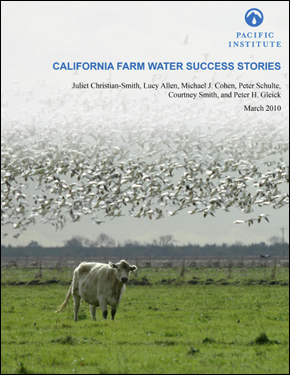
  • Peter Gleick: Farm Water Success Stories

    The Pacific Institute has just released a new report, California Farm Water Success Stories, including a separate video, describing a variety of different examples of innovation in California’s agricultural sector showing the way toward more efficient water management and use. This report is a follow-on to our major 2009 study of the potential for improving water-use efficiency in California agriculture.

    Water Numbers: 5, 7, and 8: The report describes in detail seven different case studies and the eight-minute video features five California growers and water managers. The full report and the video (along with supplemental interviews, videos, an Executive Summary, and press release) can be downloaded from the Pacific Institute website at http://www.pacinst.org/reports/success_stories/index.htm. The five California growers and water managers in the video include: Karen Ross, the past president of the California Association of Winegrape Growers; Craig McNamara of Sierra Orchards; Dale Huss of Sea Mist Farms; almond grower Tom Rogers; and Panoche District Water Master Marcos Hedrick.

    ABOUT THE AUTHOR:
    Peter Gleick
    Dr. Peter Gleick is president of the Pacific Institute, an internationally recognized water expert and a MacArthur Fellow.

    Some flavor for these success stories? In Madera County, almond grower Tom Rogers has reduced water use by up to 20% in some fields with careful monitoring and irrigation scheduling. Dale Huss of Sea Mist Farms describes how they’ve become the world’s largest user of high-quality recycled water. Craig McNamara shows how innovative financing mechanisms, drip technology, and careful management has boosted yields while reducing water needs, as well as his efforts in public education and ecosystem restoration. Karen Ross describes the Sustainable Winegrowing Program that created a program to provide the wine and grape-growing industry with data to communicate their progress to customers and regulators and a mechanism through which their farmers can identify opportunities to increase efficiencies, manage risks, improve product quality, and cut costs. Growers are working with the Department of Fish and Game to manage some of California’s last remaining seasonal wetlands — the Yolo Bypass Wildlife Area, a critical habitat for migrating birds — while still maintaining crop production. The value of good information is demonstrated by the Coachella Valley Water District’s agricultural water-efficiency initiative, known as the Extraordinary Water Conservation Program, which documented savings totaling more than 75,500 acre-feet of water over six years.

    And the report has much more.
    This new Pacific Institute report highlights seven examples of innovations in agriculture that save water and provide multiple other benefits.

    Photo Courtesy Pacific Institute
    This new Pacific Institute report highlights seven examples of innovations in agriculture that save water and provide multiple other benefits.

    With sustainable water policies and practices, innovative growers like these are moving California toward more equitable and efficient water management and use. “Mounting evidence of the effectiveness of farm water conservation and efficiency strategies is good news for policymakers and water managers,” said Dr. Juliet Christian-Smith, senior research associate at the Pacific Institute and lead author of the report. “Our study demonstrates that long-term sustainable use of water doesn’t require drastic advances in technology or heroic or extraordinary actions. It requires a commitment to sustainability and efficiency and the will to expand positive trends that are already underway.”

    The cases in the Pacific Institute report and accompanying video demonstrate diverse strategies that can reduce pressures on scare water resources, effective planning and management practices, the role for technological improvements, the potential for using alternative sources of water, and the value of setting quantitative targets and providing financial incentives. The results are efficient water use or enhanced water quality, increased crop yields or quality, and multiple benefits for other water users, such as providing increased flood protection, drought-resilience, or habitat for wildlife.

    The report offers several cross-cutting conclusions, including:

    Managing for multiple benefits. Each of the case studies offers multiple benefits and collaborations among diverse sectors of the economy.

    Accurately measuring and monitoring water use. The most significant improvements in efficiency require good information on water use, climate and weather conditions, and more.

    Capturing the untapped potential of existing technologies. In recent years, California farmers have made progress switching to water-efficient systems for distributing and using water but much more potential remains untapped. No new magic technology needs to be developed.

    Setting targets and providing economic incentives to accelerate progress. Several of the case studies show how quantitative targets and economic incentives can be effective tools to accelerate water management improvements.

    These success stories are just a few examples of the innovations already occurring throughout California agriculture, with committed individuals and groups finding better ways to manage our state’s scarce freshwater resources. It is important to incorporate the lessons drawn from these case studies in future water policy and planning in order to accelerate the adoption of sustainable water management principles and practices.

    Peter Gleick


    Dr. Gleick’s blog posts are provided in cooperation with the SFGate. Previous posts can be found here.

  • Peter Gleick: Turf Wars

    I am participating this week in the 15th Annual Water Conservation and Xeriscape Conference and Expo, in Albuquerque, New Mexico, and I’ve been thinking about grass. Those of us who work on water issues in the western U.S. and elsewhere know that a part of our water quantity and quality problems is the consequence of the vast amounts of water consumed by ornamental grass, or turf, or lawns. When early immigrants to this country came over from Europe, they brought with them their ideas of landscaping, mimicking the grand English gardens with sweeping expanses of green, manicured lawn. And when those early Americans moved west, that idea came with them again, into a climate that was completely unsuited for grass and a landscape that couldn’t afford the water.

    ABOUT THE AUTHOR:
    Peter Gleick
    Dr. Peter Gleick is president of the Pacific Institute, an internationally recognized water expert and a MacArthur Fellow.

    Water Number: 3 to 5 acre-feet per acre. This is how much water in hot, dry western climates, that turf grass can suck out of our rivers, streams and groundwater aquifers to evaporate into the air. As Amy Vickers, a leading water conservation expert and anti-lawn crusader has put it, “America’s biggest drinking problem isn’t alcohol: It’s lawn watering.”

    Today, more than half of all urban water use in most western states goes to landscaping, and most of that goes to trying to maintain green turf. In places like Las Vegas, as much as 70 percent of all residential water use goes to outdoor landscaping. Along with that water demand comes all sorts of other problems, including over-fertilization, excessive use of pesticides, air-quality contamination, and a heavy carbon footprint associated with the energy and pollution of lawn mowers.

    Study after study shows that water savings from properly designed xeriscapes can be 30 to 70 percent or even more over badly managed turf lawns, while still producing beautiful gardens. A study by the Irvine Ranch Water District in Orange County, California found a savings of over 50 percent (1.4 acre-feet per acre) in homes landscaped with native plants rather than turfgrass. The Southern Nevada Water Authority concluded in a five-year study that converting turfgrass to water-efficient landscaping save 76 percent of the water. And an Arizona study concluded that while a 3,000 square-meter turfgrass lawn used 9,000 to 15,000 gallons of water per month, that same area covered with native plants, shrubs and trees used only 800 to 1,300 gallons per month.

    My wife and I removed all the grass from our backyard, replaced it with beautiful plants, flowers, shrubs, and hardscape. We have plum, lemon, persimmon, and apple trees, and our total water use (indoor and outdoor) is under 50 gallons per person per day–far less than half what the average Californian uses. And believe me, I don’t miss mowing.

    More and more communities are exploring how to get away from the intensive water demands of turf. The East Bay Municipal Utility District’s WaterSmart program offers a rebate for removing lawn, as does the Southern Nevada Water Authority. Built Green in Colorado requires landscape design to follow xeriscaping principles. Sunset Magazine recently published an article entitled “Lose the Lawn” with 14 designs for water-efficient gardens. There are many other ideas and practices for limiting the area of turf, reducing the amount of water remaining turf consumes, and reducing the overall water implications of lawns in hot, dry climates. Google “xeriscape” or visit the resources of the Xeriscape Council of New Mexico, which is hosting this week’s conference and expo.

    Maybe it’s time to put the residential turf lawn in the same category as smoking on a plane: socially irresponsible, undesirable, and ultimately, eliminated. There are beautiful alternatives available for our gardens.

    Peter Gleick


    Dr. Gleick’s blog posts are provided in cooperation with the SFGate. Previous posts can be found here.

  • Peter Gleick: Water Fountain Victory — the Cavs Cave

    OK, my crystal ball is often cloudy, but in my last post just two days ago, I predicted that the decision by the Cleveland Cavaliers to remove the drinking water fountains from the Quicken Loans Arena (the Q), ostensibly for health reasons, would ultimately be reversed.

    ABOUT THE AUTHOR:
    Peter Gleick
    Dr. Peter Gleick is president of the Pacific Institute, an internationally recognized water expert and a MacArthur Fellow.

    Well, I was right. Fan reaction, outrage, and the perceptions that the Cavs were just trying to boost bottled water sales were all factors, but so was the fact that it is a violation of Ohio building codes to have a stadium without water fountains.

    Water Number: 1 for 1000. Most building codes require that public arenas and sports stadiums have one water fountain for every 1000 seats. This is true of the Ohio building codes and it is true of the Florida building codes, where the Central Florida University stadium water-fountain fiasco occurred.

    When the news broke, the Cleveland Building and Housing Department (which enforces building codes), told the Cavs to put them back. Today, the Cavs announced that they would reinstall water fountains. I won’t repeat the transparently false excuse used by the Cavs to explain this change of heart — let’s just say it was a face-saving statement and let them save face. (But you can find it in the good article in the Cleveland Plain Dealer by Gabriel Baird, who has been covering this story.)

    Whatever the reason, there is a broader issue here: public water fountains need to be maintained, cleaned, and made even more widely available, and the trend to eliminate public water fountains needs to be fought.

    But there is another opportunity here. The Cavs should put in new state-of-the-art water fountains: with chillers, filters, and modern designs. They should put them in prominent locations, not just near the bathrooms. Indeed, if they want to really persuade people that they are not just trying to boost bottled water sales, they should put them right near the concession stands, with free cups, and they might consider selling refillable stainless steel water bottles (with the Cavaliers colors and logo, of course) in their stores. And to take it a step further, perhaps they should stop selling bottled water.

    Peter Gleick


    Dr. Gleick’s blog posts are provided in cooperation with the SFGate. Previous posts can be found here.

  • Peter Gleick: Bottled Water Wars, and the War on Tap Water

    There is a war going on. The target? Tap water.

    In a month or two, I have a new book coming out from Island Press called Bottled and Sold: The Story Behind Our Obsession with Bottled Water. Look for it at your local… well, wherever you buy books now.

    The book is a popular account of the reasons we buy bottled water, the manipulations of the private water bottlers to get us to buy it, the industry war on tap water, the history of weird claims made for bottled water, and much more. It explores the remarkable explosion in bottled water sales and the recent consumer revolt that is beginning to threaten sales.

    ABOUT THE AUTHOR:
    Peter Gleick
    Dr. Peter Gleick is president of the Pacific Institute, an internationally recognized water expert and a MacArthur Fellow.

    But make no mistake. The war for what you drink continues.

    Water Number: $4 a bottle. In the latest skirmish in the war on tap water, the sports arena that hosts the Cleveland Cavaliers basketball team — with the lovely name of the Quicken Loans Arena concession — has removed its drinking water fountains. The only way for thirsty fans to get water now is to wait in line at the concessions counter for a free small cup or pay $4 for bottled water or try to drink water from the bathroom faucets.

    This isn’t the first time a sports arena has run into trouble over water fountains. In September 2007, the University of Central Florida opened its brand new 45,000 seat football stadium with a sell-out crowd on hand to watch the UCF Knights battle the Texas Longhorns. The loser? The fans. With temperatures near 100 degrees the crowd found out the hard way that the stadium had been built without a single drinking fountain (in apparent violation of building codes). Security concerns kept out personal water bottles. And the only water available (other than the taps in the bathrooms) was $3 bottled water, which quickly sold out. Eighteen people were taken to local hospitals and sixty more were treated by campus medical personnel for heat-related illnesses. After a massive public brouhaha, the University quickly retrofitted the stadium with water fountains.

    So what’s up with the Cleveland Cavalier’s arena? A team spokesman offered the explanation that the fountains were removed to prevent the spread of bacteria and illnesses on the advice of the NBA and the International Association of Assembly Managers. But according to Gabriel Baird in the Cleveland Plain Dealer, the NBA and the IAAM both deny that they recommend removing water fountains.

    An NBA spokesman said “We have not made any recommendations for teams to turn off water fountains.” The director of life safety and security for the International Association of Assembly Managers told reporters that the association recommends regular, thorough cleanings of all hard surfaces but not removing fountains. And Matt Carroll of the Cleveland Health Department noted that “There is nothing out there that suggests that water fountains are a particular concern.”

    A local 17-year old fan, Matt Woods of Wadsworth, Ohio cut through all the fog of excuses when he noted, “The reason is so you have to buy a $4 water.”

    This story is doubly ironic. In July 2006, Cleveland was the butt of an abusive advertisement by Fiji Water — a controversial water bottler that ships water from the South Pacific to markets around the world. The city fought back with water-quality tests and discovered that compared to Fiji Water, the city’s tap water was as high, or even higher in quality, won blind taste competitions, and was a thousandth the cost.

    We must fight to save our tap water — both the quality and access. Public spaces must have public water fountains: new models offer filtered, chilled, and even ultraviolet-purified water. Our municipal systems must continue to improve the quality of the water they deliver and educate consumers about the bargain they’re getting with tap water. And our national water-quality laws must be both enforced and strengthened to ensure our water remains safe, tasty, and protected.

    Water fountains must be considered, protected, and treated as assets, not liabilities.

    Peter Gleick


    Dr. Gleick’s blog posts are provided in cooperation with the SFGate. Previous posts can be found here.

  • Peter Gleick: Where to find one million acre-feet of water for California.

    An advanced peek at a new assessment

    Californians have improved their efficiency of water use over the past 25 years. The state’s economy and population have grown. But total water use has not grown, and per person, each Californian uses far less today. This improvement in efficiency has saved the state’s collective rear end. So far.

    ABOUT THE AUTHOR:
    Peter Gleick
    Dr. Peter Gleick is president of the Pacific Institute, an internationally recognized water expert and a MacArthur Fellow.

    But plenty of water problems still remain, despite the welcome rains of the past week. Current water use is still too wasteful, as I’ve discussed many times in this column. Here are just two examples: Even today, after California’s conservation efforts, over 60 percent of all toilet flushes are done by toilets whose flows are well above national standards, suggesting that many old inefficient fixtures remain in homes. More than 75 percent of all crops in California are still grown with inefficient flood or sprinkler irrigation systems.

    The Pacific Institute has completed a series of independent reports on urban and agricultural water efficiency that provide a comprehensive statewide analysis. (See “Waste Not, Want Not: The Potential for Urban Water Conservation in California” and “Sustaining California Agriculture in an Uncertain Future.”) Our findings have been adopted by the California Department of Water Resources in the California Water Plan. These studies show that existing, cost-effective technologies and policies can readily reduce current state demand for water by 6 to 8 million acre-feet per year, or around 20 percent. Governor Schwarzenegger’s recent call for a 20 percent reduction in water use by 2020 is thus based on sound science and economics, even if the policies to achieve such savings are not yet in place. The recent water bill takes weak steps toward an urban savings of 20 percent, and it lets the agricultural sector completely off the hook.

    Water Number: One million acre-feet of water. In a few weeks, the Pacific Institute will release a new assessment of how to save one million acre-feet of water, split 60/40 among agricultural and urban users, quickly and cost effectively. Here is an advanced look at some of our findings:

    – 400,000 acre-feet of water per year can be quickly conserved by urban users by replacing only some of the many remaining inefficient toilets, showerheads, commercial spray-rinse nozzles, and washing machines. These savings would require an investment of under $2 billion. And over the life of these fixtures the energy, water, and wastewater savings will far exceed that initial investment. Just for comparison, the proposed Temperance Flat Dam will cost an estimated $3.3 billion dollars and produce well under 200,000 acre-feet of water annually. [Some analysts think it will produce less than 100,000 acre-feet and cost far more than $3.3 billion.]

    “400,000 acre-feet of water per year can be quickly conserved by urban users by replacing only some of the many remaining inefficient toilets, showerheads, commercial spray-rinse nozzles, and washing machines.”

    – Another 600,000 acre-feet of water per year can be saved by applying smart irrigation scheduling to 30 percent of the state’s vegetable and orchard acreage, practicing regulated deficit irrigation on 20 percent of current almond and pistachio acreage in the Sacramento Valley, and converting 20 percent of Central Valley vegetables and 10 percent of orchards and vineyards to drip and sprinklers. These changes would save water at a cost of around $100 per acre-foot.

    These savings are just the tip of the iceberg: far more water could be saved at far less cost than any proposed new supply option.

    California’s total water use in 2020 could be 20% below current levels while still satisfying a growing population, maintaining a healthy agricultural sector, and supporting a vibrant economy. Some of the water saved could be rededicated to agricultural production elsewhere in the state; support new urban and industrial activities and jobs; and restore California’s stressed rivers, groundwater aquifers, and wetlands — including the Sacramento-San Joaquin Delta, where fisheries and farmers are under pressure.

    Water conservation and efficiency have the additional benefit of producing significant energy savings. Capturing, treating, transporting, and using water requires a tremendous amount of energy. This is particularly true in Southern California, where water supplies and population centers are separated by hundreds of miles, requiring a tremendous amount of infrastructure to move water from where it is available to where it is needed. Improving water-use efficiency thus saves more than water: it saves energy and reduces greenhouse gas emissions.

    Finally, a quick comment to Senator Boxer and Senator Feinstein on the recent political attempts to overturn or eliminate the requirement that the Federal government protect endangered and threatened species. This is an outrage. Species extinction is not a sustainable water policy. And the collapsing ecosystem is not the cause of our water problems, it is a symptom. If the problem is falsely and ideologically defined as “people versus fish,” our water policy will have failed. We must ensure that both people and fish can thrive with the water we have.

    Peter Gleick


    Dr. Gleick’s blog posts are provided in cooperation with the SFGate. Previous posts can be found here.