The government of the Dominican Republic announced that it will construct a university in neighboring Haiti for 10,000 students, writes Duarte 101 [es].
Author: Eduardo Avila
-
Guatemala: Adoption Bureaucracy
Luis Figueroa of the blog Carpe Diem [es] writes about the amount of bureaucracy involved to approve adoptions in Guatemala.
-
Honduras: The Murder of Journalist David Meza
Honduran blogger “El Buscador” writes about the murdered journalist David Meza [es], and how he had received death threats for reporting on narcotrafficking. Meza is the 2nd Honduran journalist to be killed in 2010.
-
Colombian: March 13 Elections
Sebastian Chaskel of the Americas Quarterly Blog provides his thoughts on how Colombians will vote in the March 13th legislative elections.
-
Nicaragua: The Passing of Musician Salvador Cardenal
Nicaraguan musician Salvador Cardenal passed away on March 8, 2010 after a lengthy illness. His official blog [es] is collecting memories of his life in music, as well as receiving messages from his fans.
-
Chile: Earthquake Testimonials
The site Terremoto 2010 [es] invites readers to submit their testimonials when and after the earthquake hit Chile.
-
Nicaragua: Poor Health of Salvador Cardenal
The poor health of Nicaraguan musician Salvador Cardenal [es] was on the mind of Central American blogger Julia Ardón, who is a fan of his voice and his lyrics.
-
Chile: Criticism of Television Coverage of Earthquake Aftermath
Andrés Azócar of the blog Hijo del Medio [es] writes about some of the criticisms aimed at Chilean television for its post-earthquake coverage. He supports some of that criticism including its sensationalist nature, for example accompanying shots of looting with ‘terror music.”
-
Chile: Communication Failure
Jorge Barahona writes about the digital communication failure by the Chilean government [es] after the earthquake, who did not make best use of the tools available. However, he praised channels like Twitter and his 3G connection that allowed him to access information.
-
Chile: Chaos in the Province of Curicó
“Chaotic continues to the situation that province of Curicó faces,” writes Luis Alberto Cabello of the blog Vivimos la Noticia [es] written from the Chilean province that was one of the hardest hit. He also adds photos of the scenes from the streets.
-
Chile: Earthquake Effects in Maule
The citizen newspaper Maulee [es] based in Maule, the epicenter region of the Chilean earthquake provides updates on how the region was affected, including fatalities, road conditions, and recommendations from authorities.
-
Chile: Architectural Structures Damaged by Earthquake
Many buildings around Chile were damaged by the earthquake. David Basulto of the architecture blog Plataforma Arquitectura [es] collects news and photos of these structures.
-
Chile: U.S. Citizen’s Account of Earthquake
Cathy Dean, a U.S. citizen living in Santiago, Chile, provides her account on her blog of the recent earthquake the hit on February 27, 2010.
-
Chile: Tsunami Strikes Juan Fernández Islands
Another Chilean island territory, the Juan Fernández Islands located closer to the Chilean coast at a distance of 667 km, was not spared from the effects of the waves caused by the powerful earthquake. Due to their closer proximity, there are confirmed reports of destruction and deaths caused by a tsunami. Many are reporting that residents were not warned with ample enough time and as a result were unable to evacuate to higher ground.
Many Twitter users who had friends and family on the islands were once again desperately searching for information on Twitter [es] for their whereabouts. Once some of them were able to get in contact with the person they were looking for, they shared their information on Twitter.
The brother of Pedro Huichalaf (@Huichalaf) had been on the island with his girlfriend. Huichalaf was finally able to get in touch [es] with him after many uncertain moments [es]:
me comuniqué con mi hermano que está en Isla de Juan Fernández . Dijo que tsunami fue avisado muy tarde
I was in communication with my brother who is on Juan Fernández Island. He said that the tsunami was announced too lateMi hermano q está en Isla Juan Fernández dijo q alarma de tsunami fue tocada cuando ola se acercaba
My brother who is on Juan Fernández Island said that the tsunami alarm was sounded when the wave was approachingHe also shared the phone number where individuals could call to get in touch with family and friends using the phone at the Civil Aeronautic station on the island, where they took turns to receive and make phone calls [es].
When word did get out about the names of the confirmed dead, many Twitter users like Mauricio Almazan (@mauro009) acknowledged the passing of a friend who was studying on the island [es], as did Francisca Ulloa (@franuyeah) who also lost a friend [es], who was working as a marine biologist on one of the islands. Hector Zamora (@melonzamora) lost a relative [es]:
la ola de juan fernandez se llevo a mi primo 🙁 y aparecieron alrrededor de 20 cuerpo no identificados
the wave at Juan Fernández took my cousin 🙁 and around 20 unidentified bodies appearedZamora also had a list of those confirmed dead [es], as many other Twitter users had been asking him for information [es]:
tengo una lista de 7 muertos y varios desaparecidos pero no entiendo bien la letra de mi mama que esta llorando por mi primo
I have a list of 7 who died and many who have disappeared, but I can't read the handwriting of my mother who is crying over the death of my cousin.However, his sadness turned nearly 15 hours later, when he received the news that they found his cousin alive [es]. The waves had carried him to other side of the island, and which was very good news for his family after the initial news that he had passed away.
When word got out about the tsunami and the damage and death caused by the waves, many like Felipe Parra (@Kaosrq) were left asking on Twitter [es], “Anybody know why the people of Juan Fernández and Talcahuano (another affected area) were unable to be warned?” The National Office of Emergency (ONEMI) placed the blame on the Chilean Navy [es], who in turn, said that it was not part of their responsibilities to provide warnings. The Navy said it only transmits information about sea levels. However ONEMI said that some of the Naval instruments had failed that day and provided faulty data [es].
Regardless as who is to blame, many Chileans on the mainland lament the loss of life and that they were unable to be warned in time. Juan Pablo Mena (@Somosmarketing) writes:
no me explico como los hab de Juan Fernandez se sienten chilenos, si no fuimos capaces de alertarlos del riesgo de maremoto
I can't explain how the residents of Juan Fernández feel like Chileans, if we are not capable of alerting them about the risk of a tsunami -
Chile: Tsunami Scare on Easter Island
Easter Island is well-known for its Polynesian monumental statues that draw tourists from around the globe. This Chilean territory, also known by its native name of Rapa Nui, lies 3500 km west of the South American continent and has a permanent population of close to 5,000. During the aftermath of the February 27 earthquake, there was also great concern for local residents and visiting tourists because of the tsunami warning.
Mexican José Alberto Castro (@elgueromex) was visiting Easter Island when the earthquake struck and when the tsunami warning was issued. He used Twitter to access information on what has happening back on the mainland and to inform friends about the current situation.
Parece ser que nos van a evacuar están esperando olas muy grandes hay les aviso
It looks like they will evacuate us, they are expecting large waves, I'll let you know.Residents and tourists were ordered to evacuate coastal areas and were moved to higher ground. When the tsunami warning had expired without any serious damage, he took this photograph of the full moon over the island and writes, “today, after so much uncertainty, Rapa Nui gives us this moon.”
The brother of José Luis Tapia (@cuatrodjspro) was on Easter Island when the earthquake hit. Tapia opened his Twitter account during the earthquake repercussions to exchange information regarding the situation on Easter Island. After phoning his brother, he shared the information that he gathered:
acabo de hablar cn mi hermano en isla de pascua y esta todo normal, segun ellos no habra vuelos en los proximos 5 dias
just finished talking with my brother on Easter Island and everything is normal, according to them there won't be any flights for the next 5 days.en isla de pascua hubo un tsunami de caracter leve en el sector de tongariki alrededor de las 9 de la mañana ningun daño ni heridos
on Easter Island, there was a mild tsunami in the area of Tongariki around 9 a.m., but there was no damage or injuries.Alejandro Tucki (@JanoTC) also opened a Twitter account post-earthquake. He took the following photo on Easter Island that shows a stone wall that was damaged by the waves in an unpopulated area:

Photo of damaged stone wall on Easter Island by Alejandro Tucki
Another Chilean who was on the island when the tsunami warning was announced, Daniel Sovino (@dsavino) also writes that everything is fine, but not without alarm:
todo bien por aca, aparte del susto de despertar con evacuacion de tsunami, la sacamos mas barata que el continente….
everything fine around here, other than the scare of waking up with the tsunami evacuation, we got off lighter than the continent…. -
Chile: The Legacy of the 1960 Earthquake in Valdivia
Fifty years ago, the strongest earthquake ever recorded in history rocked the city of Valdivia, Chile. On May 22, 1960, the 9.5 magnitude earthquake struck the epicenter near the city of Cañete. However, Valdivia was the hardest hit locality with nearly 40% of its building destroyed and leaving close to 20,000 homeless.
Many current users of citizen media are too young to have experienced the 1960 quake, but some like Mauro Barrientos (@maurobarrientos) talked with someone who was there fifty years ago:
Mi awela dijo este terremoto ni se compara al del terremoto de valdivia en 1960
My grandmother said that this (2010) earthquake does not compare with the Valdivia earthquake in 1960However, the legacy that the earthquake has had on Chile's history was on the minds of many around the country. Yondaime Andres (@EomerElessar) writes:
a toodos se les aparece el fantasma del 60 por eso el temor
people are afraid because this (earthquake) looks like the ghost of (the earthquake of 19)60.From the city of Valdivia, Betsabé Sandoval (@_Nahra) has been uploading various vintage photos at Twitpic of the destruction from the 1960 earthquake, including this photo of the damage to the Valdivia Cathedral. In total, she has uploaded 10 different photographs.

Photo of Valdivia post-quake uploaded by _Nahra
There are many Twitter users who currently live in the city of Valdivia. Throughout the day, they have been reacting to the developments of the 2010 earthquake and how their fellow residents were affected. The Twitter user @tapeks writes about the current mood of the city:
Se ve el temor en la gente, todos andan intranquilos y las calles se ven desoladas, se ve tan raro #Valdivia
You can see the fear in the people, everyone walks around restless, the streets are desolate, it looks unusualWith the approach of nightfall on the first night after the earthquake, Evelyn Arriagada (@evelynarriaga) and Daniela Contreras (@dcontrerasl) both remark how things are a little calmer, but everyone is heading to bed with a little bit of fear.
Nevertheless, not only is the damage caused by the 1960 earthquake on the minds of many, but also the reaction by the Chilean people 50 years ago. Pancho Ballesteros (@Pancho_B) writes:
Si hace 50 años nuestra patria se puso de pie despues de lo de Valdivia, hoy es el momento de volver a hacerlo…
If our country got up on our feet after the (earthquake) in Valdivia 50 years ago, today is the moment to do the same… -
Chile: Powerful 8.8-Magnitude Earthquake Strikes Country
At 3:34 a.m. local time, an earthquake with a magnitude of 8.8 struck off the coast of the Maule region in Chile. The earthquake was felt in the capital city of Santiago located 325km from the epicenter. Extensive damage has been reported throughout the country, and the number of casualties continues to go up. Throughout the day, aftershocks have also been felt in the region.
A blog Terremoto Chile [es] (Earthquake Chile) was quickly created by Francisco soon after the earthquake hit. In addition to posting recommendations on what citizens should do following the earthquake [es], he has been collecting and linking to various Twitpic pictures.
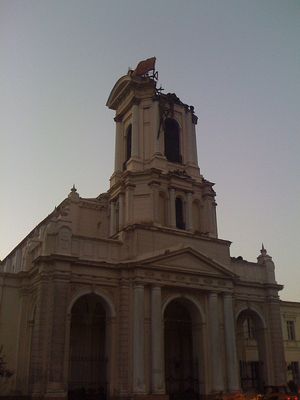
Photo of damage to Nuestra Señora de la Divina Providencia Church in Santiago. Taken by Julio Costa Zambelli and used under a Creative Commons license.
Near the epicenter, Robinson Esparza of the citizen newspaper El aMaule [es], part of the Diarios Ciudadanos [es] network has been updating a post with the latest regional and national news [es]. Many comments have been worrying about family members in areas outside the capital, and this lack of communication has continued to be an issue for relatives trying to contact family and friends in places where electricity and phone lines have been affected. Ign. Rodríguez de R. (@micronauta) writes about this frustration:
tratando horas d comunicarme con familia en Valparaíso, la red fija telefónica VTR es desastrosa, no se les debería permitir dar servicio :@
trying for hours to communicate with family in Valparaíso, the fixed telephone line of (the company) VTR is disastrous, they shouldn't let them provide service :@Those who have been posting on the Terremoto Chile blog have also created a Twitter account called Ayuda Chile [es] (Help Chile) in which information from other Twitter users who are looking for family members are collected and re-tweeted. Some Twitter users such as Pablo González Carcey have also offered to call relatives [es] for those such as Daniela Alvarado who was unable to reach her brother in Chile. He follows up:
@DaniAlvaradoA hice los llamados y tu familia esta bien! Abrazos
@DaniAlvaradoA, I made the phone call and your family is fine! HugsAfter daybreak, more images of the damage soon appearing online. Claudio Olivares went on a walking tour of Santiago to survey the damage and uploaded the photos on Owly, as did Costanza Campos, who took some photos of the damage to some of Santiago's churches.
YouTube user Franciso Vivallo Sainz took the following video of the collapse of a platform in the Bilbao Towers in Las Condes neighborhood of Santiago:
There are already tsunami warnings issued by the Pacific Tsunami Warning Center for locations bordering the Pacific Ocean.
-
Mexico: Critique of the Media Coverage of the “Narco War”
Daniel Hernandez of the blog Intersections critiques the media coverage of Mexico's “Narco War” and provides examples of some recent cases.
-
Guatemala: Into the Capital City
Kara Andrade of New Maya writes about her recent trip into Guatemala's capital city, and writes “I grew up with a fear of Guatemala City as this monolith of chaos that swallowed up people…” However, at the end of the day, she came away with a different view of the city.
-
Honduras: Supporting Local Tourism
Honduran singer-songwriter and blogger Guillermo Anderson is a big believer in how local tourism can help his country. He writes in a recent post called “There's This Little Hotel,” in his blog and re-published with permission that “to be able to create a tourism of this flavor is to believe in the essence and beauty of our country. It is about believing that all communities can benefit. It is about believing and having confidence that we in Honduras have more than enough to succeed without having to leave for foreign lands to seek out our futures.”

Photo by Jose Luis Duron and used under a Creative Commons license.
Anderson also has friends in the tourism industry in his country. However, they do not work for the large chains, but instead have worked hard to build their small businesses. Here, Anderson describes their work:
Contestan el teléfono llevan los libros y después de una llamada, manejan el Van y dejan al cuidado de la oficinita a su compañera. Salen a atender sus turistas y hablan tres idiomas, conocen de historia, cultura y a veces el nombre y propiedad de cada planta en el camino. Cargan en sus espaldas cayacs, grandes balsas inflables, equipos de Canopy, de escalar, hieleras con frutas para sus clientes y aún así logran mantener una sonrisa y amabilidad para los turistas fascinados con nuestra flora y fauna y la belleza natural que nos rodea.
They answer their own phones, do their own books, and whenever they get a call they drive the van themselves and leave their partner to watch over the business. They offer a personal and friendly service to the tourists. They speak three languages and understand the local history and culture, and they sometimes even know the names and physical properties of the plants along the way. They carry the canoes on their backs, big inflatable rafts, canopy and rock climbing equipment, ice coolers with fruit for their clients. And even with all of this, they manage to keep a smile on their face and remain good-natured for the tourists, who are fascinated by our flora and fauna and all the natural beauty that surrounds us.He adds more description about their work of building the tourism industry in Honduras:
Tengo amigas que con grandes esfuerzos han logrado convertir una casita en un colorido rincón o pueblo de mi país en los hotelitos y pensiones más acogedores del mundo. Amigos que que como magos, crean con piedras, bejucos, troncos y flores y con gran gusto y amor las decoraciones más creativas. La rueda de una carreta olvidada se convierte en una hermosa mesa para degustar el aromático café que una Sra. del pueblo sabe tostar, un viejo caracol se convierte en un tesoro y un cayuco que el mar dejó olvidado en la arena, en el macetero de flores tropicales más hermoso que ojos jamás han visto.
I have friends who have worked hard and managed to transform tiny houses in colorful corners or villages of my country into some of the most charming little hotels and hostels in the world. As if they were magicians, they've taken stones entangled with vines and torsos of trees and flowers and lovingly conjured up some of the most creative decorations. The wheel of an old cart left to rot has been turned into an elegant table on which to quietly sip and enjoy a cup of aromatic coffee roasted by a woman from the town. An old shell of a snail… an old dug out canoe that the sea left to be forgotten in the sand… an old clay pot overflowing with lush tropical flowers… All turned into unimaginable treasures that eyes have seldom seen.However, Anderson notes that the economic crisis has had a drastic effect on his friends in the tourism industry. Due to the lack of customers, many of these hotels have had to close. Yet, some of them have remained opened due to the sacrifices made by their owners. He speaks directly to Honduran readers:
Si este verano hay hondureños que a pesar de la crisis están pensando hacer turismo aunque de manera modesta, quiero que piensen en las pequeñas operaciones y en estos lugares y que además de acogedores son lugares que creen en nuestro potencial , que creen en nuestra gente , en nuestra cultura y son pequeños nidos de esperanza.
If there are Hondurans who, despite the crisis, are thinking about taking even a modest vacation this summer, I'd like them to consider the kind of places I've mentioned because, aside from their charm, they are places that believe in our potential, believe in our people and culture, and are tiny refuges of hope.Anderson summarizes about the role that Hondurans can take to ensure that places like the ones described above remain open and able to showcase the beauty of the entire country:
Nosotros debemos ser los promotores más entusiastas de nuestro país. Sirva este medio para sugerir lugares y promover ese “hotelito “que conocemos en un hermoso rinconcito de Honduras donde nos atendieron bien y comimos un plato nacional que no habíamos probado antes. Esa pequeña agencia donde un tipo amable nos llevó a conocer una hermosa caída de agua y aprendimos sobre plantas y animales o donde vimos una celebración tradicional que nos hizo apreciar mas nuestra cultura ; Visitar y apoyarlos será un gesto de amor a un país que hoy tanto lo necesita.
We should be the most enthusiastic promoters of our country. I would like for everyone to start thinking about helping spread the word about that “little hotel” that we know in a tiny corner of Honduras where were treated so well and where we ate Honduran food that we had never tasted before. Spread the word about that small tour company where a nice person took us to see a spectacular waterfall and taught us about the indigenous plants and wildlife, and where we saw a traditional festival that inspired us to better appreciate our culture. Let's visit and support these places. It would be a gesture of love toward a country that today very much needs it.Translation support by Marco Cáceres