Author: Eman AbdElRahman

  • Egypt: IslamOnline Employees Strike

    After the new Qatari administration announced that 250 employees in the widely read IslamOnline news website (IOL) would be laid off, hundreds of employees, editors, and journalists started an angry sit-in. The situation escalated rapidly when the administration threatened to call state security to break the sit-in, but employees confirmed they will continue their open strike till their demands are fulfilled.

    It is worth mentioning that this strike may be the first instance in which strikers use new media efficiently and effectively to draw all the attention needed to support their cause, from continuous Twitter updates to Live streaming.

    Nadia El Awady, an ex-journalist for IOL, was closely following the situation and posted a statement issued by IslamOnline striking employees on her blog:

    تصاعدت الأوضاع بشدة اليوم الاثنين داخل مقر موقع إسلام أون لاين في القاهرة، بعدما قامت الإدارة القطرية للموقع في الدوحة بإرسال محامين لاستلام المقر بكل ما فيه من ممتلكات وأوراق، والتحقيق مع 250 عامل كانوا قد أرسلوا بيانا للشيخ يوسف القرضاوي رئيس مجلس إدارة الموقع يتظلمون فيه من تصرفات الإدارة الجديدة لمؤسسة البلاغ القطرية المالكة للموقع.

    وقالت مصادر مطلعة داخل الموقع إن الهدف من التحقيق مع هؤلاء العاملين هو فصلهم تعسفيا وبالتالي حرمانهم من كافة حقوقهم المالية.

    The situation has miserably escalated inside IOL HQ in Cairo, after the Qatari management sent lawyers to take over the building, with all its properties and papers, and investigate with 250 employees who sent a statement to Sheikh Qaradawy, Chairman of the Board, complaining from unjust actions by the new management.

    Some sources said that the hidden reason behind investigating with these employees is to fire then, and so ban them from all their financial rights.

    Well-informed sources within the institution said that the aim of the investigation with employees is to arbitrarily dismiss them and therefore deprive them from all their financial dues.

    While Tadamon Masr mentioned [Ar] that the dispute may be because the new Qatari administration wants to move the HQ from Cairo to Doha, AbdelMoniem was skeptical [Ar] and wondered if it was all about extremists who want to silence moderate voices on websites like Islam Online.

    Zeinobia expressed a similar opinion to AbdelMoniem, saying:

    The new Qatari administration is said to be a very conservative one that believes the Website should stick to conservative religious issue and removed other sections

    On Twitter, Mohammed, another former journalist in IOL, broke the news saying:

    @MohammedY: To journos in Egypt & Arab world: Journalists @ #IslamOnline r being bullied by new management into silence against bad company practices
    @MohammedY: So when workers sign a petition stating their problems, the management puts the workers under investigation. WTF is wrong at #IslamOnline ?
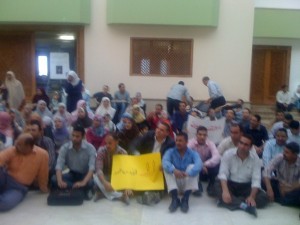
    IOL sit in

    Abdullah El Shamy and Muhammad Ghafari, who are among the strikers, were working on the live stream, continuously updating their Twitter accounts and posting pictures from the place.

    @Ghafari : For those who are concerned, Live updates on #IslamOnline employees' strike here: http://www.ustream.tv/channel/iol-on-air

    Ghafari didn't forget to mention how women were playing a vital rule in the sit-in:

    @Ghafari
    مش محتاج اقول اد ايه العنصر النسائي كان مشارك في الاعتصام والهتاف وتأليف الشعارات كمان http://bit.ly/cDXyf4 #IslamOnline #strike #women
    No need to mention how women had a vital role in the sit in, and in composing chants as well!

    Nadia El Awady was also updating through her friends on Twitter around the clock, where she mentioned:

    @NadiaE : Female employee at #Islamonline talking about staying overnight at the office in her sleeping bag to continue her strike

    @NadiaE : #islamonline employee @mos3abof calls on audience to backup website content [qatar board taking over & plans for website unclear]

    Egyptian blogger Ahmed Shokeir expressed an opinion that nearly everybody felt, commenting on how new media tools are used differently this time:

    @Shokeir
    أعتقد أن إعتصام إسلام اون لاين هو الأول الذي يتم بثه مباشر من موقع الحدث فيديو ستريم على الإنترنت – لاشك انها ستصبح وسيلة فعالة ومنشرة قريبا
    I thinkthe IslamOnline sit-in may be the first to be live streamed online. I believe it will be an effective and widely spread tool in the near future.

    It is worth mentioning that a rumor spread on Twitter that EL Qaradawi might resign, as per Mohammed:

    @MohammedY : #IslamOnline management in Qatar have been evading Al-Qaradawi's calls bec he wanted to take sides with employees (through Fathi at IOL)

    And was supported by another Tweet for Nadia:

    @NadiaE: Motaz Al-Khateeb producer of Sheikh Al-Qaradawi's Aljazeera show spoke with Sheikh's secretary who says he is still considering resignation

    Before sleeping, Ghafari concluded his updates saying they will not stop their strike unless all these demands are fulfilled:

    @Ghafari: اعتصام العاملين بإسلام اونلاين مستمر حتى الصباح لحين صدور قرار ضمانات العاملين بشكل رسمي #IslamOnline
    Employees strike will continue till the morning, till decisions are issued to grantee our rights officially.

    More pictures can be found here.

  • Midde East: Mourning the Grand Imam of Al-Azhar Mosque

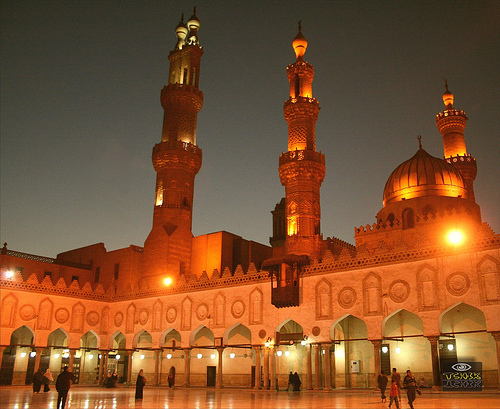
    The Al-Azhar Mosque in Cairo - by Hossam all line on Flickr

    The Al-Azhar Mosque in Cairo – by Hossam all line on Flickr

    Mohamed Sayed Tantawi, the Grand Sheikh of the Al-Azhar mosque in Cairo, Egypt has died at age 81. Reactions to his death in Middle East blogs have varied from mourning to critical recollections of his many controversial fatwas.

    Tantawi, who was regarded as one of the most important Sunni Muslim scholars, died of a heart attack during a visit to Riyadh, Saudi Arabia where he was attending a prize-giving ceremony. His son has requested for him to be buried in Saudi Arabia at ِAl-Baqi' – a holy cemetery for Muslims.

    Issandr El Amrani, an American journalist living in Cairo, who blogs at The Arabist wrote a comprehensive article saying:

    Tantawi leaves a mixed legacy behind him: overall, the immediate verdict may be that he was too liberal for conservatives, too conservative for liberals, too compliant with the regime for those who want al-Azhar to be independent, and too independent for those in the regime who needed Azharite support to enact policy changes on issues as varied as Palestine, banking and TV game shows. The overall image is of a man besieged on all sides, but adept at fighting bureaucratic battles in the bloated, clerical civil service that al-Azhar has become.

    Issandr also recalls some of the moments of outrage surrounding Tantawi, like when he shook hands with Israeli president, Shimon Peres at a UN-sponsored interfaith conference in New York, and another time when he lashed out at a girl who was wearing a niqab in a school classroom.

    In conclusion, Issandr writes:

    It is likely that Tantawi will be remembered for these controversies and his clashes with journalists — he frequently yelled at them and is said to have hit one — as well as his sometimes coarse language. He leaves behind an unreformed al-Azhar — an institution that includes a university and a school system as well as a theological center — whose credibility has hit rock-bottom. This may be because Tantawi was too pliant towards the regime, or because of the growth of various trends in contemporary Islam that reject al-Azhar's centrality. […] Whoever replaces him — perhaps Grand Mufti Ali Gomaa, another tentative modernizer — will have much work to repair al-Azhar's standing and its vitality as a place of learning. It will also have to make difficult political decisions, especially on the issue of presidential succession, at a time when clerics are beginning to voice an opinion on the prospect of a Gamal Mubarak presidency.

    Egyptian Zeinobia was among the first to mention the news on her blog :

    We have disagreed a lot with the late Sheikh yet we can't deny that from the theological point of view he made a great work.
    There is no doubt that politics harmed the late Sheikh still it does not matter because he is in the hands of God right now…

    Maysaloon, a Muslim Syrian expat studying in UK, also wrote his opinion while mourning Tantawi's death:

    I've just heard that the Sheikh of al Azhar, Mohamad Sayid al Tantawi, has passed away. I think he was a frail old man in a difficult position, and that was what made him say some of the ridiculous things he did regarding Palestine, or shaking the hand of Peres. I think that whilst the sensationalism of these mistakes has gotten a lot of attention, he should also be remembered for his work as the head of the second oldest university in the world. The oldest being al Qaraween in Fez, Morroco. The duty and responsibility of a man in his position was never going to be lightly accepted and in a time when the Arab and Islamic world's lights have never been so dim, even that such institutions exist is an achievement and defiance.

    Many other bloggers from the Middle East and North Africa region commented on the news like Banat Zayed from UAE [Ar], Al Dorah from Kuwait [Ar], Mohamed Siruhan a Muslim living in Maldives, Amal Akefy from Yemen, Abdulsalam from Syria and Mayada and Loqmet Eash [Ar] from Egypt.

    On Twitter, the news was also at the top of topics discussed in  morning.

    @Tafatefo :

    ما تركه المفسر العالم الجليل د. محمد سيد طنطاوي من علم نافع أسأل الله أن يجزيه عنه خير الجزاء وأن يغفر له
    I hope God may reward Dr. Mohammed Tantawi for all the useful Science he left behind.

    @Ayyachomsky:

    الشعب المصري شعب بيحترم الموت جدا ، أنا بحترم الشعب المصري .. صفحة على فيس بوك .. وداعا يا شيخ الأزهر http://bit.ly/bNDDJq
    The Egyptians really respect death. I respect the Egyptian people. Here is a facebook page: Goodbye Tantawi. http://bit.ly/bNDDJq

    @ahmedikhwan:

    محدش واخد باله انه لحاد دلوقت الريس منعاش الفقيد ؟ غريبة رغم ان الحاجات ده المفروض جاهزة وبتنزل علي طول
    Did anyone notice that till now the President didn't mourn him? Really weird! These kind of announcements are always ready to be published.

    @BooDy:

    أبوي زعلان على طنطاوي، الأزهر ده عامل زي المافيا يا جدعان. بينهم و بين بعض بيكرهوا طنطاوي لكن قدام الناس بيحبوه و دلوقتي زعلانين
    My father is really sad for Tantawi's death. Seems like AlAzhar is like the Mafia, they hate Tantawi secretly but love him in public, and now they are sad.

    I would like to conclude by two lines blogger Hamada, from Egypt, wrote:

    كان الدكتور طنطاوي، واحدًا من أجل علماء الأزهر وأغزرهم علمًا، لا سيما في علم التفسير.
    لكن هناك من اعتبر بعض مواقفه السياسة ليست موفقة، وأنها طغت أكثر على الجانب العملي والعلمي في حياته.
    Dr. Tantawi was one of the most important and most knowledgeable Azhar clerics, especially in interpretation of the Qur'an. But some considered his political stances were not right, and that they overwhelmed his practical and scientific sides of his life.
    Mohamed ElGohary contributed English translations to this post.
  • Egypt: How living in Egypt has changed her life

    Karishma Pais, an expat living in Egypt, wrote a nice blog post about how her experience with living in Egypt has changed her life.

  • UAE: Twenty seven million flowers

    Seabee shares his thoughts after Dubai Municipality said they planted 27n million flowering plants in Dubai last year.

  • Saudi Arabia: Why KASP is Flawed

    Saudi Jeans comments on why he thinks the King Abdullah Scholarships Program (KASP) is flawed, despite sending more than 70,000 Saudi students to many different countries around the world to continue their higher education.

  • Egypt: Recall your Corolla

    Zeinobia mentions that the Egyptian Consumer Protection Agency has obliged Toyota Egypt to recall some of its models from the market, in order to fix defects Toyota announced earlier on the company’s expense.

  • Egypt: One year on from Gaza

    Philip Rizk writes his thoughts and memories, a year after his abduction by Egyptian authorities – during his participation in the “To Gaza” march. He then covers a protest organized in Cairo in coordination with activists in Beirut, calling for an end to the construction of the Wall of Shame (as he describes it).

  • Syria: Happy fifth birthday

    Sasa celebrates her 5th year blogging in “Syria News Wire” – a fresh, independent news from the streets of Damascus and beyond.

  • Egypt: Nadia the flying fish

    Egyptian journalist and blogger, Nadia El Awady, blogs her experience with Scuba diving in Hurghada, a popular sea resort on the Western limb of the Red Sea. She also shares some of her pictures taken from under the sea.

  • Saudi Arabia: Beware of Flirtation Charges!

    Blogger American Bedu wrote about a new trend for flirtation in Saudi Arabia by sharing the PIN of Blackberry devices between boys and girls. She further mentions that the Commission to Promote Virtue and Prevent Vice (Muttawa) are now learning about Blackberry and have been given the authority to apprehend young men and women on “flirtation” charges.

  • Kuwait: One Year, 188 Questions

    Yasmine Gamal, Egyptian blogger living in Kuwait, shares her 188 questions of the day (Q.O.D) she posted on her Facebook and Twitter accounts over the past year. She initially started this idea as a way to avoid the dullness of the status update or negativity and to start a conversation between friends.

  • Egypt: Independent Single Women

    Egyptian blogger and feminist activist, Fatma Emam, celebrated this Valentine with some of her friends being “independent, mature, well educated, professional and single women.”

  • Palestine: Going to School

    Mohamed Khaled, posted pictures for Palestinian students going to schools.

  • Saudi Arabia: AIDS treatment takes step backward

    The Saudi government reported that in 2008 the number of AIDS patients in Saudi Arabia was 13,926 with 3,538 Saudis. An estimated 505 were Saudi females and 769 non-Saudi women.

    The Saudi government reported that in 2008 the number of AIDS patients in Saudi Arabia was 13,926 with 3,538 Saudis. An estimated 505 were Saudi females and 769 non-Saudi women.

    The subject of AIDS/HIV has always been a taboo in Saudi Arabia, where the debate is raging over the treatment of patients like criminals. Recently, Saudi Arabia announced its plans to shut down a volunteer clinic in Jeddah’s King Saud Hospital that is known for providing medical services, counseling and privacy to AIDS victims. Bloggers lash out at the move saying it is a step backward.

    Wafa, who attended a workshop held by a Saudi organization fighting discrimination against AIDS patients, wrote:

    I know for a fact that lots of people here still think that being an aids patients is your fault, and that you must have got it through sexual relationship. A few people know the difference between Aids and HIV. A lot of aids patients are being stained with shame and people look down on them. We really need to spread the word for a better knowledge of the disease and stop the discrimination against aids patients.

    Wafa further explained how the whole society is not welcoming to help the patients, with even the religious leaders increasing the problem due to their ignorance about the causes of the disease:

    The problem happens in the whole society. When the First and only Saudi organization for aids started its work, it was faced by ignoring from almost everyone thus it has no financial resources, society feared that acknowledging the organization is the first step to accept the existing of AIDS in Saudi Arabia, mostly because it is still believed that the cause of it is sexual relationships.
    Religious leaders also denounce the organization saying that it is working in a westerns manner by accepting illegal sexual relationships and asking for money to help with its consequence.

    Another Saudi blogger Sabria S. Jawhar, an IPhD Student in the UK, mentioned that although times have changed, but the most important rule for victims stayed the same. They have to keep the disease a secret from friends, acquaintances and even family. She then explained the new problem facing patients, in regards to shutting down the clinic in Jeddah’s King Saud Hospital:

    Now, it’s scheduled to be shut down and its AIDS patients distributed all over the Kingdom for treatment. It appears that just when Saudi Arabia achieves parity in treating AIDS sufferers with the rest of the world, as it has with its organ transplant policies and with its specialization in separating conjoined twins, it takes a step backward.

    The closure of AIDS services at King Saud threatens the privacy and consistent treatment of patients. It also increases the likelihood of spreading the disease because the trust built by King Saud doctors, nurses and support staff must be rebuilt with strangers at another medical facility. This is not an easy task.

    […]

    The transfer of patients also begs the question of what will other medical centers do with them. Will these patients be grouped with non-AIDS patients or be treated in a specialty ward? Will their privacy be protected?

    And, unlike any other society, AIDS patients need special treatment, and high level of privacy, as Sabria continued to explain:

    The emotional bond among hospital employees was strong. A trust existed between the patient and employee. Unlike many Western AIDS patients who don’t hide their illness, Saudis insist on it because it means being judged by one’s family and friends. The trust between patient and hospital employee meant their secret was safe.

    One AIDS patient said recently of King Saud Hospital: “When we go there we feel like we are treated like human beings. I know people will listen to me. But I don’t tell anyone else.”

    That secret is now at risk as these patients are shuttled to different facilities. Ensuring proper treatment and taking precautions to prevent AIDS from spreading is now at risk.

    One of the commentators on Wafa's post, Angie Nader, pitied these patients and said:

    Even there is so much talk about aids throughout the world…it still is here..we have to do whatever we can as human people to make this disease stop. And those who are suffering from eaither…we need to show them respect and let them live with dignity.

    Adding my voice to Angie, I wonder if something will be better done to help these suffering patients..

  • Saudi Arabia: A Barcamp

    Qusay announced that a new Barcamp, in Saudi Arabia, will be held at King Abdullah University of Science and Technology (KAUST) on January. The barcamp will focus on entrepreneurship.

  • Egypt: Portraits of Egyptians

    Tabsir.net published (here and here) few portraits of ordinary Egyptians, by the English artist Frederick Goodall (1822-1904), in the mid to late 19th century. Goodall's work is famous for providing a meticulous “ethnographic” view of Egypt at the time.

  • Egypt: Farewell Jean Simmons

    Egyptian famous director, Mohamed Khan, and blogger Zeinobia mourned the death of their favorite American actress Jean Simmons (1929 – January 22, 2010).

  • Egypt: Severe criticism for the human rights situation

    Alaa Kamal discusses [Ar] the upcoming Human Rights Watch (HRW) annual report, that will be published over the next days. He says that the Arab countries received the biggest share of criticism. Also, the report clearly focused on the deteriorating human rights situation in Egypt.

  • Saudi Arabia: Moving closer to child marriage ban

    Crossroads Arabia speculates that the Saudi government seems to be moving closer to a ban on marriages of women under the age of 18.

  • Jordan: Give to Haiti

    Naseem, author of The Black Iris, urges his readers or anyone who may stumble on his blog to give to Haiti if they haven’t done so already.