Author: Filip Stojanovski

  • Macedonia: If There Was No Internet

    Macedonian bloggers and other new media users offered their own responses to the question “How internet changed your life?”, posed in an article [MKD] on BBC's Macedonian language site.

    Darko Buldioski of Komunikacii.net applied a style figure reminiscent of Slavic antithesis to rephrase the question into “If I had no internet…” and posted the following answers:

    I would not have…

    • …been able to write on my blog, in which I invested much and got much in return 🙂
    • …known that BBC covers this topic, as I don't listen to radio news, I read it all online
    • …met a bunch of excellent people with whom I regularly communicate about different subjects
    • …ordered various trinkets that my brother transports for me when he comes from America (it's supposedly cheaper there)
    • …worked on what I do now, because my work is about Internet.

    Linking to the relevant South Park episode – “Over Logging” – Buldioski also invited others to share their thoughts.

    Dozens of Twitter users offered their opinions via the hashtag #danemaseinternet [MKD] or “If there was no Internet”…

    • …I would have to carry a notebook with me like [the author] Venko Andonovski to record my thoughts [- Sead93]
    • …by God I would have dealt with scientific research and as a result I would have found evidence to disprove the Theory of Relativity [- goranmitev]
    • …I would never have discovered what life on a farm is like [- lazyvlad]

    …and a number of them blamed the internet for not being in shape, lack of muscle mass or excess fatty tissue.

    Marjan Zabrcanec considers his blog Golemata slika (The Big Picture) and his Twitter and Facebook profiles his “loudspeakers” for exercising his right to the freedom of speech. He explained [MKD] that he opened his first e-mail account 15 years ago, and that without internet he would not have known “which topics and arguments are used by debaters from all over the world. Research would have been tremendously hard. Now, there's Debatopedia,” and would not have been able to effectively manage his NGO, or offer cheap but powerful internet marketing campaigns for the clients of his current employer.

    Vasilka Dimitrovska reckoned [MKD] that without Internet she would have never learned how to blog and use new media to “detect, present and protect cultural heritage,” and influence the public opinion, including appearing on TV.

    …I would have remained just one more archeologist in the sea of unknown and anemic archeologists in Macedonia without any attention from the society, and with even less respect.

    Ribaro (The Fisherman) responded via a vlog post, with audio in Macedonian and English subtitles.

    Viktor Arsovski wrote [MKD] that without Internet he probably would have continued to teach English, and not take part in the founding of IT.com.mk, and…

    • I would take our media “for granted,” and not read information from other sources.
    • I would have never known that some things in the society can improve.
    • I would not get frustrated by watching football (soccer) on [Macedonian TV] Sitel. Now by watching online streaming I know there are quality anchors who explain about the sport instead of talking nonsense. Therefore, even though it sometimes makes me nervous, at least I know that the Internet offers me a choice!

    Bloggers who posted on this subject also included Kihu Potru [MKD], who emphasized the Internet's importance in sharing art and establishing connections between artists – from visuals to haiku; Kuzmanov [MKD]; Martin [MKD]; and Dzaman [MKD].

    Finaly, some people responded through comments on blogs of others, like Oksimoron, who said [MKD]:

    If there was no internet… I would have walked around more, I would have been a better housewife, and would not look silly laughing alone in front of the monitor 🙂

    Nadezhna said [MKD]:

    – I now read more books, and they are much cheaper 🙂
    – Someone listens to my voice (reads my blog).
    – The Internet helped me to get a job.

    PRoom noted [MKD] that without Internet:

    …would not have enrolled into post-graduate studies (found over the Internet)
    – I would not have stayed awake till 5 in the morning
    – I would not have known many of my current friends
    – I would not have been able to book a hotel in Nice
    – I would not have been able to surprise my loved ones who are far away with gifts
    And for certain I would not have known that one day the Internet will die [MKD] 😉
  • Macedonia: International Women’s Day in the Blogosphere

    International Women's Day is not an official public holiday in the Republic of Macedonia, but is widely observed through interpersonal interactions and at some workplaces, through sharing of small gifts or organizing celebrations. This year, a number of bloggers used the occasion to draw attention to gender issues or for congratulatory posts aimed at women in general.

    From March 5 to 8, UNIFEM office in Skopje organized

    …the first film festival in the country dedicated to women’s rights and gender equality. Under the title ‘Women’s Rights Nights’ the four festival nights combined: screenings of documentaries developed by women directors that are portraying life stories of women and girls, and debates on related topics.

    Incited by the debate on women and tradition/religion after the screening of the film “Look at the World Through My Eyes”, gender expert Kristina Hadzi-Vasileva reflected [MKD] on her blog feministik:

    …The discussion strayed toward the issue of wearing a hijab and [whether such a choice is personal or a result of conditioning]… We seem to forget that the headscarf is just a part of the external markings of religion, and that religion is a component of tradition. Religious rules play a large role in forming lifelong habits which pass from generation to generation as “tradition.” In that context religion and tradition gain a new aspect, as they become included in the community's cultural identity. And that is the essence of the problem: how to change/better the life of women when the change involves the overly sensitive issue of identity.

    In this case, religious norms mark the cultural identity of a woman's community. The punishment for disrespect of the community can range from being branded as traitor and excommunicated, to punishment by murder. We have to ask how can a woman decide to change her position in society when the risks involve loosing her children, family, loved ones, home, money… or being mutilated or murdered.

    Women suffer pressure and control because they are charged with carrying on the identity of their community to the new generations. Women are expected to maintain the cultural identity by giving birth and basic education to the children, therefore they are under pressure to fulfill certain norms – to dress and marry in a proscribed manner, to have certain number of descendants, to eat, drink, work, move and live in a certain way – or else.

    We also have to clearly distinguish between the basic meaning of religion as spiritual need and comfort, and fundamentalism.

    Fundamentalist movements seem to have grown into the most important social movements worldwide lately. In fact these are political movements with dominant religious or ethnic imperatives. According to [British scholar] Nira Yuval-Davis these can be based on holy books or experiences related to charismatic leaders, presenting themselves as the only valid form of religion, ethnic culture, the truth. Fundamentalism can manifest as upholding traditional values or as return to the true/original sources…

    Fundamentalist constructions of social order essentially rely on control over women and the patriarchal family model. Paradoxically, some women find comfort or sense of accomplishment or empowerment by fitting into the fundamentalist movements. Even though they have the lowest status in the religious institutions, women remain their most active members, acting as guardians of the emotional and moral well-being of the family (NYD). Religion can also be a way for women to find place in the public sphere, or for self-realization of unqualified female workers.

    Fundamentalist religious and political leaders consider the ability–the right–of women to control their destiny and bodies as direct threat to their authority, and very few women would dare to act in a way that would mark them as betrayers of the holy religion and/or customs.

    If [in this context the word] religion is used as synonym for fundamentalism, and fundamentalism is politics, we have to conclude that its the politics that prolongs the oppression of women in Macedonia.

    Under this constellation of forces it would be too much to expect that every woman have to fight for her freedom on her own, as some disputants noted. Help is needed, but is it welcome?

    Hemicharot [The Chemist] quoted the Bible (Corinthians, 11) as an example of a backward tradition and ranted against the shortsighted right-wing-Christian female bloggers, ironically wishing them fulfillment of their ideological prerogatives of “many babies, personal and family success of their pillar in life [the husband], and pleasant Easter fasting during the organized parties with ancient Macedonian newly-composed music.”

    These celebrations are considered a ‘remnant of communism' but continue to be practiced in earnest by the public administration (run by political parties which declare themselves anti-communist) and some time escalate beyond providing a free meal for the female staff, into women-only excursions abroad. For instance, a weekend tour of Istanbul, as organized by a public enterprise from Skopje.

    Referring to another aspect of this phenomenon, kuzevski asked via Twitter:

    Why everybody thinks that 8th of March is the [only] day when a woman has the right to go out to a restaurant without restrictions from her partner?

    And bvelkovska replied:

    This is the way of older generations who cannot give up socialist habits. I don't know any contemporary women who celebrate the 8th of March in a restaurant 🙂

    Singing Skopjans released a cover of Yugoslav New Wave anthem [”She's waking up”] as a reminder that “8th of March is not a day for flowers, restaurants and shopping, but a day to celebrate women's rights… and to start thinking about who, how and why creates policies without taking the female factor into consideration, from anti-abortion campaigns, to campaigns to create mothers of the nation or projects to erect monuments exclusively to males.”

    On the other hand, Veles Scouts presented flowers [MKD], Psihoterapija posted a romantic song [CRO], Lepa Angelina posted a romantic movie clip, while Archeological Diary combined [MKD] a translation of a poem by Moroccan poet Kamel Zebdi [FRA] with the song “The Message” by Linda Pujol [ESP].

    Pero Nakov b.b. stressed [MKD] that the real star of nuclear fission was a woman, Idda Noddack, L'Ami du Peuple translated an essay by the Danish socialist Marie Frederiksen Women’s struggle and class struggle through four posts (1, 2, 3, 4) [MKD], Darjan Radenkovic published [MKD] a short story about family violence, and Surface Surtuk quoted David Herlihy about the not-so-ancient historical origins of patriarchy.

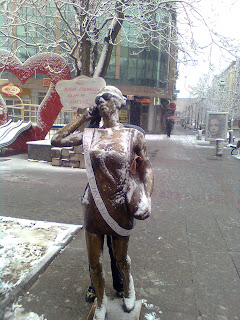
    In the meantime, the anonymous author/s of the new blog Happy 8th of March [MKD] posted photos of several street sculptures of “trendy girls” with “ideal,” Barbie-like proportions, installed by the Ministry of Culture in the center of Skopje. Someone accessorized the statues with books and labels saying “I am not a sex object,” “I got a scholarship for Harvard,” and “Nobel Prize Winner.”

    Two bloggers addressed the issue of Woman's Day from analytical perspectives.

    • Pretpriemac [The Entrepreneur] advocated [MKD] bridging the gap evident from the official workforce statistics between the level of activity between men and women, with over 30% difference.
    • Sead Dzigal, one of the authors of the media blog Komunikacii, republished [MKD] his research from 2005 on representation of gender in advertising, combining it with a video by Jean Kilbourne.
  • The Balkans: Byzantine Nostalgia

    Similar to Yugo-nostalgia, the nostalgia for the common Byzantine past can sometimes transcend some of the barriers erected through modern nationalism and racism in the Balkans.

    Mizar, a cult rock band that uses Macedonian traditional music and Orthodox Christian chant in much of their work, recently released a new single, “Konstantinopol,” featuring Harmosini Choir. YouTube user vizantijamk [= Byzantium Macedonia] created an unofficial video clip using a number of depictions of the siege and fall of Constantinople in 1453, including a modern romanticist, kitschy image of the last Greek-speaking emperor riding a horse on the battlements (minute 0:16).

    The above-mentioned image from an unattributed source is interesting in two aspects:

    Some Facebook users promoted the clip through the pages based on the Macedonian Orthodox Christian identity, such as Speak Macedonian [MKD] and Macedonia Above All [MKD], adding comments of praise for Mizar, who were the first band in former Yugoslavia to produce a rock album entirely in Macedonian language.

    Janis used the Orthodox Christian formula “may God rest their souls” to express sympathy for the defenders through a comment [MKD] on the blog Kichevo, which reprinted a 2007 post [MKD] about the fall of Byzantium. Even though the author praised modern Turkish Istanbul as a cosmopolitan tourist hot-spot, this extensive article described the event mainly from the viewpoint of the besieged Christians. The story downplayed the damage inflicted by the Crusaders, even though the siege of 1204 seems far more destructive, as shown by Balkanalysis.com:

    …With a barbarity that would have made even the wickedest sultan blush, the Crusaders looted, burned, raped and murdered their way through Constantinople, stealing both saleable riches and priceless works of art, destroying age-old monasteries, and generally going against everything that their “Christian” ideals stood for. In its severity, the Latin conquest of Constantinople was ten times worse than the Ottoman conquest of 1453.

    Of those Ancient Greek texts which are no longer extant, several were in circulation right up until 1204. Yet none of today’s “lost texts” were to survive that year. Although the terrible loss of human life is today barely an echo in our historical consciousness, we are still suffering from the cultural destruction caused by the Western sack of Constantinople. It is all but forgotten, however. While everyone recalls the rapacity of the Turks (presumable, because they were Muslim), no one remembers the violence unleashed by one Christian state on another, in a period when religion constituted the grounds for diplomatic relations.

    Amidon, recalled another old post – from 2006 – which advocated the view that Byzantium, its culture and institutions were not destroyed, but absorbed into the then-multicultural Ottoman Empire, which defined Islam as the primary state religion almost a century and a half later.

    In the post Our Misery and Constantinople [MKD], Surface Surtuk writes that he feels “appalled by this mystification of the submissive (not of the subdued!), this glorification of a battle lost 557 years ago.”

    Noting that at the time, the Ottoman value system of meritocratic feudalism was far more appealing to the Christian peoples of the Balkans than the Byzantine system of personal connections and nepotism, he explained:

    …Our [ancestors] played an important role in the conquest of the city, in several ways. The Janissaries, who first stormed the walls, were our boys. Serbian prince Lazar (or his son) took part with a squadron of brave, armored Christian knights, alongside other vassals, like the nobles from Wallachia (southern Romania). The expert Saxon miners from my native area of Osogovo undermined the city walls with explosives and dug a tunnel underneath them. Fortunately, the Byzantines also hired a Saxon from Germany who started digging from the other side, and met them half way – killing them like rats underground. A key weapon for the siege was an enormous cannon, built by a Hungarian Christian who sold it to Mehmed the Conquerer after the Byzantines declined to provide a sufficient honorarium. The city was betrayed by the Christian Venice – which refused to aid it with its fleet, because Mehmed guaranteed larger privileges – and the Genoan colony of Pera, which remained neutral and refused to oppose the Ottoman fleet. The French king preferred to expand his territories and confiscate property of slain heretics rather than to launch a new crusade to aid his fellow co-religionists.

    Our [Macedonian] contribution would have been greater, but fortunately the old Turkish vassals King Marko and Constantine Dragash had already given their lives for the Ottoman cause. Only two territories in the area resisted the Ottomans at the time: Neuberg or Novo Brdo [New Hill] fell two years after Constantinople, and in retribution the Turks killed all the leading citizens. The lands held by George Kastriot fell after his natural death in 1468, and their population was forcibly converted to Islam in retribution.

    Those who submitted and bowed to the Ottomans were not cut by the saber, nor were they assimilated into Muslim Turks, nor were they driven from their homes. They remained as they were, professing their faith and speaking their own language.

    The Saxons cleared their conscience by rising against the Ottomans during the Karposh Uprising [of 1689], resulting in their destruction as an ethnic group in Macedonia.

    This disjointed discussion continues, even though the participants do not link to each other, and maybe are not aware of the overall context.

    Libellus Antonii posted a song lamenting the end of the “Roman” empire in the Pontic Greek language, providing translation in Macedonian:

  • Macedonia: Most Popular Pop Songs on YouTube

    Igor Mihajlovski published [MKD] an interesting analysis of number of views of Macedonian pop songs on YouTube, sorting them by time periods (1945-1979, 1980-1999, 2000-2010). He included videos of the late international star Toshe Proeski, whose interpretation of folk song “Zajdi zajdi” is the ‘winner' with almost 4 million views. The results also show that duets with foreign artists definitely draw eyeballs, and point to the rise of popularity of hip hop.

  • Macedonia: Grassroots Effort to Preserve Folk Music Online

    Appreciation of folk music has been a distinguishing feature of the Macedonian culture, and thanks to selfless efforts of one dedicated blogger it spreads through the blogosphere, too.

    As part of the world heritage, traditional Macedonian music has been enjoyed and reused world over, sometimes without attribution.


    (Video: Many Hands diverse ensemble performing traditional tune from Macedonia “Jovano, Jovanke” [MKD] in Kyushu, Japan.)

    An old internet joke about ex-Yugoslav stereotypes – which has been circulating for at least 12 years – states that one of the top 10 advantages of being Macedonian is:

    4. You get to be sad and suffer while listening to folk music.

    This cultural feature extends to good times also, as the EVS volunteer Katarina Karcolova noted in her article on the youth portal Mladi!nfo:

    The young people here share many similarities with young Slovaks, but there is one significant difference, which I really like. It is the preservation of the folklore, music and dance especially. For example if there is a house party, it is common to listen to traditional music. Actually, it is not only about listening but also about singing and dancing. When I asked whether all those people are members of a folklore group because they could dance so well, they told me that they are not. Macedonian folklore is so rich that they are proud of it and want to keep it.

    The most significant recent development related to folk music and poetry in the Macedonian blogosphere is moving of the content of the Macedonian Folk Songs blog to a dedicated domain and hosting service – pesna.org (the word for “song” and “poem” in Macedonian), enabling its author Zoran Stalevski, aka GoodBytes, to add more functionalities, such as various kinds of sorting, and options for translation into English, French, and German. In addition to this, he announced [MKD] that:

    All the songs are transliterated into Latin alphabet. For instance “А бре Македонче (A bre Makedonche)” [MKD]. To access this version click on the tab “Transliterated.” This will aid at least two things: the foreigners would be able to read the text more easily, and it can facilitate access of search engines, whose users often don’t or can’t use Cyrillic.

    Audio files of the songs are no longer limited to one minute, but at popular request they are posted complete. However, in order not to violate the copyright of the performers, the downloadable mp3s are encoded to 32kbps. This is enough to hear the song or “to have it,” but no audiophile or folk music lover would be satisfied with such low quality. Therefore I assume they would buy the songs they like in the future. And if some musicians would like to share some of their rights to recorded performances, I would be happy to post the high-quality versions of the songs.

    Mr. Stalevski also stated that he intends to finance the site with his own funds till the end of his days, with some possible aid from online advertising. In an interview for It.com.mk, he confessed [MKD]:

    I started the project as my personal hobby, but also out of revolt, because the institutions paid to promote our cultural heritage still use the computers mainly to play Solitaire while waiting to punch the clock.

    By collecting the songs, I followed Gandhi’s dictum that “you have to be the change you want to see in the world.” As the collection grew, I started receiving praises, advice and direct help with the texts or audio files from visitors who like folk music. This support from people world over, including foreigners interested in Macedonian language, culture and traditional music, provided inspiration for me to continue with enriching the website. I actually do not need financial contributions, because publishing online is not very expensive. But the project can really benefit from more audio files, especially of rare songs, which are almost impossible to find via regular channels. There’s a great need to digitize the audio/video archives of the Macedonian Radio & Television, which hides an invaluable treasury, rotting in the cellars of that black hole of a “public broadcaster.” Probably some of those rare materials have been appropriated by some ethnologists or collectors – people I cannot easily reach.

    Macedonian Folk Songs uses Creative Commons Attribution-Noncommercial 3.0 License. With over 640 songs, it is probably the richest collection of its kind on the web. Archeological Diary noted that it has been used as a source for content for Wikipedia in Macedonian language.


    (Video: Oneself76 performing “Jovano, Jovanke”. His covers receive admiring comments from YouTube users from Macedonia and the diaspora.)

  • Palestine/West Bank: Peace Protesters use Avatar Movie Visuals

    Recent protest against land appropriation of the West Bank village of Bil'in included Palestinian and Israeli activists masked as Na'vi characters from the controversial Avatar movie, which they consider anti-imperialist. Video clips posted by NGO “Friends of Freedom and Justice – Bilin” show Israeli Defense Forces using tear gas and sound bombs to protect the barriers. Comments to the blog post by Susan Stark reflect diverse stereotypes held by many American readers.

  • Macedonia: Official Website of Skopje Old Bazaar

    Archaeological Diary informs [MKD] about the opening of the official website [MKD] for governmental Program for Revitalization of the Old Bazaar in Skopje, one of the most significant cultural treasures from the Ottoman period. Archeologist Vasilka Dimitrovska notes that for true revitalization, one has to work on providing content and events that would bring the visitors back into the area, because “the city's spirit consists of people also, not just architecture.” (via Ping.mk)

  • Ada Lovelace Day 2010

    Ada Lovelace Day is an international initiative striving to increase content about achievements of women in technology and science, named after the world's first programmer Augusta Ada King, Countess of Lovelace (1815-1852), Lord Byron's daughter, also famous as a character in the seminal steampunk novel The Difference Engine by Gibson & Sterling. A pledge drive is currently under way: participants take an obligation to post about geek heroines on their blogs on March 24. More info on Twitter via hashtags #AdaLovelaceDay and #ALD10.

  • Macedonia, Turkey: Connected, not Divided by History

    Chris Deliso, a travel writer and founder and director of Balkanalysis.com writes in an oped in Today's Zaman about the mutual fondness between citizens of Macedonia and Turkey, which is there despite the fact that one century ago, “Macedonia suffered tremendously during anti-Ottoman rebellions.” He sees potential for using the good will, alongside the shared cultural and archaeological heritage, in various beneficial areas, from jump-starting tourism to promoting European integration of the whole region.

  • Macedonia: Protest Against “Skopje 2014″ Plan

    Mite Kuzevski (@kuzevski) posted a video clip [MKD] and photos directly from the scene of the protest against the Skopje 2014 Plan. The protest, sparked by the unveiling of the government's “vision” for a massive rebuilding, took place on the main square of Macedonia's capital on Feb. 6.

  • Macedonia: Online Rebellion Against “Skopje 2014″ Plan

    After years of veiled announcements, media manipulation and bureaucratic dodging of requests for transparency, accountability and citizen participation, the local government of Centar Municipality [MKD] finally came out with a plan – made in coordination with the central government [MKD] – to litter the center of the Macedonian capital Skopje with a number of new monuments and buildings.

    Below is the video presentation of the government project:

    Viktor Arsovski of IT.com.mk, providing an overview of the reactions to the unveiling of the government's plan, reported [MKD]:

    Citizens use social networks, Facebook, Twitter, YouTube to comment, criticize, ridicule, and, to a smaller extent, praise the future look of Skopje in 2014. Makfax posted the video “Visualisation of the Skopje center in 2014″ yesterday, on February 4th. In just one day it attracted over 16,000 views and over 380 comments.

    Right-wing blogger Alek Careca expressed a view held by many of his ideological brethren:

    Personally, I am impressed and fascinated. Skopje will have one of the most beautiful city centres.

    However, Mr. Arsovski rightly notes that most of the reactions express disagreement for aesthetic reasons and/or due to the huge costs of the project, especially since the mayor of Centar Municipality has recently stated [MKD] that “the worst of the economic crisis is over, we have enough money for monuments,” whose total cost is estimated to be at least 17 million euro.

    Volan, a blogger with background in economics, could only note that this development is not a joke [MKD], even though it looks like one. Nenad Jovanovic quoted his grandmother [MKD], who used to say:

    Son, never underestimate the power of stupidity and kitsch.

    The portal Okno published a compilation of comments [MKD], following up on earlier articles dealing with this and the related phenomena, whose authors spoke about the burden of living in such “interesting” times [MKD] and ironically noted [MKD] that in the future Macedonia would be able to compete with Easter Island:

    Inspired tourist guides will explain to visitors from world over that this extinct civilization, in the midst of transitions and world crises, spent its meager resources on building monuments and other stoned works in order to leave traces in time that would bear witness of its defiance to the damned neighbors and other foreign clergy-fascist fiends.

    Faced with the absurd, tweets (#Skopje2014) and Facebook posts often use humor as an antidote.

    For instance, Interpreter published a lucid poem titled “Two Thousand and Fourteen” [MKD], while FlavrSavr compared the video to the Caesar IV game trailer [MKD], saying that in this version…

    …the difference is that journalists and other traitors [referring to smear tactics used by government supporters for all who express criticism] will have to play the role of gladiators.

    Twitter users also spread the statement by Ramadan Ramadani [MKD], a representative of the Muslim community, who demands inclusion of a mosque in the plan – or exclusion of the new church:

    The main square of the capital of Macedonia belongs to all the citizens and is not a field for playing [FarmVille].

    A history buff used Wikipedia to compare the “vision” to make the grand national capital through massive and costly rebuilding to similar failed ambitions from the past.

    The author of the blog Psycha… the edge of logic proposed [MKD] that the dome that the government plans to add to the Parliament building should be turned into a planetarium. Macedonia has only one such facility, built in the early 1970s and not renovated since, which suffers from neglect [MKD] due to lack of funds for maintenance.

    Members of a grassroots group who got beaten up last spring called for a spontaneous protest against the government's unresponsiveness [MKD] to the citizens' reactions. The protest is scheduled to take place this coming Saturday, at 2 PM, on the “unoccupied portion of the main square.”