Author: GenealogyBlog.com

  • More British Databases Posted at The Original Record

    The following databases have been added at The Original Record:

    1130-1770 – Bodleian Library Charters and Rolls The Original Record

    A large accumulation of documents preserved in the Bodleian Library, Oxford, formerly constituted the antiquarian collections of Anthony a Wood, Roger Dodsworth, Ralph Thoresby, Thomas Martin of Palgrave, Thomas Tanner bishop of St Asaph, Dr Richard Rawlinson, Richard Furney archdeacon of Surrey, and Richard Gough. A calendar of these was prepared by William H. Turner and published in 1878 under the title ‘Calendar of Charters and Rolls preserved in the Bodleian Library’. The word ‘charters’ is here used in a very general sense, including virtually any manuscript or copy of a manuscript, but the bulk of the contents consists of mediaeval deeds of conveyance. Turner’s calendar deals with each briefly, naming the principal parties and the nature of the deed, but hardly ever lists the witnesses. Many of these charters were undated (dating of deeds did not become standard until around 1350) or so damaged or defective (’mutilated’ is Turner’s usual description) as no longer to display a legible date. However, he contrived, from the style of the script and/or the nature of the contents, to estimate dates in such cases. He identified a few as forgeries, and these have been omitted from our indexes. The documents relate in the main to England, the Midlands, East Anglia and Yorkshire being particularly well represented, but there are some items from elsewhere in the British Isles and abroad. We have re-indexed the whole text by county and within that by decade (many of the dates in the original having been by regnal year).

    1769-1771 – Board of Stamps Apprenticeship Books: Country Collectors’ Returns
    Apprenticeship indentures and clerks’ articles were subject to a 6d or 12d per pound stamp duty: the registers of the payments usually give the master’s trade, address, and occupation, and the apprentice’s name, as well as details of the date and length of the apprenticeship. There are central registers for collections of the stamp duty in London, as well as returns from collectors in the provinces. These collectors generally received duty just from their own county, but sometimes from further afield: in 1770 a change was made to describe many of the collectors according to their county rather than their town, but no change was made to the rule that they might stamp indentures from all the surrounding area, so these labels are deceptive. The indentures themselves can date from a year or two earlier than this return. There are returns from Aylesbury, Bedfordshire, Berkshire, Brecon, Bridgwater, Bristol, Buckinghamshire, Cambridge, Cambridgeshire, Cheshire, Chester, Chichester, Colchester, Cornwall, Cowbridge, Denbigh, Derby, Derbyshire, Devizes, Devonshire, Dorsetshire, Dover, Durham, Edinburgh, Essex, Evesham, Exeter, Glamorgan(shire), Gloucester, Gloucestershire, Hampshire, Huntingdon, Kent, Lancashire, Leicester, Leicestershire, Leominster, Lewes, Lichfield, Lincoln, Lincolnshire, Liverpool, Ludlow, Lynn, Norfolk, Northampton, Northamptonshire, Norwich, Nottingham, Newcastle-under-Lyme, Newcastle-upon-Tyne, Oxford, Oxfordshire, Pembroke, Penlline, Plymouth, Reading, Salop, Scotland, Shaftesbury, Shrewsbury, Shropshire, Somersetshire, Staffordshire, Sudbury, Suffolk, Sussex, Tiverton, Wells, Westmorland, Wiltshire, Winchester, Woodbridge, Worcestershire, Yarmouth, York, and Yorkshire, each of which has been indexed separately. IR 1/57

    1771-1774- Board of Stamps Apprenticeship Books: Country Collectors’ Returns
    Apprenticeship indentures and clerks’ articles were subject to a 6d or 12d per pound stamp duty: the registers of the payments usually give the master’s trade, address, and occupation, and the apprentice’s name, as well as details of the date and length of the apprenticeship. There are central registers for collections of the stamp duty in London, as well as returns from collectors in the provinces. These collectors generally received duty just from their own county, but sometimes from further afield: in 1770 a change was made to describe many of the collectors according to their county rather than their town, but no change was made to the rule that they might stamp indentures from all the surrounding area, so these labels are deceptive. The indentures themselves can date from a year or two earlier than this return. There are returns from Abergavenny, Bedfordshire, Berkshire, Brecon, Bristol, Buckinghamshire, Cambridge, Cambridgeshire, Cheshire, Chester, Chichester, Cornwall, Cumberland, Denbigh, Denbighshire, Derbyshire, Devonshire, Dorsetshire, Durham, Essex, Glamorgan(shire), Gloucester, Gloucestershire, Hampshire, Herefordshire, Huntingdonshire, Kent, Lancashire, Leicester, Leicestershire, Lincolnshire, Liverpool, Monmouth, Norfolk, Northamptonshire, Northumberland, Nottingham, Nottinghamshire, Newcastle-upon-Tyne, Oxfordshire, Pembroke, Pembrokeshire, Plymouth, Salop, Scotland, Shropshire, Somersetshire, Staffordshire, Suffolk, Sussex, Westmorland, Wiltshire, Worcester, Worcestershire, and Yorkshire, each of which has been indexed separately. IR 1/58

    1856 – Post Office London Court Directory
    The Post Office London Directory for 1856 includes this ‘Court Directory’, listing alphabetically by surname and christian name the upper class residents of the capital with their postal addresses. ‘In order to afford space for the addresses, the abbreviation “esq.” for esquire has no longer been appended to each name in the Court Directory. It should be understood that such should be added to the name of every gentleman in the following pages to which no inconsistent addition is affixed.’ Decorations, honours &c. are generally given. Some gentlemen appear who are also listed (as professional men, &c.) in the commercial section. Those with second residences in the provinces usually have the country address given as well.

    1862-1924 – Clifton College Register
    Clifton College near Bristol was established in 1862. This edition of the Clifton College Annals and Register for the Old Cliftonian Society by F. Borwick was published in 1925. Boys are listed alphabetically by term of entry, with full names, surname first, in bold. Father’s (or widowed mother’s) name is given (surname and initials) in capitals, and address. Then there is the name of the house (N. T., North Town; S. H., School House; S. T., South Town), first and last forms, distinctions in school work and games, and month of leaving. Where known, the editor then gave a career summary with month of death; or, if still living, address as in 1925 (in italics).

    1867 – Institute of Civil Engineers Membership List
    The Institute of Civil Engineers was established by charter of George IV in 1828. The four classes of the institution were the Members, Associates, Graduates and Honorary Members. This membership list, corrected to 1 January 1867, lists members, associates and graduates alphabetically by surname and christian name, with date of election (or, for members who had previously been associates, date of election as associate (A) and date of transfer to member (M)), and address.

    1901-1905 – Queen’s South Africa Medal: Royal Horse Artillery
    The nominal roll for the Queen Victoria’s South Africa Medal – awarded (after her death, in the event) to all who had served honourably in the various campaigns in the Boer War – was compiled from these returns from the individual units. Two sets of form were completed. The main one, as in the sample scan, dates from 1901 and gives regimental number, rank, and full name (surname first), followed by a series of columns relating to different actions – Belmont, Modder River, Paardeberg, Dreifontein, Wepener, Johannesburg, Diamond Hill, Belfast, Wittebergen, Defence of Kimberley, Relief of Kimberley, Defence of Mafeking, Relief of Mafeking, Cape Colony, Orange Free State, Transvaal, Rhodesia, Talana, Elandslaagte, Tugela Heights, Defence of Ladysmith, Relief of Ladysmith, Laing’s Nek, and Natal; each entitled the man to a separate clasp to the medal, and a tick or a Yes in the appropriate column indicates the man’s actual physical presence in that battle. A final column for remarks is important in those cases where the man was no longer in the unit, by removal, death or desertion. The second form that sometimes occurs was returned in 1905, and covers men entitled to the Second South African War Medal and Clasps. It lists men by number, rank and name, checks whether they had claimed the Queen’s South Africa Medal, and then enquires as to their suitability as to three Colony Clasps, which could be awarded for service in the Cape, Orange Free, or Transvaal; whether entitled to Date Clasps (South Africa 1901 and South Africa 1902); whether also entitled to the King’s South Africa Medal; any other corps in which served in South Africa; and remarks (such as becoming non-effective, forfeiture, &c.) WO 100/39

    1926 – The Medical Directory
    This was split into several sections. The London section covered all medical practitioners resident within the London postal district; the rest of England (except Monmouthshire) was covered by the Provinces; there were separate sections for Scotland and (the whole island of) Ireland, practitioners resident abroad, and those in the armed forces (including the Indian military). Each year a schedule was sent to each doctor to be returned to the publishers, so as to keep the directory up to date. In the directory the doctor’s name is given first, in bold, surname first, in capitals; then current address. Next are the qualifications; the italic abbreviations in parentheses following the qualifications indicate the medical school at which they were gained. Then there is a list of posts and honours within the profession, starting with those then current; previous posts are preceded by the word ‘late’. Finally, brief details are given of any publications.

    1928 – Corporate Secretaries
    The Chartered Institute of Secretaries of Joint Stock Companies and other Public Bodies was founded in 1891 and incorporated by royal charter in 1902. This membership list (corrected to 2 October 1928, and printed in the annual Proceedings), arranged alphabetically by surname and initials, gives the year of being elected Associate (A.) and/or Fellow (F.), and current professional office. As of 31 August 1928 there were 2201 fellows and 3907 associates.

    1933 – Wives of Old Wellingtonians
    Wellington College, near Wokingham, was originally founded for the education of sons of military officers. A register of boys entering the school from First Term 1859 to Michaelmas 1933 was compiled by F. G. Lawrence for the Old Wellingtonian Society. In each entry the boy’s name is given in full, in bold, surname first; age at entry (usually 11 to 14); then, in brackets, the name of the dormitory or house to which he belonged, in italics, with the years of his stay; then his father’s name (usually surname and initials, but not christian name) with military decorations where appropriate. School prefects and captains are noted as such; if the boy played cricket for the school, XI with the years; academic honours, scholarships, &c.; a brief biography; and date of death, or (where known) address in 1933. Year of marriage is given, and sometimes the wife’s name and/or her father’s name. Clearly, those boys who kept contact with the school and/or had distinguished military careers have detailed entries; others disappeared into oblivion on leaving. This is the index to the maiden names of the wives, who may or may not have survived to 1933.

    1955 – Kelly’s (Gore’s) Directory of Liverpool and District
    The directory includes this alphabetical list of residents and traders, with names, addresses, and (where applicable) telephone numbers. Covering a large area around Liverpool, the directory includes Bootle, Birkenhead and Wallasey, and thus the populous areas of southwest Lancashire and of the Wirral peninsula of Cheshire.

    The Original Record now has over 9.3 million entries directly available online. They offer a free unlimited search. All records are hand-indexed (no OCR). Users my purchase sets of scans, or buy open access to the surname(s) of your choice, including variants.

    FTC Statement: GenealogyBlog has no affiliate relationship with The Original Record, and the above information is posted here because I think our readers will be interested in knowing what’s newly available at the site.
  • Registration Now Open for the 41st Annual SCGS Jamboree – June 11-13, 2010

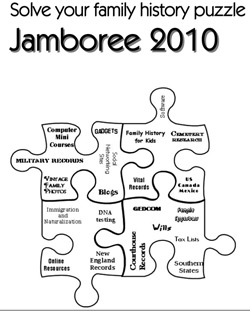
    Registration is now open for the 41st Annual SCGS Genealogy Jamboree. I’ll be there, giving 4 lectures, and exhibiting at the Family Roots Publishing Co. booth. The Jamboree promises to be a fantastic experience this year! Following is the news release from SCGS.

    It’s Time For Jamboree!! SCGS Jamboree 2010

    Registration is now open for the 41st Annual Southern California Genealogy Jamboree, which will be held Friday through Sunday, June 11-13, 2010, at the Marriott Los Angeles Burbank Airport Hotel and Convention Center in Burbank, California.

    The 2010 Jamboree follows the longstanding tradition of delivering the perfect mix of lecture sessions, exhibitors, networking and social activities. This year’s Jamboree offers nearly 130 quality classes conducted by the most knowledgeable and experienced genealogy speakers from the US, Canada and points beyond. The geographic focus for this year’s Jamboree is North America – Canada, Mexico, and all regions of the United States. DNA and technology will also receive special emphasis in 2010.

    The exhibitors represent the leading organizations and commercial companies who provide products and services to today’s genealogists and family historians, as well as local, regional, and national genealogical societies.

    WHAT’S NEW IN 2010?
    1. Thursday Evening Registration. Many of our attendees requested that they be allowed to pick up the syllabus and other registration materials on Thursday evening. We listened, and in 2010 we will have a Jamboree check-in period on Thursday evening. Thursday night’s check-in will be for pre-registered attendees only, and no walk-in registrations will be processed when the registration desk opens Friday at noon.

    2. More Seats. In response to last year’s post-conference satisfaction survey, we are expanding our seating capacity by adding a pavilion that will be situated behind the Convention Center, adjacent to the lawn. The pavilion will hold 300 seats, will be fully air conditioned, with wireless internet access. Jamboree will take over the Marriott Hotel as well as the Convention Center and hold sessions in both buildings as well as the pavilion.

    3. Mini-courses. We will be running a track of hands-on computer lab workshops throughout the weekend. About 20 people per course will bring their laptops and go through hands-on workshops on using Excel, Word, blogging software, Skype, Google Earth, etc. These mini-courses are open only to paid Jamboree registrants. A special online registration for mini-course attendees will open on May 1.

    4. Free Friday Forenoon sessions will ensure that in these economically challenging times, expense will not be a barrier to learning. Several concurrent sessions, each lasting three hours, include a Genealogy Librarian’s boot camp, a repeat of last year’s highly popular Kids’ Family History Camp, and beginner and advanced beginner genealogy sessions. Registration is required to attend the Free Forenoon Friday sessions.

    5. The “Small World” round table discussion has been expanded to three hours and moved to Friday morning. The session affords an excellent opportunity to network, to explore research tactics for specific geographic regions of the world, and to exchange tips and techniques on an informal basis. A complete list of round table discussion topics will be announced at a later date. There is no charge to attend the Small World session, but registration is required.

    6. Ancestry Scanning. Ancestry will be bringing a number of high-speed scanners and scheduling free, 15-minute scanning sessions. Ancestry has provided this service at other conferences, and we are thrilled that they will be scanning documents and photos for Jamboree attendees.

    As in years past, registration discounts are available for SCGS members and early-bird registrants (before May 1).

    For all of the details, visit our website at www.scgsgenealogy.com and click on the Jamboree brochure.

    See you at Jamboree!

  • The New 1950 Census Substitute at Ancestry.com

    One of the resources that we were informed about on January 8 when the bloggers visited Ancestry.com was the 1950 census substitute. Ancestry.com announced this last week that the resource was now posted.

    This “substitute” for the yet-to-be-released 1950 census is made up of about 2500 city directories. My first foray into the collection was made right after the Ancestry.com announcement. After a half hour or so, I was so frustrated that I moved on to more important things to be done that day. This morning, I went back and spent as hour or so searching, as well as browsing through the collection, with much more success.

    My frustration came about because I was searching for specific individuals that I thought might be found within the collection. I kept getting false hits during my searches because the given name and surname of the person I was looking for were often “close” to each other on the page, but were not on the same line, leaving me grinding my teeth.

    This morning I tried searching by surname within specific areas with a lot more luck. I also found that browsing page by page through directories for specific towns was successful.

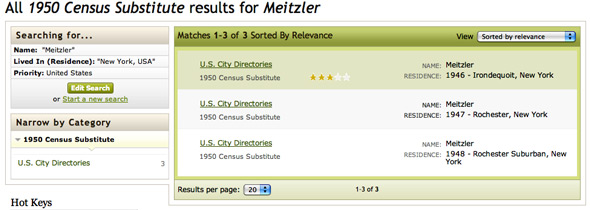
    I did a search on the surname “Meitzler” in New York State in the 1950 Census Substitute. I got three hits. The following image is of the results page.
    1950-census-sub-meitzler

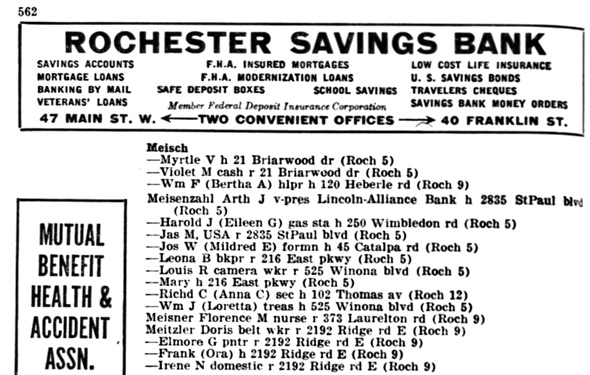
    By clicking on the Meitzler entry for 1946 Irondequoit, New York, I got a page that included my Uncle Frank Meitzler, his wife Ora, and their adult children Elmore, Doris, and Irene. Following is a screen shot of a page from Polk’s Irondequoit Directory for 1946.

    Frank & Ora Meitzler 1946 directory

    Search for your ancestors in the 1950 Census Substitute at Ancestry.com.

    FTC Statement: GenealogyBlog has affiliate agreements with Ancestry.com, although I have yet to ever get a check from Ancestry, as I don’t take the time to encode my blog in such a way that I will receive any credit if someone subscribes. Ancestry.com paid for my lunch and dinner, as well as my transportation by van from SLC to Provo, and return on Blogger’s Day, January 8, 2010. They also paid for my dinner at the annual Ancestry.com dinner January 9, 2010. I am an avid Ancestry.com supporter, not because it profits me personally, but because I believe genealogists are well-served by the company. I haven’t always felt that way, but that’s another story…

  • British Births, Marriages & Deaths at Sea Are Posted at BMDRegisters.co.uk

    The following is from the British National Archives Website:

    bmdregisters

    BMDRegisters.co.uk has added records of births, deaths and marriages of passengers at sea to its online service.

    The records give detailed information compiled from ships’ logs by the Registrar General of Shipping and Seamen and its predecessor. The registers cover 1854 to 1908 and include over 150,000 individuals. They were previously available only on microfilm at The National Archives.

    • BT 158 – Registers of Births, Deaths and Marriages of Passengers at Sea 1854-1890
    • BT 159 – Registers of Deaths at Sea of British Nationals 1875-1888. The name of this series is misleading as it includes other nationalities
    • BT 160 – Registers of Births at Sea of British Nationals 1875-1891

    It is free to search on the website but there is a charge for downloading images of original records.

    Background
    From 1874, the Registrar General of Shipping and Seamen was required to report births and deaths at sea aboard all ships registered in Britain or its colonies and on foreign-registered ships carrying passengers to or from the UK, to the Registrars General of England and Wales, Scotland and Ireland (the General Register Offices).

    There are separate volumes for England, Scotland and Ireland, corresponding to the general register office to which the details were to be reported. The registers for Scotland and Ireland contain details where the deceased was a ‘Scotch or Irish subject of Her Majesty’. The registers for England include all events not reported to the GROs for Scotland and Ireland and thus contain entries for foreign nationals as well as those for English and Welsh subjects.

    Disasters at sea
    Included in these records are 288 death records for the Royal Charter, which was traveling back from Australia in October 1859 when it became caught in a storm just miles from home off the coast of Anglesey. The ship was carrying a great number of prospectors who had gone to Australia to find their fortune, so when the ship sank on 26 October it took over 67,000 ounces of gold with it. Many inhabitants of nearby coastlines became rich overnight as the gold began to wash up on the shores.

    Also included are the casualties of the biggest marine disaster of the 19th century, the sinking of the White Star Line’s passenger ship SS Atlantic, which struck rocks off the coast of Nova Scotia on 1 April 1873. Of the 562 people who died, 508 are recorded within BT 158 and BT 159.

    Happier times
    As the majority of the ships included were passenger ships, which would travel across the world to and from America, the UK and Australia, people met, fell in love and often married onboard. Babies born at sea were often named after the ship, such as the daughter of welsh miner William Brown, born on 2 December 1883 onboard the Waroonga, who was named Elizabeth Waroonga Brown.

    Search for your British ancestors who been born, married or died at sea.

    FTC Statement: GenealogyBlog has no affiliate relationships with the the British National Archives or BMDRegisters.co.uk.

  • Heading for the Arizona Family History Expo in Mesa next week!

    Arizona Family History Expo-2010 Patty and I spent the week manning a FRPC exhibit (store?) set up in the Heritage Room at the Salt Lake Plaza Hotel. Thus the light blogging… It’s been a very busy week here. We will be here until 10 pm this evening and then tear down and prepare for the Mesa Arizona Family History Expo. Dollarhide and I are driving down on Wednesday, setting up on Thursday, exhibiting on Friday & Saturday – then driving home on Sunday. It’s gonna’ be very tiring I fear.

    A whole lot of folks are speaking at the Arizona Family History Expo this year. About 40 presenters will be giving lectures on numerous genealogical topics. Click here to learn more about the speakers. I just happen to be one of them.

    So join us in Mesa! January 23-23, 2010 – this next week.

  • Upcoming FGS Conferences – 2010, 2011 & 2012

    The Federation of Genealogical Societies has announced the dates and places for the 2010 and 2011 Annual Conferences. Last night I was given the location for the 2012 conference. I’ll add the dates when I get them. FGS Conferences are in August or September, so we know about when it will be…

  • NGS Conferences in 2011 and 2012

    Most of you know that the National Genealogical Society Conference this year will be held here in Salt Lake City (April 28-May 1). But you may not know that the conference locations for 2011 and 2012 have also been selected. They are:

    • 2011: Charleston, SC – May 11-14
    • 2012: Cincinnati, OH – May 9-12

    Mark your calendars!

  • NBC Announces That “Who Do You Think You Are?” Will Premier March 5

    At last – we have a firm date and details from NBC about the American version of “Who Do You Think You Are?” The program will be part of what NBC calls their “post-Winter Olympics primetime schedule.” Although the series was announced as upcoming in 2008 and 2009, it looks like it’s actually going to happen this time. I saw a trailer for the series when I was at Ancestry.com a few days ago – and I can tell you that the series looks fantastic! Although I’m not a fan of NBC (they seem to have a hard time getting anything right…), this time I believe they’ve backed a winner. Tell your friends – and don’t miss the premiere on March 5. MARK YOUR CALENDAR – RIGHT NOW!

    “Who Do You Think You Are?” premieres Friday, March 5 (8-9 p.m. ET) and gives viewers an up-close and personal look inside the family history of some of today’s most beloved and iconic celebrities. Among the celebrities featured are Matthew Broderick, Lisa Kudrow, Spike Lee, Sarah Jessica Parker, Susan Sarandon, Brooke Shields and Emmitt Smith. Ancestry.com is NBC’s official partner on the series. From executive producer Kudrow (”Friends,” “The Comeback”) – in conjunction with her production company Is or Isn’t Entertainment and the U.K.’s Wall to Wall productions – “Who Do You Think You Are?” is an adaptation of the hit BBC television documentary series created and executive-produced by Alex Graham.

    “Who Do You Think You Are?” is produced by Wall to Wall productions (a Shed Media Company) in association with Is or Isn’t Entertainment. Alex Graham and Lucy Carter from Wall to Wall and Lisa Kudrow, Dan Bucatinsky and Don Roos from Is or Isn’t Entertainment are the executive producers. Bryn Freedman is the co-executive producer.

    FRIDAYS: 8-9 p.m. – “WHO DO YOU THINK YOU ARE?” (premieres March 5) Don’t miss this premiere! This series looks to be an exciting series.

    Thanks to Anastasia Tyler for the heads-up about this news!

  • Call for Papers – 2010 BYU Conference on Family History & Genealogy

    The following was received from Allison Ricks, Assistant Program Administrator, BYU Conferences and Workshops.

    Call for Papers – 2010 BYU Conference on Family History and Genealogy “Tethering Tradition and Technology to Tighten Family Ties”
    Tuesday, July 27 through Friday, July 30, 2010

    Proposals are now being accepted for the 2010 BYU Conference on Family History and Genealogy, which will be held Tuesday, July 27 through Friday, July 30 at the Conference Center, BYU campus, Provo, Utah.

    Each presentation will be 60 minutes in length, which includes time for questions and answers. Each presentation should reflect the latest status of research and publication on the topic. Please do not submit more than eight proposals.

    The deadline for proposals is Monday, 1 March 2010. We welcome proposals that allow participants to gain new skills and helpful information in the following areas of family history and genealogy:

    • Getting started in family history
      o Classes specifically designed for those never having done research
      o Other beginner topics
    • Using new technologies for family research
    • Research methodology: research process, pedigree analysis, evidence evaluation, tracing immigrants, etc.
    • Beginning, intermediate, and advanced research methodology in:
      o British Isles (England, Ireland, Scotland, Wales)
      o Germany
      o Scandinavia
      o United States (regional topics)
      o Canada
      o Other world areas
    • Family organizations and collaboration
    • Family History Center support and family history consultant training

    Presentations should not only inform, but should provide step-by-step instructions to help the participants use the class materials. All syllabus materials should reflect the content of classes, both in detail and in sequence of instruction.

    Presentation style must be PowerPoint, lecture, or Internet. Conferences and Workshops will provide a laptop computer with wireless Internet connection in each classroom connected to a LCD projector. Speakers should plan to bring their PowerPoint slide show on a flash drive, CD-ROM, or DVD-ROM. Be sure to have available a backup copy of your presentation. If yours is an Internet presentation, you must have screen shot backups in case of Internet failure.

    Proposals should include:

    • Full name of presenter
    • Brief biographical sketch for the syllabus (50 words maximum)
    • Title of presentation
    • Class description used for advertising brochure and Web page (50 words maximum) – Include detailed information about the main topics to be discussed in the class
    • Audience skill level (beginner, intermediate, or advanced)
    • Medium of presentation – PowerPoint; Internet—Requires screen shot backup in case of Internet failure
    • Requested audio/visual equipment in addition to computer and LCD projector, which will already be in each room
    • Current e-mail, mailing address, telephone number(s)
    • List your previous experience presenting at conferences or workshops in the past three years, including titles of presentations

    Compensation
    Speakers participating in the Conference will receive:

    • Complimentary registration
    • Conference syllabus
    • $100 per presentation
    • a bonus of $50 per presentation if your camera-ready syllabus materials: follow the syllabus guidelines listed above; are submitted by midnight on Monday, 21 June 2010
    • Out-of-state speakers selected to present four or more presentations will also receive accommodations, $100 towards travel, and a cafeteria meal card covering the days of the conference.
    • If an in-state speaker is speaking both in the morning and in the afternoon of a specific day, lunch will be provided.

    Please e-mail presentation proposals in Microsoft Word format no later than Monday, 1 March 2010 to: [email protected]

    Initial acceptance of presentation proposals will be sent by the program committee by the end of March 2010.

  • Family Roots Publishing Company at the Salt Lake Plaza Hotel

    We’re setting up an exhibit for Family Roots Publishing Company in the Heritage Room (across from the elevators) at the Salt Lake Plaza Hotel. We plan to open up about 2 pm this afternoon and will be open tonight until 10 pm. We’ll be there from about 11 am until 10 pm Tuesday through Thursday also.

    I’ll be blogging from that location this week.

  • Blogger’s Day 2010 at Ancestry.com

    Nine bloggers spent the day at the Ancestry.com facilities on Friday. Most of those in attendance had visited Ancestry.com in January 2009. However, I didn’t because I was just getting back into blogging at that time, after having lost my blog for a few months. So the experience this year was all new to me.

    ancestrycom We met at the Little America Hotel in downtown SLC and first went to the data center, which is located in Salt Lake. Needless to say, I was impressed. There we saw row upon row of servers, all feeding data to over a million Ancestry.com members.
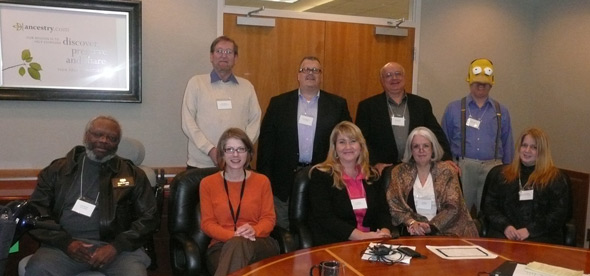
    The group then traveled to the Ancestry.com Corporate offices in Provo where we spent the day touring the facility, and attending power-point presentations, each given by by the the Ancestry.com VPs and directors.

    Ancestry.com CEO Tim Sullivan joined us for lunch, and spent an hour asking questions and looking for input from the bloggers. That evening we went to dinner at the Market Street Grill, and spent a couple more hours getting to know the Ancestry.com executives a bit better. PR Manager, Anastasia Tyler, coordinated the whole thing and made all of us feel very welcome.

    On the way to the restaurant last evening, Myrt asked me what I was most impressed with at Ancestry.com. Without hesitation, I replied that I found the Membership Services operations to be the most revealing. Prior to the visit, I imagined that Membership Services was probably where you called if you wanted to cancel your subscription or find out why your Family Tree Maker 2010 wouldn’t work on your old computer (or visa versa). Boy, oh, boy – did I have that wrong. Sure – they do those things, but they now also do little things like making a call to all new members on day 4 or 5 after someone signs up, asking what they can do to help. They have 160 employees who answer the phones, and emails, taking about 110,000 calls per month, as well as answering 40 to 50 thousand monthly emails from Ancestry.com members. Every email is to be answered within 24 hours. Many of the membership services employees are skilled genealogists, who actually have the capability of helping members with their genealogy problems. They can not only help members with getting the most out of Ancestry.com, but can help with their research. Ancestry.com currently has 1,066,000 paying subscribers, and they figure that the best way to keep those members – and get many more – is to do everything in their power to make sure that their members have success in their hobby. To have that success, content is still king, but a great membership services program is right up there alongside it. I agree.

    Ancestry.com has changed a lot – just in the last year of so. Not only is it a public company, but this emphasis on customer success and satisfaction is a marked change over the “old” Ancestry. I, like many other bloggers, have made negative comments about the company’s past seeming ineptitude when it came to doing dumb things that just ticked folks off. The management being human, I’m sure that at some point in the future, they’ll do something once again that all of us can pile onto. But, saying that, I’m willing to bet that it won’t happen often, since I firmly believe that they’re doing the right things.

    This blog is just the first of a number that I plan to make, based on my time spent at Ancestry.com, as well as my own use of the Internet site. And yes, there’s some pretty exciting stuff to blog – much dealing with new data at Ancestry.com, as well as new indexes and ways to view data… There’s a lot to tell.

    TEASERS FOR 2010…

    • The 1920 U.S. Federal Census (all 2.2 million images) will see improved & enhanced images posted online.
    • Ancestry.com will be KEYING THE FIELDS found within the 1790 through 1840 censuses (all 91,000 images). Previously only the heads-of-household were keyed and indexed.
    • The Deaf, Dumb, and Defective (DDDs) U.S. Census Schedules for CA, SC, NY, IL, NJ, WA, NE, KS, MA, IA, ME, VA, and TX (all 30,000 images with 146,000 names) will be indexed and posted.
    • A 1950 Census Substitute, made up of 2500 – 1946 though 1960 City Directories will be posted.
    • and maybe most exciting of all! U.S. land ownership maps 1860-1920 (plat maps) will be posted complete with indexes for the seven million names found thereon. Over 100,000 images will be involved.

    Bloggers attending the Bloggers’ Day 2010 event were:
    Dick Eastman – Eastman’s Online Genealogy Newsletter
    Thomas MacEntee – Geneabloggers.com
    Leland K. Meitzler – GenealogyBlog.com
    The unknown blogger – The Ancestry Insider
    Craig Manson – Geneablogie.com
    Diane Haddad – The Genealogy Insider
    Lisa Cooke – Genealogy Gems Podcast
    Pat Richley-Erickson – DearMyrtle.com
    Kimberly Powell – About.com Genealogy

    Following is a group photo taken near the end of the day in Provo. The bloggers are in the same order as I’ve listed them above. Starting with Dick in the upper left hand corner (back row) and going left to right.
    Ancestry.com Bloggers Day 2010 group

    In order to keep the FCC happy, I need to state that Ancestry.com paid for the bloggers’ transportation to SLC, hotels, and our meals. They even offered to pay my airfare. However, I declined, as the flight from Bountiful to SLC would have only been about 5 miles, and I don’t believe that Salt Lake International accepts private aircraft.

  • Join NEHGS & Ancestry.com for Family History Day 2010 in Boston

    The following news release was just received from Anastasia Tyler at Ancestry.com:

    Ancestry.com and the New England Historic Genealogical Society are excited to sponsor Family History Day 2010 — Saturday, February 20, 2010, from 8 am to 4 pm. Held at Westin Copley Place, Boston, Massachusetts.

    Join us for a full day of:

    • 6 fantastic classes to help you grow your tree
    • Ancestry.com experts on hand to answer your questions
    • One-on-one consolations with NEHGS genealogists
    • Opportunity to have photos and documents scanned on professional scanners

    The cost for attendance is $30, which includes parking. Learn more or register today for Family History Day 2010 in Boston!

  • Thousands of Files Available from the Government Attic

    An interesting article was posted in the Washington Post site yesterday. The article deals with files on soldiers, celebrities, and non-celebrities alike that are easily available through the Freedom of Information Act. The info came from the GovernmentAttic.org website initially. Two major files are dealt with in the article:

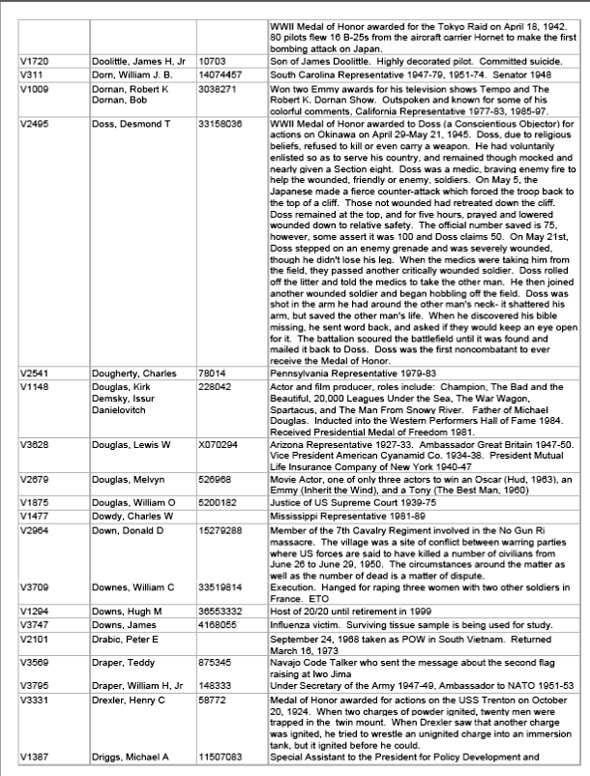
    The VIP List:The National Personnel Records Center has released a list of some 3,000 prominent former military service men and women whose service records may be obtained under the Freedom of Information Act. This list is made up of actors, singers, socialites, medal-of-honor winners, and other well-known folks. The list has about 3000 people on it.

    Following is an example of 1 of the pages (page 42 of 159). I picked the page, as it includes an entry for Desmond Doss – one of my childhood heroes of WWII.
    NPRC listing page for Desmond Doss

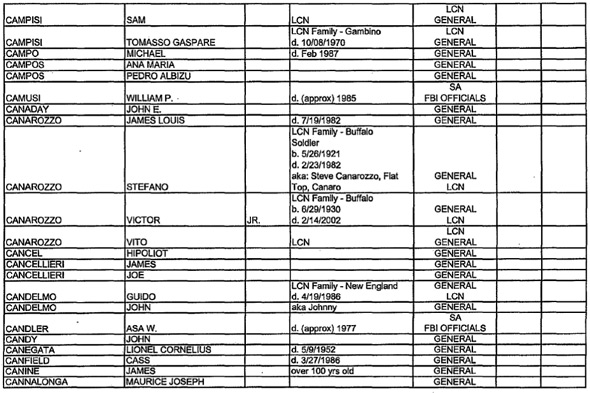
    The RIDS Dead List: This a list of the 17,000 people the FBI understands are deceased. It amounts to a list of notable or famous individuals for whom there are FBI files (usually) or cross references to FBI files. A word of warning – this listing is huge (809 pp) and takes quite a while to download – even if you have a high-speed connection. So be patient. You’ll have a black screen with seemingly nothing happening for a long time. I think it was a 5 to 10 minutes download for me, and I use Comcast cable.

    The following image is page 127 of the 809 page file. I took a screen shot of it, as it contains a line on Cass Canfield.

    FBI file Cass Canfield

    Check out the Washington Post article for more details.

  • Parental Origin Important in Genetic Studies

    According to new research, it looks like individual genetic knowledge of the mother and father are important when it comes to genetically inherited diseases. The following is from a long and rather detailed article by Justin Petrone in the January 5, 2009 edition of Genomeweb.com.

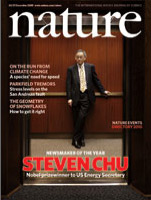
    Nature

    A recent paper published in Nature by Decode Genetics discussed the discovery of a version of a common SNP correlated with susceptibility to type 2 diabetes.

    According to the team, which also included British researchers, the impact of the T2D variant, located on chromosome 11, depends on descent: If the SNP is inherited from the father, the risk of developing type 2 diabetes increases by 30 percent, but if it is inherited maternally, the risk is 10 percent lower compared to the version of the variant that is not associated with the SNP.

    The finding highlights the importance of taking parental origin into account when conducting genome-wide association studies, and could provide an approach for doing in other studies based on Illumina microarrays, genealogical data, and statistical tools that Decode has developed, according to the firm.

    The issue of what role path-of-descent plays in interpreting GWAS findings has been discussed both in scientific literature and at recent conferences…

    While researchers are aware of the potential role parent-of-origin plays, many simply do not have access to such data for the sample sets they wish to interrogate.

    Taking parent-of-origin into account “requires significant data and know-how to do so, capabilities that most research institutions simply do not have at present,” Stefansson said. “One has to have genotypic information not only on a large number of individuals, but also, by definition, to be able to determine which genotypes were inherited through the maternal and paternal lineages. This requires either deep cohorts or the ability to impute the missing data.”

    Read the full article.

  • Google’s New “Nexus One” Phone Unveiled

    The web is all in a dither about Google’s new Android phone. The official announcement was made by Google earlier today, so the speculation is now over. I note that the news channels on television are talking up (and down) the phone also.

    The phone is made to actively compete with Apple’s iPhone – and in fact, looks a lot like it. The specs go on and on, Nexus Onebut what caught my eye was the 5 megapixel camera with GPS labeling capability. It’s also got a little roller on the bottom face of the phone, allowing the user to scroll through a web page a bit easier than the iPhone.

    It looks to me like if you really want one of these phones (like – right now), the best bet is to purchase the phone with T-mobile service. That costs $179 with a 2-year contract. The phone can also be purchased directly from Google in an “unlocked” mode for $529.00. According to Google, “The currently available Nexus One device is unlocked and will recognize SIM cards from any mobile service provider using the GSM standard, but is incompatible with the frequency band used by the AT&T and Rogers networks for 3G data… Additionally, the Nexus One is incompatible with CDMA networks such as Verizon and Sprint.” Phones using Verizon and Vodofone service (in Europe) will be available in the spring. So, it seems that service options are currently lousy -an issue that’s plagued Apple’s iPhone since the beginning (unless you really want AT&T service).

    App storage has been an issue for all currently produced Android phones. The addition of a 4GB Micro SD Card (Expandable to 32 GB), along with a promised software upgrade, should make that issue go away. Apps are important to users, including genealogists. Genealogy apps for Android phones are currently pretty limited. I know of only FamilyBee at the moment. If readers know of more, I’d appreciate a heads-up in the comments section below. iPhone has a huge head-start in the apps area, so we will be keeping a close watch on how the competition works out.

    The following specs are from Google’s Nexus One page:

    Size and weight
    Height -119mm
    Width – 59.8mm
    Depth – 11.5mm
    Weight – 130 grams w/battery; 100g w/o battery

    Display – 3.7-inch (diagonal) widescreen WVGA AMOLED touchscreen; 800 x 480 pixels; 100,000:1 typical contrast ratio; 1ms typical response rate

    Camera & Flash – 5 megapixels; Autofocus from 6cm to infinity; 2X digital zoom; LED flash; User can include location of photos from phone’s AGPS receiver; Video captured at 720×480 pixels at 20 frames per second or higher, depending on lighting conditions

    Cellular & Wireless– UMTS Band 1/4/8 (2100/AWS/900); HSDPA 7.2Mbps; HSUPA 2Mbps; GSM/EDGE (850, 900, 1800, 1900 MHz); Wi-Fi (802.11b/g/n); Bluetooth 2.1 + EDR; A2DP stereo Bluetooth

    Power and battery – Removable 1400 mAH battery; Charges at 480mA from USB, at 980mA from supplied charger
    Talk time – Up to 10 hours on 2G; Up to 7 hours on 3G
    Standby time – Up to 290 hours on 2G Up to 250 hours on 3G
    Internet use – Up to 5 hours on 3G; Up to 6.5 hours on Wi-Fi
    Video playback – Up to 7 hours
    Audio playback – Up to 20 hours

    Processor – Qualcomm QSD 8250 1 GHz

    Operating system– Android Mobile Technology Platform 2.1 (Eclair)

    Capacity – 512MB Flash; 512MB RAM; 4GB Micro SD Card (Expandable to 32 GB)

    Location – Assisted global positioning system (AGPS) receiver; Cell tower and Wi-Fi positioning; Digital compass; Accelerometer.

    Whether the Nexus One phone will be successful in it’s challenge to Apple is yet to be seen. They have a long way to go, but with Google’s money, and a dedication to advanced technology, they just might be a decent competitor…

  • Tributes Posts Their “2009 Year in Review”

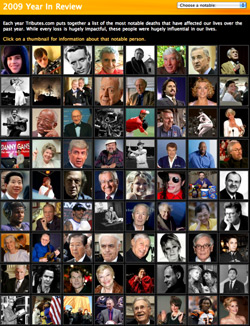
    Tributes.com has just posted their 2009 Year in Review, Known for their Celebrity obituaries, as well as those for the Tributes 2009 Year in Reviewlesser-known folks, Tributes does a great job of reminding us of those who’ve passed on.

    In looking through the many prominent people who died during 2009, I note that many of these folks were my contemporaries, if not my “heroes” at some point in my life.

    Yes… Life is a fleeting thing.

    Check out Tributes’ 2009 Year in Review.

  • Early Oregonians Database Now Available

    The following news release is directly from the Oregon State Archives website.

    As a legacy to the sesquicentennial of Oregon’s statehood, the Oregon State Archives presents the Early Oregonians Database. The information that can be found in the database is from census, death, probate, and other records to help researchers find relevant information and documents about people who lived in Oregon prior to statehood.

    Archives staff and volunteers began collecting information for this project from the 1850 and 1860 federal censuses for Oregon, in 2004. Volunteers and student interns reviewed the extracted information and combined entries that appeared on both censuses. As later census information became available online, staff searched for individuals who met the Early Oregonian criteria and added additional information and individuals. Various records from the Oregon State Archives such as probate records, death certificates and marriage records were also searched to identify individuals who appeared to meet the criteria. Additional information in the profiles was derived from numerous sources including secondary sources and publications. Family tree data from various websites is also noted.

    Currently there are over 105,500 entries representing these ‘Early Oregonians.’ Because of limits on available records and documentation, the project can only realistically be defined to include people living in Oregon from 1800 to 1860, despite the fact that large populations of Native Americans lived in the Oregon Country prior to 1840. Documentation of our earliest Natives is scant and not readily available. It wasn’t until the first federal decennial census in 1860, that any Native Americans were identified. However, instructions to the census enumerators limited how Natives were to be counted:

    “Indians not taxed are not to be enumerated. The families of Indians who have renounced tribal rule, and who under state or territory laws exercise the rights of citizens, are to be enumerated.”

    The first use of the term “Indian” doesn’t appear until the 1870 census when it became a choice in the column heading for “color.” Neither the 1850 or 1860 census for Oregon included significant numbers of Native Americans. In compiling profiles for this project, staff encountered many mixed race individuals identified as “mulatto.” In most instances these designations were changed to “Indian” unless evidence clearly indicates the individual was of mixed African American descent. Another designation that appears with some frequency is “HB” apparently indicating “half-breed.” There are many inconsistencies in the censuses over time for individuals of mixed Native American descent. Staff relied on the preponderance of evidence to determine race in these cases.

    Project volunteers are beginning to work on the Indian censuses compiled for the various reservations between 1885 and 1940 with the goal of incorporating more information and individuals in the project over time. Published Catholic Church records were used in the project and provide some of the information on Native Americans included in the database. This often included what appeared to be tribal designations, which are included when appropriate and consistent with the available evidence. Standardized names for these tribal designations were used whenever possible, because tribal names were not reported or spelled consistently.

    Volunteers and student interns have done the bulk of the data entry and research for this project. We especially want to recognize the volunteers who have spent more than five years working on this effort. They are Margaret Hoffman, Harriett Miller, Mimi Stang, Daraleen Wade and Betty Winn. Archives Manager Layne Sawyer oversaw this project from concept to publication on the Web. Other members of the Archives staff making significant contributions include Linda Bjornstad, Rhonda Lester and Austin Schulz. Archivist Andrew Needham helped to develop and implement the database on the Web. Archivists Todd Shaffer, Dave Wendell and Gary Halvorson also contributed to the project.

    Because this is a living database, in that it is our goal to add and refine information on individuals as it becomes available, we welcome you to contact us at [email protected] if you have documentation that you would like to make available to us.

    Go to the Early Oregonians Database.

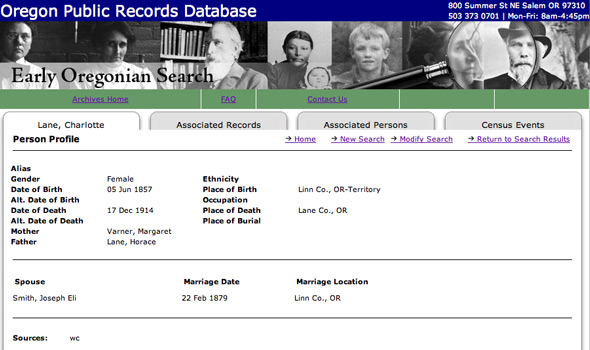
    I did a search on the Lane surname. I got many hits. Clicking on one for Charlotte Lane, I got the following screen. Click on the screen shot to go to the site – and then click on the tabs along the top. Pretty cool info…

    Early Oregonian search for Charlotte Lane

    Search the Early Oregonians Database.

  • British National Archives Backs Sale of Friends Reunited to Brightsolid – to Give Ancestry Some Competition

    It seems that the staid British National Archives is coming forward in support of the sale of Friends Reunited to Brightsolid. The sale has been somewhat in doubt, as the “Competition Commission” has expressed reluctance to allowing the sale to go through. It’s looks like the principle reason for the support is that the Archives would like to make sure that Ancestry.co.uk has competition. Following is an excerpt from an article in the January 4, 2010 edition of the Financial Times.

    Friends Reunited

    The takeover of Friends Reunited, currently facing regulatory scrutiny, has found support from an unlikely quarter – the National Archives.

    The government’s official archive rarely, if ever, intervenes in competition inquiries but it has backed the proposed sale of the social networking site operator – and its valuable genealogy subsidiary, Genes Reunited – to create a bigger rival to a larger American competitor. ITV has agreed to sell Friends Reunited to Brightsolid, a web company owned by DC Thomson, the Scottish publisher.

    The National Archives said in a submission to the Competition Commission’s investigation into the deal that a combination of Genes Reunited with Brightsolid’s Find My Past site would create “more robust and serious competition” to Ancestry.com, the US-based market leader.

    If the merger were blocked, “there is unlikely to be a realistic alternative bid from any existing genealogy company”.

    “The reduction in the number of players would weaken the competitive scene, leaving consumers with less choice of product and pricing,” it said.

    The National Archives said blocking the merger would also result in consumers having less choice in family history data and documents, and the rate of market innovation would slow.

    Read the full article.

  • Arizona Family History Expo Less Than 3 Weeks Way!

    It’s less than three weeks until the Arizona Family History Expo! It will be held on January 22 and 23 at the Mesa Convention Arizona Family History Expo 2010Center, 263 N. Center Street, Mesa, Arizona 85201.

    Ancestry.com’s C.E.O. Tim Sullivan will be the keynote speaker.

    I will be presenting several lectures. My topics will be:

    • State and Territorial Censuses & Substitutes – Additional Name Lists for U.S. Genealogical Research
    • Organizing, Preserving, Accessing and Sharing Your Digital Documents & Pictures
    • The Witness

    See the schedule for times and other lectures that are being presented.

    Click here for more information.

  • State Historical Society of Missouri Cuts Hours

    Due to a 25 percent withholding in its fiscal year 2010 state appropriation, the State Historical Society of Missouri has decreased its hours open to the public to Mondays through Thursdays, 8 a.m. to 4:45 p.m.

    To continue operations and implement the withholding, the society’s 22 staff members have voluntarily taken a 20 percent pay reduction, and three staff positions have been eliminated. These positions included one unfilled position left temporarily vacant, one retirement and one layoff.

    The society will seek private funds to continue its newspaper microfilming program and to print the Missouri Historical Review.

    Read the full article in the December 30, 2009 edition of BuffaloReflex.com.

    For more info., see the notice posted at the society website.