Author: Geoffrey K. Pullum

  • Snowclonegate

    David Marsh, in the regular language column at The Guardian, writes about the increasing frequency of -gate derivatives in recent journalism, and cites Language Log:

    All these gates are examples of a snowclone, a type of cliched phrase defined by the linguist Geoffrey Pullum as “a multi-use, customisable, instantly recognisable, timeworn, quoted or misquoted phrase or sentence that can be used in an entirely open array of different variants”. Examples of a typical snowclone are: grey is the new black, comedy is the new rock’n’roll, Barnsley is the new Naples, and so on.

    Xgate as a snowclone? Not quite. I see the conceptual similarity, but the very words he quotes show that I originally defined the concept (in this post) as a phrase or sentence template. The Xgate frame is a lexical word-formation analog of it, an extension of the concept from syntax into derivational morphology.

    I was looking at things like In space, no one can hear you X“, where the customizability is that you get to choose the verb X, but the laziness is that you don’t have to do anything else, and just about everyone will know you are alluding to the poster slogan for Alien. The concept was named later by someone else, Glen Whitman, who chose “snowclone” because of the practice of cloning variants of my original example, a rather complex and ill-defined one: If the Eskimos have N words for snow, X have {even more / just as many / a similar number} for Y. (Eskimo-snow snowclones are still alive and well, and are being produced by lazy and unimaginative writers everywhere, just about every day; see the recent ridiculous remark that Arnold Zwicky spotted about North Koreans having many words for “prison”.)

    Steve Jones, as usual, sets David Marsh right on this point in his comment below the article.

    The -gate suffix certainly is being heavily used; and it is an interesting point that it is not us (the “normal people” of whom Marsh speaks) who are using it; it is journalists, and almost only them. The etymology is by a process called metanalysis, rather like when helicopter was mistakenly taken to be a combination of heli- with copter (it’s really from helico- “like a helix” plus pter “wing”), and new derivatives like heliport were made with the wrongly analysed bits.

    What does -gate contribute to the meaning of a derived word? Xgate is a custom-made proper noun denoting the recent newsworthy scandal or brouhaha involving X. One of the latest in the UK, Irisgate, concerns a female politician with the unbelievably evocative name Mrs. Robinson who had an affair with a young man a full four decades younger than her (koo-kook-a-joo!) — and then (why can’t they just have good clean sex, these politicians, instead of bringing corruption into it?) did some backroom work to help him get financing for his business. Robinsongate would have done fine, but her first name is Iris, and Irisgate is shorter.

    Brevity, scandal, and quick-fix ways of writing stuff without actually having to think out new descriptive vocabulary or construct new phrases and sentences; that’s what keeps Britain the newspaper capital of the planet. Most mornings at the Indian shop by the bus stop on Dundas Street in Edinburgh I see no less than twelve different newspapers on the rack with twelve different front page headline stories. One will have a new scandal about apparently corrupt uses of politicians’ expenses payments (expensegate) while another uncovers a scandal about the false intelligence support that permitted the last prime minister to take the UK into a foreign war (Iraqgate) while a third finds out that the married captain of the England soccer team, John Terry, seduced the girlfriend of one of his own players, Wayne Bridge, in Bridge’s own house. Yes, the word Terrygate has been coined already.

    There was an additional twist to Terrygate, having to do with Britain’s astonishing willingness to trammel free speech and gag the press. The story was nosed out by The News of the World, but Terry obtained a court order, known as a super-injunction, that not only forbade the paper from printing its story, but also forbade all newspapers from reporting that such an injunction existed!

    I imagine that American readers of Language Log will be quite surprised at the UK’s legislative and judicial arrangements for regulating linguistic expression, which seem more North Korean than European sometimes (though we have fewer words for prison, of course).

    Injunctiongate did all come unglued, though: an appeal led to the lifting of the super-injunction, and all the newspapers were suddenly allowed to print everything about the (now much juicier) story, which ruined the News of the World‘s scoop. Now the Terrygate issue is all about whether the manager of the England team (hilariously, an Italian, Fabio Capello — you can’t make this stuff up) should fire John Terry from his job. If he does, the same papers that have gloried in Terry’s vile sexual treachery (“love rat” is the term the tabloids like) will doubtless make new shock-horror-scandal-probe stories about this Italian sacking England’s captain and endangering England’s chances in some tournament or other. If England loses the next game, the scandal will probably morph into Capellogate.

    But I seem to have wandered a little from my original topic of English lexical word formation. Sorry about that.
  • The Health Nazi

    The BBC, perennially careless on language issues, incorrectly states here that radio talk show host Jon Gaunt was disciplined by Ofcom (the UK communications regulation authority) for calling a local councillor a Nazi. The error is repeated by The Times here, and by The Independent‘s headline here (and there may be many more). They misreport Gaunt’s alleged offense. As the BBC article reports further down the page:

    The pair had been debating Redbridge Council’s decision to ban smokers from fostering children when Mr Gaunt called Mr Stark a “health Nazi” and an “ignorant pig”.

    I don’t know the extent to which “ignorant pig” was the issue, but I do want to point out that “Nazi” is not to be equated with “health Nazi”. It evokes the bad-tempered and bossy lunch counter boss in Seinfeld — the one that they referred to with awe, when out of earshot of the awful man, as “the Soup Nazi”.

    Calling someone a health Nazi strikes me as a semi-jocular (if rather abusive) way of accusing him of foisting his health ideas on others in an authoritarian way. Gaunt wasn’t saying that the councillor was a card-holding National Socialist.

    Gaunt was fired from his job for the remark, even though he apologized for it later, and that is bad enough (he is now trying to take Ofcom to a court of appeals after it upheld the complaints against him). The UK has nothing like the protections for free speech that the USA has; in the communications industry especially, you can lose your livelihood for an epithet. But things are made even worse when jocular phrases like “soup Nazi” are confused in media headlines with serious allegations like being a Nazi which are arguably actionable defamation.

    The Seinfeld characters were tagging the Soup Nazi in the sort of way an insulting cartoon would do. They weren’t making a defamatory claim about his political affiliations. If we lose track of a distinction like that, the appallingly draconian and restrictive the communications regulations and defamation laws in Britain will be even more dangerous than they are right now.

    [Actually, there’s bit more to it, because as Ian Preston reveals in a comment below for which I thank him, Gaunt also used the word Nazi without its modifier before he went on to use the phrase health Nazi immediately afterward. But he claims that was just a slip, and health Nazi was what he meant throughout. —GKP]

  • Spectacular multiple adjunct fronting from Woody Allen

    Carl Voss wrote to me about this sentence in a recent humor piece by Woody Allen in The New Yorker called “Udder Madness (I had already noticed the same sentence when reading the piece):

    That’s why when included in last week’s A-list was a writer-director in cinema with a long list of credits although I was unfamiliar with the titles I anticipated a particularly scintillating Labor Day.

    It is a remarkable piece of sentence construction. Here’s what’s going on.

    That’s is a contracted form of that is, and inside the complement of is we find a fused (“headless”) relative clause beginning with a fronted why. Inside the clause thus introduced there is a preposed adjunct beginning with a preposed when.

    Inside the clause that when introduces there is another fronted adjunct, with an structure found mostly in main clauses: it begins with a preposed passive clause included in last week’s A-list, continues with the verb was, and ends with the subject.

    But the subject has two post-head adjuncts, the second of them a very complicated one. The head noun is writer-director; the first adjunct following it is the preposition phrase (or PP) in cinema; and the complicated second adjunct is another PP, with a long list of credits. After that comes a concessive PP, although I was unfamiliar with the titles, which I think (having modified my view since I first posted this) has to be understood as modifying the main clause, which now at last we arrive at.

    At the point where we begin the main clause, we have parsed no less than four preposed adjuncts (why, when…, included…, although…), and now finally we get I anticipated a particularly scintillating Labor Day. That is the main clause.

    If we put each of the constituents I have mentioned in square brackets, we get (I think, after several revisions) this:

    That’s[why [when [[included in last week’s A-list] was [a writer-director [in cinema] [with a long list of credits]]]] [[although I was unfamiliar with the titles] [I anticipated a particularly scintillating Labor Day]]].

    It’s perfectly grammatical, I think; but it’s certainly a bit challenging, especially with the startling choice of punctuation: none, no commas at all after any of the preposed constitutents. It makes your pulse race a bit (if you’re a syntactically sensitive soul) when you encounter three preposed elements in a row, and then a verb that precedes its subject, and then another preposed element: ([why [when [[included in last week’s A-list] wasalthough…). It’s like you’ve opened four successive boxes within boxes within boxes and there still isn’t any sign of the gift.

    [Many thanks to those who wrote comments telling me I was wrong about where the concessive adjunct fits. I decided you were right, it belongs with the main clause, and I thought this page would be less confusing if I revised the post and removed the now uninterpretable comments that had convinced me to. —GKP]

  • Language Log asks you (don’t all shout at once)

    What do support poles, staff positions, battery terminals, army encampments, blog articles, earring stems, trading stations, and snail mail have in common with billboard advertising, accounts recording, making bail, and assigning diplomats?

    Now don’t let’s have everybody shouting at once. Form an orderly line and enter your answers below. Reload in a different window before submitting to make sure somebody didn’t just give the answer you were going to give.

    [Later]
    OK; it took 9 minutes before the first reader (Euphorbus, below) gave the correct answer: they are all senses of the word post. I have deleted most of the comments below (they said “Post”, “Post”, etc., and this became boring after a while — though a few had interesting extra remarks, and I left those). I will now tell you why I posted this post about post.

    I really don’t do lexical semantics, but I am often struck by the astonishing degree of polysemy in English: words that have multiple meanings, sometimes recognizably if distantly related, but sometimes apparently a thousand miles away from each other conceptually.

    Spectre-7 below had the right observation, exactly what was in my mind (I’m so proud of you readers; you are so smart):

    But how can that be? If post can mean all of those things, readers will get hopelessly confused! One word for one meaning! Prescriptivist rage!

    Yesss! Exactly the point. Prescriptivists get so concerned, so red-faced furious about the idea that a word might develop a new meaning or function, and thus have two of them. Think of the stupid kerfuffle in the 1970s about hopefully as a modal adjunct, for example: the sky was supposed to be falling because in better to travel hopefully the adverb means “with a heart full of hope” but in Hopefully they’ll win the same adverb means “it is to be hoped”. (Look in recent editions of Strunk & White; the paragraph about hopefully as a modal adjunct there is a flailing, incoherent, repetitive sequence of howls of rage.)

    And now look at what’s happened to post without anybody objecting or even noticing. Noun uses and verb uses, and more meanings for both than you can shake a stick at (I didn’t even list them all; I wasn’t aware about the horseriding senses, so I didn’t bother to copy them out of the dictionary). It is not just ambiguous; it is outrageously, promiscuously polysemous. Fence posts, army posts, the New York Post, blog posts, ambassadorial posts, post offices… And yet the sky does not fall.

    Human languages do not strive to avoid ambiguity. They do not try to align words with meanings one to one. They are not in danger of anarchy when a new word sense evolves. People don’t just tolerate languages with multiply polysemous words, they seem to love them; people thrive on multiplicity of meaning. There are thousands of examples that show this. It is only the prescriptivist thickheads who cannot see what it means.

    Yes, thickheads. I know they won’t like being called that; but hey, what do I care? I’ve shut off the comments area to new contributions now, so they can’t log in and accuse me of being a leftist softy with no intellectual standards failing to stand up and fight against the decay of the golden tongue of Shakespeare etc. etc. blah blah blah. Let them squirm and rage and fume, with the smoke coming out of their ears. I don’t care. They’re just wrong.

    I like a good distinction in senses as much as the next man, and I don’t care for ignorant word choice errors at all; but I don’t get in a stew about it when new senses finally catch on or take over. It’s the way languages are, and the way they’re going to be. You have to deal with it.

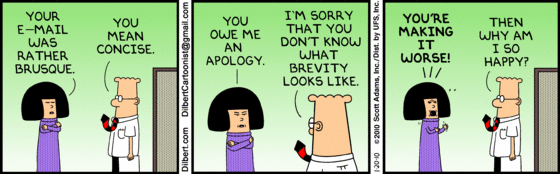
  • Dilbert fails to apologise

    Dilbert fails to grasp the distinction between brevity (a syntactic property of a locutionary act) and brusqueness (a pragmatic property relating to a perlocutionary effect), and fails to draw the distinction between sorry with clause complement and the same word employed in a speech act of apology (see here and here and here and here and other places); and more office discord results…