Author: Georgia Popplewell

  • Announcing the Global Voices Citizen Media Summit 2010

    We're delighted to announce the Global Voices Citizen Media Summit 2010! Our gathering takes place this year in Santiago, Chile on May 6-7, 2010.

    Visit the Summit web site for background information on the goals of the meeting, the program of events, registration details and information about the vibrant city of Santiago. Among the highlights of the proceedings will be the announcement of the winners of the Breaking Borders award, a new prize created by Google and Global Voices to honor outstanding web projects initiated by individuals or groups demonstrating courage, energy and resourcefulness in using the Internet to promote freedom of expression.

    Over the next few days and weeks we'll be fleshing out the program, adding speaker bios, a list of attendees and more — and do keep checking in at the site for blog posts and commentary from Summit participants and others, as well as to join in the conversation.

    You can also help spread the word about the Global Voices Summit by flying one of our Summit badges or banners on your blog or web site.

    The Global Voices Citizen Media Summit 2010 has been made possible thanks to the generous support of the MacArthur Foundation, GoogleOpen Society Institute, Knight Foundation and Yahoo!.

    Current major sponsors include MacArthur Foundation, Google, Open Society Institute, Knight Foundation and Yahoo!
  • Global Voices in Haiti: The Grand Rue Artists, After the Earthquake

    Global Voices has sent a two-person team to Port-au-Prince in the wake of the Haiti earthquake, to help support citizen media activity. Georgia Popplewell and Alice Backer are also contributing firsthand reporting to our coverage of recovery efforts. Find out more about their assignment here.

    PORT-AU-PRINCE, HAITI, 29 January, 2010

    Grand Rue in Port-au-Prince, Haiti, is one of the city's most disadvantaged neighbourhoods, but also home to a vibrant community of artists who create works of art out of the discarded materials they find in their environment. The area was host to the first Ghetto Biennale in December 2009.

    This video highlights the impact of the January 12 earthquake on the artists' surroundings and their way of life. (A version with English subtitles is available at dotSUB.) It features an interview with Belle Williams, spokesperson for Ti Moun Rezistans, an arts programme for children of the Grand Rue area.

    To offer direct support to the artists of Grand Rue, please donate to the Foundry Haiti Fund.

    •••

    Alice Backer has posted a video interview with Siméon Evans, another member of the Grand Rue creative community, in which he talks about a mural created for the 2009 Ghetto Biennale by British artist Bill Drummond. “Evans believes Bill Drummond's mural foresaw the earthquake. The mural contains the words ‘Imagine si demen pa gen mizik'. ('Imagine there is no music tomorrow'.)”

    A number of international artists and journalists have posted texts, photographs, and video recording the Ghetto Biennale online. Photographer Emily Troutman shared video footage of a musical procession in the Grand Rue at YouTube. There are photosets posted at Flickr by PRI's The World and John T. Unger. Brooklyn-based writer Richard Fleming posted several reports at his blog, and wrote a piece for the Miami Herald. Artist Tracey Moberly's account of the Biennale appears at Dazed Digital.

    A version of this report was originally posted at Caribbean Free Radio.

    Global Voices' work in Haiti is supported by our general support donors and by a humanitarian information grant from Internews. Please visit the Global Voices Haiti Earthquake page for more coverage.

    Nicholas Laughlin contributed to this post.
  • Global Voices in Haiti: On Reconstruction

    Global Voices has sent a two-person team to Port-au-Prince in the wake of the Haiti earthquake, to help support citizen media activity. Georgia Popplewell and Alice Backer are also contributing firsthand reporting to our coverage of recovery efforts. Find out more about their assignment here.

    PORT-AU-PRINCE, HAITI, 30 January, 2010

    Having spent the last year doing a house renovation, and one that’s involved a fair amount of demolition, I’m naturally intrigued by the conversations around the rebuilding of Haiti post-earthquake. We heard yesterday that they’ve begun to tear down the damaged buildings in Port-au-Prince, even though an official demolition plan is yet to be announced. We’ve seen a fair amount of salvaging, do-it-yourself rubble-removal, and a backhoe or two on our trips around town: those who can and those who can afford to, such as private enterprises like Sogebank, are forging ahead with the cleanup process.

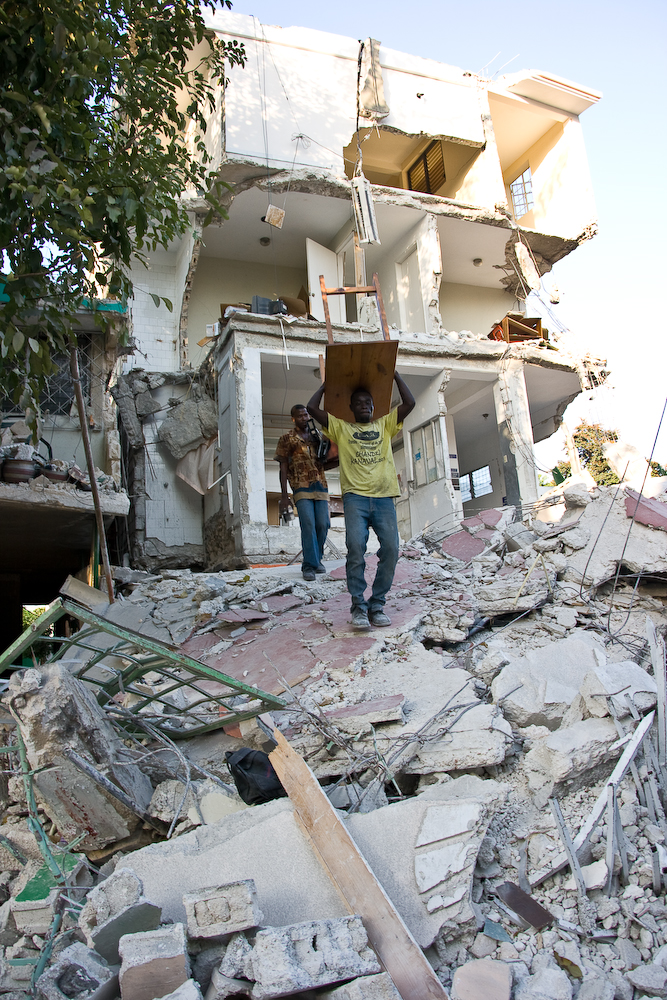
    Men salvage furniture from an earthquake-damaged house in Port-au-Prince

    Men salvage furniture from an earthquake-damaged house in Port-au-Prince. Photo by Georgia Popplewell, posted at Flickr under a Creative Commons license

    Jacqueline Charles writes in the Miami Herald that “government estimates that 25,000 government offices and businesses either toppled or need to be demolished. In addition, there are 225,000 residences that are no longer habitable. In all, some 2.1 billion cubic feet of concrete and rubble need to be hauled out of the city.” The article says that the United Nations Development Programme has hired 12,000 people to clean up debris and hope to have 50,000 clearing roads by next week. I'm assuming this information has come via the daily briefings the UN has been holding for journalists at their headquarters. A development agency contact who's been attending the briefings tells me he's yet to see a Haitian journalist there. He also says he rarely sees non-Haitians at the briefings hosted by the Haitian government.

    There's been much discussion about the role played by building standards, or lack thereof, in intensifying the impact of the disaster. Marc Herman, writing a few days ago, reminds us that cultural practices are also part of the mix. “But Adolphe Saint-Louis, a 49-year-old quake survivor interviewed in Port au Prince by New American Media, describes something more complicated than iffy concrete,” Marc writes:

    Her home was built as a series of additions, — and with rebar, she says — to keep extended family under one roof, and share building costs in the family. Making the building expandable served an important function, but proved catastrophic when the structure failed.

    But even houses that don't appear to be designed with expansion in mind appear to favour concrete as a roofing material. Travelling around Port-au-Prince, I've seen gables and hip roofs made of concrete.

    Then there's the critical matter of shelter for those who have lost their homes. Those who can manage it are already beginning to repair and rebuild for themselves. Those who can't have been evacuated to the country side or are living in increasingly fetid improvised tent cities — or rather “sheet cities”, as I heard someone remark, as genuine tents are few and far between.

    There's talk of setting up official settlements with proper facilities, which one hopes won't replicate the old mistakes. In the meantime, the crowds camped out in Place St. Pierre in Pétionville — likely one of the better serviced settlements — make do with a handful of portable toilets, and the daily information bulletins ask people to refrain from defecating in the streets. You keep your fingers crossed that this will all be sorted out in time for the rainy season, which begins in three months' time.

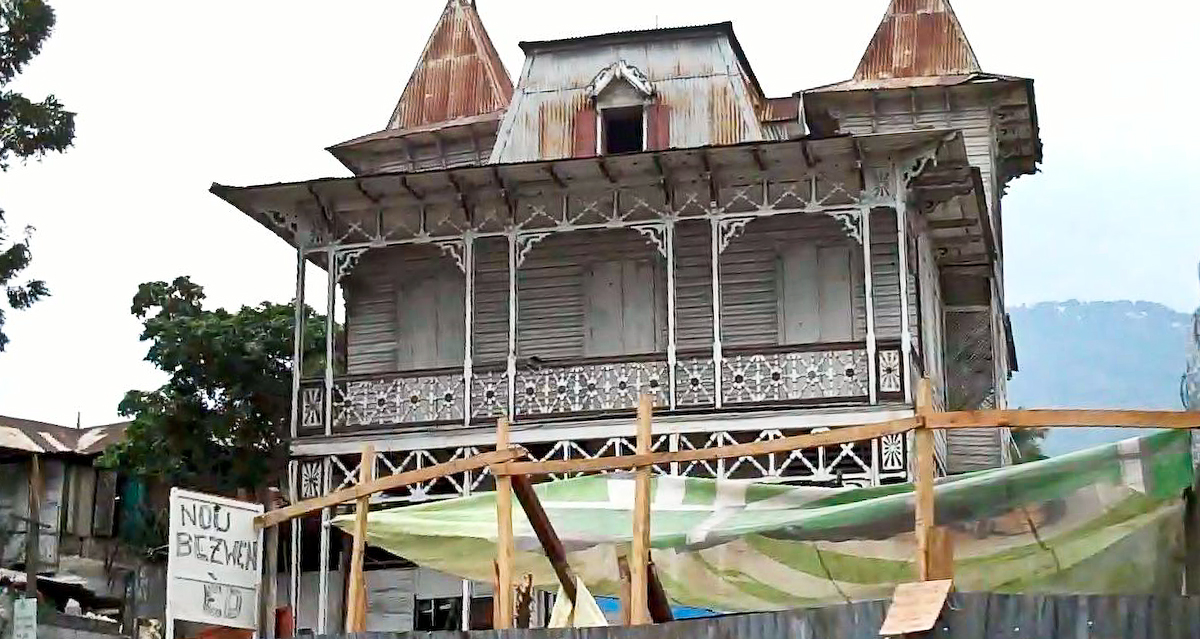
    Several of the 19th-century gingerbread houses in Port-au-Prince managed to weather the January 12 earthquake

    Several of the 19th-century gingerbread houses in Port-au-Prince managed to weather the January 12 earthquake. Photo by Georgia Popplewell, posted at Flickr under a Creative Commons license

    Writing on the Corbett Haiti mailing list, Anne-Christine d'Adesky highlights another factor complicating the reconstruction process — the preservation of traditional architecture:

    As the bulldozers work to clear the rubble, some Haitians who are very involved in Preservation of Haiti's rich cultural heritage are sounding the alarm about the need to PRESERVE and RESTORE Jacmel's unique architecture - including 100 year old houses. Ironically in P au P, Haiti's famed gingerbread houses are among the only ones standing (like my late grandmere's house in Bois Verna, an otherwise very hard-hit section with nearby Sacre Coeur church collapses. We need to learn from the survival of these well-built wooden houses…

    Originally posted at Caribbean Free Radio.

    Global Voices' work in Haiti is supported by our general support donors and by a humanitarian information grant from Internews. Please visit the Global Voices Haiti Earthquake page for more coverage.

  • Global Voices in Haiti: Litmus Test

    Global Voices has sent a two-person team to Port-au-Prince in the wake of the Haiti earthquake, to help support citizen media activity. Georgia Popplewell and Alice Backer are also contributing firsthand reporting to our coverage of recovery efforts. Find out more about their assignment here.

    PORT-AU-PRINCE, HAITI, 27 January, 2010

    We went into downtown Port-au-Prince again yesterday. We'd heard via Twitter that food was being distributed near the National Palace, followed by reports, from Carel Pedre and Karl Jean-Jeune, of UN security “spraying gas” and “throwing tear gas”. Examining the footage posted to YouTube by Carel Pedre, my Global Voices colleague Marc Herman concluded that the substance being sprayed looked more like pepper spray. The pepper spray story was corroborated by reports from the UK Times Online and the Australian Broadcasting Corporation, though Al Jazeera English maintains the tear gas line.


    Food distribution line in Port-au-Prince

    Whether pepper-spray or tear-gas-related, the scuffle has died down by the time we arrive in town. The line is long, but people are waiting patiently. We ask a bystander what’s being distributed. He says he thinks it’s rice. I ask Roosevelt, our driver, to circle the Champs de Mars for a bit, so we can see what’s going on in the vast tent city that now occupies most of the city’s central square.

    Unsurprisingly, the regular rhythm of Haitian life seems to have established itself in the maze of makeshift shelters clustered among plinths bearing statues of Toussaint, Pétion and company, the country’s founding fathers. Women are cooking, bathing babies and doing laundry in basins along the perimeter wall, bathing themselves at the roadside. Children are playing football, vendors have set up stalls on the periphery. Near the National Palace, people have gathered to watch a safe being lowered from a government building. Less formal salvage and scavenging operations are taking place in other parts of the city as well. We pass groups of men shoveling rubble, people picking among the ruins of buildings for things they can reuse. Among the detritus, Port-au-Prince is slowly coming back to life.


    Around the tent city on the Champs the Mars, life resumes its normal rhythm

    Last night a friend who's come here to work with a Canadian NGO wondered how many of the “displaced” were people whose homes were intact but who were simply afraid of sleeping indoors. Yesterday the Haitian government, such as it is, issued a bulletin summarising the impact of the earthquake. On her blog, Anne-Christine D'Adesky posts translations of some of the highlights:

    “Around 112,000 dead, 195,000 wounded, 1 million homeless, half the houses destroyed in Port-au-Prince, Jacmel and Leogane; at least 23 private hospitals collapsed.

    “The government yesterday announced the creation of 2 camps for displaced persons in Port-au-Prince: one on the road to Tabarre, the other at Croix des Bouquets. Another site has been identified in the zone of Leogane.

    “Only qualified engineers can determine if a damaged building is sound enough to be recoccupied. The rule to follow until an engineer has evaluated a property is: if the building doesn't look sound, it isn't.

    “Today, we estimate the capacity of food distribution varies between 200,000 and 300,000 rations a day. This means that, in Port-au-Prince and its surroundings alone, over 800,000 people will not be reached. This is the major challenge.

    “The government is opposed to precipitous adoptions and uncontrolled departures from Haiti of vulnerable or orphaned children and is concerned about the risk of trafficking.

    “NGOs engaged in humanitarian or food aid are encouraged to work with the UN system that has been established.”

    It’s hard to know what’s really happening on the ground. Port-au-Prince is a vast and unfamiliar city, and my primary goal in being here is not to report on the situation. We’re staying in Pétionville, away from the fray. As the tear gas story above demonstrates, it’s difficult to verify information. You try to get around as much as you can, but in the end you’ll see only a tiny fraction of the whole, and perhaps understand or read accurately only a fraction of that. But the overriding story is about the distribution of aid: how badly it’s going, how supplies are failing to get to those who need it, and also how difficult the whole exercise is. I'm pretty sure that one is true.

    On the edge of the tent city near the National Palace I talk to a pair of middle-aged women from Bel Air. They say they haven’t received any food supplies. I ask them if they plan on leaving the city for the countryside. The older one says no. I ask why. She says it’s because her father is dead — she has no family left “en province“.


    Earthquake damage in Carrefour

    We drive out west to the bedroom district of Carrefour, where 40 to 50% of the buildings are said to have sustained damage. Along the main roads at least, the impact of the quake doesn’t seem as dramatic as in central Port-au-Prince, as the buildings are lower and not as densely clustered. Tent cities have sprung up on the median strips and there are mounds of burning garbage along the roadside. But Carrefour didn’t need an earthquake to render conditions appalling. Still, the community is going about its business, obviously accustomed to the general squalor and the grey slurry of macerated garbage underfoot. We pass three money transfer agencies with long lines in front, a sign that remittances, which by some estimates account for over half of the country's national income, are flowing back into Haiti once more.


    Tent city on the median strip on the Carrefour main road

    Crowd gathered at a money transfer agency in Carrefour, awaiting remittances from abroad

    We head back into central Port-au-Prince to engage with a different side of Haiti at the storied Hotel Oloffson in Bois Verna, where it seems like half of the Corbett Haiti mailing list is lunching. We chat briefly with hotel proprietor Richard Morse (@RAMhaiti), who now has 12,065 followers on Twitter and appears on 638 Twitter lists, all as a result of the earthquake. Also there: Anne-Christine D’Adesky, who’s been blogging and posting to the Corbett list consistently since the earthquake hit, and who says that Haiti is the litmus test for whether the lessons learned in other recent humanitarian situations have really been learned; New Yorker Tequila Minsky, just in from taking photos in a nearby neighbourhood; writer Amy Wilentz, who’s blogging for TIME magazine; Haitian photographer Daniel Morel, who corrects my camera-holding techniques; and Leah Gordon, who offers to take us to Portail Léogane to visit the sculptors of the Grand Rue.

    But that's the subject of another post. Over and out.

    Originally posted at Caribbean Free Radio.

    Global Voices' work in Haiti is supported by our general support donors and by a humanitarian information grant from Internews. Please visit the Global Voices Haiti Earthquake page for more coverage.

  • Global Voices in Haiti: Arriving in Port-au-Prince

    Global Voices has sent a two-person team to Port-au-Prince in the wake of the Haiti earthquake, to help support citizen media activity. Georgia Popplewell and Alice Backer are also contributing firsthand reporting to our coverage of recovery efforts. Find out more about their assignment here.

    PORT-AU-PRINCE, HAITI, 25 January, 2010

    Only managed to sort out reliable Internet access yesterday evening, so lots to catch up on.

    ***

    We arrived in Port-au-Prince on Saturday afternoon, after a long but uneventful drive from Santo Domingo. As we approached Jimani, on the Dominican border, we began seeing probable evidence of the situation on the other third of the island: makeshift roadside stalls selling gallon bottles of gasoline, heavy trucks carrying cargo, a motorcycle passenger with his leg bandaged to the thigh. The area near the border gate was swarming with vehicles and people, and we fully expected border formalities to take some time. But after a mysterious confab between our driver and the two associates who’d come along on the trip and a man in a purple cap, we drove through the border gates just like that, with nary a nod from the guards or a request to see a passport, through the few yards of tierra de nadie between the two borders, and into Haiti. Later I noticed that the man in the purple cap had joined us and was sitting in the tray of the pickup among our luggage — turns out he was our Haitian navigator.

    ***

    It was some time before we saw any earthquake damage — the epicentre was south-west of the city of Port-au-Prince, and we were approaching from the east. Then, here and there, the odd ill-starred building with a collapsed balcony, in parking lots and clearings, clusters of makeshift tents. Then both sights became became more frequent: residences with collapsed upper storeys, framed pictures still hanging off the walls, crushed sofas; the clusters turned into tent cities. But still not anything like the images from the news.

    ***

    I think that part of me has come to Haiti wanting to believe that the images I’d been seeing in the media were somehow exaggerated. In largely middle-class Delmas, where our journey from Santo Domingo ends on Saturday, a number of commercial buildings and residences along the Route de Delmas have collapsed, either entirely or partially, and walls everywhere show cracks and fissures. From one building, a large pane of glass leans precariously out over the sidewalk, and a pale yellow three-story residence has caved in on itself like a fallen cake, the ground floor flattened beneath the weight of the floors above. The arbitrariness of the damage was striking — why this building and not that one? But the Canadian Embassy is perfectly intact, and a reporter is recording a stand-up on one of the parapets above the road. Businesses, including gas stations, are operating. People carrying five-gallon water bottles are lined up in orderly fashion in front of a water distribution shop. Traffic is flowing, and in spite of the damage it appears that things have returned almost to normal in Delmas.

    Delmas water line

    Queueing for water in Delmas

    The offices of the National Democratic Institute, which the Internews team has commandeered for its use while in Haiti, are buzzing with activity. A young Haitian hanging out in front of the building helps us take our luggage up the stairs. “Ça va [How’s it going]?” he says. “Ça va bien,” I reply. The stock response, but it displeases him. “Ca va *pas* bien [It's *not* going well]”, he says. “J’ai perdu ma maison, mon beau-frère. Je suis sans-abri [I’ve lost my house, my brother-in-law is dead. I’m homeless].”

    We’ve arrived just at the moment when the Internews team is rushing to get their daily information programme on air, so nobody pays us much heed. The place is crammed with suitcases, air mattresses, cases of water, laptops, emergency radios. Towels are slung over chair backs, and one shelf of a stationery cupboard is loaded with canned food. It doesn't look like there'll be room for us. We issue tweets saying we're looking for accommodation and Alice gets on the phone and starts working her family contacts. Within 45 minutes Alice’s friends L and B have arrived to collect us, and we head back out on to the Route de Delmas, now in darkness except for the headlights of cars and the fires and flambeaux on street vendors’ stalls.

    On our way up to L and B’s house in Laboule we pass through well-heeled Pétionville, which is reported to have been largely unaffected by the quake. Two of its gracious squares, Place Boyer and Place St. Pierre, have nevertheless been transformed into teeming tent cities, filled with the newly homeless from other parts of this divided city. The luckier people are settling down for the night under the canopies of camionettes parked at the side of the road. In spite of the people milling around in the darkness, it is quiet. Parked across from the Hotel Kinam on Place St. Pierre is a MINUSTAH truck.
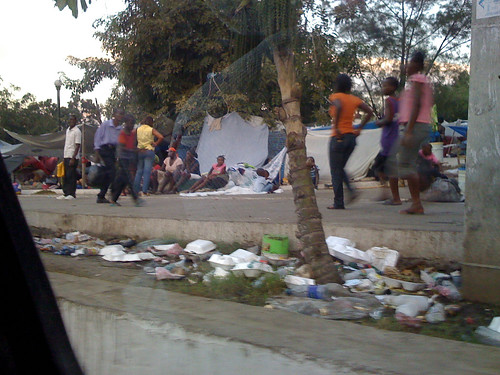
    Tent city at Place St. Pierre, Pétionville

    Tent city at Place St. Pierre, Pétionville

    It’s odd to wake up the next morning in Laboule and look out upon a stunning mountain view. None of the houses in the area appears to have sustained much damage, though L and B have lost a retaining wall. The absence of running water and electricity probably have less to do with the earthquake than the fact that we’re in Haiti. At L and B’s house there are a few hairline cracks in the mortar that L, an engineer, has marked with black crayon, so he’ll know if they widen. L takes what he calls a scientific approach to the quake. He explains the math behind the Richter Scale and has decided it’s not worth worrying about aftershocks. In fact, L sleeps through the aftershock that occurs on Sunday afternoon.

    The radio reports on Sunday indicate that people continue to be evacuated from the city. Over lunch, L tells us that some “méchants” (troublemakers) are spreading rumours that people who opt for evacuation won’t be allowed to return to the capital for five years. We also talk about L’s sister, a physician who has come from the States to volunteer her services and is now working in a centre at Croix des Bouquets. L’s sister reports that Haitian doctors are being sidelined in the relief efforts, and it’s only after she gives an interview to CNN that she starts getting some grudging respect from the big international agencies.

    ***

    We finally leave Laboule late on Sunday afternoon and descend into Port-au-Prince. There are fallen buildings all along the Route de Bourdon and a slum that covers the hillside across the distance like a skin looks chipped and battered. It gets worse as we get nearer to the city centre, but it's still not the total wreckage from the photos. We arrive at the Champs de Mars, the massive square, which has been partly overtaken by a multi-section tent city. The sinking feeling sets in officially as we stop in front of the National Palace with its caved-in roof. That one certainly matches the news photos, except that up close it’s more massive and more desolate. We drive around the Champs de Mars and pass in front of the Plaza Hotel, where a news cameraman is filming what looks like a heap of black rags in the street. The black rags are in fact two dead bodies, perhaps recently pulled from the wreckage, their limbs intertwined.

    The area just east of the Champs de Mars is straight out of the news photos. A long corridor of rubble, not a building left standing. You’ve all seen it by now, so I don’t need to describe it further, or the scent of decay that hangs in the air, now several times less intense than it was a few days ago.

    I'm adding these last few lines just so I can say I didn't end on a note of despair. I apologise for adding to the heavy burden of bad news already borne by this country. And now to make a plan for what we'll be doing while we're here.

    Originally posted at Caribbean Free Radio.

    Global Voices' work in Haiti is supported by our general support donors and by a humanitarian information grant from Internews. Please visit the Global Voices Haiti Earthquake page for more coverage.