Author: Global Issues

  • Foreign aid: highest levels ever but still way below promised amounts

    The OECD (Organisation for Economic Co-operation and Development) recently published new preliminary figures for aid in 2009.

    It showed official development assistance (ODA) aid from wealthy governments had increased to just over $123 billion in 2009 (at constant 2008 prices). This is roughly 0.31% of GNI (Gross National Income) of the donor nations.
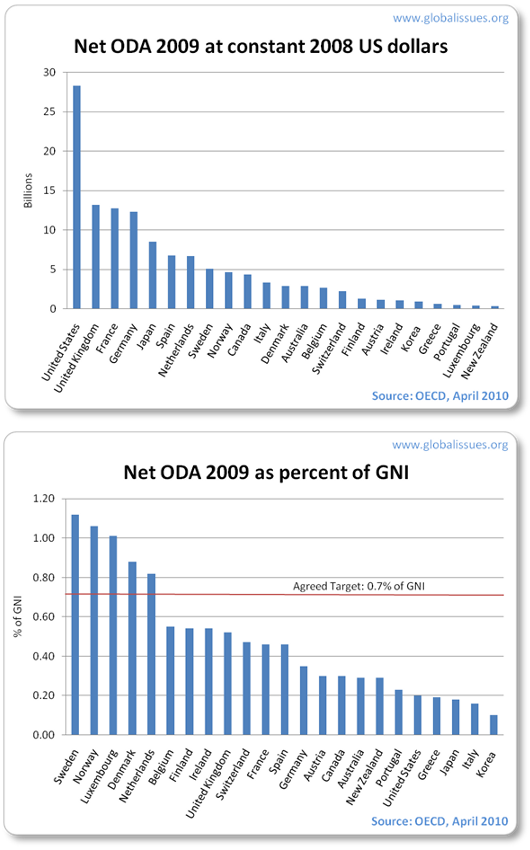
    Net ODA in dollars: the US provided the most in dollar terms. As a percent of their GNI, Sweden provided the most

    Yet, almost 40 years ago nations promised to reach 0.7% of their GNI. While each year the amount of aid falls quite short of that 0.7% target, the quality and effectiveness of that aid is often questionable, sometimes benefiting the donor more than the recipient due to the types of conditions attached to this aid.

    This update includes a number of new and updated charts and graphs.

    Read full article: Foreign Aid for Development Assistance

  • Foreign aid: shortfall reaches $3.6 trillion; greater than aid given

    Almost 40 years ago, rich country governments agreed to give 0.7% of their GNI (Gross National Income) as official aid to poor countries for development assistance.

    The average aid delivered each year has actually been between 0.2 to 0.4%. The shortfall has therefore accumulated to over $4 trillion dollars at 2008 prices, while total aid delivered in that same time frame has reached just under $3 trillion.

    Of the total aid that has been promised in those 40 years, only 43% has actually ever been delivered

    This update includes updated charts and graphs that look into this further.

    Read full article: Official global foreign aid shortfall: $4 trillion

  • Today, over 24,000 children died around the world

    Over 24,000 children die every day around the world. That is equivalent to:

    • 1 child dying every 3.6 seconds
    • 16-17 children dying every minute
    • A 2010 Haiti earthquake occurring almost every 9-10 days
    • A 2004 Asian Tsunami occurring almost every 10 days
    • An Iraq-scale death toll every 16–40 days
    • Just under 9 million children dying every year
    • Some 79 million children dying between 2000 and 2007

    The silent killers are poverty, hunger, easily preventable diseases and illnesses, and other related causes.

    Although the number of children dying each year is being reduced (just under half a million less deaths in 2008 than 2007, for example), the rate of reduction is slow. Furthermore, it is feared that once more recent data comes in, the global financial crisis will undo some of that annual reduction.

    And yet, despite the scale of this daily/ongoing catastrophe, it rarely manages to achieve, much less sustain, prime-time, headline coverage. This update includes updated numbers, charts and graphs.

    Read full article: Today, over 24,000 children died around the world

  • Beef: subsidies encourage unhealthy food consumption and makes healthy food more expensive

    Food subsidies in countries like the US are arranged in such a way that they encourage more meat production and unhealthy food consumption which become cheaper than healthy foods. On top of the environmental degradation caused by industrial farming, excessive meat consumption harms health.

    Some additional statistics, graphs and charts have been added that look into this further.

    Read full article: Beef

  • Women’s Rights and Beijing +15 Conference

    Coinciding with International Women’s Day, the beginning of March saw the 54th session of the United Nations Commission on the Status of Women to report on global efforts toward democracy and human development through the empowerment of women.

    Despite the 2-week meeting and many issues being progressed, there were still uncertainties in areas such as commitments to various gender related rights and funding.

    This small update includes further links and description of the above conference, as well as further links, quotes and a video on women’s rights related issues.

    Read full article: Women’s Rights

  • Obesity: a growing global problem

    Obesity typically results from over-eating (especially an unhealthy diet) and lack of enough exercise.

    In our modern world with increasingly cheap, high calorie food (example, fast food — or junk food), prepared foods that are high in things like salt, sugars or fat, combined with our increasingly sedentary lifestyles, increasing urbanization and changing modes of transportation, it is no wonder that obesity has rapidly increased in the last few decades, around the world.

    The number of people overweight or obese is now rivaling the number of people suffering from hunger around the world. Obese people were thought to be mainly from richer countries or wealthier segments of society, but poor people can also suffer as the food industry supplies cheaper food of poorer quality.

    Environmental, societal and life-style factors all have an impact on obesity and health. While individuals are responsible for their choices, other actors such as the food industry are also part of the problem, and solution. Unfortunately, the food industry appears reluctant to take too many measures that could affect their bottom line, preferring to solely blame individuals instead.

    The obesity page has been updated to include additional data, information and videos about the impacts of obesity, childhood obesity and what can be done about it.

    Read full article: Obesity

  • Conservation struggle: tiger numbers continue to decline

    Tiger numbers are on the decline. The estimated number of tigers remaining globally is thought to be between around 3,400 to 5,100 tigers with possibly just under 40 left in China.

    The tiger is a powerful symbol of conservation, yet despite measures to help their numbers, various threats such as habitat loss and poaching continue to threaten their numbers.

    These and additional numbers as well as a video from the BBC were added.

    Read full article: Nature and Animal Conservation

  • Haiti

    The devastating earthquake that hit Haiti earlier in January has led to immense coverage of the ensuing humanitarian emergency.
    But Haiti’s problems are numerous and goes back decades. A combination of a long turmoiled history, outside influence/interference preventing local democracy and development, political instability, environmental degradation, poverty and natural disasters all combine making it incredibly difficult to see how Haiti will be able to get out of its present situation.

    The Haiti page on this web site has been updated to provide an overview of the earthquake related problems that occurred, though is not an up to date service on the relief efforts. However, the page has a lot of background information on Haiti from a geopolitical angle, which may provide some background and context to the nations’ troubles and challenges.

    (The Inter Press Service news coverage on Haiti carried by this web site may be of interest for more up to date stories.)

    Read full article: Haiti

  • Racism

    Racism can be found in many places around the world, often rooted in complex historical circumstances mixed with contemporary issues and conditions. The racism article on this site was getting quite old, so it has been updated with a few more examples and background information. More will be added over time.

    Read full article: Racism

  • Poverty around the world: informal settlements and slums

    Approximately 1 in 6 people live in informal settlements, or slums. In developing countries, some 1 in 3 people living in cities are living in slum areas.

    While there have been some successes in reducing the number of people living in such areas in recent years by about a tenth (mostly in China and India), numerous problems persist.

    Some settlements are not officially recognized despite being present for decades and being home to thousands of people. This then means that residents have been denied a range of essential services provided by the government to other residents such as water, sanitation, electricity, garbage collection, health, education, access roads and transport.

    In some places, people face an almost daily threat of forced eviction without notice or appropriate compensation. Human rights groups have filmed cases where bulldozers come in without warning while residents are there. This often occurs when developers want the land for further development and may include state collusion.

    Due to the very conditions in which people live, their ability to stand up for their rights and have their voices heard is greatly reduced. And yet, despite this, there is much of humanity to be found in these areas, with vibrancy and enterprising people struggling to make a living.

    The poverty around the world page has been updated to explores some of these aspects further, with additional information and videos.

    Read full article: Poverty Around The World

  • Copenhagen Climate Change Conference

    December 7 – December 18, 2009, Copenhagen, Denmark was the venue for the 15th annual United Nations Climate Change Conference, also known as the 15th Conference of the Parties — or COP 15.

    As with previous conferences, thousands of politicians (including head of states), diplomats, journalists, lobbyists and NGOs attended hoping the summit would finalize a post-Kyoto international agreement on climate change to take effect in 2013.

    The build-up to the meeting was full of optimism and hope, as the US was, for the first time in a long time, going to be seen as a positive contributor, and their involvement is always recognized as key. There was also increasing focus on emerging economies such as China and India.

    Instead of a positive outcome, most commentators saw it as a failure, though for different reasons.

    This article provides a very brief summary of the outcome and related issues:

    Read full article: COP15 — Copenhagen Climate Conference

  • Iran: recent nuclear weapons concerns unfounded?

    Towards the end of 2009 it was revealed published a document which purportedly described an Iranian plan to do experiments on what the newspaper described as a neutron initiator for an atomic weapon. However, it seems US intelligence sources find this Iran nuclear document to be a fabrication. Shortly before his term as head of the IAEA ended, Dr. Elbaradei reiterated that using the language of force on this issue has not been helpful and despite some serious failings recently failings by Iran not to disclose an enrichment facility by a certain time, to present the Iran threat as imminent is hype.

    This update expands on the above as well as adds a few notes on the recent political violence that has erupted as Iran’s security forces have clamped down on protesters supporting moderate opposition parties.

    Read full article: Iran

  • Inequality in Rich Countries

    Once nations are industrialized, more equal societies almost always do better in terms of health, well-being and social cohesion. Large income inequalities within societies destroys the social fabric and quality of life for everyone.

    That is what the Equality Trust in the UK have found after researching numerous aspects of inequality.

    They looked at a wide range of health and social problems and found that,

    • Outcomes are substantially worse in more unequal societies
    • The problems tend to move together, implying that they share an underlying cause
    • Whether their findings are tested internationally among the rich countries, or among the 50 states of the USA, there is almost always the same tendency for outcomes to be much worse in more unequal societies.

    For industrialized nations, it would seem that economic growth is therefore less important than equality when it comes to social cohesion and individual well-being.

    This update includes a video describing this in further detail, as well as charts and graphs showing the relationship between various social factors and inequality.

    Read full article: Poverty Around The World

  • Women’s Rights and Climate Change

    There has been 30 years of the UN women’s rights treaty, the Convention on the Elimination of All Forms of Discrimination against Women (CEDAW). Many indicators suggest that immense progress has been made, with the treaty even being described as one of the most successful human rights treaties ever. Nonetheless, numerous challenges remain around the world.

    At the same time, it is increasingly accepted that women (especially in poorer countries) are going to be more vulnerable to climate change impacts. This can be for a number of reasons, including poverty, inequality and deprivation.

    Fighting for women’s rights and gender equality is therefore seen as crucial from a number of perspectives.

    This update includes a few notes on additional progress seen around the world due to the CEDAW treaty as well as information and a couple of videos on how climate change already impacts women in similar ways in places far apart as Bolivia and Vietnam.

    Read full article: Women’s Rights

  • AIDS Around the World

    UNAIDS has updated their estimates for various aspects for AIDS/HIV. It says that for 2008 worldwide, there were an estimated:

    • 33.4 million living with HIV
    • 2.7 million new infections of HIV
    • 2 million deaths from AIDS

    Approximately 7 out of 10 deaths for 2008 were in Sub-Saharan Africa, a region that also has over two-thirds of adult HIV cases and over 90% of new HIV infections amongst children.

    Looking over recent years, UNAIDS finds some improvements, such as reductions in deaths from AIDS and of new incidences of HIV infections. Yet, were it not for the politics and other problems throughout the past couple of decades, perhaps means more lives could have been saved.

    The AIDS page has been updated with newer graphs and charts.

    Read full article: AIDS Around the World

  • Landmines

    Throughout the 1990s, a coalition of numerous non-governmental organizations, the International Campaign to Ban Landmines (ICBL), campaigned successfully to prohibit the use of landmines.

    This helped to create the 1997 Convention on the Prohibition of the Use, Stockpiling, Production and Transfer of Anti-Personnel Mines and on their Destruction, also known as the Ottawa Treaty. (It also won the ICBL the 1997 Nobel Peace Prize for their efforts.) This treaty came into force in 1999.

    Although landmine use in the past decade has been significantly reduced, problems such as clearance and rehabilitation remain. Furthermore, some key countries continue to use landmines, or support the need for them, despite the problems they often cause for civilians long after conflicts have ended.

    The landmine page has been significantly updated to describe the above further.

    Read full article: Landmines

  • Global Arms Sales Decreased in 2008 compared to 2007 but was still high

    The latest data covering global arms sales shows that sale of arms in 2008 decreased to around $55 billion, over 75% of which went to developing countries. This was down from a total of almost $60 billion the year before but was still the second highest amount in the 8 year period the data covers.

    While the global financial crisis has affected many countries, it seems like the decrease in arms purchases in 2008 occurred mostly in industrialized nations; developing nations saw a slight increase in purchases.

    Updated graphs and charts on arms sales data are provided here.

    The arms trade is big business. The 5 permanent members of the UN Security Council (US, Russia, France, United Kingdom and China), together with Germany and Italy, account for over 80% of the arms sold between 2001 and 2008.

    Some of the arms sold go to regimes where human rights violations will occur. Corruption often accompanies arms sales due to the large sums of money involved.

    Read full article: The Arms Trade Is Big Business

  • Protecting the environment by giving it an economic value?

    For years, many have argued that our current economic system does not fully capture the cost of the environment. The price signal, for example, should be an indicator of resource scarcity or other environmental concerns, but often does not capture the full costs. (Current climate change is perhaps a clear indication of this.)

    As a result, we continue efficiently producing products and services that have a negative impact on the environment in some way (which is inefficient, on the whole, in the long run).

    For those who fear excessive government regulation, a truer accounting of such costs could allow markets to more naturally price goods and services, and highlight seemingly efficient companies and industries as inefficient, forcing change through markets, rather than regulation, which market proponents always fear. (The irony may be that to see such a change in our economic systems may require political leadership by governments and citizens — although that is how national and global market systems came into being in the first place.)

    The biodiversity page has been updated to explain this further.

    Read full article: Why Is Biodiversity Important? Who Cares?