Author: GreenRightNow.com

  • Lowes wins top Energy Star award

    From Green Right Now Reports

    Who sells more Energy Star appliances than anyone?

    Well, we don’t know. Stores typically won’t reveal their sales figures, which they consider to be proprietary.

    But if Jeopardy asks, you might answer: Lowe’s. The retail home improvement chain is being honored later this month for its longtime commitment to energy efficiency, particularly for its emphasis on selling ENERGY STAR appliances.

    The Fortune 50 company will be honored with the EPA’s Energy Star  Sustained Excellence Award in Retail at a ceremony on March 18.

    Lowes has been a leader in selling energy-efficient appliances for many years, and has won eight consecutive ENERGY STAR awards from 2003 to 2010, according to a company news release. The awards recognize the retailer’s efforts to educate consumers on energy use, select products that save energy and ultimately reduce greenhouse gas emissions. The Sustained Excellence Award is a sort of sweepstakes ENERGY STAR  honor, given only to companies that have won previous EPA awards.
    An Energy Star partner since 2001, Lowe’s  sold enough ENERGY STAR products to save consumers more than $265 million off their energy bills compared with non-ENERGY STAR products, the company estimates.

    In 2009, Lowe’s increased the number of ENERGY STAR appliances it offered, for instance, adding dishwashers until its inventory included 90 percent of the ENERGY STAR-rated models. The company increased employee training and signs on ENERGY STAR products,  has partnered  with many  utility companies to host energy efficiency rebate events, and has created an online system to help utility companies simplify rebate promotions.

    Lowes isn’t just resting on its Whirlpools, though, the store offers “thousands of products to help consumers save energy and money,” according to a spokesman, as well as a Home Audit Tool and tip sites for homeowners such as Lowes.com/BuildYourSavings and Lowes.com/EfficientHome.

    Finally, the stores are helping customers hook-up with state rebates for appliance purchases at  Lowes.com/CashForAppliances.

  • Olympic Games medal in energy efficiency

    By Harriet Blake
    Green Right Now

    Vancouver scored highly as an Olympic venue despite weather concerns. Equally impressive, the Winter Games also scored well in terms of their energy efficiency.

    According to Pulse Energy’s Venue Energy Tracker, the software technology that measured the 17 days of athletic contests, the games were the most energy efficient Olympics ever.

    vancouver_olympic_center3

    The Vancouver Olympic/Paralympic Center uses heat from ice-cooling operations to warm the building.

    The total energy savings achieved at the games was 906 MWH, which is the equivalent of a 15 percent reduction in energy use. To put it in perspective, says a Pulse Energy spokesman, that is enough energy for Canadian Gold medalist Katie Weatherston to play 1.7 million full hockey games or for Canadian ski-cross member Julia Murray to race down the ski-cross course 100 million times.

    IOC president Jacques Rogge has declared that the 2010 Winter Games could stand as a sustainability blueprint for all future Games.

    The Olympic sites that were measured for live energy tracking were the Richmond Olympic Oval, Canada Hockey Place, Vancourver Olympic/Paralympic Centre, South East False Creek Community Centre, Whistler Blackcomb Roundhouse Lodge and Snowmaking Facilities and the Olympic and Paralympic Villages.

    The Venue Energy Tracker measures real-time energy, enabling facility managers to maximize their energy efficiency as operational problems occur. The tracker is a joint venture of the software technology company, Pulse Energy, and the utility company, British Columbia Hydro.

    Copyright © 2010 Green Right Now | Distributed by GRN Network

  • What you need to know: Household cleaners

    By Shermakaye Bass
    Green Right Now

    Not so long ago, Mr. Clean and company were considered the good guys, the go-to-gang for a deep house cleaning. But in the past several years, alarms have been sounding about chemicals used in conventional household products.

    Be they phosphates, sulfates, bleach, ammonia or phenols, certain ingredients are causing strong concerns among consumer-protection groups, federal and state governments, and even a few manufacturers. The new conventional wisdom asserts that many household cleaners contain compounds that pose environmental risks and can lead to health conditions such as asthma, nerve damage, reproductive damage, even cancer. (See our GRN guide below)

    Greener cleaners are non-polluting, indoors and out

    Greener cleaners are non-polluting, indoors and out

    Complicating the issue, however, is the fact that many companies refuse to disclose all ingredients in their products, stymieing consumers’ ability to make informed choices. We may be seeing more disclosure, however. The non-profit group Earthjustice recently filed a lawsuit in New York State citing a little-known Empire State statute (circa 1976) that requires makers of HH cleaners to disclose their contents. Filed in February, the suit claims the Commissioner of the New York Department of Environmental Conservation has the authority to require such disclosures. The lawsuit has obvious national implications, considering that the cleaners used by New Yorkers are the same as those sold in the rest of the states, even the world.

    Earthjustice notified several companies about the never-used law last year. SC Johnson and Simple Green responded by agreeing to list ingredients in their products for New York state consumers. Other major manufacturers like Proctor & Gamble, Colgate-Palmolive, Reckitt-Benckiser and Church and Dwight, have refused.

    Get the risk out, with eco-friendly cleaners

    In the meantime, a new crop of  greener cleaners has emerged over the last two decades, offering consumers healthier alternatives. Companies like BioKleen and Seventh Generation debuted in the late 80’s and early 90’s. Shaklee greened its cleaners and started selling concentrates, saving on bottles. Lately this movement has gone mainstream, with Clorox producing its Greenworks line and Safeway offering the eco-aware house brand, Bright Green. SC Johnson has taken some if its best-known brands, like Windex and Shout, and reformulated them into an eco-friendly variant as part of its Nature’s Source line.

    These are but a sampling of the eco-friendly cleaners on the market today.

    Design for the Environment is a new EPA endorsement program for safer cleaners

    Design for the Environment is a new EPA endorsement program for safer cleaners

    So popular is green-cleaning that the Environmental Protection Agency has just (in 2010) introduced a new Design for the Environment/Safer Product Recognition program, in which manufacturers whose products substitute harmful ingredients with safer ones become DfE “partners” and their products are labeled with DfE seal of approved. (The Design for the Environment program also provides a list of those making the grade.)

    For now, consumers seeking green cleaners still need to look carefully. Cleaners that call themselves “organic” or “all-natural” can carry questionable chemicals. Clues to the most eco-friendly products can be found by looking for these words on labels:

    • Plant-based cleaning agent — generally gentler and not from petroleum products.
    • Biodegradable — which means the ingredients break down when exposed to water, air or soil, generally within days, into simple elements that can be absorbed by the environment.

    Readers also might find this list from the Los Angeles County Department of Public Works helpful. It categorizes HH cleaners that can be hazardous and warns residents to dispose of them in accordance with new county guidelines. The products to watch out for are conventionally formulated:

    • Ammonia-based cleaners, like window cleaners
    • Oven and drain cleaners
    • Floor care products
    • Aerosol cleaners
    • Furniture polish
    • Metal polishes and cleaners
    • Tub, tile and toilet bowl cleaners

    All these can be hazardous to waterways, wildlife, soil and air when dumped in the trash or down the drain; not to mention the irritation and health effects to humans breathing their vapors or coming into skin contact with these harsh chemicals. (See more details below.)

  • Empire State Building lauded for energy-saving retrofit

    From Green Right Now Reports

    Retrofitting doesn’t always get the attention that new green building generates, with its “net zero” and passive solar designs.

    Empire State Building (Photo: Empire State Building Co.)

    Empire State Building (Photo: Empire State Building Co.)

    But the impact of retrofitting can be great, and it comes with the bonus of preserving historic and treasured structures — like the Empire State Building.

    The iconic New York high rise, built in the 1930s, has received an award for its 2009 retrofit, which is expected to save 38 percent of the building’s energy and $4.4 million annually.

    The Sustainable Buildings Industry Council gave it the “Beyond Green High Performance Building Award”, which recognizes the energy efficiency and air quality improvements planned for the retrofit, designed by a collaboration of real estate company Jones Lang LaSalle, the Clinton Climate Initiative, energy efficiency experts Johnson Controls and the Rocky Mountain Institute.

    In addition to the energy savings, the redo is projected to prevent 105,000 metric tons of carbon emissions over the next 15 years.

    The collaborators hope that the Empire State Building will serve as an example of what can be accomplished with existing buildings because buildings are the single biggest energy users in any city or town.

    Managers for the Empire State Building say the retrofit will save tenants money for electricity, a top tenant expense after payroll and rent, and also help them curtail turnover,  because of improved indoor comfort. Tenants will benefit from the energy-saving features of more thermal-protective windows, fresh air ventilation, a state-of-the-art cooling HVAC system.

    The Rocky Mountain Institute, whose experts helped guide the retrofit, say the award comes at an opportune time, just as they are launching a RetroFit initiative.

    See more on the project on this YouTube video:

  • Veggies get their own phone app

    From Green Right Now Reports

    We know there are thousands of apps available for your iPhone. But here’s one we think will be really useful, the HappyCow VeginOut Guide.

    Happy Cow phone apps help you find veggie restaurants

    Happy Cow phone apps help you find veggie restaurants

    It’s available for Palms, phones that use Android and the iPhone. The iPhone app is called VegOut.

    These apps allow you to easily find thousands of eating spots that are either vegan, vegetarian or veg-friendly.

    If you or someone close to you is a veggie, you’ll know how valuable such a reference can be when you’re on the road encountering meat-oriented restaurants at every interchange.

    We’ve used HappyCow.net on the Internet to find wonderful vegetarian dining while traveling, relying on reviewers and restaurant summaries to help us find a sandwich or main dish that’s not just minus-the-meat.

    Once we used HappyCow to shimmy away from a famous barbecue joint in a city famous for its barbecue. We simply couldn’t get a personal recommendation that didn’t involve ribs. Another time we discovered a marvelous Indian eaterie far off the Interstate but renowned in its neighborhood for the wonderful cooking by its owner/chef. He had converted to vegetarianism in mid-life, took his restaurant in the same direction and his customers followed along! We feasted on dal, Palak Paneer, Rajma Masala and fresh naan.

    Happy Cow makes for happy veggie diners. Now you can click in from anywhere with your cell phone.

  • Walmart plans to lower carbon emissions across its vendor network

    By Barbara Kessler
    Green Right Now

    Walmart announced a plan to reduce carbon emissions across its global supply chain today, saying it intends to shave 20 million metric tons off its greenhouse gas emissions   through 2015.

    Walmart CEO Mike Duke annoucing carbon reduction goals

    Walmart CEO Mike Duke annoucing carbon reduction goals

    The reductions will come from Walmart’s own operations and  from “the life cycle of the products we sell,” said Walmart CEO Mike Duke, adding that the savings would be the equivalent of taking 3.8 million greenhouse gas-emitting cars off the road for a year.

    “It’s a very sizable goal, as we often do here at Walmart,” he said.

    Calculated another way, the reductions represent 150 percent of Walmart’s anticipated carbon growth over the next five years.

    The reductions will be done as Walmart works with suppliers and will come from reduced energy spent on manufacturing and transportation; from products redesigned to consume less raw material or last longer; from the reduction of disposable products and the increased use of recycled goods, Duke said. “All of this is part of the life cycle of products.”

    “We will be the leader in retailing because we will be the first to look at the supply chain on a global basis,” he told an audience of partner groups, reporters and suppliers during the webcast announcement from the company’s headquarters in Bentonville, Ark..

    Duke explained that Walmart sees these carbon reductions as compatible with business growth.

    “There are millions more customers around the world who really do want to save money and that Walmart could reach. We do plan and want to continue to build stores. We want to add square footage, that’s the reality of our business. Yet we know we need to get ready for a world in which energy will only be more expensive. And there will be a greater need to operate with less carbon in the supply chain,” Duke said.

    He said he expects that the efficiencies found as suppliers reduce their carbon emissions will result in continued lower prices for customers. “Like everything we do around here at Walmart, this commitment ends up coming down to our customers, and helping our customers around the world save money and live better.”

    More sustainable business practices also can help shield customers from high energy costs in their own lives, Duke said.

    “That is why America needs comprehensive legislative policy that addresses energy, energy security, the country’s competitiveness and reducing pollution.”

    Several environmentalists and advisors, including Environmental Defense Fund President Fred Krupp, joined Duke and Walmart executives for the announcement.

    EDF has set up at office in Bentonville, Ark., near Walmart headquarters.

    The retailer also has worked with the Natural Resources Defense Council and World Wildlife Fund to develop its sustainability plan.

    Tree Hugger and Planet Green co-sponsored the webcast. TreeHugger founder Graham Hill helped kick off the news conference by remote, with a video lesson on greenhouse gases, which he likened to a blanket that’s getting too thick and threatening to disrupt the climate humans are adapted to. He discussed ways products can be more earth-friendly, alluding to paper towels that can be ripped off in half sheets and proper sizing of food portions.

    TreeHugger Editor-in-Chief Meaghan O’Neill talked with an invited panel about how business and sustainability can interact. A FoxHome Entertainment executive showed off a DVD package that has less plastic and Paul Kelly of Walmart-owned Asda in the UK talked about how more sustainable products can be low cost.

    “You can decouple business growth from carbon growth,’’ said Asda exec Kelly.

    Walmart, once widely derided as a merciless profit-seeker and crusher of small businesses, has in recent years taken a variety of steps, from using fuel-efficient trucks to buying more local food and daylighting its stores, to reduce its carbon footprint. Lately, it has been pushing its suppliers to operate more sustainably, and already gives points to products that come with less packaging and lower greenhouse gas emissions.

    Critics says that Walmart’s push is more about squeezing out costs than greenhouse gases. But others, including some leading environmentalists, vouch for Walmart’s sincerity and believe its scale gives it an incredible podium.

    “Walmart is looking at the big picture,” said Krupp, by leveraging its vast vendor network to achieve change.

    During a mock interview with a Walmart executive during the webcast, Krupp said Walmart is showing leadership by acting in advance of government mandates to reduce carbon emissions and also throwing out a challenge to consumer products companies around the world.

    “What’s sensational is that you’re (Walmart) going to launch a process, a race, a treasure hunt among your suppliers to find ways to cut carbon pollution and cut their energy costs.”

    For more information, see the Walmart Fact Sheet on how it intends to reduce carbon emissions.

    Copyright © 2010 Green Right Now | Distributed by GRN Network

  • RFK Jr. explains why nuclear power isn’t green and coal isn’t cheap

    By Harriet Blake
    Green Right Now

    As passionate as his father was about civil rights, Robert F. Kennedy Jr. is equally so about the environment.

    Robert Kennedy Jr.

    Robert Kennedy Jr.

    In a lecture in Fort Worth on Wednesday, the 56-year-old son of the late Senator, advocated for moving the nation to green energy, which he doesn’t see as encompassing nuclear power.

    Coal is not the only power-producing industry that needs scrubbing, said the longtime environmentalist, nuclear energy is simply not safe. “Nuclear energy is the most catastrophic form of energy. No bank will finance it…[and] no insurance company will insure it,” he said.

    “It’s not just a bunch of hippies saying it’s unsafe. There are spills all the time into the Hudson,” says Kennedy, who serves as chief prosecuting attorney for Riverkeeper, whose mission is the restoration of the Hudson River. Three Mile Island was not the last accident despite what nuclear advocates say.

    He made it clear that lobbyists for fossil fuel and polluting energy industries are powerful and dangerous. The nuclear industry, for example, managed to find a way to get a Congressional exemption that leaves them free from damage. “All homeowners’ policies in the U.S. exclude radiation from the nuclear industry,” he said.

    Kennedy believes greed has taken over the utility companies as well. “Utility companies make money by selling more energy – even if the energy is green. We need to change the rules,” he says. “Don’t reward bad behavior.”

    He believes it’s a question of loyalty. “Instead of being loyal to their shareholders, company leaders need to be loyal to our nation,” he says.

    Along with serving on the boards of green energy companies, Kennedy, a resident of Mount Kisco, N.Y., has led the efforts to protect New York City’s water supply, both through Riverkeeper and as a senior attorney for the Natural Resources Defense Council. He is the president of Waterkeeper Alliance and a professor and supervising attorney at Pace University School of Law’s Environmental Litigation clinic. (After getting his undergraduate degree from Harvard and law degree from the University of Virginia, he picked up a masters in environmental law from Pace.)

    As a partner with Silicon Valley’s VantagePoint Ventures, he is involved firsthand with green energy. VantagePoint funds an array of emerging clean tech and green energy companies., including solar, algae fuel and energy conservation businesses.

    During his lecture at Texas Christian University, Kennedy also addressed the coal industry’s claims that coal is clean and cheap. It is neither, he says.

    The problem is that once a coal plant is built, there are many hidden costs such as pollution and healthcare.

    “More than 60,000 Americans are killed each year due to ozone particulate pollution,” he says. In addition, every fish in the United States is affected by dangerous levels of mercury, thanks to the coal industry. That mercury level also has grown in humans. Babies being born to women with high mercury levels have a higher percentage of illness ranging from autism to mental retardation.

    On the other hand, “Once a solar plant is built, the energy is free forever.” There are no pollution and health costs, and no strings attached, he said.

    Using coal to produce electricity is a destructive business from the beginning of the process, says Kennedy, who opposes the mountain-top removal mining in Appalachia in which ancient mountains are sheared off to get to the coal. The practice destroys forests and the resulting debris pollutes area rivers. (Coal companies say they ameliorate the damage by planting new trees, but environmentalists say these saplings cannot replace the mature forests; that erosion, runoff and river pollution are not abated.)

    Kennedy recalled his father being against what was then known as strip-mining. “He told me, [the coal industry] is not just destroying the environment, but permanently impoverishing the surrounding communities. They’re doing this so they can break the unions.”

    It’s particularly a shame because Appalachia, Kennedy points out, “is the oldest ecosystem on the continent.”

    “Today,” he says, “ninety-nine percent of coal in West Virginia is owned by Wall Street bankers such as JP Morgan and Chase.” The reason? Many of the homeowners were tricked into selling their mineral rights because they didn’t know any better. “The coal industry has liquidated the people of West Virginia of their cash,” he says.

    Kennedy says he’s not just fighting for ecosystems and halting the destruction of the environment. “It’s about the subversion of American democracy, the public process and transparency in government.

    “Government is supposed to protect us,” but because of the influence polluting companies and lobbyists wield in Washington, that’s not happening.

    Interestingly enough, he says, “every nation that has attempted ‘de-carbonization’, has prospered afterward. In Iceland, they became scared of global warming and within 15 years, went from being the poorest nation in Europe to the fourth richest. Sweden is another example. After Sweden de-carbonized and closed their nuclear facilities, they prospered. Tons of entrepreneurs came in as clean energy was introduced.”

    He named Brazil and Costa Rica as having robust economies after they de-carbonized as well.

    Robert Kennedy Jr. speaks at TCU.

    Robert Kennedy Jr. speaks at TCU.

    Kennedy would like to see an increase in geothermal power, which he uses at his home in New York. “Geothermal,” he says, “is an underutilized resource. It’s been unexploited until now, but it could be a boon, especially in Texas where you already have holes in the ground from gas/oil drilling.” His home also has solar panels and between the two forms of energy, his home generates more power than he can use, which he then sells back to the utility company. “But you can’t do this in all states. This needs to be fixed. We need to reward efficiency; and punish inefficiency. We should be able to turn every home into a power plant.”

    Another resource he’d like to see used more is wind. “There’s enough wind in the states of North Dakota, Minnesota and Texas to power the entire country,” he says.

    The Obama Administration faces some major obstacles, Kennedy says. “We need to get rid of the subsidies that give breaks to dirty energy. And we have to build an electric grid that can accommodate the entire country.”

    Kennedy compares the effort to the interstate highway system that was built during the Eisenhower years. The United States has the technology, Kennedy says. “And we have the resources – wind that blows at night; and sun that shines by day…We can put PVCs on every south-facing roof in the country.” Taking advantage of these green energies should be a no-brainer.

    The TCU lecture was part of the Frost Foundation Lectureship for Global Issues, sponsored by the TCU Center for International Studies.

    Copyright © 2010 Green Right Now | Distributed by GRN Network

  • Legislators give Vermont Yankee Power Plant the heave-ho

    Green Right Now Reports

    In a blow to the nuclear power industry, Vermont’s State Senate is pulling the plug on the Vermont Yankee Nuclear Power Plant,  which has been beset by environmental problems ranging from missing fuel rods to the uncontrolled release of radiation.

    The Vermont Yankee Power Plant (Photo: NRC)

    The Vermont Yankee Power Plant (Photo: NRC)

    The Senate voted this week (26-4) to not renew a requested extension of the plant’s 40-year license, which expires in March 2012. The vote came after the Nuclear Regulatory Commission acknowledged this week that yet another radioactive leak had occurred at the Yankee reactor in 2005. It also followed President Obama’s declaration of a new era for nuclear, beginning with $8 billion in federal loan guarantees for a large nuclear power plant near Augusta, Ga.

    Vermont’s House of Representatives may vote on the issue, but if either chamber denies the extensive of the license, the plant must be closed. The Vermont Yankee Power Plant, licensed in 1972, is permitted until March 2012, according to the DOE.

    The power of Vermont lawmakers to shutdown the facility is unique among states, and the move by the Senate marks the first time a state legislature has closed a nuclear plant, according to Greenpeace, which lauded the move.

    “Vermonters sent a message to President Obama and the nuclear industry today,” said Greenpeace’s Nuclear Policy Analyst Jim Riccio. “The nuclear renaissance is dead on arrival.  We can retire old, decrepit and leaking reactors like Vermont Yankee and help usher in the energy revolution that America needs.”

    “When Americans have the choice about the kind of energy they want in their communities, they don’t want nuclear,” Riccio said in a news release. “… Greenpeace is calling on Vermonter legislators to vote against relicensing in the house as well so that the message to America registers loud and clear.”

    Said Vermont Organizer Jarred Cobb, “From farmers and schoolteachers to businesspeople and students, the people of Vermont are overwhelmingly in support of a energy future that relies on clean and safe renewables like wind and solar. The communities living in the shadow of Vermont Yankee have had to worry for too long about this aging reactor.”

    Environmentalists are divided on whether nuclear power should play a role in a new clean energy economy. Some like that nuclear reactors do not emit carbon emissions, but many others fear that just the sort of leaks and difficulties faced by the Vermont Yankee Plant make nuclear power risky and damaging to the environment.

    The Yankee Nuclear Power Plant, a boiling-water type reactor, is owned by Entergy.

  • Former ‘green czar’ Jones to receive NAACP Image Award

    Van Jones founded Green for All, an organization promoting green-collar jobs.

    Van Jones founded Green for All, an organization promoting green-collar jobs.

    From Green Right Now

    One of Barack Obama’s best-regarded appointments by environmentalists, Van Jones, was forced to resign as “green czar” last September amid conservative backlash that labeled him a radical. This Friday he will be celebrated as pioneering hero in environmental and civil rights and honored with an NAACP Image Award.

    As author of The Green Collar Economy, published in the fall of 2008, Jones was a leading promoter of the idea that the American economy could be revived with the introduction of more green jobs. Such jobs would help the environment and provide work for many, he argued.

    Under President Obama, Jones briefly was head of the Council on Environmental Quality, which helped coordinate different government agencies in an effort to create millions of green jobs. After what many consider a smear campaign to remove him from office — he was tagged a communist and was linked to a Sept. 11 conspiracy group, among other accusations —  Jones said the criticism was unwarranted and based on false information.

    NAACP President Benjamin Jealous says he is not concerned with any of the criticism.

    “The real Van Jones story is about how a young leader became the father of the green jobs movement,” Jealous said in an appearance on CNN. ” In response to a longstanding jobs crisis in Oakland, California, Van Jones initiated the Oakland Green Jobs Corps, one of the nation’s first job training programs targeting low-income people for work in the solar and green industries. This program has become a renowned model for numerous initiatives that are now up and running across America.”

  • Test your ocean smarts and win a chance at an eco trip

    From Green Right Now Reports

    Oceana.org has launched a bright, graphic, photo-rich web game called Ocean IQ Quiz where you and your kids can learn about ocean wildlife and habitats.

    And quiz yourself.

    oceana_gameThe games are suitable for kids or adults. They are challenging. It took two of us, one adult, one teen, to score an 8 out of 10. Maybe we need to spend more time in the Explore section of Oceana website from which the material is drawn.

    Try out any Ocean IQ Quiz and you’ll be entered in a drawing for a Wii, a trip to Baja California or Nautica clothing. You must be 13 and up to enter, and a resident of the United States, and you must include the email addresses of four friends to be entered in the drawing for the grand prize, the Baja trip. That trip includes an excursion with the ecotourism group SEE Turtles, which will take you to see turtles, in the sea, see?

    Seriously, though, this is fun stuff. We found out, for instance, that we only thought we knew what a manatee looked like. Turns out the manatee has a cousin creature, which caused us to miss our second question.

    “Whether you live a landlocked life or in a coastal area, the ocean can often seem both mysterious and so vast as to be invulnerable, but that couldn’t be farther from the truth,” said Andrew F. Sharpless, CEO of Oceana. “The Ocean IQ Quiz engages participants with surprising facts and insights, and rewards them for their knowledge. And the more they know, the more we believe people will want to protect the world’s oceans.”

    Content for the Explore section of the newly redesigned Oceana website is provided by leading reference publisher Dorling Kindersley (DK).

    The multiple choice quiz also offers five different versions, allowing visitors to take it more than once.

  • A Clean Air solution to lawn care

    By Barbara Kessler
    Green Right Now

    As you get ready for the annual war on weeds in your front lawn this spring, you can choose to load up on conventional weed-and-feed and launch a chemical offensive, or you can call the local lawn service to begin the assault on your behalf.

    Clean Air truck with solar panels charging lawn mowers (Photo: Clean Air Lawn Care.)

    Clean Air truck with solar panels charging lawn mowers (Photo: Clean Air Lawn Care.)

    Or…you can skip the harsh chemicals and the usual services and find an organic lawn service.

    Organic lawn care companies are pushing into the market. So much so, that even Chem Lawn, a king of the old guard, now goes by TruGreen and offers an all-organic plan. These days a check for “organic lawn care” will usually pop up someone in your region, if not your exact town. And a search for do-it-yourself organic lawn care products, like corn gluten pre-emergent weed killer or composts for fertilizing, will turn up products at hundreds of online and off-line retailers.

    But we only know of one lawn service, the Clean Air Lawn Care franchise, that is aiming for green on a multiple levels, greening lawns with organic materials while also making its operations sustainable by using solar power and electric mowers.

    Clean Air Lawn Care is a pioneer in its industry, based in Fort Collins, Colo., wants to live up to its name, offering customers a chemical-free lawn, mowed by electric mowers that are charged by solar panels mounted on the company trucks, offering a clean, quiet, non-polluting alternative.

    “We’re providing sustainable lawn care; it take all facets into consideration. By using electric equipment we’re not contributing to emissions, to climate change, those type of things. We’re also quiet. In a neighborhood, you won’t even hear us. The noise pollution (reduction), that’s a huge issue,” said Skip Vest, owner of the Raleigh, N.C., franchise.

    Vest has been an organic lawn care expert for years. His master’s degree from the University of Montana is in natural resources management. For years, he worked restoring natural habitat for industrial construction projects. He decided a lawn care franchise would keep him closer to home, so he searched for the right opportunity.

    Green, the color of organically treated lawns (Photo: Clean Air Lawn Care.)

    Green, the color of organically treated lawns (Photo: Clean Air Lawn Care.)

    He hit pay dirt with Clean Air Lawn Care – a company devoted to improving lawns by caring for the soil organically and reducing not only pesticide pollution, but lawn mower exhaust also. Franchises use electric lawn mowers made by Neuton and Black and Decker.

    Emissions from lawn mowers and leaf blowers are not regulated. According to Clean Air, electric mowers emit 5,000 times less carbon dioxide than gasoline powered lawn mowers, and zero emissions when they are recharged from clean energy sources. (Even electric mowers charged on the grid, with a coal-fired electrical plant or two providing the electricity, still come out with emissions far lower than gasoline models.)

    A gas lawn mower operated for one hour emits greenhouse gas emissions comparable to running 40 cars for the same time period, according to the EPA.

    So Clean Air comes by its name honestly. And people are noticing. Founder and CEO Kelly Giard was named Emerging Entrepreneur of the Year by Entrepreneur Magazine in late 2009.

    The only not-green aspect of the Clean Air program has been that there are no electric light-duty trucks available for crews to use, says Vest. He is looking at buying hybrid trucks, Toyota Tacomas, but until then, all the crews can do is drive responsibly.

    They can do much more in yards, where they reclaim a healthy environment by adding organic fertilizers that feed the soil and ultimately, sustain heartier grass. Crews also mow the grass at a higher level than other services, leaving taller grass to shade out weeds and form drought-resistant roots. And they leave clippings on the lawn, providing a free nitrogen boost.

    “What we’re after is the soil,’’ says Vest. “And what we’ve seen is that by doing this (enriching the soil) after a while, you almost work yourself out of a job.”

    Daniel Whittaker, owner of Green Planet Catering in Raleigh, is a customer of Clean Air Lawn Care. He started the service after scouring ads for an organic lawn service to revive and maintain the small front yard of his downtown area house.

    Whittaker appreciates that when the Clean Air crew arrives to mow outside his bedroom window early in the morning, they don’t even wake him up. But his lawn is waking up after nearly a year of organic care.

    “As far as the results, it’s a twofold thing,’’ he said. “One, the lawn looks really good and it was in horrible condition when he (Vest) started; it was nothing but crab grass and clover. He put down some organic pre-emergents and reseeded with some organic seed.”

    Even casual visitors have noticed the turn-around.

    “One guy said he stopped and ran his hands thru the lawn because he said it looked so soft.”

    • To find a Clean Air Lawn Care service in your area, see the website location tool.
    • Other organic lawn services are available, including  Natural Lawn, with more than 20 years in the business, and the green wings of TruGreen and Scotts Lawn Service.
      (Warning: Some of the organic lawns services are only partly organic because they kill pests like fire ants chemically, though sometimes with “safer” chemicals.

    Copyright © 2010 Green Right Now | Distributed by GRN Network

  • Enviromentalists say bear hunts not in the spirit of the Games

    From Green Right Now Reports

    More than 25 conservation groups have taken the occasion of the Olympics to call for the end of one controversial sport in British Columbia: the trophy hunting of bears.

    The groups oppose the trophy hunting of black and grizzly bear, which they say also jeopardizes the distinctive and revered “spirit bear,” a rare light-coated variation of the Kermode bear. The Kermode, along with grizzlies, will be the target of trophy hunts set to open in a few weeks in  British Columbia’s Great Bear Rainforest. The trophy hunts are timed to when the bears emerge from hibernation.

    The Spirit Bear (Photo: Ian McAllister/pacificwild.org)

    The Spirit Bear (Photo: Ian McAllister/pacificwild.org)

    “How can British Columbia be celebrating the spirit bear in the opening Olympic ceremony and as an official mascot to the Olympics when trophy hunting is allowed in over 98 percent of the animal’s genetic range?” asks Ian McAllister of B.C.-based Pacific Wild, an organizer of the campaign to stop the trophy hunts.

    Though laws restrict the hunting of the genetically distinct white-coated spirit bears, they are produced by the Kermode bear.

    “It just doesn’t make sense to protect only the white coloured bears when the black bear also carries the gene that produces white cubs,” said Kitasoo-Xai’xais bear viewing guide Doug Neasloss, in a news release about the effort to stop the hunts.

    Neasloss, and other naturalists, say that bear should be protected to assure their continued existence in the temperate Canadian rainforests, and that bear-watching tourism is an important part of the economy.

    Neasloss explains in a video on the Pacific Wild website.

    Hunting for the Kermode bear is allowed across the vast majority, about 98 percent, of its territory. It is only protected on a small area of BC rainforest shown on this map.

    Many groups in the U.S. as well as Canada support an end to trophy hunting of black bear and grizzlies in the Great Bear Rainforest.

    While the Olympic Games will soon end, the conservation groups have vowed to continue the pressure to stop bear trophy hunting.

    “The eyes of the world are on B.C. and the global campaign to end the trophy hunting of bears in Canada’s Great Bear Rainforest will continue to escalate until they are protected,” said Rebecca Aldworth of Humane Society International/Canada, in the news statement.

    Groups representing native people also support the end of trophy hunting.

    “This is not a sport, it is a senseless slaughter,” said Art Sterritt, Executive Director of Coastal First Nations. “The trophy hunt goes against every moral teaching that we carry and is disrespectful to our culture and values.”

    In a news release, the groups note that:

    • 2,000 grizzlies have been killed in the last nine years in British Columbia since Premier Gordon Campbell lifted a moratorium on trophy hunting of grizzlies.
    • A 2009 Ipsos-Reid poll showed that 80 percent of residents in British Columbia opposed bear trophy hunting

    Along with Pacific Wild and the Human Societies of Canada and the United States, groups supporting a ban on bear trophy hunting in the Great Bear Rainforest include:

    Humane Society

    Wildlife Land Trust

    Coastal First Nations

    Greenpeace

    Sierra Club BC

    Western Canada Wilderness Committee

    David Suzuki Foundation

    The Spirit Bear Youth Coalition

    Valhalla Wilderness Society

    Bears Matter

    Forest Ethics

    Animal Rights Sweden

    Freedom for Animals – Croatia

    Brigitte Bardot Foundation – France

    Franz Weber Foundation – Switzerland

    Global Action in the Interest of Animals (GAIA) – Belgium

    Fundacion para la Adopcion, Apadrinamiento y Defensa de los Animales
    (FAADA) – Spain

    Four Paws (International)

    Respect for Animals – UK

    Commercial Bear Viewing Association of British Columbia

    Robin Wood

    Canopy

    Friends of the Earth

    BCSPCA

    Vancouver Humane Society

    Natural Resources Defense Council

    Copyright © 2010 Green Right Now | Distributed by GRN Network

  • EPA announces plan to clean up Great Lakes and fight those ginormous invading fish

    From Green Right Now Reports

    Even after monumental clean-ups that rescued the Great Lakes from acid rain and industrial dumping in the 20th Century, these national water resources continue to suffer environmental assaults.

    Sewage overflows into the lakes — some 25 billion gallons of untreated sewage from 20 cities in 2008 — have resulted in waters that periodically test positive for dangerous levels of E coli in 2008, according to a report by the Natural Resources Defense Council.

    Asian Carp  (Photo: US Fish and Wildlife Service.)

    Asian Carp (Photo: US Fish and Wildlife Service.)

    Lately, too, the lakes are under threat from the large and destructive Asian carp, an invasive species that has been making its way up rivers to Lake Michigan, where scientists say it could annihilate whole populations of native fish, creating havoc in the Great Lakes, and depleting food and fishing jobs. (The carp were imported decades ago by catfish farmers to clean their stock ponds; they escaped during Midwestern floods.)

    Today, the EPA officially unveiled a five-year plan to help restore the Great Lakes, which supply 30 million people with water and support billions in fishing and recreational businesses.

    “We have an historic opportunity to restore and protect these waters. This action plan outlines our strategy to protect the environmental, human health, and economic interests of the millions of people who rely on the Great Lakes,” said EPA Administrator Lisa P. Jackson. “We’re committed to creating a new standard of care that will leave the Great Lakes better for the next generation.”

    State governors were, predictably, pleased. Said Wisconsin Governor Jim Doyle, co-chair of the Council of Great Lakes Governors, “Wisconsin is defined by the Great Lakes, and one of our greatest responsibilities is to preserve this important freshwater resource for future generations. This action plan sets a strong course of action as we confront tremendous challenges to not only protect, but also restore the Great Lakes.”

    “We must protect and preserve our lakes for our families and outdoors enthusiasts, as well as the industries that rely on the waterways to transport their goods around the world,” added CGLC co-chair  Ohio Gov. Ted Strickland, in the same news release.

    The five-year action plan was developed by 16 federal groups on an inter-agency task force headed by Jackson. It will have five areas of focus, according to an EPA news release:

    • Protection and cleanup of the most polluted areas in the lakes: The task force will work with state and municipal partners to clean up toxic hotspots so that critical “working waterways” are reclaimed for healthy fishing and recreation.
    • Combating invasive species: The plan will take a “zero tolerance” approach toward invasive species, such as the Asian Carp, to keep them out of the lakes.
    • Protection of high priority watersheds and reduced runoff from urban, suburban and, agricultural sources: Reducing runoff and pollution to help clean up Great Lakes beaches.
    • Restoration of wetlands and other habitats: Restoration work will begin with an assessment of the entire 530,000 acre Great Lakes coastal wetland, which has never been done before, to help the task force identify and restore affected areas for healthier wildlife and habitats.
    • Implementation of accountability measures, learning initiatives, outreach and strategic partnerships: The task force will work closely with the Great Lakes states, non-profits, stakeholder groups and Canada to protect and restore the lakes.

    The initiative is slated to be funded with $475 million for a Great Lakes Restoration Initiative proposed this month by President Barak Obama. If approved, it would be the most significant investment in the Great Lakes in two decades, according to the EPA.

  • U.S. car fever waning after a century of growth

    (This article, originally entitled U.S. Car Fleet Shrank by Four Million in 2009 – After a Century of Growth, U.S. Fleet Entering Era of Decline ran on the Earth Policy Institute website in January. Lester R. Brown is president of the EPI and author of Plan B 4.0: Mobilizing to Save Civilization.)

    By Lester R. Brown

    America’s century-old love affair with the automobile may be coming to an end. The U.S. fleet has apparently peaked and started to decline. In 2009, the 14 million cars scrapped exceeded the 10 million new cars sold, shrinking the U.S. fleet by 4 million, or nearly 2 percent in one year. While this is widely associated with the recession, it is in fact caused by several converging forces.

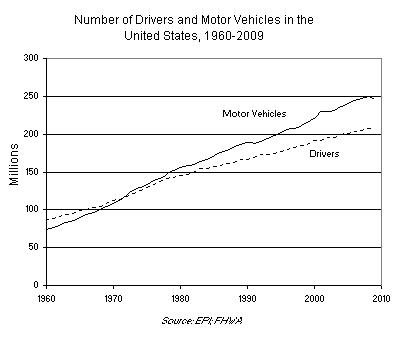
    Future U.S. fleet size will be determined by the relationship between two trends: new car sales and cars scrapped. Cars scrapped exceeded new car sales in 2009 for the first time since World War II, shrinking the U.S. vehicle fleet from the all-time high of 250 million to 246 million. It now appears that this new trend of scrappage exceeding sales could continue through at least 2020. (See data.)

    Among the trends that are keeping sales well below the annual figure of 15–17 million that prevailed from 1994 through 2007 are market saturation, ongoing urbanization, economic uncertainty, oil insecurity, rising gasoline prices, frustration with traffic congestion, mounting concerns about climate change, and a declining interest in cars among young people.

    Market saturation may be the dominant contributor to the peaking of the U.S. fleet. The United States now has 246 million registered motor vehicles and 209 million licensed drivers—nearly 5 vehicles for every 4 drivers. (See data.) When is enough enough?

    Number of Drivers and Motor Vehicles in the United States, 1960-2009

    Japan may offer some clues to the U.S. future. Both more densely populated and highly urbanized than the United States, Japan apparently reached car saturation in 1990. Since then its annual car sales have shrunk by 21 percent. The United States appears set to follow suit. (See data.)

    The car promised mobility, and in a largely rural United States it delivered. But with four out of five Americans now living in cities, the growth in urban car numbers at some point provides just the opposite: immobility. The Texas Transportation Institute reports that U.S. congestion costs, including fuel wasted and time lost, climbed from $17 billion in 1982 to $87 billion in 2007.

    Mayors across the country are waging a strong fight to save their cities from cars, trying to reduce traffic congestion and air pollution. Many are using a “carrot-and-stick” approach to reduce costly traffic congestion by simultaneously improving public transportation while imposing restrictions on the use of cars.

    Almost every U.S. city is either introducing new light rail lines, new subway lines, or express bus lines, or they are expanding and improving existing public transit systems in order to reduce dependence on cars. Among the cities following this path are Phoenix, Seattle, Houston, Nashville, and Washington, D.C. As urban transit systems expand and improve, commuters are turning to public transit as driving costs rise. Between 2005 and 2008, transit ridership climbed 9 percent in the United States. Many cities are also actively creating pedestrian and bicycle-friendly streets, making it easier to walk or bike to work.

    Forward-looking cities are also reconsidering parking requirements for new buildings. Washington, D.C., for example, has rewritten its 50-year-old codes, reducing the number of parking spaces required with the construction of both commercial and residential buildings. Earlier codes that once required four parking spaces for every 1,000 square feet of retail space now require only one.

    As parking fees rise, many cities are moving beyond coin-fed parking meters and replacing them with meters that use credit cards. The nation’s capital is making this shift in early 2010 as it raises street parking fees from 75¢ to $2 per hour.

    Economic uncertainty makes some consumers reluctant to undertake the long-term debt associated with buying new cars. In tight economic circumstances, families are living with two cars instead of three, or one car instead of two. Some are dispensing with the car altogether. In Washington, D.C., with a well-developed transit system, only 63 percent of households own a car.

    A more specific uncertainty is the future price of gasoline. Now that motorists know that gas prices can climb to $4 a gallon, they worry that it could go even higher in the future. Drivers are fully aware that much of the world’s oil comes from the politically volatile Middle East.

    Perhaps the most fundamental social trend affecting the future of the automobile is the declining interest in cars among young people. For those who grew up a half-century ago in a country that was still heavily rural, getting a driver’s license and a car or a pickup was a rite of passage. Getting other teenagers into a car and driving around was a popular pastime.

    In contrast, many of today’s young people living in a more urban society learn to live without cars. They socialize on the Internet and on smart phones, not in cars. Many do not even bother to get a driver’s license. This helps explain why, despite the largest U.S. teenage population ever, the number of teenagers with licenses, which peaked at 12 million in 1978, is now under 10 million. (See data.) If this trend continues, the number of potential young car-buyers will continue to decline.

    Beyond their declining interest in cars, young people are facing a financial squeeze. Real incomes among a large segment of society are no longer increasing. College graduates already saddled with college loan debt may find it difficult to get the credit to buy a car. Young job market entrants are often more interested in getting health insurance than in buying a car.

    No one knows how many cars will be sold in the years ahead, but given the many forces at work, U.S. vehicle sales may never again reach the 17 million that were sold each year between 1999 and 2007. Sales seem more likely to remain between 10 million and 14 million per year.

    Scrappage rates are easier to project. If we assume an auto life expectancy of 15 years, scrappage rates will lag new sales by 15 years. This means that the cars sold in the earliest of the elevated sales years of 15–17 million vehicles from 1994 through 2007 are just now reaching retirement age. Even though newer cars are more durable than earlier models, and may thus stay on the road somewhat longer on average, scrappage rates seem likely to exceed new car sales through at least 2020. Given a decline of 1–2 percent a year in the fleet from 2009 through 2020, the U.S. fleet could easily shrink by 10 percent (25 million), dropping from the 2008 fleet peak of 250 million to 225 million by 2020.

    At the national level, shrinkage of the fleet combined with rising fuel efficiency will reinforce the trend of declining oil use that has been under way since 2007. This means reduced outlays for oil imports and thus more capital retained to invest in job creation within the United States. As people walk and bike more, it will mean less air pollution and fewer respiratory illnesses, more exercise and less obesity. This in turn will also reduce health care costs.

    The coming shrinkage of the U.S. car fleet also means that there will be little need to build new roads and highways. Fewer cars on the road reduces highway and street maintenance costs and lessens demand for parking lots and parking garages. It also sets the stage for greater investment in public transit and high-speed intercity rail.

    The United States is entering a new era, evolving from a car-dominated transport system to one that is much more diversified. As noted, this transition is driven by market saturation, economic trends, environmental concerns, and by a cultural shift away from cars that is most pronounced among young people. As this evolution proceeds, it will affect virtually every facet of life.

    Copyright © 2010 Earth Policy Institute

  • The IPCC report was wrong…but the Himalayan glaciers are retreating

    By Barbara Kessler
    Green Right Now

    OK, I admit, I didn’t want to wade into this slush.

    I was aware, as most of you no doubt are, that the IPCC (that’s the Intergovernmental Panel on Climate Change) has been caught in a few mistakes recently. And I was concerned, because we reporters rely on the IPCC’s reports — especially that last one from 2007. The one that many scientists believe underestimates what will happen with climate change.  We rely on it because it’s based on the efforts of hundreds of peer-reviewed reports by scientists around the world and it’s widely considered to be the best forecast we have of what climate change might bring.

    Of course, I had trouble hearing myself think in the din of cheers from climate skeptics, who were already reveling in record snows in the U.S. (The naysayers conveniently ignore that extreme weather patterns are predicted by global-warming models.) They shout from the stands, as though this were a junior high wrestling match instead of a serious discussion of what’s true or not, or reasonable to believe, about the future of the planet.

    I mean, a little gravitas would have been nice.

    We did get a serious response from chief climate skeptic U.S. Sen. James Inhofe, (around the same time his family was building an igloo to taunt Al Gore).

    Inhofe on the Senate floor: “The ramifications of the IPCC [problems] spread far and wide, most notably to the Environmental Protection Agency’s finding that greenhouse gases from mobile sources endanger public health and welfare.  EPA’s finding rests in large measure on the IPCC’s conclusions-and EPA has accepted them wholesale, without an independent assessment.”

    His criticism seems fair, actually. If the EPA were relying just on the IPCC for its conclusions that greenhouse gases are dangerous, then we’ve got a problem.

    Except it isn’t. The agency does turn frequently to the IPCC report, because it’s the big compendium on the topic, composed by a worldwide network of top scientists, who aren’t all of one mind, who are fallible, yes, but have been working for decades to put various pieces together. The IPCC experts are studying everything from the bleaching coral in the acidifying Pacific to the speed of glaciers breaking off in Greenland.

    The EPA’s State of the Knowledge report to the public indeed leans heavily on IPCC findings. But its discussion of the Health and Environmental Effects of Climate Change points to our own U.S. agencies that monitor the weather and the nation’s natural resources. Much of this info is gathered together by the U.S. Global Change Research Program. (Which is worth checking out if you want to know more. You’ll be reassured that scientists and policymakers are trying to tease out what’s true, what’s likely and what’s less likely to transpire with climate change.)

    As my teenagers would say, the EPA staff are not idiots, they know they need multiple sources.

    But back to the IPCC. Without rehashing everything that’s gone on, it is clear that mistakes have been made.

    Here’s a look at one of them: In its 2007 report the IPCC says the Himalayan glaciers could vanish by 2035. The IPCC drew that information from a World Wildlife Fund report, which had relied on another report — that had inaccurately cited yet another report, which was in hieroglyphics.

    I’m kidding about the hieroglyphics. The reports don’t go back quite that far.

    The bottom line: You could barely follow the chain of custody here, let alone find the solid science calculating that the Himalayan glaciers would be gone by 2035. It was, in the end, speculation. And more than a few someones were lazy in vetting this information at WWF and the IPCC. (Read the WWF’s explanation for more detail.)

    So what is the truth? According to one peer-reviewed report, the  Himalayan glaciers are losing mass, which could be very bad for the half billion people who depend on them for water.

    And this is most likely (some would say almost certainly) caused by climate change, and also possibly soot from little cooking stoves used in that part of the world.

    The climate change, by the way, is most likely caused by human-created carbon emissions.

    At what point does this science become fact? When the weight of the science shows — even despite some missteps, a few jealous colleagues withholding evidence, occasional hyperbole and a few related bugs and warts — that climate change is happening.

    I was convinced awhile back. I think the IPCC’s failings are worrisome. But I understand that science is a process — steered by humans. At some point, we need to jump, and run with the solutions. While we can.

    Copyright © 2010 Green Right Now | Distributed by GRN Network

  • Promises made in Copenhagen shouldn’t stay in Copenhagen

    By Barbara Kessler
    Green Right Now

    When the Copenhagen Climate Conference ended in mid-December, it was widely decried by climate activists as embarrassingly inconclusive, at best, and a failure at worst (you can’t get much worse than that).

    And yet, there were plenty of voices, including that of President Obama, urging everyone to hold tight and pointing out that alliances had been formed and the world’s major polluters had stepped up, however tentatively. They had issued hard numbers, a percentages by which they would try to rollback greenhouse gas emissions.

    And that’s what it’s all about, reeling in those emissions. So despite the chaos, the under-achieving, the low-ball aspirations, the feinting and ducking, the world’s leading nations, including previously absent U.S., stepped up to the plate. You could say they hit a series of ground balls, but at least they took the bat.

    These nations were asked to officially record their promises by signing the Copenhagen Accord by the end of January. This follow-up event was anti-climatic and received less media attention.

    But the end result was that the emissions targets were documented and recorded for posterity — and hopefully for prosperity. (That’s what everyone seems to forget, that we need to forgo the pollution so we and future generations can live long and prosper, not so we can have higher electric bills.)

    photo-jschmidt

    NRDC International Climate Policy Director, Jake Schmidt

    Anyway. This week, in his blog, Jake Schmidt, director of the NRDC’s International Climate Policy, writes that 60 countries have firmed up their pledges in the final document; including the top 12 carbon-emitting nations.

    Schmidt and the NRDC have put together a table of these commitments to emphasize that world leaders are somewhat  (actually literally) on a page.

    “These countries are the “big players” which almost single-handedly hold the key to solving global warming.  The steps they take are critical.  So let me repeat: countries representing over 80% of the world’s emissions have just committed to steps to reduce their global warming pollution. As I’ve discussed here, this is a huge shift from where we were just 2 years ago (and even 6 months ago).  That is something to build upon since the key to solving global warming is whether or not key countries are committing to take action.”

    But Schmidt knows that “commitments” and “action” can wave at each other over a large chasm. He says environmentalists must just get out there and start proving that reducing GHGs can create jobs and won’t wreck the economy.

    Then we’ll see our government follow along.

    (Stay tuned for more hopeful musings by another blogger, who says that this leadership by the public is already happening — especially in the business sector.)

    Copyright © 2010 Green Right Now | Distributed by GRN Network

  • TD Bank investing in green

    TD Bank

    TD Bank is going carbon neutral and building LEED-qualified banking centers

    From Green Right Now Reports

    TD Bank, which touts itself as America’s Most Convenient Bank, has decided to build its next branches to green building standards, the corporation announced today at its first green branch in Farmingdale, N.Y..

    The bank, with more than 1,000 stores from Maine to Florida, will be opening another green store, a prototype for more to come, at 214-32 Jamaica Ave., Queens Village, N.Y., this spring.

    TD Bank, with headquarters in Cherry Hill, N.J. and Portland, Maine, declared that its entire operation will now be carbon neutral, via its greener buildings, lowered energy consumption and purchases of renewable energy.

    The bank expects to open another five to 10 new green stores in 2010, the majority of which will be submitted for LEED certification at the platinum level.

    Those new branches will include features such as wood from sustainably managed forests, low VOC building materials, insulated glass to cut heat gain and sensors to control lighting.

    The Queens prototype store, and subsequent stores, will have a solar canopy over the drive-through lanes that will generate electricity (hey customers be sure to cut the engine while waiting in line). The Queens location also will have secure bike parking, efficient plumbing and drought-tolerant landscaping.

    In 2011, “the vast majority of new TD Bank stores constructed will be LEED certified” and all stores thereafter will be LEED qualified, the bank reported. TD Bank already opened LEED certified offices at 200 State Street in Boston, and it is buying enough wind power to run its entire network of 2,600 Automated Teller Machines (ATMs).

    TD Bank’s new 3,800 square-feet stores based on the Queens prototype will reduce energy consumption by 50 percent compared with previous designs, the company estimated, with nearly 20 percent of the store’s energy being produced on-site through solar panels and those solar drive-through canopies.

    Tapping the sun. Now that’s convenient.

  • Congressmen request fracking fluid info from natural gas companies

    By Barbara Kessler
    Green Right Now

    Congressmen Henry A. Waxman (D-Calif.) and Edward Markey (D-Mass.) are asking for more information about the chemicals used to extract natural gas wells.

    urban gas well outside a mall in North Texas

    Urban gas well outside a mall in North Texas

    Today, the two lawmakers sent letters to eight oil and natural gas companies requesting details of the ingredients used in hydraulic fracturing, a method of accessing natural gas deposits by blasting or fracturing the rock with a high pressure injection of water treated with chemicals.

    The practice has come under scrutiny as natural gas drilling for shale deposits has encroached upon urban areas and watersheds in Texas (in the Barnett Shale region) and in the Northeast (the Marcellus Shale region). A  2005 law exempted oil companies from disclosure of the contents of their “fracking fluid” formulas after Halliburton convinced the Bush Administration the formulas should be proprietary and Congress slipped in an amendment to an energy bill.

    This exemption to the Clean Drinking Water Act, known as the Halliburton loophole, has left the public in the dark about the current mix of chemicals used in fracturing, and in affected regions, many residents are concerned that natural gas operations could contaminate the air and underground water supplies. (A house bill has been introduced to repeal the loophole, The Natural Resources Defense Council is running a campaign where citizens can register their support for lifting the exemption.)

    Benzene, a known carcinogen, is one chemical typically used in  fracking operations. Dozens of other toxic chemicals are employed. In an earlier request to Halliburton, BJ Service and Schlumberger, Waxman and Markey found that Halliburton and BJ were using toluene, ethylbenzene and xylene — all of which are considered environmentally harmful.

    The response to that earlier request also revealed that the companies were using seven diesel-based fluids, potentially in defiance of a voluntary agreement with the EPA to not use those pollutants, according to a press release from Waxman’s office.

    “Hydraulic fracturing could help us unlock vast domestic natural gas reserves once thought unattainable, strengthening America’s energy independence and reducing carbon emissions,” said Waxman, chairman of the House Committee on Energy and Commerce, in a news release.

    “As we use this technology in more parts of the country on a much larger scale, we must ensure that we are not creating new environmental and public health problems.  This investigation will help us better understand the potential risks this technology poses to drinking water supplies and the environment, and whether Congress needs to act to minimize those risks.”

    “Natural gas can play a very important role in our clean energy future, provided that it is produced in a safe and sustainable way,” said Markey, chair of the subcommittee on Energy and the Environment.

    The natural gas industry has argued that regulation of fracking fluids is not needed because the vast majority of fluids are removed from the well and systematically disposed of. A recent report by ProPublica, however, challenged that contention, citing  industry experts who told ProPublica that 85 percent of the fluids used remain in the ground.

    The Congressional requests for additional information sent out today are going to Halliburton, BJ Service, Schlumberger and five other companies providing services in the natural gas field, Frac Tech Services, Superior Well Services, Universal Well Services, Sanjel Corporation, and Calfrac Well Services.

    The Environmental Defense Fund praised Waxman and Markey for their efforts to drill for more info.

    “We commend Chairman Waxman and Subcommittee Chairman Markey for this important step. There is no reason that gas producers need to run roughshod over the environment in order to increase natural gas supplies,” said EDF Senior Policy Advisor Scott Anderson.

    “Because the problem of global warming is so severe and the time for action so short, all low and lower carbon energy options, including natural gas, should be considered as part of the nation’s energy mix, but only if such options can be accomplished without significant adverse health or environmental impacts.”

    Copyright © 2010 Green Right Now | Distributed by GRN Network

  • Calling out cell phones on radiation

    From Green Right Now Reports

    Whether or not cell phone radiation presents a human health risk remains one of those dangling  public health questions. Some studies have suggested that longtime users of cell phones face an increased chance of developing brain or salivary gland cancers. But many others have found no link, prompting some public health groups to give cell phone a clean bill.

    Motorola Droid at the high end of the radiation scale at 1.49 SAR when held at the ear

    Motorola Droid at the high end of the radiation scale at 1.49 SAR when held at the ear

    In the absence of a clear signal either way, and in the  belief that we’d be better off to err on the side of caution, the Environmental Working Group analyzed the radiation from some of the newest model cell phones.

    The results, released today, show that some of the top-rated, do-everything phones emit some of  highest levels of radiation.

    “Motorola Droid, Blackberry Bold 9700, HTC Magic and LG Chocolate Touch, hyped as the latest and greatest new cell phones in 2010, rate high marks from tech experts for performance and features,” the EWG reported in a news release.

    “But the flashy ads don’t disclose that these new models top the radiation charts. EWG has found that all four phones’ emissions are pushing the edge of radiofrequency radiation safety limits set by the Federal Communications Commission (FCC).”

    The EWG is proposing a solution, inform consumers at the point of sale about a phone’s radiation ratings.

    “A number of health agencies around the world advise people to reduce exposures to cell phone radiation, driven by recent studies raising questions about the safety of this radiation, particularly for children,” said Jane Houlihan, senior vice president for research at Environmental Working Group.

    “That’s why it’s essential for consumers to have radiation output information before they purchase phones for themselves and their families.”

    California and San Francisco officials are already discussing potential disclosure requirements. Those would require that the radiation emitted — technically known as the Specific Absorption Rate or SAR, a calculation based on emissions ouput measure again a kilogram of body weight — be placed on a phone’s label.

    Federal law requires that a phone’s SAR level be disclosed to the FCC, but this information rarely makes it to consumers, the EWG says.

    Apple iPhone, middle of the pack of phone's analyzed by EWG

    Apple iPhone, middle of the pack of phone's analyzed by EWG

    The CTIA Wireless Association, however, points out that consumers can find a phone’s SAR rating online and more importantly, can be assured that any phone sold in the U.S. does not exceed the FCC’s limits for radiation exposure from cell phones, set at 1.6 watts per kilogram (1.6 W/kg).

    “The peer-reviewed scientific evidence has overwhelmingly indicated that wireless devices, within the limits established by the FCC, do not pose a public health risk or cause any adverse health effects,” said John Walls, vice president of public affairs for CTIA-The Wireless Association. “That is why the leading global heath organizations such as the American Cancer Society, National Cancer Institute, World Health Organization and the U.S. Food and Drug Administration all have concurred that wireless devices are not a public health risk.”

    One ripple in the theory that cell phone use is safe: People haven’t been using them that long, leaving a lack of long-term studies.

    The EWG maintains that given the unknowns, labeling phones would better serve consumers by helping them sort out the high radiation phones from lower-emitting phones.

    The non-profit public advocacy group argues that users need this information at least as much as they need the details of a phone’s features and aesthetics.

    Motorola Brute, lowest on the list for radiation

    Motorola Brute, lowest of those tested for radiation at 0.86 W/kg

    There is good news in the EWG report. Three of the new 2010 phones — the Motorola Brute, Pantech, Impact and Samsung Mythic emit “significantly less radiation” than their higher-emitting competitors.

    Also, users of any cell phone can take steps to limit dangerous exposure.

    By texting, instead of talking, and using headsets or the speaker mode, phone users can limit the amount of time their phone is in direct contact with their head or body.

    See the EWG’s list of cell phone safety tips for more info on wise phone use.

    For more information in the debate over whether cell phone use increases one’s chance of brain, acoustic or salivary gland cancers, see this recent article in New Scientist magazine.

  • ‘Slow Death by Rubber Duck,’ a tale about the chemicals within us

    By Barbara Kessler
    Green Right Now

    Concerned about all those dangerous household chemicals you keep hearing about: BPA, phthalates and pesticides with cryptic names like 2,4-Dioxane?

    We’ve found just the book for you.

    Slow Death By Rubber Duck:The Secret Danger of Everyday Things (Counterpoint, 2009. U.S. $25) will take you on a chilling, but informative ride through our chemically enhanced consumer product world. Starting with your kid’s Rubber Duck, which contains five chemicals of concern, imagine what the rest of the household contains.

    cover_medFrankly, I worried that this cleverly titled book about the dangerous additives lurking in our house dust, furniture, hand soaps and Teflon pans would be just that, an inspired title followed by surface information. But I was quickly relieved of that concern. Co-authors Rick Smith and Bruce Lourie are not just scratching the stick-resistant surface here.

    Dr. Smith, executive director of Environmental Defence Canada, and Lourie, a longtime environmental adviser to governments and corporations, look at how dangerous chemicals got into our products — because they were invented! and people wanted eggs that slipped off pans before we knew much about the chemistry of those pans, and manufacturers wanted to protect us from flaming couches by dousing them with flame retardants, now linked to increased cancer risks and neuro-motor deficits in children. And, well, there’s a story behind every chemical load in every product. The takeaway: Often these added chemicals are needless, or of dubious added value.

    Perhaps more importantly, Smith and Lourie looked at how toxic ingredients leap from consumer goods into our bodies. Despite the reassurances of manufacturers that PBDEs (flame retardants), Teflon and Bisphenol A remain locked into their respective products, scientific studies have revealed that PBDEs turn up in household dust; Teflon fumes can fry not only eggs but the lungs of pet birds and BPA, as you’ve likely heard, leaches from polycarbonate plastic containers, getting into food and drinks. (and it’s in the resin lining food cans everywhere.)

    Our Rubber Duck guides don’t just recite that science, or take it on faith, they test it. Smith and Lourie become the guinea pigs for their inquiry, exposing themselves systematically to common problem ingredients and then having their urine and blood tested to see whether their levels of contamination increased.

    For instance, Smith tested his levels of phthalates, a plastics-additive found in toys and dozens of  body products, before and after exposing himself to a pre-selected list of highly scented deodorants, toiletries, dish soap and an air fresheners containing phthalates.

    His levels of one type of phthalate, DEPs (diethyl phthalates, which turn up in the body as MEPs, monoethyl phthalates, and which have been linked to male reproductive problems) shot through the roof.

    “It worked all right,” Smith writes. “I was actually shocked at the results…And my little experiment showed how amazingly easy it is to dramatically crank up levels of MEP after a simple change in toiletries for two days. Who knew that conditioning your hair could be hazardous to your health?”

    Of course, the upside is, if you can make the levels of chemicals in your body go up, you can also make them go down, in many cases, as the authors also demonstrate.

    I don’t want to spoil other outcomes here, but let’s just say, Smith and Lourie’s findings ranged from interesting to hair-raising. Their escapades with phthalates, flame retardants,  BPA, Teflon, mercury, anti-microbials and pesticides, were at turns humorous and dismaying. It left me riveted. I grew so fond of this book, I threw over my usual fiction for several nights running to curl up with the adventures of these chemical detectives.

    And while I was provided a free review copy of the book, that will hardly cover the cost of the stainless steel pans I’ll now be buying to replace my non-stick set. Hmmpff!

    Copyright © 2010 Green Right Now | Distributed by GRN Network