Author: Hailey Reissman

  • Meet the new meat: A TEDx talk on the first lab-grown hamburger

    Yesterday, the first lab-grown hamburger was cooked. And eaten! And according to The Week, it didn’t taste too bad. This lab-grown patty took two years and $325,000 to produce. And as sources revealed, the money came from Google co-founder and TED speaker Sergey Brin. (Watch his talk on Google Glass, or his talk with Larry Page on the genesis of Google.)

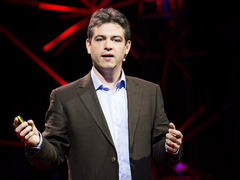
    But the TED connection doesn’t end there. The burger is a product of Cultured Beef, a project born at Maastricht University in The Netherlands and headed by Mark Post, a specialist in tissue engineering.  At TEDxHaarlem, Post gave a talk called “Meet the new meat,” during which he introduced Cultured Beef to the world and explained the process behind its growth. He also discussed the future he envisions for in-vitro meat.

    Here’s an excerpt from his talk, featured above:

    “This hamburger contains 60 billion cells. Now, that’s a lot. You need to culture a lot of cells. You need to somehow find a way to do that efficiently because, remember, we have to be more efficient than the cow or the pig…

    It has to be efficient and it has to also be meat. Not some kind of substitute. We have more than enough substitutes from vegetable proteins. It needs really to be meat. Nothing less, nothing more…

    It takes about 7-8 weeks to grow a muscle fiber, and so, also 7-8 weeks to grow a hamburger. You could do it at home if you like … If you have the right materials, it’s very, very easy to do. And in fact [the] stem cells … they survive freeze-drying, so you could envision that over the Internet we would eventually sell little, sort of, tea bags of stem cells — from tuna, from tiger, from cows, from pigs, from whatever animal you could imagine. Then, in the comfort of your own kitchen, you could grow your own tissue. You would have to know what you want to eat 8 weeks in advance — because it takes a while.”

    For more about Cultured Beef, watch Professor Post’s TEDx talk, or take a look at the website.

    This post originally ran on the TEDx Blog. Read more there »

  • I used to think I couldn’t get out of hell: Chicago public school students react to TEDxYouth@Midwest

    TEDxYouth@Midwest-1

    Jullien Gordon, a founding partner of New Higher, says on the TEDxYouth@Midwest stage , “Our generation has two choices, we can hope or we can hustle.”

    Earlier this month, 450 Chicago public school sophomores and juniors, plus 120 of their teachers, crowded into the city’s Harris Theater for TEDxYouth@Midwest, an event all about inspiring, motivating and empowering the young people of a city known for youth gun violence, but full of so much more — culture, history, educators and students dedicated to helping their city thrive.

    Chicago’s public schools have been a fixture in the news lately. 54 schools in the city are slated to close in 2013, and according to reports in The Chicago Tribune, the 2011-12 school year brought the highest number of public school students affected by gunfire since 2008. Twenty-four students were killed; 319 students shot.

    At TEDxYouth@Midwest, organizers strove to turn the focus from problems, and keep it focused on the potential. 17 speakers addressed the audience, including people like guerrilla gardener Ron Finley, who is planting gardens in South Central LA; Dr. Benjamin Harrison, a researcher working on growing replacement tissue for patients who have lost their own; and Chicago native Zoe Damacela, who started her own apparel line as a high school student in the city.

    This year, TEDxYouth@Midwest launched their TEDxMidwest Youth Connections Program, a project pairing TEDxYouth@Midwest students with career experiences designed to open the doors to potential careers — from job shadowing to summer internships to discussions with local entrepreneurs. Through the program, 35 TEDxYouth@Midwest student attendees found summer internships and, next year, the team at TEDxYouth@Midwest hopes to raise that number to 100.

    “The event was levels better because of the students’ infectious energy, and its potential to really have a life-changing effect on hundreds of kids and teachers,” said organizer Mike Hettwer. “The speakers were so motivated to speak there.”

    The immediate effects of the event shone in students’ responses to comment cards asking how their thinking changed throughout the event. Some of their responses are truly incredible. A sampling:

    I used to think… “That once you made a bad decision, that was it for you. People say you write your life’s story in ink — if you make a mistake there is no way to erase it. You are done!”
    Now I think… “That I should no longer aim for perfection, but rather strive for success. Success is not measured by how many times you fall, but actually choosing to get up once more then you fall.” 

    I used to think…”That you have to use violence in order to make peace.”
    Now I think… “But I realize that I can use peace to make peace.”

    I used to think… “That because I am considered a minority, I would not be able to do amazing things I really want to do.”
    Now I think… “That I can do anything I set my mind to if I do not let anything hold me back. Only I can prevent myself from achieving my goals and my passion.”

    I used to think… “I couldn’t get out of Hell.”
    Now I think… “I can with Mellody Hobson’s speech.”

    I used to think… “I was one of the few teenagers passionate about science.”
    Now I think… “TED is all about diversity of ideas and other people are as passionate about science as I am.”

    I used to think… “If you come from a broken home, would live in a broken future.”
    Now I think… “You can shape your own future and get away from the brokeness.”

    I used to think… “This was going to be a long boring program with weird snacks.”
    Now I think… “This experience has been the best experience in my whole entire life.”

    The audience at TEDxYouth@Midwest was made up of sophomores and juniors.

    The audience at TEDxYouth@Midwest was made up of sophomores and juniors.

    TEDxYouth@Midwest-2

    Dave Gallo, Director of Special Projects at Woods Hole Oceanographic Institution (WHOI) talks about the deep sea and its deep secrets.

    One of the amazing comment carders from TEDxYouth@Midwest.

    One of the amazing comment carders from TEDxYouth@Midwest.

    Read much more about TEDx and its extraordinary constellation of events on the TEDx Blog »

  • Bosons, bicycles and big data: 7 things I learned from TEDxCERN

    Backstage at TEDxCERN

    There’s a place in Switzerland where scientists travel on bicycles through tunnels filled with atom-smashing tubes, where the first webpage was born, and where a giant wooden globe watches over researchers replicating the very beginnings of our universe. That place is CERN, the European Laboratory for Particle Physics, and last Friday, it held its first TEDx event: TEDxCERN.

    At the event, 23 speakers and performers — including a Nobel laureate, an Ig Nobel Prize founder, a Google Science Fair winner, and an opera singer — gathered together in CERN’s Globe of Science and Innovation to talk about the Higgs boson, science education, classifying galaxies, and — naturally — an analysis of the forces required to drag sheep.

    So what did we at TED HQ learn at TEDxCERN? A lot. But to make things easy, here are seven takeaways from TEDxCERN:

    1. In 2010, when prompted to draw a “scientist,” only 33% of schoolchildren asked drew a woman.
    In 1980, the figure was 8%. At TEDxCERN, Londa Schiebinger, head of the Gendered Innovations project at Stanford University, talked about some of the issues women in the sciences face today, and the importance of recognizing gender bias in science and technology.

    2. Animated elephants and double scoops of ice cream make pondering particle physics a lot more palatable.
    Thanks to a collaboration between the whip-smart scientists at CERN and the talented animators at TED-Ed, four new TED-Ed lessons premiered at TEDxCERN — bringing mind-boggling concepts like antimatter, big data, the Higgs boson, and the origins of the universe to life in a way that even the most science-averse student could appreciate: with chocolate-almond ice cream, a lemon, and a giant pile of leaves.

    3. Brian May from the band Queen is an astrophysicist.
    Yeah, we didn’t know that either. But thanks to a talk from Zooniverse head Chris Lintott, we learned that not only is May a card-carrying astrophysicist (he earned a Ph.D. in astrophysics from Imperial College in 2007), he is a fan of Lintott’s Galaxy Zoo project — a herculean effort to gamify and crowdsource galaxy classification.

    4. Science goes beyond geography.
    People called SESAME (Synchrotron-light for Experimental Science and Applications in the Middle East) “an impossible project.” But this lab in Jordan, built around a giant synchrotron particle accelerator, has brought together Israeli, Jordanian, Palestinian, Turkish, Pakistani and Iranian scientists to study a universe bigger than us all. At TEDxCERN, SESAME scientists Eliezer Rabinovici and Zehra Sayers talked about the project’s groundbreaking work.

    5. Cool teachers bring their students on field trips via Google Glass.
    Physics class can be boring. But not so much if your teacher is Andrew Vanden Heuvel, the TEDxCERN presenter and online physics teacher who traveled to Switzerland to give his students a live tour of the world’s largest particle collider live through his eyes, using Google Glass. At TEDxCERN, we got to see a video diary of his trip, and it is mesmerizing:

    6. Herrings communicate by farting. Really.
    When you’re a scientist, what you think you’re looking for isn’t always what you find, and Marc Abrahams — organizer of the Ig Nobel Prize, the annual celebration of “improbable” science — thinks this is awesome. At TEDxCERN, he spoke on improbable findings, and shared some surprising discoveries by past Ig Noble winners, including one Robert Batty, who — with his team at the Scottish Association for Marine Science — discovered that strategically released gas allows herrings to communicate at night.

    7. The Higgs field is a big deal. In fact, if its value changed too much, it’s quite possible “all atomic matter would collapse.”
    Theoretical physicist Gian Giudice knows a lot about the Higgs boson, the Higgs field, and researchers’ attempts to understand it better. At TEDxCERN, he pondered the question, “What might the Higgs mean for the fate of the universe?” and got us all flustered when he said that new discoveries about the famed boson might mean that someday the value of the Higgs field could change and all would be doomed. But not to worry — whatever happens, we’ve got a lot of time before it does.

    For more dispatches from TEDxCERN, including some killer photos, visit the website or check out their Facebook or Instagram.

  • How the TED Machine was built


    When illustrator/storyteller Oliver Jeffers and animator/woodworker Mac Premo get together, sketchbooks travel 60,000 miles, suitcases wander the streets of Brooklyn and sandwiches are skewered with bows and arrows.

    Jeffers and Premo created the opening video for TED2013 — and its star,  the TED Machine. The TED Machine works like a schedule board in an old train station — with panels that reveal, with each new flip, the names of the 72 speakers and performers at TED2013 in squiggly handwriting. In the video above, the machine comes to life in stop-motion animation, revealing a magical world filled with ukelele strumming and changing backdrops. At TED2013, the video — which has a homespun charm a bit different from TED’s regular polished punch — elicited the kind of ‘oohs’ and ‘ahhs’ normally reserved for fireworks displays.

    On Monday, New York creative types crowded the workshop space of Manhattan’s 14th Street Apple Store for an evening with Jeffers, Premo, and TED’s  Design Director Mike Femia, for a conversation about building the machine and where to find the best trash in the city. During the event, Jeffers and Premo revealed how they met (at summer camp); what they do when they’re not making art (they make hot dogs text); and how they pitched their idea for the TED machine.

    Being asked to create the TED2013 opening sequence was nerve-wracking, Premo told the crowd, but he and Jeffers knew it would be a great opportunity to stretch their creative muscles. “TED is the most intellectually-stimulating blitzkrieg in the world,” he said. “And we had to make a film that encapsulates it.”

    So they set out to build the TED Machine by doing what they do best: Premo taking on the woodwork and Jeffers creating a collage — something they had to physically attach to the 72 rotating “name bumpers” on the machine, because as Premo said, “We needed the things to turn.”

    In the end, filming took five days (note: this is a 72-second long video!) and even included a trip to Coney Island in 7 degree weather.

    Femia explained what drew the design team at TED to Premo and Jeffers in the first place — they were impressed by the hand-painted wooden map that the two had created for TED Prize winner JR to track his Inside Out project. The piece eventually became a landmark of the design for the 14-city TED Worldwide Talent Search.

    “The moment before talks start at a TED conference is very dramatic,” Femia explained. “People are settling into their chairs; the lights are getting dim. We asked ourselves, ‘How could we make it special?’”

    Femia said he knew Premo and Jeffers were right for the job because of their ability to tell a story with their art. “What I like about their work,” Femia said, “is that it’s explanatory — it celebrates the process, the messiness, the dirtiness.”

  • 6 reasons to watch TEDxCERN this Friday

    TEDxCERN-location

    TEDxCERN will be held inside CERN’s world-famous Globe. Photo: TEDxCERN

    You have probably heard of CERN — the European Organization for Nuclear Research and the home of the Large Hadron Collider (LHC), the world’s largest and most powerful particle accelerator that is longer than the island of Manhattan. CERN and LHC are famous for their role in the recent discovery of what very likely is the Higgs boson, a particle crucial to the standard model of physics. But now, CERN will house another exciting first: their first TEDx event.

    This Friday, May 3, CERN will bring together thinkers of all kinds to examine our universe and provide insight into why studying it matters. And lucky for you, you don’t have to go to Switzerland to watch in real time. The program will stream live online at the TEDxCERN website from 13:45  to 20:00 (CEST).

    So why should you tune in?

    1. Because of the incredible speaker lineup. CERN has invited 23 great speakers and performers to the stage. Some highlights of the lineup:

    • Philosopher John Searle, the winner of the 2004 National Humanities Award
    • Astrophysicist George Smoot, cosmologist and Nobel Prize laureate
    • Chris Lintott, the head of Zooniverse at Oxford University and co-presenter of the BBC’s Sky at Night program
    • Marc Abrahams, MC of the Ig Nobel Awards and editor of the Annals of Improbable Research
    • 18-year-old Britney Wegner, grand prize winner of the 2012 Google Science Fair
    • Sergio Bertolucci, director for research and scientific computing at CERN

    2. Because the venue will be thrilling. TEDxCERN will take place at the Globe of Science and Innovation on the CERN campus in Geneva. This giant wooden globe — about the size of the Sistine Chapel — was first constructed for the 2000 World Exhibition in Hanover, but now stands as a stirring tribute to the groundbreaking work happening at CERN’s headquarters every day. Says the CERN website, “A landmark by day and by night, the Globe … sends a clear message on science, particle physics, cutting-edge technologies and their applications in everyday life.”

    3. Because they make understanding particle physics child’s play. Part of CERN’s mission is making the work done there accessible to those who don’t have a deeply-honed understanding of particle physics. To that end, CERN scientists have teamed up with the animators of TED-Ed to create five easy-to-understand (and fun-to-watch) lessons that explain concepts like the Big Bang, dark matter, big data and Higgs boson. The first of these lessons, “The beginning of the universe, for beginners,” is currently available via TED-Ed. The other four lessons will premiere at TEDxCERN — those watching live will be the first to see ‘em.

    4. Because CERN is part of the reason we have the internet. Ever wondered who created that little thing called the World Wide Web? Tim Berners-Lee was a software engineer at CERN in the 1980s, when he proposed the idea to his bosses as a way to “reframe the way we use information.” Twenty years ago this week, CERN offered up the software required to run a web server, a basic browser, and a standard library of code — all royalty free. To celebrate the anniversary, CERN posted the very first public web page ever — dedicated to the “World Wide Web project itself.”

    5. Because Higgs boson is poised to change everything. In 2012, the media was abuzz with stories about the “god particle,” aka Higgs boson. This particle was theorized to exist in 1964 by six scientists, including one Peter Higgs. The existence of the particle would confirm the existence of the Higgs field, believed to surround everything, giving mass to elementary particles that, without it, would be massless. The discovery of Higgs boson is the beginning of a whole new field of research and several TEDxCERN talks will touch on where it’s headed. We’re looking forward to the talk, “What the Higgs might mean for the fate of the universe,” from theoretical physicist Gian Giudice.

    6. Because you won’t be alone. More than 25 universities, laboratories and organizations will be hosting TEDxCERN livestreaming parties, including TEDxAthens in Greece, the Indian Institute of Technology in Bombay, Università di Pavia in Italy, Kathmandu University in Nepal, the SLAC National Accelerator Laboratory in the United States, and even TED HQ here in New York! Take stock in knowing you’ll be watching along with some of the world’s leading scientists, researchers, and hard thinkers.

    Tune in to the TEDxCERN webcast on Friday, May 3rd. It will be available to the public here »

    For more information on TEDxCERN, visit their website, or follow them on Facebook or Twitter.

    TEDxCERN set-up, in progress. Photo: TEDxCERN

    TEDxCERN set-up, in progress. Photo: TEDxCERN

  • Rethinking the term ‘illegal’ immigrant: Because people can’t be illegal

    Last week, the Associated Press announced its decision to remove the term “illegal immigrant” from the AP Stylebook. In a blog post by Director of Media Relations Paul Colford, AP’s executive editor Kathleen Carroll revealed the news: “The Stylebook no longer sanctions the term ‘illegal immigrant’ or the use of ‘illegal’ to describe a person. Instead, it tells users that ‘illegal’ should describe only an action, such as living in or immigrating to a country illegally.”

    TEDx speaker and former Washington Post reporter Jose Antonio Vargas has been one of the outspoken critics of this term. At age 16, he found out he’d been brought to the United States illegally as a child. In a frank and moving talk given at TEDxMidAtlantic, “I am an illegal immigrant,” Vargas reveals what it’s like to “come out” as a person living in the United States without documentation, and explains his objections to using the word “illegal” to describe people.

    “It’s actually legally inaccurate to refer somebody as an illegal, because to be in this country without papers is a civil offense, not a criminal one,” he says. “As I stand here right now, there are tens of thousands of students across America who are here without papers, and I would hate to think that they’re sitting in their classrooms listening to us talk about them and internalizing the word ‘illegal.’ … It’s incredibly dehumanizing and pejorative and [so many connotations] come with it — negative, all of them. That we’re criminals. That we’re not supposed to be within even the block that you live in or the school that you go to. Actions are illegal — never people. Something is terribly wrong when we refer to people as ‘illegal.’”

    Watch Vargas’ talk, above.

  • Three reasons to watch TEDxChange tomorrow

    Melinda-Gates-at-TEDxChange

    Photo courtesy of TEDxChange

    TEDxChange, happening this Wednesday, April 3, is a global conversation on some of the most pressing and intractable health and equity issues in our world today — like access to clean water, to schools, to medicine, to technology and to information. Overall, the event will deliver inspiration to those who have the courage to believe that change is possible.

    The event, hosted by Melinda Gates, will begin at 9 am (PDT) at the Gates Foundation Campus in Seattle, Washington. The 90 minute program will stream live online at TED.com and TEDxChange.org.

    Why should you be one of the many people watching TEDxChange live?

    The theme: Positive Disruption. We all want our world to be a better place to live in. But most of us know that sometimes that’s easier said than done. Sometimes, it takes a shake-up to our assumptions, our traditions, our schedules, our values and our communities to get us to spring to action and make real change happen. This is where TEDxChange comes in. It’s that (positive) disruption to your regularly-scheduled program. RSVP to watch »

    You won’t be alone. More than 200 TEDxChange events will be bring together folks around the world in their schools, homes and businesses as they watch the TEDxChange livestream and discuss the ideas they hear in it. Find an event near you »

    The speakers.  Melinda Gates has traveled the world seeking out great speakers with bold ideas for change. Here is the speaker lineup:

    • Julie Dixon, director of Georgetown University’s Center for Social Impact Communication
    • Spoken-word poet David Fasanya
    • Halimatu Hima, Niger’s first Youth Parliament president
    • M. Cathleen Kaveny, a professor of law and of theology at the University of Notre Dame
    • Salim Shekh and Sikha Patra, 15-year-olds working to eradicate polio from their communities
    • Roger Thurow, author of the book Enough: Why the World’s Poorest Starve in an Age of Plenty

    Tune in tomorrow at 9:00 am (PDT) to watch TEDxChange »

    Or find a TEDxChange livestream event near you »

  • The courage to believe change is possible: A Q&A with Melinda Gates

    Melinda French Gates (right) speaks to TED's Chris Anderson. CourtesyoftheGatesFoundation

    Melinda French Gates (right) speaks to TED’s Chris Anderson. Photo courtesy of the Gates Foundation.

    Can a person change a world rife with problems — villages without basic healthcare, girls turned away from schools, hospitals unable to get life-saving vaccines to the people who need them? For three years, TEDxChange, a partnership between the Bill & Melinda Gates Foundation and the TEDx program, has said yes, by spotlighting people who are taking risks, thinking big ideas and making change happen.

    On Wednesday, April 3, the conversation continues at TEDxChange 2013: Positive Disruption. TEDxChange will begin at 9 am Pacific time, April 3, at the Gates Foundation Campus in Seattle and will stream live online at TED.com and TEDxChange.org. The program will run for 90 minutes.

    Hosted by Melinda Gates, TEDxChange features seven speakers:

    Julie Dixon, director of Georgetown University’s Center for Social Impact Communication;

    spoken-word poet David Fasanya;

    Halimatu Hima, Niger’s first Youth Parliament president;

    M. Cathleen Kaveny, a professor of law and of theology at the University of Notre Dame;

    Salim Shekh and Sikha Patra, 15-year-olds working to eradicate polio from their communities; and

    Roger Thurow, an author of the book Enough: Why the World’s Poorest Starve in an Age of Plenty and a recipient of Action Against Hunger’s Humanitarian Award.

    Around the world, you can gather at an independently organized TEDx event to watch a live broadcast of TEDxChange. This year, at 200 events in 65 countries, including Amsterdam, Kyoto, Delhi, Bogotá and New York, TEDxers will consider TEDxChange’s theme of Positive Disruption — the power of disruption for good. Spaces are still available at many of these events; to join the positive disruption and find a TEDxChange livestreaming event near you to attend, click here.

    Here, TEDxChange host Melinda Gates chats with TED Curator (and former TEDxChange host) Chris Anderson to talk about positive disruption. Below, their conversation:

    Chris: Melinda, I’m really looking forward to TEDxChange and am excited to see you host this year. Tell me a bit about the speakers you’ve lined up…

    Melinda: Thanks Chris! With only one week to go, I’m focused on preparations for my role as host. It’s quite different from the work I did leading up to my talk last year – and given the impressive job you’ve done as TEDxChange host until now, yours are big shoes to fill.

    Luckily, I’ll be sharing the stage with some truly talented and inspiring people. I was really struck by Roger’s book The Last Hunger Season. At TEDxChange, he’ll be telling the story of Ethiopia’s smallholder farmers and how their lives have been transformed with access to the technologies we take for granted in the U.S. and Europe. I have such admiration for Cathy Kaveny, who shares my belief in the power of faith communities to bring about positive change in the developing world. I’m excited, too, to see Halima again. We met in Niger – the country with the highest fertility rate in the world. The insights and stories she shared from her country contributed to my ongoing learning on the importance of advocating for access to contraceptives as a way to unlock the potential of entire communities.

    Chris: And the theme, Positive Disruption, why did you choose it?

    Melinda: Positive Disruption really comes down to courage. I’m very fortunate that my work at the foundation means I have the opportunity to travel. Wherever I go in the world, I meet so many amazing people with the courage to believe that, for the world’s poorest people, change is possible. And the commitment to make that dream a reality.

    Chris: What are you hoping comes out of this event? Why does an event like this matter?

    Melinda: At this year’s TED conference in Long Beach, Bono spoke about the progress that has been made in the fight against poverty. But too often these stories of progress remain untold. We started TEDxChange in 2010 to give voice to the issues that still affect so many around the world today –  HIV/AIDS, nutrition, access to life-saving vaccines. My hope for this year’s event is that it will give more people the courage to be disruptive and in doing so, unlock the potential of many others all over the world.

    Chris: Lastly, why TEDx?

    Melinda: The TEDx community is such an awesome force for change. It’s incredible that 200 TEDx organizers, from Kabul to Amsterdam, are holding TEDxChange events this year. I’m reminded of the work of one of our speakers, Julie Dixon, who will talk about influence as a currency for change. The TEDx community has already shown that it has real influence on global conversations—but also the heart to use that influence to change lives for the better.

  • Happy 4th Birthday, TEDx!

    imageTEDxSamsung celebrates TEDx’s fourth

    TEDx is now 4! This past Saturday, March 23, TEDx celebrated this milestone with a global birthday party, convened by TEDx organizers, volunteers and fans worldwide. There were cakes, candles, wishes and even a kite or two — all paired with enough enthusiasm to last another four years and beyond.

    With 6,417 events in 149 countries and 1,777 cities over the past four years, and now over 25,000 talks online, the TEDx program would be nothing without its ever-expanding network of dedicated and hard-working volunteers.

    So, take a moment and toast them and 4 years of TEDx with a selection of favorite sweet treats and tweets from TEDx’s 4th:

    imageTEDxGolfLinksPark in Bangalore, India, made TEDx a very impressive birthday cake — with sprinkles!

    image
    The mini birthday banner on TEDxZurich’s Swiss birthday cupcake just melts all of our hearts.

    imageTEDxPortauPrince and TEDxUAEU curators celebrate TEDx’s 4th birthday together at Haiti Partners’ Children’s Academy on the mountains outside Port-au-Prince. This cake might have the best view of all TEDx birthday cakes.

    imageTEDxYouth@Budapest sent over this photo with birthday wishes in Hungarian: Boldog 4. születésnapot TEDx!”

    imageThe TEDxAnnaba team in Algeria eschews forks and knives to eat their TEDx birthday cake faster. We approve.

    image
    The TEDxCordoba team tweeted this picture of coconut birthday cupcakes with well-wishes in Spanish. Gracias, TEDxCordoba!

    And a bonus, TEDx staffers celebrate at TED HQ with a gift of TEDx birthday flowers from TEDxWWF organizer Wee Ping Tan:

    image

    Happy birthday, TEDx! Here’s to many more!

  • 7 talks on the wonder of 3D printing

    Lee-Cronin-imageFrom ordering movie tickets to booking a dentist appointment, mobile and web apps have made the tasks of daily life easier. But there are some things that an app can’t do. Standing in line at the pharmacy is one of them.

    Lee Cronin: Print your own medicineLee Cronin: Print your own medicineIn today’s talk, Lee Cronin asks: “Could we make a really cool universal chemistry set? In essence, could we app chemistry?”

    With his team of researchers at the University of Glasgow, Cronin has created a 3D printing application that allows scientists to print out laboratory equipment specific to the experiment they wish to run — something they’ve called “reactionware.” Someday, Cronin says, the same software that runs reactionware could open up the doors of possibility. In this talk, Cronin shares one application — the idea that, in the future, people could print their medicine. With a custom-built 3D printer and chemical inks, users would download the appropriate molecules to perform “on-the-fly molecular assembly.” Meaning that they could print out whatever medications were needed that day — even if they were for a new superbug.

    At TED, we love sharing stories of 3D printing and its rapidly developing power to make new things possible. TED Fellow Bre Pettis’s Makerbot; the Thingiverse  database allow makers worldwide to share designs for printers; designers printing artificial limbs; artists re-inventing their process — we can’t wait to see what’s next. In honor of 3D printers here are some TED and TEDx talks on understanding this technology.

    Lisa Harouni: A primer on 3D printing
    So what exactly is 3D printing? Lisa Harouni breaks it down — from machine to design to product. Learn how it all works in this talk from TEDSalon London Spring 2011.

    Klaus Stadlmann: The world’s smallest 3D printer
    Klaus Stadlmann built the microprinter, the smallest 3D printer in the world. In this talk from TEDxVienna, he demos this tiny machine that could someday make customized hearing aids — or sculptures smaller than a human hair.

    Scott Summit: Beautiful artificial limbs
    In his work, prosthetics designer Scott Summit noticed that a lot of people had to hack their own artificial limbs — with socks, bubble wrap, even duct tape — to feel comfortable. In this talk from TEDxCambridge, he describes how he turned to 3D printing to create limbs that not only match a person’s body, but their personality as well.

    Anthony Atala: Printing a human kidney
    The shortage of organ donations is a crisis in healthcare. A possible solution? Printable organs. In this stirring talk from TED2011, Anthony Atala describes his research into the development of an organ-printing 3D printer, and introduces a recipient of the product of a similar technology — a bladder grown by borrowed cells.

    Marc Goodman: A vision of crimes in the future
    Sometimes, despite the very best intentions, the things we create aren’t used in the ways we thought they would be. In this talk from TEDGlobal 2012, Marc Goodman draws from his experience in law enforcement to show the dark side of technology — what happens when great tools get into the wrong hands. In his talk, he shows a way 3D printing could be used for harm and cautions us to guard against these potentials.

    David F. Flanders: Why I have a 3D printer
    David F. Flanders is a 3D printing guru and the host of PIF3D, a collective dedicated to hosting “build parties,” during which 3D printing experts help curious outsiders build personal 3D printers. In this talk from TEDxHamburg, he discusses the development of the technology and the implications of its mass use, including 3D printers’ role in recovery relief, architecture, and the office supply closet.