Author: Heather Rousseau

  • USGS Survey Finds Contamination in Public Wells

    A new study reveals that 105 million Americans drink from contaminated wells, but further research is needed to explain the health effects of specific contaminants.
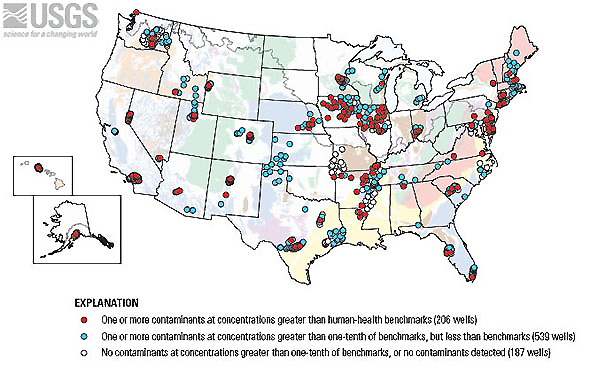
    USGS Water Contaminants

    By Heather Rousseau
    Circle of Blue

    More than one-third of the U.S. population uses drinking water from contaminated public wells, according to a 14-year-long study by the U.S. Geological Survey that was released late last week. The study, Contaminants in Groundwater Used for Public Supply, which compiled untreated water samples that were taken between 1993 and 2007, found that 20 percent of the public wells surveyed contained at least one natural or man-made contaminant above government standard concentrations.

    Roughly 80 percent of the wells contained multiple contaminents at concentration levels that were near or above standards. But these levels don’t necessarily cause health concerns, according to one USGS scientist.

    “Detections of contaminants does not necessarily indicate a concern for human health because USGS analytical methods can detect many contaminants at concentrations that are 100-fold to 1,000-fold lower than human-health benchmarks,” said Patricia Toccalino, a lead scientists and hydrologist for USGS.

    “Detections of contaminants does not necessarily indicate a concern for human health because USGS analytical methods can detect many contaminants at concentrations that are 100-fold to 1,000-fold lower than human-health benchmarks.” (Repeats above paragraph)

    “Assessing contaminants in these small amounts helps to track emerging issues in our water resources and to identify contaminants that may warrant inclusion in future monitoring,” Toccalino told Circle of Blue.

    Dieldrin was found at levels that exceed the health benchmarks set by USGS and the U.S. Environmental Protection Agency in roughly three percent of the samples taken. The unregulated man-made contaminant is a potential carcinogen that can have negative effects on a person’s liver and central nervous system if he is exposed to it at high concentrations for a long period of time. Of the 932 wells USGS sampled, higher levels were found in unconfined and shallow aquifers in the Northern Atlantic and coastal plains such as Delaware and New York as well as other principal aquifers in the Southeast U.S.

    The EPA evaluated Dieldrin and determined that it should not be regulated “in part because it has been banned for a long time” says Patricia Toccalino, lead scientist and Hydrologist with USGS.

    Although the unregulated, man-made contaminant was banned in 1987, it degrades slowly, which might be one reason why it’s still detected, according to Toccalino.

    Though it is not required that utility services treat the water for Dieldrin, it is possible that different treatment facilities do remove the insecticide.

    “The research about the health risk of trace amounts of contaminants in water is something that is still being researched. Public water systems are required to treat contaminated water under the Safe Drinking Water Act, if you do that it dramatically reduces the health risks, “ said Cliff Treyens, public awareness director for the National Groundwater Association.

    A smaller study on treated drinking water revealed that man-made organic contaminants were still found in the water at close to pre-treatment levels. Research does not yet fully explain the health risks involved with interactions between multiple contaminants or the health effects on even a single contaminant.

    Until further research is done, Toccalino said the public should approach their water utility for the best available information.

    “The number one thing is to contact your water utility every year to receive your watery quality report.”
    Although the United States has increased population nearly 200 percent in the last 50 years (seen on the horizontal x-axis), the amount of U.S. soil devoted to agricultural use (vertical y-axis) has decreased, as has the income percentage of the GDP from agriculture (size of ball). However, despite these cuts in overall U.S. agricultural production, some contaminants, such as Dieldrin–banned in 1987–have not degraded and remain in the water table at levels that exceed the human health benchmarks.

    Heather Rousseau is a reporter for Circle of Blue. Reach Rousseau at [email protected]. Read more about USGS’ study.

  • Dust Storms Create Snow Melt Problems in Colorado

    Storms in the Rocky Mountains in Colorado have already lead to water shortages in Aspen.

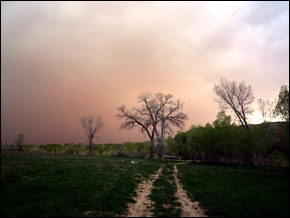
    Man-made dust storms are threatening the snow packs atop the Rocky Mountains in Colorado, causing trouble for farmers, power companies and recreational businesses that rely on water from the melting snow, NPR reports.

    Eight dust storms have been recorded this season, while 12 occurred last year altogether, according to the New York Times.

    Since the dust is blacker and absorbs more heat, it causes the snow to melt more rapidly. Early snowmelt can cause reservoirs to overflow early in the spring, leaving low levels of water in the late summer. Local water department officials are concerned about the capability of catching and storing enough water as the heat absorbed by the dust leads to faster runoff.

    The dust has caused a water shortage in Aspen, which relies on spring runoff for its water, according to Aspen Public Radio.

    And while the Colorado Plateau is usually the main source of dust in the Rockies, the particles can come from as far as China.

    “The Alps receive dust from the Sahara and the Taklamakan in western China, and the Gobi deposits dust into the mountain ranges in northwest China and Mongolia,” director of the Snow Optics Laboratory at the University of Utah, Thomas Painter, told NPR.

    These non-native dust particles are so small that they pass through water filters, affecting water quality. To keep the water clean the Aspen Water Department are increasing their use of a polymer-based chemical that binds the dust particles together.

    Meanwhile scientists have noticed an increase in early snowmelt over the years and that the dust storms will worsen as “grazing, mining and increased recreational use removes vegetative cover and to expose loose soils to wind,” according to the New York Times. Construction of renewable energy development and transportation needs for the projects may also disturb the dry landscapes, causing ideal circumstances for dust storms.

    Aspen’s water department fears it could see further water shortages if the number of dust storms continues to increase around the city. The department might have to increase its storage facilities to brace for these potential changes.

    Source: NPR, The New York Times, Aspen Public Radio