The arrival of the Windrush on 22 June 1948 is widely considered the landmark of mass migration to Britain and to celebrate the anniversary there will be a number of events across the country.
The Prime Minister paid tribute to the ‘Windrush generation’ and their contribution to modern Britain:
Prime Minister David Cameron said:
The 65th anniversary of the arrival of the Empire Windrush at Tilbury Dock on 22 June 1948 marks a truly historical moment for modern day Britain. Nearly 500 people arrived from the Caribbean that day to find work or a new life, and it led to the transformation of this country into the richly diverse nation it now is.
The early arrivals from the Caribbean came to help rebuild our country after the Second World War. They brought with them the skills and resolve to help get Britain back on her feet and to make a better life for themselves and their families. But as history has shown many of them suffered unjust hardships and barriers – from social exclusion and prejudice to discrimination and racism.
I pay tribute to the Windrush generation and praise their fortitude and determination in overcoming those difficult challenges. Younger generations are rightly very proud of those early pioneers, and while some social issues still need to be tackled, I strongly believe that our country today is an overwhelmingly fair and tolerant one. And this is in part down to the people from the Caribbean and around the world who settled here.
Those early migrants did so much for our country, and paved the way for their children and subsequent generations to make enormous contributions to Britain in the 21st century. Whether this is in the field of public service, business, culture or the arts, the children of the Windrush generation have given so much.
Whenever I meet people from Britain’s African-Caribbean community, I’m always struck by the stories I hear. Stories of guts, determination and sheer hard work. Our island is richer in every sense of the word for your contribution.
G8 leaders have committed at the G8 summit in Lough Erne to agree to further transparency on the sharing of tax information – and bring the international tax rules into the modern age.
As the summit closed the G8 leaders’ communiqué announced that they will move to establish the automatic exchange of information between tax authorities as the new global standard and will work with the OECD to develop a model for this.
The G8 leaders stated their support for the OECD’s work to tackle tax avoidance by multinational companies, and announced that they will draw up a template for global corporations to report to tax authorities where they make their profits and pay taxes around the world.
This will give governments a new tool against tax avoidance by multinationals and will be particularly helpful to the governments of developing countries.
The G8 will provide support to developing countries to collect the tax they are owed.
Following the UK’s announcement that it will establish a register of company ownership, the G8 agreed to publish action plans to require companies to obtain and hold information on who really owns and controls them, and ensure this information is available to tax authorities and law enforcement, including through central registries.
Earlier this year Prime Minister David Cameron identified tax as one of the three areas he wants to concentrate on during the UK’s presidency of the G8 – alongside trade and transparency.
The government has also announced further plans to assist developing countries in strengthening their tax systems – also known as capacity building – in order to help them claim the tax which they are owed and benefit from information exchange.
The Department for International Development (DfID) will fund a programme of international tax seminars where HMRC tax experts will share their experience and expertise on negotiating information exchange agreements with counterparts in developing countries and support them in joining in the Multilateral Convention on the sharing of tax information.
“As leaders of the G8, we are committed to open economies, open societies and open governments as the basis of lasting growth and stability. We have today agreed concrete steps to play our part in ensuring a safe and prosperous world.
We met at a time of continued economic uncertainty. Our urgent priority is to promote growth and jobs, particularly for the young and long-term unemployed. We will continue to nurture the global recovery by supporting demand, securing our public finances and reforming our economies to deliver growth.
Our economies together make up around half of the global economy, and we have a responsibility to support prosperity worldwide. We agreed actions in three specific areas:
Trade – a key engine of global economic growth. We will break down barriers to trade at home and abroad by resisting protectionism and concluding a set of ambitious trade deals. In particular, we welcome the launch of negotiations for an EU-US trade agreement, the major progress towards agreeing the Trans Pacific Partnership and the launch of the EU-Japan trade agreement negotiations and we look forward to the completion of the EU-Canada trade agreement. We aim to finalise all these deals as soon as possible. We also welcome the trade and economic integration of Russia with some of the countries in the region, which will be pursued in line with World Trade Organisation (WTO) principles. We are committed to strengthening the multilateral trading system and securing a WTO deal in December that cuts bureaucracy to make it easier and faster for goods to cross borders. And we will keep our promises to help developing countries slash barriers to trade that impede growth.
Tax systems – essential to fairness and prosperity for all. We commit to establish the automatic exchange of information between tax authorities as the new global standard, and will work with the Organisation for Economic Cooperation and Development (OECD) to develop rapidly a multilateral model which will make it easier for governments to find and punish tax evaders. On tax avoidance, we support the OECD’s work to tackle base erosion and profit shifting. We will work to create a common template for multinationals to report to tax authorities where they make their profits and pay their taxes across the world. We will support developing countries to collect the taxes owed them, with access to the global tax information they need. We agree to publish national Action Plans to make information on who really owns and profits from companies and trusts available to tax collection and law enforcement agencies, for example through central registries of company beneficial ownership.
Transparency – empowering people to hold governments and companies to account. We have agreed a transformative Open Data Charter to make budget data and other government information public in an easily accessible way. We will make progress towards common global reporting standards to make extractive industry payments more transparent. And we will work with resource-rich countries to help them better manage their extractive revenues so as to provide a route out of poverty and reliance on aid.
We will continue to work with the poorest countries to help lift people out of poverty by keeping our aid promises and being accountable to the public for them. We will accelerate efforts to tackle the under-nutrition that blights millions of lives. We will work closely with African governments and citizens to promote sustainable growth.
We share a commitment to work together to counter terrorism and tackle the drivers of instability wherever in the world they are found and particularly in northern Africa and the Middle East. We have identified five priority areas for action to respond to the growing threat posed by terrorists operating in the arc of instability from Mauritania to Somalia. Alongside the countries themselves, we will work together, focussing our collective political and practical support, to help governments find and dismantle terrorist networks and to build effective and accountable government.
We are committed to protecting our nationals and reducing terrorist groups’ access to funding which allows them to thrive. We unequivocally reject the payment of ransoms to terrorists and we call on countries and companies around the world to follow our lead and stamp out this as well as other lucrative sources of income for terrorists. We will help each other to resolve hostage incidents by sharing best practice in advance and offering expertise as necessary when they take place.
We strongly support the proposal for a conference to reach a political solution to the appalling conflict in Syria through full implementation of the 2012 Geneva Communiqué. We will contribute generously to the latest United Nations (UN) appeal for humanitarian help. We condemn in the strongest terms any use of chemical weapons and all human rights violations in Syria. We are committed to leading international support for Libya’s security and democratic transition and to urgent work for a lasting peace in the Middle East.”
The Prime Minister, President Obama, President of the European Council Herman Van Rompuy and President of the European Commission José Manuel Barroso set out their plans in a joint press conference in Lough Erne.
The Prime Minister hailed a potential deal “that could add as much as £100 billion to the EU economy, £80 billion to the US economy, and as much as £85 billion to the rest of the world”.
He continued:
And we should be clear about what these numbers could really mean.
Two million extra jobs, more choice and lower prices in our shops. We’re talking about what could be the biggest bilateral trade deal in history, a deal that will have a greater impact than all the other trade deals on the table put together.
When we last met at Camp David in the G8 and we first suggested we could reach this moment here in Lough Erne, many doubted it would be possible. Everyone knows these trade deals are difficult. Some take years to get off the ground, and some never happen at all. So it’s a testament to the leadership and the political will of everyone here that we’ve reached this point. We must maintain that political will in the months ahead. This is a once-in-a-generation prize, and we are determined to seize it.
After the summit, the Prime Minister made a statement in the House of Commons.
What is the G8?
The G8 is a forum that brings together 8 global leaders to address international issues and tackle the most pressing global challenges. Find out more about the G8.
The Presidency of the G8 rotates each calendar year. The UK holds the Presidency throughout 2013. Read about:
The Prime Minister has announced that the G8 and 15 developing countries have agreed to work together to make sure that the poorest people benefit from their country’s natural resources, by improving the transparency of their extractive industries and land rights.
Mr Cameron made the announcement during a panel session with African leaders at the Open for Growth event today (15 June 2013), which focussed on tax, trade and transparency.
A lack of transparency means poor countries are not benefitting as much as they should from their natural resources so that they can fund their own development and fight poverty.
Many developing countries have vast extractive resources like oil, gas and minerals but they are often sold at below market prices, or the money made is misused or poorly invested.
At the same time unclear land ownership rights and weak systems for managing land creates uncertainty which stops farmers and companies wanting to invest. This in turn threatens food security and increases the likelihood of local conflicts over land.
The partnerships announced today will see G8 nations work with 8 developing countries to help them improve the information available around the sale of extractives by:
encouraging companies and countries to adopt the new Extractive Industry Transparency Initiative – where companies publish what they pay to governments and governments disclose what they receive from companies for their extractives resources
strengthening communication between governments, companies and civil society, ensuring that the new information on extractives can be properly used to hold governments to account
introducing stronger legal frameworks to regulate the extractives sector example by introducing new laws that make EITI standards a legal requirement
Another 7 country partnerships will help developing countries implement globally agreed guidelines on land governance and safeguard individuals’ and companies’ rightful claims to land, to improve transparency and accountability on land deals, by:
supporting local authorities to formally register and protect rights to land
helping countries collect better data on land transactions
helping countries attract high quality investment that benefits the country’s economy.
International Development Secretary Justine Greening said:
Lack of transparency is preventing developing countries from benefitting from their valuable resources. When they do not know how much their resources are worth, people and governments have no way of knowing if they are getting a good deal for them.
These partnerships will help developing countries make the most of their valuable resources, attracting the investment and income needed to drive economic growth, fight poverty and, eventually, end their need for aid.
Making information about the buying and selling of natural resources publicly available is vital to tackling mismanagement. If people can see how much their government receives from selling the country’s extractive wealth they can question how that money is being spent.
At the same time greater security over land rights means local people can raise capital against their land to improve it while international companies have greater confidence in the security of any investment.
The G8 member states are partnering the following countries to improve transparency around extractives: Burkina Faso (France), Colombia (EU), Ghana (UK), Guinea (USA), Mongolia (Germany), Burma (USA), Peru (Canada), Tanzania (Canada). Private sector and civil society are backing the partnerships include Rio Tinto in, Peru and Mongolia, BG (British Gas) in Tanzania.
The G8 member states are partnering the following countries to improve land registration and security of land tenure for communities and commercial investors: Tanzania (UK); Nigeria (UK) Senegal (France), Burkina Faso (US), South Sudan (EU), Namibia (Germany) and Niger (EU).
Prime Minister David Cameron announced the launch of Global Development Innovation Ventures, which will find innovative solutions to some of the world’s most pressing problems. It will test their successes and invest in the best performers – including entrepreneurs, academics and non-governmental organisations.
The British government will invest £50 million over five years in the new investment platform, which is expected to unlock further investment capital from both the private sector and other countries. The US government and impact investor Omidyar Network will also be founding partners of the new platform.
More than any time in history our world is being shaped by innovation, new ideas, new technologies and new companies. This is the story of the global economy.
Countries around the world have got to get this. Jobs and growth depend on it. We’ve all got to open up our economies to innovation, we’ve got to nurture new ideas, we’ve got to bend over backwards to attract the best and the brightest. A global race is underway and it is waiting for absolutely no one.
International Development Secretary Justine Greening said:
Britain has already supported groundbreaking technology around the world, from mobile banking in Kenya to GPS weather-warning systems in Bangladesh. We need a model that can build on these successes and make sure great ideas that can change the lives of the world’s poorest people get the investment they need.
This new organisation means that the UK will play a key role in kickstarting a new era of innovative, cost-effective development which can help deliver a safer, more prosperous world.
USAID Administrator Dr. Raj Shah said,
We are proud to see that this model, born at USAID, has become a global tool for improving effectiveness in development. Our partnership with the UK and future investors will amplify our impact through the discovery of breakthrough technologies and approaches to help end extreme poverty.
Managing Partner of the Omidyar Network Matt Bannick said:
The challenges facing those from the poorest communities cannot be solved with conventional approaches to development aid alone.
Global Development Innovation Ventures promises to replicate the most effective strategies we’ve deployed as a global impact investor: public and private organisations working together, leveraging technology and investing in both for-profit and non-profit organizations to spark innovation and scale successes.
Omidyar Network is proud to be a founding partner alongside the UK and US government and to lend our perspectives and expertise to this important undertaking.
Global Development Innovation Ventures will be open to promising innovations from around the world. The UK’s Department for International Development (DFID) will engage with innovators all over the world to encourage them to submit ideas, creating jobs both in the UK and across the developing world.
The opportunity to ask the Prime Minister questions came ahead of his hosting the G8 Summit at Lough Erne, Northern Ireland on 17 to 18 June. The UK last hosted the G8 Summit in 2005.
Topics included the G8’s main themes of tax, trade and transparency plus questions on the conflict in Syria, wider events in the Middle East and the UK’s relationship with China.
The Innovation Conference brought together today’s leading innovators and thought leaders across disciplines, from the G8 and beyond. From public policy to science and technology, this conference facilitated conversations that influence the dialogue throughout the UK G8 Presidency.
High profile speakers included:
David Willetts, BIS Minister for Science and Innovation
Sir Richard Branson, who discussed entrepreneurship and innovation
Ron Dennis of McLaren who talked about innovation in F1 and how technologies spin out into other sectors
Daphne Koller, founder of Coursera, who discussed online education
Zaha Hadid, architect
Thomas Heatherwick, the designer of the new London bus, discussing innovation and creativity
Delegates included around 250 leading international entrepreneurs, researchers, scientists, creatives and policy makers from more than 22 different countries.
In the afternoon, G8 Innovation Conference delegates split into small groups and visited innovation centres of excellence. They heard from world leading innovation practitioners and reflected and discussed on how new approaches can address current challenges.
These included:
Tech City in East London
The Big Innovation Centre
Open Data Institute
Royal Academy of Engineering
Overall, the event set out areas where the UK is a global innovation leader in entrepreneurship, creativity, science and technology and demonstrated the UK’s ability to provide the conditions for the cross fertilisation of ideas and inter-disciplinary collaboration. As a result, the event inspired international innovators, and enabled UK businesses and innovators to find international partners to enable them to collaborate and develop new ideas in response to global challenges.
On Wednesday 12 June 2013 David Willetts hosted the G8 science ministers at the Royal Society to look at key scientific challenges. For the first time the meeting also included heads of national academies.
At the top of the agenda was dealing with global challenges, namely antibiotic resistance in medicine, and how governments can work together to develop new antibiotics and employ them more wisely.
Antibiotics are the cornerstone of modern medicine. But due to the spread of bacteria that are resistant to several drugs, a scenario is fast approaching in which many everyday infections will become untreatable. This will make routine medical care such as hip replacements and chemotherapy much riskier. Resistance to earlier generation anti-malarial medicines is widespread in most countries where the disease is endemic.
However the number of new antibiotics in development is at an all time low and the overuse of antibiotics is driving up resistance.
Following the meeting, the group issued a statement, signed by all G8 members. They agreed to work together in a global effort to develop new antibiotics and technologies for quicker diagnosis and more targeted treatments.
They also discussed other pressing global challenges, including climate change, energy security and neurodegenerative diseases like Alzheimer’s.
The statement recognises the role that science has to play in securing present and future sustainable growth. It also proposes new areas for the G8 to work together and collaborate on, including global research infrastructure, open scientific research data, and expanding access to scientific research results.
On 20 November, David Cameron announced that as the Chair of the G8, the UK would host the G8 Summit in Lough Erne, Northern Ireland. This announcement was a demonstration that Northern Ireland is a modern and dynamic part of the United Kingdom that is open for business, with huge potential for investment and tourism.
At the start of the year, the PM wrote to his fellow G8 leaders to outline his plans for the G8 Presidency, where he hoped that the G8 commitment to open economies, open governments and open societies would support enterprise and deliver economic growth.
On January 24, he set out the economic priorities for the G8 at the World Economic Forum in Davos, where he spoke in more detail of the G8 agenda on tax, trade and transparency.
In an article for the Wall Street Journal, the Prime Minister spoke in more detail of the importance of freer trade, and the enormous benefit it can bring globally. He also stressed the need for financial openness, fairer taxes and greater transparency alongside more open trade.
World leaders have today signed a global agreement that will prevent millions of infant deaths, and boost the life chances of millions more, by equipping the developing world with the means to beat malnutrition.
Prime Minister David Cameron, Brazilian Vice President Michel Temer and the Children’s Investment Fund Foundation president Jamie Cooper-Hohn led a high level summit in London of developing and developed nations, businesses, scientific and civil society groups, committing them to supporting a historic reduction in “undernutrition”.
Undernutrition is a chronic lack of nutrients that can result in death, stunted physical development and in a lower resistance to illnesses in later life. It is the biggest underlying cause of death in under-five-year-olds in the world and is responsible for 8,000 child deaths each day. It stunts the growth of children, reducing their potential, undermining their adult earnings by up to 10%, and in some countries reducing the size of the economy by 11% as a result.
The participants – who signed a Global Nutrition for Growth Compact – committed their countries and organisations by 2020 to:
improving the nutrition of 500 million pregnant women and young children
reducing the number of children under five who are stunted by an additional 20 million
saving the lives of at least 1.7 million children by preventing stunting, increasing breastfeeding and better treatment of severe and acute malnutrition
This file may not be suitable for users of assistive technology. Request a different format.
To request this document in an alternative format such as braille, audio
or a different file type please email [email protected]
quoting your address, telephone number along with the title of the
publication (“Global Nutrition for Growth Compact”).
Among the participants in today’s central London summit were two presidents and four prime ministers from Africa, Irish Taoiseach Enda Kenny, philanthropist Bill Gates, former UN Secretary General Kofi Annan and Unilever chief executive Paul Polman.
Donors have today secured new commitments of up to £2.7 billion ($4.15 billion) to tackle undernutrition up to 2020, £1.9 billion ($2.9 billion) of which is core funding with the remainder secured through matched funding. The UK has today committed an additional £375 million of core funding and £280 million of matched funding from 2013 to 2020.
This file may not be suitable for users of assistive technology. Request a different format.
To request this document in an alternative format such as braille, audio
or a different file type please email [email protected]
quoting your address, telephone number along with the title of the
publication (“Nutrition for Growth Commitments”).
Countries which have previously increased nutrition funding, like the US and Canada, today committed themselves to continuing those high levels of funding while others, like the European Union, the World Bank and Ireland, have increased their support substantially.
The funds will focus on:
making world-class scientific knowledge and evidence available, including through a new Global Panel on Agriculture and Food Systems for Nutrition, so that farmers can grow nutrition-rich and resilient crops, such as vitamin-enriched sweet potato and corn, to feed their families and local areas
promoting breastfeeding as a priority for protecting nutrition and saving lives
supporting the governments of developing countries to formulate high quality national nutrition plans and helping them to mobilise domestic resources for them and
ensuring businesses in developing countries place good nutrition at the heart of their workforce welfare priorities.
Undernutrition is stopping children and countries from reaching their full potential, accounting for the loss of billions of dollars in productivity. A strong and healthy workforce is vital if a country’s economy is to prosper. This means business and science taking a lead in fighting for good nutrition because we understand that better nutrition is the smart way to tackle extreme poverty, child mortality and economic underachievement.
The commitments secured today will help transform the life chances of millions of children and pregnant women by ensuring they get the right nutrition at the right time, securing greater long-term economic growth and prosperity for all.
President and CEO of the Children’s Investment Fund Foundation (CIFF) Jamie Cooper-Hohn said:
We have a unique window of opportunity now to marshal the global coalescence around the nutrition agenda and to tackle the root cause of child mortality and economic underachievement. With renewed commitment from all of us in recognition of the centrality of nutrition to economic growth and development we will be making one of the most important contributions to the growth and economic development of some of the poorest countries in the world.
Today marks the start of a sustained financial and political commitment to ending undernutrition within a generation. Working together, this unique coalition can take action which history will judge as having contributed to saving the lives of millions of women and children and setting nations on a strong economic path to prosperity.
Undernutrition is an underlying cause in 45% of deaths amongst children under five, while nearly 165 million suffer from stunting which stops children’s bodies from developing properly. The effects of undernutrition have the greatest impact in the first 1,000 days of life from conception to a child’s second birthday. Failure to get the right nutrition at this critical time causes irreversible lifelong damage.
Nutrition for Growth builds on the process started at last year’s Hunger Summit held by the UK and Brazilian Governments in London, which highlighted the devastating consequences of undernutrition on children.
The World Health Assembly recently agreed a new global target of a 40% reduction in the number of stunted children by 2025. The commitments secured today will transform progress towards this goal. Commitments made today will be monitored and tracked annually, and progress made in addressing undernutrition will be measured at a global event in Brazil at the Rio 2016 Olympics.
The Prime Minister today visited the Cameronbridge Distillery in Fife, where drinks business Diageo recently completed a unique renewable energy facility. The facility powers the distillery by recycling the natural co-products of distillation, and is a flagship for Diageo’s ambition to drive environmentally sustainable growth.
Cameronbridge Distillery is a key part of Diageo’s Scotch whisky production business. Scotch represents one of the UK’s outstanding economic success stories, with industry exports generating £135-per-second for the UK balance of trade in 2012.
The Prime Minister said:
Whisky is an iconic product with a rich heritage and a fantastic future. It is a truly global brand.
It was a real pleasure to see the Cameronbridge Distillery. It is at the cutting edge of the spirits industry, a world leader in embracing bioenergy technology and a major contributor to Scotland’s economy.
All those who work there should be proud of what they produce.
During the visit to the distillery, the Prime Minister met a group of Diageo apprentices who work across a range of engineering, scientific and craft roles at the distillery. He also hammered the bung – a ceremonial tradition in the Scotch whisky industry – into a cask of single grain spirit produced using renewable energy from the bioenergy plant. The Prime Minister’s cask will now be laid down to mature for 10 years, with a pledge to auction it to raise money for environmental good causes in the future.
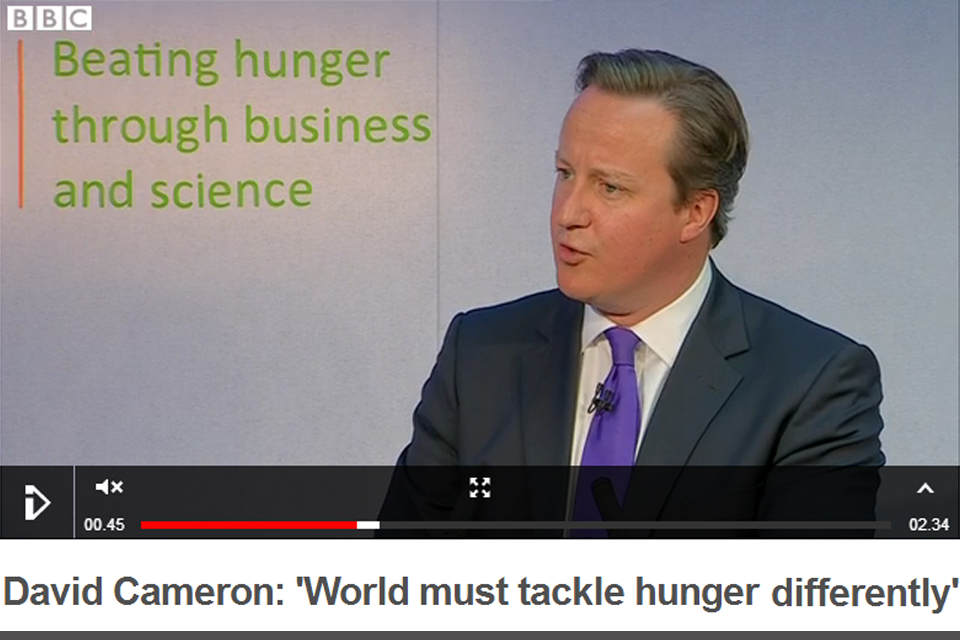
The Prime Minister today welcomed ‘Enough Food for Everyone IF’ supporter David Walliams and 100 school children from across the UK to Downing Street ahead of Saturday’s G8 event ‘Nutrition for Growth: Beating Hunger through Business and Science’.
Speaking ahead of Saturday’s event, the Prime Minister said:
I’m proud of the UK’s leadership in the fight against global hunger. Having fired the gun at last year’s Olympic Hunger Summit, the Nutrition for Growth event will be an opportunity for everyone — and that includes governments, business, scientists and NGOs — to step up and make a lasting difference in tackling under-nutrition and improve children ‘s life chances.
The children had been invited to showcase plates they had decorated in support of the ‘Enough Food for Everyone IF’ campaign.
The UK will be seeking to secure ambitious commitments from everyone attending to address under-nutrition and food insecurity at the event. Ahead of the event, the Prime Minister has been speaking to leaders and NGOs to secure this much needed ambition.
Undernutrition is an underlying cause of 45% of deaths amongst children under five, while nearly 165 million suffer from stunting which stops children’s bodies from developing properly. This has a devastating impact of the future productivity in these countries. It’s clear that investing in nutrition now not only saves lives in the short-term, it also assists developing countries to achieve stronger, more resilient economic growth.
This report sets out a clear roadmap for eradicating extreme poverty by 2030.
We need a new global partnership, to finish the job on the current Millennium Development Goals, tackle the underlying causes of poverty, and champion sustainable development.
The overarching goals include ending extreme poverty for good, making sure everyone has access to food and water, promoting good government and boosting jobs and growth.
The individual targets include promoting free speech and the rule of law, ending child marriage, protecting property rights, encouraging entrepreneurship and educating all children to at least primary school level.
The goals the report put forward are based on 5 big ideas:
finish the job: the Millennium Development Goals aimed to halve poverty – these new goals will end it by 2030
go green: for decades, the ‘green’ and development agendas have been separate. This report says they should be brought together
go for growth: economic growth is the only exit from poverty. A greater focus is needed on jobs, business and economic opportunity for all
good government: the need for free speech, good government, and tackling corruption has been avoided in the development debate. The panel put building the institutions of an open society at the heart of its approach, as well as ending conflict and violence
global partnership: everyone around the world must work together to make it happen
The final report comes after 8 months of consultation with more than 5,000 public groups across 120 different countries. Citizens, governments, businesses, local charities, community groups and development experts all had a chance to contribute their ideas.
The process began last year when the Prime Minister, alongside Presidents Yudhoyono of Indonesia and Johnson Sirleaf of Liberia, was asked by Ban Ki-moon to set out ideas for a new set of development goals that could replace the existing Millennium Development Goals.
The panel’s work is now complete, but its report will now be used to kick-start 2 years of discussion and negotiation to set the development agenda that will succeed the current Millennium Development Goals when they expire in 2015.
The films, which are part of the Cabinet Confidential series, contain interviews with Robert Armstrong, Robin Butler, Richard Wilson, Andrew Turnbull and Gus O’Donnell. They all talk about what happened behind the scenes whilst working as the Prime Minister’s most senior civil servant.
“Cabinet secretaries are among the rarest of rare breeds” explains contemporary British historian Lord Hennessy, who carried out the interviews along with political historian Anthony Seldon. “They have discretion built into the calcium of their bones. So a chance to talk to them on the record across the whole range of their special calling is an occasion to be savoured”.
All of the films were produced by Queen Mary, University of London in partnership with Number 10.
Film launch event
The first two films were launched at an event at Downing Street, with Lord Armstrong and Lord Butler.
In the first film, Lord Armstrong recalls events during his time working with Lady Thatcher.
The Metropolitan Police believe they know his identity but said he has yet to be formally identified. His next of kin have been informed.
In line with the wishes of his family his identity will not be released at this stage.
Chief of the Defence Staff General Sir David Richards said:
I was appalled to hear of this abhorrent crime committed against one of our servicemen. I add my voice to that of the rest of the country in condemning this foul act and I extend my deepest sympathies to the family and loved ones of the victim during this most distressing time.
Defence Secretary Philip Hammond said:
I am shocked by the brutality of this cold-blooded murder of a serviceman on the streets of London. We are co-operating with the Metropolitan Police in their investigation and will take all steps necessary to protect our servicemen and women. My thoughts are with the family and loved ones of the deceased.
A post-mortem examination will take place later today.
EITI was set up to help tackle corruption, to improve the way revenues from oil, gas and minerals are managed and to make sure that people across the world share in the economic benefits of the natural resources in their country.
The EITI provides an assurance that companies will publish what they pay for extracting natural resources and that governments will disclose the money that they receive from this – so that people know how the resources of their country are being managed.
Prime Minister David Cameron said:
Mineral wealth for developing countries should be a blessing, not a curse. And I urge our G8 partners to champion the same high standards of transparency.
I am determined to use our G8 leadership to put a new and practical emphasis on transparency and accountability, particularly in our partnerships with less developed and emerging countries.
This is an issue that affects half of the world’s population: 3.5 billion people live in countries rich in oil, gas and mineral resources. Many of the world’s poorest countries have some of the greatest supplies of natural resources, but are plagued by a lack of transparency and corrupt practices. If resources are managed well then the revenue can be reinvested and help countries grow, develop and graduate from aid.
The revenues from natural resources can help drive a country’s growth and reduce poverty, far more than traditional aid. For example, last year Nigerian oil exports were worth almost $100 billion, more than the total net aid to the whole of sub-Saharan Africa.
By signing the Extractive Industries Transparency Initiative, the UK and France will play their part in ensuring that people around the world benefit fairly from the natural resources of the countries in which they live.
Business Secretary Vince Cable said:
Some of our biggest extractive companies in the UK are already in favour of the measures – whether as founding members of EITI, sitting on the EITI board or reporting in the other countries which already use the standard.
It is of course key we get this right for everyone – this is about levelling the global playing field and boosting transparency, not about getting in the way of business and meddling in their affairs.
There is a long road ahead to make sure that this works best for everyone. That is why discussions will commence soon between the Government, industry and all interested parties as to how we can get this system working as effectively as possible for the UK.
G8 Summit 2013
At this year’s G8 Summit, the UK Chair will seek to secure higher global standards for the extractives industry. Alongside signing up to EITI, the UK will promote partnerships with key developing countries who are willing to move forward on extractives transparency. These partnerships will provide support to new countries signing up to EITI, and also help existing members maintain and implement global EITI standards.
Employment Relations and Consumer Affairs Minister Jo Swinson will now lead the implementation of the EITI in the UK.
Following the fatal incident in Woolwich on Wednesday 22 May the Prime Minister asked the Home Secretary Theresa May to hold a meeting of the government’s emergency co-ordination group, COBR (Cabinet Office Briefing Room).
The aim of COBR is to provide effective decision-making and rapid coordination of the central government response to the incident, and draw on the resources of other government departments, including the security and intelligence agencies, the police and other relevant organisations.
Speaking in Paris on the evening of 22 May the Prime Minister David Cameron said:
I’ve been briefed by the Home Secretary about this absolutely sickening attack in Woolwich in London. It is the most appalling crime. We are urgently seeking, and the police are urgently seeking, the full facts about this case. But there are strong indications that it is a terrorist incident. Two people at the scene of the murder were wounded by the police, and they are being treated as suspects.
The Home Secretary is chairing COBR tonight (22 May) to bring together the police, the security services – all of the agencies – so that we gather every piece of information that we can. The police and the security services in the UK will get all of the support that they need to deal with this, or indeed with any other incident.
I’ll be returning to London later tonight so that I can chair a COBR meeting again in the morning to make sure that we have all of the facts of this case. Tonight our thoughts should be with the victim, with their family, with their friends. People across Britain, people in every community, I believe, will utterly condemn this attack. We have had these sorts of attacks before in our country, and we never buckle in the face of them.
Speaking after chairing the first COBR meeting, the Home Secretary Theresa May said:
What happened today in Woolwich was a sickening and barbaric attack. I have been briefed by the Commissioner of the Metropolitan Police and the Director General of the Security Service, and this evening I chaired a meeting of COBR. The police and Security Service are establishing the full facts of this barbaric case, but there is a strong indication that it was an act of terrorism. The Prime Minister is returning to London and will chair another COBR meeting in the morning. In the meantime, security has been increased at Army barracks across London. This attack was an attack on everyone in the United Kingdom, and it will be condemned by people from every community.
Our thoughts and prayers tonight are with the victim and his family. We have seen terrorism on the streets of Britain before, and have always stood firm against it. Despicable acts like these will not go unpunished.
Speaking earlier today Commander Simon Letchford from the Metropolitan Police Service said:
I am here to give you an update about the incident that has unfolded here in Woolwich this afternoon and to give you further details of the situation and an outline of the facts as we understand them at this time. This is at a very early stage and as such I will provide you with what information I am able to. At approx 2. 20 pm we were called to reports of an assault in John Wilson Street, Woolwich where one man was being assaulted by two other men. A number of weapons were reportedly being used in the attack, and this included reports of a firearm. Officers including local Greenwich officers arrived at the scene. Shortly afterwards firearms officers arrived at the scene. On their arrival at the scene they found a man, who was later pronounced dead. At this early stage I am unable to provide any further information about the man who has died.
Two men, who we believe from early reports to have been carrying weapons, were shot by police. They were taken to separate London hospitals; they are receiving treatment for their injuries.
I can understand that this incident will cause community concerns, and I would like to reiterate that we are investigating what has taken place today. The MPS will investigate the circumstances that led a man to lose his life and the IPCC, as is routine, will investigate the circumstances in which police discharged their weapons.
There will continue to be an increased police presence in this area, and the surrounding areas this evening. That presence will continue as long as is needed. I am asking people to remain calm, and avoid unnecessary speculation. I will update you again as soon as I am in a position to do so.
As part of the Government’s efforts to agree concrete action to tackle tax evasion and aggressive tax avoidance during the G8, the Prime Minister has today written to the leaders of crown dependencies and overseas territories about their role in getting the UK house in order.
The letter has been sent to the leaders of:
Bermuda
British Virgin Islands
Cayman Islands
Gibraltar
Anguilla
Montserrat
Turks and Caicos Islands
Jersey
Guernsey
The Isle of Man
Prime Minister’s letter
As you know, I have made fighting the scourge of tax evasion and aggressive tax avoidance a priority for the G8 Summit which the UK is hosting next month. With one month to go, this is the critical moment to get our own houses in order. I am looking to all the Overseas Territories and Crown Dependencies to continue to work in partnership with the UK in taking the lead on two critical issues: tax information exchange and beneficial ownership.
Let me set out exactly why. I have said before that I want to see the Overseas Territories and Crown Dependencies flourish, and I respect your right to be lower tax jurisdictions. I believe passionately in lower taxes as a vital driver of growth and prosperity for all. But lower taxes are only sustainable if what is owed is actually paid – and if the rules to achieve this are set and enforced fairly to create a level playing field right across the world. There is no point in dealing with tax evasion in one country if the problem is simply displaced to another.
So I very much welcome the commitments you have made to automatic tax information exchange, both on a bilateral and multilateral basis, which will help us to reach our goal of setting a global standard in tax transparency. There is a critical mass building. Last week’s European Finance Ministers meeting showed that the EU is getting on board. And I hope others around the world will follow the lead we are setting together.
We also need to ensure information exchange works effectively for all, particularly the poorest countries in the world. That is why we strongly support the Multilateral Convention on Mutual Assistance in Tax Matters. I know many of you have been considering joining and I ask you all to commit to do so in the run-up to the G8 Summit.
But dealing with tax evasion is not just about exchanging information. It is also about improving the quality and accuracy of that information. Put simply, that means we need to know who really owns and controls each and every company. This goes right to the heart of the ambition of Britain’s G8 to knock down the walls of company secrecy.
Some of you have already led the way with public commitments to produce Action Plans on beneficial ownership – and I hope those who have yet to can do so as quickly as possible. Getting the right content in these plans will now be critical. These will need to provide for fully resourced and properly managed centralised registries, that are freely available to law enforcement and tax collectors, and contain full and accurate details on the true ownership and control of every company.
As we continue our negotiations over the coming weeks, I look forward to working with you to ensure we fully meet the spirit as well as the letter of the Financial Action Task Force standards on beneficial ownership. The UK is hosting a high level event on 15 June to showcase progress on tax, trade and transparency, and I hope you can join us on the day to showcase the progress you have made. This is a real opportunity to set the global standard on transparency – and I am confident the Overseas Territories and Crown Dependencies will rise to the challenge.