Author: Issa Villarreal

  • Global: Concerns About Anti-Counterfeiting Trade Agreement (ACTA)

    The last meeting of negotiations for the Anti-Counterfeiting Trade Agreement (ACTA) has provoked the protest of online communities against both its content and the circumstances of their negotiations. The main point of the agreement, which currently involves more than 11 countries, is to deal directly with the piracy on Internet through the construction of a legal framework that will strengthen the protection of the intellectual property rights in each country.

    Those behind the agreement cite the need to combat all forms of piracy of intellectual property. Twitter user Juan José Burciaga (@jjbfigueroa) agrees with the basic reasons for an agreement, but not at all costs.

    La piratería es un cancer contra el cual debemos de luchar, pero no pisoteando las garantias individuales de las personas #ACTA #OPENACTA

    Piracy is a cancer that we all must struggle against, but not stepping over the individual rights of the people #ACTA #OPENACTA

    With this, many users are worried about whether their user data will remain private if Internet Service Providers (ISP) are forced to provide that information, and whether the penalties would be too harsh. In addition, much has been said about the way that negotiations have been carried out, since the agenda and the advances of each meeting have been regulated under confidentiality clauses.

    Current countries involved in the negotiations include Australia, Canada, members of the European Union, Japan, South Korea, Mexico, Morocco, New Zealand, Singapore, Switzerland, and the United States. Recently, a leaked document revealed details of the enforcement system to be implemented in several of them: anti-circumvention tools beyond the DMCA, take down notices, a liability scheme for Internet Service Providers and the three strikes rule that will allow any service provider to disconnect the user from the Internet.

    Calls for Greater Transparency

    Michael Geist, professor of the University of Ottawa and one of the leaders against ACTA, offered an unofficial summary of the seventh meeting, which took part during the last days of January in Guadalajara, Mexico and the stances of some countries regarding transparency. You can follow further discussions on ACTA by Prof Geist by subscribing to his RSS on ACTA.

    During the seventh meeting, many from the Mexican online community protested in Twitter under the hashtags #Acta and #openActa, demanding ACTA to make the agenda public and the documents of the agreement available for public scrutiny.

    Photo by Neto González. Used following a Creative Commons license. Taken from http://www.flickr.com/photos/netogonzalez/4270933008/

    Photo by Neto González. Used following a Creative Commons license. Taken from http://www.flickr.com/photos/netogonzalez/4270933008/

    After the movement of #InternetNecesario that defended the Internet from being taxed by the Mexican government, the dialogue between Twitter users and authorities was more direct, and it included participants such as the president of the Science and Technology Commission of the Senate, Javier Castellón, who appealed through Twitter the need of transparency of the agreement [es], as the negotiations were held in his country:

    Informo al grupo de las negociaciones de ACTA y de la demanda de mayor transparencia e informacion al senado. Manifiestan interes

    I inform the group of the ACTA negotiations and of the demand for an increase in transparency and information for the Senate. They are interested.

    An important part of the protest was channeled through Open Acta [es], both website [es] and Twitter [es], which has the objective of making public the documents of the agreement [es] “so a real public and democratic discussion about its content and its reach can be begin.” It started its activity 2 years ago when the Mexican Institute of Industrial Property [es] (IMPI, in Spanish) regarding ACTA [es] announced that it would join to the ACTA negotiations by asking citizens to send their suggestions to the agreement.

    One citizen who tried to give her input was Twitter user, Geraldine Juárez, representative from the civil organization Mexican Pirate Party [es] and known in Twitter as Miss Pirata (now offline), , who shared a story about how she tried to become involved through contributing her input to the IMPI. She wrote about the meeting with the IMPI and how she protested by abruptly leaving when she was asked not to tweet about the meeting:

    Me salí, enojada sí. Pero también me quedó claro que esto es un asunto serio en el cuál la autoridad apoya a la industria públicamente y que no esta dispuesta a ceder por una ciudadana con una postura que disiente completamente, no solo en cuanto al proceso de negociación del ACTA, sino de la penosa injerencia de la industria del entretenimiento en para controlar la libertad de mi país y en mi mundo: Internet.

    Yes, I left angry. But it was also clear that this is a serious matter where authorities openly support industry, but it is not willing to concede to opposing approaches from citizens, not only in the negotiation process of ACTA, but the shameful interference of the entertainment industry in order to control the liberty of my country and my world: Internet.

    For the seventh meeting, Open Acta called for emails to the Senate [es] to “demand transparency, rights and liberties and respect to the fundamental principle of the web.”

    Possible New Legal Frameworks

    There are other concerns about the agreement. Alejandro Pisanty, one of the leaders of the #InternetNecesario movement, commented on his blog about the repercussions of ACTA [es] on legal structures in each of the countries:

    En lo que se sabe, de manera parcial, extraoficial e informal, hay bases para temer que ACTA pueda llevar a la necesidad de que algunos países creen legislación nueva (por ejemplo, un país puede tener que crear legislación, ahora inexistente allí, que permita la persecución de la piratería como un delito, persecución ex-officio cuando ahora sólo es mediante acusación), a aplicaciones draconianas de la legislación existente, a la supresión o debilitamiento de la presunción de inocencia, y a la creación de un ambiente poco conducente al acceso al conocimiento, a compartirlo y a la creación colectiva de nuevos arte, ciencia, reflexión y conocimiento. No es posible en este momento confirmar o desmentir con base en documentos oficiales que esto ocurra, ni lo contrario. El tema requiere vigilancia constante.

    What it is known, partially, unofficially and informally, that there are reasons to fear that ACTA might lead countries in the need to create new legislation (an example, a country might have to create a legislation, now nonexistent, that allow the prosecution of piracy as a crime, ex-officio prosecution, although currently that can happen only through an accusation), to draconian exercises of the existent legislation, to the elimination or weakening of the presumption of innocence, and to the formation of an environment that does not facilitate access to knowledge, to sharing, and to the collective creativity of new types of art, science, reflection and knowledge. It is not possible in this moment to confirm or deny with official documents that this could happen nor the opposite. The subject needs constant surveillance.

    Protection of User Data and Harsh Penalties

    Another subject of discussion was the access to sensitive information of Internet users, as pointed out by one of the official documents leaked. However, the AMIPCI publicly rejected [es] any chance of forcing the Internet service providers to share private user data about those users suspected of illegal activities.

    There are also reports that there is a proposal to implement a three strikes policy for any user that engages in illegal file sharing. The penalty for this is disconnection from their internet service. Cory Doctorow, blogger and journalist, argues in this video (available in English, French and Italian) that the Internet is too central to our lives to be taken away for three accusations of copyright infringement, like a death penalty.

    The eighth meeting for negotiations will be held on New Zealand, in April 2010. Different organizations like EFF, Reporters without borders and IP Watch, are concerned with the future of the Net, the lack of transparency and openness that should be implemented by exemplary democracies in the world like the countries involved in the negotiations. Furthermore, citizens are demanding their authorities transparency and access to the negotiation and a public consultation to have a word on it by organizing meetings in different locations, blogging-twitting in different languages, and sharing documents and concerns via the web.
    Renata Avila contributed to the article
  • Graffiti and Urban Art: Voices from Latin American Streets III

    Editor's Note: This is the third and final in a series of posts about graffiti and urban art around Latin America. To visit the other posts in the series, please click here and here.

    In public spaces, street art (or urban art) represents the voice of the community, marginal groups, and young people that strive to be heard, often defying the notion of private property. Latin America is not an exception for this. Some of Latin American street art is distinct from what is created by the hip-hop movement, focusing on political messages and stories of struggle that speak directly to the viewer.

    Through the lens of bloggers, Flickr users and communities, and contributors on YouTube, we offer you an online tour of the art of the streets that communicate secrets and passions at every turn.

    Venezuela

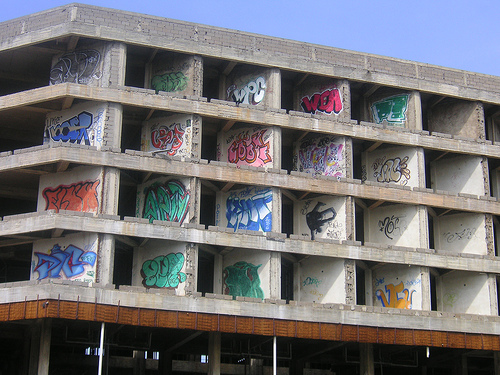
    Venezuelan graffiti has extensive documentation on the Internet, and a notable part comes from users that act as collectors for all kinds of purposes. In Crónicas de un Aprendiz de Periodista blogger Jorge González interviewed graffiti writers [es] from several cities about the main characteristics of this type of urban art as an exercise to practice journalism. He presents inside opinions from the artists themselves, like writer MK 21 from Catia:

    «mucha gente se encuentra segura y a gusto cuando escribe su nombre. Tenemos la sensación de afianzarnos, de identificarnos con nosotros mismos. Cuanto más escribes tu nombre, más piensas en ti y comprendes cómo eres. En cuanto empiezas a hacerlo te reafirmas como individuo, tienes identidad».

    «many people feel comfortable and secure when they write their names. We have feelings of high esteem, and identification with ourselves. When you write your name, the more you think of yourself, and understand how you are. When you start doing [making art] you reaffirm yourself as an individual, you have an identity».

    Another collecting approach comes from blogger BlogZup, who gathered some of the best graffiti works in Venezuela [es], creating an avalanche of responses (100 comments). On the other hand, the blog Solo en Venezuela compiled graffiti and written messages with humorous content [es] found on streets around the country.

    Photo by blmurch. Used following a Creative Commons license. Taken from http://www.flickr.com/photos/blmurch/296870012/

    Photo by blmurch. Used following a Creative Commons license. Taken from http://www.flickr.com/photos/blmurch/296870012/

    Graffiti and street art can also be subjects of academic study, as a part of contemporary art forms. For example, the Network of Scientific Journals of Latin America and the Caribbean, Spain and Portugal (Red de Revistas Científicas de América Latina y el Caribe, España y Portugal) has an interesting collection of articles related to graffiti [es], available to download in PDF format. One of them is the study “El graffiti en la V República Venezolana. Estudio del graffiti sobre asuntos públicos”, which analyzes the political content of 740 explicit graffiti pieces [es/en] on the streets of Caracas as a way to evaluate the public opinion.

    More photos can be found on the Flickr group Mural paintings and graffiti in Venezuela, which is joined by more than 100 members.

    Mexico

    On the ground, sharing the message of the street art might be as important as the work itself. As a user, Mexican artist Mr. Fly has a complete website [es] for his work, and supports his portfolio with videos on YouTube and his work on Flickr and Fotolog. He works with stencils, posters, and stickers to leave traces of his imagination on public spaces throughout the city, flying from one spot to another:

    The intro of the video reads the following:

    En esta puta ciudad caótica, donde el arte es privilegio, recorrer las calles es una necedad, una necedad necesaria en busca de la libre expresión.

    In this f*cking chaotic city, where art is a privilege, walking the streets on a whim, a necessary whim in search of freedom of expression.

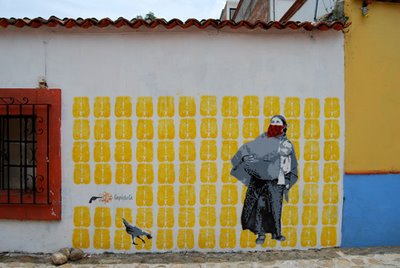
    Collective Lapiztola, from Oaxaca, mixes stencils and serigraphy to create political images with contrasts of textures. In their blog, they document [es] both their contributions to “formal” events and what they create for the streets.

    By Lapiztola. Used with permission. Taken from http://lapiztola.blogspot.com/2008/08/mujeres-de-maz.html

    By Lapiztola. Used with permission. Taken from http://lapiztola.blogspot.com/2008/08/mujeres-de-maz.html

    The above work is presented in the post “Mujeres de maíz [es]” (”Women of corn“) with the following explanation:

    Estencil pintado en la curtiduria con motivo de la presentación de una exposición itinerante formada por artistas mujeres que buscan usar su arte para llamar la atencion sobre el tema del Maíz y que es lo que significa para el futuro de México; el aumento del precio de la tortilla, el desinteres del gobierno por la economia campesina indigena y la identidad cultural.

    Stencil painted on tanned hides for a presentation of an itinerant exposition by women artists that use their art to call attention to the subject of corn and what it means to the future of Mexico; the rise in the price of tortillas, and government indifference to indigenous agricultural workers and their cultural identity.

    An interesting video interview in Spanish [es] is available in the Mexican blog Andamos armados.

    From Monterrey, Los Contratistas is a collective of street artists who present their works on their blog [es], as well as events, photo galleries, and details of their installations using mixed techniques (including objects, disassembled parts, recycled material).

    By Screw. Used with permission. Taken from http://loscontratistas.wordpress.com/2008/09/14/mty-saltillo/dscf6241/

    By Screw. Used with permission. Taken from http://loscontratistas.wordpress.com/2008/09/14/mty-saltillo/dscf6241/

    On their blog, they share a manifesto [es] that explains their name (”contractors”) and their collective philosophy:

    Entiendas[e] como contratista cualquier persona que demuestre el oficio, la rudeza y buena vibra para realizar cualquier proyecto de electricidad, arte, plomería, albañilería o expresión personal; ya sea en las alturas o a nivel de “cancha”.

    “Contratista” (”contractor”) is understood as any person that shows the workmanship, the strength, and good vibes to create a project of electricity, art, plumbing, brickwork or personal expression; whether is it from the top or at ground level.

    Despite its frequent clashes with legality, the graffiti and street art scene in Mexico is strong. A complete documentary of the Mexican street art can be found on YouTube [es], created by Aiwey.tv [es]. More artists and works can also be found in the Flickr groups Street Art Mexico [es], Mexican Bomber [es] and Stencil + Arte Urbano (Mexico) [es], the latter with +500 members.

    Afterword

    These examples of contemporary expression defy and contrast with the common idea of art, which is usually portrayed as something so valuable that it needs to be protected and kept in a safe place, like high-security musems and elite galleries. With a growing acceptance of community, Latin American graffiti writers and urban artists take the Internet as they take any other public space: with the strength of unique voices that reach out to others by any means possible.