Author: Ivan Sigal

  • SuperPower: BBC and Global Voices

    It's a great pleasure for me to announce a joint project between Global Voices and BBC News as part of the BBC's SuperPower season, which launches today.

    This past year has been particularly eye-opening in terms of the increasing interplay between mainstream media and citizen journalism. Events in Mumbai, Moldova, Iran, Haiti, and now Chile are but a few examples in which the world has been eager to make immediate and direct contact with citizens in crisis in local contexts. These citizens may have had blogs, Twitter accounts, and cell phones for years, but only in the last year has the mainstream media adopted the narrative of citizen media as an integrated element in their news reporting.

    When Global Voices was created at Havard University's Berkman Center for Internet & Society five years ago, the initiative focused on citizens in developing countries and non-English speaking societies who were beginning to use blogs to build bridges to people from different cultures and countries. What could be learned from reading and translating the words of online dissidents in China? What could be gained by reading the blogs of Arab women? And how could Global Voices encourage mainstream media to recognize the value and benefits of sourcing intelligent and locally admired bloggers in their own reporting?

    Over the years, we've become close partners and friends of organisations such as Reuters, the BBC, CNN, La Stampa in Italy, and many others. At the same time, internet access has increased such that it has reached a threshold of awareness and participation in most countries around the world. In countries where just a few years ago the number of blogs could be counted on one hand, there are now thousands of citizens typing away, telling their own stories and documenting the world around them. Lives and communities have changed as a result. In aggregate, the internet has collapsed many of the working principles of mass media social and political communications, creating multiple, overlapping platforms for people to speak, participate, and organize.

    At Global Voices, we've continually sought new ways to complement the news cycle and develop new platforms to highlight how global citizens are communicating in their own words. We have a virtual, grassroots newsroom made up of more than 200 talented and innovative individuals from countries you rarely get to hear about in the news.

    When I last met with the editor of the BBC News website, Steve Herman, in June 2009, we discussed how we might collaborate on investigating the role and effects of citizen media throughout the world, with a focus on how local perspectives can affect global news.

    Since then, we've seen mainstream media cover major conflicts such as Iran substantially through the eyes of citizen content. The idea that citizen journalism is somehow opposed to or in conflict with traditional journalism is now clearly past; it's evident that both exist in symbiotic relationship to one another, with many opportunities to collaborate on the creation of news, storytelling, and distribution of content.

    For two weeks, we will be exploring opportunities to put those collaborations into practice. Global Voices managing editor Solana Larsen will be visiting the BBC newsroom in London. We'll be adding citizen media links within BBC news stories, and while sharing off-the-radar stories from our own newsroom with BBC editors and reporters. From the frontlines of online battles of freedom of expression to everyday stories about language, culture, and daily life in foreign blogs, we look forward to sharing our best with a broader audience.

    Ivan Sigal is executive director of Global Voices Online.
  • Breaking Borders award at the GV Summit 2010

    The Breaking Borders Award is a new prize created by Google and Global Voices and supported by Thomson Reuters to honor outstanding web projects initiated by individuals or groups that demonstrate courage, energy and resourcefulness in using the Internet to promote freedom of expression. Closing date for applications is February 15. Get your nominations in soon!

    We're excited to announce that the Breaking Borders winners will be announced at the Global Voices Citizen Media Summit 2010, in Santiago, Chile on May 6-7, 2010.

    Visit the Summit web site for background information on the goals of the meeting, the program of events, and registration details.

    Over the next days and weeks we'll be fleshing out the program, adding speaker bios, a list of attendees and more, and do keep checking in at the site for blog posts and commentary from Summit participants and others, as well as to join in the conversation.

    You can also help spread the word about the Global Voices Summit and Breaking Borders by flying one of our Summit badges or banners on your blog or web site.

    The Breaking Borders Award is open to people of all nationalities. Winners will be selected by a panel of experts in the field of freedom of expression. A cash prize of $10,000 will be awarded in each of three areas:

    1. Advocacy, given to an activist or group that has used online tools to promote free expression or encourage political change
    2. Technology, given to an individual or group that has created an important tool that enables free expression and expands access to information
    3. Policy, given to a policy maker, government official or NGO leader who has made a notable contribution in the field

    Nominations for and additional information about the Breaking Borders Award can be submitted at http://breakingborders.net and close on February 15, 2010.

    Contact us at [email protected] with any questions.

  • Who writes about ICT4D online?

    Over the past months Global Voices has been engaged in researching and writing about ICT for development supported by Harvard's Berkman Center for Internet & Society and Canada's International Development Research Centre (IDRC). The challenge was to find out what was being said about ICT4D in global blogs and citizen media. We wanted to see what was being said beyond the halls of science, by practitioners in their own words.

    We've collected our findings on a Future of ICT for Development special coverage page.

    So what's being said?

    After several months of dedicated analysis and writing about how ICT for development is covered on the web, here are some thoughts about the online availability of information about ICT4D – from academic articles, to conversation, commentary, and citizen media reflections on what works, what’s difficult and what is worth sharing.

    It has been six years since the IDRC and Harvard held their first groundbreaking forum on ICTs and poverty. Since then there have been a great many zeros and ones spilled about practice and scholarship of ICT4D online. Much of this takes the form of research papers, books, and presentations produced by scholars or practitioners affiliated with institutions and nonprofit organizations.

    It is, however, relatively more difficult to find blogs and citizen media content from unaffiliated individuals, and from those who experience the benefits, and sometimes challenges of internet technologies in developing-world contexts. While there are scattered discussions and commentaries, sustained, community-driven dialogue is not easy to find. This is perhaps not surprising, given the often complex and technical nature of the field.

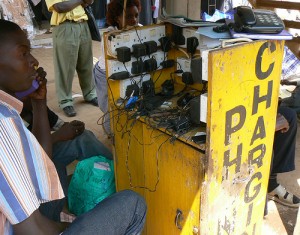
    Phone charging station in Uganda in 2008, by Ken Banks - kiwanja.net

    Phone charging station in Uganda, 2008, by Ken Banks – kiwanja.net

    There has been tremendous improvements in internet access and  explosive growth of cell phones in developing world, as Matthew Smith outlines in his essay for IDRC/Harvard’s latest conference, Communication and Human Development: The Freedom Connection? in September 2009.

    However, GV’s research (led by Aparna Ray and John Liebhardt) has found ambiguous evidence of online discussion of these themes that advances beyond well-worn anecdotes of fishermen with mobile phones. Those discussions surely exist, if not online; a look at the Manthan Awards in South Asia, for example, gives us a window into communities of practitioners in this field, and the focus of their work.

    In general, we observed that there are several categories of people writing online about ICT4D:

    1. People who both understand grassroots development needs and are proficient in ICT. A very small percentage of online writers fall in this category. These people have the skills to develop tools/ techniques, speak the language of ICT4D, and are able to get exposure for their projects.
    2. Academics who are interested in the field. They are able to develop concepts in ICT4D, and mostly run small research projects to prove/ disprove their hypotheses, build concepts, and make predictions. There is a lot of energy here – perhaps why we saw so many research papers in our web searches. These people explore and predict trends, but are not often in contact with grassroots folks, and rarely implement projects.
    3. Everyone else either comes from the ICT community, and open to designing tools for development/ social projects, or people working in the  development sector who need ICT solutions but have relatively low/ no knowledge of ICT. These two sets of people do not usually speak the same language.

    Broadly speaking, many development experts seem hesitant to learn technical skills and languages. They may want a ICT solutions, but there are numerous obstacles to engagement, including expertise, time, resources, and organizational culture. Hence ICT experts sense that development practitioners are rarely clear about helpful solutions.

    Likewise, ICT tool developers may not involve development communities in the need analysis/ development phase, producing many solutions that are top-down, and without user support.

    Solutions and strategies:

    ICT4D is a vibrant theme, but also quite complex, and with little awareness outside of specialist communities. Our first months of coverage have captured some of the best of existing citizen media writing. A next step would be to fill the gaps in coverage and language that we found. Some approaches:

    Continued engagement: Much more can be written, with a focus on clarifying who the audiences are for content.

    Popularizing complex ideas: much of the content of the GV posts is news for those who are not in the ICT space; for ICT experts, it has less to offer. How stories are reported is key. Strategies include:

    • Conducting interviews with experts and practitioners to simplify language and concepts for target audiences.
    • Finding a common language and platform for dialogue among people both in grassroots development and in ICT technology development.
    • Including writers from different perspectives and parts of the world.
    • Highlighting the work of interesting ICT projects.
    • Focusing on user experience and feedback.
    John Liebhardt and Aparna Ray contributed to the observations and conclusions in this post.
  • Global Voices and Google announce freedom of expression award jury

    The Breaking Borders Award is a new prize created by Google and Global Voices and supported by Thomson Reuters to honor outstanding web projects initiated by individuals or groups that demonstrate courage, energy and resourcefulness in using the Internet to promote freedom of expression.

    We are proud to announce our jury members for the award. The jury is drawn from experts and leaders in the freedom of expression, journalism, digital activism, and technology sectors, and includes representatives from around the world. Members of the jury are:

    Sheila Coronel, Director, Stabile Center for Investigative Journalism, Professor of Professional Practice, Columbia University Graduate School of Journalism
    Jose Roberto de Toledo, Projects and Training Coordinator, Brazilian Association for Investigative Journalism (ABRAJI); Director, PrimaPagina
    Edetaen Ojo, Convenor, International Freedom of Expression Exchange, Executive Director, Media Rights Agenda
    Dean Wright, Global Editor, Ethics, Innovation and News Standards, Reuters
    Rebecca MacKinnon, Co-Founder, Global Voices; Visiting Fellow, Princeton University Center for Information Technology
    Robert Boorstin, Director, Public Policy, Google

    The Breaking Borders Award is open to people of all nationalities. Winners will be selected by a panel of experts in the field of freedom of expression. A cash prize of $10,000 will be awarded in each of three areas:

    1. Advocacy, given to an activist or group that has used online tools to promote free expression or encourage political change
    2. Technology, given to an individual or group that has created an important tool that enables free expression and expands access to information
    3. Policy, given to a policy maker, government official or NGO leader who has made a notable contribution in the field

    Nominations for and additional information about the Breaking Borders Award can be submitted at http://breakingborders.net and close on February 15, 2010.

    Global voices is very excited to be associated with this event. Contact us at [email protected] with any questions.