Author: Jamia Wilson

  • Turning New York City INSIDE OUT: Volunteering at JR’s photo truck

    New-Yorker-2

    JR, the man behind the participatory global art project INSIDE OUT, has parked a photobooth truck in Times Square, from now until May 10. Photo: Instagram/newyorkermag

    On an unseasonably chilly Monday evening in Manhattan, hundreds stood in line in Times Square for up to two hours. As a city-dweller for seven years, I’ve seen queues this long for big Broadway openings or on New Year’s Eve. But this line was formed for a very different purpose — for people to have their faces and stories featured in what JR describes as “the biggest art gallery in the world.”
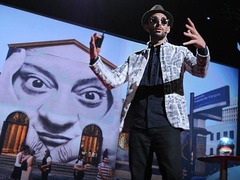
    JR's TED Prize wish: Use art to turn the world inside outJR's TED Prize wish: Use art to turn the world inside outIt’s been three years since TED Prize winner JR made the wish to turn the world INSIDE OUT with a global collaborative art project. As a documentary about the project premiered at the Tribeca Film Festival last weekend, JR decided to use his time in New York productively. He hatched the plan to park a truck with a photobooth on-board in the middle of Times Square, as he’s done in other cities before. As soon as I heard about this project, I knew that I wanted to be one of the volunteers for the truck’s inaugural night in my hometown.

    When I arrived in Duffy Square (the northern triangle of Times Square), stunning rows of freshly pasted black and white portraits covered the ground. Smiling, smirking and winking visages of passersbys — with homes as diverse as the Bronx and Tokyo — replaced the usual bareness of the concrete. Throughout my shift, elders, painters, skateboarders, toddlers and even NYC’s infamous Naked Cowboy posed for INSIDE OUT’s camera, adding their photos to the street-side quilt of images that breathed life and humanity into the street.

    As an INSIDE OUT volunteer, I learned how to capture and distribute large-scale portraits and make and apply wheat-paste. Over and over again, commuters interrupted their busy and purposeful strides and stopped to behold “the people’s art project.” Since I was adorned in INSIDE OUT’s trademark black and white spotted t-shirt, I was repeatedly asked about the origins of the project, how people could get involved, and how much it would cost to buy the portraits. Almost everyone eagerly jumped in line after learning that they could participate by giving their time, image and elbow-grease to help paste pictures.

    Placing the faces of strangers side-by-side in a collective masterpiece created a powerful sense of community. People marveled at the process of taking their pictures in the speckled black and white photobooth and watched in awe as their likeness printed from the side of the truck. I spoke to one man who was so addicted to the practice of snapping and pasting his photo, that he has followed JR’s installation to three cities around the world, including Tokyo and New York.

    As I walked away from Times Square, I thought of the thousands of people who have contributed 120,000 portraits to city walls, streets and countless other surfaces from Tunisia to South Dakota. I wondered if volunteers in the each of the 110 countries INSIDE OUT has touched experienced what I did. Did they see giggling children who were shorter than the portraits of their likeness dance blissfully with images of themselves? Did they witness a bride and groom take photos in their wedding finery and paste their pictures next to each other to symbolize their bond? Or, did they see what I repeatedly witnessed, a sense of recognition, pride and purpose in the eyes of folks who were given a moment to be truly seen – with big, bold, authentic, and honest emotion.

    “The people’s art project” gave New Yorkers a chance to choose to remain anonymous while also being visible. By providing us with an opportunity to pause and be present together, INSIDE OUT created a humbling a sense of intimacy in the most populous city in the United States.

    Help INSIDE OUT transform the city! If you live in New York City or will be visiting between now and May 10, email [email protected] to volunteer by yourself or with a group.

    The artist himself examines portraits pasted in Times Square. Photo: Anna Verghese

    The artist himself examines the portraits tiled in Times Square. Photo: Anna Verghese

    Pasting in action. Photo: Instagram/JR

    Pasting in progress. Photo: Instagram/JR

    A bride and groom make their portraits kiss at the INSIDE OUT photo truck. Image: Instagram/JR

    A bride and groom make their portraits kiss at the INSIDE OUT photo truck. Image: Instagram/JR

    The bride snaps her portrait. Photo: Instagram/NewYorkerMag

    The bride snaps her portrait. Photo: Instagram/NewYorkerMag

    A closer look at a section of portraits. Image: Anna Verghese

    A closer look at a section of portraits. Image: Anna Verghese

    New-Yorker-3

    A view of the truck itself. Photo: Instagram/NewYorkerMag

    Pharrell Williams takes a moment to add his image to the mosaic. Photo: Instagram/JR

    Musician Pharrell Williams takes a moment to add his image to the mosaic. Photo: Instagram/JR

  • A documentary about JR, and his participatory art project INSIDE OUT, to premiere at the Tribeca Film Festival

    The documentary INSIDE OUT: The People’s Art Project will premiere at the 2013 Tribeca Film Festival in New York this Saturday, April 20, giving an intimate look into the courageous victories and heartrending challenges involved in creating the world’s largest participatory art project.

    JR's TED Prize wish: Use art to turn the world inside outJR's TED Prize wish: Use art to turn the world inside outIn 2011, French street artist JR announced his TED Prize winning wish to connect people worldwide through a collaborative artistic action. He launched INSIDE OUT, inspiring thousands of people — from South Dakota to Iran — to collectively transform their personal identities into public artwork. From Moscow to Tunisia, citizens have turned more than 120,000 digital portraits into bold posters covering everything from city walls to trains.

    Besides shifting the way INSIDE OUT’s participants and onlookers contemplate storytelling and public space, JR’s big dream has inspired diverse individuals to define the soul, values and vision of their communities with a few simple tools — a camera, paper and paste.

    Inside Out: The People’s Art Project debuts on HBO on May 20th at 9PM ET. For a sneak peek, watch the trailer above.

    Inspired?

    Participate in an action in your community »

    Check out just a few of the amazing — and stunning –images pasted in cities across the world »

  • From the Hole in the Wall to Yale: A Q&A with Arun Chavan

    Sugata-Mitra-and-kids

    Sugata Mitra carved a hole in a wall in a New Delhi slum—about 3 feet high—and placed a computer in it. When kids asked what it was, he said, “I don’t know,” and walked away. Photo: courtesy of Sugata Mitra.

    After his 6-year-old son taught himself to use a computer, 2013 TED Prize winner Sugata Mitra wanted to test the idea that kids can learn on their own, by discovery rather than formal training. So Mitra and his colleagues dug a hole in the wall near a slum in New Delhi, set up an Internet-connected computer there, and abandoned it in 1999. They also set up a hidden camera.

    Sugata Mitra: Build a School in the CloudSugata Mitra: Build a School in the CloudBefore long, children from the community figured out how to search for information online. They began learning English and other subjects, and started teaching each other. Consequently, Mitra’s “Hole in the Wall” experiment catalyzed his pursuit to advance child-driven learning for thousands of kids around the world.

    In his talk from TED2013, Mitra describes repeating the “Hole in the Wall” experiment 300 miles away. He installed a mysterious computer on the side of a road where such machinery was even less familiar than in New Delhi.

    12-year-old Arun Chavan was one of the kids who found himself drawn to that computer in Shirgaon, a coastal village in India. Over the next few months, he taught himself to use it. And now, more than a decade later, he lives in the United States and studies at Yale University.

    We connected with Chavan to discover how the “Hole in the Wall” impacted his life. Here’s what he’s up to today:

    How old are you?

    I am 23 now.

    And you’re at Yale. What inspires you about your field of study?

    I am doing a PhD in Evolutionary Biology. I’m just amazed by the stunning diversity of organisms around us. The excitement of digging into the past to discover how it arose is what keeps me going.

    What were your first thoughts when the street-side computer appeared in your community? 

    I was a kid then, studying in the sixth grade. I had never handled a computer before. I thought it was great to have those computers lying around to play with. I don’t remember being afraid to use them. I think we figured out soon enough that restarting the computer fixes almost every problem!

    What was your favorite thing about participating in the “Hole in Wall” program?

    I would say mainly three things: First, that there was nobody telling us what to do and not to do. Second, that it wasn’t the same as having a computer to yourself. We learned things as a group. We learned everything empirically, and taught each other what we found. And third, that the computers in the “Hole in the Wall” were connected to the Internet. It was amazing to be able to Google anything, or to chat with my sister who was studying in a different city.

    How did your family feel about your participation?  Did it affect their lives in any way?

    My parents were as excited as I was. A few years later when we got ourselves a computer, the only thing I taught my father to do was to switch it on. In his 40s, he taught himself how to use it, and now he regularly blogs to share his paintings and writings.

    Are you still in contact with the kids you studied with using the “Hole in the Wall” computer? 

    Unfortunately, I am not in contact with many of my friends from that time. Some of us went to different cities to attend college after high school. Most of those who stayed back attended vocational training programs and are working now.

    Now that you’re a PhD student, are you teaching? If so, did your experience with the “Hole in the Wall” impact the way you instruct and connect with students?

    Only recently have I started teaching. In the discussion sessions I lead, I tend not to intervene unless it is necessary, and I try to let the students understand things from their own discussion and ideas. I don’t know if I borrowed this approach from “Hole in the Wall,” but I find it similar.

    What is the most important thing you learned from the “Hole in the Wall” experience?

    Sugata Mitra’s “Hole if the Wall” idea is quite radical, I think. But it’s too important to be ignored. I like how he dares to imagine (and also hopes for) a completely different future of education than most of us do.

    Along with the “Hole in the Wall,” many other things — interactions with certain people, books, and parents — have impacted my way of thinking. It’s really hard to tease apart what I have learned from the “Hole in the Wall.” I think that you can learn anything if you really want to — this could possibly be a “Hole in the Wall” effect.

    What does curiosity mean to you?

    A driving force to explore something new, I guess! Curiosity is also exciting for me.

    If you could give a TED Talk, what would it be about?

    My father writes and directs plays. As a kid, I acted in many of them. These plays have significantly influenced my thinking and have greatly contributed to who I am. If I had to give a TED talk, it would probably be about that experience.

    Arun-Chavan

    Arun Chavan is now studying for a PhD at Yale. Photo: courtesy of Arun Chavan.

    To learn more about the Hole in the Wall, read Sugata Mitra’s TED Book, Beyond the Hole in the Wall: Discover the Power of Self-Organized Learning. And for more on how to inspire self-organized learning wherever you may be, download this toolkit »

  • 4 inspiring kids imagine the future of learning

    Future-of-Learning-kidsAfter more than 13 years of research convinced him that children have the ability to learn almost anything on their own, 2013 TED Prize winner Sugata Mitra aspires to shape the future of learning by building a School in the Cloud, helping kids “tap into their innate sense of wonder.”

    In the spirit of Mitra’s invitation to the world to “ask kids big questions, and find big answers,” we asked four brilliant young people to tell us: What do you think is the future of learning?

    Here, their answers.

    Adora Svitak, 15-year-old writer, teacher and activist

    “One of the most powerful shifts in the future of education will come from not only the tools at our disposal, but from an underutilized resource: the students whose voices have for too long been silent. We’re increasingly pushing for seats at the decision-making tables, empowering ourselves by shaping our own learning, and taking on activist roles both online and off. To me, this signals one of the most hopeful signs of the future of education — the shift from a top-down, learning-everything-from-the-authority-figure approach to an approach characterized by peer-to-peer learning, empowerment  and grassroots change.”

    Watch Adora’s talk to discover “What adults can learn from kids” »

    Kid President, 10-year-old inspiration machine

    “My older brother and I believe kids and grown ups can change the world. We’re on a mission with our web series, Kid President, to do just that. If every classroom in the world could be full of grownups and kids working together, we’d live in a happier world. Kids want to know about the world and about how they can make an impact. Kids also have ideas. It’d be awesome if teachers and students could work together and put these ideas into action. There should be lessons in things like compassion and creativity. If those two things were taught more in schools we’d see some really cool things happen.”

    Watch Kid President’s inspiring “pep talk” for the world »

    Ying Ying Shang, 16-year-old blogger, teen advisor to the UN Foundation, and SPARK Movement activist

    “For most of my life, the media has been a constant presence, whether it’s in the form of a TV droning in the background or the billboards that whiz by on the highway or the never-ending barrage of sounds and images on social media. That’s why I know the importance of learning media literacy early. It’s so important that the power of the media be recognized, both in its capacity for sexualization and distortion of reality, as well as its capacity to be harnessed for good.

    Also, it seems inevitable that future educators will turn to online learning tools, replacing blackboards with smartboards and note packets with YouTube videos. In the wake of this shift, analysis and critical thinking skills should be taught more than ever in classrooms.”

    Read Ying Ying’s blogs about creating healthy media and ending the sexualization of women and girls »

    Thomas Suarez,13-year-old app developer and founder of Carrot Corp, Inc.

    “The future of education should include programming as a major subject. The class will allow students to collaborate on code, teach each other, and communicate outside of the classroom using services such as Google+. This way, students will think more during other classes, be much more likely to get a job and, most important, have fun.”

    Watch Thomas’s talk and learn about how he taught himself to build iPhone apps »

    Join the conversation! What do you think is the future of learning? Tell us in the comment section below.

  • Before the Hole in the Wall: A Q&A with 2013 TED Prize winner Sugata Mitra

    Sugata-Mitra-trendingLast week, education researcher Sugata Mitra won the first-ever $1 million TED Prize to build his School in the Cloud. Sugata Mitra: Build a School in the CloudSugata Mitra: Build a School in the CloudPrior to his TED Prize win, Mitra was known for his “Hole in the Wall” experiment. In 1999, Mitra and his colleagues dug a hole in a wall near an urban slum in New Delhi, installed an Internet-connected PC and left it there — while a hidden camera filmed the area. Through the video feed, they observed children from the slum playing around with the computer, teaching themselves how to use it and sharing with others their amazing discoveries.

    At TED2013, Mitra invited the world to embrace child-driven learning by setting up Self-Organized Learning Environments (SOLEs) and helping him design a learning lab in India, where children can “embark on intellectual adventures.”

    We gave Mitra a call and asked him to reflect on his TED Prize win, dive deeper into his thoughts about learning and share the personal experiences that inspired his passion for igniting curiosity in children across the globe.

    Here’s our conversation:

    What does winning the TED Prize mean to you?

    To me, it is a great symbol of recognition — that my work of the last few decades does have acceptability and is of real interest to the world. I was nervous that my work would get put aside as “out of the box,” a phrase I dislike immensely, and forgotten. I am more confident now, thanks to TED.

    How did your upbringing shape your interest in self-directed learning?

    I did not know anything about self-directed learning until 1999 when I stumbled upon it because of the Hole in the Wall experiment. I grew up more or less by myself in a big bungalow in Delhi with a large garden that had lots of trees and all sorts of birds, animals and insects. We used to learn together, if that makes any sense.

    If you were part of a SOLE as a child, what big question do you imagine you might have asked first?

    I think I have always been in a SOLE. I grew up quite alone and used to experiment constantly with my surroundings — trees and animals and birds and myself. There were no computers, so I used to ask questions to nature, and often, she would answer.

    What is the first thing you remember learning on your own? Did you enjoy the process?

    When I was 4 or so, we used to live in my mother’s house in Calcutta. The morning newspaper was rolled up and tossed into our first-floor balcony by the newspaper man. I was always up very early and used to pick it up and take it to my grandfather. I did not know he was dying from cancer. One day when I went to his room with the paper, it was empty and there were people crying. I went back to the balcony and put the paper back where it had fallen and stood for some time wondering if I should pick it up and try again. I learned you can’t turn back time. I did not enjoy the process, I am afraid.

    Some people have misunderstood your strategy as anti-teacher, when in fact you are arguing that teachers have a crucial role to play — just a different one — in this technological age. Who was your favorite teacher and why?

    My favorite teacher was Father Lewicki at St. Xavier’s High School. When I was 16, I told him I don’t see why I should believe in God. He said I should read Teilhard de Chardin and decide for myself.

    Will child-driven education work differently depending on a child’s culture, gender and access to resources?

    Easy access to an unsupervised, publicly visible computer with broadband is critical. But children are impacted differently depending on their reading comprehension, particularly in English. Culture does not matter so much when you are dealing with 8-12-year-olds. Neither does gender.

    How has parenting informed your perspective on self-directed learning?

    My father did his Ph.D. under Benjamin Bloom in Chicago, in the days of objective-driven and “programmed” learning. He then became one of the first psychoanalysts in India. I think he taught me a lot of things by not telling me to do things — by not teaching and only listening.

    I learnt how to listen and that people will tell you everything if you listen and say “hmmm” once in a while. My mother, who was once a student of Rabindranath Tagore, taught me how to do lots of things just by thinking about them.

    Your Hole in the Wall experiment inspired Vikas Swarup’s novel Q & A, the book that Slumdog Millionaire is based onHow do you think your TED Prize wish will impact popular culture?

    In an age where “knowing” may be obsolete, Homo sapiens will have to reinvent ourselves. The wish, I hope, will be a tiny step in that direction. If children have wings, they will learn how to fly.

    Did your experience as a parent impact your views about self-directed learning?

    The Hole in the Wall experiment was based on what I had learned from my son when he was 6. It was 1987 and I had bought my first PC, spending nearly a year’s salary at the time. When it arrived, I said to my son, “Don’t even think about it.”

    About three days later, I was looking for a file on the DOS system. Every time I typed DIR, all the file names would scroll up too fast for me to read them. As I was trying the third time, a little voice from behind said. “If you type DIR/W/P, it will show up like a page.” I was a bit shocked. “How did you know that?” I asked. “Well, that’s what you did yesterday!” he said. From then on, I let him use the computer.

    In a couple of weeks, I was asking my son how to do things that I did not know my computer could do. I wrote a paper suggesting that children can learn to use computers by themselves just by watching each other. It was very badly received. Twelve years later, in 1999, my friend and employer Rajendra Pawar let me do the Hole in the Wall. He had no clue what I was trying to find out. The rest is history.

    Learn more about Sugata Mitra’s TED Prize wish »

  • 8 great ideas for cities: The City 2.0 award-winners in video

    Future-CityAs the world’s population expands toward 10 billion people within the next 50 years, urban citizens face an unprecedented opportunity to build more vibrant, just and inclusive urban centers. Because we know that cities are powered by people, and people enable change, TED responded to the rapidly changing urban landscape by granting the 2012 TED Prize to an idea: the City 2.0.

    Last month, TED launched our redesigned City 2.0 website, a storytelling platform for city dwellers to share stories, videos and innovations related to urban transformation. Citizen-powered and story-driven, the City 2.0 site highlights what motivates people to take action and work together to shape the cities of our future.

    The City 2.0 site also features remarkable stories from the 10 City 2.0 award winners, who are improving their cities by turning world-changing ideas into sustainable solutions and collaborative action. From Kampala to Melbourne, City 2.0 grantees are investing their energy, passion and resources towards making a difference in areas like education, safety, health, food and public space.

    Watch these eight videos, released this week at TED2013 and TEDActive 2013, featuring remarkable City 2.0 award-winners from across the globe and learn how ordinary citizens are sparking extraordinary change:

    Crowdsourcing the Quiet
    As city populations expand, it becomes increasingly difficult for denizens to find places to retreat and relax in silence. Jason Sweeney and his team are working to “crowdsource the quiet” through their Stereopublic project, using web and smartphone-based technology to help people geo-locate quiet spaces in urban environments.

    Designing Chicago
    Designing Chicago leverages public participation and design to make citywide navigation better. The ultimate goal is that the app will take transit planning to the next level, incorporating functionality that people can use in a responsive, holistic way. Need to pick up a cup of coffee on the way to a meeting? Work that into your transit plan. Forgot the bus might be crowded because of the baseball game? The app will remind you of that, too. Need to plan elevator and escalator routes because you’re stuck with a big stroller? No problem.

    Hollaback!
    Emily May and Hollaback! are putting technology to work in the movement to end street harassment. Street harassment may be considered a social and cultural norm, but May is using crowd-source technology and social media to change the way we think about this insidious form of gender-based violence. Emily May wants you to Hollaback!

    Lost in Lahore
    A trio of impassioned mapmakers and technologists — Asim Fayaz, Omer Sheikh and Khurram Siddiqi — are going to use the $10,000 from their City 2.0 Award to become superheroes for people who are desperate and lost in Lahore. They are taking Allama Iqbal Town, one of the most densely populated localities in Lahore, and using it as a demonstration, of sorts. The signs they erect will follow international standards and have road names in Urdu and English. In addition to installing the new signage, they will also engage a team of paid experts and passionate volunteers to maintain the signs for a trial period of three months, documenting the time and effort required.

    Mapping Sanitation
    Faisal Chohan, a Senior TED Fellow and TEDxIslamabad organizer, will continue his mapping work with a related mission: Improving sanitation in order to prevent the spread of cholera, a bacterial infection in the small intestine, primarily caused by drinking water or eating food that has been contaminated by the feces of an infected person. The rapid dehydration and electrolyte imbalance that results from cholera can lead to death if left untreated.

    Recycled Amusement
    An artist and community organizer, Ruganzu Bruno Tusingwire had an imaginative idea for how to engage and empower the children of his home country: play. Tusingwire became the first 2012 City 2.0 Award recipient at the TEDxSummit in Doha, Qatar, where he pitched his plan to turn thousands of plastic water bottles into an amusement park where kids growing up in the slums can play and learn.

    Re-imagining the Commons
    Recognizing the irreplaceable power of the local gathering space, Next American City, a Philadelphia-based nonprofit directed by Diana Lind, is living its mission by turning its headquarters into a vibrant local learning laboratory, art gallery and hot spot for boundary-crossing conversation.

    WikiHouse, a House and Home for the 99%
    Inspired by a desire to “create something that would allow the 99% to make cities for the 99%,” designers Alastair Parvin and Nick Ierodiaconou aimed to explore practical applications of their philosophical commitment to a more democratized design movement. They created a blueprint allowing everyday people to build their own homes using open-sourced designs and locally sourced materials. Since the project’s inception, five prototypes have been assembled.

    Inspired by the City 2.0 award winners’ stories? Share your stories and inspirations on www.thecity2.org and download The Atlantic Cities and TED Books’ original ebook, City 2.0: The Habitat of the Future and How to Get There.


  • Announcing: The new City 2.0 website launches today. Share your stories.

    City2.0-Homepage-redo

    In the next 30 years, two-thirds of our planet’s population will live in cities. Have you ever tried to envision the cities of the future?

    Cities are enlivened by people, and people enable change. So today, we are launching our redesigned website TheCity2.org, a gathering place for all urban denizens to share stories, videos, ideas and innovations related to urban transformation.

    Citizen-powered and story-driven, the City 2.0 site will showcase community driven, user-generated stories about what moves hearts and minds to take action to improve the way we share the planet. The new site features stories from some of our TEDxCity2.0 participants and City 2.0 prizewinners who received grants of $10,000 each to support their impactful work in areas like transportation, education, health, public space, safety and food.

    The 10 prizewinners’ remarkable stories include grantee Emily May’s use of crowd-sourcing and social media to end street harassment, TED Fellow Gabriella Gomez-Mont’s desire to fight a health crisis in Mexico City by launching a citywide dance competition, and the Norwegian firm TYIN tegnestue Architects’ plan to build a community center in partnership with the residents of Bangkok’s largest slum.

    Most importantly, the new TheCity2.org needs your story so we can learn from each other to make our urban spaces more vibrant, inclusive, and just. Please submit a story or inspiration from your city at TheCity2.org » 

    We are excited about how your passions and projects will help us reimagine the cities of our present and future together. This is your opportunity to contribute to a global community of city dwellers, urban entrepreneurs, organizers, dreamers and doers.

    The new City 2.0 website was born from a groundbreaking TED Prize winning idea, focused on sharing concepts, designs, and resources to spark urban transformation worldwide.