Author: Jason (Admin)

  • How Can Anyone Be Loyal To The “Domestics” When They’ve Laid Off Thousands?

    As a long-time fan of the Toyota product, I’ve heard or read hundreds of comments about how Toyota isn’t an “American” company, that buying a Toyota product is hurting the American worker, etc.

    I’ve always tried to educate the people who make these statements, explaining that 1) most “domestic” cars aren’t nearly as domestic as they think and that 2) some Toyotas (and Nissans and what have you) are designed, built, and sourced in the USA (like the Tundra).

    Yet sometimes this info falls on deaf ears.

    So, instead of detailed explanations about where Toyota’s profits go or numerous examples of supposedly imported products winning “most American” awards, I’m just going to talk about two numbers:

    -266,536

    and

    +74,885

    The first number? The number of workers fired or laid off by GM, Chrylser-Fiat, and Ford since the year 2000. The second? Workers hired by Toyota, Nissan, Daimler etc.*

    *Numbers according to Automotive News

    266,536 Jobs Lost?!

    It’s appalling to me that the three stalwarts of the American auto industry can lay off 266,000 employees, yet still have ardent defenders. How can anyone talk about buying an “American Made” product from Ford, GM, or Chrysler-Fiat under the guise of supporting the American worker? Those three companies put more than a quarter of a million workers in the street since the year 2000.

    To put that number in perspective:

    • If each of these 266,536 people earned an average of $60,000 a year, that’s nearly $16 billion in lost wages per year.
    • If each of these 266,536 people collected $2,000 a month in unemployment benefits for a period of 18 months before finding a new job, that’s $9.5 billion in government provided benefits to workers who GM, Ford, and Chyrsler-Fiat fired or laid off.
    • If each of these 266,536 lost jobs supported 2-3 additional jobs each (school teachers, store clerks, dealerships, etc.), this 266,000 job “contraction” could have actually been about 1 million jobs lost.

    Now I realize that GM, Ford, and Chrysler-Fiat were bloated, poorly managed corporations that had to lay off workers in order to stay competitive. It’s called “capitalism,” and I’m all for it.

    However, explain to me how it makes sense to be loyal to a group of companies that laid off 266,536 people over the last decade (or so) under the premise of supporting your fellow Americans…cause I don’t get it.

    Fortunately, “Imports” Hired 74,885 North Americans

    While Ford, GM, and Chrysler-Fiat were busy laying off workers, Toyota, Nissan, Daimler, and others were busy hiring people by the thousands. About 75 thousands, to be precise.

    Toyota in particular opened three new auto plants since 2005:

    • TMMTX in San Antonio, which builds Tundras and Tacomas
    • TMMC in Woodstock, Ontario, which builds Rav4s
    • TMMMS in Blue Springs, Mississipi, which builds the Corolla

    Is this proof that Toyota is good and Ford, GM, and Chrysler-Fiat are bad? No. It’s just evidence that the whole “I only buy cars made by American companies cause’ I believe in the American worker” argument is nonsense, at least if you think that only your average Ford, GM, or Chrysler-Fiat product is made by the American worker.

    Blind loyalty to Ford, GM, and Chrysler-Fiat is mystifying to me for a lot of reasons…this one of them.

    The post How Can Anyone Be Loyal To The “Domestics” When They’ve Laid Off Thousands? appeared first on Tundra Headquarters Blog.

  • Hyundai Santa Cruz Pickup Truck by 2017?

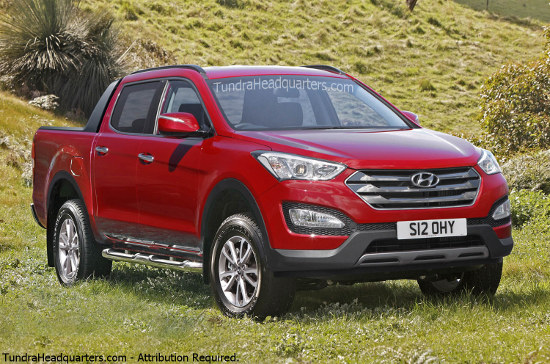
    Rumors of a Hyundai pickup truck have been flying around for a few years now, with the most substantial being a rumored tie-up with Chrysler-Fiat. While that particular rumor has died, a new (and well sourced) rumor has Hyundai importing a mid-size pickup truck in 2017.

    The truck would be based on the long wheel base version of the Santa Fe, would be built in Korea (Ulsan), and would challenge the Tacoma, the soon-to-debut Chevy Colorado, and the Nissan Frontier for a slice of the North American pickup truck market. This truck would also be sold outside North America to compete with the Ford Ranger and Toyota Hilux.
    Hyundai pickup truck

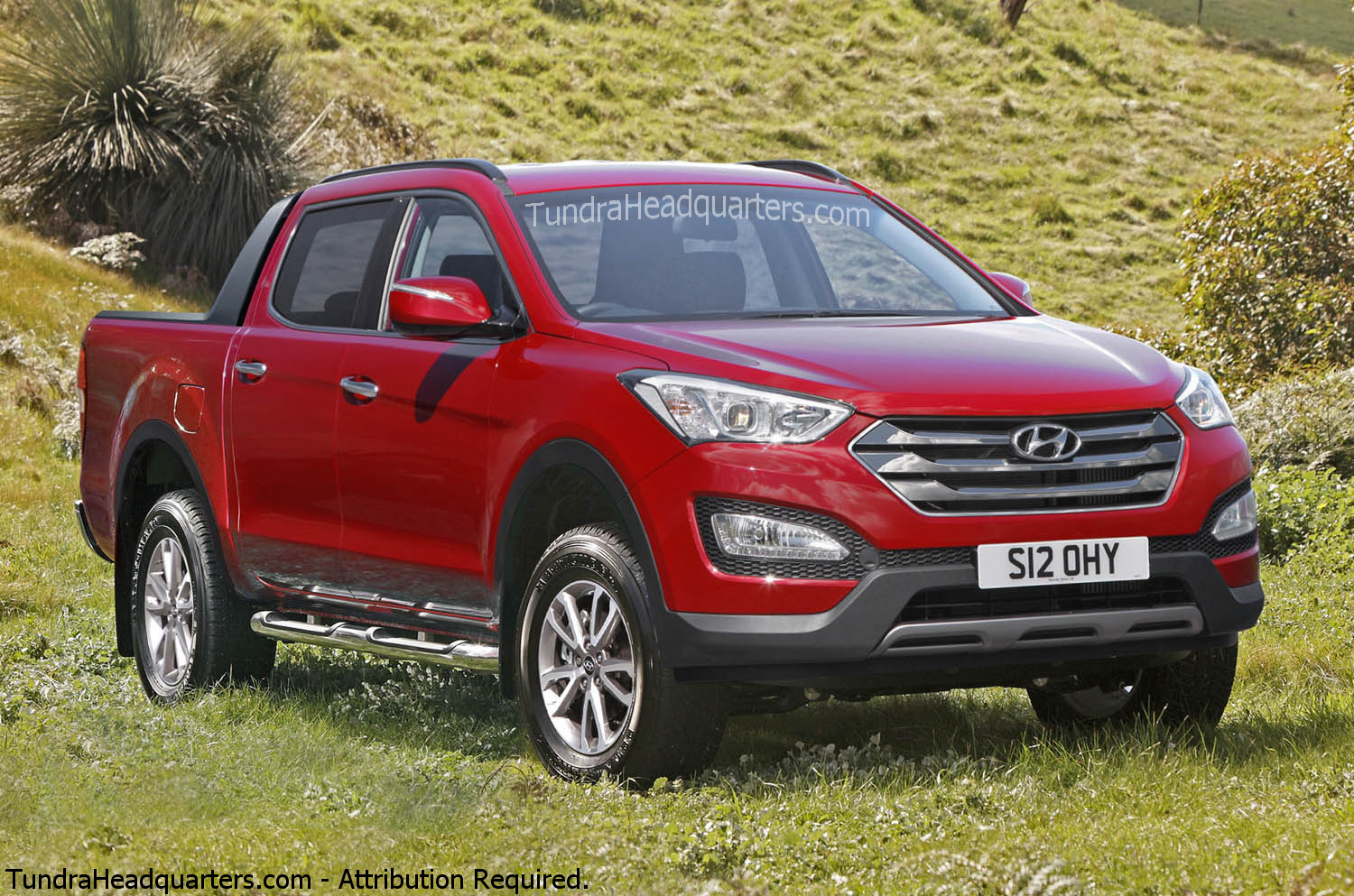
    This rendering of the rumored Hyundai pickup based on the Santa Fe – which we’re calling the Santa Cruz – looks feasible, doesn’t it? Click for a larger view.

    What follows is an analysis of this rumored truck, with informed estimates about this truck’s name, configuration, and specs. As always, we’ve taken the time to consult with various sources in the industry when preparing this estimate. This isn’t to say that what we’re presenting here is factual, but we feel it’s a good first guess at Hyundai’s future truck plans…and there are a lot of reasons to expect this pickup in 2017 or 2018.

    First, Why Is Hyundai Going To Start Selling Trucks?

    There are a few great reasons for Hyundai to start selling trucks in 2017:

    1. The “chicken tax”, a 25% tariff on imported trucks, expires in 2017.
    2. Fuel economy and emissions regulations will force full-size truck manufacturers to add on a lot of expensive fuel saving features beginning in 2017. As full-size truck prices increase, the market for mid-size trucks (which won’t need the same costly fuel sipping features) could grow.
    3. The cost of developing a pickup from the existing Santa Fe platform is relatively cheap compared to developing a truck from scratch. By focusing on 4-door mid-size truck buyers, Hyundai can essentially bolt a bed onto the back of an existing platform and start selling (eg., the Honda Ridgeline).
    4. Trucks are generally very profitable, and profits are the name of this game.
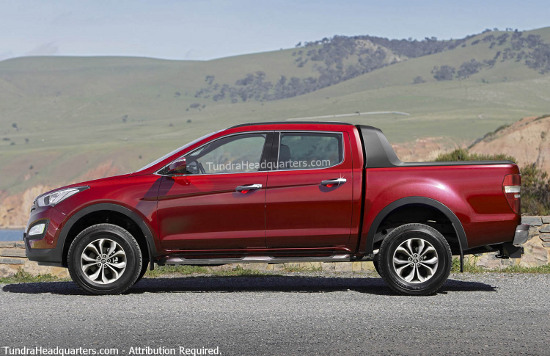
    Hyundai Truck rendering

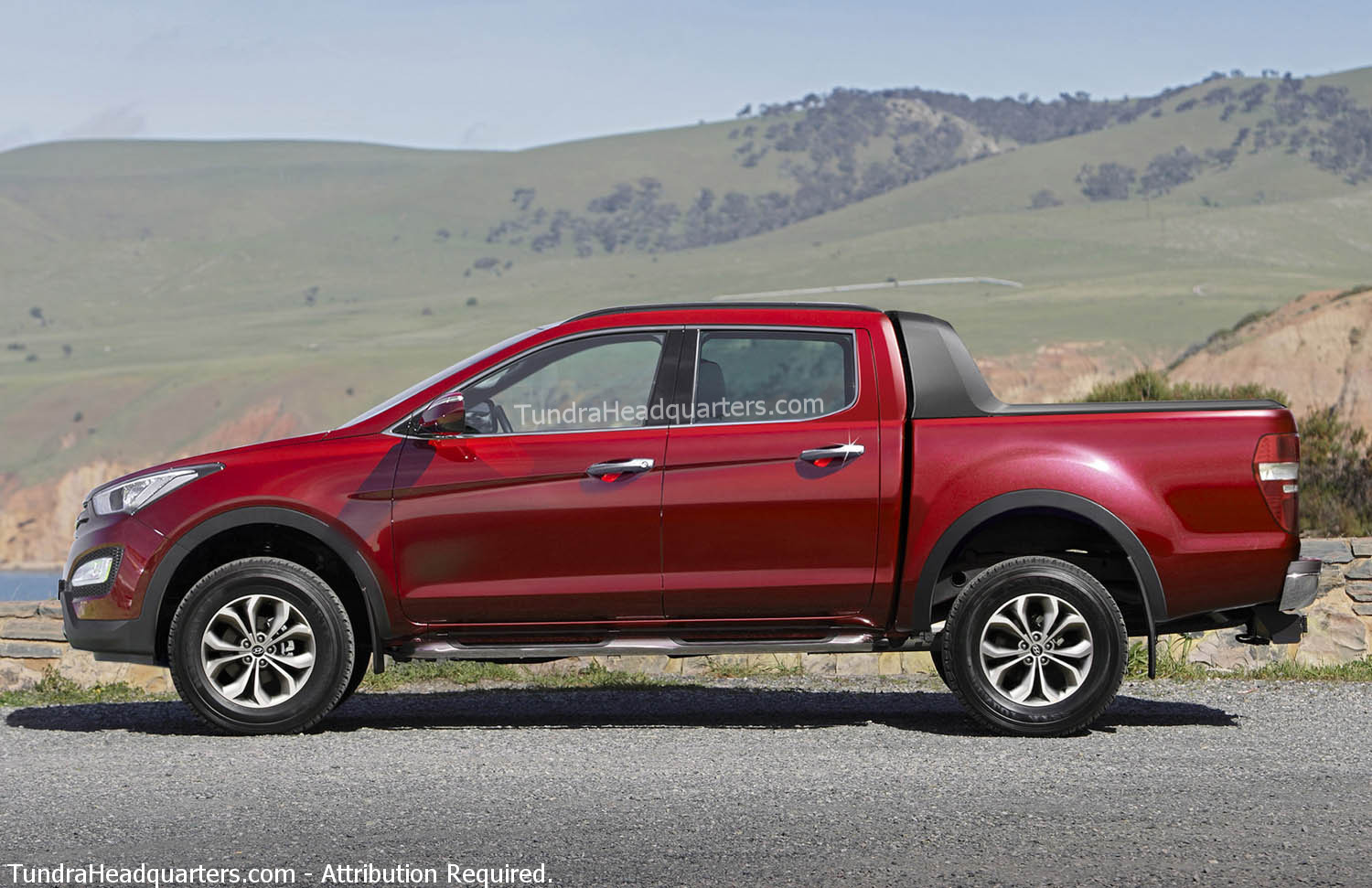
    The bed in this rendering is probably a bit too short when compared to the likely truck we’ll see (which should have a 5 foot bed). However, you get the idea. Click for a larger view.

    What’s In A Name?

    We’ve guessed that the name of this truck will be the Santa Cruz, partially because that name is a logical connection with the parent model Santa Fe, and partially because Hyundai seems to like naming their products after cities in the Southwestern USA.

    • Santa Fe – mid-size SUV
    • Tucson – a smaller SUV
    • Veracruz – a larger crossover SUV that’s been discontinued

    See the pattern? They’re all Southwestern cities, and there’s an alphabetical order here too. Possible names for the Hyundai truck might be:

    • Santa Cruz (our guess)
    • Nevada
    • Rincon
    • Toro
    • Zapata

    All of these are well-known Southwestern city names, and all of them sound like good pickup truck names (at least to me). However, for simplicity’s sake, we’ll refer to the rumored Hyundai as a “Santa Cruz” for now, subject to revision.

    Powertrains

    Since the Santa Fe is the platform for this future pickup, it stands to reason that the Santa Fe’s powertrain options will be offered on this truck as well. Since the truck will be based on the long wheelbase version of the Santa Fe, Hyundai’s 3.3L V6 seems probable. Producing 290hp and 252lb-ft of torque, the 3.3L V6 will likely be a capable challenger to engines offered by Toyota and Nissan.

    Hyundai Pickup Toyota Tacoma Nissan Frontier
    3.3L V6 4.0L V6 4.0L V6
    Direct Injection, DOHC DOHC DOHC
    290hp at 6400 RPM 236hp at 5200 RPM 261hp at 5600 RPM
    252 lb-ft at 5200 RPM 266 lb-ft at 4000 RPM 281 lb-ft at 4000 RPM

    However, it’s worth pointing out that the 2.0L turbo 4-cylinder available in the 5-passenger Santa Fe Sport is very comparable to the V6 – 264hp and 269lb-ft of torque. It may be that the 2.0L turbo is the primary engine in the Santa Cruz at some point.  It’s also possible that Hyundai will offer a small diesel engine (they currently offer a 2.2L diesel on the Santa Fe in Europe), only there are cost concerns with offering this engine in the USA.

    As far as putting power to the ground, it’s safe to assume the Santa Cruz would be offered as either a FWD or AWD with a 6-speed automatic. While a 6-speed manual is offered on the Santa Fe sold in Europe, all of the sources we consulted state that it’s unlikely to be offered in the USA.

    Towing and Hauling

    The maximum payload on a decked-out AWD Santa Fe LWB is about 1300lbs, with a curb weight of 4300 lbs. If we assume that Hyundai will be able to save weight replacing the back end of a 7-passenger SUV with a pickup bed, than a 1500 lbs max payload rating seems perfectly reasonable.

    As for towing, a max tow rating of 5,000 lbs seems likely. Based on my discussions with automotive engineers over the years, you can get any mid-size vehicle on the road to pull 3,500lbs with minimal investment. To get to 5,000lbs towing, however, Hyundai will likely need to invest in some frame strengthening, larger brakes, and additional cooling for the engine and transmission.

    It may be that Hyundai will decide against making this investment…if market analysis concludes that your average 4-door mid-size truck buyer can “get by” with 3,500 lbs tow capacity, Hyundai might save their pennies on upgrading the frame, brakes, etc.

    Cabs, Beds and Pricing

    The Santa Cruz will be offered as a crew cab with a 5′ bed. The reasons for offering only one cab option are many:

    1. A four-door cab is by far the most popular choice for recreational truck buyers.
    2. The shorter 5′ or 5.5′ bed is the most popular length for buyers of both full-size four door trucks and buyers of the Tacoma and Frontier.
    3. Fewer options and configurations reduce costs.
    4. The Santa Cruz is going to be designed with a worldwide marketplace in mind, and a 5′ bed is just fine everywhere in the world. Only buyers in the USA ask for longer bed lengths.

    It’s safe to assume Hyundai will offer the same trim levels as the Santa Fe – a GLS and a Limited. Pricing should fall between $30 and $35k, making the Santa Cruz pricing very comparable to pricing on similar four door Tacomas and Frontiers.

    Holes In Our Analysis

    No responsible prediction can be offered without discussing some of the limitations of the prediction being offered. The biggest “hole” in this analysis is that the mid-size pickup truck market isn’t expected to grow. It’s unusual for an automaker to invest in building a product for a declining market segment (but not unheard of).

    Additionally, fuel economy and emissions regulations will make selling pickup trucks much harder after 2020. While Hyundai undoubtedly has a plan to get the Santa Fe to meet all the fuel economy requirements, making a pickup truck that will also pass these requirements may be cost-prohibitive (assuming small sales volume, that is). Of course, a longer wheelbase pickup truck doesn’t have to meet the same targets as the base SUV, so there may not be a problem here.

    Finally, the biggest problem is that no one at Hyundai has confirmed any of this.

    Still, we believe that Hyundai is going to bring the truck described above to the USA in 4 years or so, and none of the people we talked to thought our analysis was unreasonable.

    What do you think – will Hyundai build the truck as described, or will it be different? Or will there be no truck at all?

    The post Hyundai Santa Cruz Pickup Truck by 2017? appeared first on Tundra Headquarters Blog.

  • We’re Giving Away Some Horns!

    The creator of the Toyota devil horns emblem shown below has graciously given us an emblem that fits a 2007+ Tundra, and we’re giving it away to you!

    Tundra Devil Horns

    Devil Horns – win them for free!

    Enter below (entry is 100% free).

    Enter to Win A Devil Horns Emblem For Your Tundra!You need to enable javascript to enter this campaign !
    Powered by PromoSimple.

    You can read an interview with Andres (the creator of this horns) here – Q&A with Devil Horns Maker Andres Diaz

    Questions, comments, reflections on how this devil horn emblem might bring your Tundra to life?

    The post We’re Giving Away Some Horns! appeared first on Tundra Headquarters Blog.
  • Consumer Reports Annual Car Survey – What It Looks Like

    As a Consumer Reports subscriber, I received an email asking for my input on vehicles. Here’s what Consumer Reports asked and how this particular survey might come up short.

    Can You Say “Complicated”?

    Surveying people with accuracy is difficult. First of all, many questions are open to interpretation. Second, the method for collecting answers is often imperfect. Finally, not every survey response offers the same amount of diligence and effort.

    NOTE: If you need proof that surveys are problematic, think about all those political survey results we hear…more than half the time, these scientific surveys are patently incorrect.

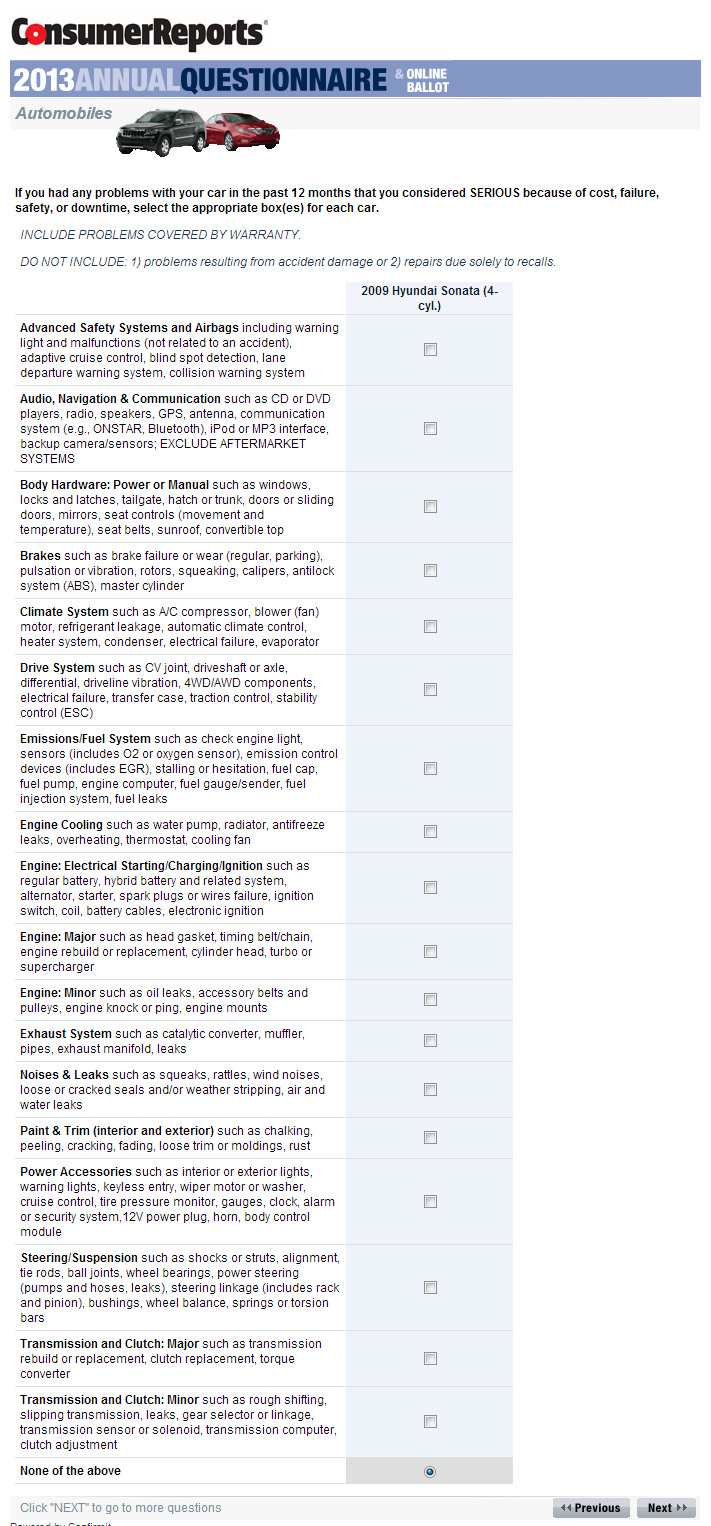
    In my opinion, the biggest flaw in the survey I received from Consumer Reports is that it’s too damn complicated. Take a look at this survey page (click for a larger view):

    Consumer Reports annual car survey sample

    Here’s a nice long list of serious problems that Consumer Reports wants to know about. How many people read this list completely and carefully?

    Did you read each and every line of that survey? Me neither. Quite frankly, I can’t imagine that most people read this list carefully. Instead, they problem skim the headings like “steering/suspension,” and then click if/when they think they’ve had an applicable issue. I have three problems with this:

    1) Some of the headings – like “Drive System” – are incredibly ambiguous. If I asked a random man or woman on the street about problems with their vehicle’s “drive system,” who knows what kind of response I might get. Granted, the survey offers some examples, but there are a few sub-headings here that just aren’t descriptive enough.

    2) This detailed list requires the respondent to make some fairly nuanced distinctions. For example: Let’s say your vehicle had a manual transmission with a grinding noise caused by worn synchros. Which category would you mark this down under?

    • Transmission and Clutch: Major?
    • Transmission and Clutch: Minor?
    • Noises and Leaks?
    • Drive System?

    If you review things carefully, you’d probably pick the second item on my list. OR, you might get annoyed, close the survey, and move on…which brings me to my third problem.

    3) This survey requires a fair amount of effort on behalf of the respondent. Therefore, you’re more likely to get responses from people who are either really angry, really happy, and or really excited about contributing to Consumer Reports.

    For all these reasons, I’d argue the results from the Consumer Reports surveys are anything but definitive.

    Is the Consumer Reports Survey Worthless?

    Of course not. Imperfect survey data is better than no survey data, and while the length, detail, and ambiguity of the survey undoubtedly leads to erroneous conclusions, the survey data is likely good enough to spot trends.

    If (for example) very few Lexus owners report problems compared to BMW owners, it’s likely that Lexus is more reliable than BMW…especially if this trend holds for a period of years. Likewise, if a greater percentage of Chrysler owners report problems compared to the average, it’s likely that Chrysler products are below-average in terms of quality.

    Yet it would be foolhardy to trust Consumer Reports data exclusively. In fact, the best approach would be to consult data from Consumer Reports alongside data from JD Power, reviews from trusted entities like Edmunds.com, and of course market data (resale value), which is arguably the economic expression of a vehicle’s quality and reliability relative to competing models. Looking at historical trends would also be wise, at least in the case of JD Power and Consumer Reports.

    The point? Consumer Reports survey data is imperfect. Don’t buy a car just because Consumer Reports says so.

    The post Consumer Reports Annual Car Survey – What It Looks Like appeared first on Tundra Headquarters Blog.
  • DIY 2014 Tundra Now Available – Build Your Own New Truck

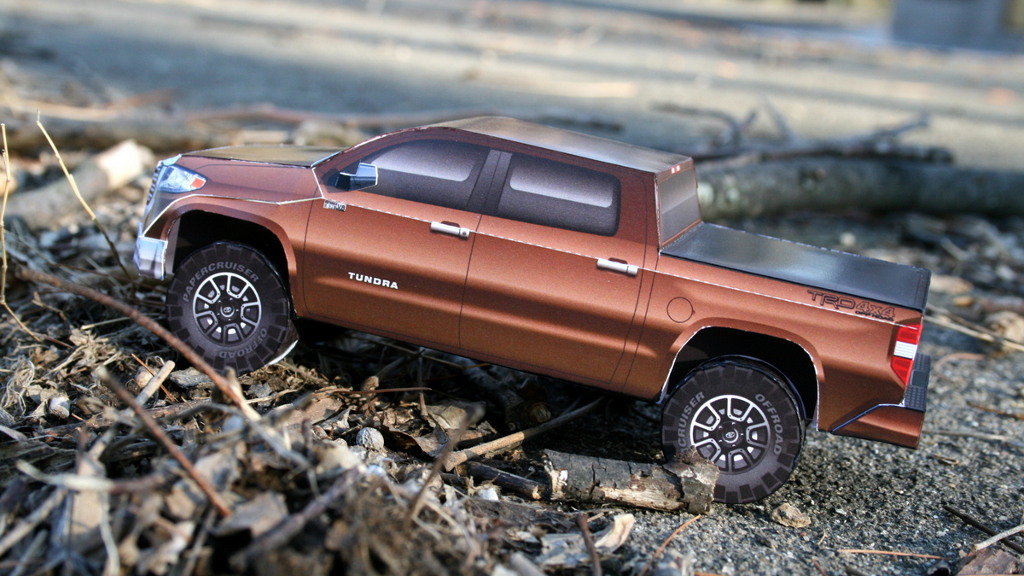
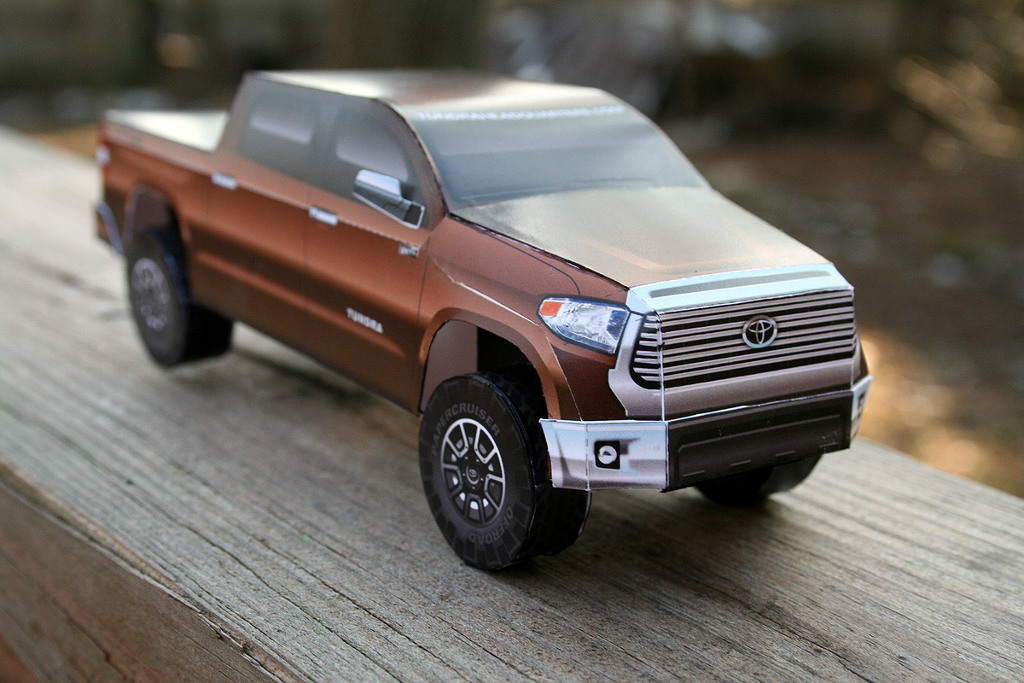
    The DIY craze has finally hit the auto industry. For the first time in 100 years you can build your own brand new truck: all you need is some paper, scissors, and glue.

    The best part? This new truck doesn’t burn any gas, won’t ever need any maintenance, and can go wherever you want it to go.

    2014 Tundra Paper Model

    Build your own 2014 Toyota Tundra with nothing more than paper, scissors, and glue. Click for a larger view.

    OK – you caught me. It’s a Tundra made from paper. However, you CAN build one yourself – the template is free. Download it below.

    A Tundra Paper Model?!

    Why not? The 2014 truck isn’t going to be available for a few more months, so this should tie you over until then. As mentioned above, the tools you need to build this truck are:

    1. A pair of scissors or – even better – an X-acto knife
    2. Some simple elmers glue (that really does work best)
    3. A straight edge and a cut surface to cut on (Olfa cutting pads work great)
    4. Some heavy card stock
    5. A good printer (or a couple bucks for printing at your local print shop)
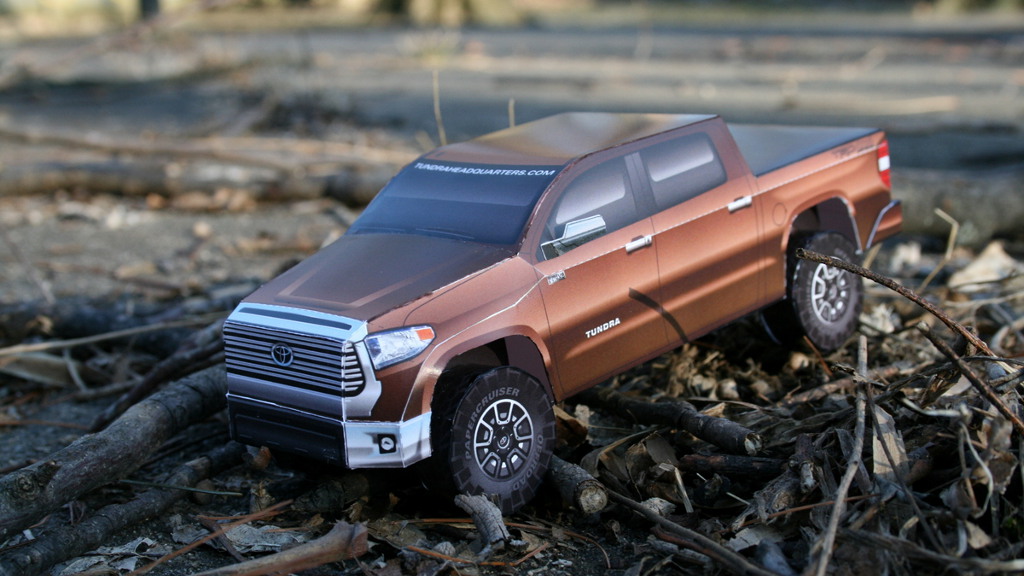
    Paper Tundra model side view

    Off-roading has never been easier. Go anywhere you want to. Click for a larger view.

    The creator of this truck – Jesse of PaperCruiser.com (who we hired to create this just for you) – recommends taking the PDF download to your local print shop (or Kinkos) and having them do the printing for you. Then, just start cutting and gluing.

    If you’d like help with assembly, you can watch this time-lapse video for some tips:

    Click here to view the embedded video.

    How To Get Your Free 2014 Tundra PDF Template

    There are three ways to get your own free template – like us on Facebook, follow us on Google+, or send out a Tweet with a link to this page.

    Give us a Google+1 to Download Your DIY 2014 Tundra

    Send out a Tweet with a link to this page to Download Your 2014 Tundra!

    NOTE: The PDF download is a couple megabytes, so it might take a minute to download.

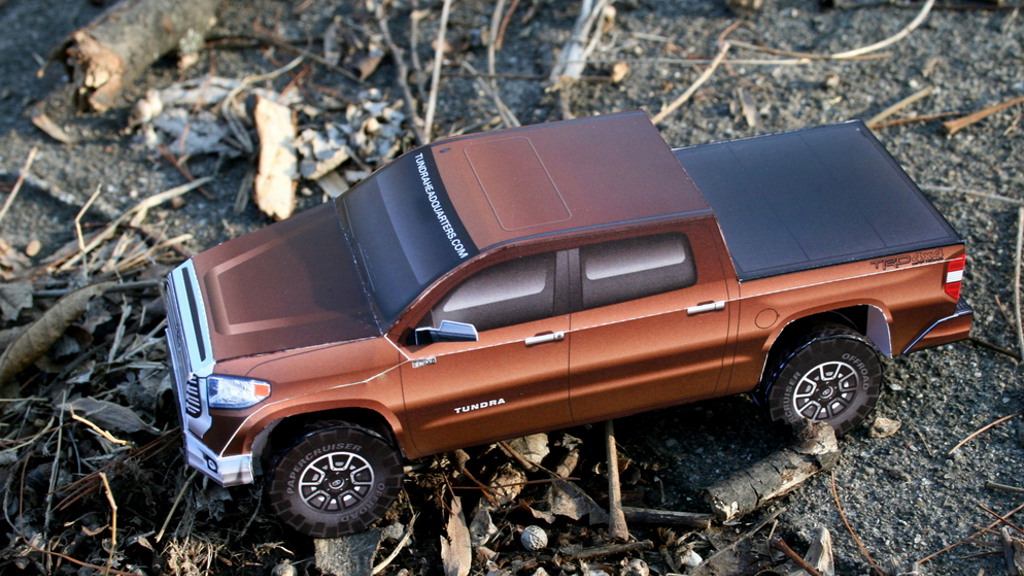
    Paper 2014 Toyota Tundra model - top view

    This DIY 2014 Tundra comes with a free tonneau cover! Click for a larger view.

    OK…there’s a fourth way, but I really hope that you’ll take a minute to use one of the methods above instead. However, if you click on this link, you’ll be able to download the PDF without liking us, following us, etc. However, if you go this route, we’d really appreciate it if you at least like the page your on using the “like” button below.

    TundraHeadquarters paper model

    If you cheat and use the direct download like, please take a minute to like this post for us. Thanks! Click for a larger view

    Thank you! Have fun!!

    The post DIY 2014 Tundra Now Available – Build Your Own New Truck appeared first on Tundra Headquarters Blog.

  • Ram Owners Manuals Being Translated Into Italian

    As you all know, Fiat is working to obtain 100% ownership of Chrysler-Jeep-Ram this year. As negotiations continue, Fiat is beginning to prepare for 100% ownership in a few ways:

    1. They’re continuing to restructure their holdings in Europe in an effort to balance world-wide manufacturing capacity
    2. They’re holding “Lavoratore Indottrinamento” management meetings at all key facilities, with the aim of breaking down cultural barriers between American and Italian executives, engineers, and plant managers
    3. Most incredibly, they’re working furiously to translate all Chrysler, Jeep, and Ram vehicle owners manuals into Italian, so that manuals can be printed in both languages by the end of the year.

    Why, you ask, must owner’s manuals be in both English and Italian? There’s a little-known Italian law that mandates all Italian corporations must produce consumer materials in Italian, even if the materials aren’t for Italian consumers.

    The law – known as “L’italiano è la lingua migliore mai” – was originally designed to keep Italian corporations from printing owners manuals, warranty agreements, etc., exclusively in French or English, a common problem in the early 90′s when Italy’s economy was an export powerhouse.

    Today – 20 years later – this law is out-dated and unnecessary. However, because this law applies to ALL products produced by Italian companies, Chyrsler, Jeep, and Ram owners are going to have to shuffle a few more pages after the first of the year.

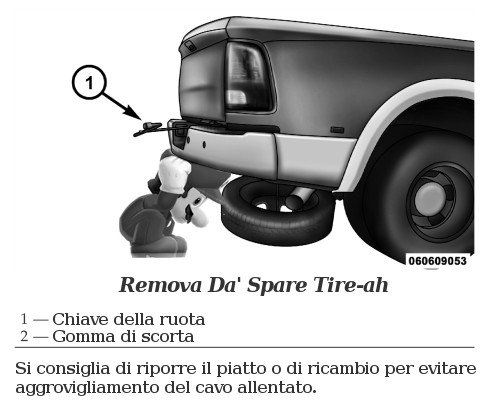
    We’ve obtained an example of the owner’s manual translation – check it out:

    Ram owners manual italian

    Italian translation of page from Ram 1500 owner’s manual

    What do you think? Is this bonkers or what?

    Do you think a lot of Ram owners wish they didn’t have to buy Italian pickup trucks?

    Search terms people used to find this page:

    • 2014 toyota tundra trd

    The post Ram Owners Manuals Being Translated Into Italian appeared first on Tundra Headquarters Blog.
  • Press Fleet Ram Catches Fire – Worker Sabotage To Blame?

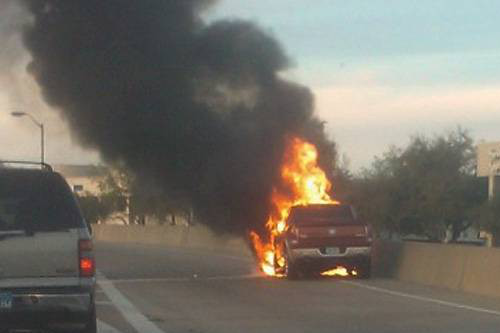
    Dallas Morning News contributor Terry Box had a pretty exciting vehicle review recently. He was driving a brand new Longhorn Edition Ram 1500, when other motorists started to waive and gesture at him frantically. The problem? His brand new press fleet Ram was burning.

    By the time he got pulled over and out of the truck, the vehicle was quickly engulfed. See the story here.

    Ram worker sabotage fire

    Brand new Ram burns to the ground – sabotage at play? Image from Dallas Morning News

    The question is, was this “a one-in-a-billion situation” as described by Ram CEO Fred Diaz, or is this problem a result of reported worker sabotage at Ram’s Warren Truck Assembly Plant?

    The Trouble With Sabotage

    Sabotage is inherently risky. You never know who it’s going to effect, nor can you be certain about how it will play out. If a Ram worker decided to wipe a little grease on this particular truck’s exhaust manifold, it’s likely that grease would smolder and stink to high heaven. A harmless bit of sabotage that might annoy a new truck buyer, waste a dealership’s time, etc., but nothing serious.

    However, wipe too much grease on the manifold, and you get a giant fire.

    To be clearI have no Earthly idea what caused this truck to burn down. It could have been one-in-a-billion bad luck, it could have been something the reviewing journalist did (maybe he was cooking burgers on the manifold or something), or it could have been the same mysterious gremlins that caused so many Toyota owners to step on the gas instead of the brakes a couple of years ago.

    Whatever the cause, I know this:

    1. Ram’s record for quality and durability has never been great. JD Power frequently rates Ram below average in their annual initial quality and long-term durability surveys (you can read more details about Ram’s performance on these surveys here).
    2. We have documentation that Ram workers were sabotaging trucks (here’s that sabotage story link again)
    3. As a general rule, trucks don’t spontaneously combust…well, except for F150s with defective cruise control modules or GM trucks with windshield wiper fluid heaters

    I’ve said it before and I’ll say it again: There’s no good reason to buy a Ram. Between sabotage concerns, a track record of poor quality, and a list of quality alternatives (namely the Tundra and F-150), buying a Ram makes little sense.

    Hat tip to PickupTrucks.com

    Related Post

    The post Press Fleet Ram Catches Fire – Worker Sabotage To Blame? appeared first on Tundra Headquarters Blog.
  • The Right Way To Unload A Flatbed

    Sure, you could unload this the “traditional” way, but this method is so much easier.

    Click here to view the embedded video.

    What do you think? Click “read more” to comment.

    Thanks!

    The post The Right Way To Unload A Flatbed appeared first on Tundra Headquarters Blog.
  • Why Do People Buy Trucks – 2013 Edition

    In 2009, I wrote a post titled “Why Do People Buy Trucks” that explained the most common reasons consumers gave for buying a pickup. This data came from Ford market research:

    As you can see, towing and work dominate the results, with about 1 in 6 buyers buying because of “image.”

    While I believe these numbers understate the “image” market (a lot of the “towing” people talk about is infrequent and well within the capabilities of smaller vehicles), it’s the best data we have about the purpose people have in mind when they buy a truck.

    However, this data doesn’t shed much light on how people decide to buy a specific make and model. Fortunately, recent data published by JD Power paints a very interesting picture.

    Quality and Reliability Top Factors in Purchase Decision

    In data that shouldn’t be surprising, quality and reliability are two of the main concerns customers have when they’re deciding on whether or not to buy a specific make and model. Here’s the list of the top 10 factors consumers evaluate:

    1. Reliability/Durability
    2. Interior Comfort
    3. Exterior Styling
    4. Gas Mileage
    5. Quality (this is really 4th, as mileage and quality are tied)
    6. Conveniently Located Dealership
    7. Vehicle Performance
    8. Advanced Technology
    9. Vehicle Image (tied for 8th with technology)
    10. Safety

    This list is for ALL vehicle buyers, not just truck buyers. If we reconcile this list with the graph above, it seems likely that truck buyers value image and performance more heavily than car buyers, and perhaps gas mileage a little less…but that’s not the interesting part.

    The interesting part is that this data shows:

    Advanced Technology and Great Fuel Economy Doesn’t Sell Pickups!

    If we believe the data from Ford and JD Power, than we must conclude that truck buyers probably don’t care nearly as much about fancy fuel saving technology as we think they do. EcoBoost engines and Ram’s fuel-sipping V6 are all fine and good, but they likely don’t motivate buyers as much as reliability, quality, styling, and comfort.

    Amazingly, truck buyers care more about comfort than advanced technology

    Amazingly, truck buyers care more about comfort than advanced technology

    What’s more, let me emphasize that conveniently located dealerships might be just as important to truck sales as technology. That’s amazing when you think about it, because it means that someone might buy a truck just because there’s a Ford or GM dealer in their neighborhood.

    Personally, it’s hard to imagine basing my choice between Ford and Toyota (or Nissan and Ram or whatever) on my proximity to a dealer…but that’s a different discussion.

    Note: Don’t get me wrong. Every buyer is unique, and there are lots of people who buy trucks purely because they have the best fuel economy, people that don’t care about styling, etc. I’m speaking in terms of the general marketplace when I say that advanced technology and fuel economy are less important.

    What Does it All Mean?

    To sum up:

    • Truck buyers care about performance in terms of towing and hauling, not in terms of “twin turbos” or “hp per liter”
    • Quality and reliability are more important to truck buyers than technology, fuel economy, or the aforementioned performance
    • Styling and comfort are critical to truck sales

    When you compare this list of 3 bullet points to the 2014 Tundra redesign, you see that Toyota knows exactly what they’re doing. They redesigned the Tundra to be better looking, more comfortable, and they ignored fancy new technology so that they could focus on improving what is already the industry’s best truck in terms of quality and durability (as determined by JD Power).

    I’d also like to point out at this time that the Tundra pulled the Space Shuttle, which speaks to it’s performance as a towing and hauling truck.

    2014 Tundra

    The 2014 Tundra wasn’t revolutionary, but the data shows it’s going to be a sales success

    Bottom Line: Toyota knows the truck market better than I think they do, as they focused only on the factors that really matter to truck consumers and ignored the rest. Toyota’s new Tundra might not have impressed fan boys like me, but it seems to hit all the notes that matter.

    Search terms people used to find this page:

    • why do females buy trucks

    The post Why Do People Buy Trucks – 2013 Edition appeared first on Tundra Headquarters Blog.
  • Numbers Show Tundra Is Poised to Eclipse GMC Sierra, Possibly Overtake Ram 1500

    Over the last few weeks, PickupTrucks.com has published both 2012 half-ton retail sales figures and 2012 total half-ton sales, which gives us the data we need to talk about “fleet mix,” or the percentage of trucks that Ford, GM, Ram-Fiat, Toyota, and Nissan sell to fleets.

    • F-150 sales – 19.1% fleet
    • Sierra 1500/Silverado 1500 sales – 11.5% fleet
    • Ram 1500 – 12.3% fleet
    • Tundra – 4.2% fleet
    • Titan – 16.5% fleet

    These numbers show that Ford is the king of fleet sales, and that Toyota doesn’t depend on fleet transactions nearly as much as the rest of the truck manufacturers listed.

    Why does this matter? Because fleet sales should never be compared to retail sales, as a fleet buyer has very little in common with a retail buyer (more on that below). Yet despite this inequality between a fleet buyer and a retail buyer, Ford, GM, and Ram-Fiat are never shy about quoting total sales numbers (which include fleet) and then using these numbers to brag about their “increased share.”

    Specifically, if we look at retail numbers only, Toyota’s share of the retail half-ton truck market is about 9.5%, and that number is only going to grow as the 2014 model hits the street.

    Tundra Sales Poised to Grow

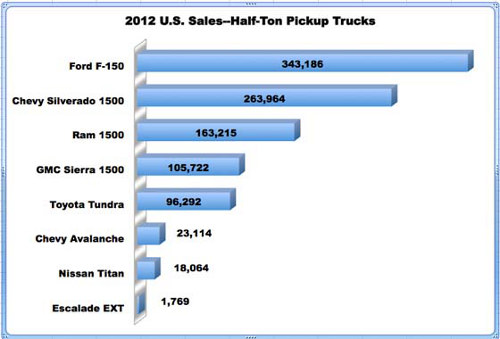
    Whenever a new model hits the ground, sales improve. Both Toyota and GM are bringing new trucks to the market this year, so they should both see growth from the numbers below (graphic borrowed from PickupTrucks.com).

    2012 Half-ton sales - RETAIL only

    2012 Half-ton sales – RETAIL only. Image from PickupTrucks.com (click to see the original)

    Ram, on the other hand, is on the wrong side of the new model launch curve. Instead of selling the hell out of their new truck with lots of new features, they’re spinning their wheels trying to overcome production issues (including workers sabotaging new trucks, if you can believe it). Ram still hasn’t delivered trucks with the new Pentastar V6 (at least not in volume), their air suspension system isn’t available yet, etc.

    If you launch a new truck but can’t get it to market before GM and Toyota launch their new trucks, than you’ve squandered your opportunity. Therefore, I don’t see Ram sales growing in 2013 at a rate any better than the rest of the industry. In fact, we may see them underachieve (which, incidentally, is what the early figures are showing, as Ram sales are only up 8% compared to 20% for the rest of the industry).

    Then we have GMC. The sales gap between the GMC and the Tundra is very close, and the Tundra is 2-3 good sales months away from tying GMC sales. That would be historic (only, admittedly, sales figures really don’t matter, so this is all about bragging rights).

    My Soapbox – Why Fleet Sales Can’t Be Compared to Retail Sales

    Fleet buyers care about one thing: cost. How much does the truck cost today, how much will it cost tomorrow, etc. When fleet purchasers evaluate pickups, they look at a handful of costs and concerns:

    1. Total up-front cost
    2. Long-term cost
    3. Resale value
    4. Cash flow

    As I wrote a couple of years ago, the math works out in such a way that it’s really the total up-front cost that drives fleet sales, as operating costs are roughly equivalent from one model to the next, and resale value isn’t really important to buyers who drive their trucks into the ground.

    Good commercial financing (like the programs offered by Ford Motor Credit) can also help promote fleet sales, as they can reduce the cash flow hit that business must take when they invest in new equipment.

    The point? When you hear a Ford or GM fan tell you about how many trucks their favorite company sells, you can explain that a big chunk of those sales are the cheapest trucks on the planet, and that anyone can get that fleet business…they just have to be cheap enough.

    Kudos to Ford, GM, and Ram-Fiat for making their trucks so cheaply.

    Search terms people used to find this page:

    • ram truck sabotage
    • ram truck backlog at warren
    • ram truck 1500 production delays
    • 2014 tundra
    • toyota hilux 2014
    • toyota hilux 2014 model
    • toyota tundra diesel
    • tundra diesel
    • tundra sales figures 2013
    • rams new diesel engine 1500

    The post Numbers Show Tundra Is Poised to Eclipse GMC Sierra, Possibly Overtake Ram 1500 appeared first on Tundra Headquarters Blog.