In fifth grade, students begin to identify, compare, and analyze the properties of geometric shapes. The Virginia Standards of Learning include topics such as angle classification, size comparison, transformations, lines of symmetry, two and three-dimensional figures, and the overall relationship between shapes. The text and web resources listed below will help you keep the students interested and engaged while also supporting instruction.
Text Resources
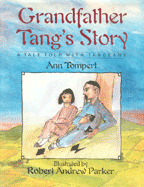
Grandfather Tang’s Story
written by Ann Tompert
and illustrated by Robert Andrew Parker
Grandfather Tang tells a story about fox fairies from Chinese folklore who use geometry and magical powers to alternately change into predator and prey in a shape changing game. As he tells the story, he makes the animal shapes with tangrams. The illustrations have an oriental brushwork appearance and include both the animal and the tangram representation of the animal so students can create the changes with their tangram sets.
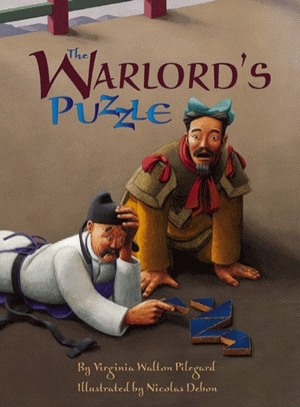
The Warlord’s Puzzle
written by Virginia Pilegard
and illustrated by Nicolas Debon
In ancient China, an artist hopes to avoid punishment for breaking a beautiful blue tile into seven piece by suggesting that the Chinese warlord hold a contest to see if anyone can put it back together. A poor fisherman’s boy quietly plays with the geometric shapes and solves the tangram puzzle. A tangram template is provided making this useful in introducing geometric concepts.
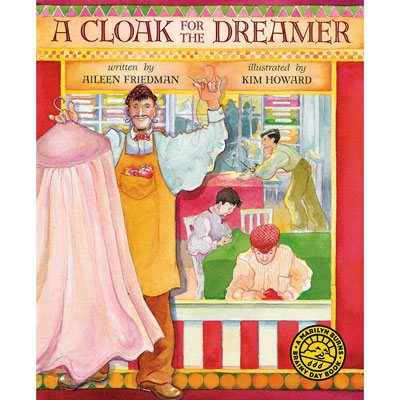
A Cloak for the Dreamer
written by Aileen Friedman
and illustrated by Kim Howard
A tailor asks his three sons to make colorful cloaks from small pieces of cloth sewn together. The older sons use square and triangular pieces and make fine cloaks. But the youngest son chooses circles and his cloak will not keep out the wind. The father uses geometry to solve the problem cleverly. This story fits with a unit on tessellations or a unit on shapes within shapes.
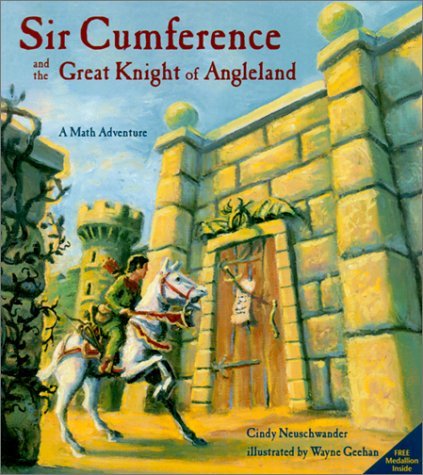
Sir Cumference and the Great Knight of Angleland: A Math Adventure
written by Cindy Neuschwander and illustrated by Wayne Geehan
Radius, the son of Sir Cumference and Lady Di of Ameter, ventures on a heroic quest to earn his knighthood. He first proves his ability to make a “knightly right angle,” as Sir D’Grees has trained him, and then doubles the right angle to make a straight angle. So he is sent off with the family medallion, in the shape of a circle (cardboard medallion included), to rescue the missing King Lell. Falling bridges, a cryptic riddle, a crocodile-infested moat, and a winding labyrinth all must be mastered before finding the king and his twin dragons, known as “Pair of Lells.” Sir Cumference has something to offer a wide range of readers. Some will be too young to understand the math and the word puns but will enjoy the story of a knight rescuing a king. Others will puzzle over the math and how to use the protractor (medallion) to solve the riddle. This group will be helped by the somewhat primitively painted pictures, which give clues to these angled decisions and enhance the story of a brave knight on his quest.
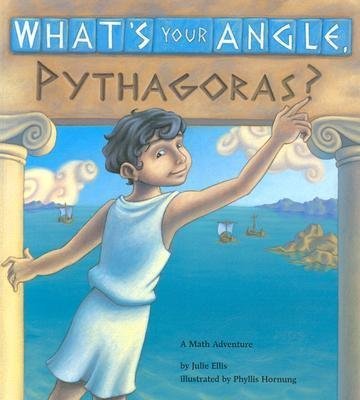
What’s Your Angle Pythagoras?
written by Julie Ellis and illustrated by Phyllis Hornung
Pythagoras always seems to be in trouble, but it’s only because he’s so curious. You never know where you’ll find him. He could be up in a tree with the birds, spying on workmen, or messing about with maps. He is deep into his latest adventure, and trouble, when he discovers a pattern that gets him on everyone’s good side.
Web Resources
PBS Kids has educational online games for all of their television programs including Sagwa the Siamese Cat! Sagwa Tangrams will be fun for the students and help them practice their shape relationships! There are five easy as well as five hard puzzles to choose from!
Cyber Chase is another great PBS Kids program dedicated to making learning fun. Their website is full of great online games and the math topics that correlate with each. In Point Out the View, each member of the Cybersquad is looking at a bunch of blocks from a different place in the room. The player must show what each person sees from their point of view. Because what you see depends on your point of view, different people looking at the same objects can see them differently!
MATHO is similar to an interactive BINGO game. Your gameboard is a MATHO board with shapes and angles on it. A problem appears below the gameboard in yellow. Solve the problem and look for the answer on your gameboard. If you find your answer, select it and hit Enter. If you do not find your answer, click on Enter and you will be given a new problem. When you answer correctly, a marker will color your square. You have Matho when you get 5 colored squares in a row. The game is timed, so choose quickly!
Banana Hunt! Given a specific angle and a full circle, drag the monkey to that exact angle. If you select the correct angle given, then the monkey will find all of his bananas! For every degree off, the monkey will lose a banana. How many bananas can you find in ten searches? Angles are not labeled so this is practice for those who know their angles well!
Protractor Measures! Slide and rotate the protractor by degrees to match it to the given angle. Use the protractor to measure the angle and enter the degree measurement to move on to the next problem. This is a very realistic activity.
Additional Resources
This site offers online timed quizzes for every topic in fifth grade geometry (check out the other grades and subjects too!). These quizzes are relevant, kid-friendly, and record a score for teacher use once completed. If a wrong answer is chosen, an explanation of the correct answer is provided! The students may also stop at any time by choosing “submit and finish.”
This site offers amazing interactive lessons! Working With Angles(16) and Slides and Flips(17) are most relevant to fifth grade geometry. The lessons start off with real-world examples and continue with narrated visual diagrams. Although it moves at a brisk pace, the student has the option of pausing or going back. During the lesson students are engaged with labeling, sorting, and shifting insturments. Students will have a lot of fun using a virtual protractor to measure angles. If one of my students were to miss a vital lesson, this would be my go-to place to give him/her a good foundation of knowledge.
Teach the students a few songs to help them remember their geometry terms! For only $2.99 you can order the CD of all 14 songs!