Author: Jessica Gross

  • Further reading on what makes a good end of life

    Judy-MacDonald-Johnston-at-TED

    Judy Macdonald Johnston speaks at TED University, where audience members from TED2013 get the chance to speak.

    “What would be a good end of life?” Judy Macdonald Johnston asks in today’s talk, given at TED2013. Her answer — based on her own experience of helping two friends face death in a way that respected the incredible life they’d built — involves five practices, all of which can help maintain a high quality of life even as independence and bodily function decline.

    Judy MacDonald Johnston: Prepare for a good end of lifeJudy MacDonald Johnston: Prepare for a good end of lifeFirst, make a plan, which means “answering straightforward questions about the end you want.” Second, recruit advocates who have “the time and proximity to do this job well” and can thrive under the unique pressures of this task. Third, prepare important documents — like summaries of your medical history — for the hospital. Fourth, select caregivers who fit your needs and desires, which might take a few tries. And fifth, ponder and discuss last words: “What do you want to hear at the very end and from whom would you like to hear it?”

    We talk about how to live the good life all the time. And yet, though we all face death, we’re less willing to talk about what would be a good conclusion to life. Here, some further reading, watching and listening on this hard but important topic.

    1. Read: This Wild Darkness. In the mid-‘90s, Harold Brodkey wrote a series of essays, mostly for The New Yorker, about his experiences and emotions as he died of AIDS. In these essays — subsequently published in a single volume as This Wild Darkness: The Story of My Death — Brodkey reckons with the realities of both his impending death and, through that lens, his life. His style can be self-aggrandizing, but ultimately, the book acts as a case study of how self-reflection through writing can make nearing death a little bit less terrifying. “The obsession with literary power games, with recognition and reputation, gradually subsides and gives way to something like acceptance,” Michiko Kakutani wrote in The New York Times upon the book’s publication.
      .
    2. Watch: A Will for the Woods. The new documentary A Will for the Woods, featured in our roundup 9 documentaries that you need to see in 2013, follows psychiatrist Clark Wang as he battles lymphoma and arranges his own burial. His resolve for a burial that helps, rather than harms, the environment spawns the first natural burial ground in the state of North Carolina. The film’s website notes that green burials were the norm “before the contemporary funeral industry propagated expensive and elaborate funerals as traditional,” and applauds the growing demand for them now.
      .
    3. Bookmark: The Hospice Foundation. The Hospice Foundation of America offers several quite lovely pages (and for-sale booklets) about approaching your own, or a loved one’s, death. A page entitled “Signs of Approaching Death” explains what death looks like in a purely practical sense—something we don’t and can’t know the first time we confront it. The unknown tends to frighten us most, so having a bit more advanced warning of what’s to come might serve as a comfort. For example, the site explains that as you near death, fluid can build up in your lungs, casing a rattling as you breathe. “This breathing sound is often distressing to caregivers but it is not an indication of pain or suffering,” the site assures us. (There are also practical sections, as on advance care planning.)
      .
    4. Bookmark: New Old Age. The New York Times“New Old Age” blog, which Johnston links to on her own website, explores what it’s like to care for adults over age 80.  Recent posts are on Vermont’s passage of the ‘Aid in Dying’ measure, a look at a recent study on dementia units, and what millennials need to ask their parents while they can.
      .
    5. Listen: “When Prolonging Death Seems Worse Than Death.” Last year, Fresh Air’s Terry Gross interviewed Judith Schwarz, of the nonprofit Compassion & Choices, about end-of-life decisions for the terminally ill. In the interview, Schwarz argues that terminally ill patients should have the right to choose to die sooner. Beyond dealing with the realities of what terminal illness means, the interview offers a thoughtful, compassionate way of looking at the multiple and varied desires of the dying. That is: it’s a lesson in empathy and a reminder that though some ideas may frighten us, it behooves us to look at them in depth. In the story, Schwarz also prods us to consider what it really is like to live through a painful end-of-life, and suggests that in some cases, death is not the worst option on the table. And that’s okay.
      .
    6. Bookmark: Seven Ponds. The website Seven Ponds aims to “promote a healthy attitude towards the process of death by encouraging a meaningful experience that is in harmony with the environment.” Their recommendations: cremation and natural burials (see #2, above!). “We see a world where everyone can experience death in their own personal way and feel it’s all okay,” writes Suzette Sherman, Seven Ponds’ founder. For her blog, go here.
      .
    7. Watch: “Older, and Unafraid to Talk about It.” This New York Times interactive video gallery presents the stories of three seniors who have recently started therapy to work through the changes they’re facing as they near the ends of their lives. “I’m surrounded by people who are old, and I had to come to grips with that,” an 87-year-old woman says. And, from an 86-year-old man: “You can’t do the things you used to do. You can’t go where you wanted. People look at you differently. What psychiatry does is help you go through the problems and adjust your thinking.”

  • Playlist: 6 education ideas from unlikely places

    Geoffrey-Canada

    Geoffrey Canada rocked the audience at TED Talks Education with his passionate talk. Photo: Ryan Lash

    Geoffrey Canada gives a very interesting analogy in today’s TED Talk: He compares the current education system in the United States to the era when banks were only open between the hours of 10am and 3pm.

    Geoffrey Canada: Our failing schools. Enough is enough!Geoffrey Canada: Our failing schools. Enough is enough!“Now, who can bank between 10 and 3?” asks Canada to a big laugh. “It went on for decades. You know why? Because they didn’t care. It wasn’t about the customers. It was about bankers … Now one day, some crazy banker had an idea. Maybe we should keep the bank open when people come home from work?”
    What do “bankers’ hours” have to with education? Well, Canada says, many of the US education system’s similar ingrained habits — long summer vacations, testing at the end of the school year — go against everything we know about student learning. And yet these old habits continue. As Canada puts it: “Here’s a business plan that simply does not make any sense.” Among his ideas: Shorten vacation so kids don’t backslide academically during the long summer; and test early in the school year, when there’s still time to correct course.

    To hear his passionate plea for educators to start looking at data and to think more about the customers — students — in order to curb the United States’ abysmal dropout rate, watch this powerful talk.

    And here are more fascinating TED Talks that suggest ideas for education from other seemingly unrelated fields.

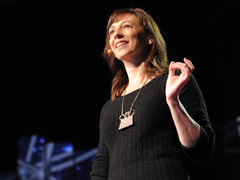
    Susan Cain: The power of introvertsSusan Cain: The power of introvertsSusan Cain: The power of introverts
    Idea: Make time for solitary work, not just groupwork
    From: Psychology
    Susan Cain’s blockbuster talk from TED2012 focuses on the wondrous, largely ignored skills that introverts have to offer. She points out that schools are unabashedly built for extroverts, with their emphasis on group exercises and group activities — and urges classes to leave time for solitary work to capture the best of introversion.
    Margaret Heffernan: Dare to disagreeMargaret Heffernan: Dare to disagreeMargaret Heffernan: Dare to disagree
    Idea: Teach kids how to debate
    From: Business
    In this talk from TEDGlobal 2012, Margaret Heffernan contends that conflict, challenge and openness to changing our minds are all key to progress. The problem is, we tend to avoid disagreement at all costs. How to counter that? Heffernan describes a Ph.D. program that requires students to submit five statements that they’re prepared to defend in the face of authority. “I think it’s a fantastic system, but I think leaving it to Ph.D. candidates is far too few people and way too late in life,” she says. “I think we need to be teaching these skills to kids and adults at every stage of development.”
    Carl Honore: In praise of slownessCarl Honore: In praise of slownessCarl Honoré: In praise of slowness
    Idea: Ban homework (or ease up on it)
    From: The Slow Movement
    We’re trying to do more and more with less and less time — and Carl Honoré explains why this isn’t a good thing. “By slowing down at the right moments, people find that they do everything better: they eat better, they make love better, they exercise better, they work better, they live better,” he says. And, of course, they learn better. Kids, Honoré says, are overworked to the point of burnout. He proposes that we embrace slow education, easing up on (or even banning!) homework to allow kids time to process and relax after school.
    Jarrett J. Krosoczka: How a boy became an artistJarrett J. Krosoczka: How a boy became an artistJarrett J. Krosoczka: How a boy became an artist
    Idea: Drawing helps kids deal with emotions
    From: Art
    At TEDxHampshireCollege, Jarrett Krosoczka, an author and illustrator of children’s books, says it’s essential that kids get the opportunity to flex their drawing muscles through extracurricular classes. He talks about the emotional outlet that art and writing gave him as a child — even as he dealt with hard emotions surrounding his complicated parents.(Check out Krosoczka’s picks for 10 great children’s books that are destined to be classics.)

    And a bonus unreleased talk:

    Stuart Firestein: Celebrate ignorance
    Idea: Don’t just teach answers — teach questions
    From: Science
    In this yet-to-be-released talk from TED2013 — about the necessity of high-quality ignorance to scientific discovery — Firestein proposes a model of education based on evaluation rather than weeding out. Instead of feeding kids facts that they can then repeat, he imagines a system in which we encourage kids to ask, not answer. (Watch for the talk this fall!)

  • 5 mnemonic devices for reading Chinese characters

    ShaoLanHsueh-at-TED2013To an outsider, the Chinese language “seems to be as impenetrable as the Great Wall of China,” says ShaoLan Hsueh in today’s talk, given at TED2013. Hsueh’s mission over the past few years has been to break down that barrier, making reading and writing in Chinese accessible to people who didn’t grow up doing it.

    ShaoLan: Learn to read Chinese ... with ease!ShaoLan: Learn to read Chinese … with ease!Her solution? A method she calls “Chineasy.” To achieve basic literacy, Hsueh says, you need only know 1,000 characters, and the top 200 allow you to comprehend 40 percent of basic literature. Chineasy involves pairing characters with facial expressions, body movements and images that conjure up words in English.

    In her talk, Hsueh moves through eight foundational characters, describing mnemonic devices and showing artful depictions. “Open your mouth as wide as possible until it’s square,” she says. Are you doing it? Voila, the character for mouth: 口. Hsueh shows a graphic her team has designed of a person going for a walk, based on the character for person: 人. Fire is the character for person with what look like two arms waving, as if the person is engulfed in flames and yelling, “Help!”: 火. Hsueh also takes us through tree (木), mountain (山), sun (日), moon (月), and door (門), which “looks like a pair of saloon doors in the Wild West.”

    These eight characters “are the building blocks for you to create lots more characters,” Hsueh explains. Using Chineasy’s simple, beautiful illustrations, it’s just a hop, skip and a jump to many other words and phrases. In this talk, Hsueh takes us through almost 30 characters; here, some more examples based on those foundational eight.

        1. In her talk, Hsueh shows the Chinese character for person, 人, which looks like a person strolling along. Multiply by two, and you’ve got the character for everyone:
          everyone .
        2. In her talk, Hsueh shows us how combining fire (火) and mountain (山) gives us a volcano (火山). What happens when we add a mouth (口) to a volcano? Think about it: the mouth of a volcano is … a crater!
          crater.
        3. Hsueh shows us that the character for big (大) looks like a person (人) with her arms outstretched, as if to say, “Sooooo big!” Combine those two, and you get adult (大人):’
          adult.
        4. Write two suns (日) side by side and you get the character for “bright”: 昍. On her Facebook page, Hsueh writes, “I promise you, this is a character that will impress your Chinese friends. This is such a rare character that 99 percent of Chinese native speakers/readers would struggle to tell you what it is, never mind how to pronounce it.”
          bright.
        5. Here’s a really clever one that Hsueh brings up in her talk: the character for “to dodge” or “to avoid” is composed of a person (人) inside a door (門), as if the person is sneaking out! 閃 What she adds on her Facebook page is that this character has a second meaning, “flash.” As she explains, “this person is sneaking out at such speed that the shape of him dashing resembles a streak of light.”
          dodge


  • 7 tech tools now available in the classroom, for better or worse

    iPad-useThe analog-to-digital shift that has seen e-readers booting out books, smartphones trumping landlines and tablets making desktops look fuddy-duddy is also bringing new tech tools to the classroom. Last month, I read this New York Times article about CourseSmart, an app that allows teachers to track whether students have done their reading in digital textbooks, with interest. In the article, the dean of Texas A&M’s business school, which is testing out the technology, admitted it was “Big Brother, sort of, but with a good intent.” And while it did seem to undermine one of the main points of college — that reading and studying are self-motivated — it also seemed like a good way for students to be able to demonstrate to professors that, yes, they are paying attention, and for professors to get real data as to what material just isn’t clicking for their students.

    The tech solutions available to teachers now go far beyond the overhead projector. Below, a look at some tools in this burgeoning category.

    1. BetterLesson
      The Boston-based startup BetterLesson, founded in 2008, is a social media platform that educators can use to organize and share their curricula. Last year, the Bill and Melinda Gates Foundation awarded BetterLesson $3.5 million. “Considering the startup allows teachers to browse a serious repository of documents, presentations, lessons and even complete units and courses, all through a simple search interface, and upload their own lessons onto a dashboard, you can see why teachers will love this kind of resource,” TechCrunch wrote in 2011. “Add the ability to share curricula directly with international educators and receive feedback, and you’ve got yourself a goddamn deal, as Dave Chappelle would say.”
      .
    2. ClassDojo
      Launched in August 2011, ClassDojo helps teachers with what many call their hardest task: classroom management. The platform, which teachers can use on a smartphone, laptop or tablet, allows them to give students points (or take them away) “in real-time, with just one click,” as the website has it. Students are notified (“Well done Josh! +1 for teamwork!”), and teachers can use the platform to generate analytics and reports to share with parents and administrators.
      .
    3. PowerSchool
      PowerSchool allows teachers to track attendance, grades, and a lot more for students and parents to view at home. According to Pearson, which sells the system, PowerSchool supports 10 million students in over 65 countries.
      .
    4. SMART Board
      An “interactive whiteboard,” SMART Board allows teachers to write class notes digitally, so they can be saved for students to access later. (Feel like building your own whiteboard? At TED in 2008, Johnny Lee showed how you can hack a Wii Remote to build a simple interactive whiteboard.)
      .
    5. Remind101
      Started by a team of two brothers, Remind101 enables students and parents to sign up to receive teachers’ text-message reminders about assignments. It’s private—these are mass texts, and teachers can’t see students’ phone numbers. It’s also one-way, meaning that teachers can send out texts, but students can’t respond to them.
      .
    6. Educreations
      Using Educreations, teachers can produce video lessons using a “recordable interactive whiteboard” via an iPad app or the website. There’s a public directory of lessons, available for browsing by students or other teachers (or you).

    Share your own favorite teacher tech in the comments, and for a comprehensive list, check out the NewSchools Venture Fund’s interactive map. We’re curious—what tools here sound like a good idea and which could be problematic?

  • Walking meetings? 5 surprising thinkers who swore by them

    Nilofer Merchant's boots at TED2013 were certainly made for walking. Photo: James Duncan Davidson

    Nilofer Merchant’s boots at TED2013 were certainly made for walking. Photo: James Duncan Davidson

    In today’s talk, Nilofer Merchant gives a startling statistic: we’re sitting, on average, for 9.3 hours per day—far more than the 7.7 hours we spend sleeping. “Sitting is so incredibly prevalent, we don’t even question how much we’re doing it,” Merchant says.Nilofer Merchant: Got a meeting? Take a walkNilofer Merchant: Got a meeting? Take a walk “In that way, sitting has become the smoking of our generation.”

    But there are consequences. Physical inactivity, Merchant says, leads to upticks in our risk of breast cancer, colon cancer, heart disease, and type II diabetes.

    Merchant’s own habits changed when a colleague couldn’t fit a meeting into her schedule and asked if Merchant could come along on a dog walk instead. Now, she says, “I’ve taken that idea and made it my own.” Instead of meeting in conference rooms, she asks people to go on walking meetings—20 to 30 miles’ worth a week. “It’s changed my life,” she says.

    Merchant is carrying on a long tradition of frequent, even ritualistic, walking. Here are some other fans of the amble. Some are walk-and-talkers; others or simply stroll for its own sake.

    1. Aristotle allegedly instructed students while strolling about—which fits with his students’ being called “Peripatetics.”
      .
    2. In August 1910, Sigmund Freud took a four-hour walk with the Austrian composer Gustav Mahler, who had requested an “urgent consultation” via telegraph, according to the BBC. Mahler’s marriage was disintegrating, and he was about to have a breakdown—hence the emergency walk-and-talk with the founder of psychoanalysis. In fact, Freud conducted a number of walking analyses, according to Freud: A Life for Our Time. Another significant example: Freud conducted his first training analysis on Max Eitingon in 1907 through a series of evening walks. Eitingon went to become president of the International Psychoanalytic Association.
      .
    3. Steve Jobs made a habit of the walking meeting, especially for first encounters, according to CNNMoney, which quotes from Jobs’ biography: “taking a long walk was his preferred way to have a serious conversation.”
      .
    4. Harry S. Truman was a routine-oriented man, and walking was a fundamental part of that routine. According to the University of Virginia’s Miller Center, Truman woke up at five in the morning for a “vigorous” walk of a mile or two, “wearing a business suit and tie!” (This in addition to his frequent midday swimming session in the White House pool, “with his eyeglasses on.”)
      .
    5. Charles Dickens “was from childhood an avid, even compulsive, walker,” Sports Illustrated wrote in 1988. (Apparently, the mid-1800s was “the golden age of professional foot racing, or ‘pedestrianism.’” Who knew?) Dickens frequently walked around 20 miles a day—one night in 1857, he logged 30 miles—and often did so at night. Walking was a means of both observing the cities around him and de-stressing. “Dickens found composition to be hard, painful work,” SI writes. “The hours he spent at his desk agitated him tremendously, and walking served as a kind of safety valve.”

  • Texting as a “miraculous thing”: 6 ways our generation is redefining communication

    John McWhorter asks us to think of texting less as "written language" and more as "fingered speech." Photo: James Duncan Davidson

    John McWhorter asks us to think of texting less as “written language” and more as “fingered speech.” Photo: James Duncan Davidson

    Texting is not a blight on the English language, says linguist John McWhorter in today’s talk, given at TED2013. Rather, texting is a “miraculous thing”: a novel linguistic mode that’s redefining the way we communicate with each other — for the better.

    John McWhorter: Txtng is killing language. JK!!!John McWhorter: Txtng is killing language. JK!!!McWhorter points out that texting shouldn’t be categorized as written language –but as speech. This shift makes the apparent problem of grammatical errors seem misplaced and unimportant.

    If we think of texting as “fingered speech,” as McWhorter puts it, it also opens our eyes to texting’s distinct linguistic rules, structures and nuances. McWhorter dives into the example of “lol,” which originally stood for “laughing out loud.” But over the past few years, “lol” has “evolved into something that is much subtler,” signifying empathy and accommodation.

    As the mediums through which we communicate quickly multiply, our modes of communication are following suit. After you’ve watched the talk, here are some more examples of new linguistic forms that have developed in tandem with technology.

    1. Like “lol,” hashtags started out with a literal function: making topics easy to tag, and thus search for, on Twitter. But in 2010, Susan Orlean, a writer and avid tweeter, pointed out that hashtags had taken on an emotional resonance. Orlean gives this (dated, sorry) example: “Sarah Palin for President??!? #Iwouldratherhaveamoose.” She writes that, while no one would search for “Iwouldratherhaveamoose,” its use here “makes it look like it’s being muttered into a handkerchief; when you read it you feel like you’ve had an intimate moment in which the writer leaned over and whispered ‘I would rather have a moose!’ in your ear.” Hashtags can also be used to indicate a joke, or even — when employed back-to-back –comment on the hashtag that came before. “Amazing how rich and complex 140 characters with a few symbols thrown in can be,” Orlean writes. And how much richer they are now, three years later.
      .
    2. GIFs, those omnipresent video loops, are nothing new: they date back to 1987. But in recent years, they’ve started to populate blogs and articles, standing in for written descriptions, often to hilarious effect. Take #WhatShouldWeCallMe (there’s that hashtag again!), a Tumblr started by two friends in law school on opposite sides of the country, where Austin Powers stands in for the boundless joy of discovering your roommate has cleaned and a panda illustrates massive post-party regret. Or this personal essay about a New Yorker’s experience during Hurricane Sandy, where the accompanying GIFs help make the horrifying event lighter and easier to process.
      .
    3. “Fingered speech” though it may be, cellphone communication is generating new avenues for writing, too. In 2008, The New York Times reported from Japan that cellphone novels (what they sound like: novels written on cellphones) had dominated the previous year’s list of best-selling books. One woman wrote hers, which hit number five on the best-sellers list, during her commute to work. “[M]any cellphone novelists had never written fiction before, and many of their readers had never read novels before, according to publishers,” the Times article notes. (A 2010 Los Angeles Times article indicated the trend was still in full force.)
      .
    4. More recently, Twitter, too, has been coopted as a tool for fiction. Last year, Jennifer Egan wrote a short story in 140-character nuggets, which were posted on Twitter before they were published in The New Yorker as “Black Box.” A few months later, novelist Elliott Holt wrote her own Twitter story, creating three different avatars/characters and posting from “their” accounts. “The three characters have distinct voices—and by telling the story through them, Holt embraces Twitter for what it is, rather than trying to bend it into some tool that it isn’t,” Slate opined. “With its simultaneous narrators and fractured storyline, this is not the kind of tale that could march steadily across a continuous expanse of white space. It’s actually made for the medium.”
      .
    5. Email signoffs, as all things, have their haters: many a screed has implored humanity to dispense with these vulgar written appendages. (Admittedly, this rant in Slate is hilarious: “My transition from signoff submissive to signoff subversive began when a former colleague ended an email to me with ‘Warmest regards.’ Were these scalding hot regards superior to the ordinary ‘Regards’ I had been receiving on a near-daily basis?”) But others among us appreciate the space for expression that signoffs offer. Sadie Stein, in the Paris Review Daily, explains her own choice, “As ever.” And a few years ago, The New York Times offered this survey of signoffs from a bishop’s “+” to Norman Mailer’s “Cheers” to the author’s own “Carpe Diem.”

    John McWhorter was a part of TED’s worldwide talent search, giving a shorter version of his talk at the New York stop of the tour. After the talk, he sat down with the TED Blog for this short Q&A »

    McWhorter would also like to thank his students at Columbia University for teaching him about the new world of texting: specifically Yin Yin Lu, Sarah Tully, and Laura Milmed for the miracle of “slash.”

  • What motivates us at work? 7 fascinating studies that give insights

    Dan-Ariely“When we think about how people work, the naïve intuition we have is that people are like rats in a maze,” says behavioral economist Dan Ariely in today’s talk, given at TEDxRiodelaPlata. “We really have this incredibly simplistic view of why people work and what the labor market looks like.”

    Dan Ariely: What makes us feel good about our work?Dan Ariely: What makes us feel good about our work?When you look carefully at the way people work, he says, you find out there’s a lot more at play—and a lot more at stake—than money. In his talk, Ariely provides evidence that we are also driven by meaningful work, by others’ acknowledgement and by the amount of effort we’ve put in: the harder the task is, the prouder we are.

    During the Industrial Revolution, Ariely points out, Adam Smith’s efficiency-oriented, assembly-line approach made sense. But it doesn’t work as well in today’s knowledge economy. Instead, Ariely upholds Karl Marx’s concept that we care much more about a product if we’ve participated from start to finish rather than producing a single part over and over. In other words, in the knowledge economy, efficiency is no longer more important than meaning.

    “When we think about labor, we usually think about motivation and payment as the same thing, but the reality is that we should probably add all kinds of things to it: meaning, creation, challenges, ownership, identity, pride, etc.,” Ariely explains.

    To hear more on Ariely’s thoughts about what makes people more productive – and happier – at work, watch this fascinating talk. Below, a look at some of Ariely’s studies, as well as a few from other researchers, with interesting implications for what makes us feel good about our work.

    1. Seeing the fruits of our labor may make us more productive
      .
      The Study: In a study conducted at Harvard University, Ariely asked participants to build characters from Lego’s Bionicles series. In both conditions, participants were paid decreasing amounts for each subsequent Bionicle: $3 for the first one, $2.70 for the next one, and so on. But while one group’s creations were stored under the table, to be disassembled at the end of the experiment, the other group’s Bionicles were disassembled as soon as they’d been built. “This was an endless cycle of them building and we destroying in front of their eyes,” Ariely says.
      .
      The Results: The first group made 11 Bionicles, on average, while the second group made only seven before they quit.
      .
      The Upshot: Even though there wasn’t huge meaning at stake, and even though the first group knew their work would be destroyed at the end of the experiment, seeing the results of their labor for even a short time was enough to dramatically improve performance.
      .
    2. The less appreciated we feel our work is, the more money we want to do it
      .
      The Study: Ariely gave study participants — students at MIT — a piece of paper filled with random letters, and asked them to find pairs of identical letters. Each round, they were offered less money than the previous round. People in the first group wrote their names on their sheets and handed them to the experimenter, who looked it over and said “Uh huh” before putting it in a pile. People in the second group didn’t write down their names, and the experimenter put their sheets in a pile without looking at them. People in the third group had their work shredded immediately upon completion.
      .
      The Results: People whose work was shredded needed twice as much money as those whose work was acknowledged in order to keep doing the task. People in the second group, whose work was saved but ignored, needed almost as much money as people whose work was shredded.
      .
      The Upshot: “Ignoring the performance of people is almost as bad as shredding their effort before their eyes,” Ariely says. “The good news is that adding motivation doesn’t seem to be so difficult. The bad news is that eliminating motivation seems to be incredibly easy, and if we don’t think about it carefully, we might overdo it.”
      .
    3. The harder a project is, the prouder we feel of it
      .
      The Study: In another study, Ariely gave origami novices paper and instructions to build a (pretty ugly) form. Those who did the origami project, as well as bystanders, were asked at the end how much they’d pay for the product. In a second trial, Ariely hid the instructions from some participants, resulting in a harder process — and an uglier product.
      .
      The Results: In the first experiment, the builders paid five times as much as those who just evaluated the product. In the second experiment, the lack of instructions exaggerated this difference: builders valued the ugly-but-difficult products even more highly than the easier, prettier ones, while observers valued them even less.
      .
      The Upshot: Our valuation of our own work is directly tied to the effort we’ve expended. (Plus, we erroneously think that other people will ascribe the same value to our own work as we do.)
      .
    4. Knowing that our work helps others may increase our unconscious motivation
      .
      The Study: As described in a recent New York Times Magazine profile, psychologist Adam Grant led a study at a University of Michigan fundraising call center in which  student who had benefited from the center’s scholarship fundraising efforts spoke to the callers for 10 minutes.
      .
      The Results: A month later, the callers were spending 142 percent more time on the phone than before, and revenues had increased by 171 percent, according to the Times. But the callers denied the scholarship students’ visit had impacted them.
      .
      The Upshot: “It was almost as if the good feelings had bypassed the callers’ conscious cognitive processes and gone straight to a more subconscious source of motivation,” the Times reports. “They were more driven to succeed, even if they could not pinpoint the trigger for that drive.”
      .
    5. The promise of helping others makes us more likely to follow rules
      .
      The Study: Grant ran another study (also described in the Times profile) in which he put up signs at a hospital’s hand-washing stations, reading either “Hand hygiene prevents you from catching diseases” or “Hand hygiene prevents patients from catching diseases.”
      .
      The Results: Doctors and nurses used 45 percent more soap or hand sanitizer in the stations with signs that mentioned patients.
      .
      The Upshot: Helping others through what’s called “prosocial behavior” motivates us.
      .
    6. Positive reinforcement about our abilities may increase performance
      .
      The Study: Undergraduates at Harvard University gave speeches and did mock interviews with experimenters who were either nodding and smiling or shaking their heads, furrowing their eyebrows, and crossing their arms.
      .
      The Results: The participants in the first group later answered a series of numerical questions more accurately than those in the second group.
      .
      The Upshot: Stressful situations can be manageable—it all depends on how we feel. We find ourselves in a “challenge state” when we think we can handle the task (as the first group did); when we’re in a “threat state,” on the other hand, the difficulty of the task is overwhelming, and we become discouraged. We’re more motivated and perform better in a challenge state, when we have confidence in our abilities.
      .
    7. Images that trigger positive emotions may actually help us focus
      .
      The Study: Researchers at Hiroshima University had university students perform a dexterity task before and after looking at pictures of either baby or adult animals.
      .
      The Results: Performance improved in both cases, but more so (10 percent improvement!) when participants looked at the cute pictures of puppies and kittens.
      .
      The Upshot: The researchers suggest that “the cuteness-triggered positive emotion” helps us narrow our focus, upping our performance on a task that requires close attention. Yes, this study may just validate your baby panda obsession.

    What have you noticed makes you work harder – and better?

  • 5 great stories with double lives as allegories

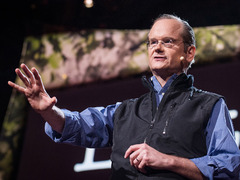
    Lawrence-Lessig-at-TED2013

    Lawrence Lessig talks about a fundamental corruption at the core of the U.S.’s political system. Photo: James Duncan Davidson

    “Once upon a time, there was a place called Lesterland,” Lawrence Lessig begins today’s talk. “Of its 311 million people, it turns out 144,000 are called Lester,” Lessig says.

    Lawrence Lessig: We the People, and the Republic we must reclaimLawrence Lessig: We the People, and the Republic we must reclaimIn Lesterland, this .05% of the population is granted extraordinary power. Each election cycle, there’s a general election, in which the people get to vote, and a Lester election, in which only the Lesters can vote. “In order to run in the general election, you must do extremely well in the Lester election,” Lessig explains. “So we have a democracy, no doubt, but it’s dependent upon the Lesters and dependent upon the people. It has a competing dependency—we could say a conflicting dependency—depending on who the Lesters are.”

    The trick: the United States is Lesterland, only instead of the Lester election, we have the “money election.” As in Lesterland, to run in the general election, you’ve got to win with the funders first. The “relevant funders” comprise .05% of the population; in fact, Lessig says, just 132 Americans, or .000042% of the country, gave 60% of the latest Super PAC funds. So holding office has become about catering to the funders rather than the general public—and sometimes the funders’ interests run counter to everyone else’s.

    Lesterland, then, provides a piercing allegory for what Lessig describes as our political system’s fundamental corruption. “The corruption I’m talking about is perfectly legal. It’s a corruption relative to the framers’ baseline for this republic,” Lessig says. “It’s a pathological, democracy-destroying corruption.”

    To hear what we can do to correct this corruption, watch Lessig’s talk or read the companion TED Book, Lesterland.

    Because we’re so moved by Lessig’s Lesterland analogy, below we’re rounded up more examples of allegories that have described — sometimes brilliantly, sometimes less so — political and societal problems.

    1. Whether or not L. Frank Baum intended for The Wonderful Wizard of Oz to be read as an allegory, it’s been interpreted as one for decades. Henry M. Littlefield wrote in 1964, “Dorothy is Baum’s Miss Everyman. She is one of us, levelheaded and human, and she has a real problem. For all the attractions of Oz, Dorothy desires only to return to the gray plains and Aunt Em and Uncle Henry … Dorothy sets out on the Yellow Brick Road wearing the Witch of the East’s magic Silver Shoes. Silver shoes walking on a golden road; henceforth Dorothy becomes the innocent agent of Baum’s ironic view of the Silver issue.” Littlefield continues dissecting the Oz storyline for its parallels to late-1800s economics and Populism, writing, “Baum created a children’s story with a symbolic allegory implicit within its story line and characterizations … The relationship and analogies outlined above are admittedly theoretical, but they are far too consistent to be coincidental.”
      .
    2. In James Cameron’s 2009 film Avatar, the Na’vi — an alien race — is threatened by invading Earthlings. It’s been analyzed as an allegory for a “surprising” range of situations, as Joshua Keating posted on Foreign Policy at the time, from the exploitation of Chinese citizens to the exploitation of an indigenous tribe in India to a justification of Obama’s Nobel Peace Prize.
      .
    3. The new documentary Room 237 argues that Stanley Kubrik’s 1980 film The Shining wasn’t just a horror film, but an intricate and meaning-laden work filled with “important and, in some cases, truly dark meanings,” per Bill Wyman on the New Yorker’s blog. What meanings, exactly? Less clear: as Wyman has it, the supposed allegories involve “the Holocaust (stemming from Nicholson’s German typewriter), the Apollo Space project, fairy tales, and more and more and more.”
      .
    4. Perhaps the paradigmatic political allegory is George Orwell’s Animal Farm, which uses, yes, a farm full of animals to depict and critique the situation in 1940s Russia. “Animal Farm was the first book in which I tried, with full consciousness of what I was doing, to fuse political purpose and artistic purpose into one whole,” Orwell later wrote.
      .
    5. Fritz Lang’s 1927 film Metropolis depicts a city of “soaring towers of glass and steel” sustained by a working class “far below, in cellars and catacombs,” as David Edelstein put it in Slate in 2002. Although the film is sometimes seen as a Marxist appeal, Edelstein argues that it’s much more nuanced than that. “Part of what makes Metropolis such a complicated allegory is Lang’s fear of the fascism of the mob,” Edelstein writes. “Lang understood why the mob would want to tear the city down. But he also believed that the technology it embodied promised a better life for people of all classes, and that only the innocent would suffer in the course of a revolt.”

  • 100 Websites You Should Know and Use (updated!)

    In the spring of 2007, Julius Wiedemann, editor in charge at Taschen GmbH, gave a legendary TED University talk: an ultra-fast-moving ride through the “100 websites you should know and use.” Six years later, it remains one of the most viewed TED blog posts ever. Time for an update? We think so. Below, the 2013 edition of the 100 websites to put on your radar and in your browser.

    To see the original list, click here. While most of these sites are still going strong and remain wonderful resources, we’ve crossed out any that are no longer functioning. And because there are so many amazing resources out there, please add your own ideas in the comments. Happy surfing!

    BUSINESS + E-COMMERCE

    AUDIO + VISUAL

    LITERATURE, MEDIA + CULTURE

    POLITICS, NEWS + GLOBAL ISSUES

    EDUCATION

    SCIENCE + TECHNOLOGY

    And now, the original list from 2007, created by Julius Wiedemann, editor in charge at Taschen GmbH. While most of these remaining thriving websites, we’ve crossed out defunct websites and added notes when possible:

    CURIOSITY & KNOWLEDGE

    GRAPHICS, MUSIC & ARTS

    E-COMMERCE EXPERIENCE

    SEARCHING & FINDING

    ONLINE RESOURCES

    TOP INTERACTIVE EXPERIENCE CREATORS

  • What does extreme poverty look like today? Some nuanced and insightful readings

    Bono-at-TED2013In today’s talk, Bono — U2 frontman, founder of the anti-poverty organization ONE, and 2005 TED Prize winner – reflects on the past decade’s dramatic reduction in extreme poverty worldwide. “Exit the rockstar, enter the evidence-based activist, the factivist,” he says.

    Bono: The good news on poverty (Yes, there's good news)Bono: The good news on poverty (Yes, there's good news)Since 2000, according to Bono’s data, eight million more AIDS patients are getting antiretroviral drugs; eight countries in sub-Saharan Africa have cut their rates of death due to malaria by 75 percent, and the mortality rate for kids under five has fallen by 2.65 million per year—that’s 7,256 lives saved every day.

    “This fantastic news didn’t happen by itself. It was fought for, it was campaigned for, it was innovated for. And this great news gives birth to even more great news,” Bono says: the number of people living on less than $1.25 per day has declined from 43 percent in 1990, to 33 percent in 2000, to 21 percent in 2010. “If you live on less than $1.25 a day, if you live in that kind of poverty, this is not just data,” Bono says. “This is everything.”

    According to Bono’s calculations, if this trend continues, 2028 will see zero percent of the population living in extreme poverty.

    “The opportunity is real, but so is the jeopardy. We can’t get this done until we accept that we can get this done,” says Bono. “Inertia is how we screw this up. Momentum is how we bend the arc of history down towards zero.”

    Don’t miss this inspiring talk with a powerful message about the past 3,000 years of history. And for anyone interested in what it means to live in extreme poverty today, here is a series of nuanced essays and interviews that give insight.

    1. In February 2010, John Lee Anderson reported from post-earthquake Haiti in The New Yorker. The piece follows Nadia Francois, who was deported back to Haiti from the U.S.; through her story, we see a country not only ravaged by poverty, violence and political upheaval, but also “almost uniquely victimized by nature,” Anderson writes.
      .
    2. Until recently, Mali “was widely viewed as a gentle if very poor democracy,” Joshua Hammer wrote in The New York Review of Books last month. “But the country has long combined poverty, radical Islam, and tendencies to armed rebellion.” In 2011, he writes, that “combustible mix” came to a head as northern Mali became a terrorist haven.
      .
    3. In her book Behind the Beautiful Forevers, Katherine Boo chronicles life in a slum in Mumbai, India, based on three years of research. In this interview in Guernica, Boo discusses her aim to investigate “what I didn’t know: how people get out of poverty,” she says. “Mumbai, especially, had so many contradictions. You have this manifest prosperity, but then more than half of its citizens lived in slums. The life expectancy in Mumbai is seven years shorter than the country as a whole. How can that be in one of India’s wealthiest cities?”
      .
    4. In 2011, Philip Gourevitch wrote for The New Yorker about a cycling team in Rwanda through which boys like Gasore, an orphaned street kid, found second chances.
      .
    5. Rio will host the World Cup in 2013 and the Olympics in 2016. Which puts the spotlight on “the persistent presence of the militias and drug gangs controlling its favelas, these fearfully poor but hardy communities located all across town,” Misha Glenny wrote in FT Magazine last fall. “The juxtaposition of opulence and misery in Rio highlights the moral disgrace of Brazil’s historical legacy. At the same time, it forces the authorities to make good on the genuine commitment of President Dilma Rousseff and her two predecessors to banish the scourge of chronic inequality.”
      .
    6. In 2011, Barbara Ehrenreich wrote a decade-later follow-up to her book Nickel and Dimed, in which she went undercover as a minimum-wage employee to report on the extreme hardships Americans in poverty faced.

  • 11 entertainers who sidestepped the usual avenues and found creative ways to make a living

    Amanda-PalmerMusician Amanda Palmer has spent her career seeking out connection: first as a living statue on the street, who traded intimate eye contact and a rose for a passerby’s money; then, as one half of the band The Dresden Dolls, who didn’t hesitate to ask fans for support, either in person or over Twitter.

    Amanda Palmer: The art of askingAmanda Palmer: The art of asking “I think when we really see each other, we want to help each other,” Palmer explains in her talk from TED2013, which has already surpassed a million views. Her experience bears out this theory: her fans are not just willing, but eager, to lend a hand in exchange for the reward they get from her music.

    The Dresden Dolls built a loyal following, playing extra shows on their nights off from opening for Nine Inch Nails. Soon, they were picked up by a major label and sold 25,000 copies of their second album. For Palmer, it was a triumph — but the record label considered it a flop.

    At a show, though, a fan walked up to Palmer with a $10 bill. “I’m sorry, I burned your CD from a friend,” he said. “I just want you to have this money.”

    The exchange brought a realization. “This is the moment I decide I’m just going to give my music away for free, online, whenever possible,” Palmer says. She resolved to encourage people to download and share, but to ask for help in exchange — just as she had from passersby on the street. To fund her next album with her new band, Amanda Palmer and the Grand Theft Orchestra, she set up a Kickstarter page. Her goal was to raise $100,000. She got $1.2 million — from about 25,000 people.

    When people ask how she made so many people buy her album, she says, “I didn’t make them. I asked them.”

    Palmer is part of a cohort of artists who are finding methods of disintermediation. Instead of proceeding down the well-trod roads of signing with a record label, finding a book publisher or getting a video game distributor, this group is finding new ways to make a living through connection. Here are other examples — some successful, some not — but all fascinating new models for making a living in the changing creative landscape.

    Who: Radiohead
    What they gave away: Their 2007 album, In Rainbows. Downloads cost whatever fans wished to pay, from nothing up through £99.99 (about $212, at the time). The box set cost £40.
    Why’d they do it? It was manager Chris Hufford’s idea, frontman Thom Yorke told David Byrne in Wired that year. “We all thought he was barmy,” Yorke said. “But it was really good. It released us from something. It wasn’t nihilistic, implying that the music’s not worth anything at all. It was the total opposite.”
    The results: “In terms of digital income, we’ve made more money out of this record than out of all the other Radiohead albums put together, forever — in terms of anything on the Net. And that’s nuts,” Yorke said. Still, however, Radiohead returned to the traditional model for its next album, The King of Limbs.

    Who: Nine Inch Nails
    What they gave away: The first volume of the 2008 album Ghosts, on BitTorrent with a Creative Commons license. The entire four-volume album was available as a $5 download on the band’s website.
    Why’d they do it? “We believe in finding ways to utilize new technologies instead of fighting them,” Nine Inch Nails said at the time.
    The results: A week after the release, Trent Reznor reported that he’d gotten more than $1.6 million in orders and downloads.

    Who: Louis CK
    What he gave away: His latest standup special, Live at the Beacon Theater, which he made available for download on his website for $5 in December 2011. Not pay-what-you-wish, but still far less than a large company would have charged.
    Why’d he do it? “The experiment was: if I put out a brand new standup special at a drastically low price ($5) and make it as easy as possible to buy, download and enjoy, free of any restrictions, will everyone just go and steal it?” Louis CK wrote on his website. “Will they pay for it? And how much money can be made by an individual in this manner?”
    The results: In less than two weeks, he’d earned $1 million. A good chunk of which went to costs, bonuses for his crew … and charity.

    Who: Aziz Ansari
    What he gave away: His new comedy special, Dangerously Delicious, also for $5, a few months after Louis CK released Live at the Beacon.
    Why’d he do it? Ansari noted on his website that he was inspired by Louis CK, and pointed out the freedom, for both artist and fans, that comes with controlling the terms of sale for your work. “I wanted to release it online because I saw how many people viewed clips from my last special online on sites like YouTube,” he writes. “I also like releasing it myself because there are no commercials, bleeps, or any of that stuff.”
    The results: “As soon as I did it, the overwhelming response was, ‘I’m so glad you did it, too. I hope more comedians do this,’” Ansari told Fresh Air’s Terry Gross. Later that year, comedian Jim Gaffigan again put the model into practice, too, selling Mr. Universe on his website for $5.

    What: Santorini Grill in Williamsburg, Brooklyn
    What they gave away: Greek food. Name your price point.
    Why’d they do it? Proprietor Paula Douralas planned to run the pay-what-you-wish promotion for a month, “but it’s worked so well and attracted so few freeloaders that she’s decided to make it permanent,” New York Magazine wrote in December 2011.
    The results: Sadly, the restaurant closed four months later—not because people abused the flexible cost scale, Douralas told Gothamist, but because they stopped coming. (In a 2010 interview in Salon, an economist points out that pay-as-you-wish makes much more sense for a musician, since an album is cheap and requires a single purchase, than for a restaurant, which necessitates repeat business and higher prices.)

    What: One World Everybody Eats in Salt Lake City, Utah
    What they gave away: Café food, “pay what you can,” starting in 2003.
    Why’d they do it? To bring healthy, delicious food to patrons who couldn’t otherwise afford it.
    The results: Founder Denise Cerreta found the business model challenging, and One World Everybody Eats is now owned by a nonprofit group. In 2009, Cerrata closed the original café and now directs her efforts toward helping other, nonprofit-backed restaurants bloom. According to the website of the eponymous One World Everybody Eats Foundation, the organization “has directly or indirectly helped launch 30 community cafes and is mentoring over 50 cafe groups in the planning stage worldwide.”

    Who: 2D Boy, an indie game development duo
    What they gave away: Pay what you wish for “World of Goo,” their award-winning physics-based puzzle game, for two weeks in 2009.
    Why’d they do it? To celebrate the one-year anniversary of the game’s release.
    The results: A week in, about 57,000 people had bought the game off 2D Boy’s website at an average price of $2.03, and there was a spike in sales for a couple other games by the company. 2D Boy ran a survey to find out more, and reported that “few people chose their price based on the perceived value of the game.  How much the person feels they can afford seems to play a much larger role in the decision.”

    Who: Joost “Oogst” van Dongen, a game developer
    What he gave away: The game “Proun,” pay-what-you-want, in 2011.
    Why’d he do it? As an experiment.
    The results: In a very thorough analysis on his blog in 2011, after three months of Proun sales, van Dongen notes that he made a lot of money for a hobby project—€14,105—but estimates that if he’d set a fixed price, he would have made five to 10 times as much. Only 1.76% of Proun’s 250,000 players paid for it. (The Humble Indie Bundle, through which you can buy a group of video games from indie developers for whatever you want to pay, has done better—possibly, Techdirt has noted, because it offers the option of donating the money to charity, which Proun did not.)

    Who: Moby
    What he gave away: Music, for use in non-commercial or non-profit films and videos, via the website Moby Gratis. (Use in a commercial film requires that you apply for a license; proceeds are donated to The Humane Society.)
    Why’d he do it? “I have a lot of friends in the independent film world and working for non-profits, and one of the problems that they have is getting music for their films, because a lot of times record companies and publishing companies make it difficult and want to charge too much,” Moby said.
    The results: Moby Gratis is still going strong! The service even provided music for the montage featured in Yves Rossy’s talk from TEDGlobal 2011, “Fly with the Jetman.”

  • 5 examples of how the languages we speak can affect the way we think

    languageEconomist Keith Chen starts today’s talk with an observation: to say, “This is my uncle,” in Chinese, you have no choice but to encode more information about said uncle. The language requires that you denote the side the uncle is on, whether he’s related by marriage or birth and, if it’s your father’s brother, whether he’s older or younger.

    Keith Chen: Could your language affect your ability to save money?Keith Chen: Could your language affect your ability to save money?

    “All of this information is obligatory. Chinese doesn’t let me ignore it,” says Chen. “In fact, if I want to speak correctly, Chinese forces me to constantly think about it.”

    This got Chen wondering: Is there a connection between language and how we think and behave? In particular, Chen wanted to know: does our language affect our economic decisions?

    Chen designed a study — which he describes in detail in this blog post — to look at how language might affect individual’s ability to save for the future. According to his results, it does — big time.

    While “futured languages,” like English, distinguish between the past, present and future, “futureless languages,” like Chinese, use the same phrasing to describe the events of yesterday, today and tomorrow. Using vast inventories of data and meticulous analysis, Chen found that huge economic differences accompany this linguistic discrepancy. Futureless language speakers are 30 percent more likely to report having saved in any given year than futured language speakers. (This amounts to 25 percent more savings by retirement, if income is held constant.) Chen’s explanation: When we speak about the future as more distinct from the present, it feels more distant — and we’re less motivated to save money now in favor of monetary comfort years down the line.

    But that’s only the beginning. There’s a wide field of research on the link between language and both psychology and behavior. Here, a few fascinating examples:

    1. Navigation and Pormpuraawans
      In Pormpuraaw, an Australian Aboriginal community, you wouldn’t refer to an object as on your “left” or “right,” but rather as “northeast” or “southwest,” writes Stanford psychology professor Lera Boroditsky (and an expert in linguistic-cultural connections) in the Wall Street Journal. About a third of the world’s languages discuss space in these kinds of absolute terms rather than the relative ones we use in English, according to Boroditsky. “As a result of this constant linguistic training,” she writes, “speakers of such languages are remarkably good at staying oriented and keeping track of where they are, even in unfamiliar landscapes.” On a research trip to Australia, Boroditsky and her colleague found that Pormpuraawans, who speak Kuuk Thaayorre, not only knew instinctively in which direction they were facing, but also always arranged pictures in a temporal progression from east to west.
      .
    2. Blame and English Speakers
      In the same article, Boroditsky notes that in English, we’ll often say that someone broke a vase even if it was an accident, but Spanish and Japanese speakers tend to say that the vase broke itself. Boroditsky describes a study by her student Caitlin Fausey in which English speakers were much more likely to remember who accidentally popped balloons, broke eggs, or spilled drinks in a video than Spanish or Japanese speakers. (Guilt alert!) Not only that, but there’s a correlation between a focus on agents in English and our criminal-justice bent toward punishing transgressors rather than restituting victims, Boroditsky argues.
      .
    3. Color among Zuñi and Russian Speakers
      Our ability to distinguish between colors follows the terms in which we describe them, as Chen notes in the academic paper in which he presents his research (forthcoming in the American Economic Review; PDF here). A 1954 study found that Zuñi speakers, who don’t differentiate between orange and yellow, have trouble telling them apart. Russian speakers, on the other hand, have separate words for light blue (goluboy) and dark blue (siniy). According to a 2007 study, they’re better than English speakers at picking out blues close to the goluboy/siniy threshold.
      .
    4. Gender in Finnish and Hebrew
      In Hebrew, gender markers are all over the place, whereas Finnish doesn’t mark gender at all, Boroditsky writes in Scientific American (PDF). A study done in the 1980s found that, yup, thought follows suit: kids who spoke Hebrew knew their own genders a year earlier than those who grew up speaking Finnish. (Speakers of English, in which gender referents fall in the middle, were in between on that timeline, too.)

  • The best animals at TED

    War-HorseHorses, parrots and mosquitos: oh my!

    TED2013 will commence in just nine days, and the TED Blog is gearing up for our live, minute-by-minute, coverage. One thing we can’t wait to see: which speaker will bring an animal onstage with them? (Our money is on ornithologist Kees Moeliker.) Sometimes, speakers arrive with a live animal, other times they have a very convincing imitation. Either way, it’s always a fun moment when a member of the animal kingdom makes an appearance in the auditorium, as this playlist reveals.

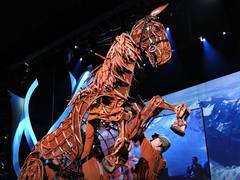
    Handspring Puppet Co.: The genius puppetry behind War HorseHandspring Puppet Co.: The genius puppetry behind War Horse
    Handspring Puppet Co.: The genius puppetry behind War Horse
    TED2011
    Puppeteers Adrian Kohler and Basil Jones, who created the horses featured in War Horse, explain the mechanics and artistry of making and manipulating their puppets. “An actor struggles to die on stage, but a puppet has to struggle to live,” Kohler says. When they bring a horse, three puppeteers, and a rider on stage, it’s almost impossible to remember that it’s not an animal breathing, strutting, prancing and whinnying right before our eyes.
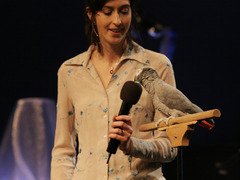
    Einstein the Parrot talks and squawksEinstein the Parrot talks and squawks
    Einstein the Parrot talks and squawks
    TED2006
    On stage, Einstein, an African grey parrot, oinks like a pig, makes laser noises, yells “OH MY GOD!,” dances, and even sings “Happy Birthday” to Al Gore. Hilarious, charming and truly uncanny.
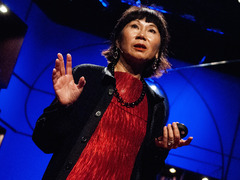
    Amy Tan: Where does creativity hide?Amy Tan: Where does creativity hide?
    Amy Tan: Where does creativity hide?
    TED2008
    In a talk about how she creates whole people and worlds from her imagination, Amy Tan credits not only her beliefs and thought processes, but also her “muse”—her sweet, tiny dog, who emerges from her handbag to strut across the stage.
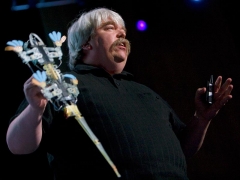
    Robert Full: Learning from the gecko's tailRobert Full: Learning from the gecko's tail

    Robert Full: Learning from the gecko’s tail
    TED2009
    Biologist Robert Full brings to the stage a gecko robot that mimics the animal’s incredible foot structure and movement, which allows it to climb—only, though, with the added (and quite surprising) functionality of its tail.
    Bill Gates: Mosquitos, malaria and educationBill Gates: Mosquitos, malaria and education

    Bill Gates: Mosquitos, malaria and education
    TED2009
    In a talk in part about malaria, Bill Gates releases live mosquitoes into the audience. “There’s no reason only poor people should have the experience,” he says, to laughter. (These mosquitoes are not, of course, infected.)
    Nellie McKay sings "The Dog Song"Nellie McKay sings "The Dog Song"
    Nellie McKay sings “The Dog Song”
    TED2008
    Is that a dog pitter-pattering and panting? In a tribute to her own dog, singer and pianist Nellie McKay does a fairly convincing (and pretty adorable) impression.

    Tune in to the TED Blog for live coverage of TED2013 beginning on February 25. And read much more about “The Young. The Wise. The Undiscovered” »

  • Reading list for TED2013: Books to get you ready

    BooksCounting the days until TED2013 starts on February 25? In the meantime, curl up with a book by one of the talented, scholarly, funny and wise speakers who will grace the stage in Long Beach, California. These books are organized below by session. And make sure to tune in to the TED Blog starting on the 25th for exclusive — and extensive — live conference coverage.

    Books from speakers in Session 1, “Progress Enigma”

    Books from speakers in Session 2, “Beautiful Imperfection”

    Books from speakers in Session 3, “The Spark”

    Books from speakers in Session 4, “Disrupt!”

    Books—after-Session-4

    Books from speakers in Session 5, “Dream!”

    Books from speakers in Session 6, “Create!”

    Books from speakers in Session 7, “Sustain!”

    Books from speakers in Session 8, “Coded Meaning”

    Books from speakers in Session 9, “Indelicate Conversation”

    Books from speakers in Session 10, “Secret Voices”

    Books from speakers in Session 11, “Who Are We?”

    Books from speakers in Session 12, “A Ripple Effect?”

    Books-endTune in to the TED Blog for live coverage of TED2013 beginning on February 25. And read much more about “The Young. The Wise. The Undiscovered” »

  • The Best Props at TED

    Jill-Bolte-Taylor's-brain

    TED2013, “The Young. The Wise. The Undiscovered,” begins in just 20 days and we at the TED Blog are gearing up to bring you live reporting on each of the 70 speakers who’ll be ascending the stage, not to mention assorted news from the scene in Long Beach, California. One thing we hope to see more of at this amazing event: props. There’s something so bold about a speaker who steps on stage with a prop. When wielded with finesse, a prop can make a good talk that much more captivating.

    To inspire any speakers thinking along these lines, here are some of the most eye-opening, innovative and humorous props from TEDs past, from a human brain to a parrot puppet.

    Jill Bolte Taylor’s stroke of insight
    Brain researcher Jill Bolte Taylor got an unwelcome surprise one morning as she got ready for work — a pain in her left eye that escalated to a loss of balance. When her right arm became paralyzed and she could no longer produce words, she realized that she was having a stroke. As she tells her tale at TED2008, all about the wonder of the human brain, she produces one on stage — replete with spinal cord.

    Susan Cain: The power of introverts
    Writer and self-described introvert Susan Cain believes in the power of quiet personalities. In this talk, she shares that, as a child, her favorite “social” activity was reading and that she brought a suitcase full of books with her to summer camp. As she sounds a call to action at TED2012 for society to help introverts thrive, she reveals her old suitcase. And yes, it’s still filled with books.

    Amy Tan: Where does creativity hide?
    “How do I create something out of nothing?” novelist Amy Tan asks. The answer has to do with a belief that there are no absolute truths. In this talk from TED2008, Tan shares that she is constantly questioning, embracing uncertainty and immersing herself in her own fictional world. What’s her “muse?” A surprise that emerges from her handbag at the very end of her talk.

    Andy Puddicombe: All it takes is 10 mindful minutes
    Andy Puddicombe, a monk, uses juggling as an analogy for practicing mindfulness. Equating three orange balls with thoughts at the TEDSalon in London, he shows how focusing on them or relaxing too much make juggling and talking impossible; how an anxious thought will pop up again and again; and how a nagging thought can dog us.

    Hans Rosling: The magic washing machine
    Hans Rosling uses an on-stage washing machine to tell the story of his mother buying her own, when he was 4-years-old. Rosling argues it’s one of the most revolutionary inventions we have: most women today still wash clothes by hand, like his grandmother used to. (At the end of his talk, a surprise emerges from the washing machine!)

    Ainissa-Ramirez-blowtorch

    Ainissa Ramirez: A sputnik moment for STEM education
    At TED2012, Ainissa Ramirez straightened a piece of bent wire with a blowtorch to demonstrate atoms’ ability to rearrange. In her talk, Ramirez explained that the rare earth elements we depend on now are being quickly depleted—and argues that science education could provide the key to solving that crisis. (This talk became the TED-ed lesson, “Magical metals, how shape memory alloys work.”)

    Tom Rielly delivers a comic sendup of TED2006
    Tom Reilly’s rollicking mockery of the 2006 TED speakers, which closed out the conference, features a “scream bag” (a shoulder-bag one screams into so as not to disturb other audience members), dolls, oversized playing cards, an interactive chart propped on an easel, a $100 bill, a prototype of a granola house with a Sun Chip roof and a parrot puppet. Naturally.

    Tune in to the TED Blog for live coverage of TED2013 beginning on February 25. And read much more about “The Young. The Wise. The Undiscovered” »

  • 10 places where anyone can learn to code

    Teens, tweens and kids are often referred to as “digital natives.” Having grown up with the Internet, smartphones and tablets, they’re often extraordinarily adept at interacting with digital technology. But Mitch Resnick, who spoke at TEDxBeaconStreet in November, is skeptical of this descriptor. Sure, young people can text and chat and play games, he says, “but that doesn’t really make you fluent.”

    Fluency, Resnick proposes in today’s talk, comes not through interacting with new technologies, but through creating them. The former is like reading, while the latter is like writing. He means this figuratively — that creating new technologies, like writing a book, requires creative expression — but also literally: to make new computer programs, you actually must write the code.

    The point isn’t to create a generation of programmers, Resnick argues. Rather, it’s that coding is a gateway to broader learning. “When you learn to read, you can then read to learn. And it’s the same thing with coding: If you learn to code, you can code to learn,” he says. Learning to code means learning how to think creatively, reason systematically and work collaboratively. And these skills are applicable to any profession — as well as to expressing yourself in your personal life, too.

    In his talk, Resnick describes Scratch, the programming software that he and a research group at MIT Media Lab developed to allow people to easily create and share their own interactive games and animations. Below, find 10 more places you can learn to code, incorporating Resnick’s suggestions and our own.

    1. At Codecademy, you can take lessons on writing simple commands in JavaScript, HTML and CSS, Python and Ruby. (See this New York Times piece from last March, on Codecademy and other code-teaching sites, for a sense of the landscape.)
      .
    2. One of many programs geared toward females who want to code, Girl Develop It is an international nonprofit that provides mentorship and instruction. “We are committed to making sure women of all ages, races, education levels, income, and upbringing can build confidence in their skill set to develop web and mobile applications,” their website reads. “By teaching women around the world from diverse backgrounds to learn software development, we can help women improve their careers and confidence in their everyday lives.”
      .
    3. Stanford University’s Udacity is one of many sites that make college courses—including Introduction to Computer Science—available online for free. (See our post on free online courses for more ideas.)
      .
    4. If college courses seem a little slow, consider Code Racer, a “multi-player live coding game.” Newbies can learn to build a website using HTML and CSS, while the more experienced can test their adeptness at coding.
      .
    5. The Computer Clubhouse, which Resnick co-founded, works to “help young people from low-income communities learn to express themselves creatively with new technologies,” as he describes. According to Clubhouse estimates, more than 25,000 kids work with mentors through the program every year.
      .
    6. Through CoderDojo’s volunteer-led sessions, young people can learn to code, go on tours of tech companies and hear guest speakers. (Know how to code? You can set up your own CoderDojo!)
      .
    7. Code School offers online courses in a wide range of programming languages, design and web tools.
      .
    8. Similarly, Treehouse (the parent site of Code Racer) provides online video courses and exercises to help you learn technology skills.
      .
    9. Girls Who Code, geared specifically toward 13- to 17-year-old girls, pairs instruction and mentorship to “educate, inspire and equip” students to pursue their engineering and tech dreams. “Today, just 3.6% of Fortune 500 companies are led by women, and less than 10% of venture capital-backed companies have female founders. Yet females use the internet 17% more than their male counterparts,” the website notes.
      .
    10. Through workshops for young girls of color, Black Girls Code aims to help address the “dearth of African-American women in science, technology, engineering and math professions,” founder Kimberly Bryant writes, and build “a new generation of coders, coders who will become builders of technological innovation and of their own futures.”

  • TED2013 speakers tweet about the lineup, their talks, and Bono

    TED2013

    Earlier this month, when we released the incredible lineup of TED2013 speakers, you couldn’t hide your excitement. But you’re not the only tweeps chirping about the conference. Below, find a sampling of posts from the speakers themselves — both about prepping their talks and about the fellow speakers they can’t wait to watch. Spoiler alert: Bono-mania appears to be a common theme.