Author: Jillian C. York

  • Global Voices Authors Speak Out Against Censorship

    The Internet is the tool most feared today by the elites, the media and by the power. It empowers those who otherwise would remain forgotten, oppressed. It is a weapon that gives ammo to those who are protesting for justice, equality and freedom and that shakes the structures of the state – and of companies – which sees no other choice but to censor.

    Brazilian blogger and Global Voices author Raphael Tsavkko Garcia

    Today marks the World Day Against Cyber Censorship, an initiative promoted by global NGO Reporters Without Borders (RSF) in support of a single Internet that is unrestricted and accessible to all.   The day will hopefully inspire Internet users to increase their own awareness of online censorship, which is something that many Global Voices authors know all too well.

    GV author Lina Ben Mhenni is one such blogger.  She lives in Tunisia, which has been named by RSF as an “enemy of the Internet” several years in a row.  In her own blog, she writes:

    Do you know how does it feel to be censored?

    Well, I do !
    Indeed, I am experiencing this DISGUSTING feeling since February, 24th 2010. That day, back home from work, I was so disappointed when I discovered the horrible “Error 404″ message- a message that stands for a censored web page in my country- when I tried to log in my Facebook and my blog.

    Diego Casaes, a Brazilian GV author who wrote this post on the subject linking to bloggers around the world and highlighting Global Voices' many projects, wrote his own prescription for how governments should deal with the Internet on his blog:

    I also think that governments should be encouraged not to regulate, but rather give the proper infra-structure and educate people on how to use the web. This way, citizens will trust the government and be able to freely express themselves on the web: this is of utmost importance! On this matter, I also think companies should become  more aware of their influence in society. Google’s decision not to regulate search results in China after having some Human Rights activists’ accounts hacked (follow this link for more information) is a demonstration of  how companies should position themselves.

    Today is the World Day Against Cyber Censorship

    Today is the World Day Against Cyber Censorship

    On his blog, Moroccan GV author Hisham answers the question, “What does anti-censorship mean online?”:

    In my humble opinion it means protecting what in some countries has become the last frontier of freedom of expression, which is at the core of all other freedoms; the last place where people can still escape restrictions of oppressive regimes. It means using blogs, videos, pictures, social networks, podcasts and the innumerable tools available online to mobilize people around a cause, expose rights abuses, communicate local struggles and causes to the rest of the world, give voices to the disenfranchised and the minority groups, hold governments accountable, investigate and reveal the truth.

    Pakistan is not considered an “Internet enemy,” but its online censorship often affects bloggers heavily. Of his country, GV Advocacy author Awab Alvi writes:

    It is my position that the internet should be free and open to the People of Pakistan allowing the people to harness this boundless platform for creating new spaces for exchanging ideas and information, the Internet should be considered as a force for freedom and looked upon as a tool for progressing the growth of a struggling nation.

    Lebanon is not engaged in filtering the Internet, but that doesn't stop Layal Al Khatib from speaking out about it on her blog.  This is what being anti-censorship means to her:

    Freedom! Our most basic right as human beings! We need to be free to express our feelings, thoughts and opinions with no fear of anyone! Censorship by other parties usually ends up with self-censorship, you’ll end up imprisoning yourself if they don’t do it themselves! Which is more dangerous to me..

    Lingua Malagasy translator Tomavana notes that in Madagascar, the problem is not necessarily filtering, but access, reminding us [FR] that censorship is not the only barrier to free expression:

    Quant à évoquer cette liberté d’expression à Madagascar, c’est invariablement buter à la réalité des manques de moyens communs aux pays en développement….De plus, avec un taux d'utilisation d'internet de moins de 5% de la population, il s'agit plus d'un avantage supplémentaire que monnaie une minorité de privilégié plutôt que de véritable droit. Je formule cependant le vœu que ces dérives ne puissent servir de prétexte à un musèlement ni une censure d'Internet à Madagascar mais qu'au contraire son accès soit facilité pour le plus grand nombre notamment par une amélioration de l'offre internet accompagnée à une baisse des coûts de connexions.
    As for talk of freedom of expression in Madagascar, is invariably up against the reality of lack of resources common to developing countries….Moreover, with a rate of Internet penetration rate of less than 5% of the population, it is more of an advantage to a privileged, moneyed minority rather than an issue of actual law. But I hope that these deviations will not be used as a pretext for MUZZLING or censorship of the Internet in Madagascar but to provide easy access for many, as well as improvement of the Internet, accompanied by declining cost of connecting.
  • Morocco: Christian Aid Workers Expelled

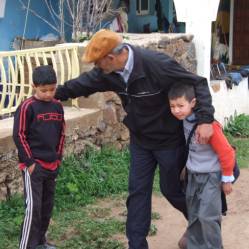
    Saying goodbye (photo from the Village of Hope official website)

    Saying goodbye to some of the orphans (photo from the Village of Hope official website)

    Last week, 20 staff members of the Village of Hope, a small orphanage in a small town in rural Morocco, were deported from the country without warning, under charges of proselytizing. The Village has quietly existed for the past ten years, and is staffed mostly by Christians from Western countries.

    Staff members claim they have always been transparent about their Christian identities to Moroccan authorities, without incident. For many of the children, the orphanage is the only home they have ever known.

    The Village of Hope's official Web site hosts a statement, endorsed by all of the staff members who were asked to leave the country, which reads:

    On Monday 8th March, all 16 overseas workers, including 10 parents, and 13 natural-born dependents, were told they were to be evicted from the site and country.  The reason given was that the parents had been proselytizing, with no explanation of who, when, where or how this was alleged to have occurred.  No charges concerning the welfare and care of the children have ever been raised as a concern by the Moroccan authorities in the 10 year history of VOH.

    The Moroccan authorities have not produced any evidence of the alleged offence and they gave only a few hours for the parents to pack up belongings and explain to their children that they might never see them again.

    Few media outlets have picked up on the story (the official Moroccan news agency [FR]  is one), but a number of bloggers with personal connections to the Village have begun to spread word about the incident, some with hopes of returning the staff to Morocco. Blogger Elizabeth Shelby, a Christian worker who volunteered at the orphanage in the past, is calling for prayer from her community, but also is hoping to find explanation from the government as to why the sudden change of heart occurred. She writes:

    It has been over 24 hours since 20 workers (most, parents) at the Village of Hope were taken from their children, unexpectedly by Moroccan officials. They were given thirty minutes to pack their belongings and leave the country, with no guarantee of ever seeing their Moroccan children again. The Village of Hope has been in compliance and worked with the Moroccan government for 10 years, and have had very few problems. As of January 4th, Morocco has a new Minister of Justice (ironic) Mohammad Naciri, one who feels he must exercise his power in order to shut down the Village of Hope because he believes “Christians are proselytizing.”

    Shelby is also leading a campaign on Twitter, using the hashtag #MoroccoOrphans and has started a Facebook group.

    The Moroccan Dispatches has written a thoughtful piece exploring the various aspects of the government's decision, as well as the operations of the orphanage. In respect to both, the blogger writes:

    As I mentioned, it's hard to know what really is permissible and what is not in Morocco since a rule on the books does not necessarily mean anything. So perhaps, the Moroccan authorities turned a blind eye for the past few decades just as they do with alcohol, hashish, prostitution, and speeding. Or perhaps The Village of Hope hid some of their activities. I do not know.

    An American blogger in Morocco writes in with support for the Village:

    [The Village's staff]  honestly thought they were complying with regulations, but were interrogated and deported with almost no time to pack or to say goodbye to the children. Orphans have a particularly hard lot in Islamic countries, where, even if adopted, they don't have the same rights as biological children, and even the Muslim Moroccans who worked with these kids got kicked off the premises, so there is not a single familiar face taking care of them right now. Please be in prayer for the children, for those who were deported, and for those who may still be deported. Its a rough situation, especially since Morocco has been considered a moderate nation which encourages peaceful relations between peoples of different faiths. Keep the people of this beautiful country in your prayers.

  • Morocco: In Meknès, a Devastating Accident

    Bab Berdieyinne Minaret, Meknes Morocco (photo by Eli J. T.)

    Bab Berdieyinne Minaret, Meknes Morocco (photo by Eli J. T.)

    On February 19, devastating news from Morocco: the minaret of the Bab Berdieyinne Mosque (also known as the Lalla Khenata bint Bekkar Mosque) in the UNESCO heritage city of Meknès, Morocco (where I lived from 2005-2007) had collapsed during Friday prayers.  The initial death toll was reported as 11, but by the following Saturday, CNN had reported it as 36, with an additional 71 injured.  The collapse was reported to have occurred due to recent heavy rains which weakened the structure of the minaret.

    Bloggers are sharing local stories and condolences with the people of Meknès.  MontanaRon, who taught English in the city, writes:

    I forgot to offer my condolences to all of my Moroccan friends for the devastating loss of life in the collapse of the Bab Berdieyinne Mosque. I pray that those of you I know are all well, Insha’Allah.

    For those who haven’t heard, the mosque disaster occurred in Meknes, where I worked for a year. At last count, 41 people have died and many more have been injured. My heart goes out to all of those who have been affected. Here’s a link to a photo I took of the old city of Meknes from a position across the wadi, where I lived in the new section of town. Although I don’t know where the Bab Berdieyinne Mosque might be in that photo, I’m sure it’s one of those pictured. If anyone views the shot, let me know if you see it. Again, my condolences to anyone affected by this disaster.

    Bahraini Foreign Minister Khalid Al Khalifa pointed readers in the direction of a photo of the mosque (pictured above) on Twitter, saying:

    Bahraini Foreign Minister Khalid Al Khalifa

    Bahraini Foreign Minister Khalid Al Khalifa

    Local Neglect?

    Moroccan news blog Morocco Post is one of several bloggers who finds the circumstances surrounding the minaret's collapse neglectful.  Drawing a comparison between the accident and a recent case in England of canine neglect, the blogger writes:

    For instance, on Monday 22 February 2010, a police officer in England was given a six-month conditional discharge and ordered to pay £2,500 costs for a criminal offence that he committed last year.  PC Mark Johnson was found guilty of  the death of 18-month-old Jay-Jay and seven Jet, who  were in the back of a police vehicle during a heat wave in June last year…

    …So broaden your imagination and juxtapose the two disasters: 41 human beings died after a mosque minaret collapse on them and no one is to assume responsibility as the rain was the cause, whereas 2 dogs died of heatstroke and the police officer in charge was brought to justice.

    Now the question is: who are the dogs and who are the human beings?

    Life Goes On

    Morocco Time reports that a number of foreign governments have offered their condolences to the people of Morocco.

    The site where the minaret once stood (Photo by The Moroccan Dispatches)

    The site where the minaret once stood (Photo by The Moroccan Dispatches)

    And The Moroccan Dispatches, a foreigner living in Meknès, shares photographs of the accident site, explaining that:

    Life continues as normal in the neighborhood, but many Moroccans stop to gawk and discuss the collapse.

  • Morocco: The Death of a Newspaper

    Jamal Elabiad writes of the possible demise of Morocco's only English-language newspaper, The Casablanca Analyst.

  • Morocco: To Valentine or Not to Valentine?

    In Morocco, as in many countries, celebrating Valentine's Day has caught on as a modern expression of love.  In major cities, storefronts stock candy hearts and teddy bears, but, as blogger Robin du Blog points out, the Moroccan media doesn't always encourage the celebration.  In a post entitled “La Saint-Valentin Halal,” the blogger writes:

    [Au Maroc] un simple bécot peut toujours les mener droit au panier à salade mais, marketing oblige, des jours durant, à l'approche du 14, sur les vitrines, des cœurs rouges virevoltent et flamboient à l'unisson. Alors, parce que cette date s'est inscrite dans le calendrier et que l'on est à l'affût des événements sur lesquels faire réagir les auditeurs, la Saint-Valentin a pris également sa place dans les programmes radiophoniques. Au petit déjeuner du 14, donc, dans le cadre d'une de ces émissions interactives lors desquelles les auditeurs sont invités à téléphoner pour faire connaître leur point de vue sur l'un ou l'autre des sujets traités, l'animatrice d'une des radios locales les plus écoutées lance celui du jour : l'amour, on l'aura compris. Mais alors, tout en rappelant qu'on est à la Saint-Valentin et que la Saint-Valentin est la fête des amoureux, ne voilà-t-il pas qu'elle nous livre en préambule une superbe tirade où elle nous dit ceci : 1/ la source de l'amour ne serait autre que l'amour porté à Dieu ; 2/ il n'est pas de plus bel exemple en matière d'amour profane que celui de l'engagement affectif du Prophète à l'égard de Khadija, sa première femme ; 3/ c'est de ce modèle que les amoureux – amoureux légaux dûment unis par la charia, at-elle bien pris soin de préciser – devraient avoir la bonne idée de s'inspirer.

    [In Morocco] a simple peck can still lead straight to the paddy wagon, but marketing forces these days, with their approach of the 14th on windows, hearts and flaming red twirl in unison. Then, because this date is included on the calendar and we are abreast of the events on which listeners should respond, Valentine's Day also took place on radio programs. At breakfast on the 14th, therefore, in the context of these interactive programs in which listeners are invited to call to make known their views on various topics, the host of a local radio's most popular launches of the day: love, we will understand. But then, recalling that is Valentine's Day and Valentine's Day is for lovers, lo and behold, she gives us no preamble in a superb tirade where she says this: 1) the source of love is none other than the source of God; 2) there is no finer example in matters of love than the emotional commitment of the Prophet with regard to Khadija, his first wife, 3) that is the model that lovers – lovers united by due legal Sharia, she was careful to state – should have the good sense to follow.

    The blogger continues explaining the discussion on the radio show and the implications of the imported Valentine's Day in Morocco, concluding: “L’amour, c’est l’amour, point. Qu’on nous laisse, ne serait-ce que l’espace d’un jour, le concevoir libre de toute barrière” (”Love is love, period.  Let us leave, if only in the space of one day, this idea free from any barriers”).

    Peace Corps Volunteer oclynn in morocco expresses surprise at the recognition of the holiday at her post in a rural part of the country:

    So I decide to go down to the Coop this morning, a little later than usual-didn’t really have any specific business to do, but had told Zahra that I’d come by. Glad I did. She greets me with questions about today’s holiday. Huh? You know, the American Holiday today. Huh? Geez, I just found out yesterday that it’s President’s Day Weekend on Skype w/Jo, but why would Zahra know about that? Then she’s asking, isn’t there a holiday of the heart today? OHHH. Valentine’s Day. Yes! Duh, Lynn. She’s wishing you Happy Valentine’s Day! Thanks! Mind you, this is a Coop of all unmarried women. I didn't give any other description of the holiday. Decided I like the idea of a Holiday of the Heart.

    Some Moroccan bloggers are heavy into the holiday.  L'Cassetta, a music blog, offers a cornucopia of romantic music from around the globe, saying:

    Que vaut l’amour sans la musique ? Que vaut le fait d'aimer si pendant cette sensation on ne prend pas gout dans l'accompagnement vers la jouissance musicale ? Que vaut le fait de dire que la musique est bonne quand on n'a pas un jour vécu la souffrance qui émane des mots, des paroles ; des notes ? On a toujours dans la tête une de ses chansons slow, cette superbe chanson qui mélange bonne mélodie et paroles bien ciselés. Aimer donc n'est qu'entre autres le fait d'accompagner le bonheur a coté de la souffrance.

    What is love without music? What is the act of love if while loving one doesn't take pleasure in the very process that leads to music enjoyment? What's the point of pretending that music is good when one's never experienced the pain that might erase from words and notes? We always remember those romantic songs; the kind of beautiful songs that mix good melody and well-crafted lyrics. Therefore love, among other things, helps to deal with feelings of well being as well as sorrows.

    Last but not least, need a place to celebrate Valentine's Day 2010? Casawaves just might have the answer. Poking fun at the oft-made comparison of the film Casablanca to Morocco's largest city of the same name (the two, in reality, have little in common), the blogger writes:

    Pour la Saint-Valentin, « pourquoi ne pas déclarer votre flamme en 2010 à Casablanca au Maroc. En effet pour un voyage en amoureux à la Saint-Valentin 2010, cette ville offre un incroyable dépaysement ».

    Au début, en lisant cette offre publiée sur un site d’actualité internet j’ai cru à une farce, voire à un poisson d’avril légèrement précoce. Mais non, il s’agit bien de fêter la Saint-Valentin dans notre métropole.

    For Valentine's Day, why not declare your love in 2010 in Casablanca, Morocco? Indeed for a trip to a romantic Valentine's Day 2010, this city offers incredible scenery.

    At first, reading this offer posted on an Internet news site I thought it was a joke, even an April Fool's joke slightly early. But no, it is good to celebrate Valentine's Day in our city.

  • Morocco: Talks on Western Sahara to Resume

    The dispute over the Western Sahara is a complex one–Morocco claims it as their own, while the Saharan independence movement (the Polisario), backed by Algeria, desires independence. Three years ago, talks resumed between the Polisario and Morocco, but after four rounds of formal negotiations, a conclusion still had not been reached. Morocco's current proposal is autonomy, but the Polisario demands a referendum on the territory's future, including an option for independence.

    The latest news is that talks are set to resume on February 10, informally, in upstate New York. Bloggers are weighing in with their thoughts on what the future might hold for the region. Maghreb Blog, whose author is based in the U.S., gives a bit of background to the conflict, and offers this opinion:

    If the plan is not to their liking, which is obviously the case, then it is incumbent upon Algeria and the Polisario to step up to the plate and propose a non-obstructionist, realistic alternative. The blind rejectionism of anything Moroccan will only lead to maintaining the current status-quo largely in favor of Morocco at this point. Any meaningful compromise between Morocco and Algeria is beneficial, not only to the two countries, but also to the other three countries in the Maghreb region, as it could be a tremendous step towards full economic and political integration.

    Commenter Chasli expresses disagreement with the blogger's assessment, saying:

    You and clearly Rabat are in total denial that the Polisario has already offered a plan. Shortly before Morocco officially came forward with their autonomy plan the Polisario presented a plan that called for a referendum that, as far as I can tell, could include just about anything as long as it included independence as an option. And if the inhabitants voted for independence the Polisario pledged to allow the illegal Morrocan colonists to remain and to institute a special relationship with Morocco. This is I feel a very impressive compromise that deals with a number of Rabat's concerns; however, because Rabat flatly refuses to discuss the UN-mandated referendum on self-determination they have totally ignored the Polisario plan.

    The debate continues throughout the comments section.  Blogger Analitikis also takes on the subject in a recent post; discussing a recently-issued UN statement, the blogger writes:

    Reading the statement and subsequent euphoria on the seeming acceptance of the parties to engage in yet another round of “talks”, one would think that a resolution to the Western Sahara conflict is within reach; that all it takes is a Security Council’s resolution, a Secretary General’s report, a Special Representative’s statement, and a parties half-hearted acceptance for a 35-year-long intractable conflict to be resolved. Little attention is paid to the process, to the parties’ readiness, and to the contextual conditions that may signal the opposite. As far as I know, neither the parties nor the UN (I use the term loosely here) are ready for any kind of serious and honest engagement that would put an end to the conflict of attrition known as the Western Sahara conflict.

  • Arab World: Should the New York Times Reassign Ethan Bronner?

    Over the past couple of weeks, a much-discussed topic in the broader Arab blogosphere has been a news story that broken by a member of the blogosphere itself.  On January 25, the Electronic Intifada (EI) reported that the son of Ethan Bronner, New York Times‘ Jerusalem bureau chief, had recently been inducted into the Israeli Defense Forces.  Citing the NYT's company policy, EI argued that the paper had a responsibility to disclose the information to readers; the NYT's foreign editor, Susan Chira, responded by email, stating (and effectively disclosing):

    Ethan Bronner referred your query to me, the foreign editor. Here is my comment: Mr. Bronner's son is a young adult who makes his own decisions. At The Times, we have found Mr. Bronner's coverage to be scrupulously fair and we are confident that will continue to be the case.

    Nearly two weeks later, the NYT's Public Editor, Clark Hoyt, stated in his column that he too believed that Bronner should be reassigned.  Executive editor Bill Keller disagreed.

    The Angry Arab, whose prior comments can be found here, here, and here, was unconvinced by Keller's explanation:

    If only one reporter for the New York Times would, for purposes of an experiment, announces that he/she has a son who has joined Hamas or Hizbullah forces, we would like then to see if Bill Keller would make the arguments that he has made regarding Ethan Bronner's son. I mean, Mr. Keller. Who are you kidding?

    Arab-American blogger Suleika Jaouad sees the case as not being about Bronner, but as part of a larger issue:

    This disturbing imbalance in the Times' reporting on the conflict raises some serious ethical questions about Zionism in the US media. Journalist Philip Weiss, on his blog Mondoweiss, lists a few of them: how deep does it go, and will anyone ever look into it? And on from that, Why are so many of the MSM reporters on Israel/Palestine Jews with intimate ties to Israel? When do [Arab-Americans] get to cover this story?

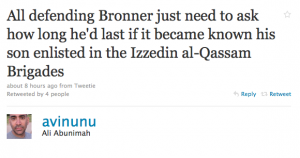
    Palestinian writer Ali Abunimah, who is a co-founder of Electronic Intifada, raises an interesting question to that effect on Twitter:

    Screen shot 2010-02-08 at 11.30.19 PMAbunimah expands on that question on Mondoweiss, then takes it a bit further.  Like Jaouad, he sees the problem as going beyond the case of Ethan Bronner and toward the question of equality.  After clarifying his belief that being Jewish does not pose a conflict of interest in reporting on Israel (”So anyone who says that being Jewish automatically leads to pro-Israel bias is wrong”), he brings up the example of Palestinian Times journalist Taghreed El-Khodary, saying:

    Yes, recently they have had Taghreed El-Khodary in Gaza […] But here is a crucial point: El-Khodary is allowed to report only on Palestinians. Neither she nor any other Arab reporter is allowed to report on Israeli Jews. While Jews/Americans may report on Palestinians, the converse is not true. Why is this? It must be — I assume — because there is an inherent, perhaps unacknowledged assumption that an Arab/Palestinian is or will be automatically biased against Israelis/Jews. Whereas, we are supposed to accept that in no case is a Jewish reporter who identifies with Israel biased even when his son has joined an occupation army that is raiding Palestinian refugee camps and communities dozens of times per week. Seriously?

    To what can we attribute this double-standard? I am afraid it smacks of racism.

  • Syria: Netizens Discuss SourceForge Ban

    For six years, Syrian users have been affected by U.S. government trade sanctions that exclude certain goods from the Syrian market.  Specifically, the Syria Accountability Act (SAA) of 2004 prohibits the export of most goods containing more than 10% U.S.-manufactured component parts to Syria, with the exceptions of food and medicine.  Sudan, Cuba, North Korea, and Iran are all also affected by similar sanctions.

    In the past year, the fact that the sanctions against Syria include software has garnered significant attention.  Last year, in an attempt to comply with the sanctions, LinkedIn unintentionally cut off Syrian users entirely (the sanctions require that sites block software downloads, not general access), a decision that was quickly reversed.  Web-hosting companies have also kicked off Syrian, Iranian, and other users, some of which were not actually prohibited from use.

    The discussion recently reached a fever pitch when, a day after U.S. Secretary of State Hillary Clinton called for a free and open Internet, Syrian users noticed they could no longer access open-source software community SourceForge.  Syrian Abdulrahman Idilbi, writing for ArabCrunch, broke the news:

    As of January 2008, people from those countries can browse SourceForge projects and download from them, but access to the secure server was not allowed, so they would not be able to log in to SourceForge or contribute to projects. As of January 2010, blocking went further with not allowing people coming from “banned locations” to download anything from SourceForge.net, having a response similar to this one: http://sourceforge.net/t7.php.

    SourceForge's blockpage for Syrian users

    SourceForge's blockpage for Syrian users

    Hiconomics, who tweets here, started up a discussion on the subject on the Yalla! Startup community (founded by Habib Haddad of Yamli.com).  He writes:

    As some of you may already know… SourceForge.net has suddenly blocked Syrian & Sudanese users on the basis of being compliant to US law.

    This has obviously opened up the debate (again) about how ‘Open', ‘Open Source' really is… and how susceptible it is to the shackles of Politics and National laws. I'm not looking to open any political debate… but there must be a way to help.

    In an excellent analysis on Syria Comment, guest blogger Idaf questions whether or not the sanctions against Syria are helpful, and questions who they serve:

    Does this serve American interests? It is hard to see how. The stated objective of the policy is to “stop US technologies from reaching terrorists.” The only problem with this lofty goal is that all the  “terrorist” organizations that America accuses Syria of supporting are based outside Syria:  Hamas is in Palestine; Hizbullah is in Lebanon; and Iraqi insurgents live in Iraq. The US sanctions none off these countries. On the contrary, US IT corporations pour money into these three countries under CSR, development and market expansion plans. And besides, the technology of these companies reaches Syrians through third parties. Of course, the restriction make the technology more expensive and it annoys us, but we get it. Cisco routers can be purchased in Damascus; they are brought from Lebanon. Cheap Chinese knock offs are also easily obtained in the Syrian market. One can also argue that Washington’s policy is also counter-productive because it will cause long term damage to US businesses in these region.

    On the Middle East Journal's Editor's Blog, Michael Collins Dunn shares the sentiment, remarking:

    US restrictions have been used to limit open-source software access in countries under US sanctions, sometimes harming dissidents more than governments. Nations are still trying to understand how to regulate (or not regulate) new media, and in general it would seem greater access is normally a good thing. Sanctions that in effect help regimes control their populations unintentionally should be reconsidered.

    Finally, SourceForge staff have commented on the block, explaining the law with which they're required to comply.  They did state, however:

    We regret deeply that these sanctions may impact individuals who have no malicious intent along with those whom the rules are designed to punish. However, until either the designated governments alter the practices that got them on the sanctions list, or the US government’s policies change, the situation must remain as it is.

  • Morocco: “Smile, You’re in Fez”

    The View from Fez gives us a look at the new mascot of Fez in this post.