Author: Jim Daly

  • The asocial side of social media: TED Book author Damon Brown on our “virtual shadows”

    Our-Virtual-Shadow-Q&AAre your endless tweets, status updates and Instagrams robbing you of enjoying what’s special about the moments you’re trying to share? Damon Brown fears they may. In the TED Book Our Virtual Shadow: Why We Are Obsessed With Documenting Our Lives Online, he lays out a compelling case for mindfully balancing your online presence with being present in the here and now.

    We caught up with Damon to get a better sense of why he feels that social media may have an asocial downside.

    You argue that the electronic umbilical cord that connects us to others – Facebook, Twitter, etc — may, in fact, be strangling us. But you also say that this only happens if we let it. How so?  

    Technology has always been an issue for us, whether it was a child in the 1950s watching too much TV or a prehistoric caveman playing with a new discovery called fire. Like our ancestors, what we really need to do is find a smart way to integrate our newfound technology into our lives. The only difference now is that today’s tech is being discovered or created more rapidly than before. That, to me, is still no reason for us to throw up our hands and say our lives are suddenly spiraling out of our control.

    Tech isn’t going away, either. In fact, it shouldn’t! But it should be balanced with old-school, classic ways of connecting. We shouldn’t believe that letter writing, phone calls, or even face-to-face meetings were rendered obsolete, just as email, texting, and Facebook messaging are not the ultimate ways for us to connect. I think saying technology is making us less attentive is a cop out. Now we should be focused on tech integration — not subservience.

    This isn’t a new problem, as you suggest with your caveman example. We’ve struggled with these issues for thousands of years.  

    It is definitely not a new problem. In Our Virtual Shadow, I talk about Socrates having as much trouble with then-new technologies as we do with modern tech. Culturists seem to fall into two camps: Believing tech is our devil or that tech is our savior. Both are false, just as they were in the past.

    In your book, you discuss the importance of ‘anchors of memory’, which are markers we use to remember a moment. How are those changing in our new tech-saturated age?

    Anchors of memory are symbolic items we make to help remember a special time. It could be a photo of your grandfather coming back from the war or simply a Facebook check-in saying you are at a rock concert. You make them for something you deem important enough to note. Our anchors of memory today are becoming more virtual than physical, like our Instagrams and tweets, but they are just as valid as the physical photos and letters of yesteryear.

    My concern is that we seem more and more focused on creating these anchors of memory – FourSquare check-ins, status updates, and so on. Unfortunately, the tools we use to create our modern anchors of memory, like the smartphone, require a level of multitasking that takes us away from the very experience we’re trying so hard to capture! It is the ultimate irony.

    The computer scientist and author Jaron Lanier said he feels that social media makes us all feel blandly similar. Do you agree?  

    Lanier wrote the book, You Are Not a Gadget: A Manifesto. To paraphrase, he talked about social media flattening people into one big pile of mush. How can you represent the contradictions, dimensions and ideas of any one person in a simplified social media profile? You can’t. It’s like those business commercials where they promise to not treat you like a number. In my interpretation, Lanier said that social media’s architecture and format essentially turned everyone into another number. It is rubbing all the rough edges off of everyone’s personality and making them fit into a fixed box. These varied people, then, turn into a big, non-descript pile of mush.

    In Our Virtual Shadow, I argue that Lanier’s theory not only applies to social media, but also to how we interpret and receive news on the Internet. For instance, I can tweet something right now to my couple of thousand followers and, because they trust me, they will retweet it to their followers, and so on. It could be shared to so many degrees that people don’t even know that it came from me. Is what I said true? There is no way to prove the voracity and, at a certain point, it’s not going to matter to the reader. It will just be accepted as truth because someone they trusted shared it. That “news” has been scrubbed of all its edges – and its accountability – and it just becomes something someone heard on the ‘net.

    There’s also a lot of good that social media brings us, though, on a personal and professional side.  

    There is definitely much good that comes from social media. I’m a huge Twitter fan and even cofounded my own social media app, Quote UnQuote. I think we just need to ask the same question we do with other activities: Is this affecting my quality of life? For instance, if you’re spending quality time with your family and you feel the urge to pull out your smartphone and do a Facebook post about spending quality time with your family, consider if it is really necessary at that very moment.

    Social media has the ability to make things feel more urgent than they actually are. We jump from attention-stealing activity to attention-stealing activity and, before we know it, time has flown by. The point of the book is that we use these potentially-distracting tools to capture a moment, but they are just time consuming enough to significantly pull us out of the moment. We will never again, say, watch our toddler walk for the first time or have a virgin meal at the famed The French Laundry. Facebook, Twitter, and the rest of the networks, however, will be right there waiting for us whenever we want to visit. Life disappears, social media doesn’t — though we are often operating based on the opposite assumption.

    How do we balance out the good with the bad? How do we become more present?

    The best solution is to remember that there will always be a new social media tool, a new gadget, or a new technology that will ask for our attention, but there will never be a tool that replaces our memories when we allow ourselves to be fully present. There are several recent studies that say not only can’t we multitask successfully, but that multitasking prevents us from remembering life experiences as well as we could. The next time you are having a breath-taking experience, try not to do a Pavlovian reach for the smartphone.  Researching this book made me really question my own social media habits, and, if you put the smartphone aside for a bit, I think you’d be surprised at what you recall — what you notice — and even what you feel.

    Our Virtual Shadow” is available for the KindleNook, or through the iBookstore. Or download the TED Books app for your iPad or iPhone. Read more »

  • We can make our government work: A Q&A with TED Books author Lawrence Lessig

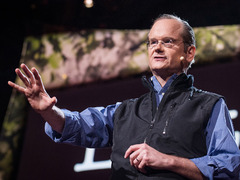
    BLOG Q-A larrylessigWhen it comes to US politics, many are frustrated that gridlock and grandstanding so often substitute for the hard job of getting things done. Just 14% of Americans say they approve of the work that Congress is doing, according to a recent Gallup poll. (Which, as a recent TED speaker notes, is lower than the approval rating for cockroaches, though higher than meth labs.)

    Underlying that disappointment is a central corruption in our electoral system, says legal activist Lawrence Lessig: the fact that Congressional candidates depend on funding from a tiny percentage of citizens, who in turn control what the rest of us get to vote on. Lawrence Lessig: We the People, and the Republic we must reclaimLawrence Lessig: We the People, and the Republic we must reclaim That’s the argument at the core of his blistering talk from TED2013. In his new TED Book, Lesterland, Lessig takes a deeper look at the problem and describes a powerful method for fixing this broken system.

    In the great literary tradition of metaphors, Lessig has created Lesterland, a large country run by a small group of people named Lester. In the book, he uses Lesterland to describe what happens when the wealthy control the powerful. While political corruption is not new, Lessig believes we now have both the technology and the social media tools needed to expose and strike at the root of this corruption. To hear more about his ideas, and how he arrived at this metaphor, we caught up with Lessig and asked him a few questions.

    Your book paints a pretty grim view that our political system is undermined by money and corruption. How did we allow this to happen? 

    We allowed it to happen simply because we’re busy with our lives: We’ve got jobs, or kids, or hobbies — maybe all together! We expect the Congress to do their job. Most of us don’t have the patience to try to keep up.

    Why has this system of corruption taken hold so firmly?

    Because it pays so well. K Street — where most lobbyist offices are in Washington, D.C. — has become one of the most profitable businesses in America. And they have convinced other businesses across America that they need K Street. So the cycle feeds itself: businesses pay lobbyists; lobbyists channel money to politicians; politicians reward the businesses.

    What gives you hope that we can change this cycle?

    The only hope is that most Americans get this and — if pushed — will create the political force to change it. What we need to do now is to push them.

    How do we do that? What can the average person do?

    The first step is to get involved. I started an organization called Rootstrikers — inspired by Thoreau’s quote: “there are a thousand hacking at the branches of evil to one striking at the root” — which recruits citizen teachers: people who recognize the corrupting influence of money and who are willing to help spread this message. At Rootstrikers you can be assigned tasks to help do that essential work. If we’re successful, then we will create the political conditions necessary to make reform possible.

    Any other specific ideas you have for how we can turn things around?

    The problem isn’t simple, but the first step is a no-brainer: We have to change the way elections are funded. If we change that, we make every other change possible. If I were King for a Day, at a minimum, I’d enact John Sarbanes’ Grassroots Democracy Act. More ambitiously, I’d enact the American Anti-Corruption Act put forwarded by the Represent.us organization.

    What are the consequences of the corrupt and money-driven system we live with?

    It’s very simple — a government that doesn’t work, or if it does, not for us. None of the most important issues facing us today can be addressed sensibly given the senselessness of this system: climate change, health care, financial reform, food safety, a tax system, the debt, inequality. You name it, and I’ll tie it to the money.

    The folks who are pulling the strings — the Lesters — have a lot to lose if your ideas are implemented. Do you expect to see an active quashing of your ideas?

    The closer we get, the more they will squeal. We need to have in place the political force that can overcome that squeal.

    Lesterland is available for Kindle and Nook, as well as through the iBookstore. Or download the TED Books app for your iPad or iPhone. A subscription costs $4.99 a month, and is an all-you-can-read buffet.

    Read an excerpt »

  • How we can make elections about the people, not just funders: An excerpt of Lawrence Lessig’s new TED Book, “Lesterland”

    LesterlandBefore we can tackle climate change, financial reform, education reform or, well, anything, there is a single issue that we in the United States must confront. As legal activist Lawrence Lessig says in today’s talk, before we can bring about change on any of the thousands of issues that matter to us, we must change a central corruption at the root of the American political system — that politicians must raise vast amounts of money in order to have a chance in the general election. This makes them prone to the influence of a very small percentage of the population.

    Lessig’s powerful talk brought the TED2013 audience to its feet. And he has so much more to say about how we can overturn this deeply entrenched system. In a TED first, on the same day his talk premieres, Lessig is releasing a new TED Book expanding on the ideas he presented on stage. In Lesterland: The Corruption of Congress and How To End It, Lessig takes on the deep flaws in our campaign finance system and lays out a plan for fixing it. As he says in the book’s pages: The American political system has been weakened by a corrupt campaign funding system, but we can change it. And the time to do it is now.

    Here is how Lesterland begins:

    Once upon a time, there was a place called “Lesterland.”

    Lawrence Lessig: We the People, and the Republic we must reclaimLawrence Lessig: We the People, and the Republic we must reclaimLesterland was a lot like the United States. Like the United States, it had a population of about 311 million souls. Of that, like the United States, about 150,000 were named “Lester.”

    Lesters in Lesterland had a very important power. There were two elections every election cycle in Lesterland — a general election, and a “Lester election.” In the general election, all citizens got to vote. In the Lester election, only the “Lesters” got to vote.

    But here’s the catch: To run in the general election, you had to do extremely well in the Lester election. You didn’t necessarily have to win, but you had to do extremely well. Democracy in Lesterland was thus a two-step dance. The Lesters controlled the first step.

    What can we say about “democracy” in Lesterland?

    First, we could say, as the United States Supreme Court said in its remarkable ruling in Citizens United v. FEC, that “the people have the ultimate influence over elected officials” — for, after all, there is a general election. But the people have that influence only after the Lesters have had their way with the candidates who wish to run in that general election. The people’s influence is ultimate. But it is not exclusive. Instead, the field of possible candidates has been narrowed to the field of Lester-plausible candidates, just as the field of candidates that citizens in the Soviet Union could select among had been narrowed by the choices of the Communist Party.

    Second, and obviously, this primary dependence upon the Lesters would produce a subtle, understated, and somewhat camouflaged bending to keep the Lesters happy. For all candidates, both prospective and already successful, would know that they couldn’t gain or retain power without Lester support. Such bending couldn’t be too obvious, for fear it would trigger the votes of voters who resented the Lesters’ influence. (No doubt, there were some.) But neither could it be too subtle, for fear the Lesters would miss who their real allies were. Thus the Goldilocks principle of Lesterland politics: Not too little, and not too much. The best politicians were the best precisely because they practiced this balance well.

    Lesterland is thus a democracy. But it is a democracy with two dependences: The first is a dependence upon the Lesters. The second is a dependence upon the citizens. Competing dependences, possibly conflicting dependences, depending upon who the Lesters are.

    That’s Lesterland.

    There are three things to see now that you’ve seen the democracy called “Lesterland.”

     (1) The United States is Lesterland.

    Like Lesterland, the United States also has 311 million souls. It also has about 150,000 people named “Lester.” And it also has two types of elections: One, the traditional “voting election,” where citizens cast ballots. The other, a distinctively modern “money election,” in which the relevant “funders” give money to afford candidates the chance to run effectively.

    Voting elections are discrete — they happen on a particular day, in a regular cycle. They include the vote in the general election; for a small portion of us, they also include the vote in the primary. In both cases, every citizen eighteen and older has the right to participate. And as the constitution has been interpreted, he or she has the right to participate equally. If the vote I cast for my representative to Congress is weighted more than yours (because there are fewer voters in my district than in yours), the Constitution requires the state to redraw that congressional boundary.

    By contrast, the money elections are not discrete. They are continuous. Every day, throughout the election cycle, every citizen is in effect asked to contribute to one candidate or to another. That contribution is in effect a “vote” for that one candidate or the other. But unlike “votes” in the discrete elections, to vote for one candidate in the money election does not mean you can’t vote for another as well. Citizens are free to hedge their money votes in the money election by voting for both candidates in a two-person race, or as many candidates in as many races as they wish. The only regulation is that no citizen is permitted to give more than $2,600 to any one federal candidate per election, or more than $123,200 to all federal candidates and federal PACs combined in an election cycle. And finally, and obviously, while the Constitution has been interpreted to require equality in the voting election, there is nothing close to equality in the money election. The per capita influence of the top 1 percent of American voters is more than 10 times the per capita influence of the bottom 99 percent.

    As in Lesterland, the money election and the voting election have a special relationship in U.S.A.-land too: To be able to run in the voting election, one must do extremely well in the money election. One doesn’t necessarily have to win — though 84 percent of the House candidates and 67 percent of the Senate candidates with more money than their opponents did in fact win in 2012 — but you must do extremely well. The average amount raised by winning Senate candidates was $10.4 million; losing candidates raised $7.7 million. The average amount raised by winning House candidates was $1.6 million; losing candidates raised $0.774 million. Money certainly isn’t the only thing that matters. But anything other than money is way, way down the list of “things that matter.”

    And here is the key to the link between Lesterland and the United States: There are just as few relevant “Funders” in U.S.A.-land as there are “Lesters” in Lesterland.

    “Really,” you say?

    Yes, really.

    Read more of this fascinating and, ultimately, inspiring book. Lesterland is available for Kindle and Nook, as well as through the iBookstore. Or download the TED Books app for your iPad or iPhone. A subscription costs $4.99 a month, and is an all-you-can-read buffet.

  • New TED Book turns critical eye on Keystone XL Pipeline

    TED-Book-Keystone-XLThe proposed Keystone XL pipeline would stretch 1,700 miles from Western Canada to the Gulf Coast of Texas. And it has become a touchstone for the bitter fight over America’s energy future. Opponents say the pipeline — designed to bring oil from Canadian tar sands down through the United States — would further bind future generations to outdated oil-based energy policy. Meanwhile, supporters say it represents a step toward America’s energy independence.

    Steve Mufson, author of the new TED Book Keystone XL: Down the Line and a reporter at The Washington Post, has journeyed along the entire length of the proposed pipeline. He suggests that its real story is twofold: about the American frontier spirit, and about just how far we are willing to go to feed our oil addiction. In the book, Mufson asks readers to consider the Keystone XL debate — beyond the issues of climate change, tar sands and U.S. energy trade policy. He unpacks issues that don’t get as much play in the press: the ups and downs of the North Dakota shale boom, prairie populism in Nebraska, drinking-water concerns near the Ogallala aquifer, Native American communities’ desire to protect their land and burials sites along the Trail of Tears, and ranchers’ objections to the use of eminent domain by Canadian companies.

    In many ways, the Keystone XL pipeline serves as a larger metaphor, Mufson says, illuminating the vast energy infrastructure it takes to sustain the American lifestyle. It underlines the choices we make in pursuit of short-term comfort. Which risks are we really willing to take?

    To give you a taste of this riveting read, check out an excerpt from the book’s preface:

    In spring 2012, I proposed an unusual road trip, one that would trace the full 1,700-mile route of the proposed Keystone XL oil pipeline. The pipeline project, which I was covering for The Washington Post, had aroused intense controversy. TransCanada, a Calgary-based company, had applied for an international permit from the U.S. State Department, something that had never raised many hackles before. But activists had turned the pipeline into an environmental litmus test for President Obama. In late August and early September 2011, pipeline foes protested outside the White House; more than 1,250 were arrested. The police carted off the likes of Middlebury professor Bill McKibben, actress Daryl Hannah and renowned climate scientist James Hansen. Later that fall, thousands of protesters surrounded the White House.

    What made this pipeline different from the more than 2 million miles of existing oil and natural gas pipelines that had been built in the United States with little fuss or fanfare? A journey by car would provide a window onto what this policy debate looked like at the ground level.

    The first stop: The gaping black pits at the oil sands, or tar sands, of Alberta, Canada, the source of the oil that would flow down the Keystone XL. Then a quick flight — to avoid driving a perilous highway full of sleepy truck drivers — to Edmonton. There in a rented car — a Ford Flex that made up in roominess what it lacked in grace or style — I set out, accompanied by Post colleagues photographer Michael Williamson and videographer Whitney Shefte and my 18-year-old daughter Natalie, who jumped at the chance to see those vast stretches of America.

    From Edmonton, we drove through Alberta and part of Saskatchewan, then down the spine of America to the Texas Gulf Coast. We visited spacious corporate headquarters and crammed trailer parks, ranches and farms, boomtowns and dead towns, a border town of nine people and a century-old oil refinery. We attended a Nebraska cookout and an Oklahoma pow-wow. And along the way, this inanimate pipeline came to life.

    It became clear that the real story of this pipeline permit was one about American frontiers — the lengths to which we go for oil supplies and the intrusive effects that quest causes all the way down the line.

    Each segment of the trip touched on different issues: climate change and the oil sands; the U.S. energy trade with Canada; the North Dakota shale boom and its woes; prairie populism in Nebraska and pipeline politics; the Ogallala aquifer and the threat of leaks; Native Americans and their desire to protect land, water and burial sites along the old Trail of Tears; the fight of ranchers and farmers against a Canadian company’s right to eminent domain; and why both oil sands producers and Texas refiners want to see the pipeline completed.

    Since the journey, the Keystone saga has continued. The Army Corps of Engineers approved the pipeline’s southern leg, and when construction began protesters in east Texas turned to civil disobedience. The new Secretary of State, John Kerry, has said he would rule soon on the permit needed for the northern segment.

    As a journalist for The Washington Post, I take no position on whether the pipeline should be built. But I can paint a picture of the trade-offs. The United States stands at the brink of a sharp increase in oil produced at home and in neighboring Canada. The supplies could upend long-held economic assumptions, slashing our oil import bill, reviving domestic industries and creating jobs. But these resources come with risks. And concerns about climate change and greenhouse gas emissions have tempered any celebration of these newly accessible troves of fossil fuels.

    Which risks are we willing to take? As long as the world relies on fossil fuels for transportation and industry, we will face unappealing choices. Drill in the Chukchi Sea off Alaska’s Arctic coast? Or drill in the Gulf of Mexico where a BP well spilled nearly 5 million barrels into the water? Drill thousands of holes in half a dozen shale plays, using vast supplies of water and producing hazardous waste? Or buy more oil from abroad, where most governments don’t agonize over development trade-offs? If nothing else, the Keystone XL pipeline illuminates the vast energy infrastructure it takes to sustain this American lifestyle and the choices we have made about that without really thinking.

    Keystone XL: Down the Line is available for Kindle and Nook, as well as through the iBookstore. Or download the TED Books app for your iPad or iPhone. A subscription costs $4.99 a month, and is an all-you-can-read buffet.

  • New TED Book: How Did You End Up Here?

    HowDidUEndHereWho hasn’t found themselves at party, standing awkwardly by the guacamole, approximately five feet from another person doing the same? Sometimes it’s just hard to know what to say to start a conversation.

    Davy Rothbart can help. In his new TED Book, How Did You End Up Here?: The Surprising Ways Our Questions Connect Us, Rothbart collects more than 100 of his all-time favorite questions to ask someone you’ve just met, generated by people around North America whom he’s only just met himself. Rothbart opens his toolbox, sharing secrets of his trade, stories from the road, and strategies for approaching people and pushing past superficialities while also taking a close look the questions themselves — the funny, strange and surprising questions we all want to ask the people around us.

    Rothbart — a writer, reporter and documentary filmmaker — is known for his curiosity about other people’s lives. Whether it’s the folks he interviews as a frequent contributor to public radio’s This American Life, or the people he connects with through the personal notes and letters published in his annual magazine, Found, Rothbart has honed a unique talent for compassionately probing into the lives of strangers and drawing out surprisingly revealing stories of beauty, heartbreak and humor.

    How Did You End Up Here? is available for the Kindle and Nook, as well as through the iBookstore. Or download the TED Books app for your iPad or iPhone, and get a subscription with a new TED Book every two weeks.

  • Let’s fix science education: A Q&A with “Save Our Science” author Ainissa Ramirez

    AinissaRamirez-Q&AHow is it that science classes have become about memorization and filling in the right circle on a Scantron sheet, rather than about doing hands-on experiments and activities that reveal the wonder of the world around us? It’s a problem that Tyler DeWitt tackled in yesterday’s talk, “Hey science teachers — make it fun.” And it’s a warning bell that Yale professor Ainissa Ramirez has been sounding for a long time.

    At TED2012, Ramirez talked about a crisis in education: The problems of our time require creativity and nonlinear thinking, and in the United States, students simply aren’t being prepared to come up with the solutions we’ll need. Now, in her new TED Book Save Our Science: How to Inspire a New Generation of Scientists, Ramirez shares what she sees as the best way to inspire new learners — a commitment to improving science, technology, engineering and math (STEM) education. In the book, Ramirez takes a hard look at the cultural and historical reasons why STEM education has declined in the United States over the last few decades. Her plea: We need to bring it back.

    Curious to hear more about what can be done to make STEM fun again, we asked Ramirez a few questions about her new TED Book.

    What inspired you to write this book now?

    There is a line in the poem On Crime and Punishment by Khalil Gibran that says, “He falls for those ahead of him, who though faster and surer of foot, yet removed not the stumbling stone.”

    As a scientist who has walked along this bumpy STEM pipeline, I wanted to leave clues and a map on how to navigate it. Save Our Science is the map. It’s not only for those within the pipeline, but also for the whole STEM ecosystem. Everyone feels helpless in this education crisis. Save Our Science is a manifesto to recharge and empower everyone. In it, I am acting as an on-the-ground Secretary of Education, attempting to help all Americans feel empowered to make change. This book spells out how we — teachers, parents, citizens, politicians — can use all the pieces that are working and arrange them in a way that will make the US a leader in STEM education again. It includes actions that individuals and groups can take to get the education system back on track.

    Why is STEM education so vital?

    First, most of the jobs of the 21st century will require people to be comfortable with science and math — not only the content and information, but the mindset that comes from these fields, such as trial-and-error and the skill of asking good questions.

    Second, all the focus on testing is not allowing children to be children. That is, there are few opportunities for kids to explore something inspired by their curiosity, and few chances to get their hands dirty. Some might say that American childhood is under attack and with it all the key human development steps needed to make whole and healthy adults. STEM is like a training camp for key skills like encouraging curiosity and patience, and making friends with failure.

    It has been shown that the ability to self-regulate — in other words, patience — is a better marker for success than IQ. There’s the famous marshmallow experiment, where children are given a marshmallow that they can eat now, or they’d get two if they wait 15 minutes. It was found that those who waited (less than 30% of them) actually did better in school. In this microwave era, STEM teaches children patience; you can’t rush an experiment. For example, try to quickly make rock candy from sugary water. You can’t! It takes time and requires patience. But it is so worth it! Learning to wait is a muscle that is lacking but important for human development. STEM provides human skills and virtues that will make our children successful down the road.

    What key changes can we all make to improve STEM education?

    Save Our Science suggests action items everyone can do to make STEM more fun and engaging. It could be a shop owner installing a 3D printer; or a mechanic having bike-repair nights in the neighborhood; or restaurants showing the chemistry of cooking. Parents can take stuff apart with their kids and learn together how things work. Show science videos at malls, in movie previews and at the dentist’s office. Of course, policymakers could learn more about what really works from other countries. The bottom line is, if we lather engaging STEM opportunities everywhere, we are going to change the cultural thinking about science.

    I’ve seen it in my own town. I was having carpets cleaned in my home for Thanksgiving. The cleaning guy immediately recognized me from my science videos that play on the local cable channel in town. Our conversation moved from chitchat about the weather to an intense discussion of science. He talked about what he learned on the video, and then we started actually coming up with ideas for another video. He emphatically made suggestions. But that is not the point; the point is that he got it. He got that science was for him, and he could demand more, inspired by his curiosity. Science was part of his language now, and we were having a real conversation about real issues. Making science accessible and engaging is the first step to individual ownership of the concepts, and is the first step to making real change in STEM education.

    How do you personally make STEM education more fun?

    I am a STEM evangelist and try to make it fun in a number of ways. If I am at a cocktail party, I’m that person who will pull out a party trick. In my case, it is a small piece of memory wire that I store my wallet. This material changes its shape when you heat it with a match. If you want to see adults show childlike enthusiasm, this wire does it every time. After I show the wire demo, then I wait. Some people will be hooked and will ask what is going on. I’ll make analogies between atoms to members of a marching band, where each individual makes a small change, but the whole is a pronounced change. You can see this wire in action in this small TED-Ed video here.

    As for younger people, at Yale I created a science lecture series for kids called Science Saturdays. Here, children get to learn about science from experts in an age-appropriate but not-dumbed-down way.

    For a broader reach, I created a series of short science videos call Material Marvels, which have been seen all over the globe. I try to make science appealing with outlandish demonstrations (that often need a blowtorch), or make silly analogies — like that solar cells are sandwiches of silicon. These videos are playing on local television in my town, and I am surprised by their impact. When I go to the barbershop, gas station, or even at church, occasionally someone will come up to me to say they watched these videos. One woman recently said to me, “Hey, I saw you on TV doing science. I loved it, not because I know you, but because you made it fun. And I am an English major!” That is a huge testimonial to the impact of making science enjoyable and putting it where folks have access to it. People will come if you build it, and bring science to them in a way that is palatable.

    In my classroom, I do some of the same outlandish demonstrations, but I also add lots of group discovery. Students learn better from their peers, so I’ll start a lesson and have an in-class assignment that they will do together. This is a less threatening approach for learning and, I’ve been told by my students, is fun.

    Also, I’m an author. Right now I’m writing a book about American football through a science lens, called Newton’s Football, for Random House. With my collaborator, Allen St. John, we are using football as a model to describe the hot topics in science like chaos theory, the physics of football helmets, concussions, and other nuggets in a fun, big-think, non-preachy way. I think football fans will like a new way to look at the game, and non-football fans will gain a new point of entry to the game.

    All in all, my joy is learning new things and translating what I’ve learned so that other people understand it too. In essence, I am acting as a science conduit and translate science so that it seems relevant to everyone. That is my mission, anyway.

    Save Our Science is available for the Kindle and Nook, as well as through the iBookstore. Or download the TED Books app for your iPad or iPhone. A subscription costs $4.99 a month, and is an all-you-can-read buffet.

  • New TED Book: Save Our Science

    TED-Book-Save-Our-ScienceIt is not nearly enough for students to simply churn out answers from memory. No, in our ever-changing time, they need to be able to think expansively and creatively. In order to solve the complex problems of tomorrow, the traditional academic skills of reading, writing, and arithmetic must be replaced with creativity, curiosity, critical thinking and collaboration — skills that are inherent in scientific research.

    In Save Our Science: How to Inspire a New Generation of Scientists, Yale professor Ainissa Ramirez makes an impassioned call for a recommitment to improve science, technology, engineering and math education — often referred to as STEM — in our schools and throughout our society. She describes what habits we need to change to make STEM fun again, as well as a plan for how to increase every child’s participation in these disciplines.

    Ramirez notes: “The artist Pablo Picasso once said that all children are born artists and that the trick is to stay that way as an adult. I believe that all children have an inner scientist within them, and we need to get them in touch with their inner scientist again.”

    Save Our Science is available for the Kindle and Nook, as well as through the iBookstore. Or download the TED Books app for your iPad or iPhone. A subscription costs $4.99 a month, and is an all-you-can-read buffet.

    Ramirez is no stranger to TED. At TED2012, she gave a powerful plea for us to rethink STEM education. Pointing out that we are quickly running out of rare earth minerals, essential for almost all of our technology, Ramirez believes that it will take major ingenuity to create a way to recycle these precious materials. Are we as a society prepared? Could this be a Sputnik moment for education? Read all about her talk » 

    Ramirez was also the educator behind the TED-Ed lesson “Magical metals, how shape memory alloys work,” which used slices of bologna to bring walking, talking atoms to life. Watch the fascinating lesson below.

  • Why radical openness is unnerving and necessary: A Q&A with TED eBook authors Don Tapscott and Anthony D. Williams

    RadicalOpenness-Q&A-feature

    Secrecy and propriety used to define our cultural and professional lives. We kept trade secrets, held closed-door meetings, had whispered conversations and kept the details of our comings-and-goings to ourselves. That’s no longer the case. We have entered a new era — one characterized by openness — in which our world and our relationships have become increasingly interconnected.

    Don Tapscott: Four principles for the open worldDon Tapscott: Four principles for the open worldIt’s difficult to say what this new age of collaboration will mean. But in the new TED book Radical Openness: Four Unexpected Principles for Success, authors Anthony D. Williams and Don Tapscott (who gave the TED Talk “Four Principles for the Open World“) explore some of the questions and and uncertainties ignited by this new era. Their big question: what this will mean for the boundless inventiveness of the human mind?

    We sat down with Tapscott and Williams to ask them more.

    What do you mean by the term ‘radical openness’?

    Tapscott: We wrote the book, in part, because the word openness was so ambiguous and ill-defined. It generally tends to have very positive connotations and is associated with concepts like freedom, flexibility, expansiveness, engagement, sharing, access and candor. But in practice we find that “openness” can mean many things, depending on the circumstance. So we’ve looked at four different strategies for openness that ultimately entail some pretty deep changes in business and society.

    That leads to the other reason for writing the book. We think that leaders are not fully exploiting the power of openness in their businesses and institutions. In fact, when it comes to innovation, competitive advantage and organizational success, “openness” is rarely the first word one would use to describe companies and other societal organizations like government agencies or medical institutions. For many, words like “insular,” “bureaucratic,” “hierarchical,” “secretive” and “closed” come to mind instead.

    Williams: The new form of radical openness described in this book stands in stark contrast to the insular, bureaucratic, hierarchical, secretive and closed systems and organizations of the past.  For example, smart organizations, from education to health care to government, are shunning secretive practices and embracing transparency as a means to foster trust and speed up the metabolism of business. Industries — from software to manufacturing to pharmaceuticals — are opening up their innovation processes and treating their customers and partners as valuable sources of intelligence and new ideas. And rather than go to extraordinary lengths to control and protect proprietary resources and innovations, a growing number of companies are sharing intellectual property and releasing patents in a bid to accelerate research, foster relationships and stimulate progress in other areas where they will see profits. All this adds up to nothing less than a paradigmatic, transformative shift in the way organizations — from companies to social movements — compete and succeed.

    You say that old systems are failing us. How so?

    Williams: Times have changed. Organizations either adapt to these dramatic changes or they will die. Take the dramatic increases in transparency for example. While secrecy and opacity have been hallmarks of business behavior in the past, maintaining and defending secrets is costly and difficult in an era where billions of smartphone-wielding citizens can transmit information around the globe in a heartbeat.

    Tapscott: When it comes innovation, it’s simply the case that radical openness produces demonstrably better results. Companies that produce new products in remote, closed-off laboratories, for example, tend to be slower, less agile and less innovative than companies that open up and reach outside their boundaries to find exceptional talent and ideas. Procter & Gamble is a good example of a company that really exemplified the old industrial model of closed innovation for most of its history. This worked well until about the year 2000 when global competition began increasing and P&G found it increasingly difficult to keep up. Since embracing a radically new external collaboration program called “Connect and Develop,” the company has dramatically increased their innovation success rate by enlarging the pool of new product ideas (with close to 60 percent coming from outside the company) and the revenue drawn from them, while still managing to save over $1 billion in R&D costs annually.

    We also see examples of deep institutional failure and cases where radical openness is revolutionizing entire systems and industries, not just individual companies. We write about the crisis of innovation in drug development, for example, where the basic model for inventing and commercializing potentially life-saving medications is broken and failing society badly. The problems there have largely to do with a highly risk-averse and legalistic industry culture that comes at the expense of opportunities to co-develop early-stage technology tools, establish data standards, share clinical trial data or pursue other forms of collaboration that could lift the productivity of the entire industry. Fortunately, companies like GSK are strategically releasing patents and leading the charge toward more open models of drug development that will increase research productivity and stimulate medical progress.

    What factors are forcing the dramatic opening up of society? Financial? Societal?

    Tapscott: Changes in regulation (think the Sarbanes-Oxley Act, for example) have been influential, but arguably the most important force is the digital revolution. For the first time, billions of people can use cheap digital devices to capture and publicly disclose information that people in positions of power would rather remained hidden. This explosive combination of the spread of the Internet and the ability of people everywhere to connect and collaborate around shared interests is forcing an unprecedented degree openness in virtual every major social and economic institution.

    Why is radical openness such an unnerving concept for business?

    Williams: Radical openness is most unnerving when companies are unprepared to operate in a highly transparent environment. In the past, companies were rarely forthcoming with pertinent information, especially with regard to flaws, errors or weakness. But today they operate in a world where the Internet has wrested control of public discourse away from centralized media outlets and empowered millions of people to join the conversation. Companies not only have less and less control over information, they also have less ability to shape and massage public perceptions of their firm. Every step and misstep is instantly subject to scrutiny. And every company with a brand or reputation to protect is vulnerable to the unrelenting webs of “stakeholders” who pass judgment on corporate behavior. It’s understandable that many firms are uncomfortable with such scrutiny, especially as social media continues to accelerate the speed at which critical messages can “go viral.”

    What are the downsides to radical openness? Sometimes, unsavory forces fill the vacuum left by great change.

    Tapscott: That’s true, and we’ve argued that radical openness poses potentially graves risks to our privacy, our identity, our safety and even our sense of personal autonomy. To be sure, there is a real upside to participating in communities, seeing photos, hearing stories or knowing the location of friends and family. Sharing also helps companies deliver personalized products and services.

    But there are massive commercial and government interests, along with malevolent individuals, who have much to gain as each of us reveals highly granular personal information online. Indeed, the real problems begin when this data is assembled into profiles, matched with other info and used by employers, law enforcement officials, public sector agencies and other interested parties to make (automated) judgments about (and decisions affecting) individuals, such as whether to hire them, or whether to admit entry, or to calculate benefits or terms of an offer, or to corroborate a claim. In such circumstances, the effects of privacy loss include discrimination, especially if the data is inaccurate.

    Williams: The bottom line is that each of us has a responsibility to be mindful of the ever-growing trail digital breadcrumbs that we leave behind when a growing proportion of our daily lives play out online.

    Any great examples of organizations that first rejected this openness and then engaged it?

    Williams: It’s actually quite typical for companies to at reject the idea of openness at first. And it’s common to see situations where leaders come to realize the value of openness only after they have seen secrecy and opacity fail spectacularly. A case in point is Micrsoft. When hacking the Xbox Kinect turned into a popular Internet sport, Microsoft initially said that it would “work closely with law enforcement” to keep the Kinect tamper-proof. But after public ridicule, Microsoft quickly reversed its stance, claiming that the Kinect had been left open to tinkerers on purpose. Today, Microsoft benefits from a whole new ecosystem of Kinect applications that have been developed by tech enthusiasts around the world. These include everything from a Minority Report–style multitouch interface to a navigation system for robots to a gesture-based interface for questing in World of Warcraft. A team of students from the University of Warwick in the UK even built a robot that had the potential to navigate through post-earthquake rubble and search for trapped victims. How could this kind of unsanctioned innovation not be valuable, both for Microsoft and for its customers?

    What are some of your favorite examples of radical openness?

    Tapscott: In the book, we write about the unprecedented steps GlaxoSmithKline took in October 2012 to release all of its clinical trials data on the Web. It was an extraordinary move — a bid to aid in the discovery of new medicines and end any suspicion that the pharmaceutical giant had secrets to hide. This was an incredible first in the ultra-secretive world of drug development. Chief executive Andrew Witty called the move essential to finding new drugs to treat the diseases plaguing the world and there has been much admiration for these efforts in the broader medical community.

    In government, a growing number of public officials see openness as a positive force in increasing citizen participation and driving public sector reform. The Eye on Earth portal from the European Environmental Agency (EEA) is a case in point. This interactive mapping platform provides citizens with real-time information about environmental quality (including air and water) in Europe’s 27 member countries. Users can browse the visual imaging interfaces and drill down for detailed, neighborhood-level data about ozone levels, nitrogen dioxide, particle matter and carbon emissions. Citizens can even contribute their own data and observations about the environment around them, including first-hand experiences of climate change or potential explanations for environmental degradation in specific areas. Jacqueline McGlade, the EEA’s executive director, says the real opportunity here is that when more people understand what’s happening in their area, more will contribute to solving environmental problems.

    Does radical openness operate the same globally as in the US?

    Williams: You need only look at the Arab Spring to see that no country is immune to the forces of radical openness. That said, it’s clear that the US and other Western nations with a history of democratic traditions and with widespread access to modern technologies are well ahead of newly emerging democracies and countries like North Korea or Iran where the forces of openness are aggressively curtailed by the current regimes.

    In what ways has radical openness proved successful for different organizations?

    Tapscott: There are many, but let’s take two examples. One way radical openness can improve success is to increase trust, which is really the essential glue that binds together the complex networks of participants involved in the creation of economic value today. Companies that are transparent, and appear to have nothing to hide, are considered more trustworthy by their customers and partners. We reference Zappos, the online footwear retailer, which shares an unprecedented amount of information with its customers and suppliers in order to foster trust-based relationships. As CEO Tony Hsieh puts it: “The more they know about us, the more they’ll like us.”

    Another way that radical openness breeds success is by giving companies access ideas and capabilities that lay outside their corporate boundaries. Think about the world’s most successful mobile platforms like Apple’s App Store or Google’s Android. Conventional wisdom suggests that companies should fiercely protect the products and platforms they have worked hard to develop. But what smart companies like Apple and Google have learned from the open-source community is that exposing these assets to the world creates far greater opportunities for external parties with the right combinations of skills and insight to create something even more valuable.

    The App Store has more than 700,000 applications that have been created almost entirely by third-party developers. Meanwhile, Google has taken openness to whole different level with the open-source Android platform that allows users and handset makers to tinker with the guts of the system. Android (which has 700,000 apps of its own) has been installed on 500 million phones worldwide and is growing by 1.3 million activations a day. In both of these examples, the products themselves (iPhones or Android smartphones) have become open stages on which vast ecosystems of exceptional talent create and assemble some of the world’s best innovations.

    Is Wikileaks a good use of radical openness?

    Williams: Wikileaks is interesting because there are elements of good and bad in the way that the whistleblowing site has been deployed by Julian Assange. On one hand, revealing information about the activities of powerful individuals and institutions is a potent deterrent to misbehavior. The more people can find out, inform others and organize, the less politicians can pursue self-serving behavior, spend taxpayer dollars indiscriminately or act against the public interest. On the other hand, WikiLeaks’s approach of forcing transparency on organizations is hardly unproblematic. Why should we trust its founders to make responsible decisions about the information they disclose when so little is known about its criteria for assessing leaked documents? Who watches WikiLeaks? Can it be held accountable when sensitive and potentially life-threatening information is leaked to the public? These tough questions will be actively debated as the forces of openness intensify.

    .
    Radical Openness
    is part of the TED Books series. It is available for the Kindle and Nook, as well as through the iBookstore.  Or download the TED Books app for your iPad or iPhone. A subscription costs $4.99 a month, and is an all-you-can-read buffet.