Author: Joe

  • Politico: “Signs of life” for climate bill – Murkowski “dirty air” Amendment vote June 10 will be a key test

    The inside-the-beltway media mavens at the Politico report today that the Senate climate and clean energy jobs bill has a heartbeat:

    EXCLUSIVE – BIG SUMMER AHEAD FOR ENERGY LEGISLATION: Senator Majority Leader Harry Reid has scheduled a meeting of climate/energy chairs (Kerry/Boxer/Bingaman/Baucus/Rockefeller/Lincoln) for June 10, and asked them to give him feedback on the Kerry-Lieberman American Power Act by June 8. “Shows new urgency – feeling very good,” a Senate leadership source e-mails. Sen. Kerry met Wednesday with Phil Schiliro, President Obama’s congressional liaison, to discuss the floor schedule for the bill.

    Other signs of life for the legislation:

    –A bill is most likely to happen when/if the Fortune 500 demand it. And there were Ford, Google, PepsiCo and other biggies, signing a letter yesterday to President Obama and Senate leaders from 60 enviro groups, unions, trade associations and corporations: “It’s time for Democrats and Republicans to unite behind bipartisan, national energy and climate legislation that increases our security, limits emissions, and protects our environment while preserving and creating American jobs.” Read the letter

    –President Obama pushed the bill yesterday in his opening remarks in the East Room: “If nothing else, this disaster should serve as a wake-up call that it’s time to move forward on this legislation. It’s time to accelerate the competition with countries like China, who have already realized the future lies in renewable energy. And it’s time to seize that future ourselves. So I call on Democrats and Republicans in Congress, working with my administration, to answer this challenge once and for all.”

    The Politico further reports that “top strategists” in both parties tell them, “we’ll know a comprehensive energy bill’s likelihood of passing after a June 10 vote on an amendment by Sen. Lisa Murkowski (R-Alaska) that would block the EPA’s ability to regulate greenhouse gases. Top Dems say if she gets over 50 votes, that’s BAD for the prospects of comprehensive energy legislation. If she gets 55 votes, that’s DEATH KNELL for the bill. Under 50, supporters are still in the ballgame, even thought the conventional wisdom is still against them.”

    The ever-shrinking Sen. from South Carolina, however, is here to embrace the conventional wisdom and pull the plug on the patient, as Climate Wire (subs. req’d) reports:

    Sen. Lindsey Graham (R-S.C.) said the administration’s toughening stance on domestic oil and gas exploration — just two months after President Obama expanded drilling — could disrupt delicate negotiations designed to gain crucial votes from lawmakers in Alaska and Louisiana.

    Obama’s decision, announced yesterday, comes five weeks after an underwater well began shooting thousands of barrels of crude daily into the Gulf of Mexico.

    “It made the hill steeper,” Graham said of the decision’s effect on passing climate legislation in an interview yesterday. “I understand why the president is taking a pause on drilling, but when you talk about cancelling leases, when you talk about stopping Alaska exploration, it makes it harder for this concept to sell.”

    … “If [Obama] says we’re gonna not be able to drill along Alaska’s coast, put a moratorium on that, that makes it harder for Lisa Murkowski to pursue this grand bargain we’ve got,” Graham said.

    “Let’s be blunt here. Kerry-Lieberman doesn’t have enough support on the Democratic side to come to the floor,” said Robert Dillon, Murkowski’s spokesman. “Sen. Murkowski continues to support economically sound climate legislation. Unfortunately, as of yet, we have not seen a proposal that meets her criteria of doing no harm to the economy.”

    Unlike, say, the BP oil disaster, which is I guess doing no harm to the economy — or global warming, for that matter (see “Lisa Murkowski proposes to fiddle while Alaska burns“).

  • Three easy tips: delete messages, app switcher, app grid

    Oftentimes I browse BlackBerry related sites looking for good quick tip ideas. It seems like there are an almost infinite number of functions you can perform with your BlackBerry, and the more we present the better off our users will be. Sometimes, though, I come across tips that don’t quite merit their own posts. I’m going to start combining these into easy tip packages. Today’s three-pack will include deleting old messages to free up memory, easily switching applications, and how to change your application menu grid style.

    (more…)

  • MN professor eviscerates Monckton in must-see video – TVMOB’s talk proves “how easy it is to fabricate data.”

    “The number of errors Chris Monckton makes is so enormous it would take a thesis to go through every single one of them.”

    The Viscount Monckton of Brenchley (TVMOB) is a shameless purveyor of hate speech and anti-science disinformation (see links below).

    Nonetheless, you rarely sees such a thorough debunking of an anti-science disinformer as this astonishing point-by-point evisceration put together by John Abraham, an engineering professor at St. Thomas University in St. Paul, MN.

    One of the two reasons you rarely see this is because few people are willing to put in the time and effort that Prof. Abraham has — not merely looking up just about every reference TVMOB uses but actually e-mailing the authors of those scientific papers and asking them if TVMOB has accurately represented their work.

    The second reason you rarely see this kind of thorough dismantlement is that few people make stuff up with the relentlessness of TVMOB or push the kind of hate speech that make people want to debunk them entirely:

    Kudo to Abraham for this masterful debunking.

  • NOAA expects “active to extremely active” Atlantic hurricane season – 95% of above normal seasons have 2 Gulf hurricanes, 50% have at least one in June-July

    Across the entire Atlantic Basin for the six-month season, which begins June 1, NOAA is projecting a 70 percent probability of the following ranges:

    *  14 to 23 Named Storms (top winds of 39 mph or higher), including:
    *  8 to 14 Hurricanes (top winds of 74 mph or higher), of which:
    *  3 to 7 could be Major Hurricanes (Category 3, 4 or 5; winds of at least 111 mph)

    Hurricane Ike.NOAA’s Climate Prediction Center issued its seasonal outlook today.

    It is a worrisome.  Administrator Lubchenco, says, “If this outlook holds true, this season could be one of the more active on record.”

    What is the biggest uncertainty in the forecast?

    “The main uncertainty in this outlook is how much above normal the season will be. Whether or not we approach the high end of the predicted ranges depends partly on whether or not La Niña develops this summer,” said Gerry Bell, Ph.D., lead seasonal hurricane forecaster at NOAA’s Climate Prediction Center. “At present we are in a neutral state, but conditions are becoming increasingly favorable for La Niña to develop.”

    The CPC report explains:

    La Niña contributes to reduced vertical wind shear over the western tropical Atlantic which, when combined with conditions associated with the ongoing high activity era and warm Atlantic SSTs, increases the probability of an exceptionally active Atlantic hurricane season (Bell and Chelliah 2006). NOAA’s high-resolution CFS model indicates the development of La Niña-like circulation and precipitation anomalies during July.

    One of the three key factors leading NOAA to this forecast is the high sea surface temperatures:

    Warm Atlantic Ocean water. Sea surface temperatures are expected to remain above average where storms often develop and move across the Atlantic. Record warm temperatures – up to four degrees Fahrenheit above average – are now present in this region.

    Here is more of the forecast:

    An important measure of the total overall seasonal activity is the NOAA Accumulated Cyclone Energy (ACE) index, which accounts for the intensity and duration of named storms and hurricanes during the season. We estimate a 70% chance that the 2010 seasonal ACE range will be 155%-270% of the median. According to NOAA’s hurricane season classifications, an ACE value above 117% of the 1950-2000 median reflects an above-normal season. An ACE value above 175% of the median reflects an exceptionally active (or hyperactive) season.

    And what about the Gulf where a massive oil spill resides:

    Because of the ongoing oil crisis in the Gulf of Mexico, we are including some historical statistics of tropical cyclone activity for this region (excluding the Bay of Campeche) based on past above normal seasons. These statistics do not represent an explicit forecast for tropical cyclones in the Gulf of Mexico during 2010, as it is impossible to reliably predict such activity so far in advance. Historically, all above normal seasons have produced at least one named storm in the Gulf of Mexico, and 95% of those seasons have at least two named storms in the Gulf. Most of this activity (80%) occurs during August-October. However, 50% of above normal seasons have had at least one named storm in the region during June-July.

    If you want a comprehensive discussion of what a Gulf hurricane might mean for the oil disaster, Dr. Jeff Masters has a good post, “What a hurricane would do the Deepwater Horizon oil spill.”

    Related Post:

    How accurate are the NOAA seasonal hurricane forecasts?  Click here.  Summary at Wunderblog.

  • BlackBerry News From The Wire for the Week of 5/24/10

    As a wise man once said, “don’t believe everything that you breathe, you get a parking violation and a maggot on your sleeve.” I’m not sure exactly what that last part means, but in any case it’s a friendly reminder that much of what we hear comes in the form of rumors. By definition, a rumor might not be true. Thankfully, that’s the case with our lead item in last week’s News From The Wire. The BlackBerry Pearl 9100 appears to be safely and soundly headed to the U.S.

    (more…)

  • Obama: “Climate change poses a threat to our way of life.” – Starts the pivot from spill to bill: “I’m going to keep fighting to pass comprehensive energy and climate legislation”

    Obama will be holding a press conference about the BP oil disaster today at 12:45 p.m. eastern time.  You can watch the conference live at this link: http://www.whitehouse.gov/live.

    We’re not going to be able to sustain this kind of fossil fuel use.  This planet can’t sustain it.

    Obama gave a big speech at Solyndra, a California solar manufacturing plant, yesterday, which I’ll excerpt below.  For background on Solyndra, see “First Energy Department loan guarantee goes to … a solar manufacturer.”

    DotEarth opinion blogger Andy Revkin just tweeted,

    Obama sci chief: POTUS will give major speech on climate (not imminent). “He believes it, he understands it, we’re going to get it done.”

    Here are excerpts from Obama’s speech:

    We’ve got to go back to basics.  We’ve got to go back to making things.  We’ve got to go back to exports.  We’ve got to go back to innovation.  And we recognized that there was only so much government could do.  The true engine of economic growth will always be companies like Solyndra, will always be America’s businesses.  But that doesn’t mean the government can just sit on the sidelines.  Government still has the responsibility to help create the conditions in which students can gain an education so they can work at Solyndra, and entrepreneurs can get financing so they can start a company, and new industries can take hold.

    So that’s why, even as we cut taxes and provided emergency relief over the past year — we also invested in basic research, in broadband networks, in rebuilding roads and bridges, in health information technology, and in clean energy.  Because not only would this spur hiring by businesses — it would create jobs in sectors with incredible potential to propel our economy for years, for decades to come.  There is no better example than energy.

    We all know the price we pay as a country as a result of how we produce and use — and, yes, waste — energy today.  We’ve been talking about it for decades — since the gas shortages of the 1970s.  Our dependence on foreign oil endangers our security and our economy.  Climate change poses a threat to our way of life — in fact, we’re already beginning to see its profound and costly impact. And the spill in the Gulf, which is just heartbreaking, only underscores the necessity of seeking alternative fuel sources. We’re not going to transition out of oil next year or 10 years from now.  But think about it, part of what’s happening in the Gulf is that oil companies are drilling a mile underwater before they hit ground, and then a mile below that before they hit oil.

    With the increased risks, the increased costs, it gives you a sense of where we’re going.  We’re not going to be able to sustain this kind of fossil fuel use. This planet can’t sustain it.  Think about when China and India — where consumers there are starting to buy cars and use energy the way we are.  So we’ve known that we’ve had to shift in a fundamental way, and that’s true for all of us.

    Now, earlier today I spoke to Energy Secretary Steven Chu, who, as you know, is a Nobel Prize-winning physicist.  And he’s been on the scene in the Gulf, deeply involved in our efforts to bring this crisis to an end….

    … a lot of damage has been done already — livelihoods destroyed, landscapes scarred, wildlife affected.  Lives have been lost.  Our thoughts and prayers are very much with the people along the Gulf Coast.

    And let me reiterate:  We will not rest until this well is shut, the environment is repaired, and the cleanup is complete. And I look forward to returning there on Friday to review the efforts currently underway and lend my support to the region.

    But even as we are dealing with this immediate crisis, we’ve got to remember that the risks our current dependence on oil holds for our environment and our coastal communities is not the only cost involved in our dependence on these fossil fuels.  Around the world, from China to Germany, our competitors are waging a historic effort to lead in developing new energy technologies.  There are factories like this being built in China, factories like this being built in Germany.  Nobody is playing for second place.  These countries recognize that the nation that leads the clean energy economy is likely to lead the global economy.  And if we fail to recognize that same imperative, we risk falling behind.  We risk falling behind.

    Fifteen years ago, the United States produced 40 percent of the world’s solar panels — 40 percent.  That was just 15 years ago.  By 2008, our share had fallen to just over 5 percent. I don’t know about you, but I’m not prepared to cede American leadership in this industry, because I’m not prepared to cede America’s leadership in the global economy.

    So that’s why we’ve placed a big emphasis on clean energy.  It’s the right thing to do for our environment, it’s the right thing to do for our national security, but it’s also the right thing to do for our economy.

    And we can see the positive impacts right here at Solyndra.  Less than a year ago, we were standing on what was an empty lot.  But through the Recovery Act, this company received a loan to expand its operations.  This new factory is the result of those loans.

    Since the project broke ground last fall, more than 3,000 construction workers have been employed building this plant.  Across the country, workers — (applause) — across the country, workers in 22 states are manufacturing the supplies for this project.  Workers in a dozen states are building the advanced manufacturing equipment that will power this new facility.  When it’s completed in a few months, Solyndra expects to hire a thousand workers to manufacture solar panels and sell them across America and around the world…..

    But thanks to loans through the Department of Energy, which helped provide Tesla motors with the financial wherewithal to expand, that shuttered plant is soon going to reopen.  (Applause.)  And once again — once again, it will be a symbol of promise, an example of what’s possible here in America.

    Tesla is joining with Toyota in a venture to put a thousand skilled workers back to work manufacturing an all-electric car.  (Applause.)  And this is only the beginning.  We’re investing in advanced battery technologies to power plug-in hybrid cars.  In fact, today in Tennessee there’s a groundbreaking for an advanced battery manufacturing facility that will generate hundreds of jobs.  And it was made possible by loans through the Department of Energy, as well as tax credits and grants to increase demand for these vehicles.

    We used to account for about 2 percent of advanced battery technologies for cars.  We’re expecting, in the next couple years, to get up to 20, 30, maybe even 40 percent, building our market share right here in the United States of America.

    We’re investing in an advanced electricity grid.  And Governor Schwarzenegger and I were just talking about this before we came out, because this has been a big priority for him — that will be more efficient and better able to harness renewable energy sources.  We’re providing grants to build wind farms and install these solar panels, helping us double our ability to generate renewable energy.  We’re expanding our capacity in biofuels to reduce our dependence on oil.  We’ve helped forge one historic agreement — and are on track to produce a second — to dramatically increase the fuel efficiency of America’s cars and trucks.  So we are making progress.  It’s progress that’s going to produce jobs, that’s going to help secure our future.

    But we’ve still got more work to do, and that’s why I’m going to keep fighting to pass comprehensive energy and climate legislation in Washington.  (Applause.)  We’re going to try to get it done this year, because what we want to do is create incentives that will fully unleash the potential for jobs and growth in this sector.

    Already we’re seeing the results of the steps we’ve taken.  As I said, before the Recovery Act, we had the capacity to make less than 2 percent of the world’s advanced vehicle batteries.  In the next five years, we’ll make 40 percent of these batteries here in the United States.  Before the Recovery Act, we could build just 5 percent of the world’s solar panels.  In the next few years, we’re going to double our share to more than 10 percent.

    Here at this site, Solyndra expects to make enough solar panels each year to generate 500 megawatts of electricity.  And over the lifetime of this expanded facility, that could be like replacing as many as eight coal-fired power plants.  It’s also worth noting, to achieve this doubling of our share of solar capacity, we actually need to make four times as many solar panels, because other countries are adding capacity, too.  Nobody in this race is standing still.

    So these steps are helping to safeguard our environment.  They’re helping to lower our dependence on oil.  At a time when people are struggling and looking for work, these steps are helping to strengthen our economy and create jobs.  We all know how important that is, because times here in California are still tough.  It’s going to take time to replace the millions of jobs we lost in this recession.

    Unemployment remains high, even though the economy is growing and has started adding hundreds of thousands of jobs each month.  So it took years to dig our way into this hole; we’re not going to dig our way out overnight.  But what you are proving here — all of you, collectively — is that as difficult as it will be, as far as we’ve got to go, we will recover.  We will rebuild.  We will emerge from this period of turmoil stronger than ever before.

    That’s not all.  You’re also proving something more.  Every day that you build this expanded facility, as you fill orders for solar panels to ship around the world, you’re demonstrating that the promise of clean energy isn’t just an article of faith — not anymore.  It’s not some abstract possibility for science fiction movies or a distant future — 10 years down the road or 20 years down the road.  It’s happening right now.  The future is here.  We’re poised to transform the ways we power our homes and our cars and our businesses.  And we’re poised to lead our competitors in the development of new technologies and products and businesses.  And we are poised to generate countless new jobs, good-paying middle-class jobs, right here in the United States of America.

    That’s the promise of clean energy.  And thanks to the men and women here today — and the innovators and the workers all across America — it’s a promise that we’ve already begun to fulfill.

    Related Post:

  • Will Late Mate really help keep you on time?

    During the past few years, in an attempt to act like an adult, I’ve made a concerted effort to arrive to events on time. Even for informal meet-ups with friends I’ve tried to get there at the assigned time, at most five minutes late. Previously, my friends had to account for Joe Time. That represented a buffer of between 10 and 30 minutes, determined by my tone of voice when making the plans. It wasn’t as bad as Andy Time, though — 5 minutes meant 15, 10 meant 30, 15 meant 60, and anything more than 15 meant it’s time to take a nap. Like others, I tried setting my clocks ahead, but that never works because you’re aware of it. A new BlackBerry application, Late Mate, tries to correct for your calibration.

    (more…)

  • Stunning NOAA map of Tennessee’s 1000-year deluge – 15 sites had rainfall exceeding maximum associated with Hurricane Katrina landfall

    What is a 100 year flood? A 100 year flood is an event that statistically has a 1% chance of occurring in any given year. A 500 year flood has a .2% chance of occurring and a 1000 year flood has a .1% chance of occurring. The map below relates [the] amount of rainfall that fell to the chances of that amount of rain actually occurring.

    Nashville1 5-10

    Climate Progress has been documenting the woefully underreported Tennessee deluge of 2010 aka Nashville’s ‘Katrina’. It was an off-the-charts extreme weather event that human-caused global warming set the table for and almost certainly made more intense, as a leading climate scientist explained to me (interview to be posted next week).

    But I didn’t understand just how unprecedented this superstorm was until I saw the above map from the Office of Hydrological Development at NOAA/NWS.  I have never seen a map like this before, but then that may be because there simply aren’t many events to rival this one.  Look at the red streak, which is the area hit by a greater than 1000-year deluge.  And look at how much of western Tennessee was slammed with a greater than 500 year downpour.  This is the “high water” of Hell and High Water.

    The NWS has more maps that put the deluge in perspective, including how it compared to Hurricane Katrina’s rainfall:

    May 1 and 2, 2010 Tennessee Rainfall Totals

    Here are some amazing factoids:

    • Fifteen (15) observation sites had rainfall measurements exceeding the maximum observed rainfall associated with Hurricane Katrina landfall.
    • The two day rainfall of 13.57 inches at Nashville International Airport shattered the monthly rainfall record for May which was 11.04 inches.
    • The rainiest month in Nashville is 13.92 inches in January 1950.
    • Nashville International Airport experienced its 1st and 3rd rainiest days on back to back days.
    • The heaviest rainfall occurred in a swath across Davidson, Williamson, Dickson, Hickman, Benton, Perry, and Humphreys Counties.  An average of 14 to 15 inches of rain fell equivalent to 420 billion gallons of water in just two days.

    And here is what Katrina did:

    Hurricane Katrina Rainfall Totals

    So yes, this superstorm deserve to be called Nashville’s Katrina.  It is all the more stunning for having generated so much rain without actually being associated with a hurricane, similar to the Georgia superstorm from September (see Weather Channel expert Stu Ostro’s discussion of Georgia’s record-smashing global-warming-type deluge).

    I suppose people can stick their head in the sand water if they want, but CP readers understand that this is the shape of things to come for many of the world’s great cities if we stay anywhere near our current greenhouse gas emissions path.  More on the way.

    Related Posts:

  • Obama: BP disaster tells us we must pass a “long-term energy strategy” – Reid: “This is an opportunity for us as a country to move away from fossil fuel, to do a better job of looking at renewable energies that are available to us all over this country.”

    “I said to the Republicans, join with me,” Obama said. “There’s been some good work done by John Kerry and Joe Lieberman and Lindsey Graham. Let’s go. Let’s not wait. Let’s show the American people that in the midst of this crisis, all of us are opening our eyes to what’s necessary to fulfill the promise to our children and our grandchildren.”

    Greenwire (subs. req’d) reports today on Obama’s remarks at an SF fundraiser for Sen. Boxer (D-CA) and the Democratic Senatorial Campaign Committee.  Here’s more:

    “The fact of the matter is, is that not only do we have to revisit how these oil companies are operating … but we’ve also still got this overarching issue,” Obama said….

    “Even if you hadn’t seen the catastrophe down in the Gulf, the reason that folks are now having to go down a mile deep into the ocean, and then another mile drilling into the ground below, that is because the easy oil fields and oil wells are gone, or they’re starting to diminish.”

    He added, “That tells us that we’ve got to have a long-term energy strategy in this country. And we’ve got to start — we’ve got to start cultivating — we’ve got to start cultivating solar and wind and biodiesel. And we’ve got to increase energy efficiency across our economy in our buildings and our automobiles.”

    Obama spoke about the push for an energy and climate bill just hours after meeting with a skeptical Senate Republican conference on Capitol Hill where members — including Graham — urged him to pare back and try a less comprehensive approach because of uncertainties over the oil spill.

    Yes, Lindsey Graham, who has morphed from a bipartisan statesman to an incoherent pol mocked by his colleagues, has now become the incredible shrinking man, on his way to becoming a truly de minimis politician:

    “On energy and climate, the way you move forward is you have a comprehensive approach you can sell, and I don’t think many people believe that the oil spill has helped to get more voters on offshore drilling,” Graham told reporters after the meeting with Obama. “It’s made it a harder climb, so let’s do smaller versions of an energy, climate bill.”

    Let’s do a teeny-weeny, itsy-bitsy energy bill that just opens up the South Carolina coast to drilling — and only by BP — okay?

    Here, on the other hand, is the Senate majority leader today on the Senate floor:

    The bill can’t move forward without some Republican cosponsor.  Since that does not appear to be Graham ( though I would expect he’d vote for the final bill if it made it that far), and since Sen. Cantwell has given Sen. Collins (R-ME) all the cover she needs to abandon her long-standing commitment to climate action, that leaves Sen. Snowe (R-ME), who did not prove terribly reliable during the healthcare debate, but who certainly understands the threat of anthropogenic global warming.

    Sad, really, that this most modest, market-0riented climate bill, which would easily get 60 votes if Republicans were not hell-bent on denying Obama any victories that might show he is a bipartisan leader who can solve problems, may well wither on the vine.

    Related Post:

  • Brulle: “The NY Times doesn’t need to go to European conferences to find out why public opinion on climate change has shifted…. Just look in the mirror.”

    The NYT’s Elisabeth Rosenthal had another front-page “teach the controversy” piece yesterday, “Climate Fears Turn to Doubts Among Britons.”  That has apparently become a specialty of the one-time paper of record (see NYT faces credibility siege over unbalanced climate coverage and The NYT once again equates non-scientists — Bastardi, Coleman, and Watts (!) — with climate scientists).

    I asked Dr. Robert J. Brulle of Drexel University, whom the NYT itself quoted last year as “an expert on environmental communications,” for his comments.  Here they are:

    It is well known in both sociology and communications that public opinion is largely shaped by media coverage.  So the shift in public opinion about climate change is linked to the nature of mainstream media coverage of the so-called “climategate scandal.”

    Several media researchers have documented the persistent bias in main stream media.

    (See the links to the AAAS presentations of Max Boykoff and William Freudenberg).

    Other links from FAIR;

    Yet none of these independent analyses are noted in the article by Ms. Rosenthal.  Acknowledging the media’s role in facilitating the public relations aims of the climate denialists strikes too close to home for the NY Times to cover.  The aim of the climate denialists public relations campaign is to spread confusion and doubt about climate change.  They have been very successful, aided by, what Dr. Boykoff noted as the exaggeration of outliers and a false sense of balance:

    “Such claims are amplified when traditional news media position noncredible contrarian sources against those with scientific data, in a failed effort to represent opposing sides.”

    The article by Ms. Rosenthal ends with the observation that “The public is left to struggle with the salvos between the two sides.”  Why is this the case?  Because the media has abdicated its duty to inform the public under a misguided notion of providing “balance” between science and nonsense.

    The NY Times doesn’t need to go to European conferences to find out why public opinion on climate change has shifted.  They can save the carbon emissions of the trip.  Just look in the mirror.

    I would add that the British media is arguably now worse than the American media on this issue:

    Rosenthal herself notes in the article:

    In March, Simon L. Lewis, an expert on rain forests at the University of Leeds in Britain, filed a 30-page complaint with the nation’s Press Complaints Commission against The Times of London, accusing it of publishing “inaccurate, misleading or distorted information” about climate change, his own research and remarks he had made to a reporter.

    “I was most annoyed that there seemed to be a pattern of pushing the idea that there were a number of serious mistakes in the I.P.C.C. report, when most were fairly innocuous, or not mistakes at all,” said Dr. Lewis, referring to the report by the United Nations Intergovernmental Panel on Climate Change.

    On top of that, the “British winter was the coldest for 31 years.“  We have had enough warming now that people are surprised by coolish winters, so it’s no surprise that over a short period of time, it will impact public opinion, even when that winter isn’t actually close to record breaking.  Stanford communications expert Jon Krosnick notes that “One factor that can influence opinion is the perception of local changes in the weather” (see “One more reason that recent U.S. polling on global warming is down slightly“).

    As long as the NYT diverts so much of its scarce front-page coverage on climate to articles like this one, the prospects remain poor that the public will become informed on the actual state of the science.

    Related Post:

  • Will eco-disasters destroy Obama’s legacy?

    That’s the headline of my new piece in Salon (click here).

    The president is in now in genuine political trouble over the BP disaster, some of his own making, some not.

    Here are my thoughts — as always, I’d love to hear yours:

    The truth is that there’s not much more that President Obama can do to stop the eco-disaster now hitting the Gulf of Mexico. But his response to our fossil fuel-driven crises — so far — can still be deemed grossly inadequate.

    That’s because the Gulf spill is actually one of two environmental catastrophes now unfolding, and Obama doesn’t seem to understand how they are related.

    The milder but more imminent of the two is the BP disaster. It’s now clear that the Gulf Coast will be ravaged, that the impact will be felt for at least a generation, and that we will probably be testing seafood from the area for decades. If the Loop Current entrains a significant amount of the oil and dispersants to the Florida Keys, America’s great coral reef might suffer irreparable damage.

    Most of the blame rests with BP — and with Big Oil’s powerful supporters in Congress, who have created the voluntary, “trust us” self-regulation we now have. Some of the blame also resides with the Minerals Management Service, which became absurdly cozy with the industry under the Cheney-Bush administration.

    Because BP and Big Oil deluded themselves (and everyone else) into believing that such a disaster was unthinkable, nobody was prepared for it. The Rube Goldberg contraptions that BP is slapping together now is proof of this. If a single major oil company had thought that any of BP’s jury-rigged solutions made sense, they would have pre-built and prepositioned them a long time ago.

    With its reckless cost- and corner-cutting and efforts to hide the magnitude of the gusher, BP has proven itself completely untrustworthy. As millions of gallons of oil and hundreds of thousand of gallons of dispersants cause their inevitable damage to sensitive coastal wetlands, fish, fowl and wildlife, frustration will boil over, a process that has already begun.

    The right is out for Obama’s head because that’s what they do. The media is out for Obama’s head because that’s what they do. And, of course, the left is out for Obama’s head because that’s what they do. Many environmentalists are angry over Obama’s too-clever-by-half embrace of drilling earlier this year and eager to say I told you so.

    Unfortunately for Obama, Congress established the principle that the oil companies are responsible for dealing with major spills after the Exxon Valdez disaster two decades ago. The oil companies pay for the cleanup and the federal agencies oversee the process.

    But even more unfortunate for Obama is that in spite of BP’s incompetence, nobody really knows how to stop the mile-deep undersea volcano (other than drilling a relief well, which takes many weeks). And nobody knows how to clean it up. Independent experts calculate that BP may be spewing the equivalent of the Exxon Valdez disaster ever few days. As Robert Brulle, a professor of Public Health at Drexel University and 20-year Coast Guard veteran, has noted, “With a spill of this magnitude and complexity, there is no such thing as an effective response.”

    Buried at the end of a piece on how Louisiana Gov. Bobby Jindal and others are criticizing the administration for various failings, the Washington Post has this quote from Byron W. King, an energy analyst: “But really, Uncle Sam has almost no institutional ability to control the oil spill. For that, you need people with technical authority, technical skill and firms with industrial capabilities.”

    As of Monday, the Coast Guard, which is overseeing BP’s cleanup efforts, has no plans to take over. Adm.Thad Allen said, “To push BP out of the way would raise the question: to replace them with what? They’re exhausting every technical means possible to deal with that leak.”

    On Monday, Sen. Bill Nelson, D-Fla., issued a seemingly compelling call that others have made: “The military ought to take charge. The military can organize it and be the head of the rescue operation. Otherwise we have a situation that’s going out of control.” But the Navy is already providing technical assistance in plugging the leak and the Coast Guard is coordinating and overseeing the cleanup effort by BP. Even Nelson couldn’t explain how the military was better positioned to deal with the disaster.

    If I were Obama, I’d put Jindal in charge of the Louisiana response. In the unlikely event Jindal can accomplish much, everybody wins. In the likely event he can’t, well …

    Obama’s problem is that the situation is virtually uncontrollable. And this is characteristic of big environmental disasters — particularly so with the biggest catastrophe that is now unfolding: human-caused global warming. Indeed, the impact of unrestricted emissions of greenhouse gases — from sea level rise to desertification to ocean acidification — will likely be irreversible for centuries.

    And that’s why Obama’s legacy — and indeed the legacy of all 21st century presidents, starting with George W. Bush — will be determined primarily by whether we avert catastrophic climate change. If not, then Obama — and all of us — will be seen as a failure, and rightfully so.

    There would be no other way to judge all of us if we (and the rest of the world) stay on our current greenhouse gas emissions path, which risks warming most of the inland United States by nine degrees or more by century’s end and which could lead to sea levels 3 to 6 feet higher (rising perhaps an inch or two a year), cause the Southwest — from Kansas to California — to become a permanent dust bowl, and transform much of the ocean into a hot, acidic dead zone. All of this would make the BP oil disaster fade into distant memory.

    By the end of the third decade of this century, all of American life — politics, international relations, our homes, our jobs, our industries, the kind of cars we drive — will be forever transformed by the climate and energy challenge.

    Obama is the first president in history to articulate in stark terms both the why and how of the sustainable clean energy vision. Last April, he said, “The choice we face is not between saving our environment and saving our economy. The choice we face is between prosperity and decline.” In October, he said at MIT, “There are those who will suggest that moving toward clean energy will destroy our economy — when it’s the system we currently have that endangers our prosperity and prevents us from creating millions of new jobs.”

    But while Obama is a great speechmaker, he is not yet a great communicator — like, say, Ronald Reagan or Winston Churchill. He lacks Reagan’s overarching, consistent ideology and he lacks Churchill’s laser focus on the imminent threat and the consequences of inaction.

    Obama needs to take charge of the spill response, yes. But more important, he needs to communicate to Americans that the disaster was ultimately caused by our addiction to fossil fuel — and to make it clear that we face a far greater disaster if we don’t start working toward ending that addiction. In short, it’s time to move away from the dirty, unsafe fuels of the 19th century and to embrace the clean safe fuels of the 21st century that never run out.

    He needs to devote himself to passing comprehensive climate and clean energy legislation this year, the best chance he’ll have during his presidency to do so — and thus to preserve the health and well-being of future generations of Americans (not to mention his legacy). And this means more than just saying all the right things. What Obama must do is lead the Senate to a solution that many are too fearful to devise themselves.

    There may not be much more Obama can do about the eco-disaster in the Gulf. But he absolutely can — and must — do much more to stop the eco-disaster hitting our climate.

    Related Posts:

  • JP Morgan invented credit-default swaps to give Exxon credit line for Valdez liability

    Credit-default swaps are widely seen as a major contributor to the recent financial meltdown. But the origin of CDS’s with the Exxon Valdez oil disaster isn’t as widely known.

    The New Yorker has a long review of a couple of financial books, including Fool’s Gold: How the Bold Dream of a Small Tribe at J.P. Morgan Was Corrupted by Wall Street Greed and Unleashed a Catastrophe.  It details the history of the CDS, an idea that came out of a June 1994 JP Morgan off-site in Boca Raton (where “binge drinking occurred” and  “a senior colleague’s nose was broken”):

    The Boca Raton meeting first bore fruit when Exxon needed to open a line of credit to cover potential damages of five billion dollars resulting from the 1989 Exxon Valdez oil spill. J. P. Morgan was reluctant to turn down Exxon, which was an old client, but the deal would tie up a lot of reserve cash to provide for the risk of the loans going bad. The so-called Basel rules, named for the town in Switzerland where they were formulated, required that the banks hold eight per cent of their capital in reserve against the risk of outstanding loans. That limited the amount of lending bankers could do, the amount of risk they could take on, and therefore the amount of profit they could make. But, if the risk of the loans could be sold, it logically followed that the loans were now risk-free; and, if that were the case, what would have been the reserve cash could now be freely loaned out. No need to suck up useful capital.

    In late 1994, Blythe Masters, a member of the J. P. Morgan swaps team, pitched the idea of selling the credit risk to the European Bank of Reconstruction and Development. So, if Exxon defaulted, the E.B.R.D. would be on the hook for it—and, in return for taking on the risk, would receive a fee from J. P. Morgan. Exxon would get its credit line, and J. P. Morgan would get to honor its client relationship but also to keep its credit lines intact for sexier activities. The deal was so new that it didn’t even have a name: eventually, the one settled on was “credit-default swap.”

    The story doesn’t have a happy ending for the American economy, of course, but things turned out all right for ExxonMobil.

    The oil giant appealed all the way to the Supreme Court and in 2008 the corporate-friendly justices slashed a lower court’s award of punitive damages down to half a billion dollars and ultimately “Exxon recovered a significant portion of clean-up and legal expenses through insurance claims.”

    ExxonMobil made $295 billion in profits from 2001-09 and more than $6 billion in the first quarter of 2010.  Who ever said justice delayed is justice denied?

    Related Post:

  • How to perform a soft reset and a hard reset

    If your BlackBerry is acting funny, chances are a simple reboot will do the job. The question, however, is of how to perform the proper reset. Some problems are small and can therefore be solved with a soft reset. Other problems are a bit more ingrained, and will require a hard reset. In this post we’ll go over the terms and how to accomplish them.

    (more…)

  • Stunning video makes clear prevention is the only cure: What dispersants have really done to Gulf – BP’s name being dragged ‘literally through the muck.’

    Back on May 6, I discussed how dispersants do not solve the Gulf Coast’s oil problem (see “Out of Sight: BP’s dispersants are toxic — but not as toxic as dispersed oil“).  They do decrease the amount of oil that directly reaches the shores or the creatures that live on the shores or sea surface. But they increase the exposure to oil by creatures that live in the water or on the sea floor — like, say, shrimp or oysters.

    Now, finally, we have some must-see video of the hidden underwater “nightmare” BP has created, from Good Morning America, which had the help of “Philippe Cousteau and a team of specially-trained divers”:

    Remember, BP’s CEO Tony Hayward said last week, “The Gulf of Mexico is a very big ocean. The amount of volume of oil and dispersant we are putting into it is tiny in relation to the total water volume.”  And he calls the oil disaster’s ultimate impact “very, very modest”

    In fact, though the Obama administration and local Gulf officials have acted quickly, history has taught that no amount of clean up effort will ever be able to fully reverse the spill of many millions of gallons of oil into the ocean.  The legacy of Exxon Valdez still lingers today; Dr. Jeffrey Short of Oceana testified in a 2009 hearing that:

    Despite heroic efforts involving more than 11,000 people, 2 billion dollars, and aggressive application of the most advanced technology available, only about 8 percent of the oil was ever recovered. This recovery rate is fairly typical rate for a large oil spill. About 20 percent evaporated, 50 percent contaminated beaches, and the rest floated out to the North Pacific Ocean where it formed tarballs that eventually stranded elsewhere or sank to the seafloor.

    This is yet more evidence that 20-year Coast Guard veteran Dr. Robert Brulle is right:  “With a spill of this magnitude and complexity, there is no such thing as an effective response.”

    Think Progress notes:

    While BP’s handsome profits will almost assuredly allow the company to survive the disaster, the impact on the Gulf caused by the release of 60 million gallons of oil is another matter. The ecological catastrophe will drag “BP’s reputation literally through the muck,” observes The Wonk Room’s Brad Johnson. Some images from the Gulf region:

    BP in the sand
    A pool of oil on a beach at the mouth of the Mississippi River on Monday (Getty)
    Damn BP! God Bless America!
    A sign south of Belle Chasse, LA, on Thursday (AP)
    Greenpeace takes over BP
    Greenpeace protesters take over BP headquarters in London on Thursday (AP)
    Beyond Petroleum?
    Marine scientist Paul Horsman at the mouth of the Mississippi River on Monday (Greenpeace)

    Dispersants decrease the amount of oil that directly reaches the shores or the creatures that live on the shores or sea surface. But they increase the exposure to oil by creatures that live in the water or on the sea floor — like, say, shrimp or oysters.
  • Should you purchase premium third-party BlackBerry software?

    In our nearly three years of existence, we’ve featured hundreds of BlackBerry applications. While some of these are free, most of them cost a few dollars. This, of course, turns off many prospective customers. We’ve become so used to free software that purchasing premium software can seem like a waste. I have often found myself thinking along those lines, eschewing quality software because I didn’t want to shell out the developer’s asking price. That’s a one-dimensional way of looking at the issue, though. Today we’ll run through some main points on the worthiness of premium third-party software so you can better determine whether it’s worth your money.

    (more…)

  • BP had central role in the Exxon Valdez disaster

    The AP drops this bombshell today about the 1989 Exxon Valdez disaster:

    the leader of botched containment efforts  in the critical hours after the tanker ran aground wasn’t Exxon Mobil Corp. It was BP PLC, the same firm now fighting to plug the Gulf leak.

    Pretty scary, when you consider that BP’s undersea volcano of oil is spewing some 2 Exxon Valdezes a week or more.  That said, it bears repeating what 20-year veteran of the Coast Guard Dr. Robert Brulle has written:  “With a spill of this magnitude and complexity, there is no such thing as an effective response.”

    Here’s more from AP:

    BP owned a controlling interest in the Alaska oil industry consortium that was required to write a cleanup plan and respond to the spill two decades ago. It also supplied the top executive of the consortium, Alyeska Pipeline Service Co. Lawsuits and investigations that followed the Valdez disaster blamed both Exxon and Alyeska for a response that was bungled on many levels.

    People who had a front row seat to the Alaska spill tell The Associated Press that BP’s actions in the Gulf suggest it hasn’t changed much at all.

    The Gulf leak has grown to at least 6 million gallons since an oil rig exploded April 20, killing 11, and is almost certain to overtake Valdez as the nation’s worst oil spill.

    “Gallons” is an AP correction from barrels but it is an uber-lowball number (see Expert: Based on video, BP undersea volcano spewing 3 million gallons a day — two Exxon Valdezes a week)

    Watching the current crisis is like reliving the Valdez disaster for an attorney who headed the legal team for the state-appointed Alaska Oil Spill Commission that investigated the 1989 spill.

    “I feel this horrible, sickening feeling,” said Zygmunt Plater, who now teaches law at Boston College.

    The Alaska spill occurred just after midnight on March 24, 1989, when the Exxon Valdez tanker carrying more than 50 million gallons of crude hit a reef after deviating from shipping lanes at the Valdez oil terminal. Years of cost cutting and poor planning led to staggering delays in response over the next five hours, according to the state commission’s report.

    What could have been an oil spill covering a few acres became one that stretched 1,100 miles, said Walter Parker, the commission’s chairman.

    “They were not prepared to respond at all,” Parker said, referring to Alyeska. “They did not have a trained team … The equipment was buried under several feet of snow.”

    The commission’s report dedicated an entire chapter to failures by Alyeska, which was formed by the oil companies to run a pipeline stretching from the Arctic Ocean to the Valdez terminal. BP had the biggest stake in the consortium and essentially ran the first days of containment efforts in Prince William Sound an inlet on the south coast of Alaska.

    “What happened in Alaska was determined by decisions coming from (BP in) Houston,” Plater said.

    Alyeska officials were notified within minutes of the Valdez spill, but it took seven hours for the consortium to get its first helicopter in the air with a Coast Guard investigator. A barge that was supposed to be carrying containment equipment had to be reloaded and did not arrive on the scene until 12 hours after the spill.

    During the spill, Alyeska only had enough booms to surround a single tanker. The few skimmers it had to scoop up oil were out of commission once they filled up because no tank barge was available to handle recovered oil.

    “Exxon quickly realized Alyeska was not responding, so 24 hours into the spill Exxon without consultation said, ‘We’re taking it over,’” said Dennis Kelso, former commissioner of the Alaska Department of Environmental Conservation. “That was not necessarily a bad thing.”

    BP’s role in the Valdez spill has been far less publicized than Exxon’s, in part because the state commission wanted to stay focused and avoid fingerpointing by saying who ran Alyeska in its report. Plater said he now regrets that approach.

    “In retrospect, it could’ve focused attention on BP and created transparency which would’ve changed the internal culture,” he said. “As we see the internal culture appears not to have changed with tragic results.”

    According to Alyeska, BP owned a controlling 50.01 percent share in the consortium in 1989, while a half-dozen other oil companies had smaller stakes. Since then, BP’s share in Alyeska has dropped to 46.9 percent, with the next highest owner Conoco-Phillips Inc. at 28.3 percent. The consortium works like a corporation with owners voting based on their percentage shares.

    Alyeska’s chief executive officer was in 1989, and is currently, a BP employee who’s on the company payroll, said Alyeska spokeswoman Michelle Egan.

    BP spokesman Robert Wine declined by e-mail to comment on the company’s role in the Valdez spill, saying the incident was already examined thoroughly.

    “We can’t add to something that has been so thoroughly and publicly investigated in the past, and the results of which have been so robustly and effectively implemented,” he said.

    Many who observed both disasters say there are striking parallels.

    For example, during BP’s permit process for the Deepwater Horizon, the company apparently predicted a catastrophic spill was unlikely and if it were to happen, the company had the best technology available. Prior to the 1989 spill, Alyeska made a similar case, arguing that such a spill was unlikely and would be “further reduced because the majority of the tankers … are of American registry and all of these are piloted by licensed masters or pilots.”

    Critics say the tools in both spills have been largely the same, as has BP’s lack of preparedness. Then as now, the cleanup tools used across the industry are booms, skimmers and dispersants.

    David Pettit, who helped represent Exxon after the Alaska spill, said he knew BP was the “main player in Alyeska” even though everyone at the time was more focused on Exxon’s role.

    “This is the same company that was drilling in 5,000 feet of water in 2010 knowing that what they had promised … was no more likely to do any good now than it did in 1989,” said Pettit, now a senior attorney at the Natural Resources Defense Council. “It’s the same cleanup techniques.”

    For the Gulf spill, a 100-ton containment box had to be built from scratch and wasn’t deployed until two weeks after the spill, leading some to question why such emergency measures weren’t ready to begin with.

    “If you’ve told the government there’s not a serious risk of a major spill, why should you spend shareholder money building a 100-ton steel box you’ve publicly claimed you don’t think you’ll ever use?” said Pettit.

    Precisely (see BP calls blowout disaster ‘inconceivable,’ ‘unprecedented,’ and unforeseeable).

  • BOLT upgrades browser to version 2.1

    Might this be the last stand for the BOLT browser for BlackBerry? RIM figures to debut OS 6.0 next month when AT&T releases the Bold 9800 slider, which brings along with it a Webkit browser. From what we’ve seen so far, it looks like a pretty significant improvement over the current default browser, and might make life tougher for third party browser developers. BOLT has created a quality BlackBerry browsing experience, and has continually pumped out new and improved versions. Their latest, version 2.1, continues on those improvements. I just wonder if it will hold up once RIM has a better native browser.

    (more…)

  • My critique of malaria paper, media coverage holds up

    The main subjects of my recent analysis — The non-hype about climate change (and malaria) — have chosen either to support my key conclusions or not refute them.

    NYT opinion blogger Andy Revkin, whose challenge to cover the original Nature paper led to my first post, opens his follow up:

    The climate blogger Joe Romm and I agree (breaking news): Scientific research and assessments examining the link between human-driven climate change and malaria exposure have, for the most part, accurately gauged and conveyed the nature of the risk that warming could swell the ranks of people afflicted with this awful mosquito-borne disease.

    Thank you!  Case closed.

    A key reason I filed my post under “media” along with “health impacts” is that my main critique was with the media coverage, which created the distinct impression that this new Nature paper was somehow undermining allegedly rampant exaggeration or hype in scientific research and assessments.  But it is hard to undermine a myth that simply doesn’t exist.

    Now what I didn’t realize until I read this study very closely and checked the footnotes was that the study itself help create this misimpression, with these lines:

    The quantification of a global recession in the range and intensity of malaria over the twentieth century has allowed us to review the rationale underpinning high-profile predictions of a current and future worsening of the disease in a warming climate….

    In marked contrast, however, are model predictions, reported widely in global climate policy debates3, 6, 7, that climate change is adding to the present-day burden of malaria and will increase both the future range and intensity of the disease.

    Any reader of this study would be led to believe that these footnotes advance model predictions “that climate change is adding to the present-day burden of malaria and will increase both the future range and intensity of the disease.” But, in fact, they don’t.

    Further, Footnote 6, the IPCC report, Climate Change 2007: Working Group II: Impacts, Adaption and Vulnerability? and footnote 7, the Technical Support Document for the EPA endangerment finding, are easily the two highest profile references in the paper, and thus again the reader is somehow left with the notion that those two reports make claims that in fact they don’t.

    This misleading footnoting may thus have contributed to some of the bad media coverage.

    The second author on the study, David Smith, commented on the second DotEarth piece:

    Good science reporting (or blogging) requires some degree of critical assessment of the controversy. Joe Romm never contacted any of the authors of our study, but he does make some angry accusations. For the record, I’ve read the IPCC report, including the relevant sections. I’m part of the consensus that believes the world is warming and that human activities are the main cause.

    Since he does not refute my primary critique, I am left to assume at this point that he cannot, particularly since he does attempt to refute critiques made by others.  Oddly, he chooses to refute a secondary, inferential critique of mine, “I doubt that the authors of the Nature article even bothered to go back to read the IPCC report they cited or spend a few minutes searching it for the word ‘malaria,’ since that would have made clear it is utter BS to cite it as they did.”

    That “refutation” is baffling.  I defy anybody to read the relevant sections, which I excerpt at length here, or search WGII for every single use of the word “malaria,” and see how it could possibly be used to support the sentence in the Nature piece where it appears.  It cannot.  Quite the reverse, in fact.  And it certainly is not a high profile prediction of a current and future worsening of the disease in a warmer climate.  Quite the reverse.

    His comment — along with Revkin’s email to me — seems to suggest that I thought he was not “part of the consensus that believes the world is warming and that human activities are the main cause.”  Aside from the fact that I don’t like the word consensus, I never thought that.  Just about anybody who is a serious enough scientist to get published in Nature shares the basic understanding of climate science in the literature.  I did infer, “I suspect the authors just swallowed the media/disinformer myth that the IPCC has overhyped the malaria-climate link and threat.”  But I don’t see how that can be interpreted as suggesting the authors don’t share the basic understanding of climate science.  I was just trying to come up with a theory to explain the baffling mistake of citing WGII the way they did.

    Now while sloppy footnoting is not normally a big deal, it must be said that the IPCC has had its credibility thrashed over and over again in the media over little more than poor citations like this.  So the anti-science crowd should be all over this study.  Seriously, though, I think the authors need to admit they made a mistake in using these two citations this way — or explain how the language in those citations support that sentence.

    Finally, Revkin distorts my critique, but that is par for the course. He also tries hard to find one high-profile report that somewhere, somehow oversells the malaria-climate link:

    Using malaria risk as an argument for cutting greenhouse-gas emissions, given the subtleties in that area of science, appears bound to backfire. That hasn’t stopped some pretty high-profile institutions from trying to do so.

    Yes, the UNDP’s Human Development Report 2007/8 qualifies as “pretty high profile,” and the summary Revkin links to does contain this single phrase (italics added):

    Among the threats to human development identified by “Fighting climate change”:

    *  The breakdown of agricultural systems as a result of increased exposure to drought, rising temperatures, and more erratic rainfall, leaving up to 600 million more people facing malnutrition. Semi-arid areas of sub-Saharan Africa with some of the highest concentrations of poverty in the world face the danger of potential productivity losses of 25% by 2060.

    *  An additional 1.8 billion people facing water stress by 2080, with large areas of South Asia and northern China facing a grave ecological crisis as a result of glacial retreat and changed rainfall patterns.

    *  Displacement through flooding and tropical storm activity of up to 332 million people in coastal and low-lying areas. Over 70 million Bangladeshis, 22 million Vietnamese, and six million Egyptians could be affected by global warming-related flooding.

    Emerging health risks, with an additional population of up to 400 million people facing the risk of malaria.

    But is the UNDP using the malaria risk as a primary argument for cutting greenhouse gas emissions?  Not exactly.  In a Box on page 29 of the full report, we find this:

    Second, the environment is not only a matter of passive preservation, but also one of active pursuit.  We must not think of the environment exclusively in terms of pre-existing natural conditions, since the environment can also include the results of human creation. For example, purification of water is a part of improving the environment in which we live. The elimination of epidemics, such as smallpox (which has already occurred) and malaria (which ought to occur very soon if we can get our acts together), is a good illustration of an environmental improvement that we can bring about.

    So the UNDP believes that we could eliminate malaria if we wanted to “very soon.”  Hard to make the case that the UNDP is arguing in this report that malaria risk is a major argument for cutting GHGs as opposed to a major argument for just getting off our butts and doing a bunch of non-GHG-related stuff.  And that is pretty much the point of the Nature paper!  Doh!

    And so we are left with this broad agreement:

    Scientific research and assessments examining the link between human-driven climate change and malaria exposure have, for the most part, accurately gauged and conveyed the nature of the risk that warming could swell the ranks of people afflicted with this awful mosquito-borne disease.

    From a climate perspective — contrary to much of the media misreporting — this entire episode was dog bites man or, I suppose, mosquito bites man.

  • As Arctic sea ice shrinks faster than 2007, NSIDC director Serreze says, “I think it’s quite possible” we could “break another record this year.” – Watts and Goddard seem in denial: “We are still about six weeks away from anything interesting happening in the Arctic.”

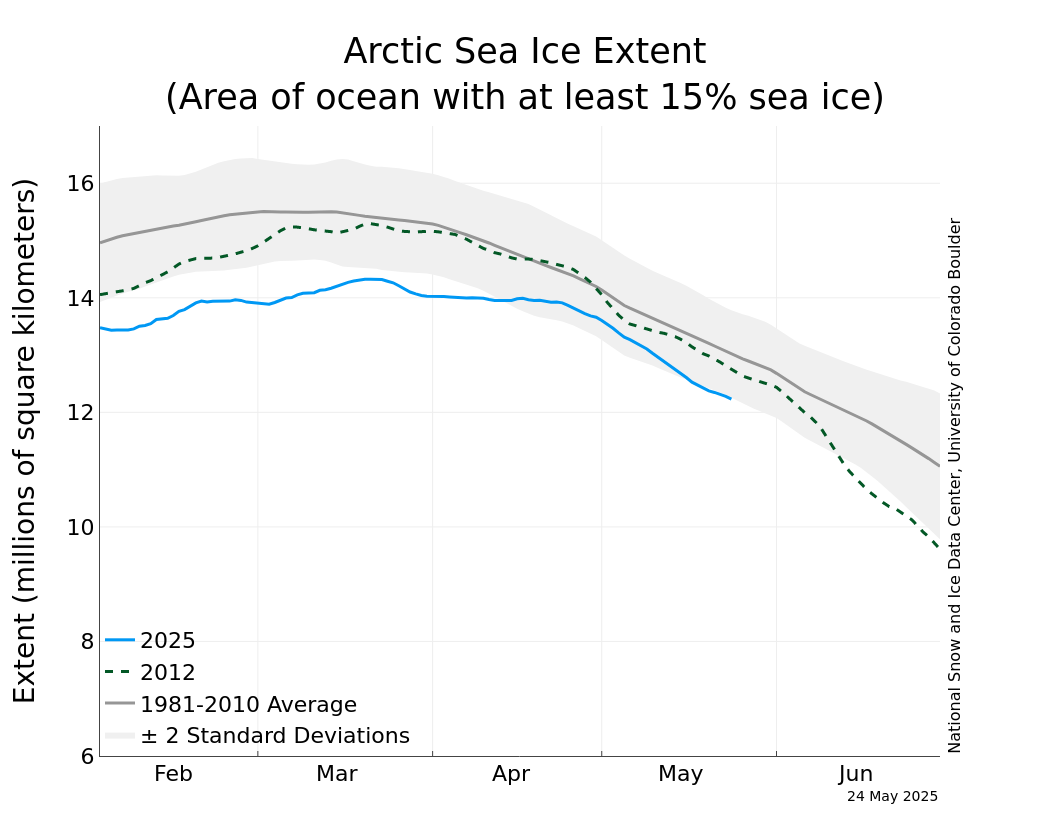
    The big climate news up north is the Arctic double stunner:  Sea ice extent (area) is now below 2007 levels, while the even more important metric of ice volume appears to have hit a record low for March.

    Data from both the Japan Aerospace Exploration Agency (JAXA) and National Snow and Ice Data Center (NSIDC) show Arctic sea ice extent shrinking below the level of 2007 at a rapid pace:

    JAXA

    Canada’s Globe and Mail headlines their story, “Arctic sea ice heading for new record low,”

    The latest satellite information shows ice coverage is equal to what it was in 2007, the lowest year on record, and is declining faster than it did that year.

    “Could we break another record this year? I think it’s quite possible,” said Mark Serreze of the National Snow and Ice Data Center in Boulder, Colo.

    “We are going to lose the summer sea-ice cover. We can’t go back.”

    … Dr. Serreze said winds, cloud cover or other weather conditions could slow the melt, but he points out that the decline is likely to speed up even more in June and July.

    And “one of Canada’s top sea-ice experts suggests things might even be worse than Dr. Serreze thinks” (see New study by Barber et al. supports finding that “the amount of [multi-year] sea ice in the northern hemisphere was the lowest on record in 2009″).

    His data could be underestimating the collapse of summer ice cover, said David Barber of the University of Manitoba. Researchers can’t learn anything from satellite data about the state or thickness of the ice.

    “What we think is thick multiyear ice late in the summer is in fact not,” he said. “It’s heavily decayed first-year ice. When that stuff starts to reform in the fall, we think it’s multiyear ice, but it’s not.”

    Arctic explorers and scientific expeditions are finding more open water and untrustworthy ice ever, Prof. Barber said.

    He pointed out the Arctic continued to lose multiyear ice even in 2008 and 2009, when total ice coverage rebounded somewhat.

    True multiyear ice – the thick, hard stuff that stops ships – now comprises about 18 per cent of the Arctic ice pack. In 1981, when Prof. Barber first went north, that figure was 90 per cent.

    “This is all just part of a trajectory moving toward a seasonally ice-free Arctic,” he said. “That’s happening more quickly than we thought it would happen.”

    The article notes:

    In April, the centre published data showing that sea ice had almost recovered to the 20-year average. That ignited a flurry of interest on climate change  skeptic blogs.

    But the most widely read of those blogs, WattsUpWithThat, seems oblivious to what’s happening, even though it keeps issuing regular “news” updates for its readers!  In Sunday’s, “WUWT Arctic Sea Ice News #6,” Watts posted a piece by Steve Goddard that opens:

    The Arctic is still running well below freezing, and as a result there just isn’t much happening….

    Huh.

    Yet just a month ago, Goddard saw fit to “inform” his readers that:

    Arctic ice extent is normal….

    The Arctic Oscillation remains negative, so circulation is clockwise – as seen below in the buoy drift map. This pattern is keeping older, thicker ice from the Canadian side inside the Arctic Basin, and bodes well for another summer of increased ice thickness and extent – relative to the record melt of 2007….

    People counting on bad news from the Arctic to keep their agenda alive are staring at a long, (rhetorically) cold summer……. The good news is that they can keep raising the red flags about Montana glaciers, if the Arctic refuses to melt.

    So it’s okay to disinform readers with the “news” about how sea ice thickness had supposedly rebounded, when in fact March 2009 had seen record low volume.

    But when the reality sets in — the supposed multi-year ice was in fact very thin and melted away rapidly — well, dear WUWT readers, it’s time to move on, there’s nothing to see here.

    Related Posts: