Author: Joe

  • The curious incident of Judith Curry with the fringe

    Get me rewrite.

    I had started writing my post to debunk the utter canard that the IPCC’s and media’s treatment of uncertainty have left the public with an overestimation of projected climate impacts on our current emissions path.  But then came her latest jaw dropper:

    The people slagging off on McIntyre, Watts et al. have probably spent no time over at their blogs or made an effort to get to know them personally and understand what makes them tick.   Or to talk to the scientific skeptics like Christy, Michaels.  Or talk to the libertarian think tanks, like CATO and CEI.  Well, i’ve made that effort, and therefore I think I know alot more about the what the “deniers” are really like than the people accusing me of naivete, who have drawn premature conclusions because somebody found some sort of obscure link to an oil company.

    That isn’t true of me or many commenters here or many science bloggers, who have wasted countless hours on those thoroughly debunked and discredited blogs.  Indeed, that’s why they are debunked and discredited.  And here’s CEI’s “obscure” link to oil.

    What is shocking is that she asserts she has spent a lot of time over at WattUp and yet still wrote the following in her unconstructive February essay, “On the Credibility of Climate Research, Part II:  Towards Rebuilding Trust”:

    And finally, the blogosphere can be a very powerful tool for increasing the credibility of climate research.  “Dueling blogs”  (e.g. climateprogress.org versus wattsupwiththat.com and realclimate.org versus climateaudit.org) can actually enhance public trust in the science as they see both sides of the arguments being discussed.

    Huh?  You may not agree with everything I write, but at least it is grounded in the actual scientific literature.  Watts posts whatever anti-scientific nonsense he can get his hands on, as just about everyone in the science blogosphere has shown (see Wattergate: Tamino debunks “just plain wrong” Anthony Watts).

    He is a hard-core disinformer (see FoxNews, WattsUpWithThat push falsehood-filled Daily Mail article on global cooling that utterly misquotes, misrepresents work of Mojib Latif and NSIDC).  He reprints utter bunk (see “here“).

    Not content to simply dispute the science with disinformation, he attacks climate scientists.  Watts said last year that NASA’s James Hansen is “no longer a scientist.”  Watts routinely smears all climate scientists, approvingly reprinting anti-science manifestos that claim global warming “is the biggest whopper ever sold to the public in the history of humankind” — see here.  He also smeared NSIDC director Mark Serreze.

    I rarely “duel” with Watts, since he’s not making a serious effort to understand and report on the science.  He is making a serious effort to spread disinformation and confusion.  I confess I gave up trying to understand what makes such a person “tick” — same for Christy, Michaels, and the disinformers at Cato and CEI.

    As Scott Mandia, Professor of Physical Sciences commented on CP:

    McI[ntyre] and Watts operate their blogs with the notion that climate scientists are liars and cheats at worst or misguided group-thinking incompetents at best.

    Dr. Curry is setting science back and hurting her reputation by including those two.

    In spite of spending time on his blog, Curry apparently believes WattsUpWithThat is somehow contributing to increasing the credibility of climate research.  In fact, Watts ain’t interested in science and balked at the biggest chance he had to do so (see Watts not to love: New study finds the poor weather stations tend to have a slight COOL bias, not a warm one).

    As for Curry, as recently as October 2007, she was going out of her way to debunk Bjorn Lomborg on the pages of the Washington Post, while endorsing “Making the transition to cleaner fuels,” in order to make a “big dent in carbon emissions” noting “the rationale for reducing emissions of carbon dioxide is to reduce the risk of the possibility of catastrophic outcomes.”

    These day Curry spends her time demonizing the much-exonerated Michael Mann, repeating the long-discredited attacks on the much-vindicated Hockey Stick, praising the well-debunked Wegman report (repeatedly asserting the falsehood that it is an NRC report), and actually criticizing a blogger for failing to include WUWT in his blogroll.

    So yes, I think I and everyone else has the right to be puzzled by what Judith Curry writes today (see “Beef with Curry” and “My response to Dr. Judith Curry’s unconstructive essay“).

    She has personalized the entire debate by insisting on dividing scientists and others into tribes — with me, according to her, apparently in a very different tribe than her.

    Some people are “warmists” (undefined), some are “lukewarmers” (undefined), some are “moderate warmers” (her, self-identified, essentially undefined), some are “deniers” (undefined), some are “affirmists” (undefined, except that, like “deniers” they “describe someone that isn’t open to changing their mind based on evidence” — which applies to not a single “warmist” scientist I know).

    When William Connolley asks of her, “I’m a bit confused by what JC’s actual views on climate change are. Not the politics or that, but the actual state of the science,” she replies:

    I find the main text of the WG1 Report to be an accurate assessment of the science.  The problem that I have with the WG1 Report is the summary narratives (executive summary, summary for policy makers) where all this is integrated and summarized.  My main issue with the WG1 report is that I think that many of confidence levels are too high: there is inadequate scientific uncertainty analysis, and lack of accounting for known unknowns and unknown unknowns.   I have substantial issues with the WG2 report and the impacts.

    So what does all this add up to?  A moderate warmist that sees very large uncertainty with regards to hypothesized catastrophic impacts

    Of course this “adds up to” undefined meaninglessness, since she doesn’t spell out what the “hypothesized catastrophic impacts” are or what emissions scenario she is talking about.  Like many people who don’t define their terms or spell out what they believe the science says happens under business-as-usual emissions, she conflates uncertainty in the climate’s sensitivity with uncertainty about how much we’re going to emit.

    You see, I’m also a moderate warmist that sees very large uncertainty with regards to hypothesized catastrophic impacts — if we act quickly to limit emissions and stay below 450 ppm.  But WG1 doesn’t really leave much doubt that if we, say, listened to the people like Anthony Watts — or other disinformers, like those at CATO and CEI who keep asserting the whole damn thing is a hoax (or might actually be good for us) — then we are headed to very high concentrations (and yes catastrophic impacts) with high probability [see U.S. media largely ignores latest warning from climate scientists: “Recent observations confirm … the worst-case IPCC scenario trajectories (or even worse) are being realised” — 1000 ppm].

    Doing nothing sharply reduces the uncertainty of hypothesized catastrophic impacts (see here).

    Curry says things like, she says, “If I say members of the climate consensus or establishment, that would almost leave out Romm and Hansen, since both go beyond the IPCC consensus in some ways.”  But wait — I thought people should be open to changing their mind on evidence.  And the overwhelming majority of studies published since the IPCC are more dire than the IPCC — sea level rise being the most obvious case.

    Indeed, in a AAAS presentation this year, William R. Freudenburg of UC Santa Barbara discussed his research on “the Asymmetry of Scientific Challenge”:

    New scientific findings are found to be more than twenty times as likely to indicate that global climate disruption is “worse than previously expected,” rather than “not as bad as previously expected”

    So by Curry’s logic, anyone who doesn’t believe that climate impacts on the business-as-usual emissions path will be worse than the IPCC projected is either an affirmist or a denier.

    And that is why failing to define one’s terms makes debate all but meaningless.

    I believe her views on hurricanes have evolved.  After much discussion with her trying to understand the hurricane issue while I was writing my book, she gave me this projection in late 2006:

    On our current warming trend, four super hurricanes — category 4 or stronger — a year in the North Atlantic is likely to become the norm 20 years from now.

    Now that is pretty friggin’ alarming, don’t you think?

    If her views have evolved based on newer science, that’s fine.  But then she can’t criticize others for evolving their views based on the science.

    She tells Kloor in a second interview:

    So should Joe Romm be puzzled by this?  Probably, but I think part of his puzzlement arises from assuming that I and all “warmist” climate researchers share his policy objectives.  People really find it hard to believe that I don’t have a policy agenda about climate change/energy (believe me, Roger Pielke Jr has tried very hard to smoke me out as a “stealth advocate”).  Yes, I want clean green energy, economic development and “world peace”.  I have no idea how much climate change should be weighted in these kinds of policy decisions.  I lack the knowledge, wisdom and hubris to think that anything I say or do should be of any consequence to climate/carbon/energy policy.

    That’s nonsense.  And she should know it.

    I spent a lot of time with her giving joint talks in Florida. She made clear again and again she was not an energy policy expert and didn’t want to talk about energy policy.  But, again, she never defines what “policy” is, so like many of her statements, this one is all but meaningless.

    When asked if our current understanding of climate sensitivity means “we should aim to keep CO2 well below 550 ppmv,” she writes in the comments of Kloor’s second post:

    No. There is the whole issue of what constitutes “dangerous” climate change. Which is a value laden issue.

    I for one do not have any confidence in setting a CO2 limit with two significant figures, given the uncertainties described in 1-3. This takes us into a policy arena, which is where I am drawing the line in this discussion.

    Can’t set a CO2 limit with two significant figures?  That isn’t “moderate warmist.”  That is “maximal agnostic.”

    Some people objected when I said she was in the McIntyre and WattsUpWithThat “tribe.”  But I was using the term tribe the way she seems to.  It does not mean people who share the same scientific and/or policy views.  After all, she lumps me in with Hansen — and while I have far too much respect for Hansen to ever claim to be in his “tribe,” it is widely known that I do not share his scientific and/or policy views.  She has also lumped me in with RealClimate, and again, I don’t share all of their views on the science — and they tend to avoid policy entirely.

    No, tribes are determined by whose faults you gloss over. That seems to be Curry’s point about the IPCC.  And THAT is why I wrote, “She has joined the WUWT and McIntyre tribe.

    That is why I titled this “The curious incident of Judith Curry with the fringe” (along with the fact that I’m a fan of the musical Oklahoma).  As the Sherlock Holmes story goes:

    “Is there any point to which you would wish to draw my attention?”

    “To the curious incident of the dog in the night-time.”

    “The dog did nothing in the night-time.”

    “That was the curious incident,” remarked Sherlock Holmes.

    If you read her Discover interview or her “On the Credibility of Climate Research, Part II:  Towards Rebuilding Trust” paper, what’s curious is that among her incessant attacks on Mann, Jones, IPCC scientists and the like she has nothing negative whatsoever to say about McIntyre and Watts.

    That’s the sense she’s in their tribe.  When the most people are listening, she just can’t find fault in them.  Now we know it’s because she spends so much time with them trying to understand what makes them tick.


  • Salazar approves Cape Wind, first U.S. offshore windfarm: “This will be the first of many projects up and down the Atlantic coast.”

    http://wiki.ggc.usg.edu/mediawiki/images/0/08/Cape-wind-power-farm-b1.jpg

    Secretary of the Interior Ken Salazar today approved the Cape Wind renewable energy project on federal submerged lands in Nantucket Sound, but will require the developer of the $1 billion wind farm to agree to additional binding measures to minimize the potential adverse impacts of construction and operation of the facility….

    A number of similar projects have been proposed for other northeast coastal states, positioning the region to tap 1 million megawatts of offshore Atlantic wind energy potential, which could create thousands of manufacturing, construction and operations jobs and displace older, inefficient fossil-fueled generating plants, helping significantly to combat climate change.

    At the press conference, Salazar said he expected this would be the “first of many projects up and down the Atlantic coast.”  He said America was leading  “a clean energy revolution that is reshaping our future” and that “Cape Wind is the opening of a new chapter in that future.”

    The announcement could not have been better timed.  Offshore wind taps the clean, safe energy of the 21st century that never runs out, in contrast to that other offshore energy resource, the not-so-clean, not-so-safe energy of the 19th century that can’t sustain the human race (see Spill Baby Spill and ‘Safe’ offshore oil rig explodes, 12 missing, seven critically hurt).

    The DOI news release is here, project fact sheet here.

    The project calls for 130 turbines of 3.6 megawatts, each with a maximum blade height of 440 feet, to be arranged in a grid pattern in 25 square miles of Nantucket Sound in Federal waters offshore Cape Cod, Martha’s Vineyard, and Nantucket Island. The projected maximum electric output would be 468 MW (average of 183 MW).

    Here is what the project would bring to the region.

    The Cape Wind project would be the first wind farm on the U.S. Outer Continental Shelf, generating enough power to meet 75 percent of the electricity demand for Cape Cod, Martha’s Vineyard and Nantucket Island combined. The project would create several hundred construction jobs and be one of the largest greenhouse gas reduction initiatives in the nation, cutting carbon dioxide emissions from conventional power plants by 700,000 tons annually. That is equivalent to removing 175,000 cars from the road for a year.

    The junior Senator from Massachusetts begs to differ:

    US Senator Scott Brown criticized Salazar’s decision, saying it was “misguided.”

    “With unemployment hovering near ten percent in Massachusetts, the Cape Wind project will jeopardize industries that are vital to the Cape’s economy, such as tourism and fishing, and will also impact aviation safety and the rights of the Native American tribes in the area. I am also skeptical about the cost-savings and job number predictions we have heard from proponents of the project,” Brown said in a statement.

    I guess he’d rather be drilling off the coast of Massachusetts.

    Related Post:

    < Back to front page Text size +

    Interior secretary approves Cape Wind, nation’s first offshore wind farm

    Posted by Beth Daley April 28, 2010 12:33 PM

    By Beth Daley and Martin Finucane

    In a groundbreaking decision that some say will usher in a new era of clean energy, U.S. Interior Secretary Ken Salazar said today he was approving the nation’s first offshore wind farm, the controversial Cape Wind project off of Cape Cod.

    salazar_nantucket.jpg

    Secretary Ken Salazar

    “This will be the first of many projects up and down the Atlantic coast,” Salazar said at a joint State House news conference with Governor Deval Patrick. The decision comes after nine years of battles over the proposal.”America needs offshore wind power and with this project, Massachusetts will lead the nation,” Patrick said.

    The decision had been delayed for almost a year because of two Wampanoag Indian tribes’ complaints that the 130 turbines, which would stand more than 400 feet above the ocean surface, would disturb spiritual sun greetings and possibly ancestral artifacts and burial grounds on the seabed, which was once exposed land before the sea level rose thousands of years ago.

    Salazar said he had ordered modifications to “minimize and mitigate” the impact of the project that would “help protect the historical, cultural, and environmental resources of Nantucket Sound.” He said his approval would require Cape Wind to conduct additional marine archaeological surveys and take other steps to reduce the project’s visual impact.

    “I am convinced there is a path we can take forward that both honors our responsibility to protect historical and cultural resources and at the same time meets the need to repower our economy with clean energy produced from wind power,” he said.

    He said the United States was leading “a clean energy revolution that is reshaping our future. … Cape Wind is the opening of a new chapter in that future and we are all a part of that history.”

    Supporters have long said an approval would be a giant step forward for renewable energy efforts in the country, while opponents have said they would seek to kill the project through legal action. The project, if it is not held up by lawsuits, could begin construction within the year.

    The project has undergone years of environmental review and political maneuvering, including opposition from the late Senator Edward M. Kennedy, whose home overlooks Nantucket Sound. While opponents’ main concern is esthetics — the turbines would be visible low on the horizon from the Cape and Islands — the battle was fought by raising other issues, including possible effects on property values and harm to birds, fishing, aviation, and historic and cultural sites.

    Horseshoe Shoals, the part of Nantucket Sound where the wind farm is proposed, is widely considered the best place along the East Coast to build a wind farm. That’s in part because the site is in shallow, sheltered waters close to shore — the nearest beach is five miles away. But it is also because it is in federal waters: Political will to build such a massive wind farm in state waters three miles from shore does not exist.

    Salazar said the project would create 1,000 construction jobs and produce energy equivalent to that of a medium-sized coal-fired power plant. He said it would reduce carbon emissions by the equivalent of 175,000 cars.

    Cape Wind Associates said the wind farm could produce enough wind power to handle three-quarters of the electric needs of the Cape and Islands. The price of its electricity is expected to be higher than conventional power. The company is still in negotiations with National Grid, the utility, that has agreed to purchase some of the power the farm produces.

    US Senator Scott Brown criticized Salazar’s decision, saying it was “misguided.”

    “With unemployment hovering near ten percent in Massachusetts, the Cape Wind project will jeopardize industries that are vital to the Cape’s economy, such as tourism and fishing, and will also impact aviation safety and the rights of the Native American tribes in the area. I am also skeptical about the cost-savings and job number predictions we have heard from proponents of the project,” Brown said in a statement.

  • I’m speaking at Harvard Friday on science blogging

    HarvardI welcome thoughts on some of the key points I should raise.

    The all-day workshop is titled, “Unruly Democracy: Science Blogs and the Public Sphere.”  It is jointly sponsored by the Program on Science, Technology and Society at the Harvard Kennedy School, the Shorenstein Center at the Harvard Kennedy School, and the Knight Science Journalism program at MIT.

    I’m on an afternoon panel.  There is still a little space available.  You can register here.  Click on poster to enlarge (big PDF).

    Full agenda and fellow panelists are below:

    Friday, April 30, 2010, 9:30am–4pm
    Bell Hall
    Belfer Building
    79 JFK Street
    Harvard Kennedy School

    PROGRAM

    9:30am
    Introduction/Framing
    Sheila Jasanoff (STS Program, Harvard Kennedy School)

    10:00am-11:00am
    Panel 1: BLOGGING AS BUSINESS
    Henry Donahue (CEO, Discover)
    Gideon Gil (Science Editor, Boston Globe)
    Representative of Seed Magazine [pending confirmation]

    11:15am-12:15pm
    Panel 2: SCIENCE ON THE WEB
    Francesca Grifo (Union of Concerned Scientists)
    Chris Mooney (MIT and Discover)
    Jessica Palmer (ScienceBlogs: Bioephemera)

    1:15pm-2:30pm
    Panel 3: RULES AND RESPONSIBILITY
    Amanda Gefter (New Scientist)
    Kimberley Isbell (Citizens Media Law Project)
    “Dr. Isis” (ScienceBlogs)
    Thomas Levenson (MIT)

    2:30pm-3:30pm
    Panel 4: NORMS AND LAW
    Sam Bayard (Citizen Media Law Project)
    Phil Hilts (Knight Program, MIT)
    Joseph Romm (Center for American Progress)
    Cristine Russell (Harvard Kennedy School)

    3:30pm-4:00pm
    Open Discussion and Wrap-Up

  • Poynt turns your BlackBerry into a social tool

    When we released our top BlackBerry apps list a few weeks ago, we named a number of applications that we haven’t gotten to featuring on the site. That’s going to happen with a list that prolific. One of those applications, Poynt, just got an upgrade, so it seems like as good a time as any to feature it. Poynt is an excellent tool for any BlackBerry user. It taps the power of location, using GPS or cell tower data to search local businesses, restaurants, and more. It takes this a few steps further, too.

    (more…)

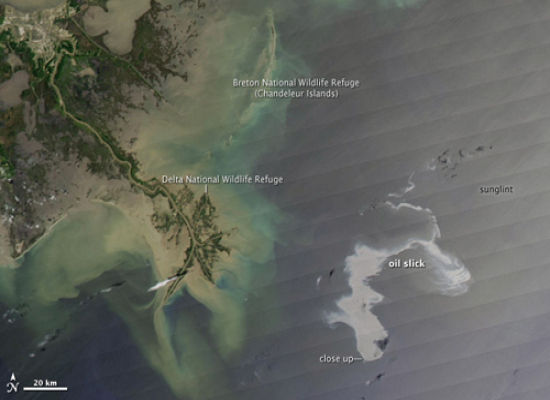
  • Spill Baby Spill

    That’s the banner headline from HuffPost.  Be sure to read their story on how “Big Oil Fought Off New Safety Rules Before Rig Explosion.”  They link to some amazing NASA photos of the “worst oil rig disaster in decades”:

    And here’s the close up:

    To paraphrase the movie Airplane, looks like Obama picked the wrong time to give up the offshore drilling moratorium.

    Related Posts:

  • CCS stunner: New study finds geologic sequestration “is not a practical means to provide any substantive reduction in CO2 emissions”

    Carbon capture and storage (CCS) has dug itself into quite a  deep hole.  Costs remain very, very high (see Harvard study: “Realistic” first-generation CCS costs a whopping $150 per ton of CO2 — 20 cents per kWh!).  And nobody wants the CO2 stored underground anywhere near them (see CCS shocker: “German carbon capture plan has ended with CO2 being pumped directly into the atmosphere”).

    Now comes a new study in the Journal of Petroleum Science and Engineering, “Sequestering carbon dioxide in a closed underground volume,” by Christene Ehlig-Economides, professor of energy engineering at Texas A&M, and Michael Economides, professor of chemical engineering at University of Houston.  Here are its blunt findings:

    Published reports on the potential for sequestration fail to address the necessity of storing CO2 in a closed system. Our calculations suggest that the volume of liquid or supercritical CO2 to be disposed cannot exceed more than about 1% of pore space. This will require from 5 to 20 times more underground reservoir volume than has been envisioned by many, and it renders geologic sequestration of CO2 a profoundly non-feasible option for the management of CO2 emissions.

    The study concludes:

    In applying this to a commercial power plant the findings suggest that for a small number of wells the areal extent of the reservoir would be enormous, the size of a small US state.  Conversely, for more moderate size reservoirs, still the size of Alaska’s Prudhoe Bay reservoir, and with moderate permeability there would be a need for hundreds of wells. Neither of these bodes well for geological CO2 sequestration and the findings of this work clearly suggest that it is not a practical means to provide any substantive reduction in CO2 emissions, although it has been repeatedly presented as such by others.

    Realistically, it has always been hard to see how CCS could be more than a small part of the solution to averting catastrophic climate change, as I discussed at length in my September 2008 post, Is coal with carbon capture and storage a core climate solution?

    We need to put in place 12 to 14 “stabilization wedges” by mid-century to avoid a multitude of catastrophic climate impact — see “How the world can (and will) stabilize at 350 to 450 ppm: The full global warming solution (updated)”   For CCS to be even one of those would require a flow of CO2 into the ground equal to the current flow of oil out of the ground. That would require, by itself, re-creating the equivalent of the planet’s entire oil delivery infrastructure, no mean feat.

    But any significant amount of leakage would render CCS pointless.  The UK Guardian’s article on the study quotes the coauthor:

    Previous modelling has hugely underestimated the space needed to store CO2 because it was based on the “totally erroneous” premise that the pressure feeding the carbon into the rock structures would be constant, argues Michael Economides, professor of chemical engineering at Houston, and his co-author Christene Ehlig-Economides, professor of energy engineering at Texas A&M University

    “It is like putting a bicycle pump up against a wall. It would be hard to inject CO2 into a closed system without eventually producing so much pressure that it fractured the rock and allowed the carbon to migrate to other zones and possibly escape to the surface,” Economides said.

    The paper concludes that CCS “is not a practical means to provide any substantive reduction in CO2 emissions, although it has been repeatedly presented as such by others.”

    The Guardian talked to “The Carbon Capture and Storage Association (CCSA), which lobbies on behalf of the sector”:

    Jeff Chapman, chief executive of the CCSA, believes Economides has made inappropriate assumptions about the science and geology. He believes the conclusions in the paper are wrong and says his views are backed up by rebuttals from the Lawrence Berkeley National Laboratory, the Pacific Northwest National laboratory and the American Petroleum Institute.

    The British Geological Survey confirmed it was looking at the Economides findings and was hoping to shortly produce a peer-reviewed analysis.

    Yet the concern laid out in the study is not a new one.  Indeed, my 2008 post quoted a BusinessWeek piece, “The Dirty Truth About Clean Coal”:

    The method is widely viewed as being decades away from commercial viability. Even then, the cost could be prohibitive: by a conservative estimate, several trillion dollars to switch to clean coal in the U.S. alone.Then there are the safety questions. One large, coal-fired plant generates the equivalent of 3 billion barrels of CO2 over a 60-year lifetime. That would require a space the size of a major oil field to contain. The pressure could cause leaks or earthquakes, says Curt M. White, who ran the U.S. Energy Dept.’s carbon sequestration group until 2005 and served as an adviser until earlier this year. “Red flags should be going up everywhere when you talk about this amount of liquid being put underground.”

    Precisely.

    Since CCS is probably at least two decades away from being practical and affordable for large-scale commercialization (assuming we have a high and rising CO2 price by then), we’ll have plenty of time to test different wells and geologies and find out just how many of those red flags we should be paying attention to.

    Fortunately, there are many, many other carbon-reducing and clean energy solutions available to us now:

  • RIM gives us a video look at OS 6.0

    If you have a free two minutes and want to get a quick look at OS 6.0, which will be released in the third quarter this year, you can check out this video.

    I really wish they had made a more straight forward video, without the bouncing screen shots and dancing people. And the crappy music, though that’s on a more subjective topic.

    This post originated at BBGeeks.com – home to all things Blackberry! Also a great source of info about AT&T BlackBerry.

    RIM gives us a video look at OS 6.0

    This post originated at BBGeeks.com – home to all things Blackberry! Also a great source of info about AT&T BlackBerry.

    RIM gives us a video look at OS 6.0


  • Exclusive video: Sir Richard Branson on the Carbon War Room, peak oil, and why dyslexia has made him a better communicator – “Fuel prices could easily go through $200 a barrel” in the near future

    Late last year, Sir Richard Branson founded a new nonprofit, the Carbon War Room.  The objective of CWR is to “bring together successful entrepreneurs in collaboration with the most respected institutions, scientists, national security experts, and business leaders to implement the change required to avoid catastrophic climate change.”

    The Virgin Group founder told Time in December, “There are some of us who believe that the problem of warming is as bad as the First and Second World Wars combined.  It’s that serious, and you know the key is carbon, [but] there’s no war room coordinating the attack on carbon.”

    I interviewed the British billionaire at the CWR’s “Creating Climate Wealth” conference last week.  He had some fascinating comments on peak oil, specific measures he is pursuing in his airline business to reduce emissions, and one unexpected ‘benefit’ of his dyslexia:


    For the record, he seems like a genuinely sincere guy.  And given the diminishing prospects for federal action — and hence diminishing prospects for global deal — we will need as many hard-core entrepreneurs working as hard as possible to get us off of our current emissions path and jumpstart the transition to a clean energy economy.

    For more on what they are doing in the shipping industry, see “The Carbon War Room starts to bust barriers in shipping,” which has my interview with Jigar Shah, the clean energy financing guru who now heads the CWR.

  • NYT: ‘Energy-only’ bill in Senate would be tough sell

    If Sen. Lindsey Graham (R-S.C.) bolts the Senate climate coalition, it must be time to turn to the “energy only” bill that centrist Democrats have been promoting as a bipartisan alternative to a climate bill, right?

    Not so fast…. It is almost as difficult to add up 60 votes in the Senate for the energy-only approach as it is to find 60 votes for a climate bill.

    The energy bill is not popular with either side,” said Robert Dillon, spokesman for Sen. Lisa Murkowski (R-Alaska), top Republican on the energy committee.

    That’s the NY Times (reprinting a Greenwire piece) on the “Bingaman bill,” which passed the Energy and Natural Resources Committee chaired Jeff Bingaman (D-NM) last year.  Graham’s active support for a comprehensive climate and clean energy jobs bill now in question, but based on my discussions with staffers and wonks, the notion that an energy-only bill is more politically tenable is quite dubious.

    The Bingraman bill “does have bipartisan support. But it also has bipartisan opposition, and that opposition has only gotten stronger in the intervening months”:

    Environmentalists and liberal senators from coastal states have never liked the offshore drilling provisions in the bill, which would allow rigs 45 miles off the Florida coast. And with oil gushing out of a well 50 miles off the Louisiana coast, the political momentum is on the side of opponents.

    “The Bingaman bill is waiting in the wings,” said Mike Gravitz, oceans advocate for Environment America. “But there are lots of negatives to it.”

    Republican opponents said it did not do enough to encourage states to allow offshore drilling because it did not cut states in on the royalties. And others complained that there was not enough encouragement for building new nuclear power plants.

    The political essence of the Bingaman bill is a deal to trade drilling off the coast of Florida for a “renewable energy standard,” or RES, ordering utilities to use more renewables. The deal is that environmentalists and industry both get something they want but not everything.

    It sounds workable in principle. The bill passed out of committee with four Republican votes.

    But six Republicans voted against it for reasons as varied as nuclear power and property rights.

    Indeed, the political climate today is one where conservatives  are willing to cut off their nose to spite their face as the saying goes –  they simply don’t want to give  the president and progressives political successes and the pastiche of bipartisanship to parade in front of the public before the election.

    Graham  himself is unlikely to support a narrower bill (see Stick a fork in the energy-only bill: Lindsey Graham (R-SC) slams push for a “half-assed energy bill”).

    But the prospect of a solid bloc of GOP opposition leaves little or no room for intra-party disagreements among Democratic senators.

    And two Democrats voted against the bill for diametrically opposite reasons. Sen. Robert Menendez of New Jersey voted “no” because he opposes drilling. But Sen. Mary Landrieu of Louisiana opposed it because it was not pro-drilling enough.

    Landrieu cast her “no” vote after the committee shot down proposals to give coastal states a cut of the royalties from oil and gas drilled off their shores. Called “revenue sharing,” the practice is supported by the oil and gas industry because it smooths the way for state approvals.

    Landrieu’s opposition reflects the position of pro-drilling coastal Democrats who say they need revenue sharing to get them to the table. Virginia’s two Democratic senators, Mark Warner and Jim Webb, and Sen. Mark Begich (D-Alaska) support drilling, but only with revenue sharing.

    But powerful interior Democratic centrists, like Bingaman and Sen. Byron Dorgan (D-N.D.), the leader of efforts to drill off Florida, vehemently oppose revenue sharing. They joined with Sen. Jay Rockefeller (D-W.Va.) in a letter last week blasting the concept.

    Bingaman and Dorgan might not vote against the bill if they are getting everything else they want in terms of drilling and an RES.

    It  bears pointing out that the Bingaman RES would not significantly expand renewable power beyond  what is the projected under business as usual.   Unless it is substantially expanded –  something the overwhelming majority of Republicans are sure to oppose –  is hardly a reason to vote for the bill.

    But the prospect of losing out on billions of dollars in the future could cost votes among other interior-state lawmakers who are not as invested in the process.

    But the opposition of senators like Menendez is only growing. Menendez and his New Jersey Democratic colleague flatly threatened to vote against a climate bill if it encouraged more offshore drilling. And that was before a spill off the Louisiana coast started gushing 42,000 gallons a day into the Gulf of Mexico, creating a 600-square-mile sheen of crude that threatens coastlines from Louisiana to Florida.

    “This latest incident should give the administration and our fellow Members of Congress pause in their effort to expand oil drilling along the East Coast. We plan to oppose any climate or energy legislation before the U.S. Senate that does not include significant safeguards for the Jersey Shore,” the New Jersey senators said in a statement, even before it was clear that oil was leaking into the gulf.

    Ten liberal senators declared their flat opposition to coastal drilling and the revenue sharing they believe would encourage it. And that did not include anti-offshore drilling Republicans Susan Collins and Olympia Snowe from Maine.

    Some liberals signaled they might be willing to accept more drilling in exchange for strong limits on greenhouse gas emissions. But without those limits, and with concerns growing about the gulf spill, they are less and less likely to agree to such a deal.

    Precisely.

    It will be hard to square this circle in the current political climate.  And, of course, and any Senate bill would have to go back through the House, which  might well be reluctant to take up another bill with controversial provisions.

    If the White House can’t get a comprehensive bill, I doubt  it will get a significant energy-only bill.  That leaves a  strategy similar to the one they are now using on jobs, where they put forward very tiny bills with a couple of hard-to-oppose provisions.  Hard to get terribly  excited about that in the face of looming Hell and High Water.

  • Antair Snippets can save you time, Memo Pad can save money

    I have a policy for evaluating BlackBerry applications — at least for personal use. If it’s free and appears remotely useful, I’ll give it a shot. All this costs me is the marginal amount of time it takes to download and use the app, and then the time to restart my BlackBerry if I decide to delete it. If, on the other hand, the app costs money, I had better be sure before I buy it if I’m going to need it or not. When I first saw Antair Snippets, I thought that it might be worth it. But then I saw the price tag and thought that Memo Pad might be able to perform a similar function for free. I thought I’d present the case for you in this space.

    (more…)

  • Chait and Klein: Lindsey Graham is Right – Senate staffer: Graham’s been “completely genuine” in bipartisan negotiations for climate and clean energy jobs bill

    If email, comments on CP, and some eco-bloggers are to be believed, conservative Sen. Lindsey Graham (R-SC) has been planning to walk on the climate bill for a long time — perhaps, nefariously, from the very beginning!  And I certainly understand where that sentiment is coming from, given that the GOP strategy on health care and financial reform has been to feign interest and then bolt.

    In fact, however, that view lacks plausibility, as The New Republic’s Jonathan Chait explained in his Sunday column, “Lindsey Graham Is Right.”  Indeed, the WashPost’s Ezra Klein argues today that Graham, “is not only right to be annoyed, but as far I can tell, is actually right.”

    I spoke to a Senate staffer today who is familiar with Graham’s multi-month efforts with Kerry and Lieberman and the White House to develop a bill.  He said Graham has been “completely genuine.”  Long-time readers of this blog know that Graham has made stronger statements than almost anybody on the Democratic side about this bill (reposted below).  He could easily have walked away months ago, say, when Scott Brown won the Massachusetts special election or when the Dems used the reconciliation process to pass health care.

    As Klein writes, “He’s taken a huge risk to be the lone Republican on climate change.”  Chait goes further, saying it “seems unfair” to accuse Graham of having “negotiated in bad faith,” pointing out:

    Graham has been painstakingly attempting to assemble a political and business coalition for legislation to mitigate climate change. He has also been working on immigration reform, but the Democrats’ weak signals of interest before last week have helped contribute to an atmosphere where nobody expected a bill to advance this year, and thus little headway has been made. There has been no House immigration bill, whereas the House has passed a climate bill already. Graham was set to unveil his bill on Monday when Harry Reid pulled the carpet out from under him by announcing that immigration would come first and climate — which gets harder to do as the elections gets closer — probably never.

    As for bad faith, Graham is a Republican Senator from South Carolina. His highest risk of losing his seat, by far, comes from the prospect of a conservative primary challenger. Indeed, I’d say that prospect is far from remote, and Graham is displaying an unusual willingness to risk his political future. He has little incentive to negotiate on these issues except that he believes it’s the right thing to do. So when Democrats put climate change on the backburner to take up immigration, and so so for obviously political reasons, Graham has every right to be angry. He’s risking his political life to address a vital issue, and Harry Reid is looking to save his seat.

    If you don’t think Graham can get a serious challenger from his right because of this, one need look no further than his good friend John McCain, who went from being his party’s standardbearer to just another insufficiently-hard-line-ideologue for the Tea Partiers in a matter of months.

    And consider Graham’s various statements on this subject.  Back in January, he said:

    But the idea of not pricing carbon, in my view, means you’re not serious about energy independence. The odd thing is you’ll never have energy independence until you clean up the air, and you’ll never clean up the air until you price carbon.

    And he also said:

    “Six months ago my biggest worry was that an emissions deal would make American business less competitive compared to China,” said Senator Lindsay Graham, a Republican from South Carolina who has been deeply involved in climate change issues in Congress. “Now my concern is that every day that we delay trying to find a price for carbon is a day that China uses to dominate the green economy.”

    He added: “China has made a long-term strategic decision and they are going gang-busters.”

    This just isn’t the language of somebody who is acting in bad faith, who has been planning to bolt for months.  Indeed, I expect we’ll be waiting a long, long time to hear such blunt language about pricing carbon from any significant number of moderate Democrats.

    Finally, the fundamental difference between the GOP bad-faith feints on healthcare and what Graham is doing on the climate bill is that, as we saw, the Democrats in the Senate could get 60 votes for a health care bill.  They never actually needed the Republicans.  It was only (misguided) Democratic desire for bipartisanship that led them to being suckered by Republicans into wasting several months trying to get a single GOP vote.  Dems wanted Reps, they didn’t need them.

    From the start, however, supporters of climate action needed multiple Republicans, as I pointed out many times.  But Olympia Snowe, the most obvious candidate, never was successfully engaged.  And Maria Cantwell helped enable Susan Collins to avoid negotiations on a bill that could plausibly pass the Senate.  Absent Graham, Dems had no plan B.

    In short, if Graham wasn’t doing this because he firmly believed in it, then none of his actions this year actually make any sense.  Now it is sometimes [often] the case that politicians repeatedly do things that make no sense.  But Graham certainly knew that the Democrats needed him infinitely more than he needed them.

    Based on most of what I’ve heard in the past 48 hours, I’m currently expecting that Kerry-Lieberman-Graham will shortly send their bill to EPA to be modeled and Reid will put their bill in play before immigration.  At that point, the story can move from being about Lindsey Graham’s alleged bad faith, to the actual bad faith of the anti-science ideologues who are the primary obstacle to passing a serious climate and clean energy jobs bill.

    If that doesn’t happen, I think it will be mostly due to the ongoing wishy-washiness of the White House — see Brad Johnson’s latest Wonk Room post:  White House: Immigration Is ‘Important’ And Energy Is ‘Critical,’ But Reid ‘Sets The Agenda’, which notes:

    When it comes to setting the national agenda and leading the Democratic Party, the buck stops at the President’s desk, not at Harry Reid’s. The real people who need real action on immigration and climate reform need the White House to assert leadership.

  • Beef with Curry – With some heated Stoat on the side

    I used to know Dr. Judith Curry pretty well — heck, she even gave me a jacket quote for Hell and High Water!  Now I obviously don’t.

    Everyone who follows climate science should read what is easily the most revealing interview I’ve ever seen a scientist give.  Be sure to read all the comments, since they are even more revealing.

    Curry 2.0 lumps Gavin Schmidt and Richard Lindzen together as basically two sides of the same coin — Not (see “Re-discredited climate denialists in denial“).  She calls the Wegman report — aka the “Independent” critique of Hockey Stick revealed as fatally flawed right-wing anti-science set up — a National Research Council report, which is a blatantly false statement she repeats a number of times.  In fact, Schmidt is to the real NRC report on the Hockey Stick what Lindzen is to the Wegman report (more on that in a later post).

    She labels my blog, RealClimate, and all others in blogger Keith Kloor’s blogroll “warmist sites.”  That actually is another untrue statement (he includes the anti-science website PlanetGore, for instance), but she’s annoyed he doesn’t link to the extremist anti-science site WattsUpWithThat!

    Curry 2.0 pigeonholes into the “warmist” tribe anybody who articulates the understanding of climate science that we have direct observations, basic physics, and the peer-reviewed literature.  But if she has a single disagreement with anyone in the anti-science tribe, she keeps it to herself.

    I interviewed Curry 1.0 a number of times and quoted her work on the hurricane-warming connection at length for my 2006 book, “Hell and High Water” (click on “Look Inside” for back jacket quote).  Later, I spent a day giving talks with her in various Florida cities.  She reviewed large parts of my book and heard my give a couple of talks and I’ve never once heard her dispute my characterization of the science.  A long time ago in a galaxy far, far away — well, 2007, anyway — she wrote a response to Bjorn Lomborg in the Washington Post that would appear to be at completely odds with her current warmist-skeptic spin.

    Since I’m a tad focused on dealing with the climate-bill blow up to do a point by point, I thought I’d reprint — with permission — the excellent dissection of Curry’s comments by former climate modeler William M. Connolley (aka Stoat) titled, simply, “Curry“:

    Eventually I decided to tone down the headline; Curry is wrong about a great many things, I think, but let’s be polite. So, all this is prompted by her Q+A for Keith Kloor. I fear I am going to have to read it. All of this segues into the “tribalist” stuff that I’m going to have to write sometime; but not now. Onwards.

    So, Curry said the Oxburgh investigation has little credibility in my opinion.… When KK tasks her on this, she backs off a bit: what she means is, it doesn’t cover the areas she is interested in. Well, tough. If she wants her own inquiry, with her own terms of reference, she should set one up. I don’t see any ack from her that we’ve had two inquiries so far that have found nothing worth the effort. The septics have nailed their colours to the mast over this – as far as they are concerned, inquiries finding nothing necessarily implies black helicopters. Hopefully Curry isn’t going to fall off that cliff, but she is teetering.

    Some of the stuff she says here shows evidence of failure to think. For example: Criticisms of the Oxburgh report that have been made include: bias of some of the members including the Chair – ah – she means that as an ex-Chair of Shell he is obviously pro-industry? Oh no, funnily enough that wasn’t what she meant (it is a shame that KK isn’t alert enough to push her on that one).

    The other whinge she has is shamelessly derived from the septics not examining the papers that are at the heart of the controversies. Well, that too is spiffy. Unfortunately the septics haven’t said what papers they would have liked to have included, and so Curry doesn’t know either. Hopefully they’ll let her know in a while and she can pass the ideas on [Update: I missed a bit: they did let her know, and she has added one of her own. See the updates].

    [JR:  For background on Oxburgh report, see “Climatic Research Unit scientists cleared (again).”]

    Corruptions to the IPCC process that I have seen discussed include. This seems to be the most deliberately provocative bit. What has she got to justify this? A repeat of the von S claim from 2005 that the IPCC folk writing the AR’s need to be independent of the work. I commented on Von S’s stuff a while ago… but that wasn’t the commentary I wanted. Oh well, I’ll repeat myself: I don’t think it is realistic to find a pile of independent experts to review this stuff. Anyone who knows it is involved.

    As for the rest: it is very thin, and noticeably free of actual examples. Again, I think KK should have pushed her on this. However, the septics won’t care, because they get to use “IPCC is currupt says Curry” in their headlines and they don’t care about the details. I care, because Curry is making vague brad-brush allegations and seems to feel no need to substantiate what she is saying.

    There is then some ranting about how the CRU inquiries didn’t cover Chapter 2.3 in the IPCC WG1 Third Assessment Report. Can Curry really have missed the NRC (and, less credibly, the Wegman) reports? Why does she want another one? The subtext here appears to be Curry-hates-Mann and wants people to keep having reports until one of them damm well convicts him of something, anything. She also doesn’t know what an “elephant in the room” is – the phrase means, something large and important that people aren’t prepared to talk about. And the MBH reconstruction is most certainly talked about.

    What else? Well, a senior leader at one of the big climate modeling institutions told me that climate modelers seem to be spending 80% of their time on the IPCC production runs, and 20% of their time developing better climate models. As it happens, a small stoat I met on the footpath told me the direct opposite, and I believe it. So we’re in stalemate. The only difference is I’m not spamming my scuttlebutt onto a blog. Oh, wait…

    And there is a huge rush of journal article submissions just before the IPCC deadlines. Bloody hell, really? Who would have guessed it, eh? It is also a fact that a large fraction of the scientific literature is derivative twaddle, of interest mostly to the people that need to push up their publication count. Everyone knows that too. But it keeps journals in business, and no-one can afford to step off the treadmill, so it keeps going. Never mind, people know to avoid the 80% that is dross, so (for those on the inside) it does no great harm, even if to those on the outside it looks bad. Just like the IPCC deadlines, really.

    some topics where I think the confidence levels in the IPCC are too high – this section is at least defensible. I think it is wrong, and I think it is again rather telling that she chooses to skip over the actual content too lightly, but fair enough: there is room for disagreement there. Were she actually to make a substantive arguement, there would be something to talk about. But she hasn’t, so there isn’t, yet.

    On speaking out JC: At the beginning, I… was very leery of getting misquoted by the media. WMC: “Ah, but now you have cast fear aside and show not the slightest regret for saying things that are very easy to misquote”. JC: “Gavin Schmidt and Richard Lindzen are saying, well, what you would expect them to say. I and a few others (e.g. Von Storch, Hulme) are trying to provoke reflection…” – ah, look at the casual careless lazy putting of people onto sides. GS is the opposite of RL. Meanwhile, thoughtful people like JC and von S are trying to think (mt picks up on this in the comments; it is an obvious point; again, I would have hoped that KK would have noticed).

    Summary: I congratulate KK for getting the interview done, and note his comment #21 (in his comments) that back-and-forth is difficult (but I still think he should have tried). The major feelingI have from all this is that Curry won’t go into detail, and it isn’t clear if she hasn’t really thought it through, or is lazy, or is too busy, or is afraid to commit herself, or what. If she actually cares about all this, and she says she does, then she really needs to write it down, carefully, with examples and documentation. Let me raise one obvious specific: she has attacked the Oxburgh report for looking at the wrong, or not enough, papers. Which important ones does she think were omitted?

    But… I hear you say, that was nothing but criticism. Shirley there was *something* good in what she wrote, or her fundamental premise? Who, after all, could disagree with calls for Integrity. Well, this as I said segues into the Tribalism stuff. And while we’re on Hidden Motives and other dark stuff, I do get the feeling that Curry is very Anti-Mann for reasons that she won’t articulate clearly. I think I’ll reserve any praise I might wish to offer Curry for later. At the moment I’m not that way inclined.

    Addendum: I’ve just noticed At the heart of this issue is how climate researchers deal with skeptics. I have served my time in the “trenches of the climate war” in the context of the debate on hurricanes and global warming over at Romm’s place. To take the last point first: has she? Where? [Update: Curry’s answer to this is comment 31] Also, I’ve just noticed http://curry.eas.gatech.edu/ climate/ towards_rebuilding_trust.html but not yet done more than skimmed it. I don’t think it answers my desire for more detail. On the first point: if that really *is* the heart of the issue… then why is she spending so much time on the periphery?

    [Updates: Curry doesn’t quite say “I don’t hate Mann” but she does assert (see comment #21, which may or may not be carefully phrased I’m not sure) that she has had little interaction with him.

    Also, (see comment 3) my snark about not proposing papers isn’t right: Curry *has* indeed parrotted the skeptics in proposing “Jones 1998 and Osborn and Briffa 2006”. I now need to see if these are interesting. That will first involve identifying the papers concerned; scholar proposes several Jones et al. 1998, but no Jones 1998, so I don’t know which one she means -W]

    [Update: guesses seem to be correct, see comment 24. Curry confirms via email that the papers she means are:

    1. Science 10 February 2006:
Vol. 311. no. 5762, pp. 841 - 844
DOI: 10.1126/science.1120514        Prev | Table of Contents | Next
    The Spatial Extent of 20th-Century Warmth in the Context of the Past 1200 Years
    Timothy J. Osborn* and Keith R. Briffa
    
    2. GEOPHYSICAL RESEARCH LETTERS, VOL. 30, NO. 15, 1820, doi:10.1029/2003GL017814, 2003
    Global surface temperatures over the past two millennia
    Michael E. Mann  and Philip D. Jones
    
    3. Jones, P. D., K. R. Briffa, T. P. Barnett, and S. F. B. Tett, High-resolution palaeclimatic records for the last millennium: Interpretation, integration and camparison with General Circulation Model control-run tempera- tures, The Holocene, 8, 455-471, 1998.

    I think #2 has been added now, and wasn’t one of the two listed earlier, but that is OK.

    -W]

    Since Curry doesn’t blog, and she hardly ever defines her terms, there really isn’t a lot more to go on to figure out what she believes.

    I will (try to) do another post on this later this week.

    Related Post:

  • Yes, there were over 100,000 at the Earth Day rally – Washington Post downplays this amazing show of support for climate and clean energy action

    Earth Day

    In its main environmental story today –  “On climate bill, Democrats work to overcome Graham’s immigration objections” — the WashPost said:

    In some ways, the problem that proponents of climate legislation face is that they’re pursuing a policy goal that is not much of a hot-button political issue. Environmental activists had a well-attended event Sunday on the Mall, with musical stars Sting and John Legend, but immigration reform advocates are likely to dwarf that turnout with dozens of rallies across the country Saturday.

    Yes, the biggest single climate rally in U.S. history is dismissed by comparison with the hypothetical cumulative turnout of dozens of future rallies on immigration.  Who says the media isn’t fair?  Apparently preserving the health and well-being of countless future generations isn’t “hot-button” enough for the media to be interested [kind of an ironic phrase, considering the rally was for action of global warming].

    The “problem” for the White House (and Senate Majority Leader Reid) is that if they push immigration first, they kill both bills — knowingly — and they break a long-standing (and oft-repeated) commitment to three major constituencies:  environmentalists, clean energy types (like me), and young voters.

    I am not an immigration analyst, so let me quote The New Republic’s Jonathan Chait from Friday, writing about the possibility that “Senate Democratic leaders have decided to try to put immigration reform first on the agenda”:

    This strikes me as a terrible idea. First of all, climate legislation is just plain more important than immigration reform. The latter is important, but the former is dire. Given that Republicans may well take control of the House in November, and could easily hold it for a long time, this year could literally be the last chance to pass climate legislation, however watered down.

    Now, I suppose I could be persuaded of the merits of this move if it seemed clear that the climate bill had little chance to pass and immigration stood a great chance to pass. But this does not seem to be the case….

    It’s true that immigration splits the GOP. But it also splits the Democrats, who have a lot of members representing heavily white, working-class areas. Increasing the political salience of immigration at a time when unemployment is over 9% does not seem like a good strategy to help them. Also keep in mind that the House has already passed a climate bill, but hasn’t passed an immigration bill.

    Indeed, Politico persuasively suggests that the cost of shelving climate for immigration is probably to kill both….

    If this is Reid’s decision, the White House needs to come down hard on him. It’s outrageous to sacrifice a chance to make progress on the biggest single policy challenge merely to increase the reelection chances of one Senator. This episode also shows, again, why it’s a bad idea to have your Senate leader hail from a state that leans toward the opposing party.

    There’s some good background on the timeline of events from Brad Johnson’s WR post, “Whisper Campaign Derails Climate Bill Rollout.”  I’ll have more to say about Graham’s role shortly.

    Finally, for those who want to read about the Earth Day event in the WashPost, you have to go to the Style section, “Earth Day’s moment in the sun,” which has some great pictures, like the one above.  I’ll post more on the event when I get the videos.

  • RIM announces BlackBerry Pearl 9100, Bold 9650

    It’s the morn of WES 2010, and as expected RIM has made a few announcements. First, we learned of the 3G Pearl that we’ve been anticipating for most of the year. This includes not only the 9100, but also the 9105, that 14-key model that I’ve ranted about during the past couple of weeks. RIM says they’ll be available in May on various carriers, so we have no hard date, nor do we have the exact pricing.

    Also as expected, RIM announced the BlackBerry Bold 9650, the update to the Tour, which was released last July. As with the Pearl 9100, we’ve known about the 9650 for quite a while. Expect a faster processor, Wi-Fi, and trackpad upgrades as compared to the Tour. As with the Pearl, the Bold will hit shelves in May, though there is no set release date. Last week we heard May 16 on Sprint.

    Finally, RIM has made Mobile Voice System 5 available for its BlackBerry Enterprise Server customers. This allows for Wi-Fi calling, among other features. You can learn more at blackberry.com/mvs.

    This post originated at BBGeeks.com – home to all things Blackberry! Also a great source of info about AT&T BlackBerry.

    RIM announces BlackBerry Pearl 9100, Bold 9650

    This post originated at BBGeeks.com – home to all things Blackberry! Also a great source of info about AT&T BlackBerry.

    RIM announces BlackBerry Pearl 9100, Bold 9650


  • Control what appears in your BlackBerry inbox

    Over the course of BBGeeks’ almost-three years, we’ve done plenty of quick tips. So many, I suppose, that I sometimes think we’ve covered something, but have not. That sometimes works out well. Today, for instance, I had planned a tip about removing phone information from your BlackBerry inbox. I thought we had done a tip on separating SMS from your inbox, but after a few searches I found that not to be the case. So it’s a two-for-one. How to remove SMS, and then how to remove call information from your BlackBerry inbox.

    (more…)

  • Global warming means local storming

    The Earth Day rally was incredible.  Well over 100,000 people were in the crowd, well over 10x what the Tea Partiers delivered on tax day, so you can figure out which event the media fawned over.

    I ended up spending a lot of time chatting with James Cameron, and I’ll do a separate post on what he’s like in person.   I also chatted with a few people in the know about inside-the-beltway climate politics who were relatively optimistic that the climate bill can be put back on track.  We’ll know more in a day or two.

    I’m hoping that the Earth Day folks put together individual video clips that I can post later.  I had been scheduled for three minutes and ended up with only getting a little over one minute, so I had to gut my carefully crafted talk.

    But there was one science-meets-rhetoric riff that I mostly kept, which I thought was a useful rhetorical device:  Global warming means local storming.  Here’s what I had written:

    Global warming means local storming.  Global warming makes storms like Katrina more fierce.  Record wild-fire-storms in the West, Record dust-storms in Australia, record snowstorms and rainstorms here on the East Coast.  Global warming set the table for those local superstorms.

    Before the comments and emails come in on how one can’t scientifically attribute any single hurricane to global warming (duh), I’ll just quote from Dr. Kevin Trenberth, head of the Climate Analysis Section at the National Center for Atmospheric Research, back in 2005:

    Sea temperatures have risen nearly 1 degree in the tropics over the last century, with most of the rise coming since 1970, and most of that increase can be attributed to the release of carbon dioxide into the atmosphere through the burning of coal and gasoline, he said.

    NCAR researchers have correlated the rise from human influences to a 3.5 percent increase in the amount of water vapor in the Earth’s atmosphere. That vapor and the heat it transports is sucked up by a storm as it intensifies.

    By Trenberth’s calculation, global warming has raised the heat available to a major storm by about 7 percent.

    “So, when a storm is over land, you are probably getting, on the relative order to the same storm in the 1970s, about 7 percent more water,” Trenberth said. “Maybe that is the straw that breaks the camel’s back. Maybe that is the extra water that causes the levee to break.”

    I am using the phrase “set the table” because that’s what Stu Ostro, Senior Meteorologist at the Weather Channel, used in making a comparable point about Georgia’s devastating September rainstorms.  Of course, Ostro pointed out there was no way to know if global warming had “caused” the record floods, but

    Nevertheless, there’s a straightforward connection in the way the changing climate “set the table” for what happened this September in Atlanta and elsewhere. It behooves us to understand not only theoretical expected increases in heavy precipitation (via relatively slow/linear changes in temperatures, evaporation, and atmospheric moisture) but also how changing circulation patterns are already squeezing out that moisture in extreme doses and affecting weather in other ways.

    It is the compounding of “typical” extreme weather events on top of human-caused climate change that creates the devastating, record-smashing “global-warming-type” events.  To re-excerpt the Must re-read statement from UK’s Royal Society and Met Office on the connection between global warming and extreme weather:

    We expect some of the most significant impacts of climate change to occur when natural variability is exacerbated by long-term global warming, so that even small changes in global temperatures can produce damaging local and regional effects. Year on year the evidence is growing that damaging climate and weather events — potentially intensified by global warming — are already happening and beginning to affect society and ecosystems. This includes:

    * In the UK, heavier daily rainfall leading to local flooding such as in the summer of 2007;
    * Increased risk of summer heat waves such as the summers of 2003 across the UK and Europe;
    * Around the world, increasing incidence of extreme weather events with unprecedented levels of damage to society and infrastructure. This year’s unusually destructive typhoon season in South East Asia, while not easy to attribute directly to climate change, illustrates the vulnerabilities to such events;
    * Sea level rises leading to dangerous exposure of populations in, for example, Bangladesh, the Maldives and other island states;
    * Persistent droughts, leading to pressures on water and food resources, and the increasing incidence of forest fires in regions where future projections indicate long term reductions in rainfall, such as South West Australia and the Mediterranean.

    These emerging signals are consistent with what we expect from our projections, giving us confidence in the science and models that underpin them. In the absence of action to mitigate climate change, we can expect much larger changes in the coming decades than have been seen so far.

    The UK’s Royal Society is the UK’s national academy of science, “the world’s oldest scientific academy in continuous existence,” founded in 1660.  The Met Office, the UK’s National Weather Service (i.e. meteorological office), is within the Ministry of Defence.

    The point of the phrase “global warming means local storming” is that one of the key ways people are going to experience climate change is through these blow-out, uber-extreme weather events:

    Global warming means local storming, which is precisely why the anti-science disinformers try to shout down any talk of a link between climate change and extreme weather.  Don’t let them.

  • Watch the Climate Rally now. I’m on at 4:50 EDT.

    The “largest climate rally ever” is taking place on DC mall right now.  You can watch the live stream of everyone from James Hansen to James Cameron, from Sting to me, right here:


    I’m supposed to be on around 4:50 pm for 3 minutes, though severe weather could obviously change that.

    If someone can find a full schedule, please post the link.  You can get more information by clicking on the Earth Day Network website.

    Sting I believe it will be on last, right before the 7 pm end.  Other speakers this afternoon include:

    Climate scientists like James Hansen, and Stephen Schneider.
    EPA chief (and heroine!) Lisa Jackson & CEQ Chair Nancy Sutley
    Cultural leaders like James Cameron (Avatar; Titanic) and Margaret Atwood (The Handmaid’s Tale; The Blind Assassin)
    Top business executives from Siemens, Phillips, UL, Future Friendly & SunEdison
    Top labor leaders, including the President of the AFL-CIO and Secretary of the SEIU.
    Progressive activists, including Jesse Jackson, Lydia Camarillo, & Hilary Shelton
    Climate policy gurus like Joe Romm, Phaedra Ellis-Lamkins, & Rafael Fantauzzi
    Spiritual leaders, including Rev. Theresa Thames, Rev. Richard Cizik, & Rabbi Warren Stone
    Athletes like Dhani Jones, Aaron Peirsol, & Billy Demong
    Environmentalists like Bobby Kennedy & Phillipe Cousteau

    In between the speakers we will hear from some of the most committed artists in the nation, including Sting, John Legend, The Roots, Willie Colon, Passion Pit, Bob Weir, Jimmy Cliff, Joss Stone, Booker T, The Honor Society, Mavis Staples….

  • Welcome to Climate Progress, Green Tea Partiers!

    Cover image of Joe Romm's book, Straight Up: America's Fiercest Climate Blogger Takes on the Status Quo Media, Politicians, and Clean Energy SolutionsTom Friedman has a new column, “Tea Party With a Difference.”  He refers to my “insightful new book” Straight Up.  If you want to buy that book, which has been called the “premiere book on climate change,” click here.

    If you want to know more about me or this website, start with “An Introduction to Climate Progress.”  You can get daily email updates on climate science, solutions, and politics by clicking here.  The Climate Progress post he quotes from is “Straight Up: What to look for in the bipartisan climate and clean energy jobs bill.”

    Friedman proposes a Green Tea Party of the “radical center” to supersede the current fringe Tea Party that is lurching to the “hard libertarian right”:

    Indeed, the Green Tea Party could say, “We’ve got our own health care plan — a plan to make America healthy by simultaneously promoting energy security, deficit security and environmental security.”

    “Think about it,” said Carl Pope, the chairman of the Sierra Club. “Green tea is full of antioxidants,” which some believe help reduce cancer and heart disease. “It’s really good for your health.” And a Green Tea Party, he added, could be good for the country’s health “by harnessing all of its energy and unconventional politics” to end our addiction to oil.

    Yes, I know, dream on. The Tea Party is heading to the hard libertarian right and would never support an energy bill that puts a fee on carbon.

    So if there is going to be a Green Tea Party, it will have to emerge from a different place — the radical center, a center committed to a radical departure from business as usual. Acting on that impulse, Senators John Kerry, Lindsey Graham and Joseph Lieberman are expected to unveil a bipartisan climate/energy/jobs bill on Monday that deserves an energetic centrist Green Tea Party to support it.

    This bill is far from perfect. It is a shame the fossil fuel industries still have such a stranglehold on Congress. But it’s the best we’re going to get, and we have got to get started. But without a centrist Green Tea Party Movement — one that brings the same passion to cutting emissions that the Tea Party brings to cutting deficits — even this effort will never pass.

    I think that we won’t get serious climate and clean energy jobs legislation until we have a movement of single-issue voters on the issue with the intensity of the current Tea Partoers, but much larger than that tiny, overhyped group.  [For more on that hype, the Politico had a must-read piece Thursday, “The tea party’s exaggerated importance.”]

    And yes, breaking news creates a real possibility that the bill won’t be introduced Monday, at least not with Graham.

    Friedman quotes me on the bill’s virtues, such as they are:

    This bill introduces a carbon price and other means to control the CO2 emissions of various sectors of the economy, without an economywide cap-and-trade system. The bill’s goal is to cut greenhouse gas emissions by 17 percent below 2005 levels by 2020. But to garner broad support, it will also expand domestic production of oil, natural gas and nuclear power and offer tax breaks to manufacturers who make their facilities more energy efficient and create green jobs.

    “No bill that could pass Congress right now or in the immediate future would be sufficient to produce enough clean power to mitigate climate change at the rate we need,” remarked the physicist Joe Romm, who writes the blog climateprogress.org and is author of an insightful new book on this subject, Straight Up. “We simply aren’t sufficiently desperate to do what is needed, which is nonstop deployment of a staggering amount of low-carbon energy, including energy efficiency, for the rest of the century.”

    The reason a Green Tea Party should coalesce to support this bill, argued Romm, is because it will set a price on carbon pollution and help foster commercialization of clean technologies — like hybrids, batteries and solar — at sufficient scale to enable the U.S. to rapidly ramp up when the seriousness of climate change becomes inescapably obvious to all.

    In short, the bill is a step in the right direction toward reducing greenhouse gases and expanding our base of clean power technologies so we can compete with China in this newest global industry. It ain’t perfect, but it ain’t beanbag. And if we don’t start now, every solar panel, electric car and wind turbine we’ll have to buy when climate change really hits will come with instructions in Chinese. Go Green Tea Party.

    You can’t win if you don’t play (see “The only way to win the clean energy race is to pass the clean energy bill“)

    Related Post:

  • Breaking: Sen. Graham threatens to halt work on climate and energy bill over immigration plans

    Sen. Lindsey O. Graham (R-S.C.) threatened to abandon his effort to push a climate and energy bill Saturday, saying he will only continue if Democratic leaders promise to relinquish plans to bring up immigration legislation first.

    Graham’s departure, if he follows through on his ultimatum, would likely doom any chance of passing a climate bill this year. He is the sole Republican working with Sens. John Kerry (D-Mass.) and Joseph I. Lieberman (I-Conn.) on a compromise proposal which they had planned to unveil Monday.

    This WashPost story is a big deal.  If the White House loses Graham that would certainly kill any chances of a climate bill this year.

    And yes, I’m now putting this on the White House — from the campaign through Copenhagen until now, comprehensive climate and clean energy jobs legislation was always said to be one of the president’s top three priorities, along with the economy and health care.

    Indeed, Obama made clear time and time again that comprehensive climate and energy legislation was key to sustainable economic growth and job creation:

    Obama at MIT: “From China to India, from Japan to Germany, nations everywhere are racing to develop new ways to producing and use energy. The nation that wins this competition will be the nation that leads the global economy. I am convinced of that. And I want America to be that nation…. There are going to be those who make cynical claims that contradict the overwhelming scientific evidence when it comes to climate change, claims whose only purpose is to defeat or delay the change that we know is necessary.”

    It takes five weeks for the EPA to do the analysis on the bill when it is turned over to them, which is just about the time it will probably take to get the financial services bill passed.

    There’s plenty of time to do immigration after energy and climate, especially since the conventional wisdom is that the immigration bill has a far, far less plausible chance of becoming law.

    Kerry and Lieberman will roll out their climate and energy plan Monday despite Graham’s decision to step aside, aides said.

    I think they should wait a day or two until this is sorted out before publicly going forward with their bill.  It makes little sense to announce this without Graham.

    In a letter to leaders of the effort to enact climate and energy legislation, Graham wrote, “I want to bring to your attention what appears to be a decision by the Obama Administration and Senate Democratic leadership to move immigration instead of energy. Unless their plan substantially changes this weekend, I will be unable to move forward on energy independence legislation at this time. I will not allow our hard work to be rolled out in a manner that has no chance of success.”

    He added, “Moving forward on immigration — in this hurried, panicked manner — is nothing more than a cynical political ploy.”

    Senate Majority Leader Harry Reid (D-Nev.) declined to assure Graham on Saturday that he would put immigration behind energy in the legislative lineup, saying he “will not allow” Graham “to play one issue off of another, and neither will the American people.”

    “As I have said, I am committed to trying to enact comprehensive clean energy legislation this session of Congress. Doing so will require strong bipartisan support and energy could be next if it’s ready,” Reid said in a statement. “I have also said we will try to pass comprehensive immigration reform. This too will require bipartisan support and significant committee work that has not yet begun.”

    The White House also declined to indicate whether it would address Graham’s concerns, issuing a statement by climate and energy czar Carol Browner saying, “We believe the only way to make progress on these priorities is to continue working as we have thus far in a bipartisan manner to build more support for both comprehensive energy independence and immigration reform legislation.”

    Browner praised the three senators for their work on a compromise, adding, “We’re determined to see it happen this year, and we encourage the senators to continue their important work on behalf of the country and not walk away from the progress that’s already been made.”

    Graham told reporters Thursday he was outraged at the idea that Reid had raised the idea of bringing up immigration before an energy bill, especially since he and Sen. Charles Schumer (D-N.Y.) had spent weeks working on a bipartisan immigration measure and had not been alerted to the change in plans.

    “Am I supposed to write every bill for the whole country?” Graham asked. “This comes out of left field.”

    Graham made a similar threat during the health-care debate, but he did not abandon the climate negotiating process. This new ultimatum poses a more serious danger to the bill’s sponsors, however, because there is less time left before the fall election.

    At least we will get to see people’s real priorities as this plays out.  Here’s the full letter:

    April 24, 2010

    Dear XXX,

    I want to bring to your attention what appears to be a decision by the Obama Administration and Senate Democratic leadership to move immigration instead of energy. Unless their plan substantially changes this weekend, I will be unable to move forward on energy independence legislation at this time. I will not allow our hard work to be rolled out in a manner that has no chance of success.

    Recent press reports indicating that immigration — not energy — is their priority have not been repudiated. This has destroyed my confidence that there will be a serious commitment and focus to move energy legislation this year. All of the key players, particularly the Senate leadership, have to want this debate as much as we do. This is clearly not the case.

    I am very disappointed with this turn of events and believe their decision flies in the face of commitments made weeks ago to Senators Kerry, Lieberman and me. I deeply regret that election year politics will impede, if not derail, our efforts to make our nation energy independent.

    I truly appreciate Senators Kerry, Lieberman, and their staff for the long hours of work. They have been tremendous partners who have negotiated in good faith and stood ready to make the tough choices necessary to bring forward a comprehensive energy bill.

    I continue to believe our nation’s reliance on ever-increasing amounts of foreign oil poses a direct threat to our national security and economic well-being. I know we can create thousands of jobs by pushing for a renaissance in nuclear power, expanded offshore drilling, and unleashing America’s innovative spirit. One only needs to look to China and Europe, where 21st Century clean energy jobs are currently being created while we fail to act.

    Like you, I share the belief that becoming energy independent and better stewards of our environment are complementary — not competing — standards. I was greatly looking forward to the opportunity to address these issues on the floor of the U.S. Senate as we pushed energy independence legislation forward into law. But it appears President Obama and the Senate Democratic leadership have other more partisan, political objectives in mind.

    Moving forward on immigration — in this hurried, panicked manner — is nothing more than a cynical political ploy. I know from my own personal experience the tremendous amounts of time, energy, and effort that must be devoted to this issue to make even limited progress.

    In 2007, we spent hundreds of hours over many months with President Bush’s Secretary of Homeland Security Michael Chertoff, Secretary of Commerce Carlos Gutierrez, and nearly every member of the U.S. Senate searching for a way to address our nation’s immigration problems. Unlike this current “effort,” it was a good-faith attempt to address a very difficult national issue.

    Some of the major provisions we embraced in 2007 — such as creation of a Virtual Fence using cameras, motion detectors and other technological devices to protect our borders — have been scrapped for the time. Other issues we found agreement on at the time, such as a temporary guest worker program, have unraveled over the past three years.

    Expecting these major issues to be addressed in three weeks — which appears to be their current plan based upon media reports — is ridiculous. It also demonstrates the raw political calculations at work here.

    Let’s be clear, a phony, political effort on immigration today accomplishes nothing but making it exponentially more difficult to address in a serious, comprehensive manner in the future.

    Again, I truly appreciate the tremendous amount of time you have committed to the effort to make our nation more energy independent. I look forward to continuing to work with you so that when the U.S. Senate finally decides to address this issue we will be prepared for battle and confident of a successful outcome in the effort to make our nation energy independent once and for all.

    Lindsey O. Graham
    United States Senator

    Related Post:

  • BBGeekcast: April 23, 2010 – Episode 113

    We’ve got a bit of hardware news and a bit of software news this week, and they’re both going to be controversial. What else is new? It seems that everything RIM does is under the microscope these days, because of the competition from Apple and Google. Still, I think it’s pretty good news.

    So click on over here to hear the BBGeekcast (10 min, 17 sec)

    And don’t forget to subscribe to the podcast so you won’t miss future episodes!

    You can also subscribe to the BBGeekcast in iTunes.

    Highlights include:
    (more…)