Author: John H

  • Teaching Earth Science with Children’s Literature: Our Patchwork Planet


    our patchwork planet


    “No one knows for sure what the future will hold, but we do know that tectonic plates will continue to influence us, along with every other creature.”

    Our Patchwork Planet, by Helen Roney Sattler, is an oversize book that reads as a 5th grade text-book  on tectonic plates and the Earth’s layers. The first few chapters feature many different world maps that illustrate the plates and their movement,  as well as diagrams of the Earth’s layers. The authors follow these with chapters on continent formation, earthquakes and volcanoes, and ends with a look into the future of Earth’s formation.

    Curriculum Connections

    The book would be a good resource for covering concepts and vocabulary dealing with tectonic plates, earthquakes and volcanoes, and the basic structure of the earth’s interior (5.7c,d).  The vocabulary the students need to know (lithosphere, slip fault) is presented in the text and visually, while the non-buzzword word choice is not too challenging, making the book something a teacher could read aloud to 4th graders.

    Additional Resources

    •  This BBC video on YouTube is called How Volcanoes Form but is actually a great 4 1/2 minute video on tectonic plates as well
    • This National Geographic video on YouTube, Earthquake Destruction, begins with some harrowing footage of earthquakes.  From there it explains earthquakes and their connection to tectonic plates.
    • Brainpop has a page on Plate Tectonics that is funny and informative.  You do need an account to view it however.

    Book Details
    Book: Our Patchwork Planet
    Author: Helen Roney Sattler
    Illustration: Giulio Maestro
    Publication: National Geographic
    Pages: 48
    Grade Range: 4-6
    ISBN: 978-0688093129
  • Teaching Life Science with Children’s Literature: The Bug Scientists

    bug scientists

     Summary

    The Bug Scientists, written by Donna M. Jackson, takes a different approach by teaching students about insects but also about the men and women who study them in different ways. The book introduces us to insects and their attributes (body parts, survival methods), as well as a few different ways humans study bugs or use them in their study of other things.  For instance, we meet a forensic entomologist who uses maggots to solve murders.  Your 3rd – 6th graders will love some of the “gross” pictures and details, as well as the section on “amazing insects” at the end.

    Curriculum Connections

    The Bug Scientists is a great way to teach children about insects in a way that acknowledges their initial reactions but tells a compelling story that bugs are wonderful and interesting creatures . The photos are big enough for classes to see during oral reading, and detailed enough for students to study on their own. This book is for grades 3-6, and it can be a good resource for learning about living systems, the insect class, and the invertebrate phylum.

    Additional Resources

    Students can learn more about classifying insects at www.insects.org, a bug bio site.

    The students can learn more about the growth of butterflies here, which gives directions for insect science project experiment to determine how temperature affects the growth of butterflies.

    This site has some good Q&A you can use with students when teaching about insects

    General Information

    Book: Bug Scientists
    Author:
    Donna M. Jackson
    Publisher:
    Sandpiper
    Publication Date: 2004
    Pages: 48 pages
    Grade Range: 3-6
    ISBN-10:
    0618432329

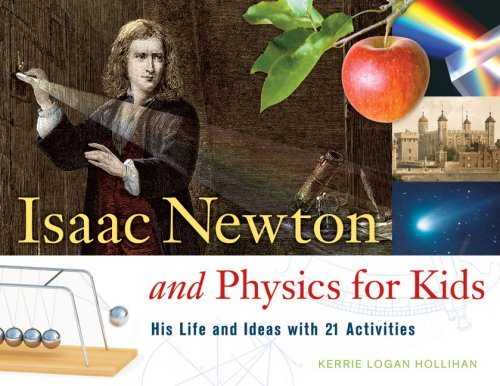
  • Teaching Physical Science with Children’s Literature: Isaac Newton and Physics for Kids – His Life and Ideas with 21 Activities

    isaac newtown


    Summary


    Kerrie Logan Hollihan has written a great book called Isaac Newton and Physics for Kids that introduces students to the brilliant life and works of the famous mind of Isaac Newton.  Many people know of Newton through the anecdote about the apple, or from his laws of motion, but as this book shows there was so much more to the man.  Starting with his parents, Hollihan lets us meet the real Isaac Newton, with all his flaws, and goes in depth about his discoveries in physics, astronomy, optics, and mathematics.  Best of all, this book matches the information with 21 activities that students can perform, all of which Newton did himself.

    Curriculum Connections

    While the book’s notes recommend it for ages 9-12, after reading it I would say that 11-14 is more appropriate. It would be a perfect tie in for investigating and understanding scientific principles and technological applications of work, force, and motion (PS.10).  It is also a great biographical text for students to understand one of the greatest thinkers in history.

    Additional Resources

     Science Discovery has this great kids application for understanding  Newtons 3 laws of motion.

     There are some physics activities you can do indoors with students on this family fun website.

    My Physics Lab has some good animations of physical properties at work.

    General Information

    Book: Isaac Newton and Physics for Kids: His Life and Ideas with 21 Activities
    Author: Kerrie Logan Hollihan
    Illustrator: Laura D’Argo
    Publisher: Chicago Review Press
    Publication Date: 2009
    Pages: 131
    Grade Range: 5-9
    ISBN: 978-1556527784

  • Teaching Process Skills with Children’s Literature: Hidden Worlds

    Hidden Worlds


    Introduction and Summary

    • Hidden Worlds: Looking Through a Scientist’s Microscope ,written by Stephen Kramer with photographs by Dennis Kunkel, is not only a book about the wonders of the microscopic world, but about the life of a scientist as well.  The book has stunning photographs of microscopic views of all sorts of things, and with them are accounts of how Dennis uses microscopes to get a closer look at the world around him.  It also tells a story of how he became a scientist, and gives information on how students can follow in his path

    Curriculum Connections

    • This book is a perfect way to teach kids about living systems, matter, and cell structures.  The photography gives views of things that would be hard to come by in the classroom.  There is quite a lot of text, so I would suggest the book for selected out-loud readings or for individual students to read on their own.

    Additional Resources

    The Virtual Cell Tour is a quick and interesting tool for more advanced study of cell structure.

    Students can use The Virtual Electron Microscope to look at more microscopic images, and quiz themselves for fun on what they are looking at

    There is also a flash quiz game called Microscope Mania for students to test their knowledge of the microscope.

    General Information

    Book: 
    Hidden Worlds: Looking Through a Scientist’s Microscope

    Author: Stephen Kramer

    Photographer: Dennis Kunkel

    Publisher: Sandpiper

    Publication Date: 2003

    Pages: 57

    Grade Range- 3-6

    ISBN: 978-0618354054

  • Teaching Economics with Children’s Literature: Henry Hikes to Fitchburg

    Henry Hikes Cover

    Introduction and Summary
    Henry Hikes to Fitchburg
    written by D.B. Johnson, is a short story about two friends trying to get to Fitchburg.  Henry (modeled after Henry David Thoreau) decides to walk while his friend works odd jobs to earn money for a train ticket.  The two have very different days based on that decision, but nonetheless they meet in Fitchburg by the end of the story.

    Curriculum Connections
    This book can teach children about how people can work to earn money in order to purchase goods and services.  The theme of the story is that it is often worth slowing down and enjoying nature, and that money cannot buy everything.  Still, the half of the story that focuses on Henry’s friend earning money is a good way to connect to learning about earning and saving money (VA SOL 1.9).

    Additional Sources:

    Book: Henry Hikes to Fitchburg
    Author:  D.B. Johnson
    Publisher: Houghton Mifflin Books for Children
    Publication Date: 2000
    Pages: 32 pages
    Grade Range: Recommended K-2
    ISBN: 978-0395968673

  • Teaching History with Children’s Literature: Roman Town

    Roman Town

    “This book is about a Roman town.  It is not an actual town, instead it is composed of the many elements typical of Roman towns throughout the empire at the beginning of the 1st century AD.  Look around the town, and find out what it was like to be a tourist in Roman times.”

    Roman Town is a detailed and informative book written by Hazel Mary Martell.  It takes the reader through a tour of a Roman town, to places such as the ampitheater, the slums, the temple, and the baths to name a few.  In each place, the author makes comparisons and contrasts to modern life that can be found.  All this detail is matched with rich, elaborate illustrations that give a the reader an idea of what a typical Roman town would have looked like.

    Curriculum Connections

    I would recommend this book for grades 3-6.  There is a lot of detail and information within, so it is a book which the teacher can read to the students, or more advanced readers can read on their own.

    This book can be used to address VA History SOL 3.1 – The student will explain how the contributions of ancient Greece and Rome have influenced the present world in terms of architecture, government (direct and representative democracy), and sports.

    Additional Resources

    Brainpop.com has a great video about The Fall of the Roman Empire.

    This site has some great info about The Roman Colosseum.

    PBS has a good site called The Roman Empire: In the First Century, which has a lot of information that would supplement this book quite nicely.

    General Information

    • Book: Roman Town
    • Author:  Hazel Mary Martell
    • Illustrator: Mark Bergin
    • Publisher: Franklin Watts
    • Publication Date:  1998
    • Pages: 48
    • Grade Range: 3-6
    • ISBN: 0531153452
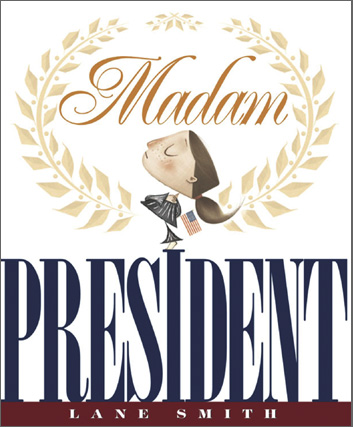
  • Teaching Civics with Children’s Literature: Madam President

      Madam President Cover


    “A President has to lead by example, even if it means cleaning her own room.”

    Madam President is a fun and clever book written by Lane Smith.  It follows a girl as she explains some of the duties of the president, but through the wonderfully modern illustrations the girl takes us through what those duties mean to a young lady at school and at home.  She vetoes tuna casserole in the lunchroom, and her goldfish is Secretary of Underwater Exploration.  Get your singing voice ready, as she also takes the school band through her own version of “Hail to the Chief”.  Don’t forget to turn all the pages, or you’ll miss the Secret Service cat’s last word.

    Curriculum Connections

    I would recommend this book for grades 1-4.  It is fun and not only teaches children about what a President’s job is, but it also subtly lets kids know that a girl can grow up to be anything she wants, including President of the United States.

    This book is perfect for addressing the roles and powers of the executive branch of government, Virginia Civics and Government SOL CE.7b: The student will demonstrate knowledge of how public policy is made at the local, state, and national levels of government by describing the roles and powers of the executive branch.

    Additional Resources

    Here is a great game that kids can play on their own or in groups of two or three called If You Were President.  I would recommend this game for grades 3 and up.  Balancing the budget on the third slide is a little tricky, and it asks you to explain why different aspects (Military, Health Care, Education, etc) are important to you, and it ends by creating a newspaper article about President (your name here).

    For the lower grades, here is a page of President Coloring Pictures.  They suggest it for President’s Day, but I say you can use it whenever you like.

    And here are slide shows of Presidents and Presidential Pets.

    General Information

    • Book: Madam President
    • Author:  Lane Smith
    • Illustrator: Lane Smith
    • Publisher: Hyperion Books for Children
    • Publication Date:  2008
    • Pages: 40
    • Grade Range:  1-4
    • ISBN: 1423108469