Author: John Wilson

  • blog post:Dad, the AV guy

    I, like a lot of fathers I suspect, am the AV person at home.  It is my responsibility that all still images and video are properly archived, and retrievable for quick historical reference.  This is a heavy responsibility that I doubt my father had while I was growing up.  I remember watching projected slides of our family outings so there was some burden to bear for my father I’m sure (dad, in case you’re reading this) .  The game has changed since I was a kid, accumulating content is a lot easier than it used to be.

    Right after our first child was born we invested in our first video camera.   I chose a refurbished mini dv camera that was a consumer reports best buy.  A reasonable choice at the time but not anything I would recommend to new dads.  One of the biggest challenges I have is transferring this video to the computer.  First,  if you have 60 minutes of video it will take you 60 minutes to transfer it.  This is okay, I guess, but every time I start to transfer video the computer loses connection with the camera.  Maybe it’s because I bought a refurbished camera.  Maybe it’s because I bought a cheap cable.  I’m hoping it is the cable.  I am resisting paying someone to transfer the videos but if I had the money it would be well spent transferring the headache to someone else.  This is something I have to sort out soon because I have about 30 tapes at home that have not been properly archived. To mitigate this issue I recently purchased a portable HD video camera for the primary reasons of:

    • Sharing video clips with family scattered around the country
    • Capturing short clips
    • Ease of transfer to my computer
    • Dissect my golf swing  (60 frames per second)

    I was pretty happy with the purchase but soon starting questioning my need to record in HD.  This happened right after I saw that a 3 minute video was 500+MB.  I don’t know if I remember exactly what the size was but it was certainly HUGE!  At this rate my 1TB external drive would fill up in no time.  I quickly fell in love with 640×480.  It is a hard sell at home though.   It is hard to convince everyone in the family that even though you can record in 1080, we probably don’t need to.  First,  unless the lighting is spectacular the video quality won’t be that good.  Second,  in our house we have no way of displaying the majesty of HD unless we leave it on the camera.  I currently have no method of delivering archived HD content to our HD TV unless it is piped there from the device that generated it.  This is why when we buy our next laptop it will have HDMI out!

    I do think it’s great that we can collect all of these memories in videos and images but is it better than what my parents had when I was a kid?  Will my kids look back as fondly as I do when I think about how we would load up the carousel, gather the family, turnoff the lights, and watch the slide show?

  • blog post:Vision at 40+

    I got my eyes checked on Friday and I walked out of there over $400 lighter in the wallet, and I’m covered under two vision insurance policies.  What did I get?

    1. An eye exam for contact lenses
    2. Some sample cleaner solution
    3. A commitment for them to buy 6 months worth of contacts once we determine the pair they prescribed are fitted correctly.
    4. $350 worth of contact “fitting”.

    That last one is a difficult one for me to rationalize.  Last year my contact fitting fee was about $100.  Because I am over 40, and my eyes don’t focus as well, I am trying these so-called multifocal lenses.  My eye doctor described them like looking through a screen door…If you look through the screen door and focus on what is on the other side you won’t notice the door.  So if  I focus far or close these lenses will support that endeavor, though I suppose not as well as someone under 40 can see.  The doctor offered up the option of the single focal contact with a pair of reading glasses but my vanity didn’t allow proper consideration of that option.

    One thing that really bothers me is that  they dilated my eyes as part of the scam, I mean exam.  When it came time to put up money I was a little off my game because everything within a couple of feet of me was blurry.  I couldn’t read the contract I signed, especially the bold print at the bottom stating “No refunds on fitting costs”.  I think I should have asked for my prescriptions and told them I’d be back when I could focus.

    I called the Dr.’s office on Saturday to ask about another charge and told the person on the phone that this fitting fee was a difficult pill to swallow.  She giggled and told me that at least I wouldn’t have to pay it next year.  Really?!?!?!? They told me the same thing last year.  I plan on getting the single focus contact my next visit, at which point I think they wouldn’t need to charge me such a huge fee for fitting since I have already been fitted for single vision the last two years.  We’ll see if they agree.

    I have tried to understand why the fee would be so insane.  I have tried to do some mental math on how many people work there and their time, the other costs of their operations, and the fact that they are in the business to make money.  In the end I’m not able to feel that “wheels of commerce”  gratification.

    In my world of Thermal/Airflow Design Consulting Services it would be like me binding my customer to a contract which charges them for work that may not be necessary, before they can receive other bids, while they are blindfolded.  It may not be exactly like that, but it sure feels that way.

  • blog post:Quantitavely Seeding the Flow

    I think that we can all agree that one feature of CFD over test is the ability to visualize where the flow is going.  It is quite easy in CFD analysis tools, at least in our tools, to seed the flow any where within the solution and follow particles upstream and/or downstream.  The limitation of this is that it is the results are qualitative.  CFD has the capability, without an extreme amount of extra effort, to quantify where the flow goes.

    As an example I have constructed a partial model of a somewhat reasonable depiction of a 1U server in FloEFD.  Each fan is fixed at 15 cfm where 2% (arbitrarily chosen) of the fluid that it delivers it tagged with a fluid marker.  For instance,  the fluid that Fan 3 supplies is 98% air and 2% “Air-Fan 3?.  “Air-Fan 3? has the same fluid properties as air, not arbitrarily chosen.  There is also geometry that represents the power supply, which also delivers 15 cfm.  The heat sinks are a porous media of reasonable flow impedance.  The optional “perf” will be considered in another post to see if I can use it to create a more robust design in the event of a fan failure.

    fan_location

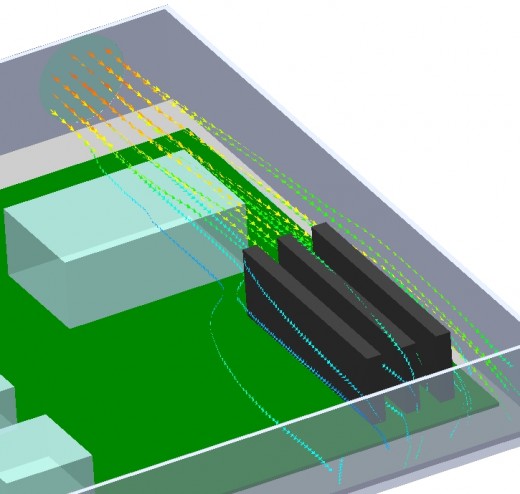
    layoutThe image below shows a qualitative depiction of the area of influence from Fan 1.  Nice, but we can get more information from the marking of the flow.
    flow_trajectories

    Below is a cross section through the center of the fans that quantifies the area of influence from Fan 1 and Fan 3.  I have clipped out the area of less than 10% influence.

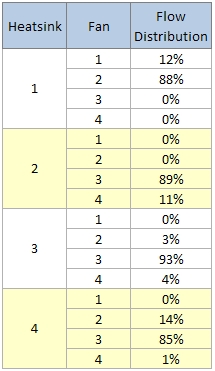
    air-fan-1air-fan-3To drive home the quantification I have tabulated how much air each heat sink is receiving from each fan.
    table_no_perf

    You can see that most of the flow that the heat sinks receive comes from Fan 2 and Fan 3.  Ideally my heat sinks wouldn’t be so reliant on flow from a particular fan.  My plan is to see if I can help the situation by adding a perforated plate between the fans and the downstream heat sinks.  Or maybe I will look at what happens when Fan 3 fails.  I do think that having this type of output would be useful in maximizing the airflow management of the design.

    There is a similar, but more evolved, approach available in FloVENT via the “capture index” which is very useful in Data Center design.  Google it and check it out.  Also, I’d love to here any thoughts about the usefulness of this approach.