Author: Jordan Bates

  • Peter Gleick: Bottled and Sold — What’s Really in our Bottled Water

    My new book on bottled water is out, at last. “Bottled and Sold: The Story Behind Our Obsession with Bottled Water” (Island Press, Washington) has apparently (according to reports from my secret field agents) started appearing in book stores. You’ve been able to order it online for a while through Island Press, Amazon, Barnes and Nobles, and other places.

    There are some great stories in the book: here is a little one, about what’s sometimes found in our bottled water.

    ABOUT THE AUTHOR:
    Peter Gleick
    Dr. Peter Gleick is president of the Pacific Institute, an internationally recognized water expert and a MacArthur Fellow.

    You don’t find what you don’t look for. This maxim holds true for arms control, as Ronald Reagan noted. And it holds true for contaminants in bottled water. One would think and expect that bottled water would be cleaner than our tap water. But is it?

    The system for testing and monitoring the quality of bottled water is so flawed that we simply have no comprehensive assessment of actual bottled water quality. Don’t misunderstand me. The inadequacies of U.S. rules for testing bottled water do not mean that bottled-water quality is poor. If bottled water was monitored as consistently, frequently, and accurately as tap water, the evidence might show that it was just as good, or even better on average, than tap water. Given how much consumers pay for it, we certainly have the right to expect it to be better.

    But we’re just not looking carefully enough. And the bad news is that when we do actually look, we find evidence that there are potentially serious quality problems with bottled water, lurking just under the cap. Even worse, outside of the U.S. (where sometimes bottled water really needs to be better than tap water) there is growing evidence that bottled water quality can be terrible.

    Most of our tap water is completely safe; most of our bottled water is probably completely safe. But to know for sure, we must look carefully. And when we do actually look, we sometimes find more than we bargained for. The most famous example is when Perrier was discovered in 1991 to be contaminated with benzene. But this example is not the only one.

    Water Number: More than 100. After months of requests and two Freedom of Information Act requests to the US Food and Drug Administration (which regulates some bottled waters), I got a list of recalls of bottled waters in the U.S. Combined with other research, I ultimately compiled a list of more than 100 bottled water recalls, affecting millions of bottles of water.

    This list (which I will soon post online) includes a remarkable list of contaminants. In addition to the benzene found in Perrier, bottled water has been found to contain mold, sodium hydroxide, kerosene, styrene, algae, yeast, tetrahydrofuran, sand, fecal coliforms and other forms of bacteria, elevated chlorine, “filth,” glass particles, sanitizer, and in my very favorite example, crickets.

    Yes, crickets. In 1994, a bottler in Nacogdoches, Texas issued a recall for sparkling water found to be contaminated with crickets. The water was distributed in Alabama, Florida, and Georgia and the recall notice wasn’t issued until seven months after being bottled and distributed, making it unlikely that consumers were notified in time to avoid buying the contaminated bottles. Maybe they thought it was a bonus, like that worm in tequila, or the weird things sometimes found in flavored vodkas.
    However you feel about crickets, my guess is you don’t want them in your bottled water.

    In addition to bottled-water quality, the book talks about advertising and marketing, weird bottled waters claims, disappearing water fountains, conflicting and weak laws protecting consumers, and the growing revolt against bottled water. I’ll post a few more times in the coming months about some of these issues. But if you want the whole story, get the book!

    Peter Gleick
    (posted from England, where I’ve been grounded by the volcano)


    Dr. Gleick’s blog posts are provided in cooperation with the SFGate. Previous posts can be found here.
  • Peter Gleick: Water and Energy – Obey the Law on Cooling Systems

    The connections between energy and water are significant and complex. We use vast amounts of energy to collect, move, treat, use, and clean water. And we use vast amounts of water to produce energy, including for mining, drilling, and processing fossil and nuclear fuels, and especially for cooling power plants. One technology in particular has long been known to use huge quantities of water and cause equally huge environmental impacts on aquatic ecosystems and fisheries: once-through cooling systems (OTC).

    ABOUT THE AUTHOR:
    Peter Gleick
    Dr. Peter Gleick is president of the Pacific Institute, an internationally recognized water expert and a MacArthur Fellow.

    OTC is simple: big thermal power plants, typically coal, oil, gas, and nuclear, suck in large amounts of water for cooling, use it once, and spit it out again many degrees hotter. The liabilities of OTC have been well understood for decades: when they bring water into the plants they kill fish and other aquatic organisms by the billions; when they pump out hotter water back into watersheds, they kill more. Because of OTC’s impacts, and because a wide range of other cooling options are available, federal and state laws have been on the books for years calling for OTC systems to be eliminated over time, as plant licenses expire.

    At least ten different federal and California laws affect OTC systems, the most important of which is the Federal Clean Water Act. Others include the Warren-Alquist Act; California Environmental Quality Act; Porter-Cologne Water Quality Control Act; the Federal Coastal Zone Management Act and the California Coastal Act; McAteer-Petris Act; both the Federal and State Endangered Species Acts; and the Magnuson-Stevens Fishery Management and Conservation Act. In 2004, the US EPA published updated rules requiring cooling systems to reduce impingement by 80-95% and entrainment by 60-90% relative to a facility with minimal controls.

    But hundreds of power plants till use OTC. California alone has over 20.

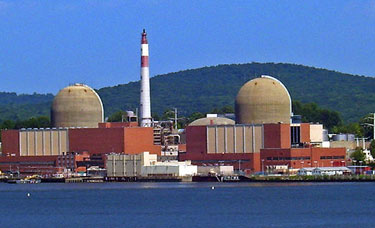
    Water Number: 20 to 30 degrees. Last week, New York State refused to renew the OTC permit for the two-unit Indian Point nuclear plants on the Hudson River. Indian Point’s OTC system is notorious for killing huge quantities of aquatic organisms, and it returns water — 2.5 billion gallons a day — to the Hudson that is 20 to 30 degrees hotter than when it went in. Company officials complain that it would cost over a billion dollars to put in less damaging cooling systems; others say the cost would be far less. And these estimates of the “costs” of replacing the system do not include the “benefits” of reducing the environmental damage.

    Indian Point Nuclear Power Plants

    Courtesy New York State Dept. of Environmental Conservation
    Indian Point Nuclear Power Plants.

    Operator of OTC systems cannot feign surprise or ignorance. Most have been operating under orders for decades to phase these old systems out. In truth, most operators of OTC systems have no intention of ever complying. Their standard operating procedure is to ignore the law, apply for exemptions, and hope that regulatory agencies will roll over in the face of threats to close the plants or raise rates. They’ve been given a pass for decades, permitted to operate environmentally damaging systems under various exemptions and rulings. For example, the EPA first told Indian Point’s owners to replace the OTC system in 1975 — over 35 years ago. And their Clean Water Act permits expired in the 1990s. Yet foot-dragging, license delays, and interim agreements permitted this, and other plants, to continue operate these damaging systems until, until, until, well, it seemed like forever.

    That may be slowly changing with this ruling at Indian Point and with some other recent efforts to finally force cooling systems to be updated.

    Knee-jerk conservatives are, predictably, lamenting this decision because it may raise electricity costs. Yes. That’s the point. Environmental damages are externalities, damages that companies impose on the public good: our rivers, lakes, air, land. As all economists know, the way to reduce environmental damages is to “internalize externalities.” Conservatives ought to be cheering. This is smart economics that will improve environmental quality, create jobs and clean technology companies, and reduce waste.

    It’s about time to make these plants pay to bring their plants up to the standards of the 1970s. In fact, it’s 40 years past time.

    Finally, some readers of this blog may recall that the Poseidon desalination plant at Carlsbad, California was designed to piggyback on the environmentally damaging OTC system at the old Encina power plant. Poseidon has been hedging for years about how they’d operate and at what cost, if the OTC system at Encina were finally forced to close (now not expected until 2017). And opponents of the desalination system fear that it will become the latest excuse to plead to keep the damaging cooling system in operation even longer. I think that’s a safe, and sad, bet.

    Peter Gleick


    Dr. Gleick’s blog posts are provided in cooperation with the SFGate. Previous posts can be found here.

  • Video: California Farmers Can Save Water, Money

    Video: the water-scarce state can overhaul its agricultural water management by implementing clearer water targets, better economic incentives, and more direct communication systems, according to a Pacific Institute report.

    Farmland Success Stories
    [See post to watch Flash video]

    Video by the Pacific Institute
    The water-scarce state can overhaul its agricultural water management by implementing clearer water targets, better economic incentives, and more direct communication systems, according to a Pacific Institute report.
  • Peter Gleick: Water Scofflaws — Go Soak your Heads (Under a Low-flow Showerhead)

    After years of inaction, blatant and willful violations of federal law, and lack of enforcement by previous administrations, the U.S. Department of Energy has just announced that they intend to pursue enforcement actions against the manufacturers of water-using appliances that violate national water and energy savings laws that have been on the books for nearly 20 years.

    A number of very simple, but important, water-using fixtures can be designed to work beautifully and yet save enormous amounts of water. That was the idea behind the water-efficiency standards that passed with the National Energy Policy Act of 1992 (yes, 1992!). That law put in place rules for manufacturers of toilets, showerheads, and faucets. And since those rules went into effect, a huge amount of water, and energy, and money has been saved.

    ABOUT THE AUTHOR:
    Peter Gleick
    Dr. Peter Gleick is president of the Pacific Institute, an internationally recognized water expert and a MacArthur Fellow.

    But like all rules and regulations, they are only as good as society’s willingness to follow them and government’s willingness to enforce them. Almost all of the major manufacturers have done a great job in producing high-quality fixtures that meet the standards. But a few manufacturers have flouted the law by either failing to ensure that their water fixtures met the national standards, or by failing to prove it to federal regulators. And until recently, federal regulators looked the other way, or didn’t look at all. (Of course, this isn’t the only instance of the complete failure of the federal government to enforce rules already in place to protect the environment, nor is it the most egregious). Five years ago, the Plumbing Manufacturers Institute, California Urban Water Conservation Council, East Bay Municipal Utilities District, and the City of Seattle notified federal and state agencies of independent test results for some commercial showerheads showing blatant violations of the National Energy Policy Act. Yet no action was taken at the time.

    That is changing. A couple of weeks ago, the US Department of Energy’s Office of the General Counsel issued “Notices of Proposed Civil Penalties” to four manufacturers of showerheads for failing to certify that their products meet the standard flow rate of 2.5 gallons per minute. Unless the manufacturers satisfy the DoE within thirty days, the Department will file action either in District Court or with an Administrative Law Judge.

    Water Number: $3,475,120. This is the total of the proposed civil penalties the Department of Energy will impose on these four manufacturers if they fail to certify that their products meet the conservation standards of the law. The cost to society in lost water, higher energy use, unnecessary greenhouse gas emissions, and money out of pocket for homeowners is far, far higher.

    Why is this such a big deal, beyond the fact that the law is the law? Water-efficient fixtures save water, energy, wastewater treatment costs, water purification costs, and money for homeowners. When water utility demand is reduced by improvements in efficiency, new costly investment in water supply can be delayed or even prevented. And the numbers add up:

    A ten-minute shower using a showerhead that uses 5 gallons per minute, as opposed to one that meets the standard of 2.5 gallons per minute, will use an extra 25 gallons of water. If you take a shower every other day, this could save as much as 4500 gallons of water per year. 4500 gallons would cost me around $30, including my water and wastewater and local sewer costs. But it would also cost me another $14 in natural gas costs just to heat that extra water. That’s around $44 a year in savings from an efficient showerhead, which typically costs just a few tens of dollars to buy and install. And these savings come year after year after year. And some of the showerheads found to be violating the standards used 12 or 13 gallons per minute, not just 5. [Another problem is plumbers and architects who are starting to install shower “systems” with multiple showerheads. Each single showerhead might meet the federal standard, but this loophole is certainly a violation of the spirit of the law.]

    Multiply that waste over the population of California, or the United States, and the water and energy savings are massive. In the Pacific Institute’s 2003 report on the potential for urban water efficiency improvements, we estimated that if all remaining inefficient California showerheads were swapped out for water-efficient models, they would save 40 billion gallons a year now being used wastefully for showers. And some of the newest, well-designed showerheads flow at 1.5 gallons per minute — another massive improvement even over the federal standard of 2.5 gpm.

    Some studies suggest that shower length can go up when low-flow showerheads are installed, though others actually have found a drop in shower duration. And no doubt some readers will complain about how crummy their showers feel. But well-designed showerheads, even low-flow showerheads, feel great. If you don’t like your low-flow showerhead because of the feel, get a good one and maintain it — the expense is small.

    Here are some websites and groups that talk about the savings, review low-flow showerheads, or provide other useful water efficiency information:

    Alliance for Water Efficiency

    California Urban Water Conservation Council

    Metaefficient (The Guide to Highly Efficient Things)

    Flex Your Power

    Peter Gleick


    Dr. Gleick’s blog posts are provided in cooperation with the SFGate. Previous posts can be found here.

  • Tracking the Threat and Politics of Asian Carp

    Imported from Taiwan and brought to Arkansas as weed control agents three decades ago, Asian carp have become the poster children of potential threats to the Great Lakes. As the fish inch closer to invading Lake Michigan, regional and national politicians debate the financial consequences of coping with the invasive species. With the fate of multi-billion dollar a year industries on the line, the Obama administration has offered some fiscal support to quell the storm.

    [See post to watch Flash video]

    Video used by special permission of Primitive Entertainment.

    Imported from Taiwan and brought to Arkansas as weed control agents three decades ago, Asian carp have become the poster children of potential threats to the Great Lakes. As the fish inch closer to invading Lake Michigan, regional and national politicians debate the financial consequences of coping with the invasive species. With the fate of multi-billion dollar a year industries on the line, the Obama administration has offered some fiscal support to quell the storm.

    Meanwhile Michigan’s Lt. Gov. has taken his case to the Supreme Court twice, hoping for sweeping action. The conflict ignites deep-rooted water debates, including resource rights, diversion legitimacy, and long-term conservation planning. As action remains slow and debates continue, the invasive species become increasingly more threatening to the region.

    The Silver Menace, or Battle for the Great Lakes

    Time Line: Charting Asian Carp’s Course
    Four species of Asian carp were first imported into Arkansas in the early 1970s. Since then the voracious, rapidly multiplying fish have migrated northwards, edging ever-closer to the Great Lakes. Read more…

    Congress Holds Hearing to Debate Closing Chicago-Area Locks
    A Great Lakes expert warned members of a U.S. House subcommittee Tuesday that closing off the canals that link Chicago to the freshwater bodies is the only way to keep invasive species like Asian carp from migrating in and out. Read more…

    Obama Administration Pledges $78.5 Million To Fight Asian Carp; Great Lakes Governors Want More Than Cash
    A $78.5 million pledge from the Obama administration and a plan for part-time closure of Chicago-area locks isn’t enough to protect the Great Lakes from Asian carp, Michigan’s governor declared Monday. Read more…

    Video: Invasion of the Asian Carp, from the Waterlife Documentary
    Second fisherman: You don’t have to catch them; they get right in the boat with you. You don’t believe me, do you.
    Third fisherman: We get hit by ‘em all the time, hit in the head and hit in the chest. They knock glasses off and knock teeth out, everything. Yeah, they’re bad.Read more…

    Asian Carp Threat Prompts Protest Near Lake Michigan Shore
    Fishing enthusiasts and state representatives rallied on the banks of Traverse City’s Boardman River Saturday against Illinois’ opposition to the closure of Chicago-area locks.— Read more…

    Legal Battle Over Asian Carp in the Great Lakes Heats Up
    The White House responds to calls for a Great Lakes summit to protect the lakes and their $7 billion sportfishing industry from the invasive species. Photo Copyright. Read more…

    Michigan Takes Asian Carp Fight Back To the Supreme Court
    Michigan’s Attorney General Mike Cox has filed a new Supreme Court motion to sever the connection between the carp and the Great Lakes, saying that claims by Illinois of $190 million in annual damages from lock closures are “seriously exaggerated.” Read more…

    Supreme Court Declines To Wade Into Asian Carp Fight, Worrying Great Lakes Governors
    The battle over Asian carp intensified Tuesday as the U.S. Supreme Court declined to order an immediate closure of Chicago-area locks that could let the invasive fish enter the Great Lakes. Read more…

    Video: Filmmaker Kevin McMahon Tells the Story of the Great Lakes
    From Canadian filmmaker Kevin McMahon comes Waterlife — a cinematic survey of the state of the Great Lakes in Canada and the United States. Read more…

    Asian Carp Knocking at the Great Lakes’ Door; Michigan Attorney General Seeks To Slam It Shut
    New threat to the lakes reopens century-old legal battle over diversion of Great Lakes water, draws support from several states and Ontario. Read more…

    Asian Carp Links

    • A list of eating instructions
      The Louisiana Department of Wildlife & Fisheries posted a video and instructions on carp consumption.
    • Asian Carp Management
      An official U.S. Fish & Wildlife Service Web site designed to coordinate control and management of Asian carp in the U.S.
    • GLU: Battling Back the Asian Carp
      Great Lakes United summarizes latest Carp news, outlets for action.
    • Great Lakes Fishery Commission
      The GLFC has created a special page with Asian carp information.
    • No Asian Carp
      Michigan House Democrats host this site promoting closure of the Chicago area canals that connect to Lake Michigan
    • Noah Hall Asian Carp Litigation
      Professor Noah Hall, of Wayne State University Law School and visiting Professor at the University of Michigan, explores carp and canal law.
    • Stop Asian Carp
      Launched by Michigan Attorney General and Republican gubernatorial candidate Mike Cox to support closure of Chicago-area locks to Lake Michigan.
    • U.S. EPA: Asian Carp & the Great Lakes
      The U.S. Environmental Protection Agency created this Asian-carp specific invasive species page.
    • Wikipedia Asian carp
      General species breakdown, cultural background, litigation and source for further references.
    • Wisconsin DNR Asian Carp
      Wisconsin Department of Natural Resources’ invasive species information page.

    Steve Kellman is a Circle of Blue writer and reporter. Reach him at [email protected].