Author: JoshNelson

  • Energy Production vs. Environmental Protection: The Partisan Divide

    Via Samantha Thompson, a new Gallup poll found that, for the first time in ten years of polling, Americans prioritize energy production over the protection of the environment.

    Here is the key chart:

    While the chart is compelling, it falls short on multiple levels.

    1. The options it presents are a false dichotomy. We have several energy sources at our disposal that are environmentally sustainable such as wind, solar and geothermal. It would be interesting to see how this poll would have played out had they included a third option: methods for increasing U.S. energy production in environmentally sustainable ways should be given a priority over less environmentally friendly methods. And indeed, when Gallup asked last year which types of energy should get an increase in federal funding, clean energy sources beat oil, gas and coal by a 2-1 margin:

    2. Given the Republican party’s rightward lurch on energy policy in recent months and years, this data is relatively meaningless without the partisan breakdown. Using data provided to EnviroKnow by Gallup (crosstabs here), I created a chart showing the partisan breakdown on the energy production vs. environmental protection question:

    As you can see, while 60% of Democrats and 47% of independents prioritize environmental protection over energy production, just 25% of Republicans do so. And while 68% of Republicans prioritize energy production over environmental protection, just 33% of Democrats feel the same way. When you look at polling that seems to show a decrease in support for a liberal policy idea, you should keep this dynamic in mind. More often than not, a look at the crosstabs of the poll shows that the decrease can be largely attributed to a shift in Republican attitudes, rather than a broader shift across the board. The larger story here seems to be that as conservative opposition to President Obama solidifies and hardens, more and more Republicans who once held somewhat sensible positions on environmental issues have shifted to the right.

    This sharp partisan divide in priorities should come as no surprise to those who follow modern American politics. The Republican rank and file, as well as the party’s leadership, have adopted an ‘against anything President Obama is for’ approach. If President Obama says protecting the environment is a worthwhile endeavor, Republicans automatically assume that it is a terrible idea. This dynamic was on full display last month when, during earth hour, the Competitive Enterprise Institute actually encouraged people to waste energy. Likewise, when President Obama announced his support for increased offshore oil and gas drilling — a position Republicans have traditionally supported — Republican leaders said it still managed to pretend to be outraged.

    What Republicans apparently fail to recognize is that the economy is a subset of ecology. Without a viable natural environment to sustain us the economy as we know it would not exist. An increasing GDP is meaningless without clean drinking water and full employment is of little comfort to those who don’t have access to food that is safe to eat. Those are facts that can’t be changed by the interests of corporate polluters or the petty politics of the modern Republican party, despite the best efforts of both.

  • Obama Was Against Offshore Drilling Before He Was For It

    I have to disagree with my friend Adam Bink on this one:

    In other words, while I see headlines in other progressive media spaces “Obama flip-flops on drilling!!” and “which guy did we elect President again?!”, I see it less as a flip-flop than a validation of (a) a previously-held position and (b) that he is more of a Conservadem than many are willing to admit.

    While Adam is correct to point out that then-candidate Obama pivoted on offshore drilling in the final months of the Presidential campaign, he misses a few important points.

    1. The piece he cites begins as follows: “Obama said he might support more drilling if it were paired with comprehensive energy conservation measures and alternative energy development.”

    Obama’s announcement on offshore drilling this week was a standalone measure. It was not in fact “paired with comprehensive energy conservation measures and alternative energy development.” By taking this action without the accompanying positive measures, this is a step further in the wrong direction than what was signaled during the campaign.

    And indeed, this is the bulk of the complaint from many progressive commentators. Joe Conason calls it “surrender, then negotiate” strategy. Matthew Yglesias doesn’t understand why Obama did this without getting anything in return. Steve Benen and Kevin Drum have similar concerns. While there would have been complaints on the substance of the policy either way — it is after all, extremely bad policy — they probably would have been more subdued if it wasn’t such a baffling move politically.

    2. Adam writes, “Drilling has always been on the list of expendable issues.” This is simply not true. If Obama said anything prior to August 2008 indicating he was willing to budge on the issue, I haven’t seen it. From at least 2005 until August 2008 — after he had secured the Democratic nomination — Obama argued convincingly against offshore drilling repeatedly. Think Progress has several examples:

    “The days of running a 21st century economy on a 20th century fossil fuel are numbered – and we need to realize that before it’s too late.”

    “The truth is, an oil future is not a secure future for America.”

    “We could open up every square inch of America to drilling and we still wouldn’t even make a dent in our oil dependency.” 9/15/05

    “It would be nice if we could produce our way out of this problem, but it’s just not possible.” 2/28/06

    “Instead of making tough political decisions about how to reduce our insatiable demand for oil, this bill continues to lull the American people into thinking that we can drill our way out of our energy problems.” 8/1/06

    “Now is the time to end this addiction, and to understand that drilling is a stop-gap measure, not a long-term solution. Not even close.” 8/28/08

    So yes, for the last 90 days of the Presidential campaign, Obama expressed willingness to concede on offshore drilling. But for the previous 3+ years, throughout his Senate career and the long primary campaign, he argued against it over and over again. This is when all of us got to know Mr. Obama and what he stood for, and this is when Democrats selected him as their candidate for President.

    In conclusion, I think it is perfectly reasonable for folks to express disappointment and outrage now that he has actually gone through with a 180 degree reversal on the issue. I’m not sure what any of us have to gain by pretending drilling was “always” an expendable issue or that this was exactly what he campaigned on.


  • Clean Energy, Mass Transit Far More Popular than Nuke Plants and Oil Drilling

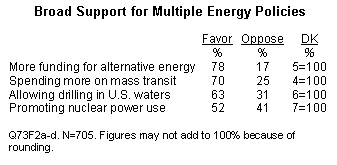
    Last week, Pew released a survey with the headline ‘Support for Alternative Energy and Offshore Drilling.’ The piece begins, “The public continues to favor a wide range of government policies to address the nation’s energy supply…”

    That is accurate, but it doesn’t get at the most striking data. The most important finding in the survey is the fact that clean energy and mass transit investments are vastly more popular than nuclear investments and offshore drilling.

    Here is how Pew presents the data (Figure 1):

    As a mini-case study on how informational graphics can add significant meaning to this sort of data, I’ve created a few simple charts.

    This chart (Figure 2) shows the approval and disapproval numbers for the four policy options:

    And this chart (Figure 3) shows the net approval numbers for the four policy options…

    Presenting the information in text only format, as Pew chose to do in Figure 1, leaves the reader to their own devices to identify the most compelling data. While the data is technically accurate, it fails to bring the meaning of the data to the forefront. Pew’s accompanying analysis of the polling data also somehow fails to identify the massive gap in net approval for the policies they surveyed.

    Creating a simple chart (Figure 2) based on the data itself adds significant value to the presentation of the data, especially for the casual reader. The reader can tell at a glance that clean energy investments are significantly more popular than polluting energy sources, and that unpopularity follows the opposite pattern.

    Going one step further and doing simple arithmetic to determine the net approval for each of the policies in the survey, as I’ve done with Figure 3, brings the most striking data to the forefront. The fact that more than 50% of Americans support a variety of policies to produce-more or consume-less energy is not, in itself, especially meaningful. But the fact that the net approval for some of these policies is 40-60%, while it is barely 10% for others, is fairly compelling.

    Originally posted at EnviroKnow.

    Tags: , , , ,