Author: joshua_pollack

  • The Dead Hand

    Wow. David Hoffman’s The Dead Hand: The Untold Story of the Cold War Arms Race and Its Dangerous Legacy has won the 2010 Pulitzer Prize in the category of general nonfiction. To win in that catch-all category, it had to beat out works on such modest and inconsequential themes as the origins of financial catastrophe and the history of belief in the Almighty.

    (John Lennon, wherever you are, eat your heart out.)

    We’re actually living through the Golden Age of well-researched and highly readable nuclear- or WMD-themed books. Bob Drogin’s Curveball: Spies, Lies and the Con Man Who Caused a War, Michael Dobbs’s One Minute to Midnight: Kennedy, Khrushchev, and Castro on the Brink of Nuclear War, and Mike Chinoy’s Meltdown: The Inside Story of the North Korean Nuclear Crisis all rate a mention. I’m particularly fond of Curveball and The Dead Hand, but they should all be on your shelf.

    (Here’s where I confess that I simply haven’t gotten to Richard Rhodes’s Arsenals of Folly yet. It’s on the list, OK?)

    Between these guys and Hoffman, you’ll notice there are three (ex-)newspapermen with some time on their hands, so yes, there is a silver lining to the harrowing of the papers at the hands of the Internet. But never mind. Hoffman, for one, is on a roll these days, producing an outpouring of articles at foreignpolicy.com that frame current events through little-known episodes from the Cold War and its aftermath — testimony to the sort of intellectual capital one builds up by spending years researching a book. Here’s his latest, on the significance of the fissile material cleanout plan. This past Sunday, too, he had an op-ed in the Post on counterforce and overkill, plus a news story about the recent removal of HEU from Chile. The guy keeps busy.

    Congratulations, David!

  • Malaysia and the Bomb [1]


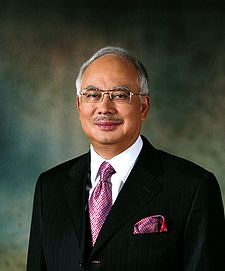
    Prime Minister Datuk Seri Najab
    Razak, man of the hour. For real.

    When most Americans think of Malaysia, they… Well, most of us don’t think of Malaysia at all. A quick visit to the Americans & The World polling site, for example, produces these penetrating insights.

    When nuke wonks think of Malaysia, though, they tend to think, “Hey, isn’t that where the A.Q. Khan network produced centrifuge components for Libya? And isn’t that the last of the industrializing countries without nuclear export controls?”

    The first part is eternally a fact. The second part, though, we’ll think no more, because the Strategic Trade Bill is now law. (ISIS has a little more on the subject. And if you just can’t get enough, here’s some more background.)

    Although the government in Kuala Lumpur denies that there’s any connection, this move comes just in time for the Nuclear Security Summit now underway in Washington. Not only is Prime Minister Datuk Seri Najib Razak representing Malaysia on this occasion, but he’s on President Obama’s calendar.

    Going South

    Indeed, it’s notable just how far off the beaten track President Obama’s meetings are. No fewer than six of the ten leaders scheduled to meet with Obama this week represent member states of the Non-Aligned Movement — nine of ten, if you want to count observer states. Of the 47 countries represented in Washington today, I count 17 full NAM members. So some of the places that normally get overlooked are having their week in the pleasant mid-April sun.

    There seem to be two reasons for an emphasis on the up-and-coming countries of the world.

    Reason Number One is the new technological reality. If you want to do something about nuclear proliferation and nuclear terrorism, it’s too late to focus narrowly on the likes of the Netherlands, Germany, and Japan. Nothing will make that clearer than the map of A.Q. Khan’s suppliers, so let’s revisit this marvelous bit of research by Sammy Salama and Lydia Hansell, cataloging where Libya’s centrifuge technology was sourced: Pakistan, the United Arab Emirates, Malaysia (of course), South Korea, Switzerland, South Africa, and Turkey. That’s more NAM than OECD.

    Reason Number Two is the diplomatic calendar. In just a few short weeks, the NPT Review Conference starts up in New York City. U.S. officials have made clear what they’ll be seeking there by way of strengthened nonproliferation measures, intended to keep the Treaty healthy in the face of today’s challenges: expanded adherence to the Additional Protocol, measures to address non-compliance with the Treaty, and measures to discourage withdrawal from the Treaty by states already not in compliance. In this setting, every member state has an equal vote, even the ones that don’t often dominate the headlines in the New York Times and Washington Post. So there’s a courtship aspect to the Nuclear Security Summit.

    The latter point has not been lost on the Iranians, who see all of the above ideas as calculated to put the screws to them. (They probably aren’t thrilled with plugging gaps in export control laws, either.) So they’re holding a counter-summit of sorts shortly afterward. Do you suppose they’ll get 47 countries, or 40+ national leaders and heads of state? Don’t stake any great sums on it.

    But Back to Malaysia for a Moment

    To capture the difficulty of healing the fractured nonproliferation consensus in a single anecdote, we could do worse than to recall the bizarre events of last November’s IAEA Board of Governors meeting in Vienna. Maybe you remember how Malaysian Ambassador Mohd. Arshad Manzoor Hussain voted the wrong way on whether to rebuke Iran and was subsequently recalled and dismissed? Here’s the story of how the vote went down, from Reuters:

    A senior diplomat close to the matter said Malaysia’s IAEA mission had been instructed to vote in line with the position of the Non-Aligned Movement of developing nations, which has historically opposed Western-driven international actions to isolate Iran, a fellow member of NAM.

    Iran denies Western suspicions that it secretly seeks nuclear weapons and NAM has stood up for Iran’s proclaimed right to develop a sovereign civilian nuclear power industry.

    When the vote was held, the diplomat said, Hussain was surprised to see NAM members Egypt, Pakistan and South Africa abstain, and India vote “yes”. Hussain had no time to double check policy with his capital, and so voted against as originally planned, the diplomat told Reuters.

    He said Malaysian diplomats who attended NAM strategy talks before the vote in Hussain’s stead because he was busy with other duties as board chair briefed him that sentiment in the group against censuring Iran was widespread.

    But another diplomat familiar with the issue said NAM states reached no consensus on how to deal with the resolution so the varying votes on the floor should not have been a surprise.

    The other opposing votes were cast by Cuba and Venezuela, both U.S. foes unlike Malaysia. All Western board members, joined unusually by Russia and China, voted in favour.

    That’s a good news story, but also a warning against complacency. The Nuclear Security Summit is just a warm-up event; the real fight will be at the RevCon.

  • Where the NPR Meets in the Middle

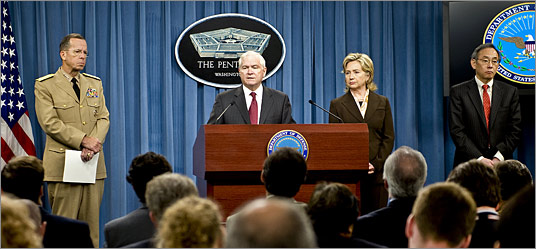
    U.S. Department of Defense photo by Cherie Cullen

    The Obama Nuclear Posture Review — and that’s what it is — is a major accomplishment. (I’ve written about it in a column to appear soon at the Bulletin. Stay tuned.) Compared to previous efforts, it takes on more issues and makes more positive changes. It also bears the imprimatur* of an array of senior officials, starting with the President.

    (*That’s Latin for “buy-in.”)

    The Obama NPR also contains some grounds for dissatisfaction. From any point of view. But before you start grumbling too much about what it doesn’t achieve, though, I’d recommend comparing it to the last one.

    The report works to reconcile certain tensions, and manages reasonably well. It reads like a tunnel dug from both ends: from this end, the nonproliferation agenda that stole the show last year in Prague, now picking up steam for the the May 2010 NPT RevCon — and from that end, the traditional set of nuclear posture issues: force types, numbers, and alert status. The latter side of the tunnel emerges into a territory within the status quo comfort zone of past years.

    Where these issue sets meet in the middle, the nonproliferation agenda largely, but not exclusively, prevails. There will be no “new” warheads or nuclear military capabilities. And there is a significantly clarified negative security assurance that breaks explicitly with the doctrine of calculated ambiguity, i.e., hinting that a chemical or biological attack might get a nuclear reply, or at least refusing to say one way or the other. That’s gone now.

    What we don’t see is a blanket statement of the sort discussed at some length at this blog, either “no first use” or “sole purpose.” Instead, we are told that

    The fundamental role of U.S. nuclear weapons, which will continue as long as nuclear weapons exist, is to deter nuclear attack on the United States, our allies, and partners.

    Which is not bad, especially in combination with the new NSA statement that

    the United States will not use or threaten to use nuclear weapons against non-nuclear weapons states that are party to the NPT and in compliance with their nuclear non-proliferation obligations.

    Why Not Go All The Way?

    The report gives us a reason:

    In the case of countries not covered by this assurance – states that possess nuclear weapons and states not in compliance with their nuclear non-proliferation obligations – there remains a narrow range of contingencies in which U.S. nuclear weapons may still play a role in deterring a conventional or CBW attack against the United States or its allies and partners.

    American conventional might and the threat to hold leaders personally accountable for their actions are deemed sufficient to deter non-nuclear weapon states in good standing within the NPT from using chemical or biological weapons, so why not also Russia, China, Iran, and North Korea? There may be logical reasons, but they aren’t spelled out.

    There may also be another reason, one not raised directly, but hinted at elsewhere. This admirably frank discussion explains what will determine the size of the U.S. strategic arsenal for the foreseeable future:

    Russia’s nuclear force will remain a significant factor in determining how much and how fast we are prepared to reduce U.S. forces. Because of our improved relations, the need for strict numerical parity between the two countries is no longer as compelling as it was during the Cold War. But large disparities in nuclear capabilities could raise concerns on both sides and among U.S. allies and partners, and may not be conducive to maintaining a stable, long-term strategic relationship, especially as nuclear forces are significantly reduced. Therefore, we will place importance on Russia joining us as we move to lower levels.

    In other words, the U.S. arsenal is scaled to the Russian arsenal. This is a tradition going back to the end of massive U.S. numerical superiority, and many people set great store by it. Not maintaining parity would “raise concerns,” although the exact nature of the concerns aren’t explained.

    For the moment, it matters not. The point is this: if we pledge never to go first against the Russians, it gets difficult to explain why our deployed strategic arsenal is the size that it is. (There’s not much satisfaction in retaliating against empty Russian launchers, is there?) So until it’s decided that numerical parity is no longer so important, we probably won’t see a “sole purpose” or “no first use” declaration, regardless of what might be said about chemical or biological weapons.

  • The “Lego Block” Nuclear Reactor [21]

    So, looking for something in a nuclear power plant, but not too big and not too expensive? How about a small, modular liquid-metal reactor, provided with its fuel installed? Look no further than the 100 MWe SVBR-100, shipped direct to you by — yes, you guessed it — the Acme company.

    According to the New York Times,

    Kirill Danilenko, the director of the Russian company, Akme Engineering, said that the technology could be made safe, with no greater risk of meltdown than that at a larger nuclear plant. His vision is that small reactors will become so common that utilities can connect them and “build power plants like Lego sets.”

    [snip]

    The Russian company, Akme, is an acronym for atomic complex for small and medium energy and sometimes renders its name in English as Acme.

    World Nuclear News reports that the new mini-reactors should be available by 2019. No word on species requirements for buyers.

  • The Media, Generals, & Passion of AQ Khan [8]


    This magazine cover irritated
    A.Q. Khan. Hey, it could have
    been worse.

    (A friendly warning: this is a long post.)

    [Update | 2153. A few clarifications and elaborations have been added at the end. Look for the numbered notes sprinkled through the text.]

    To observe something is to influence it, or so we are told. The ongoing Washington Post series based on papers written by A.Q. Khan in 2003 or 2004 (criticized recently by ISIS and here at ACW) certainly seems to be having an effect on the fortunes of the self-proclaimed father of the Pakistani nuclear bomb.

    That’s because, according to Reuters and the New York Times, Khan has been talking too freely to foreign reporters for the liking of Pakistan’s government.

    But here the story takes a twist.

    There’s no reason to believe that A.Q. Khan has spoken with anyone from the Washington Post. In fact, it doesn’t appear that he’s been in contact with any members of the foreign media in recent months.1 What he has been doing is something much more dangerous: attacking the Pakistani military in a vain effort to rehabilitate his own good name. Perhaps thinking that Khan might win that battle in the court of public opinion, his antagonists apparently prefer to take him before another court — a literal court — in order to silence him, both for what he has said and for what he might say.

    Bear with me and you’ll see.

    The Official Line from the Government

    The government of Pakistan is claiming that A.Q. Khan is jeopardizing national security, apparently through interviews with the foreign press. From the Reuters account:

    “We basically seek permission to see Dr. (Abdul) Qadeer Khan and investigate into the matter as well as restrain him from making any statement and interacting with anybody,” government lawyer Naveed Inayat Malik told Reuters by telephone.

    The petition was filed in the Lahore High Court after two articles in the Washington Post, published on March 10 and 14, reported that the Pakistani nuclear scientist had tried to help Iran and Iraq develop nuclear weapons, Malik said.

    Those deals allegedly occurred with the knowledge of the Pakistani government. Both the Pakistan government and Khan have denied the reports.

    And according to the Times:

    A copy of the government petition obtained by The New York Times cited two articles published on March 10 and 14 by The Washington Post that “have national security implications for Pakistan as they contain allegations related to nuclear program and nuclear cooperation. Further they have likelihood of adversely affecting friendly ties with the government of Iran and Iraq.” The petition requested the court to direct Mr. Khan to “refrain from interacting with foreign media.”

    But there’s just one little problem. Khan hasn’t been talking to the Washington Post. That much is clear from the stories themselves. The March 10, 2010 story (by Joby Warrick) was based not on interviews, but on documents found by UNSCOM in Iraq in the 1990s, first described by ISIS back in 2004. (The article was occasioned by the publication of David Albright’s new book, Peddling Peril.)2

    And the March 14, 2010 story — the latest in the above-mentioned series by R. Jeffrey Smith and Joby Warrick — goes out of its way to tell us that Khan himself has not been involved:

    Khan’s account and related documents were shared with The Post by former British journalist Simon Henderson, now a senior fellow at the Washington Institute for Near East Policy. The Post had no direct contact with Khan, but it independently verified that he wrote the documents.

    Pointing Fingers at Everyone Else

    So what’s moved Islamabad to go to court? The answer is not completely clear, but it seems to be twofold: first, what Khan has said about the Post’s reporting in the Pakistani press, and second, what the Post series suggests that Khan might say next.

    Let’s review.

    The first story in the Post series, appearing on November 13, 2009, described what Khan had written about past dealings with China. But more importantly, it suggested that his motive for writing and leaking the papers was to make sure he would not take the fall alone:

    [T]he narratives are particularly at odds with Pakistan’s official statements that he exported nuclear secrets as a rogue agent and implicated only former government officials who are no longer living. Instead, he repeatedly states that top politicians and military officers were immersed in the country’s foreign nuclear dealings.

    Khan has complained to friends that his movements and contacts are being unjustly controlled by the government, whose bidding he did — providing a potential motive for his disclosures.

    Overall, the narratives portray his deeds as a form of sustained, high-tech international horse-trading, in which Khan and a series of top generals successfully leveraged his access to Europe’s best centrifuge technology in the 1980s to obtain financial assistance or technical advice from foreign governments that wanted to advance their own efforts.

    That certainly sounds nothing at all like Khan’s televised confession of February 20, 2004, in which he maintained that “there was never ever any kind of authorization for these activities by the government.”

    Khan actually has been repudiating his televised confession since at least May 2008. Around July of that year, he had also accused exiled former military ruler Gen. Pervez Musharraf, the Army, the ISI (military intelligence), and the SPD (the branch of the Army in charge of nuclear security) of involvement in his proliferation activities. But after awhile, he had quieted down.

    Now Khan was quick to confirm the Post’s story in an interview with the News of Pakistan. He also returned to his old form, taking aim at Musharraf, who (so Khan claimed) conspired against Khan with CIA director George Tenet:

    Dr Khan questioned what type of justice it was that the truth was made secret for countrymen while it was transferred to the US. The nation must know that national secrets were handed over to Washington by the former president who was an American stooge, he said. He said the nation knew well who its well-wisher was.

    [snip]

    Khan demanded inquiry and trial against Musharraf and his coterie. It is an open secret that Musharraf had deep-rooted contacts with Israel and God knows how many secrets he had transferred to them. He said under a planned policy the former president had transferred all responsibility over his shoulders, which he was not going to deny. But, he demanded to expose his confessional statement secured under duress or to record his statement afresh so that real facts might be revealed.

    (The Post briefly took note of this item at the time.)

    But even before Khan’s interview appeared in the News, the same paper had reported that he was under investigation on suspicion of having spoken with the Post.

    A Turn for the Worse

    Probably his interview with the News did not help his cause, but it was the next story in the Post, on December 28, 2009, that may have sealed Khan’s fate. In mid-January 2010, the News reported on a meeting of senior military and civilian officials with the purpose of dealing with the Khan matter:

    The enormity of official concerns is evident from the fact that a high-level meeting on Friday, presided over by no less than Prime Minister Yousuf Raza Gilani, was held to exclusively discuss the issue of Dr Khan’s unrestricted exchanges.

    The meeting was attended by top military brass and government’s legal eagles. The meeting was reportedly convened at the request of the security establishment and was attended by Interior Minister Rehman Malik, Minister Babar Awan, PM’s Adviser Latif Khosa, Chairman Joint Chiefs of Staff Committee Gen Tariq Majid, DG ISI Lt Gen Shuja Pasha, DG Strategic Planning Division Lt Gen (retd) Khalid Kidwai, Attorney General Anwar Mansoor.

    What was it about the second Post story that did it — if that’s really what did it? We can’t be sure, but I’d point to this passage:

    Contradicting Pakistani statements that the government had no involvement in such sensitive transfers, Khan says his assistance was approved by top political and Army officials, including then-Lt. Gen. Khalid Kidwai, who currently oversees Pakistan’s atomic arsenal.

    The document in question was apparently written sometime in late 2003 or early 2004, during the official investigation into Khan’s activities. But in late 2009, it would have suggested where Khan might be prepared to go next.

    Despite his plea that he had not spoken with the foreign media, Khan was returned to house arrest in late January.

    [edited for clarity] Now, the appearance of retired Lt. Gen. Kidwai’s name in the Post must have brought some people in Islamabad up short. For comparison, see the Sunday Times article by Simon Henderson that first brought Khan’s papers to light. The only names it named were those of the deceased (brackets original):

    On Iran, the letter says: “Probably with the blessings of BB [Benazir Bhutto, who became prime minister in 1988] and [a now-retired general]… General Imtiaz [Benazir’s defence adviser, now dead] asked… me to give a set of drawings and some components to the Iranians…The names and addresses of suppliers were also given to the Iranians.”

    On North Korea: “[A now-retired general] took $3million through me from the N. Koreans and asked me to give some drawings and machines.”

    (Of course, it also must have helped that Khan refused to comment on that article.)

    Everyone named in the November 14, 2009 Post story is also deceased, so the appearance of the name of a living individual was new.

    Bearing all this background in mind, the latest development appears to be driven by the account from the Khan papers given in the March 14, 2010 Post story. It named two more living retired senior Pakistani military officials, Admiral Sirohey and General Beg, as playing opposed roles in dealings with the Iranians.3

    And now, in a novel twist, Khan himself has been wheeled out to deny the latest report.

    The Prisoner’s Dilemma

    Left aside so far: whether anything Khan writes or says is true.

    Most analysts of non-proliferation have long doubted his original, televised confession. But there is also reason to doubt that Khan acted on orders from the top. (The case for Khan as an independent operator has been made in detail by Christopher Clary.)

    Between these poles is another possibility. Let’s call it the coalition of the corrupt. One could imagine that, in a sufficiently “loose” and “open” setting, where the military is largely unaccountable to civilian authority, a weapons scientist on the make could form alliances of convenience with military men, who — from the perspective of foreign customers — would act as gatekeepers to the advanced technology.

    That doesn’t mean that Khan is telling the truth. It’s possible he acted without any “top cover.” It’s also possible that he had “top cover,” but decided for reasons of his own to accuse innocent individuals. There’s no way for us to know. But we can envision his situation in late 2003 and early 2004, during the investigation by Pakistani intelligence. If Khan had partners in crime, and if he thought they were about to sell him out, why then, he’d sell them out, too. Thus the documents, which he wrote and sent out of the country for safekeeping. What an irony it would be if they now come back around to cost him his freedom — but nothing, perhaps, that game theory wouldn’t predict.

    Postscript: This story isn’t over; in a comment at ACW, R. Jeffrey Smith of the Washington Post wrote that “the final thread [is] not yet reported.”

    Update | 2153.

    1 Simon Henderson, who is not affiliated with the Post, points out that he’s named in the Pakistani press as a suspected Khan contact (see the News and Daily Times).

    2 What’s more, the March 10 Washington Post story is not entirely new. The Post covered the Iraq documents on February 5, 2004 (Joby Warrick, “Alleged Nuclear Offer to Iraq Is Revisited; Memos Indicate Attempt to Sell Pakistani Bomb Plans, Equipment on Eve of ’91 War”), albeit not at the same level of detail as earlier this month. Unfortunately, the story does not appear online.

    3 As it happens, the March 14 Washington Post story is not entirely new, either. The Post covered Khan’s interactions with Iran, albeit without the benefit of his written statement, on January 24, 2004. Gen. Beg was named. Here’s the notable passage:

    Chaudry Nisar Ali Khan, a former cabinet-level assistant to Nawaz Sharif, the prime minister at the time, said in an interview Thursday that Beg approached him in 1991 with a proposal to sell nuclear technology to Iran. Former U.S. ambassador Robert Oakley said Beg told him in 1991 that he had reached an understanding with the head of Iran’s Revolutionary Guards to help Iran with its nuclear program in return for conventional weapons and oil.

    Also, a different and probably better explanation for the latest court action than what I suggested above appeared in Tuesday’s New York Times:

    The [government’s] petition was filed on Monday, hours before a court in Lahore was to announce a verdict on Mr. Khan’s petition to have his travel restrictions relaxed.

    In other words, the new action seems to have been designed to prevent, or at least delay, any legal escape from confinement that Khan might otherwise manage. The March 10 and 14 articles in the Post look like a handy pretext more than a source of genuine alarm. The real damage was already done back in late 2009.

  • NATO’s Nuclear Opacity [2]

    Once [Follow-On To Lance] had been cancelled [in May 1990], as well as the upgrade for nuclear artillery, and the INF Treaty had eliminated all longer-range missiles, only dual-capable aircraft remained available for SACEUR’s use as a nuclear deterrent. The rancor raised by the FOTL debate carried forward in to a broad public concern over any nuclear forces, thereby putting the spotlight on [dual-capable aircraft]. In response, NATO chose over the next 15 years to minimize public discussion or awareness of this aspect of its deterrent mission.”

    — Jeffrey A. Larsen, The Future of U.S. Non-Strategic Nuclear Weapons and Implications for NATO: Drifting Toward the Foreseeable Future (2006)

    Make that 20 years. For about a generation’s time now, the North Atlantic alliance has been drifting, in Larsen’s words, “toward the withering away of its nuclear capabilities.” Nuclear debates have been deferred indefinitely, leading to the present situation, wherein acquisition decisions (or non-decisions) have long substituted for fundamental policy choices.

    But now we’re having the discussion, which at times has manifested as a semi-public debate between the German Foreign Ministry and the German Defense Ministry. Behold the nuclear side of what SecDef Gates recently dubbed “the demilitarization of Europe – where large swaths of the general public and political class are averse to military force and the risks that go with it.”

    Don’t Ask, Don’t Tell

    Now that the argument has finally commenced, the official silence and habitual secrecy surrounding the exact numbers and whereabouts of NATO’s bombs must rank among the quirkier legacies of the Big Shhh that descended years ago over U.S. nuclear weapons in Europe. Consider this passage from the above-cited study by Larsen, which was sponsored by NATO:

    Most estimates claim that there remain several hundred U.S. tactical nuclear warheads in Europe, at some eight bases in six European nations that could be delivered by a fleet of dual-capable aircraft (fighter-bombers) manned by up to eight allied nations. [5]

    [5] See, for example, Hans Kristensen, U.S. Nuclear Weapons in Europe: A Review of Post-Cold War Policy, Force Levels, and War Planning (Washington: Natural Resources Defense Council, February 2005); Kristensen and Stan Norris, “NRDC Nuclear Notebook: U.S. Nuclear Forces, 2006,” Bulletin of the Atomic Scientists, January/February 2006, pp. 68-71; and Brian Alexander and Alistair Millar, eds., Tactical Nuclear Weapons: Emergent Threats in an Evolving Security Environment (Washington: Brassey’s, 2003).

    Or this passage from an instant classic of Shhh, a February 2010 paper by Franklin Miller, George Robertson, and Kori Schake:

    According to the Federation of American Scientists (FAS), the US possesses about 1,200 tactical nuclear weapons, of which 500 are operational warheads (the rest are in storage or in the process of being dismantled). The FAS indicates that 200 of the operational weapons are deployed in Europe, stationed with US and allied air crews in Germany, Belgium, the Netherlands, Italy and Turkey. [2]

    [2] Federation of American Scientists, http://www.fas.org/blog/ssp/2009/03/russia-2.php.

    Now, George Robertson used to be NATO’s Secretary-General. Who supposes that he needs Hans Kristensen & Co. to tell him where the bombs are?

    This sudden deference to NRDC or FAS is the NATO equivalent of a phrase that appears, in some version, in every Israeli news report or commentary about Israel’s “nuclear option”: According to foreign media… That fig leaf is enough to keep the military censor out of the hair of reporters and editors.

    Jive Turkey

    Speaking of figs, NATO’s extreme case study in formal opacity may be Turkey, where, as Alexandra Bell has reported, military officials are far from ready to concede the obvious:

    Turkish officials were cagey about discussing these weapons. A former Air Force general, following what seemed to be the official line, denied that there were nuclear weapons in Turkey, saying they were removed at the end of the Cold War. This differed from the other officials I met, whose wink-wink references basically confirmed the presence of the nukes. They also hinted that the weapons would be critically important if a certain neighbor got the bomb.

    Turkish civilian officials, as ACW’s own Jeff Lewis has gathered, seem to take an altogether different view on the importance of U.S. nuclear weapons hosted abroad. Turkey may be as divided as, say, Germany on the matter.

    There’s a limit to the comparison, of course: Germany isn’t undergoing the revolution in civil-military relations that is Turkish political life today.

    Latest News: Cold War Still Over

    But enough talk about talking about not talking. Whether to act — to withdraw an undisclosed number of tactical nuclear weapons from undisclosed locations in Europe — will be on the agenda of the conference of NATO Foreign Ministers next month in Tallinn, Estonia. It should be mighty interesting. This comes on the heels of a Japanese decision to disavow explicitly any claim to standing over American decisions on tactical nukes, and a Japanese news report alleging that the Americans have, as a courtesy, telegraphed an upcoming decision on that front. We’ll have to wait and see if that’s really so.

    Whenever it comes and however it comes, change is coming. As with strategic weapons, but perhaps moreso, the ground has shifted around tactical nuclear weapons. Kids today have no idea what’s meant by the Fulda Gap — trust me on this one. But everyone’s heard of Osama.

    For further reading: Pavel Podvig and yours truly at the Bulletin.

  • Pyongyang’s Priorities [7]

    Malnourished children awaiting treatment at a hospital in Sariwon City (North Hwanghae Province) on 18 February 2009. Photo: World Food Program/Lena Savelli

    Chad O’Carroll has a really fine post over at NOH about seizures of goods headed to and from North Korea under UN Security Council Resolutions 1718 and 1874. If you don’t know, 1718 prohibited imports and exports of nuclear and missile technology, luxury goods, and certain conventional weapons. 1874, adopted after last year’s nuclear test, prohibits the import and export of all weapons and toughens the earlier sanctions in a few other ways as well.

    As Chad observes, a lot of fancy goods go into North Korea, and some countries are more assiduous about trying to prevent this than others. (See under Yachts, Italian-made.) That’s all the more jarring considering the inability of the country to feed its people.

    And guess what? Even the government in Pyongyang is admitting it these days. The North Korean government has now promised the public (as discussed here) that it will stop investing in weapons and heavy industry for awhile, and focus on consumer goods and food production instead. The slogan of the day is “bringing about a radical turn in the people’s standard of living.” Andrei Lankov points out that Dear Leader — who has been visiting a lot of pig farms, fisheries, and “foodstuff factories” of late — has even expressed disappointment about the lack of good eating and basic comforts in his country:

    In January, Nodong Sinmun, a government mouthpiece, reported that Dear Leader Kim Jong-il felt bad for being unable to provide his subjects with the level of material affluence they were once promised.

    The promise was moderate, to be sure. In the 1960s, Kim Il-sung, the founding father of the country and also father of the current dictator, promised that eventually all Koreans would eat rice (not corn or barley) and meat soup, live in houses with tiled roofs (not thatched), and wear silk clothes.

    Regrets, he’s had a few.

    Which brings us back to Chad’s post. He writes:

    It was reported last week that China is looking into allegations that it may have been involved in aiding a North Korean arms shipment bound for the Republic of Congo. The shipment, which contained North Korean parts for Congo’s fleet of vintage T-54/T-55 tanks, was intercepted by South Africa in November 2009 and reported to the U.N Security Council this week.

    Take that, Amazon.com. The proceeds from a sale like that are surely worth a yacht or two.

    Of course, North Korea has a long record of shipping obsolete tanks and other weapons to sub-Saharan Africa. (The Ethiopians are said to be a big buyer, for example.) And even communist Pyongyang has learned along the way the importance of ensuring that its goods reach the customer in serviceable condition. How else can we explain what the South Africans found lining the containers sent to Congo?

    According to the report, “a large quantity of rice grains in sacks lined the containers and was utilized as protective buffers for the conveyance of the conventional arms.”

    Priorities, priorities…

  • North Korea: Peace or Else! [3]

    A statement appearing in KCNA on Tuesday — two of them, actually — lambaste the United States and “the puppet army of South Korea” for upcoming annual joint military exercises.

    Ho hum. Nothing unusual there. Not only do we see this every year, we see it often. Twice Tuesday, and twice Monday, in fact. But Tuesday’s statements out of North Korea have grabbed a fair bit of attention for their choice of threat(s), should the allies carry out the exercises.

    First is a signed commentary in the official newspaper Minju Joson, reproduced in KCNA:

    If the U.S. and the south Korean bellicose forces persist in the anti-DPRK war exercises aimed to make a preemptive nuclear attack, this will compel the DPRK to build up its self-defensive nuclear deterrent and means of its delivery.

    Second is a KCNA editorial, which connects the same threat to the failure of the U.S. to take up North Korea’s call for peace talks, back in January:

    Should the U.S. persist in its unrealistic moves to stifle the DPRK in disregard of its realistic proposal, this will only compel it to boost its nuclear deterrent and its delivery means.

    So, if North Korea really were to carry out these threats, how would it proceed?

    First, it could announce a reprocessing campaign. But since Pyongyang already claims to have done what there is to do on that front, that would seem pointless.

    Second, it could announce the successful weaponization of its plutonium, although that’s been done, too.

    Third, it could test some missiles and declare them to be nuclear-capable. (Perhaps even the long-awaited Musudan missile.)

    Fourth, it could test another nuclear device, despite signaling that it has no plans to do so this year.

    Fifth, it could set about reversing the disablement of the Yongbyon 5 MWe reactor, most visibly by rebuilding the cooling tower. Restoring the Yongbyon reactor would also restore North Korea’s ability to produce more plutonium.

    Among bad ideas, that last one takes the prize. However stubborn the Obama Administration might seem to Pyongyang right about now, I’d guess that nothing else the North Koreans could dream up [this side of, say, selling some plutonium abroad] would harden attitudes in Washington as much as restoring the reactor and starting it up again.

    The second Foreign Ministry statement of January concerning peace talks actually pointed to the blown-up cooling tower as a sign of good faith. Bringing it back would not be too likely to soften any hearts around here, or so I’d imagine. It’s not an experiment worth trying, really.

    Update | 2210. Northeast Asia Matters finds recent attacks on the upcoming joint exercises to be pretty much the same as ever.

  • Iran Probes The Limits [19]


    Enough slicing and a salami ends up like this.

    What happens when a government with a nuclear program systematically works itself into the position of being “a ‘screw turn’ away” from building a nuclear weapon? On one hand, let’s say this government wants to preserve its relations with a great power ally that arms it and shields it from sanctions; on the other hand, its leaders compete to be more pro-nuclear, aiming to win the favor of the military, the scientific establishment, and the public.

    The balance can be hard to maintain. With enough jostling, it could tip.

    To get a sense of the problem, take a few moments to read this declassified memorandum from the U.S. National Security Council staff in 1987, previously described by Mark Hibbs in the December 28, 2009 issue of NuclearFuel. Titled, “Dealing with Pakistan’s Nuclear Program: A U.S. Strategy,” it expresses the difficulties faced by the White House in persuading the Government of Pakistan (GOP) to stay within certain “nuclear red lines” — including no enrichment beyond 5% — while trying to assure Congress that the situation was still under control.

    Substitute “Iran” for “Pakistan” and “the West” for “Congress,” and you could almost imagine memos like this one being written over the last couple of years in the Kremlin and Zhongnanhai.

    As it happens, Pakistan seems to have crossed the enrichment “red line” during or shortly after an armed crisis with India in early 1990. (Senior Pakistani diplomat Abdul Sattar hinted as much at a 1994 event sponsored by the Stimson Center — see p. 42 of this edited transcript.) Afterward, the White House would no longer certify to Congress that Pakistan did not possess nuclear weapons, sanctions kicked in, and nothing remained of the alliance for an entire decade.

    Which Brings Us to Now

    In his first full-scale report Iran report as IAEA Director-General (GOV/2010/10), Yukia Amano is pretty direct about “possible military dimensions”:

    The information available to the Agency in connection with these outstanding issues is extensive and has been collected from a variety of sources over time. It is also broadly consistent and credible in terms of the technical detail, the time frame in which the activities were conducted and the people and organizations involved. Altogether, this raises concerns about the possible existence in Iran of past or current undisclosed activities related to the development of a nuclear payload for a missile. These alleged activities consist of a number of projects and sub-projects, covering nuclear and missile related aspects, run by military related organizations.

    The concluding summary of the report opens with another crisp statement:

    While the Agency continues to verify the non-diversion of declared nuclear material in Iran, Iran has not provided the necessary cooperation to permit the Agency to confirm that all nuclear material in Iran is in peaceful activities.

    That’s a non-certification if there ever was one.

    The Bad News

    We don’t know what red lines Moscow and Beijing might have communicated to Tehran, if any — although Iran’s own decision to enrich “up to 20%” may have triggered this response from the Russians.

    Among other provocative actions described in GOV/2010/10, the Iranians also rushed to commence the re-enrichment process without waiting for IAEA safeguards inspectors to show up — an incident that occasioned an unusual short report to the IAEA Board of Governors last week.

    The Iranians have now relocated nearly their entire stock of low-enriched uranium (LEU) to the Pilot Fuel Enrichment Plant (PFEP), where re-enrichment has begun. Yet GOV/2010/10 documents no progress toward setting up process lines to make new fuel assemblies for the Tehran Research Reactor (TRR) — the ostensible reason for re-enrichment. Nor is there word of any work on a process line to convert the re-enriched UF6 gas from PFEP to the uranium oxide needed for the fuel.

    The report does record that, as of last November, a process line has been completed at Iran’s Uranium Conversion Facility to produce “natural uranium metal ingots” for R&D purposes. And if that weren’t good enough, another process line is planned to make metal from 19.7% enriched UF6 — basically what’s now being produced at PFEP. Again, that’s for R&D purposes.

    As many readers will know, U metal — enriched to 80% or more — is the stuff of which bombs are made. Iran may not have the Bomb, but it has acquired a complete salami-slicing kit, and knows how to use it.

    (At least we can’t say that we had no warning at all. The Atomic Energy Organization of Iran (AEOI) publicly signaled interest in making U metal ingots as early as 2005. The idea was reiterated as recently as last April.)

    The Good News

    Amid the mounting fatalism and hand-wringing, what separates Iran in 2010 from Pakistan in 1990 is too easily overlooked. Iran is an NPT member state. Its nuclear facilities — the declared and operational ones, anyway — are under containment and surveillance, meaning that what happens there is visible to the world in short order. Also, these facilities can’t be defended effectively against the determined actions of one or more Western military powers — something Pakistan never had to contemplate. If push ever came to shove, the Iranians would have to start over again, and under very different circumstances.

    For these reasons, withdrawal from the NPT would be a dicey business. And trying to sneak around the NPT, as the Qom/Fordow experience teaches, is not as easy as it once might have seemed.

    While a diplomatic solution remains out of reach — and a military solution, if it can be called that, remains the option of last resort — vigilance and firmness can still keep the screwdriver from turning.

  • Closing the Books on TRR Diplomacy [15]

    Mark Heinrich of Reuters, George Jahn of AP, and Laura Rozen of Politico have gotten ahold of a letter to IAEA Director-General Amano from the ambassadors of France, Russia, and the United States regarding Iran’s announced decision to re-enrich LEU to the vicinity of 20%.

    (The Reuters story is here, AP is here, and Politico here.)

    The letter is of interest as a sort of statement for the record on the Vienna talks of last October, where the technicalities of a plan for refueling the Tehran Research Reactor were developed. We’ve never had a full accounting of the bargain tentatively struck there, which the Iranian side seems to have formally rejected only as of early January. This excerpt may be as close as it gets for a while:

    We regret that Iran has not agreed to the IAEA’s 21 October proposal, which our three countries endorsed. We recognize Iran’s need for assurance that the project would be fully implemented.

    We note that the IAEA’s proposal incorporates a number of provisions that provide assurances regarding our collective commitment to fulfill the IAEA’s proposal. The IAEA agreed to take formal custody of Iran’s nuclear material. We agreed to a legally binding Project and Supply Agreement. We agreed to support technical assistance through the IAEA to ensure the safe operations of the TRR. We expressed our willingness to have Iran’s low enriched uranium placed in escrow in a third country until completion of the fabrication process. The United States offered substantial political assurances that the agreement would be fulfilled.

    (Here’s my previous educated guesswork about the Technical Cooperation aspect of the proposed deal, plus analysis of Iran’s fuel-swap demand and the escrow proposal mentioned above.)

    The letter goes on to parse Iranian President Ahmadinejad’s public statements, which suggests that no one has assumed the go-between role formerly played by previous IAEA DG Mohamed ElBaradei. It concludes with a warning: the “escalation” of enrichment up to 20% — being both unnecessary and insufficient for the stated purpose of maintaining the continuity of Iran’s supply of medical isotopes — “would raise new concern about Iran’s nuclear intentions” and “further undermine the confidence of the international community in Iran’s actions.”

    From the United States and France, this is nothing new, but coming from Russia, it’s a statement.

  • Consensus Emerges on Iran’s Centrifuges [15]

    An announcement. (Sound of a fork tapping a glass.) Ladies and gentlemen — may I have your attention?

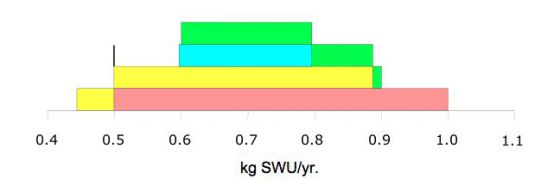
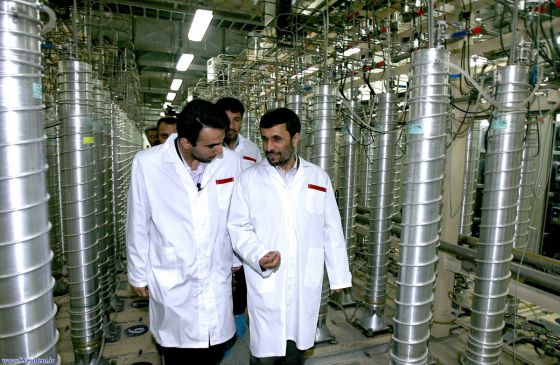
    Ladies and gentlemen, although there were no armistice talks, the SWU Wars have ended in a truce. The experts have reached a consensus, roughly speaking, about the actual separative power of Iran’s IR-1 gas centrifuges — the devices enriching uranium at the Natanz Fuel Enrichment Plant (FEP) and Pilot Fuel Enrichment Plant (PFEP). (The latter facility has been in the news lately.)

    It looks like this:

    Perhaps you’d like more explanation than that?

    Faithful readers will recall that this subject has been covered here previously (see: Estimating SWU with Expert Opinion, December 6, 2009, and IR-1 Estimates Revisited, January 18, 2010). The discussions summarized therein involved some disagreements — strong ones, at times.

    But now, way down in Section 10 of a new ISIS paper dated February 11, 2010, Iran’s Gas Centrifuge Program: Taking Stock, David Albright and Christina Walrond conclude that “the average separative capacity” of an individual IR-1 at the FEP in Natanz is between 0.5 and 1.0 kg SWU/yr.

    As a result, the experts’ estimates, depicted in the figure above, now largely overlap.

    (There’s no significance to how high or low each estimate is placed in the histogram — that’s purely an aesthetic choice.)

    In effect, we’ve just seen a slow-motion, public version of a “behavioral” approach to expert consensus: the question is argued until the participants converge, or as much as they’re willing. This is probably not the ideal approach, as there is evidence that a purely mathematical combination of initial estimates produces a better result. On the other hand, what happened is what happened. And, despite my original take, it seems better not to try to aggregate numbers when none of the experts has stated the level of confidence surrounding their estimates (e.g., 90%, 95%, or 99%). With that caveat, though, there’s no reason not to draw a picture like the one above.

    So here are the estimates that are represented visually above.

    Author(s) Data source(s) kg SWU/yr Date
    Persbo Cascades operating between 27 and 36% of total capacity (based on 2.2 kg SWU/yr. nominal) 0.59 to 0.79 2/27/09
    Wisconsin Project IAEA reports 0.5 11/16/09
    Oelrich & Barzashka (FAS) IAEA reports 0.44 to 0.88 (0.88 is highly unlikely) 12/1/09
    Kemp IAEA reports 0.6 to 0.9 12/1/09
    Albright & Walrond (ISIS) Multiple sources 0.5 to 1.0 2/11/10

    A final caveat: Consensus is in the eye of the beholder, and not everyone involved in this debate would necessarily agree that it has concluded, or concluded appropriately. (See also the view of Ivan Oelrich and Ivanka Barzashka of FAS.) I could certainly imagine ways to do this better.

    But for now, it will do. On to the IR-3 and IR-4, should they ever go beyond testing:

    Interviewer: “P2 centrifuges?”

    Ali-Akbar Salehi: “P3, P4, Allah willing. We will announce this in two months’ time.”

    Interviewer: “Iran is currently enriching uranium using P1 centrifuges, but it announced that it began experimenting with P2. Has Iran actually begun enriching uranium using the P2 centrifuges?”

    Ali-Akbar Salehi: “Not yet. But Allah willing, in two months, we will experiment with P3 and P4, and after that, we will announce the steps we will take.”

    So far, at least, the new machines are just spin jobs…

    Update | Feb. 17. The latest from Iranian President Ahmadinejad:

    We’ve tested the new generation of our centrifuges whose capacity is five times that of the current centrifuges. We’ll run them in the near future in order to supply fuel to our power plants and reactors. We keep our 20% production until our needs are met. The IAEA inspectors are well aware of our work.

  • N. Korea: Deadly in a Snowball Fight [4]

    Part Two of a two-part series on the 2010 Annual Threat Assessment of the U.S. Intelligence Community. See Part One.

    Well, it’s been a long, snowbound weekend here in the Nation’s Capital and its general vicinity. There’s not much to do while waiting for the Super Bowl commercials — assuming that your home has power this fine evening — so why don’t we take a few minutes to consider the views of the U.S. Intelligence Community on North Korea’s military capabilities?

    According to the IC’s Annual Threat Assessment, the North Koreans now have three kinds of weapons: those that no longer work, those that they may or may not have built, and those that they may or may not be working on anymore.

    Let’s start with the first sort.

    The Conventional Arsenal, Such As It May Be

    The ATA contains what must be the toughest assessment on record of the combat readiness of the Korean People’s Army (KPA):

    The KPA’s capabilities are limited by an aging weapons inventory, low production of military combat systems, deteriorating physical condition of soldiers, reduced training, and increasing diversion of the military to infrastructure support. Inflexible leadership, corruption, low morale, obsolescent weapons, a weak logistical system, and problems with command and control also constrain the KPA capabilities and readiness.

    It’s been said that North Korea has long had the practical equivalent of a nuclear bomb in the form of massed artillery in range of Seoul. But how much of a threat can such a decrepit force pose? Certainly, it doesn’t sound like it could put up much of a fight, which brings us to the next point:

    Because the conventional military capabilities gap between North and South Korea [never mind the U.S.! —JP] has become so overwhelmingly great and prospects for reversal of this gap so remote, Pyongyang relies on its nuclear program to deter external attacks on the state and to its regime. Although there are other reasons for the North to pursue its nuclear program, redressing conventional weaknesses is a major factor and one that Kim and his likely successors will not easily dismiss.

    Because, as everyone knows, you don’t bring a knife to a gunfight. The implication? That North Korea is unlikely to move too far down the path of nuclear disarmament while it perceives any serious external threat.

    But just how far has North Korea moved down the path of nuclear armament?

    Which Brings Us To The Nukes

    Let’s start with some definition of terms. On page 14, the ATA says:

    The North’s October 2006 nuclear test was consistent with our longstanding assessment that it had produced a nuclear device, although we judge the test itself to have been a partial failure based on its less-than-one-kiloton TNT equivalent yield. The North’s probable nuclear test in May 2009 supports its claim that it has been seeking to develop weapons, and with a yield of roughly a few kilotons TNT equivalent, was apparently more successful than the 2006 test. We judge North Korea has tested two nuclear devices, and while we do not know whether the North has produced nuclear weapons, we assess it has the capability to do so.

    There are a couple of dichotomies worth examining here.

    First, nuclear test vs. probable nuclear test. The difference is radionuclides. In October 2006, ODNI announced that they were found:

    Analysis of air samples collected on October 11, 2006 detected radioactive debris which confirms that North Korea conducted an underground nuclear explosion in the vicinity of P’unggye on October 9, 2006. The explosion yield was less than a kiloton.

    In June 2009, as discussed previously here and here, the ODNI press release said nothing on this point:

    The U.S. Intelligence Community assesses that North Korea probably conducted an underground nuclear explosion in the vicinity of P’unggye on May 25, 2009. The explosion yield was approximately a few kilotons. Analysis of the event continues.

    The association of the word “probable” or “probably” with the second test can be traced directly to the silence on radionuclides.

    Second, nuclear device vs. nuclear weapon. A device can go “bang” in a test shaft, but a weapon is something built for combat, implying that it would reliably achieve the expected yield, fits within a suitable casing, has a fuze, and so forth. The ATA says that North Korea is now able to make weapons, a possibility discussed recently here. But the text does not make clear whether the IC judges that these weapons could be mated to a suitable delivery system.

    Dept. of Revisions and Ambiguities

    There are two nagging little spots in the discussion of North Korea’s nuclear R&D. In one place, the IC appears to have tweaked a previous assessment — not a problem in itself, certainly! — but isn’t calling attention to the change. In the other place, it’s unclear whether or not the IC is adhering to a previous judgment. These estimates have a way of shifting around on you, if you don’t watch them carefully.

    The first point is the reference to the IC’s “longstanding assessment that [North Korea] had produced a nuclear device,” as opposed to a nuclear weapon. As Jonathan Pollack of the U.S. Naval War College* observed in his memorable 2003 article on the demise of the US-DPRK Agreed Framework, IC assessments during the early years of the George W. Bush administration did claim that North Korea was in possession of nuclear weapons. Previous assessments didn’t go quite so far. For the details, see pages 12 and 13 — I’ll put the excerpt in the comments.

    (*Around here, we call him “Pollack the Elder.”)

    The ATA’s discussion of North Korean uranium enrichment activity is somewhat vague. Mostly, it’s consistent with the readings of North Korea’s declarations that you could find here and here, and shrugs, “The exact intent of these announcements is unclear, and they do not speak definitively to the technical status of the uranium enrichment program.” Quite so.

    So much for the open sources. Does other intelligence shed any light on whether North Korea is actually making any headway on enrichment? The ATA makes reference only to the past:

    The Intelligence Community continues to assess with high confidence North Korea has pursued a uranium enrichment capability in the past, which we assess was for weapons.

    It’s silent on the matter of what North Korea is up to now up to. Joe DeTrani, DNI’s mission manager for North Korea, made a bit of a stir back in March 2007, when he signalled a lack of strong consensus on whether meaningful work continued:

    The intelligence in 2002… made possible a high confidence judgment about North Korea’s efforts to acquire a uranium enrichment capability. The Intelligence Community had then, and continues to have, high confidence in its assessment that North Korea has pursued that capability.

    We have continued to assess efforts by North Korea since 2002. All Intelligence Community agencies have at least moderate confidence that North Korea’s past efforts to acquire a uranium enrichment capability continue today.

    [Update: To avoid confusion, I’ve expanded the quote above.]

    An August 2007 IC report (quoted here) put the pieces together like so:

    We continue to assess with high confidence that North Korea has pursued efforts to acquire a uranium enrichment capability, which we assess is intended for nuclear weapons. All Intelligence Community agencies judge with at least moderate confidence that this past effort continues. The degree of progress towards producing enriched uranium remains unknown, however.

    The February 2008 ATA contained a streamlined version of the statement above. The February 2009 ATA put a different spin on the lack of consensus:

    The IC continues to assess North Korea has pursued a uranium enrichment capability in the past. Some in the Intelligence Community have increasing concerns that North Korea has an ongoing covert uranium enrichment program.

    So, as you can see, the latest ATA returns to the language of the August 2007 report about the past, but leaves us hanging on the question of the present.

    OK, then. You’ve read enough blogs for awhile — go back to shoveling snow, or to shoveling nachos while the Saints pound the Colts in the fleeting moments between commercials in sunny Miami.

  • IC Threat Report on Iran: Sifting Tea Leaves [10]

    The Annual Threat Assessment of the U.S. Intelligence Community is out, and it’s official: cyber is the new black.

    (The version presented to the Senate is linked above. Here’s the basically identical House version.)

    Judging by the many threats ably described in this report, life is short, so let’s skip to the good stuff. Pages 13-15 summarize the IC’s view of missile and nuclear developments in rogue states the Axis of Evil Iran and North Korea. Today’s topic is Iran. Tomorrow — barring the Apocalypse or unforeseen delays — we’ll consider North Korea.

    [Update | Feb. 7, 2010. After a Snowpocalypse-induced delay, we have a North Korea post.]

    Two areas are especially worth a look: the analysis of the Qom enrichment facility, and the handling of the 2007 National Intelligence Estimate on Iran, a subject of fierce public debate, probably for years to come.

    Qom — What is it Good For?

    After summarizing what the IAEA reports say about Natanz, we get to Qom, a.k.a. Fordow, a.k.a. FFEP. Let’s focus on a few points of interest:

    Second, Iran has been constructing—in secret until last September—a second uranium enrichment plant deep under a mountain near the city of Qom. It is unclear to us whether Iran’s motivations for building this facility go beyond its publicly claimed intent to preserve enrichment know-how if attacked, but the existence of the facility and some of its design features raise our concerns. The facility is too small to produce regular fuel reloads for civilian nuclear power plants, but is large enough for weapons purposes if Iran opts configure it for highly enriched uranium production. It is worth noting that the small size of the facility and the security afforded the site by its construction under a mountain fit nicely with a strategy of keeping the option open to build a nuclear weapon at some future date, if Tehran ever decides to do so.

    Deep under a mountain. This echoes the characterization of the senior administration official who spoke to the press on September 25, 2009: “a very heavily protected, very heavily disguised facility.” But as Geoff Forden pointed out shortly thereafter, the available images show a cut-and-cover facility, neither deeply buried nor heavily protected by anything but its camouflage (“very heavily disguised”) and local air defenses. Is there some misunderstanding at work here?

    To preserve enrichment know-how if attacked. This is almost what the head of the AEOI, Ali Akbar Salehi, told reporters at the time, but not quite:

    “This site is at the base of a mountain and was selected on purpose in a place that would be protected against aerial attack. That’s why the site was chosen adjacent to a military site,” Salehi told a news conference. “It was intended to safeguard our nuclear facilities and reduce the cost of active defense system. If we had chosen another site, we would have had to set up another aerial defense system.”

    The stated point, it appears, was to keep centrifuges spinning. The potential non-military application for uranium enrichment (in a hidden location, no less) after declared nuclear facilities have been destroyed is somewhat elusive. Bureaucratic inertia, as some have argued? A desire to prevent the West from imposing a “suspension by other means,” even if it has to be kept a deep secret? Or, as the IC testimony appears to suggest, to keep personnel trained up on centrifuge operations until large-scale operations could resume?

    If Iran opts configure it for highly enriched uranium production. On the morning of September 25, President Obama stated flatly that “the size and configuration of this facility is inconsistent with a peaceful program.” It appears that the IC has now walked back the part about configuration, perhaps on the basis of findings from IAEA visits. Does this mean that the President was misinformed or misspoke, or did something change at the site, perhaps in the three weeks that passed before the IAEA’s initial visit? [Update: Peter Crail of ACA points out that the language on this point in the ATA is consistent with a Q&A released last September.]

    Keeping the option open. This bit tracks with the September 25 background briefing: “our information is that the Iranians began this facility with the intent that it be secret, and therefore giving them an option of producing weapons-grade uranium without the international community knowing about it.”

    Reaffirming the 2007 NIE, Sorta

    The ATA states,

    Iran’s technical advancement, particularly in uranium enrichment, strengthens our 2007 NIE assessment that Iran has the scientific, technical and industrial capacity to eventually produce nuclear weapons, making the central issue its political will to do so. These advancements lead us to reaffirm our judgment from the 2007 NIE that Iran is technically capable of producing enough HEU for a weapon in the next few years, if it chooses to do so.

    But what about the other judgments? This passage does comment directly on the contentious questions of whether Iran A) suspended research on weaponization in late 2003, as the NIE had claimed, and B) later resumed the work, a possibility the NIE considered but did not embrace.

    This question was stirred up again by the appearance of the celebrated or infamous uranium deuteride document in the Times of London last December. In early January, the New York Times reported that “top advisers” to the President had reached the conclusion that the NIE had been mistaken about the weaponization question, a view said to be shared in Britain, France, Germany, and Israel. The NYT did not mention the views of the U.S. IC, but a few days later, DIA Director Ronald Burgess told Voice of America something close to a reaffirmation of the contested point, but not quite:

    “The bottom line assessments of the NIE still hold true,” he said. “We have not seen indication that the government has made the decision to move ahead with the program. But the fact still remains that we don’t know what we don’t know.”

    Newsweek‘s sources claimed that the IC was settling on a view that Iran had resumed research, but not development of nuclear weapons. The Washington Times went further, stating that the IC was poised to walk back the claim that Iran had suspended work in the first place.

    The closest that the new ATA comes to remarking on weaponization is this seemingly anodyne observation: “We continue to judge Iran’s nuclear decisionmaking is guided by a cost-benefit approach, which offers the international community opportunities to influence Tehran.” This language echoes the 2007 NIE Key Judgments: “Our assessment that Iran halted the program in 2003 primarily in response to international pressure indicates Tehran’s decisions are guided by a cost-benefit approach rather than a rush to a weapon irrespective of the political, economic, and military costs.”

    Readers will have to decide what that really means. After the warm welcome received by the Iran NIE Key Judgments back in December of 2007, we should not expect to see a similar release anytime soon. For clarification, we’ll probably have to settle for the forthcoming Questions for the Record.

  • Hints From Pyongyang: No 3rd Nuclear Test [11]

    Funny thing about the Bomb: you can’t eat it.

    Going by what the North Korean government has said of late, they’re not exactly beating their swords into ploughshares or their spears into pruning hooks. But, we are told, national security goals have made way for economic goals, and a third nuclear test should not be expected.

    Dismissive remarks about further nuclear testing have now appeared at least twice in reports about a major industrial achievement. On December 19, 2009, KCNA, the official news service, reported a visit by Kim Jong Il to the Songjin Steel Complex, a.k.a. Songgang, home to a new “Juche-based” method of iron and steel production. After inspecting the facilities, KJI was pleased:

    The workers of Songgang completed the steel-making method based on Juche iron by their own efforts and with their own technology, shattering conservatism and mysticism about technology, he noted, adding that this is a historic event of special mention in the development of metallurgical industry and a victory greater than the third successful nuclear test.

    On December 25, KCNA reported the visit of a delegation from the steel complex to Pyongyang, where they were greeted with “a joint congratulatory message” from the Powers That Be — the Central Committee of the Korean Workers Party and the National Defense Commission of the DPRK. It concluded:

    The above-said spectacular success represents a great victory of the immortal Juche idea and a great demonstration of the national power more striking than the conduct of the third nuclear test.

    (Emphasis added in both quotes.)

    These statements, attributed to the highest levels, are internal propaganda. That’s what KCNA is for, mostly, and outside of North Korea, who could possibly care about local developments in ferrous metallurgy? It’s hard to avoid the impression that the regime is trying to set public expectations: Don’t stay up waiting all night for more big bangs, folks.

    The tougher question is, why? Not knowing won’t stop me from guessing.

    A Shift in Priorities

    First, we could take Pyongyang at face value.

    The January 1, 2010 joint New Year editorial of three North Korean newspapers was titled, “Bring About a Radical Turn in the People’s Standard of Living by Accelerating the Development of Light Industry and Agriculture Once Again This Year That Marks the 65th Anniversary of the Founding of the Workers’ Party of Korea.” (It reads better in the original, for all I know.) The KCNA excerpt describes the past year as one of “dramatic change” and the start of “a decisive turn in the Korean revolution and the building of a thriving nation,” a time of “great revolutionary upsurge” marked by technological and industrial achievements, nay, triumphs — foremost among them the second satellite launch, the second nuclear test, the production of Juche steel, and the “attainment of the cutting edge of CNC technology.” The rest of the achievements are purely economic.

    The coming year, too, will be “a year of general offensive, when all-Party and nationwide efforts should be concentrated on improving the people’s standard of living on the basis of the laudable victory and achievements of the great revolutionary upsurge.”

    So, based on what the government is telling its people, military achievements will take a backseat to economic ones, meaning no nuclear tests to muddy the narrative. Given the new restrictions on open-air markets and the “currency reform” that destroyed virtually all private savings in North Korea in 2009, this prospect must make the average citizen shudder with dread — there’s every reason to expect the further reconsolidation of the command economy.

    [Update | Feb. 2. On reflection, the announced shift is away from both military and heavy-industrial priorities, and towards production of food and consumer goods. See the comments for further elaboration.]

    Not Necessary or Not Worth It

    Second, North Korea may judge its second nuclear test to have been a success, obviating the need for additional testing. They may believe that the second test shows they have a working weapon in the neighborhood of 4 kt yield — what they apparently told the Chinese they were aiming for back in October 2006, before their first test fizzled.

    This scenario would fit well with a view of the first test shared by a number of close observers (see: So, Like, Why Didn’t It Work?, October 10, 2006; NORK Nuke Missile?, November 3, 2006).

    Third, as Paul Kerr pointed out in these webpages around the same time, the shock value from this sort of thing starts to wear off quickly (see: More Norky Goodness, October 9, 2006). It just may not be worth it, next to how much it would piss off the Chinese, not to mention the further expenditure of limited plutonium stocks (a concern that led many experts to doubt that North Korea would test in 2009).

    Not a Good Time

    Fourth, let’s recall that the Norks are making nice. Foreign Ministry statements on January 11, 2010 (“DPRK Proposes to Start of Peace Talks”) and January 18 (“DPRK on Reasonable Way for Sept. 19 Joint Statement”) call for replacing the Korean War Armistice Agreement with a peace treaty — Pyongyang’s new condition for denuclearization, or returning to talks on denuclearization, depending on how you read it. A third nuclear test would complicate the charm offensive.

    (Incidentally, the latter statement mentions the demolition of the Yongbyon cooling tower in 2008, which I take as an indicator that they’re unlikely to rebuild it while the nice-making persists.)

    So take your pick: for some, all, or maybe none of the above reasons, North Korea is letting the man (and traffic lady) on the street know that there are no immediate plans to test again.

    Bonus!

    As a reward for reading this far — if you skipped down here, scroll right back up, mister! — here’s the video of Steven Bosworth’s January 19, 2010 appearance on the Colbert Report, in which the envoy to North Korea explains why the peace treaty condition isn’t going to fly. No, there’s no astounding impression of an atmospheric nuclear test, but Colbert does manage to leave Bosworth speechless at the end.

    Bonus bonus!

    You must have been wondering, Hey, just how often does “reasonable” appear in daily KCNA items, anyway?

    The answer, according to the invaluable search engine at NK News, is 1,163 times since KCNA went online in January 1996. Which is more than I’d expected, but still two fewer times than “nuclear war,” 88 fewer than “destruction,” 650 fewer than “aggressor,” and 987 fewer than “reactionaries.” Now you know.

  • How Not To Secure the Internet [14]

    Abraham Kaplan wasn’t addressing national security, but what he wrote in 1964 is broadly applicable and still fresh today:

    I call it the law of the instrument, and it may be formulated as follows: Give a small boy a hammer, and he will find that everything he encounters needs pounding.

    Transposed to adulthood, that principle might go some distance toward explaining certain mysteries in the story reported by John Markoff, David E. Sanger and Thom Shanker in Tuesday’s New York Times, titled, “In Digital Combat, U.S. Finds No Easy Deterrent.”

    The story describes a recent exercise involving “top Pentagon leaders” that simulated their response to “a sophisticated cyberattack aimed at paralyzing the nation’s power grids, its communications systems or its financial networks” — with “dispiriting” results:

    The enemy had all the advantages: stealth, anonymity and unpredictability. No one could pinpoint the country from which the attack came, so there was no effective way to deter further damage by threatening retaliation. What’s more, the military commanders noted that they even lacked the legal authority to respond — especially because it was never clear if the attack was an act of vandalism, an attempt at commercial theft or a state-sponsored effort to cripple the United States, perhaps as a prelude to a conventional war.

    Thus, we are told, the pursuit of cyber-deterrence has yet to bear fruit.

    But Why Deterrence?

    A number of points are left unexplained, but let’s consider just two. First, are intrusions into computer systems really capable of shutting down a wide variety of critical physical systems? And second, if this is so, why is a deterrence strategy the preferred response?

    If hackers could bring the nation to its knees at any time, one wonders why it hasn’t happened. It’s not as if America wants for unscrupulous, highly motivated, and fairly computer-savvy enemies. We shouldn’t dismiss the idea, since there has long been concern about the potential vulnerabilities of SCADA systems, although this seems more like an “insider” than a “hacker” problem. Regardless, let’s assume for the sake of argument that this is a serious ongoing problem.

    So why would the threat of retaliation be the preferred form of protection for the national infrastructure? Even if an attack on the electrical grid could be attributed with high confidence — and the chances of that sound pretty dim — what if the the hacker turned out to be a terrorist, a criminal for hire, or perhaps an amateur bent on mischief on a grand scale? Do we respond by turning out the lights in the perpetrator’s country of residence? I’m guessing not, especially if it’s Canada — or America, for that matter.

    But even more basically, if you were a government official, and your best experts told you that a serious national vulnerability existed, wouldn’t your first thought be, “How do we fix that?” If a serious threat exists to computerized control systems linked to critical infrastructure, then some equally serious effort ought to go into securing them, even if that means isolating them from the Internet, just to be safe. Even if that means seeking a new grant of regulatory power. This is a national security matter, right?

    Don’t get me wrong; I’m not averse to the idea of deterrence! But hammers are for driving nails, and this problem looks like a bunch of bolts, nuts, and washers.

    For further reading: why the “cyber threat” mostly involves espionage — and poisoning relations between major powers.

  • IR-1 Estimates Revisited [9]

    Note: Two previously overlooked estimates have been added to the data table, and the “observations” section updated accordingly.

    Last week, at an event sponsored by AAAS (depicted above*), I had the privilege of giving a presentation on “Expert Opinion on Iran’s IR-1 Centrifuge.” The session was off the record, but I can share with you, Dear Reader, a data table assembled for the occasion, along with a few observations.

    This table is an amended version of the data previously assembled by the Federation of American Scientists (see Table 1 in this report). I’ve tinkered with this dataset before (see: Estimating SWU with Expert Opinion, December 6, 2009). The amended table covers every published estimate of the separative power of the IR-1 centrifuge that I could find, running from March 2003 to December 2009. Explicit repetitions of previous estimates [or estimates explictly derived from earlier estimates] are not included.

    (N.B. “Actual” indicates the mean performance of actual devices. “Nominal” indicates the maximum power of the device on paper. Despite some ambiguities, it’s usually apparent from context which type of estimate is intended, when not stated directly. For example, I’ve tagged as “nominal” those estimates that relate to the machines believed by different experts at various points to be ancestors of the IR-1.)

    There are 29 31 estimates, although some of the “nominal” estimates from ISIS appear to be repetitions. (More on this point in a few moments.) Here it is: the whole megillah.

    Note: Thanks to Scott Kemp for the clarification on his 5/27/08 estimate, which was actually two estimates. Thanks also to Andreas Persbo for the similar observation about his estimate of 2/27/09. I’ve corrected the table to reflect both of these inputs. I’ve also corrected a few minor errors and inconsistencies.

    Author(s) Data source(s) kg SWU/yr Estimate of Date
    Hibbs Official sources 7 to 15 Actual 3/13/03
    Hibbs IAEA sources 12 to 14 Actual 5/12/03
    Hibbs AEOI data 6 to 7 Actual 5/12/03
    Albright & Hinderstein (ISIS) Senior Western officials 2 Actual 9/1/03
    Albright & Hinderstein (ISIS) Senior IAEA officials (stated subsequently) 3 Nominal (based on 4M) 3/1/04
    Gilinsky, Miller, & Hubbard Unclassified sources (and educated guesses) 1 to 3 Actual 10/22/04
    Hibbs IAEA and Western governments 2 Nominal (based on SNOR & CNOR) 1/31/05
    Glaser (not stated) 2 Nominal (estimate of P-1) 6/14/05
    Lewis Rademaker (USDOS) statement 2 < and < 3, closer to 2 Actual 4/15/06
    Lewis Aghazadeh (AEOI) statement 2.3 Actual 4/18/06
    “Feynman” via Lewis Aghazadeh (AEOI) statement 1.46 Actual 5/12/06
    “Feynman” via Lewis Aghazadeh (AEOI) statement 2.3 Nominal 5/12/06
    Albright (ISIS) Aghazadeh (AEOI) statement 1.4 to 2.7 Actual 5/17/06
    Albright (ISIS) (not stated) 2.5 to 3 “the high end of the possible” 7/1/06
    Albright & Shire (ISIS) Level Pakistan is said to have achieved 2 Actual of P-1 11/1/07
    Garwin Aghazadeh (AEOI) statement 1.362 Actual 1/17/08
    Glaser (not stated) 2.5 Nominal (hypothetical max. of P-1) 4/16/08
    Kemp via Lewis Observed efficiency of 42% 1 Actual 5/27/08
    Kemp via Lewis (not stated) 2.5 Nominal 5/27/08
    ISIS NuclearIran FAQ (not stated) 1 to 2 Actual ~9/1/08 (n.d.)
    ISIS NuclearIran FAQ (not stated) 3 Nominal ~9/1/08 (n.d.)
    Persbo Cascades operating between 27 and 36% of total capacity 0.59 to 0.79 Actual 2/27/09
    Persbo (not stated) 2.2 Nominal (based on SNOR) 2/27/09
    Salehi (AEOI) (not stated) 2.1 Unclear; nominal? 9/22/09
    Oelrich & Barzashka (FAS) IAEA reports 0.5 Actual 9/25/09; see also 11/23/09
    Wisconsin Project IAEA reports 0.5 Actual 11/16/09
    Albright & Brannan (ISIS) IAEA reports 1.0 to 1.5 Actual 11/30/09
    Albright & Brannan (ISIS) (not stated) 3 Nominal 11/30/09
    Oelrich & Barzashka (FAS) IAEA reports 0.44 to 0.88 (0.88 is highly unlikely) Actual 12/1/09
    Kemp IAEA reports 0.6 to 0.9 Actual 12/1/09
    Wood via Kemp Max. of P-1 based on validated hydrodynamic codes from the U.S. program 2.1 to 2.2 Nominal (max. of P-1) 12/1/09

    Four Observations

    First, as noted previously, the trend of the estimates declines with time. This effect only becomes more pronounced with the inclusion of the estimates reported by Mark Hibbs in NuclearFuel and Nucleonics Week in early 2003: now the trend of the decline is follows an exponential curve. These reports appeared when IAEA inspectors had just put eyes on the IR-1 (then called the P-1 in IAEA reports) for the first time. Their initial frame of reference presumably involved more up-to-date machines, rather than centrifuges whose design heritage extends back to the 1960s.

    [Update | 22:54. See Mark Hibbs’ account in the comments below.]

    Second, the decline comes in bursts, coinciding with the availability of new information. This effect is loosely similar to the influence of news on stock prices, as documented in event studies. The effect tends to be prompt in finance; a bit less so here.

    • From mid-2003 into 2005, which covers the first period of centrifuge operations at PFEP in Natanz, we see the gradual sorting-out of the design heritage of the IR-1.
    • The next wave comes in mid-2006, right after AEOI chief Gholamreza Aghazadeh gave some detailed figures during an interview with Iranian TV. Here we start to see some divergence between “actual” and “nominal” estimates, with “actual” figures falling below 2 kg SWU/yr.
    • Next come the estimates of late 2007 to early 2009 2008, after the commencement of enrichment work at the FEP in Natanz, whose results were periodically documented in IAEA reports.
    • A final burst of estimates, explicitly derived from the ever-accumulating IAEA reports, takes place in late 2009. Here, “actual” estimates fall below 1 kg SWU/yr.

    Third, in most cases, a “new entrant” tends to lead the way in pushing “actual” estimates down. That is, someone who wasn’t previously in the game seems to take hold of the new information and bring it to light, with the rest shortly catching up. In 2003 and 2004, it was David Albright and Corey Hinderstein of ISIS. In 2006, it was Jeffrey Lewis and a pseudonymous correspondent here at ACW. In 2009, it was Ivan Oelrich and Ivanka Barzashka of FAS.

    [Update | 23:51. In hindsight, Andreas Persbo was the first to present an “actual” estimate below 1, using recent IAEA reports. This contribution may have been overlooked because it was couched as a range of percentages of a nominal figure.]

    Fourth, there are lingering differences between experts in both “actual” and “nominal” figures. Much of the basis of the “actual” differences was laid bare in the FASISIS debate of late 2009. The “nominal” differences seem to originate with early reports about the design heritage of the IR-1. In March 2004, ISIS related that the IR-1 was copied from URENCO’s 4M centrifuge; both designs have four aluminum tube rotor segments. In January 2005, Hibbs reported that the IR-1 was derived from URENCO’s SNOR and CNOR machines.

    Both 4M and CNOR are said to have been capable of about 3 kg SWU/yr. The CNOR had six segments, each responsible for about 0.5 kg SWU/yr, according to Hibbs. Since the Pakistani P-1 and the Iranian IR-1 have four segments, their nominal output, if they are understood to be CNOR derivatives, is about 2 — or, according to some recent figures, 2.1 or 2.2. Most experts seem to agree with Hibbs, or wind up close to his figure. But Albright and colleagues persist in viewing 3 as the real ceiling.

    Should you, Dear Reader, notice any other subtle patterns in the data, well, that’s what the comments feature is for!

    *Actually, the picture at the top of this post does not show me giving a presentation.

  • When Disaster Strikes the Capital [3]

    Above: The Presidential Palace in Port-au-Prince, after and before. Credit: Lisandro Suero

    Here’s how former U.S. President Bill Clinton, in an interview with Esquire, summed up the state of governance in Haiti after last week’s earthquake:

    The UN was, in effect, decapitated. The Haitian government was disabled by the destruction of the presidential palace and the president’s offices, and the parliamentary building. There are senior parliamentarians still missing. Members of the cabinet still missing. The prime minister and the president are fine, and they’re setting up shop around the airport. And the U.S. has given them communications equipment.

    Haiti’s one small bit of luck at this miserable time is the readiness of the United States, among other countries, to jump to the rescue. The situation of Port-au-Prince at this moment is similar to that of New Orleans in late August and early September 2005: the local authorities were instantly overwhelmed by the disaster, leaving the U.S. federal government to step in.

    So what happens when the U.S. federal government itself is the victim of catastrophe and “decapitation”? That’s what we ought to expect in the event of National Planning Scenario #1, a 10-kiloton nuclear ground burst in Washington, DC. With the heart of the federal city in ruins, the U.S. government will have to pull itself up by the bootstraps. So who’s going to lead?

    The Haitian case suggests that who lives or dies under these sorts of circumstances is a matter of chance. As mentioned above, President Rene Préval survived the earthquake, although he’s been scarce. Much more damaging to the relief effort was the loss of the top UN officials in Haiti, whose bodies were pulled from the rubble of the Christopher Hotel on Saturday.

    So let’s ask, what happens if the President of the U.S. were killed or incapacitated in a citywide disaster of similar magnitude? If this event were to happen tomorrow, Vice President Joe Biden would take over. Unless he had suffered a similar fate, or could not be found — in which case, Speaker of the House Nancy Pelosi would take the oath of office. Unless she, too, could not be found, which brings us to the President of the Senate Pro Tempore, the Honorable Robert C. Byrd. Here’s the gentleman from West Virginia in a picture from last May:

    By longstanding Senate tradition, the ceremonial role of President pro Tempore is bestowed upon the member of the majority party with the longest tenure in office. Over the last several years, that’s often been either Sen. Byrd — who has now served longer than any other Senator in the history of the institution — or the late Sen. Strom Thurmond of South Carolina, who celebrated his 100th birthday while in office.

    Leadership is pretty important in times of crisis. Given the advanced age and uncertain condition of the most senior Senators, the current setup gives Murphy’s Law too much of an opportunity to parlay a grand national tragedy into a threat to the constitutional form of government itself. One way or another, that really ought to change.