Author: Juan Arellano

  • Peru: The Pardon of José Enrique Crousillat

    In the midst of some confusing turn of events, the Peruvian government reversed its decision to grant a pardon to former television businessman José Enrique Crousillat. This led to Crousillat to go into hiding, and some speculate that he may have fled the country. Crousillat, along with his son, were shareholders and on the board of directors of América TV television station in the 1990s.

    However, during the scandal involving the videos that showed former head of Peru's intelligence service Vladmiro Montesinos giving bribes for favorable media coverage, Crousillat and his station were implicated for receiving payment for favorable coverage for the campaign of former President Alberto Fujimori. He fled the country, but was later captured and extradited back to Peru, where he was tried and sentenced to prison.

    Peruvian government palace by martintoy and used under a Creative Commons license.

    Peruvian government palace by martintoy and used under a Creative Commons license.

    He was scheduled to have completed his sentence in 2014, but in November 2009, there were discussions that he would be pardoned for humanitarian reasons because he had complained of heart problems. On December 11, Crousillat was pardoned by President Alan García and was released the same day. This led to a wave of reactions, some in favor and others against the decision.

    Following his release, Crousillat stated his intention to retake control of his former television station. However, what turned public opinion against him were the photographs that showed him first at an exclusive resort, and later at a café in the upscale neighborhood of Miraflores. This showed that Crousillat was not on the verge of death as had been alleged.

    Due to the media pressure and citizen outrage, President García called for a review of the pardon. However, it was the role of Justice Minister Aurelio Pastor, who was fired by García, for allegedly providing unreliable evidence that led to Crousillat's pardon, which has now been revoked and which led to his going into hiding. He was the first political victim in this case was the Justice Minister Pastor, who before being fired or “resigned” as the government states, said that an economic group wanted to “crucify” him [es]. After his resignation, he left a message for his Facebook contacts.

    These events bring back memories for some citizens, such as the blogger from Plan H [es], who comments sarcastically:

    Esta historia me parece haberla escuchado antes. Un presidente que sale ante cámaras, proclama ante el país que el otro hombre es un peligro nacional y que ha dañado la imagen del país, además de ser un corrupto. El presidente lo declara enemigo numero 1 y posteriormente se lanza en su captura,.. esto se repite en las mismas circunstancias que hace 9 años, cuando Fujimori, aterrado por los reveladores vladivideos, salió a la “caza” de Montesinos en una patético demostración de la poca dignidad que le quedaba a ese gobierno. Ahora, reemplaza la palabra Fujimori por Alan y Montesinos por Crousillat y tenemos lo mismo.

    I think I have heard this story before. A president goes in front of cameras and declares in front of the nation that the other person is a national danger and that he has damaged the country's image, in addition to being corrupt. The president declares him enemy number 1 and later goes after him to capture him,… this is repeated with the same circumstances 9 years ago, when Fujimori, shaken by the revelations from the vladivideos (videos showing Montesinos giving bribes), went on the hunt for Montesinos in a pathetic demonstration with little dignity that the government remained. Now, replace the name Fujimori with Alan (García) and Montesinos with Crousillat and we have the same story.

    However, not all the bloggers take the news with the same humor, and in the month of December 2009, Silvio Rendón of the blog Gran Combo Club [es] provides his opinion on the suspected and dangerous precedent that the pardon would mean:

    El monto de reparacion civil que debe al estado quedo “sin efecto”. Después el estado se queja de que no hay dinero para pagar las reparaciones de derechos humanos. … A este paso sólo falta indultar a Fujimori. La puntada es con hilo: García prepara indulto a ex dictador Fujimori.

    The amount of civil reparation that he owes the state now remains “void.” After the state complained that there is no money to pay human rights reparations … At this rate, all that is left is to pardon Fujimori. The stitching is with thread: García prepares to pardon former dictator Fujimori.

    Victor Liza Jaramillo of the blog Metiendo la Pata [es] expresses similar opinions:

    Todo esto transcurrió en una semana que acaso, en opinión del que suscribe, es la más vergonzosa que ha vivido este régimen. Incluso más que cuando ocurrieron hechos como los “petroaudios” y el “baguazo”. Porque estas idas y venidas reflejan algo más que sentirse “burlado”, además de una tremenda descoordinación. Reflejan, sin duda alguna, que el gobierno buscaba algo más, y que esta rectificación tardía es una vergüenza para el país. Es un pésimo precedente, tanto en materia jurídica como la política.

    All this happened in a week where in a week perhaps, in my opinion, is the most embarrassing that this government has experienced. It is even more embarrassing than the “petroaudio” and “baguazo” scandals. All of these comings and goings reflect something more than feeling “tricked,” as well as a tremendous dis-coordination. It reflects, without a doubt, that the government loked for something more, and that this late correction is an embarrassment for the country. It is a terrible precedent, both legal and political.

    Juan Sheput, politician and blogger at Mate Pastor [es] points the blame directly at President Garciá for this debacle:

    El doctor Alan García ¿habría procedido a revocar el indulto sin la presión e indignación ciudadana? No, por supuesto que no. A pesar de que sus compañeros de partido afirmen que ha sido “sorprendido” yo pienso que no es así. Si se indultó a José Enrique Crousillat fue porque había una decisión política en ese sentido, y el hasta ahora ministro Aurelio Pastor fue un eficiente operador…. los esfuerzos de dos gobiernos anteriores, el de Valentín Paniagua y de Alejandro Toledo, en materia de lucha contra la corrupción, han involucionado. Hoy se hace lo posible por deteriorar la institucionalidad y ser permisivo con la corrupción.

    Would President Alan García have revoked the pardon without all of the pressure and public outrage? No, of course not. Even though his fellow party members claim that they were “surprised” I don't think that was the case. If José Enrique Crousillat was pardoned it was because it was a political decision in this regard, and until now Minister Aurelio Pastor was an efficient operator …the efforts of the two previous governments, that of (former Presidents) Valentín Paniagua and Alejandro Toledo, in the fight against corruption, have digressed. Today it is possible to damage the institutions and be tolerant of corruption.

    The well-known and controversial ex-head of the National Directorate Against Terrorism (DINCOTE for its initials in Spanish), Colonel Benedicto Jimenez writes in his blog El Pacificador [es] about his perspective of the events, and its relationship with large media companies:

    Cuando el Grupo Plural (El Comercio y La República) sintió que sus intereses eran amenazados, soltaron los “perros de presa” o “seudos” investigadores periodísticos para husmear, perseguir, ubicar, fotografiar, filmar o seguirle los pasos a José Enrique Crousillat , personaje que cometió el error de sentirse invencible, intocable, soberbio, tal vez, confiaba en que nunca iba a ser tocado porque el indulto es irrevocable o se sentía seguro y confiado porque cuenta con grabaciones sobre la negociación del indulto … porque existe la sospecha que el indulto no cayó por gracia del Espíritu Santo que se apiadó de un septuagenario próximo a morir y que debía pasar sus últimos días en compañía de sus seres queridos. Desde ese momento, dos grupos económicos se han declarado la guerra y los ciudadanos miran impávidos como se destrozan o atacan los dueños del país para hacerse dueño de América TV. Por un lado está el Grupo Plural, por otro lado, el grupo económico que representa José Enrique Crousillat

    When the Plural Group (El Comercio and La Republica) felt that their interests were threatened, they released the “attack dogs” or “pseudo” journalistic investigators to snoop, pursue, locate, photograph, video, or follow the steps of Jose Enrique Crousillat, a person who made the mistake of feeling invincible, untouchable, arrogant, and perhaps, was confident that he would never be touched because the pardon is irrevocable or felt secure and confident because it had recordings of the negotiation of the pardon … because it is suspected that the pardon did not fall by the grace of the Holy Spirit which took pity on a septuagenarian near death and that he should spend his last days with loved ones. Since then, two economic groups have declared war and the citizens are watching impassively as they destroy or attack the owners of the country to become master of América TV. On one side is the Plural Group, on the other side, the economic group that represents José Enrique Crousillat

    The case is still under development with the results being awaited of the lawsuit filed by Crousillat, even thought it was declared inadmissible [es] in an injunction filed in the northern city of Motupe, which was based on a irregular housing certificate. Crousillat's lawyer has been denounced for concealment of his client [es]. That while there is a warning that Crousillat could request via a habeas corpus to request the restitution of his pardon. There is also a Facebook group called “Wanted: Crousillat [es]” which already has more than 1,300 members.
    Translated by Eduardo Ávila
  • Peru: New Floods in Cusco Region

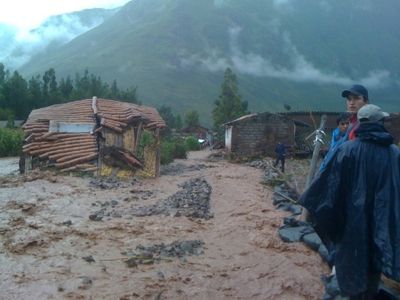
    When it was believed that the disaster situation caused by rains and flooding in Cusco, Peru and surrounding areas had gotten better, on March 1st strong rains [es] once again caused the overflow another river. The overflow of the Quesermayo River in the Taray District, Calca Province in the Cusco region produced 7 deaths, various injured and the flooding of 80% of the housing in the area [es]. It also affected the highway linking Cusco and Pisac. What made this flooding different than past occasions, is that it appeared that help arrived faster and the same day of the disaster, the Minister of Energy and Mines arrived with 3 tons of food assistance [es].

    Photo by Marco Moscoso and used with permission.

    Photo by Marco Moscoso and used with permission.

    However, it was also reported that other villages were affected [es], such as Cuya and Yacarpay, and a state of emergency was declared in other districts of Cusco, such as San Sebastián, San Jerónimo, Anta, Zurite, Limatambo and Lamay. As had been the case during the previous disaster, it was through Twitter that much of the news and photos of what was happening.

    Marco A. Moscoso (@markopunk):

    Taray en Calca se ha inundado por desborde de rio.

    Taray in Calca has been flooded because of the river overflow

    Rita A.B (@ritaposa):

    La lluvia en Cusco amenaza con continuar, Ayer llovió toda la noche y de nuevo todos los problemas surgieron, muchos niños no irán a clase.

    Rain threatens to continue in Cusco, Yesterday it rained all night and again all the problems arose, many children will not go to class.

    Javier Murillo Ch. (@ jataz8):

    Volviendo del camino Cusco – Pisac, es imposible pasar más del km 30, desde el mirador se observa que Taray esta completamente inundado

    Returning from the road Cusco – Pisac, it is impossible to go past km 30, from the lookout one can see that Taray is completely flooded

    Even though some paths were blocked, Moscoso of the blog El Caminerito [es] was able to arrive and take some photos, some which were posted on Twitpic. He also recorded video and when he returned to Cusco uploaded it to his blog:

    Hoy se realizaron trabajos de limpieza y encausamiento con el apoyo del Ejército Peruano, así como se inició con la labor de empadronar a los damnificados al tiempo de brindarles alimento. De regreso al Cusco, la pista Pisac – San Salvador se vio interrumpida al derrumbarse el cerro conocido como Morro Blanco por lo que para continuar hay que cruzar por chacras y lodo.

    Today clean-up work was carried out with the support of the Pervuian Army, and began with the task of registering the victims and at the same time providing food. Upon return to Cusco via the Pisac – San Salvador highway, one could see it was blocked by the landslide from the hill known as Morro Blanco, and which in order to cross one had to cross through fields and mud.

    He also contributed to a video with the blog Prensa Contacto [es]:

    In the above mentioned blog Prensa Contacto [es], they were able to collect statements from Ciriaco Condori, the Mayor of Calca Province:

    Nos faltó cultura de prevención, esto nos pasó de improviso. Nos encontramos negociando con el alcalde de Pisaq para que se reubiquen a las familias damnificadas en un terreno de esa jurisdicción. El gobierno central debería autorizar de manera efectiva la compra de maquinaría pesada a las municipalidades.

    We lacked a culture of prevention, and this suddenly happened to us. We are negotiating with the Mayor of Pisac to relocated affected families to some land in that jurisdiction. The central government should effectively authorize the purchase of heavy machinery for the municipalities.

    Finally, Javier Murillo of the blog El Pensador [es] (The Thinker), who was unable to arrive to Taray, uploaded photos and videos to his blog about the state of the Cusco – Pisac highway, which also suffered the ravages of nature:

    Translation by Eduardo Ávila
  • Peru: Cusco Bloggers Cover the Rain Disaster

    After two weeks of heavy rain and non-stop rainfall and following floods of Cusco, Puno and Apurímac, the citizen media has thoroughly covered the disaster in South Peru, while traditional media is now focusing on other affected zones like North shore [es], the North Jungle [es] and the Central Jungle.

    Photo by Alfredo Velarde. Used following a Creative Commons license. Taken from http://www.flickr.com/photos/velardemariscal/4316299488/in/set-72157623188793247/

    Photo by Alfredo Velarde. Used following a Creative Commons license. Taken from http://www.flickr.com/photos/velardemariscal/4316299488/in/set-72157623188793247/

    A persistent idea in the Cusco blogosphere is the lack of prevention [es] from the local and regional governments for this type of disaster that seems to happen every year. Frida Ibáñez from Crónicas desde el centro Cusco explained the geography and characteristics of the city, and questioned why there is no planning nor prevention from the authorities [es]:

    Ha llovido por cuatro días consecutivos con breves descansos, el cielo parecía no contenerse y caía agua de forma estrepitosa. Los ríos en las calles crecían cada vez más. No recuerdo una lluvia así de fuerte desde mi infancia … El Cusco es una hoyada. No es por gusto que la llaman ombligo… su geografía es particular. … Es en época de secas, entre mayo a setiembre que deberían hacerse la limpieza de los ríos, tal como lo hacían los Incas. Podríamos prevenir las pérdidas ante una eventualidad climática como la última. Nos preguntamos: ¿qué hacen las autoridades con el dinero que Cusco recibe del canon minero? recordemos que hace unos años se devolvió dinero de la Región Cusco a Lima porque no hubo capacidad de gasto y gestión.

    Rain has fallen for four consecutive days with only brief stops, the sky did not seemed able to retain itself and water fell very noisily. The rivers in the streets grew each time. I don't remember rain this heavy since my childhood … Cusco is a gully. It is not called ‘navel' by nothing… its geography is very unique. … It is in times of drought, between May and September that rivers should be cleaned, like the Incas used to do. We could prevent the loss to an climatic event like the last one. We ask ourselves: what are the authorities doing with the money that is given to Cusco by the mining taxes? We should remember that years ago money was returned from the Cusco Region to Lima because there was no spend capacity or management.

    Frida also wrote about helping those affected by the rain [es]. CafeHenry from the blog El Placard "H" also commented on the reaction from the government [es] .

    Photo by Alfredo Velarde. Used following a Creative Commons license. Taken from http://www.flickr.com/photos/velardemariscal/4315585687/in/set-72157623188793247/

    Photo by Alfredo Velarde. Used following a Creative Commons license. Taken from http://www.flickr.com/photos/velardemariscal/4315585687/in/set-72157623188793247/

    Alfredo Velarde was visiting the town of Aguas Calientes, on the foothill of Machu Picchu, when it all started. On his blog, he offered a first-hand testimony of the disaster [es] and impressive photos on his Flickr account:

    casi 3000 personas procedentes de Camino Inca y de la ciudad de Cusco, quedamos varadas en este pueblo, con escáso alimento, una pésima organización contra desastres naturales, autoridades corruptas y el desconcierto persistente, para el martes el caos se apodero del pueblo, debido a la poca ayuda del gobierno y las terribles desigualdades entre los residentes, turistas extranjeros y peruanos que las mismas autoridades genéran. … hoy por la tarde recién pude salir del lugar evacuado en un helicóptero de la Fuerza Aérea Peruana … pero preocupadísimo por los cientos de peruanos que por discriminación están siendo dejados de lado por la autoridades policiales, militares y por los grupos de extranejeros al mando de las actividades de organización para la evacuación.

    almost 3000 people from Camino Inca and the city of Cusco were stranded in this town, with almost no goods, a faulty organization against natural disasters, corrupted authorities and persistent confusion, on Tuesday the chaos reigned in town, because of the scarce support from the government and the horrible inequalities among habitants, foreign turists and peruvians, caused by the authorities themselves. … today in the afternoon I could finally leave the place by an helicopter of the Peruvian Air Force … but I was so worried about the hundreds of peruvians that are left behind because of the discrimination by the police authorities, the military and the foreign groups in charge of the organized activities for evacuation.

    Citizen media has gathered important information about the impact of the disaster. One of the most comprehensive coverages is the one of Marco Moscoso from El Caminerito, who we addressed in a previous post. He reported through his blog and Twitter account about emergency brigades, donation centers and any related irregularities, and even created a map with information of the affected areas.

    Another important example is Prensa Contacto, a project started by two young communicators from Cusco who inform about what happens on their grounds. In a recent post [es] they reported that, until February 4th, in the Cusco Region there were 35,818 affected families and 13,210 dwellings damaged, following the last report from the regional president.

    On his personal blog, Luis Figueroa made a virtual tour on Valle Sagrado with information about food and goods [es] in case of disaster. He also narrated and illustrated a mass and a procession to stop the rain [es]:

    Desde 1986 el Taytacha no salía a las calles del Cusco fuera de su día principal -Lunes santo-, hoy, sin embargo, se realizó un servicio religioso a las 10:00 horas en el atrio de La Catedral con la intención de elevarle preces para aplacar las fuertes lluvias que caen sobre la región … Sin embargo, luego de concluida la misa, el sacerdote anunció que “para cuidar la imagen” la bendición sería impartida sólo en el atrio, a lo que el pueblo replicó “¡Que haya procesión!”. Minutos después, el Taytacha de los Temblores daba una vuelta por la Plaza de Armas para satisfacción de los fieles.

    Since 1986 the Taytacha did not come out the streets of Cusco besides the main festivity -sacred Monday-, today, however, a religious service was made at 10:00 hours in the atrium of La Catedral with the purpose of praying for the tame the heavy rains that fall on the region … However, after the mass concluded, the priest announced that "in order to protect the sacred figure" the blessing would be given in the atrium, which caused the people to answer "There must be a procession!". Minutes after, the Taytacha de los Temblores [Lord of the Tremors] made rounds through the Plaza de Armas to please the believers.

    On the subject of help and solidarity, the Proyect of La Casa de Mayten reported both in text and photos [es] the current actions to help those affected in the town of Huacarpay on the blog Cambiando el Mundo:

    Mi meta principal del viaje hoy fue levantar/recopilar informacion sobre la situacion global actual en Huacarpay, identificar sus necesidades urgentes, ver su estado de salud, y identificar los puntos de contacto a traves de los cuales coordinar esfuerzos organizados. … pudimos rapidamente conocer a, y hablar con, los 10 representates de los 10 sectores formados en el cerro en el que se refugian desde el domingo pasado, 315 familias (aprox 1,575 personas) incluyendo al sr. alcalde y a la teniente gobernadora.

    My principal achievement of today's trip was to collect/obtain information about the actual global situation in Huacarpay, identify their urgent needs, check on their health status, and identify contacts by which coordinated and organized efforts can be made. … quickly we got to know and talk with 10 representatives of 10 organized sectors in the hill where, since last Sunday, are refugeed 315 families (aprox 1,575 people) including the mayor and the lieutenant governor.
    Photo by Alfredo Velarde. Used following a Creative Commons license. Taken from http://www.flickr.com/photos/velardemariscal/4316294672/in/set-72157623188793247/

    Photo by Alfredo Velarde. Used following a Creative Commons license. Taken from http://www.flickr.com/photos/velardemariscal/4316294672/in/set-72157623188793247/

    More coverage on this situation can be found on the blogs El Caminerito, Urquillos [es], Radio Voz Populi Urubamba [es], Apurímac, Christian David Peña [es], El Trotamundo Tartamudo [es] and Chikuchape [es].

  • Peru: Aid and Rescue for Flood Victims in Cusco

    The situation in Cusco, Peru remains difficult because the rains have not ceased. However, that is not the only problem the region faces. Amid allegations and rumors [es] that tourists [es] were charged money in order to be rescued, which is something that the authorities have denied [es], the Chilean government sent a Hercules aircraft [es] on January 21 to pick up Chilean citizens. There are photos of those rescued here.

    A flooded street in Huacarpay photo by Zenobio Valencia and used with permission.

    A flooded street in Huacarpay photo by Zenobio Valencia and used with permission.

    Other reports have surfaced in regards to rising food prices [es] in the area of Aguas Calientes, the gateway town to Machu Picchu. The Attorney General ordered an investigation [es] to verify and act if it finds price speculation in the restaurants and stores.

    As expected, the news soon appeared about the complaints about a lack of transparency [es] in the distribution of aid to victims. Many are hoping that the government addresses this issue.

    In addition, there are concerns about the tourists who were hiking the Inca Trail and in the Sacred Valley, when the landslides started. It is estimated that at the time, there were about 1,500 tourists in the area [es], but to date it is not known whether all are safe. The total number of tourists in and around Machu Picchu was estimated to be 2,000.

    Twitterers have been posting information on what has been happening in and around Cusco. Some of the tweets show the two sides of humanity:

    @harrygonzales:

    Sigue llegando el agua para ayudar a nuestros hermanos en la plaza de Armas #cusco http://tweetphoto.com/9723290

    Water continues to arrive to the Armas Plaza to help our brothers and sisters #cusco http://tweetphoto.com/9723290

    @harrygonzales:

    Los damnificados de Pisonay están en el centro recreacional de Calca http://tweetphoto.com/9742996 #Cusco

    Those affected in Pisonay are now in the recreational center in Calca http://tweetphoto.com/9742996 #Cusco

    Lynn Mora @lynnmora:

    En Cusco los scouts fueron enviados a las zonas de desastre para apoyar a damnificados.

    In Cusco, the (boy) scouts were sent to the disaster area to help those affected.

    @elcaminerito

    Nos avisan que existen ladrones que están saqueando en Huacarpay y Pisac,por favor los voluntarios vayan identificados, para evitar problemas

    They tell us that there are thieves that are looting in Huacarpay and Pisac, volunteers please identify them, please, to avoid problems.

    Marco Moscoso has been regularly posting photos to his Twitpic account, and he has been one of the driving forces behind the interactive map that shows the emergency areas [es]:


    Ver Cusco under Emergency to see a larger map

    In this post, the blog Cambiando el Mundo [es/en] (Changing the World), one can find a list (in English) of the needs for donated goods for the people of Huacarpay, a community that was drastically affected by the floods.

    There is also a Facebook group to collect help for Cusco: A United Cusco Against the Misfortune!! [es]

    Translation by Eduardo Ávila
  • Peru: Heavy Rains and Mudslides in Cusco

    On Tuesday January 26, after a rainy week and after three days of non-stop rainfall, the region of Cusco, Peru has been declared in a state of emergency for 60 days, in order to speed up the clean-up efforts and to help the thousands of people (local residents and tourists) that have been affected by the floods and mudslides.

    Photo by Carlos José Rey of Living in Peru and used with permission.

    Photo by Carlos José Rey of Living in Peru and used with permission.

    While it is still too early for a formal estimate of the general amount of the damages, reports state that more than 40 mudslides have not only blocked many roads in Cusco and destroyed more than 9,000 hectares of land and crops, houses and infrastructure, but also caused three deaths. In addition, almost 2,000 stranded tourists, who are currently arebeing evacuated in Army helicopters.

    Local twitterers were especially active reporting the latest events in the disaster areas, and posting photos and videos almost in real time since early morning. Some of the most active twitters were Marco A. Moscoso @Markopunk, and @Apu_Rimak, both of whom are from the area and have been tweeting all day, like these ones:From user @markopunk:

    En Pisac ha colapsado el puente principal. El puente está inclinado. Maizales y viviendas han sido inundadas. link

    Izcuchaca, inundaciones en viviendas y hospital. Dos heridos por colapsamientos de viviendas. link

    Seda Cusco comunica que en Saylla se han caido dos postes de alumbrado público que ha obstruido el bombeo de agua. link

    The primary bridge in Pisac has collapsed. The bridge is inclined. Crops and houses have been flooded.

    Izcuchaca, flooding in housing and the hospital. Two injured for the collapse of housing.

    Cusco site communicates that in Saylla, two light posts have fallen and are obstructing the pumping of water.

    From user @Apu_Rimak:

    Desde el Gobierno Regional del Cusco, se acaba de declarar en emergencia la región. link

    From the regional government in Cusco, the region has been declared in a state of emergency

    Bloggers have also been posting about the events. Derik of the blog Crío de la Niebla [es] posts two videos and says:

    Aunque estamos en temporada de lluvias, lo que está sucediendo está más allá de lo normal. Hoy los medios de comunicación informan que el Gobierno ha declarado el estado de emergencia en los departamentos de Apurímac y Cusco.

    Una vez más es importante actuar y, al mismo tiempo, reflexionar respecto a si estamos preparados o preparándonos, por lo menos, para una catástrofe que podría ocurrir en cualquier momento.

    Even though we are in the rainy season, what is happening goes beyond what is normal. Today, the media said that the government declared a state of emergency in the departments of Apurímac and Cuxco.

    Once again, it is important to act, and at the same time, reflect on whether or not we are prepared or in the process of preparing ourselves, at least, for a catastrophe that can occur at any moment.

    The videos published were filmed by YouTube user Multimediantonio, who describes the videos as “what no one reported. Part 2 can be found here.

    The Huacarpay District in Cusco literally “disappeared from the map.” The entire district remained flooded because of the lake and the river. There are thousands of affected, the people are sleeping in the mountains unprotected.

    Laura Arroyo of the blog Menoscanas writes:

    El mismo Premier ha afirmado, el día de hoy, que hubo fallas en la prevención de estos desastres. Bueno pues, es hora de que deje de haberlas pues las facturas son costosas. Una vez más, la política de reacción nos demuestra que es insuficiente. No podremos evitar que más desastres naturales causen perjuicios en el Perú, pero podríamos evitar que los mismos sean tan grandes.

    The President has stated, that there were failures in the prevention of those disasters. Well, it is time to stop having failures, because they are costly. Once again, the policy of reaction is shown to be insufficient. We cannot avoid that more natural disasters affect Peru, but we can avoid that they become so large.

    Important sources of news in English can be found at the site Living in Peru, Stu en Perú, and KnK Explore. These same sites are also regularly twittering the information, @livinginperu, @stuenperu, and @jkwak.

    The media has also provided special coverage pages about the disaster, such as the information from the newspapers El Comercio [es] and La República [es]. They are providing information not only about the mudslides in Cusco, but also in the departments of Apurímac and Puno. The rescue efforts have been concentrated on the stranded tourists in Machu Picchu and the Sacred Valley, and it is expected that rescue activities will reach local residents affected and isolated.

    With the news, many are wondering about the contingency plans for emergencies. The country has also suffered through the phenomenon of El Niño in which many things have been left unfixed. There are still retaining walls to be rebuilt, slopes to reforest, and cases to relocate. However, with the arrival of these heavy rains, many people wonder whether it is possible to take preventative mesaures so that the consequences are not so serious.

    Isabel Guerra contributed to this post.

    Translation by Eduardo Ávila
  • Peru: The Loss of Local Rock Radio Stations

    In a local context in which Peruvian radio [es] and television [es] stations have lately been closed for supposed political reasons, the end of transmission of a pair of “album-oriented rock” radio stations may seem insignificant. However, against what might be expected, the reaction from radio listeners is worth mentioning and analyzing.

    On December 8th, 2009, Miguel Villamizar of the blog LO MEJOR del Rock and Pop en PERU [es], celebrated the 12th anniversary of the station Radio Z. However, later that month on December 30, Villamizar wrote that the rock and pop music station Radio Z would stop transmitting, and in its place, La Calle Radio (The Street) would begin on the same radio frequency, which would play reggaeton, cumbia, and salsa. He writes, “this time another company owned by Mr. Capuñay are now the standard bearers of this ‘worsening' of radio music in Peru.” Even though the post is short, it attracted 221 comments, and most disagree with the closure of the radio station.

    On January 3, 2010, Villamizar wrote that Radio Z [es] could now be heard online:

    Para muchos esto puede ser un juicio subjetivo lo cual es válido desde todo punto de vista. Pero lo que llama realmente la atención es que a más de cinco días de lanzada esta emisora la cual nos amenaza de liberarnos (no sé de qué) no tiene un solo segundo de publicidad. Entonces la pregunta es : Cuál es el negocio? Uno de los argumentos para sacar del aire a Radio Z fué que el Rock no vende, que estamos en la era de la cumbia y del perroton…

    Otro argumento que escucho para justificar este hecho, es que “ellos son los dueños y pueden hacer lo que quieren… tiene que recuperar su inversión?”. Inversión? . Recuerdo a fines del 2004 cuando el poderoso grupo RPP compró la señal de Radio América para instalar su primer satélite llamado “La Mega”. La señal de América fue cortada de un momento a otro , y regreso después de dos días con la nueva radio “La Mega” . Al iniciar su transmisión todo era publicidad en la flamante nueva emisora de RPP. Y entonces de que hablamos en el caso de La Calle. El dueño de esa radio está recuperando su inversión? Cuál es su negocio. La Calle esta lleno de publicidad actualmente?. La respuesta es NO.

    For many, this can be a subjective opinion which is valid from all points of view. However, what really draws one's attention is that after five days of its launch, this station threatens to break free (do not know from what) and it does not have a single second of advertising. So the question is: How do they stay in business? One of the arguments for taking Radio Z off the air is that Rock does not sell, we're in the era of cumbia and perroton …

    Another argument I hear to justify this, is that “they are the owners and they can do what they want … they have to recoup their investment?” Investment? . I remember in late 2004 when the powerful RPP group bought Radio América to install its first satellite called “Mega”. América's signal was cut from one moment to another, and returned after two days in the form of a new radio station “La Mega”. Upon starting the transmission, the new RPP-owned station had advertising. So what are we talking about in the case of La Calle. The owner of that station is recouping its investment? What is its business. La Calle is full of current advertising? The answer is NO.

    However, on Monday, January 16, the blogger reported on the first of the new radio advertisers: the National University of Trujillo, Ecomuebles and Merchants [es], but he remained suspicious of the source of these advertisers. From Santa Clara, California, Javier Lishner of the blog Rock Around the Blog [es] spoke with Julio Villar [es], a fan and connoisseur of Lima radio station, and also with Villamizar [es]. Both interviews provide very good background information on the history and current status of radio in Lima. Fairly similar to the above case is the case of Radio Telestereo [es] (link works only in IE). Isabel Guerra of the blog Burbujas Recargadas [es] shares her impressions in this post:

    para mí, en lo personal, la noticia del día, fue el cada vez más insistente rumor de que la señal de Telestereo 88.3FM no iba más en el dial. Muchos recuerdos pasaron por mi mente mientras pasaban las horas y se hacía cada vez más evidente que no se trataba de un hoax. … Telestereo 88.3FM era la única radio, de todas aquellas con que crecí, que había sobrevivido a todo.

    Era no sólo una estación con una propuesta musical diferente, sino todo un punto de referencia en la cada vez más alicaída oferta radial limeña: era además un ancla generacional. Pensar que esta radio se mantenía pese a toda la invasión reggaetonera y cu-cu-cumbiambera era algo que nos hacía sentir que nuestros gustos todavía tenían un lugar en el dial. ¿Y ahora qué? ¿Ya no somos ni siquiera un nicho de mercado?

    for me, personally, the news of the day, was the increasingly insistent rumor that the Telestereo 88.3FM signal would no longer be on the dial. Many memories passed through my mind as the hours passed by, and it became increasingly clear that this was not a hoax. … Telestereo 88.3FM was the only radio, of all that I grew up with, that had survived them all.

    It was not just a station with a different musical approach, but quite a landmark in the increasingly sluggish Lima radio offering: it was also a generational anchor. To think that this radio was maintained despite the invasion of reggaeton and cu-cu-Cumbiambera was something that made us feel that our tastes still had a place on the dial. What now? We're not even a niche market?

    This post also received a significant number of comments, 74 so far, most of them were lamenting the virtual disappearance of the radio. Then, Guerra published another post that the Telestereo signal could be heard via the internet [es], even though there were no announcers. Javier Lishner also addressed the issue in three posts: (1, 2 and 3) to figure out what really happened to this radio because, so far nothing is definite:

    Hoy, fprtvn, otro lector o lectora del blog, dejó un mensaje en el que afirma: “Telestereo no la venden. Acabo de hablar con los dueños (ambos) y dicen que NO LA HAN VENDIDO NI ALQUILADO. En eso han sido contundentes. Parecería ser una “muerte y resurrección” lo que también se trasluce del Comunicado en el site de Telestereo. Curiosamente la tanda comercial sigue saliendo pero vía Internet (no sé que opinen de ello los anunciantes). Así que podríamos estar hablando de un “Telestereo Reloaded” los primeros días de febrero de 2010″. Con este comentario, la incógnita de los nuevos dueños se nos vuelve a alejar. Qué interesante.

    Today fprtvn, another reader or blog reader, left a message saying “Telestereo will not be sold. I just talked to (both) owners and they say that they have neither sold, nor rented it. They were very clear with that. It appeared to be a “death and resurrection” which is also what is indicated by the Communiqué on the website of Telestereo. Curiously, the commercial signal is coming via the Internet (I do not know what the advertisers think of this.). So we might be talking about a “Telestereo Reloaded” during the first days of February 2010.” With this comment, the mystery of the new owners will keep us away. How interesting.

    Leaving aside some of the specifics of each case, a common point to bloggers and commentators in the posts above is the complaint that there is a reduction in the number of listening options for certain types of music, in this case for rock and pop. Ernesto of Física3 [es] puts it this way:

    muchos dirán que en esta época ya no hace falta la radio, que solo resta armar tu lista de mp3 e ir por ahí, pero no, ese no es el punto, la radio tiene el efecto de ser una propuesta, el planteamiento de los DJs sobre lo que ellos creen que le puede gustar a su público, y la fidelidad de este público en base a esa propuesta. Ahora lo que ocurre es que no hay quien te vaya proponiendo cosas que vayan de acuerdo a tus preferencias, y siendo así el circulo vicioso de ir cayendo en la masividad de la pobre oferta existente seguirá y seguirá.

    Many would say that at this time, radio is no longer needed, and all that is needed is to build an mp3 playlist, but no, that is not the point. Radio's effect is one of being a proposal, the selection by the DJs, of what they think that the public might like, the loyalty of that public based on that proposal. Now what happens is that no one will be proposing things that suit your preferences, and in that way, the vicious cycle of falling into the massive and poor selection will continue to go on and on.

    Meanwhile, Luis Gadalupe also commented saying goodbye to Telestereo 88 FM and thanking them for everything [es]:

    Lamentablemente, en las épocas actuales, son las corporaciones radiales las que quieren acaparar todo, y finalmente absorben a los más pequeños y eso es lo que pareciera haber sucedido con Telestereo. Se respetan los gustos mayoritarios pero también deberían respetarse los gustos de las minorías que tienen todo el derecho a escuchar la música de su agrado en una emisora radial.

    Unfortunately, in current times, radio corporations want to monopolize everything and they finally absorb even the smaller stations, which is what it appears to have happened with Telestereo. Majority tastes are respected, but minority tastes should also be repected because they have all of the right to listen to their own tastes on the radio dial.

    In reality, and even though the way people identify with “their music” could be seen as being snobbish, there are some who outright dismiss the tastes of others, even going as far as being derogatory against those who do not share their own music tastes. For some, it is difficult to understand why there are less options to listen to rock and pop on Peruvian radio, despite the increase in the number of international rock bands that arrive to Lima, as shown by the recent concert by Metallica. This shows that there is in fact, a market for this type of music.

    In an article that contains some points of agreement with the problems described here, Professor Adrián Menéndez in the blog PuntoEdu [es] from the Catholic University asks, “what must be done in order for Peruvian radio to be played more often on Peruvian radio?

    ¿Que espera una emisora musical de un nuevo grupo de rock? Cuando se programa una canción en una emisora musical, se piensa en la audiencia potencial. El programador está pendiente de la volatilidad de un oyente que, por ejemplo, en promedio cambia de emisora cada 42 minutos y el tiempo que espera para cambiar una canción que no le gusta es de apenas unos cuantos segundos. Entonces, una canción al aire debe ser reconocida por la audiencia de esa emisora como una canción de su gusto. Esta es la variable que condiciona a un programador musical de radio: que por una canción nueva o desconocida se cambie de emisora.

    What does a radio station expect from a new rock band? When a new song is scheduled on a radio station, one things of the potential audience. The radio programmer is aware of the volatility of a listener, who, for exaample, changes stations once every 42 minutes and the time that one waits to change a song that one does not like is only a few seconds. A song on the air must be recognized by the audience of that station as a song of their taste. This is the variable that conditions a radio programmer: a new or unknown song, then the station is changed.

    The way that internet users protested the absence of two music stations is symptomatic of the level of civic consciousnes by listeners. Perhaps the fact that this happened in Lima and not in the provinces explains, but does no justify, this large difference in reactions.

    Thumbnail by onkel wart and used under a CC license.