Plural+ is once again calling for entries for their Youth Video Festival on Migrant issues, asking youth worldwide to send in their videos discussing identity, diversity, integration, human rights and inclusiveness among other topics. Entry deadline is June 30th and video submission is by sending in a DVD to the USA. Rules and Regulations here.
Author: Juliana Rincón Parra
-
Mali: Fabric weaves an economical and cultural support
 Through videos, we see and learn about the cultural importance and economical boost that working with fabric is giving some people and organizations in Mali. From a women's group which claim to have placed Mali as a power in the cloth dying industry, to artists who have decided to make Bamako or mud dyed cloths their medium, to the touristic industry that has grown around this art.
First, via Craft: we learned of a recent fundraising activity Maureen Gosling organized to assist her in finishing her documentary about the women cloth dyers of Bamako (Mali's capital city). In this video preview, the women dyers speak about the importance their dyed cloth has in Mali and how working with it has impacted their lives:
Another traditional textile is the mudcloth. This next video from TravelWestAfrica shot in Ségou, we see how they make the dyes which include the mud that gives the cloth its name:
Another name for the mudcloth is Bogolanfini; in this following video by hubuf made in 2006, a trainer explains to a group of students what bogolan is, what it's made of and what it means for Malian culture:
In this next video by claudiodumali we can see a group of visitors learning by doing; with small scraps of cloth they experiment with the different dyes and muds used in Bogolan making in Ségou:
If you wish to know more about Bogolan, polbenmali has uploaded a 2 part documentary (part 1, part 2 [fr]) on Issiaka Dembele, an artist who turned to Bogolan as his medium. In the videos, Dembele speaks in French about his trade, but the images show clearly the intricate and time consuming process of dying the fabric yellow, covering it in pond mud left to rot for months which will turn the fabric black, and then going over the yellow areas to remove the dye in certain parts, painting over other colors in others:
-
Chile: Tu Sunami jabs at President, quakes and aftershocks
From Chile, a video mashup by tintoweno mixes McHammer, Storm Troopers and the Chilean president Sebastián Piñera as comic relief: adding humor to the tense situation lived in Chile as they still experience very strong aftershocks after the February 27th 8.8 earthquake. The video's name, Tu Sunami refers the President's slip up when he mispronounced Tsunami.
-
Colombia: Confusing Ballots on Election Day
During the Colombian elections held on March 14, one complaint became common: the ballots were confusing and people were unknowingly making their vote null by marking the wrong boxes. During these elections, instead of the usual pictures of candidates or names in the ballot, citizens only had the party symbol and a number box. Voters had to remember what their candidate's party and number were in order to place their vote.
Sebastian Chaskel of the blog Americas Quarterly attempts to explain the voting system in place:
Colombians will vote first and foremost for their favorite party. If the party has an open list, voters may (but are not obligated to) specify which candidate they support within that party. But if the party has a closed list (which some do), then the party will have already assigned priority rankings to its candidates and voters will not be able to specify their personal preferences. As a result, many votes may ultimately help elect candidates who are not the voter’s preferred choice.
One Twitter user who did not favor this system is Miguel Olaya (@juglardelzipa) who wrote:
el sistema es mierdoso: le doy mi voto a un individuo de un partido, el man gana y le pasa el voto a un hijueputa que no quería que quedara.
The system is shitty: I give my vote to an individual from a party, this guy wins and passes the vote to some SOB who I didn't want to gain a seat.The system led others to find a way to explain it to local residents. In the vicinity of a voting center in Belén, a community leader posted a large version of the voting ballot so that voters could familiarize themselves with the voting method. This activity, which he called educational, was questioned by some who stated that he was telling people how to vote.
In this post by Mary Luz Gallego Osorio, written for Bitácora [es], EAFIT University's online magazine, she quotes the community leader's defense of his demonstration:
A la persona que se arrima le digo que ella misma coja el lapicero y marque el partido que quiera y la prueba la tengo aquí en el tablero que están borrados todos. El ejercicio lo hace la gente, yo no estoy apoyando a ningún candidato, la gente marca.
To the person who walks up I tell them to take the pen and mark the party they want, and the proof is here on the board where you can see they get erased. The exercise is done by the people, I am not supporting any candidate, people mark their choice.It was easier to understand the voting ballot system if one had internet access: different websites posted videos and voting guides. Such was the case with La Silla Vacía [es], an independent online media source, which had a “Voting Guide for Dummies” page. During the elections La Silla Vacía also had a very active twitter account, @lasillaenvivo reporting on the voting process and results as they started coming in.
Alexander Castro of the blog Updated Geek [es], in the Boyaca region wrote about his experience voting for the first time. He wrote that he was not motivated by civic duty, but rather by the tuition discount universities give to those who show the voting certificate. He also had this to say about the confusing ballots:
Cuando las destape me sentí confundido, era como encontrar la salida a un laberinto, como un juego de lógica y las instrucciones que llevan impresas en la parte posterior no servia para nada, aburrido por esto pensé en tres cosas:
1.Votar todo en blanco.
2.Hacer un cuadrado y dentro un dibujo de Optimus Prime y arriba escribir partido Autobot.
3.Votar por el primero de la lista.
4.Dejar el tarjeton tal como me lo habían entregado.When I uncovered the ballots I felt confused, it was like trying to find my way out of a labyrinth, like a logic puzzle and the instructions printed on the back were of no use, bored by all this I thought of three things:
1. Mark the “Blank vote” option on all
2. Make a square and draw Optimus Prime in it and write above it Autobot Party
3. Vote for the first one on the list.
4. Leave the ballot blank just as they had handed it to me.Regardless whether the voting system was too difficult or not, some looked forward to election day. Manuel Gomez (@manuelj) wrote:
A mi me encanta que el voto sea una moda, mientras sea un voto consciente.
I love voting to be in fashion, as long as it is a conscious vote.Julián Ortega Martínez contributed to this post. -
Costa Rica: Bicycles, Birthdays and Teachers
Julio Cordoba on his birthday post brings us a glimpse of everyday life: he recalls his triumphant feeling when his dad taught him how to ride a bicycle when he was 12. Years later, he discovered his father was a better teacher than he had thought: his father had never learned how to ride a bicycle himself, since he didn't have one when he was growing up.
-
South Africa: inappropriate content in the classroom stage
Rochele Ardesher published a video taken during a South African elementary school class of what she calls inappropriate content where the teacher berates the students for improper bathroom usage.
-
Iran: OR318 memorial to blogger’s death in prison
The one year death anniversary of blogger and journalist Omid Reza Mir Sayafi is coming around and the OR318 movement is quite active, raising awareness regarding not only Omid's death in an Iranian prison but also the risks bloggers take when they decide to write.
On their website march18.org they have gathered blog posts, videos and photographs around freedom of speech, and also have active twitter and facebook groups.
This is one of the videos, uploaded by wunderkindify, where he explains how OR318 came to happen:
Jordan Ess showed his support by taking a picture of himself holding up signs supporting the movement:
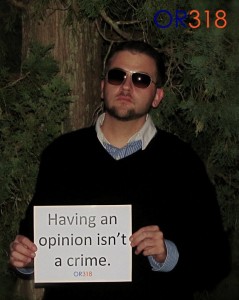
Jordan Ess shows support for OR318
How can you participate and let the world know that freedom of speech matters? MEYmedia uploaded a video where they explain the different actions you can take to support the OR318 Movement.
-
Brazil: Shocking and Moving people into Adopting Strays
In this shocking video, Joao Frigerio shows how a young murder victim's dog in Curitiba Brazil lay next to its owner's dead body during the police investigation process until the body was taken away. The purpose? To convince people of the unconditional love animals give and promt them into adopting strays. (Caution, the video contains images of a dead body that could be inapropriate for some)
-
Colombia: Transportation Strike from Pedestrian Eyes
Videos record the situation lived these past three days of city-wide transportation strike that has Bogota paralyzed. Citizens have resorted to walking, riding bicycles, hitchhiking and climbing into the backs of pickup trucks that will take them closer to their places of work. The only system that remained in operation yesterday was the Transmilenio central bus system when even taxi drivers joined the strike, and it wasn't able to deal with the exponential increase in passengers.
Most of the frustration during the transportation strike has been directed to the only massive transport system which has been in operation during the strike: Transmilenio, due to the extremely long lines to get service, the lack of buses to get from other points in the city to a station and buses that stopped at stations but were so crammed full of people that no-one could get in.
This one, recorded by pruebasyopublico shows the view from the bus as a it rolls into a station:
Inside the stations the situation was also serious. The transmilenio system which is usually the brunt of complaints due to its maximum capacity being reached during rush hours, was now at that maximum capacity throughout the day. This video shows the Virrey station during the strike:
And this other video (minute 1:40 ) shows the same station without the crowds:
The following video was made by someone recording an accident, but at minute 1:40 you can see a yellow hatchback car that is taking people to work with passengers even sitting on the floor of the trunk space:
Here is a mobile upload by Andrés Hernández Godoy (@andresgodoy on twitter) of a truck which has already placed a sign on its windshield stating its “routes” in order to transport people in lieu of buses:

Image by Andrés Hernández Godoy
Jair Andres Moreno (@budamoreno) also uploaded many different photographs regarding the long lines at the transmilenio stations, sometimes reaching 8 people wide and hundreds of meters long, like this one, or this next one where passengers are crowded on the bus arrival platform, risking their lives.
Transportation complications are not the only effects of the strike: riots, vandalism and people throwing rocks, sticks and more to buses breaking the strike, looting of businesses and private residences are what some people have lived through these past days. It seems that minors were paid between 2.5 USD and 5 USD by agitators according to Radio Santa Fe.
In Violeta Speaks blog, a frequent user of public transportation speaks about the strike, the bus driver's reasons for the strike and its impact on the citizens:
Además, si los señores conductores están exigiendo (hasta donde tengo entendido) mejores tarifas, pues nosotros, que somos los que las tenemos que pagar, exigimos que nos den un buen trato, porque a parte de todo, muchas veces el irrespeto por el pasajero es increíble…
So, if Mr. Busdrivers are demanding (if I understand correctly) better rates, then we, who are those who have to pay the higher rates, demand that they treat us well, because if it weren't enough, so many times the disrespect paid to passengers is incredible.El Tiempo newspaper collected stories from travellers who faced the strike and its problems: pregnant women affected by tear gases, workers having to walk 4 or 5 hours to get to work, others had to ride their bicycles for more than 2 hours at the middle of the night to get home, a woman who had to resort to getting into cattle trucks as transport was not only harassed but also had her cell-phone stolen.
-
Video Participation: How you see the world for BBC
Young People's Media Network posted that the BBC is looking for you to send in a 2 minute documentary on “how you see the world” to be broadcast worldwide. Deadline is March 12th. Application information here.
-
Chile: More videos recorded during the Earthquake
Costa Rican journalist Cristian Cambronero has made an excellent roundup of more videos recorded during the Chile 8.8 Earthquake early on Saturday morning.
-
Video: Chile Earthquake through Citizen’s Eyes

Santiago After the Earthquake by pviojo CC-By
As the day comes to a close, more videos crop up of the devastating 8.8 magnitude earthquake that hit Chile at 3:30 am. The earthquake, which not only affected the mainland through the ground movements, also generated tsunami waves that set out an alarm throughout the Pacific as different nations prepared for the waves to hit their shores.
Some videos were made during the earthquake itself, as this amateur video found on YouTube. It starts with a shot of a computer in a room, and as the earth moves the rumble of the earth can be heard, then the lights go out and we are left in the dark, hearing only the voices of a woman and a man we assume to be the one holding the camera trying to calm her down.
This next one was recorded by YouTube user ikonsento during one of the aftershocks:
Ikonsento has been reporting since minutes after the first earthquake, when he uploaded this video showing how his house fared: the way furniture slid on the floor and toppled over bearing witness to the earthquake's strength:
This video was made minutes after the quake, as this next one where two men who had just arrived in Chile experience the quake and then decide to leave their building and stand outside for a bit. As lights come back on their building, they walk back and the building's inhabitants are all milling in the lobby, and as they return to the building, the assess the damage: broken water pipes and cracked concrete.
As daylight came, more people went out to the streets and recorded the damage they observed:
Netprox drove through the highway, and had to squeeze under a fallen bridge to get through.Rafael Vial also went out to the streets and recorded a collapsed bridge in Llaillay, Chile, which he streamed through his mobile phone on Qik.
Communications in many areas of Chile are down and it gets harder to get in touch with loved ones to make sure they are all right. This couple of girls took advantage of YouTube and recorded their video, where they tell friends and family they are OK, and narrate a bit of what they've seen and heard regarding the earthquake:
And others, in their need to help are spreading valuable information regarding what to do to maximize the possibility of staying alive in a collapsed building. Such is the case with this video which is being passed after the quake. The Life Triangle theory basically states that the safest place to hide in an earthquake is not under furniture, but besides a strong piece of furniture: that way, if the piece of furniture is crushed by falling materials, it will not collapse on the person hiding under it. Instead, the person will be safe in the pocket created on the object's side. This promotional video which was adapted and translated into Spanish, explains why hiding under desks or under doorways is just not going to allow you to survive.
-
365: A video a day from Cartagena, Colombia

photo by Mario Carvajal CC-by
A group of videobloggers from Colombia decided to make 2010 into the year for videblogging, and set out to make a video a day during 2010. Today we bring you a selection of videos from the city of Cartagena in Colombia: UNESCO World Heritage Site and a top travel destination according to Frommer's travel guides.
Erika Pao and Luisa Santiaga are two girls who live in Cartagena and wished to show Cartagena from the perspective of those who live there, seeking to bring out the daily events and commonplace to light:
contar a través del video toda esa cotidianidad e historias anónimas que nos rodean; toda esa riqueza cultural y social en las que estamos inmersos pero que muchos desconocen de nuestra ciudad
Tell through video all the everyday events and anonymous stories that surround us; all the cultural and social wealth that we are immersed in but many ignore about our city.Part of the successful national Colombian campaign to increase tourism has been related to their slogan: Colombia is Passion. But the efforts are not only seen outside the country, inside, it has also been employed to strengthen the national pride. Such is the case with their promotional event in Cartagena: in one of the plazas of the walled city, they placed sculptures and images that reflect the campaign. The song used to accompany the video is a joint effort between many Colombian artists for the campaign and is called Colombia es Pasión:
January 2nd is the Candelaria Virgin procession, where Catholics climb up to the convent at the top of Popa hill and then bring down the Virgin on their shoulders to the chapel at the bottom of the hill:
In Cartagena, near the Carriage Plaza there is a covered passageway that used to be where slaves were sold. At the end of the XIX century, it started selling much more palatable wares: candy. The Candy Portal sells many of the traditional sweets produced in the region: Tamarind, coconut and sugar cane concoctions.
There are also other commonplace images, in this next video, barefoot children play soccer on the dusty streets under the midday sun in the “Cheap Rice” neighborhood.
These next videos show a bit about the food in Cartagena. First, a mysterious drink made of rice, milk and flavorings, with nutmeg, sweetened condensed milk, chocolate chips and ice, it is described by the vendor on his sign as : Exquisite, nourishing and refreshing:
Another traditional food staple in Cartagena is the “patacón pisao”, a squashed double fried plantain that is eaten at every meal. Luisa Santiaga takes us through the step by step process of peeling, cutting, frying, squashing, dunking, and frying plantains:
This last video takes us out of the walled city and into the streets where locals live, shop and move around:
If you want to see more of Cartagena through the eyes of these two women, you can visit and subscribe to the Cartagena 365 page or follow @luisasantiaga and @erikapao on twitter where they twit about their latest uploaded videos.
In future posts, we will bring you videos from other Colombian vloggers participating in the 365 project. Do you know of any videoblogger we should write about on Global Voices? Please write to us and let us know!
-
Congo: The Coltan Conflict is in Our Hands (and Cellphones)
Coltan, columbo-tantalite, is a mineral used to make resistors in our cellphones, video games, computers and home electronics. Likened to blood diamonds, its mining has not only caused ecological damage, human rights abuses, but some say is also fueling the conflict in the Congo.
First, ConflictVoice points towards Blood Coltan, a 52 minute long documentary by Patrick Forestier. The 2007 film, shows the ins and outs of the coltan trade, the militia situation and the how the lives of everyday citizens are affected by this ore they mine sometimes as their only source of income in impoverished villages isolated from other settlements, and whose use they might even ignore.

Back in 2006, we mentioned Congo's Bloody Coltan, the Pulitzer's Center on Crisis Reporting documentary piece on the mineral and the crisis in Congo:
Global Post posted in late 2009 a gut wrenching photo documentary and interview with a Congolese Coltan miner, a story which might be every single miner's story:
Tristan McConnell, in his Global Post article Cell phone minerals fuel deadly Congo conflict points out why we should care about this issue:
The seemingly endless and faraway nature of the wars in Congo make them easy to ignore.
Until, that is, you realize that the internet-enabled smart phone beeping in your pocket, or the handheld games console that whiles away dull hours contain inside them little pieces of eastern Congo.
Jonathan Gosier, TED fellow, writes in Appfrica about how he mashed up information from Ushahidi crisis reporting maps with areas where Coltan is mined, noting a definite overlap between violence and the mines.

As you can see in the graphic above, red indicates reports of incident captured at drc.ushahidi.com while the blue illustrates areas where coltan is mined.
Coltan isn't only produced in DRC, although they are a major source. Gosier gives some examples of actions some of the companies using coltan are taking to ensure they aren't aiding the conflict:
Many of the worlds leading technology companies use coltan in the consumer electronic products we use everyday (the Wii, Playstation, iPhone, Computers etc). Since the turn of the century most have implemented measures to ensure that most of their coltan is not coming from Congo. Who are some of them? Apple, Intel, Hewlett-Packard, Sony, Nokia, Nintendo.
However, on the Conflict Minerals blog they have quite a different story regarding the purchase of coltan from the DRC:
Once the coltan is processed and converted to capacitors, it is then sold to companies such as Nokia, Motorola, Compaq, Alcatel, Dell, Hewlett-Packard , IBM, Lucent, Ericsson and Sony for use in a wide assortment of everyday products ranging from cell phones to computer chips and game consoles.
There are others who believe that although conflict and minerals are related, the approach to seeing the minerals as the source of conflict in Congo and addressing only that issue is flawed. Such is the case of the following video Ask the African – Kambale Musavuli, Friends of the Congo:
So what CAN be done about coltan? It seems that at the moment, positive actions are to pressure consumer product manufacturers to ensure that their coltan sources are conflict-free and also to keep ourselves informed so history is not repeated. This becomes quite interesting at this moment, particularly since it seems that neighboring nations Colombia and Venezuela, who have a history of conflict and animosity between their presidents, have discovered coltan in areas near the border.
-
Italy: Realtime Video of Maierato Landslide
Patrizia Venturino filmed and uploaded the video of the Maierato landslide where a whole hill slid down the slope in the province of Vibo Valentia in Calabria. The clear video shows as the citizens run away from the river of rocks, dirt and trees amid the shouts of the police and those at the scene.
-
Citizen Video wins George Polk Journalism Award
The citizen video recording the death of Neda, an Iranian woman during the presidential election protests in Iran has won the George Polk Award in Journalism. This amateur and anonymous video spread throughout the world and became a symbol of the Iranian Resistance and citizen journalism.
-
Video: Mobile Libraries of the World

books by br1dotcom
The mobile library has become a staple in many library systems, bringing books to those who cannot access the libraries themselves. However, in many places due to bad road conditions or lack of funding, the traditional system of rigging a bus or truck as a library is not possible. Thus, library carts, donkey libraries and motorcycle libraries have appeared as viable options to bring books to the communities.
Through the Bilingual Library blog we can catch glimpses of these alternative mobile libraries. First, lets talk about the the donkey libraries. It seems that the most commonly mentioned example is the “biblioburro” of Colombia, run by schoolteacher Luis Soriano who loads up his donkey, climbs on top, holds onto a foldable picnic table with the Biblioburro sign and rides more than 4 hours each way to deliver books to children who don't have access to them. He reads them stories, helps them with homework and gives them the possibility to enjoy books they don't have at home. As he explains, through books, children can see other places, other people and can learn about their rights, their duties and the commitment they have with society, and in having this knowledge they can say no to violence and war.
And this video has had a great impact on Luis' life: after the video became public, donations started pouring in and now, the library which was under construction has been finished: there are shelves, some tables and the 250 children of La Gloria can now visit the library during the week. During the weekends, Luis continues to ride his donkeys, bringing the library to those farther away. Following is a thank you video where Mr. Soriano thanks everyone who donated for helping his dream come true:
Donkey libraries seem to be catching on. In another region of Colombia, the Arhuaco Indians are benefiting from the same system in the Santa Marta mountain range area. The biblioburro blog tells their story through pictures. In neighboring Venezuela, they are using mules instead of donkeys, and plan to add movie projectors and Internet access to them, to bridge not only the literacy but also the digital gap. In Ethiopia, as the following video shows, Ethiopian-American citizen Yohannes Gebregiorgis returned to Ethiopia to run a donkey mobile library. The greatest challenge is finding books in any of the languages commonly spoken in Ethiopia. His solution? He wrote one of his childhood stories in 3 different languages, and he's working towards getting more storybooks published.
Joining donkeys and mules in the educational process are camels. The Camel libraries in Kenya take books to schools in the region so children can learn to love reading, and also deliver books to the nomadic communities. Where there are people who move with the seasons, libraries have to move with them. In impoverished countries, books are a luxury few can afford. These mobile camel libraries take story books as well as non-fiction or school books which subscribers can take home for two weeks, after which the camel library returns and they can renew their books or take out new ones. Following is a video story of a child seeing the camel library arrive, taking out books and then teaching his father numbers from one of the books he takes home:
This next video is a short documentary piece by Ruud Elmendorp on the Camel libraries:
In Peru, the motorized mobile library was scaled down, and that's how the motorcycle library was born. Part of the Futura Project, the Obraje Community library also brings books to the children in other communities, as part of the cultural and literary activities they also host:
-
Open Video: Worldwide Wireside chat with Lawrence Lessig

Larry Lessig by Robert Scoble
What is fair use, how does copyright fit into the digital age and how can commentary, teaching, remixing and research with video be freely developed? Tune in on February 25th 6:00pm US Eastern time (GMT -5) to watch and listen to Lawrence Lessig as he discusses these topics at the Open Video Alliance website or check out for screenings in your city. At the moment, the only screenings outside the US will be in Canada, Guatemala, Brazil, Israel and India, however, if you are interested, you can host your own by contacting the Open Video Alliance.
Lawrence Lessig, law professor and political activist who is also the founding board member of Creative Commons, will speak for 45 minutes, followed by a 30 minute question and answer session moderated by Elizabeth Stark of the Open Video Alliance. Questions can be submitted by using the hashtag on twitter #wireside. While on twitter, why not follow @Lessig and @openvideo?
Are you interested in Open video? Then don't forget the Open Video in 60 seconds contest to win a trip to the South by Southwest (SXSW) Interactive Festival, deadline is this Sunday, February 14th. Or just take a look at the submitted entries on what open video means to many folks all over the world.
Still not sure about what Open Video means? Why not take a look at this entry for the contest by Qasim Virjee which explains what Open Video means to him:
What is Open Video? from Qasim Virjee on Vimeo.
-
Video: Peruvian Cuisine on the Net

ceviche picture by scaredy_kat on flickr, used according to CC license
Peruvian food is considered one of the most diverse foods in the world, due in part to the varied geography of the region, the blending of different cultures into iconic dishes and the way in which ancient recipes are still being interpreted and adapted in modern cooking. In this post, we bring you some online videos which may inspire you to try your hand at some of the most representative dishes of Peruvian cuisine.
On the Seven culinary wonders of Peru site, they have listed the top 7 dishes that represent Peruvian food: cebiche, lomo saltado, aji de gallina, anticuchos, chupe de camarones, papa a la Huancaina and causa. However, as with any contest, there are dozens of dishes which weren't included in the winning list which may have been favorites in other regions. Thus, they have expanded their search and are looking for the top seven dishes in each of the provinces of Peru.
First well start with Cebiche, the widely popular Peruvian dish made of fresh fish cooked in lime juice. There are dozens of videos around ceviche (or seviche or sebiche, all correct ways to write it) on the web, some of them showing ways in which to make it, others just showing the pleased expressions when they eat a bite of it. In this next video, you can see the steps required for making a quick and easy cebiche at home. In the video, Chef Cucho La Rosa explains that the best cebiche has only 5 ingredients: absolutely fresh fish, onions, lime juice, Peruvian chili pepper and salt. Once the cebiche is done, you can eat it with a lettuce leaf as garnish, a round of corn on the cob and a slice of sweet potato:
Another recipe is the Aji de Gallina, which can be roughly translated into Hen Chili. This simple spicy dish includes peanuts, chicken and rice, and packs a lot of flavor. This recipe is in English, brought to us by Chef Guillermo:
Not all landmark recipes made it into the list: such is the case with the millenary Andean Pachamanca. The process is quite a step from the 5 ingredient ceviche since it requires more than a day's worth of prep work, and helping hands. In fact, it is reserved for feasts and special occasions, since the lengthy process that starts with marinating the meats, digging a hole and heating up clean river rocks which will become the oven to cook a mixture of beef, pork, chicken, mutton and vegetables such as potatoes, fava beans, sweet potatoes and corn. That's the story RarezaXXX tells in his video, in his case, the process started by not only digging the hole, but actually harvesting the produce which they will eat. Check out the colorful collection of potatoes, at least 5 different varieties:
The Pachamanca has made it all the way to Mexico in this next video, where Chucheman explains and illustrates the process:
Another regional dish that didn't make it into the national list is the Juane, a rice based tamale-like concoction eaten throughout the year but of mandatory consumption during the San Juan (Saint John the Baptist) festivities in the Peruvian Amazon. There are many types of Juane, but the basic shape is respected: it is round, in the shape of St. John's decapitated head which was handed to Salome on a platter in the biblical story. In spite of the not so cheerful story behind the dish, even after diaspora, Peruvians from the amazon make this dish when Saint John's day rolls around, like elmaxin who prepared them in Spain:
What is the local cuisine like where you're from? If you would recommend one local dish that everyone should try, which one would it be? Please share your answers with us through the comments, and maybe even leave some links to videos so we can try our hand in making them!
-
Costa Rica: Online Videos add Humor to Presidential Elections

Image by thombo2 on flickr used according to CC license
The Costa Rican Presidential elections are this Sunday and through videos, many Costa Ricans are expressing their concerns regarding the candidates and the future of their country through parody and humor.
First, we have an online video uploaded by El Basureo , where they propose an innovative solution to the age old problem of not knowing whom to vote for. In this Costa Rican election, out of the 6 candidates running for office, four of them are in the lead: National Liberation's Laura Chinchilla, Libertarian Otto Guevara, Socialdemocrat Otton Solis and Social Christian Luis Fishman. El Basureo proposes a new machine which will mix and match characteristics of the candidates, and the names that come off those mixes are a wink and nod to the Costarican political situation.
Online video holds itself as a way to spread information and audiovisual propaganda that is sometimes pulled from the television after a short airing period. Such is the case with candidate Fishman's campaign ad which included grownups dressed as a babies in diapers dancing and playing the piano , pregnant women and a well recognized tune to the campaign's slogan “Fishman, the lesser evil”. It has obviously spawned parodies, such as this next one. The only thing which was changed was the audio and subtitles, the rest of the ad was kept intact:
LaErre.tv also came out with their own take on the elections: The Presidential Candidate Kit, containing everything you could need to launch yourself on a political career. With the initial lines of : If you are tired of other politician's promises, and of being sent to jail when you steal, why not become a candidate yourself and take care of your problems? It goes on to explain the skills necessary, the buzzwords you'll need and the perks you'll have once you acquire their kit and follow the steps.
Elchamukocr also posts a video making fun of Otton Solis, who during the campaign had to stop and ask for donations to continue doing TV campaigns since his funds had run out. In the video, Otton organizes a Teleotton drive to raise cash: