Author: Karen Eng

  • The shape of things: Fellows Friday with Anthony Vipin Das, on FITTLE, a toy that helps blind children read

    AnthonyVipinDas_TEDFellow_Blog
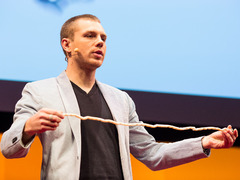
    Ophthalmologist Anthony Vipin Das is currently working on a new toy for the blind, FITTLE, with Tania Jain, a designer from National Institute of Design, Gandhinagar. The toy will help blind children learn to read Braille while getting a sense of the shape of the world around them. We asked him to tell us all about it. Below, his essay on what this toy is … and how it came about.

    For blind children, learning Braille is an integral part of how they interface with the world, and most current haptic technology for the blind focuses on Braille. However, teaching Braille at a young age is definitely a challenge. For example, a child who needs to be taught the word “fish” in Braille has no idea what a real fish looks like. He feels four Braille letters that stand for F-I-S-H, and cannot even try to visualise how a fish looks. I feel that learning of Braille can be made a lot more fun if it’s taught in an interactive way.

    Tania Jain approached me with this idea at a DIY workshop “Engineering the Eye” that I co-organized with the Camera Culture Group of Ramesh Raskar from the MIT Media Lab. Her concept involves breaking down objects into as many blocks as there are letters in the word. So, the word “fish” is constructed by joining together four puzzle blocks, which have the letters F-I-S-H on them, each embossed in Braille. When the visually challenged kid fits together the blocks by feeling and matching the right shapes, he can read the word “fish” embossed in Braille, as well as feel around the contours of the entire block, which is shaped like a fish. In this way, it becomes easy for the kid to understand shapes of various objects — and it can be taught by a parent or a teacher. The possibilities are endless.

    fittle2

    A look at the FITTLE puzzle for the word ‘fish.’

    This new toy, which we call FITTLE (“fit the puzzle”), helps children learn individual letters of Braille, construct words, and understand the form of objects, all through a playful game. Essentially, we are changing the way that blind children at a young age are going to perceive the world around them.

    We wish to help spread this idea as far and wide as possible. With current technology, FITTLE can be downloaded through open-source platforms and the pieces can be 3D printed by anyone who wishes to do so. We are in the process of creating the first alphabet series, as well as a graded curriculum where the child can progress to different levels according to age at LV Prasad Eye Institute, India.

    We are excited at how these toys can radically change the learning process of Braille and the way children will feel form. Moving forward, Tania and the FITTLE team want to experiment with different materials that would feel like the original object’s texture — like rubber to give the feel of a real fish — for kids to understand even better.

    It’s been an amazing experience to mentor the team so far, and we are really looking forward to reaching every blind child with FITTLE to help them perceive and understand the world around them in a playful way!

    Read more at FITTLE’s website, which just went live »

  • Bones of remembrance: Fellows Friday with Naomi Natale

    NaomiNatale_TEDFellow_Blog

    For four years, artist Naomi Natale’s social art practice, the One Million Bones project, has used education, hands-on artmaking and public art installation to raise awareness of ongoing genocide and mass atrocities. On June 8, Naomi and the One Million Bones team will be joined by thousands of volunteers to lay down the one million human “bones,” which participants have made by hand, on the National Mall in Washington, DC — creating a striking visual representation of conflicts we cannot continue to ignore.

    Here, we chat with Natale about where the idea for this fascinating demonstration came from.

    You’ve been working on the One Million Bones Project for a long time, and it has grown from an idea into massive, global art project. How did you get here?

    My background is in art and photography, and I’m especially interested in the intersection of art and activism — particularly the ways art can be used to bring issues that are physically far away close to home on an emotional level. I am deeply committed to the issue of genocide and mass atrocities, and One Million Bones is my way of addressing that.

    One Million Bones called for individuals all over the world to create an artistic representation of a human bone, which would then be installed on the National Mall as a visible petition and symbolic mass grave. The installation will be happening June 8 through the 10, 2013.

    There have been years of activity leading up to this moment. Tell us about the grass-roots education effort involved.

    One of the biggest elements of the project has been the educational component, because so many young people and adults simply don’t know what genocide is — let alone that it is happening today. My concern is, “How will we ever know or look for solutions to an issue if we don’t know what it is and that it is happening?”

    We designed curriculum from preschool all the way up to high school so that educators can bring the material into their classrooms in an age-appropriate manner. At the younger age levels, we talk about issues like values, ethics and respect. We talk about virtues and how our bones are like our virtues: they make us who we are though we can’t see them.

    For older age groups, we talk directly about genocide and how we can take responsibility as consumers and voters — that our voices matter. The bones they make becomes a symbol of our voices. We then direct students to other organizations that are working on these issues on a deeper level in hopes that this sparks an interest in future activism.

    This is a really difficult issue to bring into a classroom. We’ve heard this time and time again, with all the schools that we’ve been working in. But the fact that there’s an activity at the end really opens a space where students can learn about the issues, process them, and then put the intention for change into a direct action. The action piece is really important with an issue this difficult, because otherwise people can be paralyzed by that information, feel completely overwhelmed and want to turn away.

    Through the project, thousands of students were able to learn about these issues and connect to their peers abroad. One Million Bones had the amazing opportunity to partner with Students Rebuild to launch a challenge in which each bone made generated a $1 donation, up to $500,000, from the Bezos Family Foundation towards CARE’s work on the ground in Somalia and the Democratic Republic of the Congo.

    In April 2012, 50,000 bones were laid in Congo Square in New Orleans. Photo: One Million Bones

    In April 2012, 50,000 bones were laid in Congo Square in New Orleans. Photo: One Million Bones

    What is the project’s reach?

    We have had over 100,000 participants in schools in all 50 states and 30 countries. It’s been a completely grassroots effort. We laid our first 50,000 bones down in New Mexico in August of 2010. That was a critical moment for us, because it was the first time we could ever see the bones laid out, and we were able to capture a lot of reflections of how people responded. As a result of that event, we launched The Road to Washington ten months later. Thirty-five installations were laid out in 35 state capitals, all on the same day, all community-driven and organized. It was a way for volunteers who were really moved and stirred by the project to galvanize their own communities to lay down bones.

    We laid 50,000 bones down in Congo Square in New Orleans in April 2012 as well. In that city, we drew a natural connection between genocide and mass atrocities and the local violence experienced there — a lot of the discussions from the students drew from their personal experience. When they learned about the violence on the scale it is in Sudan and Congo, I think there was this very deep connection and empathy. Students in New Orleans continued to make thousands of bones and have done installations and educational programming since then, often seeing the bones as a way to find their individual voices. It can really be an empowering experience to realize you can do something, can contribute to a larger cause.

    Is there always an exhibit of some kind when teachers use the curriculum?

    Not always. Sometimes students just make bones and send them in. Sometimes the school or an arts center will host an installation. And sometimes an individual champions the project and decides they’re going to put an installation somewhere public and get a lot of other people involved. We help them from our end virtually, and do what we can to support that process.

    In September 2012, with our partners Students Rebuild, we were able to bring on 40 state coordinators, each brining the project into their local communities. Our Colorado state coordinator, Marianne Beard, got over 60 schools in Colorado to work on the project and to make bones. And they produced an installation. That’s just one example of how the project has grown.

    How did you become interested in genocide as a topic for art and activism?

    The journey began with a book I read in 2003: We Wish to Inform You That Tomorrow We Will Be Killed With Our Families by Philip Gourevitch, which was about the Rwandan genocide. I didn’t learn about the Rwandan genocide until long after it happened and, when I did, I couldn’t believe that I had never heard of it.

    It’s hard to wrap your head around how 800,000 people were killed in 90 days predominantly by machetes. You think about the intimacy of killing somebody through a method that takes a lot of power and human energy. The international community absolutely knew what was happening, and we didn’t do anything. There were things that we could have done that wouldn’t have even required us to go in, and we failed to do even that. But it was reading about what happened in Rwanda, plus knowing there was genocide happening in Sudan as well as a conflict ongoing in Congo for years made me want to make Philip’s words come to life and bring it into my part of the world so that others could see it.

    The One Million Bones project focuses on Sudan, South Sudan, the Democratic Republic of Congo, Burma and Somalia. These conflicts have been going on for such a long time. Little attention has been paid to them. Next to no action has been taken.

    Participant carrying bones for a bone laying installation. Photo: Joanne Teasdale

    Participant carrying bones for a bone laying installation. Photo: Joanne Teasdale

    It was 10 years ago last month that the government of Sudan began a genocidal campaign against its civilians in Darfur. Over 300,000 people have died, and over two-and-a-half million people are displaced. It’s pretty inconceivable that President Omar al-Bashir has been indicted by the International Criminal Court with crimes of genocide, crimes against humanity, and yet his regime still stands. In 2004, for the first time ever, the US government recognized a genocide in Sudan while it was happening, and we still failed to take any effective action to intervene.

    I think that set an incredibly dangerous precedent because before, we wouldn’t call it genocide and we didn’t take action. But to actually call it a genocide and not take action — I don’t know how we can carry on and say “never again.” When we talk to students about this, it becomes something they want to learn more about, and they want to be more active and aware. So it’s so important to be able to have an opportunity to connect with our youth about these issues, as well as everyone else.

    What are the bones made of?

    Some are made out of clay. Some are made out of plaster gauze, which is really beautiful to do because it’s like bandaging bones. Some of them are made out of wood. Some of them are glass, metal, paper, and tape — all different materials.

    I have to say, when they’re all together, when they’re all laid out, they’re quite striking and really, really beautiful. The main parameter is we ask that they are created in neutral colors. Some people have inscribed their names or prayers or thoughts on their bones as well.

    And why a bone?

    The bone was chosen as a symbol to attest to the gravity of these issues. But more significantly, it was chosen as a symbol and as a reminder that we belong to each other and that we’re responsible to one another. And that’s important: we’ve gotten a lot of pushback because it’s ultimately pretty out there to have kids making bones to address such an intense issue. But when we were able to explain the project to educators, walk them through it, and talk them through how these bones are ultimately about why we should take care of each other, they were able to embrace it. It’s very provocative, having a lot of children ultimately creating a mass grave on the National Mall. But it sends a message that’s much higher than that.

    Bones made in Tallahassee, Florida. Photo: Jane McPherson

    Bones made in Tallahassee, Florida. Photo: Jane McPherson

    Are the bones in Washington DC all those that have been created through the program?

    Yes, and they’ve been stored in hubs around the country. A lot of them were sent to our base in Albuquerque, New Mexico. Now for the last haul, they’re sending them to DC.

    What will happen in DC?

    On June 8, we will lay all the bones out on the National Mall, an action performed as a ceremony, starting at 3rd Street, which is the closest street to the Capitol. We ask people to come dressed in white. And we will lay the bones out right on the Mall. Our goal is to have 4,000 people to lay the bones out that day. That’s an incredible amount of people to organize in a city you haven’t had much time in. But we’ve done a lot of community outreach in the DC area, and we know people are coming in from all over. There’s a class of 20 kids from Tennessee who are making the trek for the entire weekend. We have a group of 60 people from the Great Lakes region who are coming out, from Tallahassee, from Boston — from everywhere. But it’s a call to everyone — so we want as many people there as possible to participate and witness. Anyone can just turn up, but we highly recommend that you register.

    You were an inaugural Fellow from the TEDGlobal class of 2009. How has the fellowship had an impact on your work?

    It’s been incredible. Hands down, this project would not have been able to evolve or carry on without the support and encouragement the TED community gave. It was such an out-there idea from the beginning, and the fact that the TED Fellows team really believed in it and in me was really huge and important. So I definitely feel that, as the project culminates, they’re all there for certain in their support. The people that I’ve met — the other fellows who are some of my dearest friends — have been extraordinary and so inspirational. And some of OMB partners have been made through the Fellows community, and that’s been extraordinary.

    After the event at the National Mall, what’s next?

    In the process of this project, our project manager Susan McAllister and I co-founded an organization called the Art of Revolution that is dedicated to creating works at the intersection of art and activism. Our hope is to continue to do these types of projects. We have no ideas confirmed, but we know that we really love working in this space and we want to continue to do that. And so we have a website called TheArtofRevolution.org, and we’ll just continue from here.

    Will the One Million Bones website continue?

    We’ve heard from a lot of different groups who work on these issues that they’d like to continue use the curriculum and educational tools. So it’s very possible that people will continue to make bones in the process of learning about these issues. We will keep the website up and see where that goes organically. In terms of where the bones are going afterwards, our goal is to create a permanent installation. We’ll wait to see how the event goes in DC and to see if we’re able to do that afterwards.

    Having lived with the issue for so long, what have you learned about genocide and what it says about human nature?

    Its definitely something very daunting to consider. We’ve known it to happen over and over again. I think about Raphael Lemkin who is the man who coined the phrase. He gave his entire life so that we would have a word that would describe this crime. Without it, we couldn’t create the Geneva Convention or an international response of law. Unfortunately, the real causes of genocide are very complex. Each country, each issue, each place is very different. Those are things that I don’t feel I have the capacity to change. What I have to offer is questioning how we as a world allow it to happen without our attention or concern.

    Above: Watch a video made for the One Million Bones Albuquerque event on August 28th, 2011.

  • The World on its Head: A Q&A about the ideas behind this exciting TEDGlobal session

    World-upside-down

    TEDGlobal 2013 guest curators Nassim Assefi and Gabriella Gomez-Mont share how they created the session, “The World on Its Head,” which will make you rethink the global order.

    Session 6 of TEDGlobal 2013 has a captivating title: “The World on its Head.” Guest curated by Nassim Assefi and Gabriella Gómez-Mont — both from the inaugural class of TEDGlobal 2009 Fellows — the session will be a chance to turn our conceptions of the Middle East and Latin America upside down, and to rethink staid assumptions about politics, religion, art, architecture, peacemaking and more. 

    Here, the TED Blog asks Assefi and Gómez-Mont to share what inspired the session and how they went about picking speakers.

    Where did the theme “The World on Its Head” come from?

    Nassim Assefi: Gabriella and I brainstormed, trying to tie together our two regions. What is the zeigeist in each of our regions? The undercurrents? What do they have in common? How have they been underestimated? Misunderstood? What is their hidden potential? We settled on “The World On Its Head” after viewing a wonderful map of the world with the South facing upward. That visual became a metaphor for rethinking deeply held assumptions and views of the world and sitting with the discomfort of a new idea until the brain adjusts.

    Gabriella Gómez-Mont: For me, the idea of “The World on Its Head” rings strongly and intimately with moments in life when I had to truly rethink important things so deeply that the former map no longer works, no longer matches the new reality. That moment, pause, gap, chaos of no longer understanding anything because one fundamental part of understanding crumbles — it’s one of the most enigmatic and profoundly human moments one can go through.

    It is both so strangely beautiful and tremendously brutal to rethink once unshakable truths. No wonder all of us, collectively and individually, try to make the world sit still and force maps to remain the same for centuries even when they no longer work. But in the end, that moment of confusion is a fundamental part of every transformation, adventure, and reconstitution — a pure turbulent threshold between paradigms. And then many new possibilities surface after finding one’s footing again in an upside-down world.

    How did the guest curation come about?

    Assefi: I had been pitching speaker ideas to [TEDGlobal curator] Bruno Giussani since the moment I met him, and many of those suggestions have made it to the TED stage. I play that role at TEDMED, too. In August 2012, we received a marvelous email invitation out of the blue from Bruno to guest curate/host a session at TEDGlobal. There are more than 300 TED Fellows from around the world, each doing amazing work, and no TED Fellow had ever guest curated a session at TED, so this is an incredible honor.

    Gabriella and I were chosen in part because we work in, and come from, distinct regions of the world — I represent the Middle East/Central Asia, and Gabriella Latin America. I’m an internist and global women’s health specialist (most recently tackling maternal mortality in Afghanistan). I also write novels, work on civic peace-oriented projects in the Middle East, defend human rights from a medical angle, and am a feminist activist, a single mom, and a diehard TEDhead. Gabriella is an artist, a documentary filmmaker, a curator for the arts in Latin America, and now head of a civic think tank/laboratory for Mexico City.

    I represent the sciences/health, literature, and global politics; she is the arts expert, the design/architecture person, a cultural force. We have different styles of working, but in reality, we overlap quite a bit. I speak Spanish and have worked in Central America. She has traveled in the Middle East. We’re both polyglots, crazy dancers, and global citizens, though we have strong predilections for our regions of origin.

    What’s the thrust of the session?

    Assefi: It’s about discarding assumptions about the Middle East, Latin America, and the way you think the world works in exchange for groundbreaking ideas that will hopefully inspire you to rethink politics, religion, art, peacemaking, the role of sports, underestimated economies and architecture, and even toxic environments.

    Gómez-Mont: Exactly, that is a great description. I was interested in reformulating and rethinking certain gray areas we take for granted, and I wanted to focus on Latin America, on certain places and subjects that could be explored more thoroughly. We sought to make our speakers complement each other, understand how we could weave certain threads among individual narratives, regions and diverse disciplines. And diversity — of age, country of origin, religion, and so on — was important to us.

    Can you describe your speakers?

    Assefi: All are global citizens/multicultural. Each of them has taken on courageous work. The lineup include: architect and urbanist Teddy Cruz; explorer, writer and filmmaker Holly Morris; economic policy innovator Juan Pardinas; historian/political scientist Trita Parsi; performance artist Tania Bruguera; accidental theologist Lesley Hazleton; and founder of the Beirut Marathon, May El-Khalil.

    We found our musician through two other TEDFellows, Meklit Hadero and Esra’a al Shafei. Dina el Wedidi is one of Meklit’s Nile Music artists and is featured in Esra’a’s MidEastTunes app. Through the Rolex Mentor and Protegee Arts Program, Dina has been paired with the famous Brazilian musician, Gilberto Gil. Dina seemed like a poetic fit for our session — the TED Fellow-link to discovering this brazen, beautiful, young woman singer-songwriter from the Middle East, who found her audience during the Arab Spring and is being influenced and mentored by a legendary Latin American musical force.

    But we don’t want to give away our speakers’ topics. It’s more fun if you are surprised by our session. At a TED conference, one generally doesn’t know what each speaker’s idea worth spreading will be until show time!

    Which speakers do you think are going to knock our socks off? Why?

    Assefi: That’s a cruel question, like asking a mother to choose the favorite between her children! The truth is, if curated well, different speakers will wow different people. It depends on what’s happening in your life, what you’ve been thinking about lately, and how open you are to certain ideas. Of the four I’ve chosen, I can imagine each one of them blowing you away. I predict Gabriella feels the same.

    Gómez-Mont: I feel the same. And one never knows until that fateful day when the crowd goes silent and the curtain goes up what will happen in that space between those words on paper and the voice on stage — between the careful planning and the happily reckless, often serendipitous, many times shifting, sometimes accomplice or sometimes trickster — reality.

    TED Global, themed “Think Again,” kicks off on June 10 in Edinburgh, Scotland. See the full list of speakers, and get lots more information about attending at the conference website. And stay tuned to the TED Blog where we will be bringing you live coverage of the conference.

  • Only connect!: Fellows Friday with Erik Hersman, on the rise of his go-anywhere modem BRCK

    ErikHersman-Q&A

    Five years ago, the non-profit tech company Ushahidi exploited existing technology to create a powerful platform that allowed users to crowdsource crisis information sent over SMS. Now the Kenyan company is set to do the same with the BRCK, a wireless, rugged, battery-powered modem ready for any environment. As the BRCK’s Kickstarter campaign gathers steam, Ushahidi co-founder and TED Fellow Erik Hersman tells us his vision for the BRCK and how it could change how we connect — in Africa and beyond.

    It sounds like the BRCK could be a pretty groundbreaking device.

    Yes. It’s always hard for people in the West to understand, just the same as it was hard for technologist to understand Ushahidi. They looked at it and said, “Yeah, what’s special about that?” To be honest, technologically there’s nothing special, and there wasn’t even five years ago. It was that we were just using technology differently to solve a certain type of problem.

    Same thing with the BRCK. It actually uses a 15-year-old technology. Modems and routers are not new — it’s the way we’re putting them together into a package that makes it really valuable. So sure, you can tether your phone. Sure, you could buy a wifi device. Those will each last two hours and can be shared with five people. Ours lasts 8 to 12 hours and can be shared with 20 people. Ours is made to deal with power on/power off all the time.

    Then there’s a cloud backend. You can go to our site and get into your own devices from anywhere in the world, and write software for it from that level. There’s also a hardware side where you can basically plug anything into it, and the devices stack like bricks. So you can plug in extra batteries, maybe a water sensor. Maybe you want connect a Raspberry Pi CPU to it and make a little server. Fine — you can do all that and actually control that anywhere in the world. So layer two is how the BRCK becomes this bridge between the cloud and the internet of things.

    Who are the intended users?
    At the moment, I think there are two kinds of users for the BRCK. In Africa, it’s will be anybody who needs to connect to the Web often, and who feel the pain of power outages and the less-than-stellar ISP activity that we have in Kenya or in Nigeria or wherever you are. Small businesses across Africa will use it for connectivity.

    In the West, I think the user type are the people who travel, who go camping, who go backpacking or hiking and want some type of internet connectivity in a rugged case. We’re happy if it gets picked up in the US and Europe, but we are much more interested in providing a device that works for people like us here in Africa.

    But I’m guessing there are many other possible applications we haven’t even thought of yet.

    BRCK-photo_2

    Where did the idea for the BRCK come from?

    It came to mind as a product during a meeting with some colleagues in South Africa. On the plane back, I pulled out my notebook and started writing down the different things that would make a router/modem for Africa really work. At that time, it was just a fun idea.

    It wasn’t until last summer that we got serious about it. We got a prototype level and said, “Oh, this might actually work.” We got a guy that came on part-time and would do the prototyping with us, and it kept accelerating. Rapid prototyping is very hard to do in Kenya, because you don’t have all the tools you would have elsewhere and you can’t overnight components that you might need, if you bought the wrong ones — which we did. But when we realized this was at a very serious point, we hired two people, one with expertise in actual product prototyping in manufacturing, and a firmware guy who’s really deep into the IO side of firmware design, which is difficult stuff.

    Everybody says you can’t do hardware in Africa, and we’re like, well, let’s try before we just say you can’t. And what we’ve found is that they’re wrong. You can do it, it’s just harder.

    Will the BRCK come with a network connection?

    It’s made just like your normal everyday router. So you can plug an ethernet cord into it and just use it that way, or of course use it over a wifi network. We want it to come with a SIM card in it. We’re still trying to figure out who will be our global partner on that – we’re talking to various providers right now. Either way, you can just pop any SIM card into it for 3G connectivity. It’s unlocked, so you don’t have to worry about that. That automatically creates a wifi hotspot that you can move anywhere. And if you have more than 20 people, you can put more BRCKs around, and they automatically mesh, so it makes it easy to expand.

    What about battery time?

    Our minimum requirement is that, if the power goes out, you’ll still have a full eight-hour work day’s worth of connectivity. We’re trying to make sure that it can take almost any type of input as well. You can plug an extra battery pack, for example. It has this micro USB slot, but underneath it is also has a GPIO port, which allows you to plug in any type of sensor.

    The BRCK can take anything from four to 15 volts, so you could plug in any solar kit. You can plug it into your car charger. If you want something seriously off-grid for a long time, then grab a car battery and that will last you, with full-time usage, probably 10 to 20 days. It doesn’t have a huge drawing power, but it does decrease depending on the amount of people on the device.

    It has 16GB of on board storage as well, so you can make a DropBox sync right there if you want, or you can make the whole device into a BPN, that kind of thing.

    I can imagine this will be a godsend for rural communities, boat communities, photojournalists, and other off-grid folks.

    Yes, I think there will be many people we didn’t expect who will need what the BRCK will provide. In fact, what I want to know from the TED community is: What other circles of people or communities be interested in the BRCK and should know about the Kickstarter campaign? Are there other niche communities — or even big communities — that this would make sense for? I think we’re closing in on $90,000 of the $125,000 we need. We need at least that amount to get to our minimum production run to get our economies of scale on certain components.

    How does the BRCK fit in with your vision at Ushahidi?

    At Ushahidi, we believe that older technology is not fully utilized. Where in the West people move to a new technology really quickly, in Africa we don’t. So there’s a reason why USSD and SMS are still really big things on mobile phones here. It’s why we think Ushahidi worked — this idea that you don’t have to throw away the old right away, you can actually use it for other things. And sometimes the problem sets that you’re solving for aren’t going to come from places that look like Cambridge or Camden; they’re going to look more like Nairobi or New Delhi. And these neighborhoods and communities are sometimes using technology that isn’t made for them. They’re trying to shoehorn in a newer technology.

    Part of our job at Ushahidi is taking a look at those things and questioning the very nature of where they are and why they stand there. And then if possible — if it has something to do with increasing information flow from ordinary people, we’ll look at it. That’s why the BRCK is something that Ushahidi is interested in doing as well.


  • The guerilla astrogardener: Fellows Friday with Louisa Preston

    LouisaPreston_TEDFellow_Blog

    Astrobiologist and geologist Louisa Preston looks for analogues to possible life on Mars in the most extreme environments on Earth. Now she’s also considering how humans might someday make a home on the red planet, and is raising funds on Kickstarter in support of AstroGardening – an educational exhibit designed to explore how we might someday grow food on Mars.

    Tell us about your Kickstarter campaign for the AstroGardening project.

    It’s based around the idea of Mars gardening. If humans want to go to Mars, how would we live when we got there? What would we need, and what would it look like? With the advancement of space exploration, we’re finding that ideas like this are actually becoming a lot more real – not quite science fiction.

    The exhibit, which will be hosted in a number of planetariums and museums in the UK, will be inside a plastic geodesic dome, within which is a beautiful, peaceful garden full of different types of plants, fruits, vegetables and flowers. The soil will be red, just like Mars. There will be signs and information everywhere where people can learn about the different plants, how they might grow on Mars, and the various ways we need to develop tools so we can garden on Mars. Mars is frozen, so we need to be able to extract water and keep plants warm, for instance.

    And there will be a rover — the first-ever rover designed solely for gardening. It will be automated to be planting a garden at the end of the exhibit, so people can see it in action.

    My project partner, installation designer, maker and guerilla gardener Vanessa Harden, and I are designing and building the rover right now. The Kickstarter funds will be used to build the rover, the exhibit itself — plants, soil, the dome — and so on. Most of the venues have agreed to house the exhibit out of kind, for education purposes, so we’re not paying a fee, and it’ll be free for anyone to come and visit it.

    Video above: Introducing the AstroGardening project — and the automated gardening rover.

    Does this mean that plants that grow on Earth could be transplanted directly to such an environment?

    Yes, absolutely. There have been a number of studies that show that if you plant things like asparagus or potato or sweet potato or different types of grains in soil that’s exactly the same as on Mars, they will grow as long as they have water and sunlight and things that plants need. I think one experiment actually showed that you could grow marigolds in ground-up meteorites, and meteorites from Mars. So we know the planet’s soil will allow it. We just need to create the environment.

    The exhibit will explain this to people. It will also teach about the conditions on Mars, how plants grow, what they need, why it’s hard for life to grow on Mars, what therefore makes the Earth so special — and from there why it’s so important for us to protect the environment.

    I wasn’t going to lead it on to terraforming, but actually I was speaking to my 10-year-old cousin about it, and he asked, “Well what about if we could change Mars to be like Earth?” Terraforming is a really interesting topic, and sounds very much like science fiction, but there are people looking into it. So hopefully the exhibit will address that point and allow people to ask questions, and we’ll be able to provide the answers about how it might be done, and what the ethics are around whether we should be allowed to change another planet to suit us.

    The whole thing came out of a desire to get the public involved in understanding that we’re not very far away from gardening in space becoming a reality — actually being able to garden and set up colonies and civilizations on other worlds — and how it might happen. So we came up with an exhibit that the public can be involved in and not only looks beautiful, but is scientifically relevant and accurate.

    How does this dovetail with your work looking for analogue Mars environments on Earth?

    It works brilliantly. I look for environments on the Earth that mimic Mars, and I study how life can grow there. In the past, I’ve studied how microorganisms survive in these environments. Are these places really hot, really cold, really acidic, really dry? So it’s a natural step for me to then start thinking about how you might grow plants or how we as humans might survive in these areas, too.

    I grew up watching TV shows and films about humans and aliens living on other worlds and I kept thinking, Well how would we live there? These worlds look completely different from ours; how would we survive? And now I’m finally in a position to actually be able to think about this question and use science to answer it.

    Rio Tinto Acidophiles

    Rio Tinto in southwestern Spain is a wonderful natural laboratory where we can study acidophiles (acid-loving bacteria) living in the iron-rich waters today (above), and study fossils of their ancestors that have been preserved for up to 2 million years within iron-rich rocks along the river bank (below).

    Rio Tinto in southwestern Spain is a wonderful natural laboratory where we can study acidophiles (acid-loving bacteria) living in the iron-rich waters today (above), and study fossils of their ancestors that have been preserved for up to 2 million years within iron-rich rocks along the river bank (below).

    How did you get into the field of astrobiology?

    I was following along a geology career, studying mining, looking at all the different types of minerals that the Earth produces and how we might utilize those as a society, and I met a PhD student who was working on life preserved within rocks in Antarctica. Up until that point I didn’t completely realize or understand that you could actually look for life on other planets as a job — that it was actually a facet of what I was doing. So I did my PhD on a combination of looking at mineral deposits like I’d been studying before, but trying to incorporate the idea of life around these rocks and then life on Mars — to try and merge the two. And I was hooked. I knew that all the rest of the work that I would do from then on would all be geared towards trying to identify and find life on other planets.

    Now my main work is looking at environments on Earth that mimic those on Mars. I look at places such as Antarctica, which is the coldest, driest desert on the Earth and is actually the most Mars-like environment we have on Earth. I look at areas in Spain such as Rio Tinto, and I work at impact craters. I’m going to Iceland this summer to do more work on volcanoes and hot springs. What all these environments have in common is that they are places where life lives at very extreme limits. It’s either very, very hot or very cold — places where humans couldn’t survive without lots of help, but some organisms can live perfectly happily.

    I try and figure out how they’re able to survive there, what adaptations they have that allow them to survive there. And I study nearby rocks as well, because as these are forming they trap the organisms in them. When I open up these rocks, I can see fossilized life, similar to the type of life we think we might find on Mars. We won’t necessarily see life scuttling around on the surface of Mars, but we might be able to break into a rock, open it, and see fossilized life inside. I look for DNA and proteins, and try to understand how these fossils are formed and identify organic molecules that indicate this fossil was once definitely an organism, not just, say, a wiggly pattern.

    You’re working with Senior Fellow Angelo Vermeulen on the HI-SEAS Mars simulation project, where they are investigating how humans might be able to cook their own food on Mars, and his own research on this mission about growing food on Mars is very similar to yours. Did you arrange this together?

    Actually, I didn’t get involved in HI-SEAS through Angelo. I do a lot of analogue mission work myself — I was a flight director for a Canadian Space Agency analogue mission. So when the call came out that they were asking for people to be involved in HI-SEAS and to support the mission, I got contacted just through my prior experience.

    Angelo didn’t even find out I was supporting the mission until he was actually in the simulation. It was a wonderful moment: we had a kick-off meeting on Skype for all the mission crew to meet the astronauts, including Angelo. When we went around and introduced ourselves, I just said, “Hi. My name is Louisa Preston. I’m an astrobiologist based in London.” All I heard in the other room was, “Louisa??” Now we’re communicating, him on Mars and myself here — and I’m trying to help him with his research as he goes through the mission. It’s really good fun. Every so often he’ll send us a call asking if anyone’s seen any good papers recently or research we might be able to incorporate.

    At the moment, I’m studying something that’s a little bit different from what he’s doing. He’s looking at plants that basically don’t need any kind of pollination. They don’t need bees; they don’t need anything to help them reproduce. They just naturally do it. I’m asking, “How would we actually get bees — or use something like bees — on Mars to pollinate plants, and how would we breed them?” So we’re removed at the moment in those areas, but we’re looking to try and join our studies eventually, so it could be interesting. Angelo and I had already been looking for a reason and a way to work together, and this was a perfect opportunity.

    Testing the temperature and acidity of hot springs in Iceland, looking for life thriving within this extreme environment.

    Testing the temperature and acidity of hot springs in Iceland, looking for life thriving within this extreme environment.

    What does it mean to be a flight director on an analogue mission, and why would a astrobiologist need to have such an experience? You’re not actually flying anywhere…

    Our analogue mission was based in Canada, and it was to send a team to the Canadian high arctic where they were going to study an impact crater. When you have a mission, whether on Mars or on Earth, you have a team that goes into the field, or to Mars, and a mission control. Leading mission control is the flight director who basically manages the team. And that was my job.

    There are a number of things you get from these scenarios. The first one is management experience, which doesn’t sound particularly exciting. But in these teams you have engineers, scientists, computational experts, field specialists, medics, psychologists, and a number of different people working together. In our field, if you’re going to stay in space science and you want to work in missions and help extend our knowledge of the solar system, you need to be able to work in a very dynamic team full of extremely different people from disparate backgrounds, and who therefore all think very differently.

    There’s a very common clash between scientists and engineers, for example. The scientists want to go to this rock, say, to look at a cool bug. The engineer says, “Well I don’t know how to get you there.” And the scientist says, “Well I want to go there.” There’s always this clash, but it’s a friendly clash with a joint goal. You need the skills to be able to negotiate through this. So to be part the larger picture and to work in these situations and planning missions to other planets it’s an invaluable experience. It’s really good fun as well.

    What has your TED experience been like so far?

    The one thing about the TED conference is I think everyone spends an entire week with imposter syndrome, because you go there very confident in what you do and very excited to tell everybody about it — then you speak to even one single person and hear what they do and think, “Oh, that’s so much cooler and more interesting than what i do.” The Fellows community is very active; I’m talking with and potentially working with three Fellows at the moment on a number of different projects, which will be really exciting. And a lot of really great publicity has come from being associated with TED, even in the UK where it might not be as well known as it is in America.

    I’m also now one of the directors of TEDxLondon, which is happening in July. Its theme is visions of the future, which is not at all in my area, but that means I’ve actually spent a number of weeks speaking with architects and designers and science-fiction writers about their visions of the future, which is absolutely fascinating.

  • The journey is its own reward: Fellows Friday with Kellee Santiago

    journey-game-screenshot-1-b

    TED Fellow Kellee Santiago has won numerous awards for the video game, “Journey.” Here, we talk to her about her craft.

    In recent months, That Game Company’s downloadable PS3 game Journey has swept up an armload of awards — the Game Developers Choice Award for Game of the Year and BAFTA Video Game Award for Best Game Design, to name just two — not to mention a Grammy nomination for Best Original Soundtrack. Company co-founder and TED Fellow Kellee Santiago tells us why she believes this remarkable game is touching so many people’s lives, what it might mean for the future of gaming. Bonus: we ask what’s next on her own horizon.

    This is a lot of awards  at once, isn’t it? How does it feel?

    It’s been totally amazing. We did have a good feeling about Journey: the responses we got last year just from our players was totally overwhelming — people really felt they were able to have personal catharsis through it.

    By December, which marks the beginning of game awards season, we’d already been getting so much good attention already — people doing costume plays of the characters, making videos, playing the music on YouTube. So we suspected Journey might get nominated as a stand-out game of the year, just as Flow and Flower, our previous titles, had. But amazingly, it also started showing up in best game of the year categories, as well as best story and best soundtrack and graphics, which put Journey in the same category as what’s known as triple-A games — the video equivalent of blockbuster movies — the high-budget disc titles like Halo 4 and Mass Effect 3, Borderlands 2 and Dishonored. Seeing Journey in along with them was amazing. Then we started winning, which was really unbelievable.

    I think it really speaks to a shift happening in the games industry around the idea of who can make a quality game, and what defines a quality game experience. The emphasis wasn’t on hours of gameplay or weapon-changing abilities, but on personal, deep experiences.

    Tell us about the game experience.

    In the game, the player is a robed figure. You wake up in the desert, and you see this giant mountain in front of you. The goal of the game is to go on this journey to the mountaintop — very much inspired by Joseph Campbell’s hero’s journey structure.

    On each level you’re exploring what appears to be a ruined civilization. You’re in this long robe, and when you encounter pieces of cloth, they can give you energy. And that energy you can use to fly, not infinitely, just for short periods. And you can build upon your ability to fly. But the idea is that cloth is really the only living thing in this desert environment. And as you move through the world, you encounter more complex life forms of cloth, and you start to learn more and understand more about this civilization and what happened there.

    It takes about 90 minutes, maybe two hours, to play. We wanted to allow people to play through in one sitting.

    journey-game-screenshot-10-b (1)

    How does the multiplayer aspect work?

    As you’re going on this journey through different environments to the mountaintop, you can encounter another robed figure like yourself, and that is another real person. We don’t have an AI system, as some people think. It is always just a one-on-one connection, to give you this feeling like you’re in this vast world. So when you happen upon another person, it’s very significant.

    One of the goals was to make an online console title that actually made you feel connected to another person, as opposed to the traditional online console gaming experience in which you start up a competitive, usually fighting or shooting game, and get yelled at by people from across the world.

    In Journey, there’s actually no language, no voice chat system, and no in-game messaging. You’re also totally anonymous — you don’t have a user ID or a name, nothing that could take you out of the world that we were creating, which also leaves it totally open to players of any age and also from anywhere in the world. Because we don’t rely on language, we can actually have a global server, so you could be playing with someone who doesn’t even speak the same language as you. Yet you share the experience.

    Then do you have to play the game together?

    You don’t have to. People have different play styles: I could be really into exploration, and they just want to go around and collect everything — then we’d naturally separate and be disconnected and left open to connect with someone else. This offers an organic way of players finding players who are similar to them.

    journey-game-screenshot-9-b

    How do the players communicate?

    The only way of communicating is through a shout or call system. When you press a button on the controller, you’ll make either a tiny shout or a large call. It can act as a way of saying “Hey, I’m over here!” if you’re in the level but can’t see each other very well. But when two people initially find each other, they “speak” in lots of short chirps. It’s amazing how much actually people can communicate this way. It gets enough across, I guess.

    Is there no way they can ever find each other in the real world?

    We’ve struggled with this, because from a game design stance, it can be very powerful to allow people to invite friends to play. But we felt the anonymity was really important, because the game is about humanity in general, not the specifics of this particular person. But if you play through the entire game, it’ll take you back to where you started again. At that moment, it will show you the other journeyers you encountered along the way, so people have connected to one another through the Playstation network messaging system afterwards.

    There’s also a Tumblr blog actually called Journey Stories, where people post their experiences of playing and try and find each other if they’ve had a particularly moving experience with someone.

    But it’s funny to think about how originally it was really just a theory when 13 of us were developing the game. We really felt that simply moving through these environments with another person would be something really compelling to share online. I guess it turned out that we weren’t alone.

    Is it meant to be played again and again?

    Yes. There are collectibles that you can go and get through multiple playthroughs. But mainly people play again because the environments are beautiful and it’s a really interesting place to be — and you can always encounter another person. That really does change your experience every time.

    So even though you know what you’re going to encounter at the end, it’s still worth exploring and making contact with somebody else.

    Yeah. A metaphor we used a lot during development was hiking — especially that feeling like we can pass each other on a busy street in an urban environment, we don’t even recognize each other. But when you’re out hiking somewhere, when you see another person, you feel a connection to them. And everyone’s pretty nice usually when you go out hiking. I’ve hiked in Griffith Park on some of the same trails many, many times now because I live right here, but it’s still a beautiful place to explore. I’ll still go back to it.

    journey-game-screenshot-18

    You’re no longer with That Game Company. What happened, and what are you up to now?

    We pretty much disbanded after Journey was shipped, about a year ago. It had been six years, and myself and co-founder Jenova Chen and the other people that had been there for a while, we had just really grown and changed. Your art imitates your life, and it was true for every single one of our games, and Journey was no exception. Jenova said in the acceptance speech that he gave at GDC that, if you played through Journey, you’d understand our own struggles as well. It reflects everything we were going through.

    So when it was over, it was time for us to hit the start-a-new-journey button, like we have in the game. I didn’t know what was next. In games, I love the practice of game development and game design, but I’m also passionate about empowering different voices in game development to be successful so that we can have a wider variety of experiences in games. I’m interested in how our business model can impact that. Because the games industry is relatively young, there’s still much room to change that and switch it up. I’ve been doing that also with an angel investment fund called Indie Fund, which I co-founded in the beginning of 2010.

    My period of exploration vacillated between both. But I thought that in order to really impact the finances and the business model of the games industry, I would ultimately have to go work for one of the large studios or large console manufacturers and work my way up to being in a position of power. I got connected with Julie Uhrman, who’s the CEO and founder of Ouya, which I joined as Head of Developer Relations a month ago. Ouya made a lot of waves last year. They ran a very successful Kickstarter campaign: making $8.5 million dollars for a new console, which is crazy. It could have only worked on Kickstarter: investors were just laughing them out of the room. No one wanted to get into hardware manufacturing.

    With Ouya, I really feel there is an opportunity to have all of the accessibility for development that mobile devices and PCs do, but in the living room — still have developers be able to develop a variety of gaming experiences, but with all the ease and openness of a platform that’s been provided through App Store and Google Play. That really excites me.

    Any regrets?

    That we lost the Grammy to Trent Reznor. But that’s OK.

  • Collapse of faith: Mohammad Tauheed on the Savar garment-factory disaster

    An eight-story building named Rana Plaza in the Savar neighborhood on the outskirts of Dhaka collapsed at 9am on Wednesday, April 24, 2013. Hundreds of workers were killed, and many more were trapped for days under the rubble until rescued with severe injuries. Photo: Institute for Global Labour and Human Rights.

    An eight-story building named Rana Plaza in the Savar neighborhood on the outskirts of Dhaka collapsed at 9am on Wednesday, April 24, 2013. Hundreds of workers were killed, and many more were trapped for days under the rubble until rescued with severe injuries. Photo: Institute for Global Labour and Human Rights.

    TED Senior Fellow and architect Mohammad Tauheed runs ArchSociety.com, a nonprofit community resource for architects and designers in developing nations. When the Rana Plaza building in Savar, Bangladesh, collapsed last week, killing hundreds of garment factory workers, Tauheed supported the rescue efforts. Here, he tells us his experience of the disaster, how corruption and greed can quickly lead to tragedy, and what’s being done to prevent illegal building practices.

    What happened?

    The Savar tragedy is a matter of great sorrow and grief. The saddest reality of the whole thing is that it was avoidable. It is not a case of a plain accident. Cracks were detected in the building a day before the collapse. According to news sources, the tenants were advised to stop all activities in the building and to evacuate. That instruction was not followed, so TV reporters went there and interviewed the owner, Sohel Rana, a local politician, and asked why. He declared the cracks were nothing serious, that the building was safe. While a bank and shops in the first two floors were closed once the cracks were found, several garment factories on the upper floors of the building stayed open. The garment-factory managers forced their fearful workers to resume work the next day, and the building collapsed within a few seconds, with thousands of workers inside. It has taken more than 500 lives so far. There were around 2,500 survivors rescued alive from the debris, and many are still missing. The second phase of the rescue work is currently running. Heavy machinery is clearing the rubble, with no more hope of finding anyone alive. Days after the collapse, Sohel Rana was arrested.

    What was your firsthand experience of the disaster?

    I went there with medical supplies to deliver to the onsite health camp. It was an overwhelming experience. Thousands of people were waiting in tears to hear the news of their relatives among the victims, a private hospital nearby was dedicatedly busy round the clock to receive wounded survivors, frequent sirens of rushing ambulances and other emergency vehicles, many small voluntary booths giving away drinking water, snacks and free phone calls. In those few days, I’m sure everyone in Bangladesh thought and wished they could come to help in some way, wished they could contribute something to save a life. I was standing amid the crowd and crying.

    I heard that the rescue workers needed light tools like cutters, drills, and so on to make holes in the concrete, so I called up architects and construction companies I knew, asked them to stop work for a day or two and send their equipment and men to the rescue site. Everybody responded positively and tried their best.

    People from all walks of life did their best to help. General people, construction workers, unknown volunteers joined actively in the rescue work hand-to-hand with the firemen and a support team from the army. Their dedication, love for people and bravery were extraordinary. They risked their lives to go inside the rubble and take someone out alive. Hundreds of people donated blood in long queues in different camps in Dhaka. People sent support whatever and however they could. Social networks and news channels were busy with the live updates of ‘what is currently needed onsite’ messages. Hundreds of people actively collected those things and sent them to Savar — food, water, medical supplies, rescue equipment, tools and machinery, flashlights, canisters and cylinders of oxygen, funeral supplies for the deceased, cash, and so on were supplied mostly by the general public. And most often the amount of supply that came arbitrarily met the need. It was heartwarming and all the way an amazing effort that we saw from the citizens.

    In your view, who is responsible?

    The biggest thing that is responsible here is corruption. From my knowledge as an architect, I can tell you about the building construction-related law and its known flaws. To build in the Dhaka area — the boundary covers nearby suburbs and towns beyond Dhaka metropolitan, including the incident area of Savar — you need permission from the main authority RajUK (Capital Development Authority), as well as permits from 13 different organizations to get permission for construction and approval of architectural design (and, in the case of large projects, structural and other designs), including the municipality, environment department, fire service, electricity and gas distribution authorities, and so on. The approval process and construction are overseen by RajUK. When building a factory, you need to get additional approval from a factory-building construction-related authority, and if it’s a garment factory, you need a license and permission from the non-government organization BGMEA, an association of garment owners that regulates the industry in Bangladesh. If corruption plays any role at any point in this process, incidents like the collapse of Rana Plaza and fire at Tazreen Garments may happen any time. And many of these organizations are infamous for institutionalizing corruption. Allegedly, often this paperwork is done or overlooked by political influences and bribery.

    In the case of Rana Plaza, the problem might have happened in a few different layers. Allegedly, the building was designed to be six stories, and the owner built an additional two floors without permission. There could be a fault in the structural design. Then there was the usage of the building: it was architecturally and structurally designed as a commercial complex, for small shops and offices. Counting the number of people per square foot and the weight of the heavy machinery, the dead load and live load of a garment factory is far higher than a commercial building. Even if the initial structural design was okay for commercial use, using the building for garment factories might have made the structure fail. It is difficult to tell what exactly happened without extensive engineering investigation. It was the responsibility of the architects and engineers involved in designing this building to check its legal status.

    All the organizations that let the owner make this building without following the rules and let them use it for unapproved purposes are responsible. And along with the building owner, the owners of the garment factories are responsible for accepting the corruption. They are especially responsible for forcing workers to go inside that building that day.

    The responsibility also falls upon the foreign companies – including Joe Fresh, Bonmarché, El Corte Ingles, Primark, Mango and Benetton – whose products were being made or had been made in those factories. They must take responsibility for checking the physical conditions, legal aspects and working environment of the factory buildings before they put an order to a third-party supplier. After all, their names and logos are all over the collapsed building, soaked in blood.

    Is there any hope for conditions changing for the better? This is not the first time such a thing has happened in Bangladesh’s garment factories.

    A few good things have happened recently with building codes and laws in the country. Bangladesh has a national building code, BNBC, first drafted in 1993. In 2006 it became mandatory to follow the code, with a penalty of seven years’ imprisonment. In 2006, a new construction law came out with the help of years’ worth of efforts by architects and related professionals. These codes and laws aren’t entirely perfect yet, but they are under constant practice, observation and development.

    And following the Savar incident, the government has declared a few reforms to improve the situation of the garment industry in the country.

    Why are the government and authorities not supportive of such changes?

    Many of these ideas and proposals will cut corruption and the power of authority of different organizations. And no one wants to mess with the garment industry in Bangladesh, because it’s the highest foreign-currency-earning industry in the country, at more than $19 billion a year and supports the also highly lucrative real-estate industry. So any law that has the potential to reduce the profits in these two sectors will likely not get support.

    This business is extraordinarily profitable – it makes people greedy and turns them into beings who can easily force their workers into a known death trap, because the stakes of shutting down a factory even for a few hours is huge in account of profit and loss. The factories are always desperate to keep running, as the supply of garments to Western countries is a highly time-sensitive business, for the frequent changes of fashion in seasons, special occasions and brand campaigns. Western fashion houses also should look into this issue of “time sensitivity” – which may cost human lives.

    Of course, not all garment factories in Bangladesh are in bad condition. There are thousands of factories properly designed and maintained, and many foreign companies who procure their products from Bangladesh with commendable responsibility.

    One great thing that has resulted from the West’s outsourcing of work to Bangladesh is that thousands of workers have pulled themselves out of extreme poverty. This flow must continue to produce more jobs and opportunities. With a little more responsibility and humane sensibility, we could save hundreds of lives and feed thousands more.

    How does the work you do with your nonprofit ArchSociety prevent tragedies like this?

    ArchSociety.com focuses on helping architects with open source resources and information. However, following the deadly fire at Tazreen Garments in November 2012, we started working on a new project: an information package that will contain easy-to-understand booklets, posters, stickers, and so on, with fire-safety information and instructions targeted for garment factories. Now it looks like we have to consider adding basic construction safety and law information to that package.

    Thanks to the Institute for Global Labor and Human Rights for use of their photo. Learn more about their work here.

  • How soon is now?: Fellows Friday with Alicia Eggert

    AliciaEggert_TEDFellow_BlogConceptual artist Alicia Eggert uses words as found objects in her sculptural art — a body of work that serves as an ongoing investigation of time. Here, she tells us about taking her neon piece “You are (on) an island” to various locations in the world, shares how childhood experiences in South Africa sparked her fascination with time, and reveals how she thinks each person experiences time uniquely.

    You live and work in Maine, but you recently toured a piece — which involves rather delicate neon sculpture — around the UK. How did this come about?

    My collaborator Mike Fleming and I originally made “You are (on) an island (2011)” for an art festival called Sacred and Profane. The festival takes place on Peaks Island, which is off the coast of Portland, Maine. Every fall, on a weekend in October closest to the harvest moon, visitors take a ferry to the island to explore an abandoned World War II army battery, which artists completely take over with installations and performances. The battery doesn’t have any electricity, and people have to walk around and explore the dark, cavernous rooms by candlelight. So when Mike and I were brainstorming ideas for an installation, we started talking about using neon, and filling a whole room with light. We came up with the statement: “You are on an island” – with the word “on” blinking on and off, so it sometimes says, “You are an island.” We worked with Pat Boulduc of Beacon Neon to fabricate the text, and we installed the sign on construction scaffolding in the middle of a room that was completely flooded with water. It was pretty breathtaking.

    We later posted documentation of the piece online, and an artist named Richard Wheater, who runs a gallery and workspace called Neon Workshops, in Wakefield, got wind of it. He wrote me an email out of the blue saying he thought it would be perfect for the UK, and he wanted us to bring it there.

    But instead of just shipping the neon over and putting it on display in his gallery, Richard suggested that we take the sign on a guerilla sculpture tour, mount it on the back of a truck and drive it around Yorkshire, and take people by surprise on their daily commute to or from work. But neither of us had the money to pay for any of that, so we launched a Kickstarter campaign, and raised over $12,000. We shipped the neon to the UK in December and flew over in January to go on tour for two weeks.

    "You are (on) an island" was originally made in 2011 for the Sacred and Profane art festival on Peaks Island, Maine. Eggert and her collaborator toured the sculpture around the UK on the back of a flatbed truck for two weeks in January 2013. In this image, it is shown parked next to the picturesque coast of North Wales. The word ‘on’ blinks rhythmically on and off. For the moment that single word remains unilluminated, a new phrase with a different meaning emerges. Photo: Alicia Eggert

    “You are (on) an island” was originally made in 2011 for the Sacred and Profane art festival on Peaks Island, Maine. Eggert and her collaborator toured the sculpture around the UK on the back of a flatbed truck for two weeks in January 2013. The word ‘on’ blinks rhythmically on and off. For the moment that single word remains unilluminated, a new phrase with a different meaning emerges. Photo: Mike Fleming

    Isn’t neon incredibly fragile, though? How did you manage to move it around?

    Yes, it’s made out of glass tubes that are pumped, in this case, full of argon and a little bit of mercury. When the gas is electrified, it glows bright blue.

    When we arrived in the UK we rented a flatbed truck, and spent the first few days erecting the sculpture’s wooden structure on the truck. We couldn’t always leave the glass letters attached to the structure, especially when we were driving long distances at 70 miles an hour on the motorway. So the neon was mounted to rails that could be lifted up and attached to the framework, but then brought back down to travel on foam in the truck bed when we were on motorways.

    Our daily routine started with a trip to Neon Workshops, where we’d load the neon onto the truck. We would then drive to a certain location, unload a ladder and tools, lift the rails up onto the structure and attach them, and then wire everything up to a little generator. We’d try to do all that by dusk so we could get some really great sunset shots — also because you couldn’t see the neon very well during the day. We would then drive short distances around that area, and make photographs and videos in different locations. And then at the end of every day we would have to take the glass back down, drive back to Neon Workshops, store it in the gallery where we knew it would be safe, and then go to bed. It was quite a rigorous routine. But over the course of two weeks we drove all over West Yorkshire, drawing a circle around Wakefield, our home base. And we made a short weekend trip over to North Wales.

    Any surprises?

    We were surprised by how many CCTV cameras there are in the UK. There’s definitely way more CCTV there, and a lot of police vans. And since we were doing the project without permission, we were unsure of what we could get away with and what we couldn’t. But whenever we did encounter a police van or a policeman, they normally just seemed curious, but didn’t even stop to ask any questions. By the end of the trip, we were driving right up onto traffic islands and down pedestrian shopping streets.

    How did the public respond?

    A lot of people asked us what it was and what are we doing. We would explain by saying, “This is art,” basically. We would hand out postcards featuring an image of the sign, and explain that we were invited to the UK to do this project by a gallery in Wakefield. A lot of people would say things like, “Oh, man. You have to go to this part of Scotland. It’s really beautiful. It would make a great photograph.”

    One time we were parked in the Bull Ring, in Wakefield, when a family walked by, and I could hear a little girl say, “We’re not on an island, are we?” I actually heard quite a few people ask that same question, which really surprised me. I realized that people in the UK don’t feel like they live on an island because they don’t feel isolated. If anything, it feels like it’s in the center of the world.

    I think people who live there forget that it’s an island because they think of it as much bigger than it actually is.

    Exactly. I’ve taken the same sculpture to Australia, and the response there was very different. People would see the sign and say, “Yes. This is perfect for us because we feel so isolated down here. And even though Australia is a continent, we feel like we’re on an island, and this sign describes exactly how it feels to live here.”

    It was really surprising to me to see how people responded to the statement very differently in the UK than they did in Australia, or in Maine where it was first on display. As artists, we can’t really have expectations about how people will respond to work. I’m often intrigued by how everyone’s response to the same thing can be very different.

    Video above: “The length of now”.

    Video below: “Now”: This kinetic sculpture’s red acrylic line segments align to spell the word “NOW” approximately once every second. Made with help from Alexander Reben. Video by David Meiklejohn.

    How did you get your start as an artist, and how you came to play with the themes of time and language?

    My background is in architectural design, but I took a sculpture class during my very last semester of college, which introduced me to conceptual art. I literally cried to the professor at the end of the semester because I felt like I had just wasted four years of school studying the wrong thing. But I went to work at an architectural firm in New York for a few years after graduating, and I eventually went back to graduate school for sculpture.

    I’ve always been very intrigued by time. I can’t really explain why. I think it’s just because it rules our lives in so many ways, but at the same time it’s so hard to define. It’s not a tangible thing, even though we see the tangible effects of time. We have very few words that we use to explain it, and words like “now” are very ambiguous.

    When I was a kid, I lived in South Africa for a few years because my parents were missionaries there during apartheid. South Africans had three different ways they used the word “now.” A simple “now” was a really casual reference to the present; it lacked any sense of urgency. “Just now” was even more casual. It’s like, “Oh, I’ll get around to it.” And then “now now” was a more urgent expression, meaning “This is happening right at this very moment.”

    I think I’ve always had an interest in how people regard and refer to the passing of time, and how the language we use to describe time also structures our understanding of it. Time is different, not just culturally, but for every single person. I really believe each person lives in a different time universe.

    I think of words as found objects, and I play with their forms in the same way Duchamp played with urinals and bicycle wheels. I began by giving words like “now” a physical form, and asking questions like, “How long is now?” For instance, I wrote the word “now” with a piece of string and then pulled it taut into a line, so I could measure the length of now. That led to other projects that allow language to change over time. And projects like “You are (on) an island” demonstrate how one word, or the absence of it, can contain a whole world of meaning.

    Would you consider doing something similar in the United States?

    Definitely. But the ability to tell people in the UK we were invited there was really empowering. It would be very different if we were to just decide to take the sculpture on tour in New York City, without receiving an invitation first. So I’m waiting to see what happens next, because I feel there are many places, many islands, the sculpture could travel to. But I would really like to receive an invitation.

    Does the location partly dictate the shape of the piece?

    In some ways, yes and, in some ways, no. I really like to make work that I feel is universal. The initial idea was inspired by an island in Maine, but the phrase “You are an island” applies to everyone, because no one can really know what it feels like to be another person. Mike and I have also had discussions about whether or not it needs to be shown on legitimate “islands,” or if every land mass is an island — and if you zoom out far enough, the Earth is kind of an island in the solar system; and our solar system is an island in the universe.

    Video above: “Pulse Machine”: This electromechanical sculpture was “born” in Nashville, Tennessee on 2 June 2012, at 6:18 PM. The sculpture will die once the counter reaches zero. Made in collaboration with Alexander Reben. Video by David Meiklejohn.

    Tell me about other work you’ve made about time.

    I’ve made quite a few things to illustrate the concept of “now.” “NOW (2012)” is a kinetic sculpture whose red acrylic line segments align to spell the word NOW approximately once every second. The lines that create it slow down ever so slightly as the word forms, but just like time itself, they never quite come to a complete stop.

    I’ve also made a sculpture with a human lifespan, called “Pulse Machine (2012).” It was made in collaboration with an engineer named Alexander Reben. We programmed the sculpture to have the lifespan of a baby born in Tennessee in 2012 — which, if you average the male and female life expectancy rates together, it about 78 years. Surprisingly, that’s actually a little bit lower than the national average in the US.

    The sculpture is made up of two parts. A kick-drum sits on the floor, beating a heartbeat rhythm, and a mechanical counter hangs on the wall nearby. The drum beats the sculpture’s pulse, and the mechanical counter uses flip digit numerals to count down the number of heartbeats remaining in the sculpture’s lifetime. And there’s a battery-operated internal clock that keeps track of the passing time even when the sculpture’s unplugged.

    Every time you plug the sculpture back in, it goes through a series of steps to determine how much time has elapsed, and the numbers reset themselves to catch up to the present time. The sculpture will “die” when the counter reaches zero.

    Creating art means creating objects that, if people deem them important, will be saved for posterity after you die. But a lot of the work that I like to make, which is new media art and kinetic art, has moving parts and electronics that need maintenance, like a car. Even if you diligently maintain it, it probably won’t be able to run forever. So I was excited to make a work of art that’s intended to die, as a way of challenging our desire for things to last forever.

    Video above: “Eternity”: A wall-mounted sculpture made in collaboration with Mike Fleming. It employs 30 electric clock movements and 36 hour and minute hands. Once every 12 hours, the hands align to spell the word ETERNITY. This video shows the piece 45 minutes before and after ETERNITY at 300 times the actual speed. Video by Mike Fleming.

    So you’re a conceptual kinetic artist.

    Maybe, although I don’t only make things that are kinetic. The kinetic aspect comes from my interest in time. I like to allow the artwork to change in the same way that everything else in the world is changing all the time.

    I’m constantly figuring out what I’m interested in. But I’ve realized that in order to be making, I need to be learning. I’m not the kind of artist who can go to my studio and sit there by myself and expect ideas to come into my imagination out of the blue. I get my inspiration out in the world, from other people. I’m inspired by other artists, and as a professor I’m inspired by my students and other disciplines. And I have a feeling my work will evolve as I keep absorbing new information and discovering new technologies.

    How’s it been to be a TED Fellow so far?

    Oh, man. The conference was probably the most inspiring experience of my life to date — not just the talks, but meeting the people that were there to attend the talks as well. So many great minds were gathered in one place. I feel like I went to the future and I got a glimpse of what it might be like, and I got to meet the people who have the potential to shape it.

    In that environment, I really had this feeling that anything is possible, and that we can all work together to solve the world’s problems. When I got home, I realized that, on a day-to-day basis, people don’t feel that same sense of empowerment. So it’s hard to maintain that level of inspiration. But the TED Fellows network is incredible. There are TED Fellows all over the world, doing great things in every imaginable discipline. And the opportunity to form relationships and learn from so many brilliant people is the best gift the Fellows program could have ever given me.

  • Welcome to the pleasuredome: Fellows Friday with Antonio Torres

    AntonioTorres_TEDFellow_Blog

    Squishy, vivid, frozen, frothy – architect and artist Antonio Torres’s wildly colorful and whimsical built spaces are often created using membranes filled with gases, liquids and organic materials, inviting people to crawl in, jump, touch and play.

    Here, we ask him about his incredible works and where his inspiration comes from.

    Tell me about yourself and how you became an artist – because, as I understand, you were originally trained as an architect.

    Actually, the first time that anyone called me an artist was the TED Fellows team! I have always considered myself an architect, but after graduate school, my work became more multidisciplinary, bringing aspects of art into architecture and playing with it. So this is new for me.

    Do you object?

    No, not at all. I think it’s good when somebody describes you as an artist and you don’t have to call yourself one.

    But I always knew I wanted to build things. It has been part of my life for a very long time. Most of my family is in construction and landscaping, so everyone has a pretty natural grasp of materials and how to put things together. I don’t know if that’s what got me involved in architecture, but it definitely is something that plays out right now. I was always around job sites, from when I was 13. At some point I was even thinking of doing civil engineering. That road would have probably been a big mistake! Now I’m trying to explore new architectural possibilities in unifying art, sculpture, soft and living materials and hilarious forms in the hope of finding different building blocks in architecture. I think I have a pretty good grasp of how to put traditional methods together – now it’s about trying to challenge what it means to build.

    I grew up in a small village in the state of Michoacan until I was 12, and then my family moved to Chicago. That’s where I did my undergrad, at the University of Illinois at Chicago. In my last year, I had the chance to study at the School of Architecture in Verailles, France – a pivotal moment for me. When I came back, I ended up doing a three-year master’s degree in architecture at UCLA, where I met my partner in crime, Michael Loverich, with whom I founded The Bittertang Farm, our design studio. Now I am back in Mexico and it has been very receptive to me and my work.

    "Ice caves of the Polar Regions are a rare treat to those who travel there. Created by hundreds of years of accumulation and erosion, to enter an ice cave is to be immersed in color, color that only ice can create. Our Ice Palace attempts to get close to this intense environment by creating vertical thick walls of dyed ice." Photo: Bittertang Farm

    “Ice caves of the Polar Regions are a rare treat to those who travel there. Created by hundreds of years of accumulation and erosion, to enter an ice cave is to be immersed in color, color that only ice can create. Our Ice Palace attempts to get close to this intense environment by creating vertical thick walls of dyed ice.” Photo: Bittertang Farm

    Your work is incredibly colorful and whimsical. How did begin?

    The playfulness I think is embedded in both of our personalities, and it probably started to translate to our work at UCLA. I think Michael and I were probably the only ones really going all out with color there. Color in architecture is, unfortunately, not used that much. You’re beginning to see it now more and more, but I think architects tend to just default to white walls. So Michael and I started looking at how to design with color — not so much as an application or a technique, but a link to the visceral.

    Actually, our early conversations about coloration were almost like girls thinking about how to apply makeup: How do you achieve depth where depth doesn’t really exist? Or how does color produce new features in surfaces, essentially creating new forms? So rather than just thinking about how to apply paint to a building or to a material, we were thinking about how we might actually transform that material into something more substantial. And so color is now one of our main themes. We really try to work with color as a material in every single project.

    Was there a before-and-after moment when you went from being interested in more standard architecture to your aesthetic of exploration and play?

    I would say that my interest in experimentation and curiosity probably developed pretty early on. I was always curious to look for alternative solutions to even simple problems. I don’t think I was ever interested in being traditional with anything, so I couldn’t let my work as an architect be standard. I had to play.

    Then I met Michael, and he was kind of similar. We learned from the great designers we had as professors, but we often shifted our understanding of design and architecture. So our ideas became more formal: the projects we designed in graduate school were about understanding more complex ways of drawing, putting things together in a physical model. UCLA definitely allowed us to focus on more complexity in forms and techniques. We did a lot of physical models and some pretty huge ones — because that was the only way we would be able to convince people that the things that we were imagining were actually being put together in a cohesive way.

    That is where The Bittertang Farm inadvertently got its start – a partnership at first sight. Actually, we finished our degrees at the same time. Then Michael went out to New York that same summer, and I stayed in LA, before cutting out in March. We both ended up in New York working at two separate offices. We never decided to catch up later on and create a partnership — it sort of just happened. So we worked in New York, and at the end of 2009, I dedicated myself full-time to Bittertang. We started making a project together as The Bittertang Farm in 2008.

    The descriptions that you have on the website — “Our work explores multiple themes including pleasure, frothiness, biological matter, animal posturing, babies, sculpture and coloration all unified through bel composto” — are wildly poetic and florid. But what do you say when you have to explain what you do?

    The website’s language is kind of geared towards the design and architecture community, which expects a certain level of abstraction. Those texts are also meant to challenge the visitor and their expectations of what architecture is, because they are immediately confronted with a nontraditional language, definitions, interpretations and yes — our diverse interest and themes. My favorite is ‘babies!’ Michael was able to write a hilarious article on babies in art and architecture from the research we did on that topic. Ultimately florid and funny is the goal with the writing on the Bittertang website.

    At the TED conference, trying to explain to people in a very short amount of time what we do at Bittertang was challenging but fun. I couldn’t be like, “Oh we work with pleasure, froth, babies, animal posturing and color all unified through bel composto,” because they probably would’ve been like “Whaaat?” Instead, I had to boil it down to how we design spaces using gases and liquids and create new building blocks in architecture with the help of pressurized membranes. That is still a little bit wild, but it proved to be more specific. The interesting part is that most people are able to pick up on our interests after the they see the images and really like the work, while others just don’t care anymore. It is also helpful to have a historical reference, like the work done with inflatables in the ’60s and ’70s, and to explain that we have added something new to the research, in that our pressurized membranes are no longer limited to air or gases but can also hold liquids, gels, soft mediums and biological matter.

    In some crowds, I  talk about a couple of our projects that were designed as a critique of how serious the profession of architecture has become, mainly advocating the importance of humor in architecture.

    "In Big Bird, color is seen as a viscous material, it has the ability to move fluidly over space and emanate auras of reflected colors and particulate throughout space thickening and extending boundaries." Photo: Bittertang Farm

    “In Big Bird, color is seen as a viscous material, it has the ability to move fluidly over space and emanate auras of reflected colors and particulate throughout space, thickening and extending boundaries.” Photo: Bittertang Farm

    Question: What do you mean by ‘frothiness?’

    Frothiness is something that always comes out in our projects — like color. Sometimes it’s as simple as creating material around predefined lines where you would expect to see a seam, but then you don’t necessarily see it because the material begins to froth — it erases straight edges with accumulation of matter. Frothiness can also be another way of creating texture and creating material that begins to bubble up, or materials that create sensations of being in clouds, or being immersed in froth.

    We actually have a project that deals with literal froth, like foam. It’s a giant 320-square-meter sculpture that generates colorful foam of different colors. It actually becomes like a weather formation on a strange planet. The aesthetic aspect of frothiness comes from our interest in rococo and baroque architecture and art. They were the masters of froth. We’re just trying to figure out a way to get that into the conversation and materialize it in different ways where it’s not just made of plaster or stone, as it has been historically.

    Do people come to you with commissions?

    Our outlet so far has been winning competitions. Our first project for a competition was an aquaculture project, a fish farm. We answered the call for entries to a publication, and we were selected. That got us started. We started to experiment. And at first, we were more just researching, experimenting and playing around, just trying to see what was out there. In a year, we realized that we had five projects, and so we decided to apply for the Architectural League prize for young architects. We got the prize, which came with the opportunity to have an exhibition in New York and showcase the work.

    Ultimately, we didn’t just show our portfolio, but instead we fabricated a new project just for the exhibition — we made a Succulent Piñata. It was the first time that we got some incentive to build something that wasn’t just for us, but for an exhibition. Immediately after that, we entered another competition with our first inflatable, and it was an international competition that we won. So yeah, most of our work right now is making projects in response to calls for submissions, but we carefully select the competitions we want to enter: they have to have our interests embedded in them.

    Commissions are always welcome, though. We are ready!

    How does the long-distance working relationship work? Does Michael come down to Mexico a lot?

    It’s good. Obviously it’s not the same as when we’re together, but through Skype we get a lot of stuff done. There are lots of ways now to share your work and always have everything accessible for people. We have been doing this for over three years, now. Last year I was going a lot to New York as well. We do have strategic meetings where we meet physically every few months, depending on what’s going on.

    "Blo Puff’s bloated body and furry innards acoustically, visually and olfactorally separates the pavilion’s interior from New York’s exuberance, allowing the naturalized interior atmosphere, views to the sky and the interior space to be enjoyed without distraction. The interior, protected by a thick envelope, becomes a place of relaxation, reading and eating, where visceral and cerebral can be enjoyed with equal pleasure." Photo: Bittertang Farm

    “Blo Puff’s bloated body and furry innards acoustically, visually and olfactorally separates the pavilion’s interior from New York’s exuberance, allowing the naturalized interior atmosphere, views to the sky and the interior space to be enjoyed without distraction. The interior, protected by a thick envelope, becomes a place of relaxation, reading and eating, where visceral and cerebral can be enjoyed with equal pleasure.” Photo: Anna Ritch

    When you make an installation together, do you just meet wherever you’re going to be and then put it together there? Doesn’t that pose technical difficulties?

    Let me tell you about our first winning project, titled Blo Puff, a pavilion we built at Union Square in New York. When we were notified that we had won the competition, we had something like two and a half weeks to pull everything together. Turns out two and a half weeks to do something that you’ve never done before is not enough time. I started looking into finding the person who was going to make this inflatable, and every available manufacturer that we came across in that short amount of time proposed to built our project with qualities we didn’t want: all the options pointed towards us showing up at Union Square with a pavilion that would have looked like a jumping castle — obviously not an option for us!

    We were very naïve at that point about how you make a transparent, translucent inflatable. The difficult part was that we knew it had to be airtight — meaning it couldn’t have a fan that would circulate air all the time. That’s the other advantage to the work that we’re doing with inflatables: before, they always needed a fan running. We found a company in Seattle that said, “Yeah. We’ve never done it, but we could probably figure it out — we have the air valves, the transparent membrane and the sealers.” We knew immediately this was our best chance. They didn’t do inflatables, but they had the right material and technology — they seam together different types of tarp material for various applications. All we had to do was teach them how to do it — which we were teaching ourselves by making small prototypes down here in Mexico.

    So the project was designed between Guadalajara and New York, and then I had to go from Guadalajara to Seattle for a week to go to the factory. They gave me a team, and we had to train them how to cut the patterns and how to seam it. And then in the process, the competition people were like, “This museum in Tel Aviv really likes your project. They want to know if you can actually make a replica in Tel Aviv.” And at that point we didn’t know if we were going to have one done! But if we were going to figure out how to fabricate one, I guessed we could get two done.

    Next thing we knew, I was flying out of Seattle at 11pm, and we’re packing two inflatables at 8:30pm. I went straight to JFK, and at that point Michael met me. He took off with one bag to Tel Aviv and I stayed in Brooklyn. So we had these two installations going on simultaneously around the world, and it all happened within three weeks.

    We also had to find these other materials — natural materials, like eucalyptus leaves, Spanish moss, a custom-made net that Michael’s dad ended up fabricating for us because he’s an ocean engineer. Our projects take on a life of their own and help us figure out so much along the way, because nothing is really set.

    Another example is Burble Bup, the summer pavilion we built in 2011, which was much bigger — it was the biggest structure we’d done to date. It was a similar process — Mexico, New York — but then more than 200 volunteers came to Governor’s Island, over a period of three weeks, to help us built this pavilion. Even the jury who chose our project didn’t really believe it could be done. It stayed up for four months and survived a hurricane, and more than 100 thousand people that visited the island that summer.

    "Built of tactile materials, the Burple Bup pavilion is a place of touch, interaction, play, and humorous social engagement. Thin membranes hold air and wood chips in bizarre and colorful volumes, attracting people to play underneath its dangling canopy and engage with their environment and neighbors in strange and interesting new ways." Photo: Bittertang Farm

    “Built of tactile materials, the Burple Bup pavilion is a place of touch, interaction, play, and humorous social engagement. Thin membranes hold air and wood chips in bizarre and colorful volumes, attracting people to play underneath its dangling canopy and engage with their environment and neighbors in strange and interesting new ways.” Photo: Bittertang Farm

    Would you want to take these pieces and then try to get them staged around the world? What is your ideal trajectory for your work now?

    We want to continue exploring and discovering new things about our work and ourselves. At the moment I am very excited with the range of materials that are planning on tackling so that we can continue to create engineering marvels and more fantasy experiences and dream spaces. We would love to parade our easily transportable projects around the world. At the end of last year, we actually proposed five projects in three different continents and that is great because we learn so much from the different environments with every proposal built or not. Commissions of course are very important for us and for our work to growth and to transform our current resources so that we can more effectively tackle the permanent and scale questions of pressurized membranes. Ideally we want to continue to build at all scales so that our work remains prolific and hopefully self-sustaining and profitable — so that we can continue to bring happiness and pleasure to our built world.

    What about things that are more permanent? Do you see building with pressurized membranes, with gases and liquids, as something that’s a sustainable building material that could last over time?

    It is a little bit difficult to  imagine that this could become advantageous for more permanent solutions, but I think there are a lot of ways this can actually be done. Right now we’re just experimenting with the basic kit, which is plastics. We understand plastics: some plastic membranes are easily wrecked. You can puncture them. But there are other materials out there that right now we don’t have the means to get at, but they can actually hold things very well — they can make architectural elements and structures more permanent. Building architecture out of soft elements is quite difficult, but our small-scale interventions have already begun to address that issue. We have so far built walls and canopies out of transient material — such as gases, liquids and biological matter — and we have been able produce strong and resilient building blocks.

    We are also interested in making things that might be applicable in space. We’re always trying to redefine physics in our projects through poetic dream spaces and so on. But we’re also interested in what happens when you have to build under difficult constraints or under different physical laws; this work is applicable in that direction as well.

    How serious are you about the sustainability angle of it?

    I am very serious, but I think the word sustainability is so charged nowadays with so many different ideas and issues in architecture, it has made us try to figure out a way to talk about it without attaching ourselves to the sustainable movement in a traditional way. With our projects, we’d rather address biological matter and talk about how to shape our projects as living systems. For example, we’re trying to encourage our membranes to develop growth, interact with nature and allow the natural environment to take over, such as mushrooms that ended up growing out of the organic materials stuffed into our pavilion. It was great to meet people at TED that are doing such work already — people who are growing materials. Just in the TED Fellows community, Suzanne Lee grows her own clothes. Rachel Armstrong is developing a material to restructure Venice’s docks and foundations, and so on. Designing and building with biological matter is already a step towards a more serious and exciting sustainable future.

    One of the fascinating things about your work is that it is so physically intimate. People are invited to crawl into, touch, jump on your built environments. It looks irresistible.

    Yeah. It has to be! For some reason, we feel responsible for encouraging pleasure through our work and allowing people to engage our spaces in a more interactive and physical way than by just looking at it. We are always bringing pleasurable elements within the reach of people. That is something that I think is not achieved or is not in the interest of some of the mainstream architects and their buildings. Our goal is to also take the intimacy of physical space to a larger scale.

    The visceral experience of our work is very important for us, and sometimes it’s very literal. Every time we get a chance to get people to interact with our projects, their responses are very rewarding to us. They come up with ways to engage with our spaces that we wouldn’t thought of. And the children — definitely our favorite clients!

  • The future unfolding: Fellows Friday with Skylar Tibbits

    skylar_QA
    Skylar Tibbits makes things that assemble themselves, with potential large-scale applications from self-adjusting water pipes to self-assembling structures in space. At his recently founded Self-Assembly Lab at MIT, he’s pioneering 4D printing — using smart materials to make objects that change shape and evolve. Here, he explains how 4D printing works, and describes his journey from architect to artist to leading inventor of self-assembly technology.

    Why is this process called 4D printing?

    The reason we call it 4D is because the object changes over time. So whereas 3D printing simply creates an object,Skylar Tibbits: The emergence of "4D printing"Skylar Tibbits: The emergence of "4D printing" the 4D-printed object is printed using smart materials that are activated by various sources — like heat, water, current, sound, pressure, and so on.

    Objects are printed with the multi-material printer using a combination of smart material and standard 3D printing material — currently, Stratasys’ Connex highly precise multi-material 3D printers can print two materials — in whatever shape you want. Then when you activate the object, it changes: swells or contracts or moves.

    Right now the material we’re using is a polymer-based water-absorbing material that expands 150%. For the non-4D material, Stratasys has a whole line, everything from soft rubber to plastic. Right now we use their hard black plastic, just a standard plastic material, alongside the 4D material as the activator.

    So the expanding material does one thing and the rigid material holds the shape, is that right?

    Right. The rigid material gives it structure and constraints. If you have two pieces and you want them to fold, how do you make it go the right direction? That way or another way? Well, you put a very thin piece of rigid material on the side you want to fold. So that means that the expanding material is going to expand, and that super thin material is going to bend. And so this basically creates a force. But then the question is, how do you make it so that the bend stops at the correct angle? So you add rigid limiters. You also use the lengths of the segments to achieve the shape you want. The rigid material is the code, and the expanding material is the energy.

    It’s just become a really elegant process from start to finish, where my hands are out of it the whole time. I build intent, but the object is manufactured as a streamlined piece. You dip it in water and it goes by itself.

    Video above: A demonstration of 4D Printing, the “MIT” self-folding strand in action.

    The first time you saw the test object fold by itself in water, were you incredibly excited?

    I had one surprising moment. I set it in water, and I had my camera set up doing a time-lapse — the process is so slow you can’t see it moving in real time. A few hours later I came back and it was folded. And I thought, “Oh, cool. It folded. It works.” But then I looked at the time-lapse and went, “Whoa!” — because it looks like a live worm. It’s not just click, click — MIT. It takes weird dynamic forms to get there. So that was cool.

    How did you originally connect with Stratasys?

    It’s actually a funny story. I was at a coffee shop, in Cambridge, right across from MIT, and the person across from me had a shirt on that said Objet — the 3D printing company that later merged with and became Stratasys. We started talking, and I introduced her to the department of architecture at MIT. I showed her the work I’m doing, saying, “I wish there was a way we could print this stuff so that we could embed the energy directly into it.” She connected me with their materials science division, which was developing this material that expands in water. Together we realized this wasn’t just a weird material that we don’t know what to do with, but a new paradigm for what you can print.

    You are the only person working on designs for this material and this particular process. So do you get all the credit for 4D?

    Well, Stratasys developed the materials and the machine, so this wouldn’t be possible without them. I had the vision of how this would be a real change in the game of 3D printing. This only became a reality once we produced the prototypes and demonstrated that it is possible. But I think 4D printing is something that in the future anyone can do. If the materials were on the market, everyone would be 4D printing tomorrow.

    But you need the design knowledge.

    That’s true. There’s the whole democratizing-design world, and they’re trying to make it so anyone can 3D print anything. This falls into that realm. It’s a little bit more complex because you need to be smart enough to figure out, say, if you want to make a fairly complex and intricate shape, you need to then be able to figure out what’s the pattern for it to go from here to here — and that’s not always easy. Going from a line to a circle is pretty straightforward. You can make a strip, and you can make a standard interval, and it will curl uniformly. But if you want to make something more intricate, you need to have the tools to be able to do that.

    Video above: A demonstration of a self-folding sheet, created at the MIT Self-Assembly Lab.

    So what now? Are you thinking up ways to apply this technology to designs?

    Yes. So far we’ve demonstrated that a one-dimensional form folds into a three-dimensional form. One goal is to go as complex as possible. I’m trying to do a 50-foot long strand that folds into eight inches: it’s called the Hilbert curve — a mathematical curve. So that would demonstrate that we can do highly simple first parts that lead to very complex other structures. And it also may have implications for studying protein folding, how they can go from one configuration to another, how they don’t tangle, and what design parameters are essential. But I also want to demonstrate all of the other low-hanging fruit — a flat 2D sheet that folds into a rigid 3D structure. A 3D object like a cube that turns into a sphere. We know we can do it — we just haven’t. There are a ton of these.

    After we’ve proved we can build complex things and we can do all geometric transformations, then we can start to use the technology for more real-world applications. Then we will need to push the materials further and make sure we have the right properties so that it is scalable. Part of me is just fascinated by pushing the boundaries of what we know, what’s possible, what materials can do, and how much information you can embed. But I also want to make large-scale things and solve real-world problems with them.

    You’ve talked to us about applying self-assembly technology to adaptable infrastructure like piping and bridges, low-energy manufacturing, and passive energy construction techniques. What about potential applications for space?

    We have been working with Shackleton Energy as a design advisor to help build space infrastructure systems using these principles. They are looking to build a whole pipeline space infrastructure for fueling and energy extraction. The idea is to provide an infrastructure for all of the private space companies, so that they don’t have to keep going back and forth, but stay in space longer. So they need an energy supply chain, module components and smart ways they can connect to one another.

    The opposite paradigm is the International Space Station: it comprises extremely complex and expensive technology made all around the world, coming together in complex ways. Nearly no module is the same. In contrast, we want to develop simple systems that can be shipped, then expand in orbit and are reconfigurable. These would be standard components that come together in many, many ways, so you have massive design possibility with a minimum number of components.

    Adaptable infrastructure: pipes that expand and contract according to need. Photo: MIT Self-Assembly Lab

    Adaptable infrastructure: pipes that expand and contract according to need. Photo: MIT Self-Assembly Lab

    Why is 4D — and self-assembly — necessary?

    The short answer is that I don’t like manual labor. People always comment that my work reduces energy consumption. But I never say that; I say it uses alternative energy sources like heat, shaking, and so on. The extra energy required to make smarter parts that self-assemble could be offset by reducing the expensive and huge amount of energy used in construction.

    Well, 4D radically modifies that argument, because the manufacturing side would also be streamlined. There isn’t excessive labor to make the parts “smart”: I don’t have to embed magnets in every single piece, for example. It goes right from design to reality — and it doesn’t stop at reality. Smart materials can even continue to adapt — changing shape or texture. But the manufacturing process is streamlined.

    How did you become interested in self-assembly in the first place?

    Skylar Tibbits: Can we make things that make themselves?Skylar Tibbits: Can we make things that make themselves?It all began in 2007, when I was in architecture school, as an undergrad in Philly. I was building these huge sculptures and breaking my back.

    Were you originally an artist?

    When I was a kid, I wanted to be an artist. I was always drawing, and also making stuff. And I was into photography in middle school and high school. But somehow I thought architecture was a lucrative art form. Architecture was all software-based, but at a certain point, you get to the limits of software. I started learning how to write code. And the code is what led to the sculptures.

    Generative art was a brand-new field at the time. At the same time, digital fabrication began. It was all brand new: fab labs were popping up, architecture schools were getting robotic fabrication machines, and laser cutters and 3D printers. Suddenly there was this code explosion, which meant that people like me could make stuff that no one else could make. It was the students that were pumped about this new technology. “Wow, we have all these crazy design tools and digital fabrication tools. Now we can build stuff that hadn’t been possible before — and with one percent of the budget.”

    Tesselion, 2008.

    Tibbits’ first installation, “Flat Panel Quadrilateral Tessellations,” 2008.

    What was your big break?

    I got a huge opportunity to do an exhibition in Philly in 2007, at the Real World house in this old bank. It’s two floors, balcony. They offered me the whole space. I pitched to do something called “Scripted by Purpose,” which was a collaboration with TED Fellow Marc Fornes. The idea was using scripted processes for design. And so we brought anyone from around the world that we knew that was doing generative design at the time.

    We had architects, but we also had Vito Acconci there, Marius Watz and Francois Roche, and other well-known architects, artists and designers. We were the first ones in the design world to put together such an exhibition, so people started inviting us to do exhibitions around the world. For us, it was an opportunity to make stuff in ways that people weren’t making before. And we could compete. Big architects were doing wild projects with billions of dollars. We could do wild geometries in smarter ways, because we could write code and run machines ourselves — for little money. But it was manual labor — people fabricating, assembling, connecting things, finishing the parts. Eventually the labor side of it made me realize that there had to be a better way. Not just code to design stuff, not just code to make stuff, but code to assemble stuff as well.

    Somewhere in there, I joined MIT Design Computation Group and started working on programmable matter and robotics, artificial intelligence, and eventually the biology stuff crept in. That showed me possibilities of construction at other length-scales that used computational processes and embedded assembly information. That led to the research on self-assembly!

    So you did ultimately get to be an artist.

    Yes, I am an artist, but I also think of myself as an architect. My art was always trying to prove an architectural point. My first installation was called “Flat Panel Quadrilateral Tessellations.” It basically said that we can make complex, doubly curved surfaces, out of flat pieces of material. So it’s super cheap and super easy to build, all through code and coded machines.

    For me, the most exciting challenge is not to do the same thing ever again, or to keep critiquing myself each time: how could it be smarter, how could this thing be more streamlined or do things that we didn’t expect? Each time I start something new, I want to do something I couldn’t have imagined was possible.

    How has the TED Fellowship had an impact on your life and work so far?

    The TED Fellowship has given me the opportunity, network and confidence to start my own lab at MIT, the Self-Assembly Lab. I likely wouldn’t have been able to take that trajectory otherwise. TED has also really been a research testbed and an opportunity to experiment. I’ve been fortunate enough to exhibit work during three of the four conferences that I’ve attended — putting the work out there, getting feedback, getting exposure and using it as a stage for development. I think this has really been a unique experience, much more tangible and direct than I could have imagined.

    Video above: Watch Tibbits’ recently posted TED-Ed animaation: “Self-assembly: The power of organizing the unorganized.”

  • No art, no life: Fellows Friday with Cyrus Kabiru

    CyrusKabiru_TEDFellow_Blog
    Cyrus Kabiru crafts striking, whimsical, colourful pieces — most famously his one-of-a-kind spectacles, C-STUNNERS — from recycled waste and objects he finds on the streets of Nairobi. In a candid conversation at TED2013, the Kenyan sculptor and painter told us about his journey to becoming an artist … and how he’s struggled to forge a life path uniquely his own.

    You’ve said that until recently, your family didn’t know about your art. What do they think you do?

    My grandmother is always trying to find me a job. When you visit her, the first thing she’ll tell you is, “If you have an extra job, if you can get a job for my boy here, he needs one.” She doesn’t understand the meaning of art and being an artist.

    My mother and father don’t know my art, but when I left Nairobi to come here to TED, they all wanted to know why. So they Googled me, saw my work, and said, “OK, so this is what he does.” In our family, they don’t bother with art, except for my brother. He encourages me.

    Wait – your family didn’t know that you were an artist until you came here to TED?

    They know that I’m an artist, but they never bothered about what kind of art I do. They didn’t know my artwork until this week. My sister has a Facebook page, but we’ve never been “friends.” Today she sent a friend request, and said, “Oh Cyrus, congrats. I saw your work. Keep it up.” So she discovered it today.

    C-STUNNERS: African mask

    C-STUNNERS: African mask

    I live very far, far away from my family. It takes two hours from my father’s place to mine, driving.My mom and dad, they live at the eastern edge of Nairobi, and I live at the northern edge. I used to visit them every weekend. But now I visit them every two months.

    Being an artist, for me, was that I was a rebel — I was a bit rude to everyone. I don’t care. I don’t follow what people want — I follow what I want. I don’t really like people. I want to go my own way. So I do everything the opposite to others, and they feel this guy is a bit of a rebel. When I was a little boy, grownups thought I was a bad example. They used to tell their kids, “Work hard. If you won’t work hard, you’ll be like Cyrus.” I was very different. I was always in my house, doing art, painting and making sculptures, and no one understood what I was doing. I didn’t study, I wore shaggy clothes. To them it was a bit weird. I didn’t know Sunday, I didn’t know Monday, I didn’t know.

    In Africa, we live in a package.

    What do you mean?

    Monday you need to go to work up to Friday. Saturday you need to wash your clothes, you need to prepare for Sunday and Saturday. Sunday you need to go to church. You need to walk around in town and see friends. But me, I don’t have Sunday or Monday or Saturday. So if it’s visiting people, I visit any day, any time. I didn’t do homework, I didn’t study, I didn’t do exams.

    But you didn’t fail at school?

    All my classmates used to be much more clever than me. So they used to do homework for me. I’d pay them with artwork. “You do the exam for me, I’ll pay you in a sketch, sculpture, glasses, anything you want.”

    You’ve been making glasses since you were a child?

    Yeah. My dad is the one who wanted me to make the glasses: he challenged me to make them. He used to have real glasses when he was young. And one day, he messed with them and crushed them by accident. He was beaten by my grandmother because of this. So he hid the glasses from that day. And I used to admire wearing glasses when I was young. He used to say, “Cyrus, if you want to wear the glasses, maybe make your own glasses.” And that’s how I started making my own glasses. I was about seven years old.

    So I think I did only one exam in my life. My dad used to be angry with me because of that. He knew. And I never performed well. After I finished high school, he said he wanted me to go to college to do electronic engineering. And I refused to join. I don’t like reading. Even after I finished high school, he used to say, “Cyrus, you know, I feel ashamed when I meet friends.” “Why?” “Because they keep asking the grades you got, your performance. And I feel ashamed to tell them.” And I was like, “Don’t listen to them. It’s my life.” And he said, “Okay.”

    But then he asked me what I wanted to do. I told him that “I want to do what I do: art.” And he told me to get into art school, and he’d pay for me.

    I told him, “No, I don’t want to study. I want to do what I’m doing. Because if I got to school I’ll follow teachers. But I have my own art. I have my own way. So if I follow a teacher, I’ll follow his way.” He said, “Cyrus, if you refuse even to go to art college, go and start your life in another place. Go do what you want.”

    C-STUNNERS: fingerprints

    C-STUNNERS: fingerprints

    He only wanted me to have a certificate. We believe much, in Africa, in a certificate. We believe that if you have one, that’s the life. As I told you, we live in a package. You study, you finish school, you go to college, you marry, you start your own life, you get kids — as many as you can — that’s the end of life. You go around like that. So if you miss one of those things, you look like you’re not normal. So when you miss a step — maybe you’re late getting married — you look abnormal.

    So my dad told me that if I wouldn’t go to college, to walk out of his house. And that’s what I did. I started my own life.

    How old were you?

    This was six years ago, I think. But he was right, because he never supported me. I think if I relied much on him, it was a bit impossible for me to reach where I am. I think he did the right thing — to show me that I need to be myself. And I remember, I moved from his house with around 3,000 shillings — that’s around $40 — with a mattress and a stove. But the lucky thing is that I have this thing of finding money anywhere, collecting money.

    You find money on the ground?

    Yeah.

    You’re just lucky that way?

    Yeah. That’s how I survived to reach where I am. My studio used to be nine kilometers from where I live. Sometimes I used to walk every day. I remember, one day I was supposed to pay rent, and I only had 20 shillings — less than one dollar. I was supposed to pay $40. I remember, I crossed the road and in the road, I found exactly the money I needed to pay it.And one day, I went with a matatu — a bus — without any money. The conductor came to get the money. I pretended I was looking for it in my empty wallet. But I couldn’t find it and turned to look for it, and I found 500 shillings in my seat.

    Has this always happened?

    Yeah, it’s always happened. Every week I find money. Even most of my friends don’t believe me. They they ask, “Cyrus, there is something that you are doing to get the money.” When I walk with my friends in a group, they joke, but when they walk with me they find it too. When they collect money they laugh: “Cyrus, this was your money, but it’s now mine.”

    Bird from the African nature sculpture series.

    Bird from the African nature sculpture series.

    Where did you practice art before you moved?

    I used to work at my dad’s home. And one of my grandmothers, who used to live in Nairobi, sometimes would go to rural areas and leave me her house, which I’d use as a studio. When I moved, I moved with my art and I rented a studio somewhere. It’s in the Yaya Centre. That’s how I started my life on my own, walking long distances to work, to the studio.

    Was it on your walks that you found the objects to make your art?

    Yes, when I walk, I get inspired by the things that I find in the street. So I’m just walking and collecting. I don’t have high-class friends. Because they know me: I’m the person who just collects everything on the street. People feel ashamed when they are with me. When you collect in the street, you look like a street boy or madman.

    You use so many materials in your art, it seems like you would spend a lot of time collecting it. You also find very beautiful things.

    Yeah. And even my studio now, the place I work, it’s like a museum. Everyone takes photos of the place because it’s half very beautiful junk, and I can’t work without it.

    Do you think much about the problem of waste and reuse? Or is it really simply free material for you?

    The place where I grew up faced the Nairobi dump site. All the trash, all the waste of Nairobi, used to be dumped in my neighborhood. So whenever I woke up, the first thing I saw was garbage. I used to tell my dad I would like to give trash a second chance. I would like to work with trash. And that’s why, up to now, that’s what I’ve done.

    I also make sculpture with rubbish. They’re fun too — and made of recycled bottle tops, wire, plastics. I have sculpture series of street musicians and wildlife.

    From the Street Musician sculpture series.

    From the Street Musician sculpture series.

    What else are you working on?

    Right now I have a project called Outreach. I travel in Kenya to different places, like rural areas, showing them how to work with the materials they have. Most recently I was in a deforested arid region, plagued by famine and drought. I targeted the older generation of a community known for their sculpture, because in Africa we believe much in older people. I know if I want to make an impact, the older generation will teach their youth. I went to show them how to work with alternative materials, such as plastic, wire. And I did a workshop there for two weeks, for 30 people. I showed them how to recycle Western materials as a resource for art.

    Do you sell your work in Kenya? Are you well known as an artist in Nairobi?

    I sell to the people who visit Kenya, mostly. Locally, people don’t understand my work.

    How do your clients find you?

    I’m doing well on the internet. Most of the people find me when they visit Kenya and just Google good places to visit. Sometimes they Google and get my name, and come visit my studio. The internet is helping me much. Galleries in Kenya don’t deal with anyone who isn’t from an established artist family. In my family, we’ve never had an artist, so I’m an unestablished artist to them. Two years ago, I put together an exhibition called Established Artists, whereby I gathered the artists who believe that they are unknown.

    But I think now things are changing. Because, as I told you, having grown up as a bad example, I’m changing, and I’m now a good example to the community.

    When I was growing up, I used to have a group of youths who used to follow my life, how I live. They used to admire me. If I had long hair or nails, all of the boys in the area did too. One day the parents told me, “Cyrus, cut your nails, because our children are now refusing to cut theirs.”And now I’m trying to help whoever follows me. One lady told me, “Cyrus, I think you changed my son’s life, because he used to follow your lifestyle. In our family we never studied, but you encouraged him to finish school and he is now finished.” Being a role model came with responsibility. For example, I don’t party. I used to fear partying because kids, they’d follow what I do. If I got drunk, they got drunk. If I smoked, they smoked. I couldn’t walk with ladies in public. That’s another reason I moved away.

    But I don’t encourage anyone to be an artist. I try to encourage them to follow their own dreams. Being an artist, for me, is a bit of a hard life, and I can’t encourage someone to be an artist, because he’ll suffer. I’ve suffered a lot. Growing up, we were six, plus my mom and my dad. We grew up in two small rooms for eight people. One room was my mom and my dad’s bedroom, and the remaining room was kitchen, dining room, and kids’ bedroom. So I used to admire living a good life.

    You think you have that now?

    Maybe, almost. I’m trying to live now the life I used to admire.

    But you’re going to keep doing what you’re doing, right?

    Yeah. I can’t live without doing what I am doing. No art, no life.

    Painting: "Rock 'n' roll"

    Painting: “Rock ‘n’ roll”

  • Playing with sound in silence: Fellows Friday with Christine Sun Kim

    ChristineSunKim_TEDFellow_Blog

    Through visual art, composition and performance, deaf artist Christine Sun Kim explores ways of transmuting sound and silence to come to terms with her relationship with it. In the process, she challenges the ways in which the hearing take sound for granted. Here, she talks about her work and career path.

    Did you always know you wanted to become an artist?

    No, I just had a lot of small experiences. I remember my mother always took me to the laundromat with her. To keep me busy, she’d draw pumpkins on napkins. It was around Halloween time, and I would draw in all the different faces. Little things like that. I always liked church because at Sunday school, the Bible was taught using pictures. All these different experiences and exposures slowly added up to my life as an artist.

    So I knew it was in me, but I was uncertain for a long time. When I first went to grad school — I went to the School of Visual Arts — I had a hard time expressing myself and I never really enjoyed painting, so I had to find a balance. And that was a struggle. Finding your path as an artist is difficult. So I feel really lucky that I’ve now found my way.

    You talked about sound etiquette in your TED2013 Fellows talk. You were told as a child to not make noise. How can you have known how not to make noise if you couldn’t hear it? That must have been very confusing.

    It’s based on my intuition. I could sense people’s reactions. For example, in school, if I dragged my feet on the ground, people would say, “Shhhh.” My family’s Korean, so they’re somewhat somber and still. I tend to be loud with my expressions, and my family would tell me to tone it down. I knew I was very animated, but that was my language. People always say, “It’s like you’re performing,” and I respond, “That’s my language.” It’s funny. But yeah, I just had to follow social cues.

    All the customs and social norms, all the rules were in my face every day. I’d go into a theater and I knew that I’d have to sit, be quiet and walk slowly. It was learned behavior from people’s reactions around me: it depended on how and if people looked at me. If everyone’s eyes were on me, I knew I was being loud or doing something “wrong.”

    Even now, I always like to stay in control of my sound. I have my phone off. I often don’t have it on vibrate. My TV has the sound off. This allows me to have control, so I know it’s not making noise. I was dating a hearing guy. He would come stay at my house a lot and would turn everything on. I kept telling him I wanted it off. He would reply, “Well I’m hearing.” But that was strange because it was my relationship with sound. I wanted to be in control, so I wanted everything off. I didn’t like the extra noise floating around me because I wouldn’t know what it was.

    "as forte as possible", black ink on paper. Photo: Christine Sun Kim

    “as forte as possible”, black ink on paper. Photo: Christine Sun Kim

    So you are very aware of this thing called “sound,” even though you’ve never experienced it…

    Right.

    …because it’s mirrored back by the people around you.

    As a society, the majority of people hear. And I mirror them. I have to follow what they’re doing. It was not like society gave me a clear, safe place to do whatever I wanted. I had to learn how to integrate to their ways. And the more aware I become of the noises and the norms, the more I play around with that in my artwork. The more experience I had trying to become accustomed to the norms, the more I tried to use that as material for my artwork. And oddly, that made my voice clearer.

    You translate sound into other forms as an investigation and performance. Is this investigation primarily for yourself, or is it for others? To what degree do you keep your audience in mind when you’re playing?

    It’s mostly about myself and my journey as an artist. Its about my relationship to and my perspective of sound as it keeps changing. It’s everlasting, it’s nonstop.

    In my past work, I was doing a one-to-one translation like sound to vibration, working with sound to create painterly imprints. I don’t know if that really translates. It’s very limited and deals with low frequencies only, and that’s just one aspect of sound. That’s why I let go of the idea of translating it. Now I’m trying to develop my own information system and new theories of what sound should or could be, using new forms.

    Most people who write music have this idea of silence, but they can hear and they use that to define or shape silence, or vice versa. So how can I learn the idea of sound and silence from their perspective? I can’t relate to that. So I’m starting over from scratch with everything. I’m redefining things. It’s not scientific evidence. People always ask me if I use sound waves in my art, but I’m not really interested in that.

    Can you tell me about the various ways that you experience sound without hearing it? I’m curious how this ties into your artwork and the various ways you explore. For example, I’d love to hear a bit more about Feedback Aftermath.

    I played with feedback for hours one night and then went home. At home I didn’t feel good and felt anxious. I couldn’t sleep well that night and I didn’t want to go back to the studio for one week. That was disconcerting. And then when I watched the video of myself — because I videotape myself sometimes — I felt sort of stressed out and uneasy. Later I realized that it had an impact on me, an extreme impact, like post-traumatic stress. Most hearing people don’t experience that. You have warning signals. If your ears hurt, you leave the room, you stop, you step away. I don’t have those signals, so I went past all warnings and experienced feedback to the full degree.

    So how does the feedback enter your body, if not through sound?

    There’s different ways sound has an impact on the body. Sound doesn’t enter only through the ears. It can go through the full body and also your psyche. More and more, people are starting to develop sonic warfare to use as a tool, as a weapon.

    I have a story about this: To get into my apartment you have to go through one building, then walk through a courtyard and then enter a second building. Once a friend of mine, who is a real estate agent, came over and once inside my apartment said, “Oh, it’s so quiet in here. It shouldn’t be wasted on you” — because New York is so noisy, so loud. But I realized I need that too. I used to live in a really crowded area, and I never felt fully rested. But in my home now, I can pass out and sleep for hours; I feel really rested. Noise truly does have an impact on my body.

    Untitled Speaker Drawings, Haverford College, PA, 2012. Photo: Lisa Boughter

    You talk a lot in your work about the idea of sound as a currency. What do you mean by this?

    For hearing people, information is captured via the ear, through sound. But you can look elsewhere and you are still getting information. With sign language, you have to be focused on what you’re seeing. Many things are dependent on sound, like Siri on the phone, voice commands. Sometimes I struggle with that, getting people to look at me or write back and forth, but they’re constantly looking away. Eye contact is lost, as is communication.

    And the music world is huge. Music and sound are culturally dominant. Everyone lives in the music world and I’m constantly amazed with the way they remember lyrics. For example: if they hear a few words, then they instantly know the song — that’s a very strong cultural aspect of the hearing world. And even artists depend on that. Online videos are cultural connections, but most of them aren’t captioned. Visual sentences and visual language occupy a limited space in comparison to sound. So that’s why I’m trying to play around with this idea of voice. In fact, I just did my first vinyl record with a collaborator.

    What’s on it?

    It incorporates a lot of different concepts I play around with. My voice is on the record, experimenting with sound. (I don’t use my voice often.) There are two records, one for the left side and one for the right side, and it comes with a list of instructions on how to listen to both of them. You are to follow these rules. You put the records on two turntables, the left on your left, the right on your right, and play them simultaneously. The right record has been designed to play loops at normal volume, the left plays continuously at low volume.

    This is a reflection of growing up with hearing aids. I’m completely deaf, but I can hear a tiny bit on the right, with the help of aids. (I can’t actually recognize or identify what the sound is; it’s just noise.) The right record reflects this imbalance: it is a little bit louder, a little bit clearer. The left side plays seamlessly, while on the right side the different loops actually stop, it gets stuck. To continue playing the record, you have to go over and physically move the needle. It’ll play for a little longer and then you’ll have to move it again. So it becomes laborious — it becomes more work for the right side. This tangible interaction echoes my experience of hearing aids.

    "Seeing Voice, The Seven-Tone Color Spectrum" in collaboration with Center for Experimental Lectures and Recess Activities, NYC, 2013. Photo: Eugene Gladun

    “Seeing Voice, The Seven-Tone Color Spectrum” in collaboration with Center for Experimental Lectures and Recess Activities, NYC, 2013. Photo: Eugene Gladun

    What is deaf culture? Is there such a thing?

    Oh, yeah. Disability has its own culture too. But deaf culture revolves around language (technically, we’re a linguistic minority), and it’s a collective culture. People are very supportive of each other. It has its ways like any other culture. For example, one behavior that’s culturally deaf is that, if you grew up with a strong deaf identity, then when you’re sitting at a table and you’re signing, if somebody joins the conversation, people don’t look up. They know you’re there, they continue talking, but they automatically move over to allow somebody else in. There’s no interruption in the conversation. They have very simple rules and ways like that, and it adds up to cultural norms.

    So it’s kind of got an etiquette of its own.

    For sure. It’s very physical and visual. Deaf people are also extremely straightforward. I love that. When I went to Germany, talking to deaf Germans was very easy. It was a different sign language, but the second you meet each other you are instantly friends. Different languages have different sign languages, but the expressions, ideas and concepts are similar. I think it’s easier for deaf people to communicate amongst their different languages than hearing people.

    You’ve been talking about the difference between American Sign Language and English as though they’re different — for example, with the translation of this interview (which was conducted live, with a translator). So how are they different, and how do you navigate the difference when you’re writing versus signing? Do you think differently?

    It’s sort of like writing from Chinese to Spanish or Spanish to French.

    That different?

    Yeah. Really. Very different. That’s why I think ASL is an unique language. ASL is derived from French Sign Language mixed with home sign language. It’s influenced by those, but has its own formalized grammar. The tone is conveyed through body movement and facial expressions.

    I like using the piano as a metaphor. Playing the piano is similar to ASL. When you put your pinky finger down that’s one note. Each finger has its separate notes, and all together you have 10 notes. So if you put them down at the same time, they become a chord. That’s like ASL. It’s not the same as English. It’s spatial, not linear. If you think of a facial expression as one note, then body movement as another note, then speed as another note, hand shape, placement, and so on — all these parts add up to convey the message. When you do it all simultaneously, it becomes a chord.

    What about bypassing language altogether? What did you think of Mary Lou Jepsen’s talk about the brain-to-digital interface?

    The idea is really creepy, but amazing. It’s a way of communicating without needing language. I do, however, question the politics of it. The people who are developing the program — are they the ones deciding what it would look like? I’m a little fuzzy on the details of it, on what it would look like if executed. Did you see Neil Harbisson’s talk about synesthesia?

    Yes. He was amazing.

    I was amazed, but it also became political because he picked the colors. There is line that is crossed. What if I wanted to decide for myself? The same parallel exists with the Cochlear implant. It’s limited to only a few channels of sound. The human ear has tons of channels, where the Cochlear implant has a very limited number. So the doctors or manufacturers are the ones deciding what hearing-impaired people will benefit from the most. I have a problem with the politics. That’s my question about this technology. I think it’s a great idea to remove language and to have a different way of communicating, but I’m curious how much control I would have.

    What has the TED Fellowship experience been like for you so far?

    Mindblowing, maddening, and exhilarating on every level. Initially, I wasn’t sure what to expect, but during the conference, I felt I could completely be myself and there was almost no attitude or ego; everyone was genuinely curious about everyone else. Being exposed to ideas outside of the arts was definitely an eye opener, as I often feel a bit too contained in the art and deaf communities. The TED staff and attendees were extremely supportive of the Fellows program, which made me refreshingly hopeful of my career as an artist. I’m definitely looking forward to potential collaborations with a number of TED folks.

    Above: watch “Face Opera,” in which performers took turns conducting and shared-conducting four separate scores on an iPad developed from the different parameters of the language. Roughly 30-40% of American Sign Language is the manual production of the language, while the rest is expressed on the face and through body movement. This is a commentary on how society places value on vocal and spoken languages, leaving little room for visual languages.

  • Spatzle in space: Fellows Friday with Angelo Vermeulen

    Angelo Vermeulen taking soil samples for microbial analysis during the shakedown mission at MDRS in Utah. Photo: Kate Greene.

    Can real food be cooked on Mars? Thanks to the work of artist, biologist and space scientist Angelo Vermeulen (watch his TED talk), the answer may one day be yes.

    When the Universities of Cornell and Hawai’i put out a call for participants for their NASA-funded HI-SEAS Mars simulation, investigating the feasibility of real food on Mars, Vermeulen – known for his Biomodd art installations creating symbiotic relationships between plants and computers — landed the crew commander position. The HI-SEAS crew has now been in training for months and, on April 15, they’ll enter the simulation habitat itself — located in Hawaii — for four months.

    Vermeulen will be blogging about his experience from within the simulation for the TED Fellows blog. In the meantime, we ask him about the mission, what it means to be a space crew commander and why boredom in isolation isn’t actually a problem.

    What will the HI-SEAS simulation be investigating and teaching us?

    The Mars simulation we’re setting up is called Hawaii Space Exploration Analog & Simulation or HI-SEAS. It’s primarily a food study. One of the main problems during long-term space travel is so-called menu fatigue. It’s basically astronauts getting tired of their food and losing appetite. By the way astronauts do not eat out of tubes and do not swallow food pills. That’s an old persistent cliché which is still in a lot of people’s minds. It’s almost an archetype of astronaut life. However this dates to the ’50s and ’60s, and has been long abandoned. The food that astronauts currently eat is pretty good, but it’s all pre-prepared. It’s add-water-and-heat, and you have your meal. But even those meals, even when they try to make variations, after a couple of months people get tired of that, and so they start to eat less. As a consequence they might also perform less, and jeopardize the mission.

    For example, in the Mars-500 experiment — an isolation study of 500 days near Moscow, a collaboration between Europe and Russia — food became the item that people constantly talked about. Food is absolutely crucial to the psychology of your crew, and you need to handle that carefully.

    One of the solutions could be to allow the crew to cook. Because cooking empowers you over your food. You can make endless variations, and there’s an interesting bonus: it improves social cohesion. You talk about food, you share food. It’s a basic human thing. The reason that space agencies have been holding it off are twofold. First of all, current human space exploration is done in microgravity conditions — like in the ISS — and as such cooking has hardly been possible. One needs a good deal of gravity to cook meals. In HI-SEAS we’re talking about simulating life on the surface of Mars, not about traveling to Mars. And since there’s a decent amount of gravity on Mars (38% of Earth’s gravity), you can do your regular cooking.

    So what you’re doing is not for people in a space vehicle.
    No, it’s not for the transit phase. It’s for an actual stay on a planetary surface, such as Mars, but also the Moon. The second reason space agencies have been holding off cooking is because it takes more time, water and energy, and all of those things are extremely precious in outer space. A pre-prepared meal is indeed way more efficient. But it’s a tradeoff: if your crew becomes unhappy and starts to perform less, you might want to invest a little bit by allotting more time and resources for preparing food.

    We are actually the first crew in the history of space exploration to be allowed to cook properly. Obviously we’re not real astronauts, we’re simulating astronaut life. But still. This is the very first, very thorough study of the potential of cooking. That’s the baseline research — that’s why we’re funded.

    Angelo Vermeulen growing vegetables inside the greenhouse at MDRS in very harsh winter conditions. Photo: Sian Proctor.

    What else does the mission entail?

    While we’ll spend most of our time researching food in different ways, there is a second layer of research, and that’s our personal research. Each crew member had to define his own or her own research program.

    Normally in space exploration you’re strictly an operator, and you do what you’re told. But in HI-SEAS, we get a higher level of autonomy, and being able to define your own research is a clear example of that. In my case, I chose to research the potential of remote operated gardening — basically gardening using robots over long distances in a separate location. It’s the first step to semi-autonomy where robots can start taking care of crops, partially by themselves.

    The personal research programs vary a lot. Roboticist and crew engineer Simon Engler will investigate the use of rovers when we’re doing so-called EVAs or explorations outside of the habitat. Crew biologist Yajaira Sierra Sastre is doing research on bacteria and nano-materials. She’s more specifically researching the use of antimicrobial garments. We’re testing NASA’s Advanced Clothing System for that purpose.

    You’ll have a lab?

    We have a lab, yeah. Crammed with all the other stuff in a 36’ diameter dome. The last layer of research is opportunistic research, very characteristic for space exploration. This means that other institutes, agencies, and researchers use the opportunity of the HI-SEAS isolation campaign to run research on us. We’re glad to help out because the more publications we can churn out after HI-SEAS, the better for science, for progress, and for future funding.

    So while you’re there, what will the space conditions simulation be like? Will you be wearing suits, or will the atmosphere be different?

    Inside the hab we’ll wear regular clothing. Once we want to go outside of the hab, we have to go through an airlock and wear space suits. They’re not real space suits — those are multi-million-dollar devices — but we’ll be wearing suits that simulate space suits, inhibiting our movements, with a glass helmet, and so on. We’re trying to get as close to the real experience of living on Mars. Essentially we’ll be subjected to restrictions that you would also experience in space exploration missions.

    If you’re growing food on Mars, the environmental conditions will be very different and you’ll have to work around that by using shielded greenhouses for example. Here I have to add something about my personal research project. In fact I cannot access the food that I’m growing in the remote-operated farm.

    Why not?

    Because the food study is focusing on shelf stable ingredients. These are ingredients that don’t need refrigeration and that can be kept at room temperature for multiple years. Moreover we’re only using food that is relatively light. And then you end up with things like flour, rice, honey, and lots of freeze-dried ingredients. And that’s what we have to work with during the 4 months of the study. Mixing in fresh vegetables would obviously confound the study, and therefore I can’t harvest my own robot-grown plants. We can grow sprouts though, and this will be the closest we get to fresh food.

    Crew of the HI-SEAS Mars mission simulation inside the MDRS training facility in Utah. The lighting devices are part of a sleep study. From left to right: Yajaira Sierra Sastre, Oleg Abramov, Simon Engler, Angelo Vermeulen, Kate Greene and Sian Proctor. Photo: Sian Proctor.

    And you’re crew commander. What are your responsibilities, and why do you think you were chosen for this role?

    Crew commander is a central role in isolation and space missions in general. It’s a bit like the captain on a ship, quite a comparable role. But with this difference: in space missions you’re dealing with highly trained, highly accomplished people. As a commander in such a situation, you simply can’t start the day by delivering orders to everybody. That’s not how it works. You’re much more of a facilitator and mediator.

    The reason I was offered the role of crew commander was because of my experience in community building in complex conditions, such as in Biomodd and other projects. I worked in the Philippines for a long time, in a volcanic disaster zone in Indonesia, and in many other places around the world, always with the goal of building communities around challenging art/science projects. Last year I’ve created a new Biomodd version in New York City with a heterogeneous group of collaborators with culturally, socially and professionally very different backgrounds. In this way I have quite some experience keeping groups together, and that definitely helped.

    How has doing this research changed your perspective?

    It’s changed my perspective on designing spaceships. Every engineer that works on spaceships should go through a similar isolation experience. Through physically living in a confined off-grid space with people, you come to realize so many things. A lot of assumptions actually seem to be wrong. A classic one: most people think when you go into an isolation study, you’ll be bored for sure. It’s a universal thing, people ask me this question all the time. However, it’s rather the contrary, you hardly have enough time. The crew gets up at seven, and almost every day we work until 10. By  then we’re all pretty exhausted. We have to almost enforce a day off, like on Sundays, otherwise we would just keep on experimenting and doing research. So boredom is really not an issue at all.

    In the photo, you’re taking soil samples in a spacesuit, doing extra-vehicular activities. If the mission is about cooking, why do you need to do this?

    It’s to increase the fidelity of the mission. If you’re doing a food study that’s supposed to be useful for a stay on Mars, you have to do all the things you would actually do when you were there. Or at least try to get as close as possible to that kind of life. Otherwise the results wouldn’t be really relevant.

    But would you personally like to be shot into space?

    I wouldn’t mind.

    Angelo will be blogging for the TED Fellows blog on a regular basis from within the HI-SEAS simulation. Stay tuned for transmissions!

  • Planck satellite data: What it can tell us about the universe

    Planck-Satellite

    An artist’s rendering of the Planck satellite. Courtesy of: ESA

    Today—March 21, 2013—the much-anticipated cosmological results from the Planck satellite have been released. In a recent blog post on her own website, TED Fellow and cosmologist Renée Hlozek describes why this is a big day for astrophysics and cosmology. We asked her to explain what the excitement is all about.

    “Planck is the ‘next generation’ satellite that measures the tiny fluctuations in the temperature and polarisation of the Cosmic Microwave Background (CMB) – which is light that comes from shortly after the Big Bang, and has been travelling towards us for over 13 billion years,” she says.

    “Planck has been operating in space since 2009, and will dramatically increase the precision with which we can measure this radiation, which tells us about the physical conditions of the universe at very early times. We use this data to fit a cosmological model, to figure out what the universe is made of, its properties and how it is changing with time. So today is a big day because it further refines our picture of where we came from and where we are going on the grandest scales imaginable!”

    Planck results are now available at the Planck Legacy Archive »

    Renée-Hlozek

    TED Fellow Renée Hlozek speaks at TED2013. Photo: Ryan Lash

  • Break it down and make it: Fellows Friday with Dominic Muren

    DominicMuren_FellowBlog

    Maker, innovator, and cottage industrialist Dominic Muren wants making to be open, global and modular. He’s just launched his latest project, Alchematter – an online open source platform that breaks down and spells out instructions on how to make, well, anything. He gives us the ins and outs of the site, covering everything from reverse crowdfunding to bricks made of eggshells and pee.

    When you first became a Fellow in 2010, you were pretty amped about the concept of skin-skeleton-guts (SSG) manufacturing involving modular electronics — a watch could be modified into a camera, and a camera into a phone, and so on — as well as local production. You wanted to make invention on a small scale possible again.

    My design lab the Humblefactory began with this idea of how could I actually be a manufacturer, because it would be fun to make stuff. And then it grew into, “How might I, as an outspoken individual, help this small-scale manufacturing movement grow?” SSG is a design framework that I am still exploring. I’m actually working on putting together a little travel laptop netbook that’s human powered.

    But I’m not as single-mindedly focused on electronics anymore. Right now, the main project coming out of Humblefactory is Alchematter.org – a platform that allows makers to share open-source designs for objects. What makes it different from Thingiverse, Instructables and such sites is that what you share on Alchematter is a whole procedure for the creation of objects. Those procedures are defined in a very modular way — which allows them to be really easily remixed or adapted or searched for.

    For example, Thingiverse is excellent for describing things 3D printed from plastic or things laser cut, but they basically have to be monolithic, one-off objects. It was meant for: “Here’s a 3D printed part. You want to print this part? Great.”

    But what if you wanted to share a procedure for creating, say, a woven piece of cloth? Thingiverse doesn’t have a lot of functionality for instructions. You can write whatever you want, but it doesn’t tell you “Here is the pattern for the cloth, and here is the procedure for using a loom.” Those things — the pattern you follow and the procedure for the loom — are two separate pieces. If you separate those, which Alchematter does, then anytime you want to weave something, you can use the technique for the loom and all you have to switch is the pattern.

    Give me an example of something I might want to go to Alchematter for.

    Let’s say that you are Peter Haas or one of the other Fellows that has a non-profit that makes a thing, that wants that thing to get massively distributed. The global maker community is a cool way to do that. If you can tell them how to make the thing, then they can just make the thing. You don’t have to spend time replicating it and shipping it, and so on.

    The problem with that is the raw materials and the skills and the tools and everything that are available in any one locality are very different from one another. How could you know how to adapt a technique for making a stove, for example?

    Let’s say that your non-profit had successfully launched stoves in Rwanda, and you decided, “This is great, we’re going to do it for Bolivia also.” Those are two different places, and it will cost you a lot of money to do the on-the-ground research or partner with an organization. Alchematter lets makers share information about what they’re capable of in Bolivia, building up a knowledge base of what materials are available, what tools are available, even what makers are available — in other words, who are the people who have made projects that look like your stove? And then you can just get on it and say, awesome, here are some of the ways we could tweak it. Here are some of the people we need to get in touch with. These are the materials we might use.

    So you’re offering instructions from one place and allowing people with resources, tools, and materials in another place to adapt them.

    Yes. The fundamental idea is to separate the description of the object from the restrictions imposed by reality — either because of skills, tools or materials — and to allow much more easy adaptation of designs for things to your local situation.

    Another cool thing is that Alchematter modularizes stuff. Again, let’s think about the stove. Let’s say that, in most places, those stoves tend to be made from some kind of factory brick. Let’s say that you wanted to make these stoves in a place that had very low fuel availability, and you wanted to make some kind of method for making a fireproof refractory, so that you didn’t have to fire it — or maybe you had to use a lot less fuel than normal, which would lower the price of the stove.

    But this is tricky. How do you do that? There are some methods — for example, there’s this woman who makes bricks out of bacteria and urea, of all things. You can basically pee in a jug, feed it to this bacteria, and its adds urease, an enzyme that breaks down the urea, using that energy to precipitate a calcium ion out of a solution. This makes a marble-like substance.

    Alchematter-redo

    Out of pee?

    Out of pee. It has to be calcium-rich pee, but you could still do that. You could grind up some eggshells with some vinegar that you could make locally using whatever sugar you had. And then you get a bunch of pee. If you put those two solutions together on sand, you get a solid because the calcium sticks the sand together. It’s a ceramic — there’s no glue.

    This is the kind of thing that Dow Chemical or Raytheon or somebody develops, but not people in their garages. But Alchematter breaks that fundamental innovation out. You can still define a hypothetical product that uses this pee bacteria thing, and you can say, “Hey, I saw this research that somebody did. I would like to have it adapted to stoves. Here’s the procedure for the stove and here’s the stove I could make if I had this thing and this hypothetical material. I will pay this X bounty for this description.” And then somebody else can come in and say, “Oh, I would pay X bounty,” or “I would pay twice that bounty. My organization can use that too,’ because the thing will be open once it’s shared.

    Essentially, you can crowdfund in reverse: instead of a smart person with an idea coming to the community and saying, “Hey, I know how to do this thing. Pay me for it,” you can have someone with a need come to the community and say, “I want this thing pretty bad. Make it for me.” And other people who need it can chip in. So it’s a different model.

    How would they know they had a need before the solution was presented?

    Since Alchematter is built around these modular procedures, it’s fairly straightforward for a designer to make, say, a table with a marble top. Another maker could pick that procedure up, and make a copy with a hypothetical material in place of the marble — a sort of placeholder, with certain specifications defined. Again, they only know what their limitations are, what skills, materials, costs, levels of energy, or tools do they have access to. So they can pitch in as much as they know, and then rely on the rest of the community to fill in the blanks. In the case above, some other maker might create a new derivative procedure which fills in the marble material with the pee rock from Professor Dosier. That’s how makers help each other be smarter than the sum of their parts.

    Where’s all the data coming from, and who’s feeding the information into the system? And who breaks down all the information into modular chunks?

    We’re initially targeting hackerspaces, mostly because they do the biggest variety of making. At least in the beginning, this site will look like Thingiverse or Instructables. But when you define a procedure, the platform asks you very clearly: What are the components that are going into this? What’s the technique that transforms them? Defining an entire procedure from scratch is actually a significant amount of work. This is not just like uploading a 3D file and writing a really short description.

    But because it’s modular most of the procedures that get made will ultimately actually be remixes of existing pieces. So for example, let’s say that you wanted to make a wood table. You could literally take an existing table and just go into one part which shows the cut list dimensions and change some of the dimensions, or you might add a piece in the assembly drawings that adds a drawer. You append things onto this existing table rather than doing the whole thing from scratch.

    Alchematter-2

    But the maker who wants to upload an object is in charge of breaking it out into modular pieces that are going to be understood? That’s a lot of work. Do you provide guidelines?

    This is a stepwise, scaffolded process that makes it easy and can distribute the labor. We’re like Wikipedia. Let’s say that you want to define “Barack Obama,” and in order to do that you have to define what a US president is, and in order to do that you have to define what the US is, and that gets complicated. But you can make a stub, and somebody else can improve a procedure by adding what’s missing. And we can encourage people to help flesh out broken pieces of procedures using game mechanics kinds of things — like you get badges or points. Alchematter is just a tool that lives online and has a community that organically participates and grows around it.

    We might also offer contests to encourage participation. A competition to make the best stove would encourage a hundred stove design entries. Only one of them wins, but we get a hundred procedures that flesh out the site.

    Or there could be a contest asking: “What could you do with pee and eggshells?” It’s really meant to be a cross-disciplinary experience. We want to give undergraduates in mechanical engineering and chemistry and electrical engineering an opportunity to a Capstone project that actually matters rather than a fake startup that you know will never go anywhere. I was part of that machine. The engineering and sciences in undergrad create a lot of work that is unvalued, never given a chance to be used. Alchematter gives such ideas a chance to become a real, practical resource.

    How do you ensure safety and quality?

    We are actually in the process of figuring out how to deal with liability for users and liability for the community as a whole. Within the method of description, it asks you a number of times, “Enumerate the dangers of this process.” Once you have those things checked, it can do a rating of procedures and it can this is this difficult and dangerous, this is less difficult and dangerous. We also will have a terms of use that basically outlines what is appropriate for the community. It will be very specific. And we will have a community standards review process.

    What are the components of the site?

    The main two pieces would be that you have a procedure editing facility, searching and editing facility. You can browse as a non-user, but as soon as you want to make something you’ve got to be on the system, because we need to know where that thing came from and how you did it. So you can search for something, browse through, pick up bits and pieces either by taking a procedure and saying, “I want to start with that and I want to make some adjustments,” and that will copy it into your editing space. You can also learn techniques for materials or tools. So in your editing space you have these pallettes of commonly used materials and commonly used techniques and that sort of thing. This chain of nodes combines and combines until you get to one final thing until you get to the point where you find what you want to make.

    The site is GUI based. You can also upload photographs, and we encourage videos. But it does have to be scaffolded within that structure: just having one giant video is not the best way. Instruction needs to be modular.

    All of the stuff on Alchematter will be on a viral license, a “you have to share and share alike” license. So if you use this thing and you want to share it, then you need to share it in some way, you need to show the whole thing. We would hope that people would be excited to contribute back, but really we’re much more interested in getting to the point where somebody makes the thing from the site. That’s number one. And thing number two is somebody contributes something back to the site.

    Dominic Muren on why electronics recycling is stupid, filmed at TEDGlobal 2010.

    Do you cater to any kind of maker? Chemists, woodworkers, cooks, knitters?

    That’s the most important piece. The coolest things that happen in making happen because you get experts in various domains interacting. You smush them together and end up with something that’s actually new — something that actually never would have happened before.

    Whenever I talk about this, everybody immediately says, “Oh, yeah. And the wealthy people in the West would totally be able to give all their knowledge to those people in the developing world.” To me, that misses the point: most of the knowledge that people in the developed West for making stuff is crappy because it requires huge infrastructure and a lot of capital investment and a lot of space. Much of the manufacturing technologies that are being used in the very informal developing world – even the more formalized developed developing world – are smaller-scale tools and small shops and raw materials that actually come from farms rather than coming from Dow Chemical.

    I want to catch that information, number one, before globalization of the economy succeeds and wipes them out; or, number two, before shit hits the fan — this massively centralized, industrialized economy runs on oil and it runs on a stable climate — and Dow goes out of business and we don’t have any raw materials. There’s so much good knowledge that is out there that is in danger of dying, either by success or by failure. Both of them are going to kill it.

    I’m hopeful that through efforts like Alchematter will be able to capture enough of the knowledge that exists as well as generate new knowledge that doesn’t exist yet that will help us to more gracefully make the continuing transition. It’s going to be all transitions from here on out. We’ve never had stasis. I don’t know if we’ve ever had stasis, but we want to be more graceful in our transition and more resilient in our response.

    I also want Alchematter to be an active exchange between art and science. I intend to see, artists who work with science — such as Fellows Kate Nichols or Suzanne Lee — come on the site and learn how to do scientific procedures in order to serve the arts. And I intend to see scientists doing stuff in order to serve the arts rather than only to serve biotech startups because they pay you a lot of money. That’s not the only reason that you should be excited to be a scientist.

    How will you get to far-flung places that don’t have the digital reach?

    The maker community is quite well distributed around the world. We also have some exciting partners in the Maker community. TED Fellow Marcin Jakubowski is working with us with Open Source Ecology, Fellow Catarina Mota with Smart Materials, and PopTech Fellow Amy Sun, who runs FabFolk, the social organization that is aligned with fab labs.

    This is a powerful community to start with, but we recognize that there will be parts of society that we’ll never be able to reach through a rich web content application. We already are thinking about how are we going to deal with using SMS, or how are we are gisting this stuff so that it can be made into a PDF, or printed on paper. The exciting thing is, because we are modularizing these pieces, it’s easy to omit stuff or restructure this data so that it can fit into a different viewing format, and fit into bit-sized chunks. We know that that is a crucial piece, and we want to capture that information. I want to know how the Maasai make everything. I want to know how the Yanomami make everything. I don’t know how to get to those guys. They don’t even have cell phones. We may have to send Fellows out to gather that information at some point.

  • Rhythms of starlight, melodies of astrophysics: Fellows Friday with Lucianne Walkowicz

    Mock-up of a proposed installation in which live chanting triggers the sounds of the stars. The orange squares are meditation cushions arranged in the shape of the Kepler telescope’s detectors, and the projection is of the star field from which the data originate – near the constellations of Cygnus (the swan) and Lyra (the harp). Image: Lucianne Walkowicz

    Mock-up of a proposed installation in which live chanting triggers the sounds of the stars. The orange squares are meditation cushions arranged in the shape of the Kepler telescope’s detectors, and the projection is of the star field from which the data originate – near the constellations of Cygnus (the swan) and Lyra (the harp). Image: Lucianne Walkowicz

    Ever wondered what the music of the cosmos sounds like? You’re about to find out. Astrophysicist and TED Senior Fellow Lucianne Walkowicz works on the Kepler mission, looking at a patch of our galaxy to learn about stars and their planets. During an interview at TED2013, she mentioned that she is also an artist and has begun composing music woven from star data, after feeling inspired by the work of Fellows like data artist Julie Freeman. Here, she tells us how this is done:

    “One of the things I like about science is that I can entertain myself by looking at the world and thinking about what’s happening at a microscopic or macroscopic level. It makes me feel like I have access to an additional dimension of information that’s around me all the time.

    Recently I’ve started doing sound installations based on the data that I use for my own work. The Kepler mission finds planets and studies stars by measuring how stars get brighter and dimmer with time. Planets block some of the starlight as they pass in front of the star, making little dips in the stars’ brightness that tell us the planet is there.

    However, stars periodically appear brighter and darker on their own because they have bright and dark patches on their surfaces caused by the star’s magnetic field. As it spins, we see light fluctuate as the patches rotate into and out of view – and the frequency of the fluctuation tells us how fast it’s spinning. To make things a bit more complicated, stars don’t rotate exactly like tops, in that different latitudes on the star spin at different rates – so usually there are several frequencies in the star’s light, and they can change and drift in time.

    I take the data and search for which frequencies are present at different times, then scale them to frequencies the human ear can hear, using a sine-wave generator. Then I create tones that change with time to represent how the frequencies in the star are changing. A first pass sounds like this: in each second of playback, you hear the three strongest frequencies in the star for a day of real time. As you listen, the sounds change as the frequencies change.

    Then I do some additional processing to get the effect I want. Usually I want to capture some echo to convey a sense of vast space, and some blending between notes to convey the dynamic nature of the features on the star’s surface that are creating the changes in the star’s light. It sounds like this:

    I do this for multiple stars, and can then weave them into compositions along with other samples. It sounds like this:

    In the following piece, Powerful Protectors, I’ve woven the sounds of two stars in with samples of Buddhist chanting around the world. The composition is about how people try to access deeper knowledge about our universe.

    As a scientist, communicator and educator, I am driven by wanting to share with others how science offers access to a deeper dimension of information. But sometimes you end up at odds with people who have looked for other ways to explain or address mysteries in their lives, and in fact some people feel alienated from science.

    Many people seek deeper meaning through religion, which is often (though not always) at odds with science. I chose these chants for their rhythmic qualities, similar in nature to the periodic frequencies of the stars I study. As the piece evolves, the sounds weave together – sometimes blending and complementing one another, but sometimes battling and drowning one another out.”

  • A Scrabble board of TED Fellows

    While the majority of the TED Fellows headed to TED2013 to give talks on their incredible work, a smaller group headed to TEDActive, representing the program while embedded in the Palm Springs action. Artist Colleen Flanigan was among them, and created this adorable, Scrabble-themed animation to represent the Fellows there with her. Here’s what she had to say about the work:

    “While at TED Active, I found my way into The Study, a place to explore TED-Ed. I had so much fun playing with iStopMotion that I wanted to make something for the Late Night with the Fellows, a short looping intro on the monitor at the House of Design at the La Quinta Resort.

    During the last session on Wednesday, I stayed in The Study and cut out little construction paper symbols to represent each of the fabulous Fellows here this week. It was a quick attempt at portraying a tiny bit of what they do for their work. For example, Esther Chae is on an arrow since she created and performs the dramatic So the Arrow Flies, about a Korean spy, and David Gurman is on a bell as he created an installation art piece, Nicholas Shadow, in which a church bell tolled to mark the death of innocent civilians during the war in Iraq.

    All the members of the TED-Ed team are incredibly fun and talented; they helped me set up the area to create a short animation sequence for the evening. I spent a couple peaceful playful hours moving things around. After years of making armatures for stop-motion puppets, it was liberating to actually experiment with capturing the movement and witness with wonder the linking shots.

  • Soul to sole: Eye surgeon Anthony Vipin Das has developed shoes that see for the blind

    Video still from Le Chal, courtesy Anthony Vipin Das.

    Video still from Le Chal, courtesy Anthony Vipin Das.

    A haunting black-and-white video screened during the TED Fellows talks, depicting people speaking into a device and then walking — at first taking halting steps, then more confident strides. As the video unfolds, the camera zooms in on the faces of the walkers — revealing that they are blind.

    With his team, TED Senior Fellow Anthony Vipin Das, an eye surgeon, has been developing haptic shoes that use vibration and GPS technology to guide the blind. This innovation — which could radically change the lives of the vision-impaired — has drawn the interest of the United States Department of Defense, which has recently shortlisted the project for a $2 million research grant. Anthony tells us the story behind the shoe.

    Tell us about the haptic shoe.

    The shoe is called Le Chal, which means “take me there” in Hindi. My team, Anirudh Sharma and Krispian Lawrence and I, are working on a haptic shoe that uses GPS to guide the blind. The most difficult problems that the blind usually face when they navigate is orientation and direction, as well as obstacle detection. The shoe is in its initial phase of testing: We’ve crafted the technology down to an insole that can fit into any shoe and is not limited by the shape of the footwear, and it vibrates to guide the user. It’s so intuitive that if I tap on your right shoulder, you will turn to your right; if I tap on your left shoulder, you turn to your left.

    The shoe basically guides the user on the foot on which he’s supposed to take a turn. This is for direction. The shoe also keeps vibrating if you’re not oriented in the direction of your initial path, and will stop vibrating when you’re headed in the right direction. It basically brings the wearer back on track as we check orientation at regular intervals. Currently I’m conducting the first clinical study at LV Prasad Eye Institute in Hyderabad, India. It’s very encouraging to see the kind of response we’ve had from wearers. They were so moved because it was probably the very first time that they had the sense of independence to move confidently — that the shoe was talking to them, telling them where to go and what to do.

    How do you tell the shoe where you want to go?

    It uses GPS tracking, and we’ve put in smart taps: gestures that the shoe can learn. You tap twice, and it’ll take you home. If you lift your heel for five seconds, the shoe might understand, “This is one of my favorite locations.” And not just that. If a shoe detects a fall, it can automatically call an emergency number. Moving forward, we want to try to decrease the dependency on the phone and the network to a great extent. We hope to crowdsource maps and build up enough data to store on the shoe itself.

    The second phase we are working on is obstacle detection. India has got such a varied terrain. The shoe can detect immediate obstacles like stones, potholes, steps. It’s not a replacement for the cane, but it’s an additive benefit for a visually impaired person to offer a sense of direction and orientation.

    Are you still in the development stage?

    The insole is already done. We are currently testing it. I’m using simple and complex paths — simple paths like a square, rectangle, triangle and a circle, and complex paths include a zigzag or a random path. Then we are going to step it up with navigation into a neighborhood. From there we’ll develop navigation to distant locations, including the use of public transportation. It will be a stepwise study that we’ll finish over the middle of this year, then go in for manufacturing the product.

    You’re an eye doctor. How did you get involved in this?

    I’m an eye surgeon who loves to step out of my box and try to see others who are working in similar areas of technology that are helpful for my patients. So Anirudh Sharma and I, we’re on the same TR35 list of India in 2012. I said, “Dude, I think we can be doing stuff with the shoe and my patients. Let’s see how we can refine it.” There was already an initial prototype when he presented last year at EmTech in Bangalore. Anirudh teamed up with one of his friends, Krispian Lawrence of Ducere Technologies in Hyderabad, who is leading the development and logistics to get this into the market. We just formed a really cool team, and started working on the shoe, started testing it on our patients and refining the model further and further. Finally we’ve come to a stage where my patients are walking and building a bond with the shoe.

    Are these patients comfortable with the shoe?

    Yes, it’s totally unobtrusive. And more importantly, we are working on developing the first vibration language in the world for the Haptic Shoe. We’re looking at standardizing the vibration, like Braille, which is multilingual. But even more crucial than the technology, the shoe is basically talking to the walker. How they can trust the shoe? So that’s an angle that we are looking at. Because at the end of the day, it’s the shoe that’s guiding you to the destination. We’re trying to build that bond between the walker and the sole.

    Building a bond with the sole. That’s good. I’m going to use that.

  • Sexy city: Gabriella Gomez-Mont appointed head of Mexico City’s creativity lab

    207488_154076934654794_3159159_nTED Senior Fellow alumna Gabriella Gomez-Mont made a suprise appearance at TED2013 with some incredible news – she’s just been appointed chief of Laboratory for the City (Laboratorio para la Ciudad), a creative think tank for Mexico City that aims to make it not only the most vibrant and sexy city in the world, but an experimental lab for City 2.0. The cultural curator of Tóxico Cultura tells how she tells how she landed herself the job, almost by accident, via a TEDx event.

    So now you’re a bureaucrat. 

    I’m a bureaucrat! I still can’t believe it. I’ve been a bureaucrat for a whole week. I would have never thought. I’ve worked in the independent space for mostly my whole working life. And suddenly in a weird, serendipitous, strange zigzagging road, TED led me right into the bureaucratic structure of Mexico City government.

    How did it happen? 

    About six months ago, I organized a TEDx with two good friends of mine. And we decided to invite Dr. Miguel Angel Mancera, our then mayor-to-be, to speak. He was running for mayor at the time, but everybody knew that he was going to win. We also chose as other speakers people that we thought it would be fascinating for him to hear about – people who have really great ideas for Mexico City. And as well as seeing a huge richness that already is, we also feel that there is enormous potential to make it an even more exciting city.

    After that, I got an invitation to propose a project. At first, I thought they would be willing to fund some things on the outside, but it turns out that he invited me to jump on his team.

    What did you propose?

    It was a project that is called Laboratory for the City. This would be Mexico City’s new creative think tank. This is not a space that exists in any other government in the world.

    One of the things we will be doing is to incubate good ideas and create pilot programs. We’ve been very much inspired by, for example, a project in Boston called New Urban Mechanics that’s directed by Nigel Jacobs. They are creating an incubator of good ideas from civil society and inside of government, working as a more experimental space that can mitigate risk. They’ve done amazing stuff, from working with a mother whose kid has autism to create all sorts of tools that she’d been working on informally that will now be implemented in public schools, to, for example, these apps where you can report if there’s a pothole.

    If and when ideas prove successful in the experimental space, then we can actually work with other departments to inject these ideas into a more formal structure.

    I’m also super excited that this is going to become a space to think about the city in a multidisciplinary manner. It’s very much akin to what I had been doing with Toxico Cultura, and it’s also very much incorporates what I’ve learned from three years as a TED Senior Fellow.

    I met my mayor because of a TEDx, but the reason why I got offered this job is because, through TED, I’ve been put through a three-year school dealing with things that not only have to do with art and culture, but a lot to do with technology and innovation – basically pushing forth a series of conversations that are not only related to arts and culture.

    So what’s your vision?

    We’d like for this to become a vortex to think about the city as a concept, and a place to invite people in from all over the world, across disciplines, to try out new ideas. In a conversation with a friend recently, we discussed how it hasn’t been since modernism that the concept of what a city is has been so much up for grabs. What is a digital city? What is a smart city? Is densification a good thing?

    Mexico City, which has been a megalopolis since Aztec times, was the poster child of everything a city should try to avoid. We have all the problems of an emerging-world city: social divide, pollution, problems with water, you name it. But now, Mexico City has a great potential to be the epitome of a city that can prototype ideas. It has an absolutely enviable infrastructure, and it’s the eighth largest city economy in the world. This is not something that a lot of people know. Because there’s densification, there are many interesting minds that are there to clash and meet and breed ideas, as Matt Ridley would say. And we just got a prize for sustainable transport, competing against smaller cities like Copenhagen.

    Basically TED has been fundamental in pushing this forth in a strange serendipitous way, preparing the mindspace for all that is coming. How can we create cities together? What is needed for Mexico City to become one of the world’s sexiest, most interesting cities?

  • Welcome to 4D printing: A Q&A with Skylar Tibbits at TED2013

    Photo: Ryan Lash

    Skylar Tibbits demonstrates self-assembly technology at TEDU. Photo: Ryan Lash

    We’ve all heard of 3D printing. But what the heck is 4D printing? During TED Senior Fellow’s Skylar Tibbits’ talk at TED University on Thursday, he unveiled the concept — 3D printed objects that seamlessly continue to expand, fold and harden into different forms (see video below). The talk has gotten a lot of attention. We spoke to Skylar about the experience and asked more about what he’s up to with his newly founded MIT Self-Assembly Lab.

    How are you feeling about all the attention, and why do you think there has been such a strong response from the public?

    It is exciting and a bit hard to believe. This is my third Long Beach conference, and the amount of press this year has completely trumped anything that was written in the past two. I think it’s mostly due to the provocation of using the words “4D printing.” We fully believe in this technology and that it truly is 4D — meaning parts transform on their own over time. But at the end of the day, the most excitement is probably just from the name. Hopefully the technology that Stratasys developed, the demonstrations we showed and the continual development of this research will emphasize that it is truly a paradigm shift in how we think of materials and making today.

    In your talk you spoke about applications for space. Can you tell us more?

    We’ve recently submitted for a NASA solicitation and are hoping to continue designing and developing new methods for full reconfiguration and self-assembly of highly functional space systems. We are interested in the opposite methodology of the international space station (or space construction today), in other words, complex structures made in expensive and complex ways that come together in even more complex ways — often requiring astronaut construction and costly energy sources. How can we develop simple systems that can be shipped compactly, that then expand and become fully functional on demand while in orbit, that can be fully reconfigurable to various other highly functional systems, completely on their own and triggered by activation energies naturally found in the space environment — such as pressure, light and temperature change?

    Tell us more about the Self-Assembly Lab at MIT. How did it come about? What are your hopes for it in terms of research and practical application?

    The lab is just starting and really an exciting time. We recently were offered space at a great place at MIT called The International Design Center, and we’re currently fundraising, grant writing and collaborating with various industry partners to kickstart the lab for the upcoming year. We are interested in developing near-term applications that can make a more adaptive and resilient environment, as well as very far-term design for the future of “making” and lifelike materials at the macro scale. Near-term projects in clued adaptable infrastructure such as piping and bridges, self-assembly for low-energy manufacturing, and passive energy construction techniques. Some of our long-term projects include developing programmable matter to be recyclable or evolvable, toolsets for a new generation of matter programmers (as distinct from computer programmers), and systems that converge natural/physical with synthetic/digital worlds.