Author: Katy

  • Teaching Earth Science with Children’s Literature: Earthquakes

    images.jpg

    “The earth beneath our feet usually feels solid and firm. Yet a million times each year-an average of once every thirty seconds-somewhere around the world the ground shakes and sways. We call this an earthquake.”

    Earthquakes written by Seymour Simon is a great nonfiction book for children. The pictures alone can make a statement. They are so powerful, that even younger children could look at this book and realize how serious Earthquakes really are. The book starts by explaining what an earthquake is, and how and why they occur. There are picture graphs throughout the book to help children get a better view on where earthquake zones are, where plates in the earth’s crust are, and also where earthquakes have already occurred. Seymour Simon also explains how scientists predict earthquakes, and how much damage they can inflict. I think this book is perfect for young readers, because the pictures will draw them into the book and interest them. Like I said, the pictures are very powerful, and any child flipping through this book will want to know how the damaged in the pictures happened.

    Curriculum Connections

    Earthquakes by Seymour Simon is a perfect book when introducing severe weather conditions to your class. (VA SOL ES 13.c) The book can be used as a read aloud, picture walk, or just in your classroom library. The pictures alone are extremely powerful, and the children will want to read about what happened. There is plenty of information in this book to get a basic understanding on how, why, and where earthquakes happen. It also allows children to see how scientists predict earthquakes. (VA SOL ES 13.b) I think this book is so powerful that it might influence children to want to make a difference, or maybe see themselves as scientists in the future.

    Additional Resources

    Become a geophysicist…a geo What? Here children get the chance to see what needs to be done to become a earthquake scientist. There is information on what you need to do in high school, college, where you would go for graduate school, and the types of jobs you would have. This is a far stretch for younger children, but it allows them to see how they can make a difference, and also allows them to see themselves as a scientist.

    Latest Quakes This website allows you to see where the latest earthquakes took place, and how powerful they were. There is a link that says, “Past 8-30 days of earthquakes” so the children can go to this site and see how frequent earthquakes really are.

    Earthquake Photo Collection Nothing is more effective than a picture. The children get a chance to really see how powerful earthquakes really are by looking through this website. This website could also be a resource for the teacher, to print off pictures to use in his/her lesson plans.

    Book: Earthquakes
    Author: Seymour Simon
    Publisher: Collins
    Publication Date: 2006
    Pages: 32
    Grade Range: K-5
    ISBN: 0-06-087715-4
  • Teaching Life Science with Children’s Literature: Animals in the Wild


    Animals in the Wild written by Joanne Ryder and illustrated by Lisa Bonforte is a story about the animals living in the wild, and how they survive the four seasons. The story starts by explaining where all the animals are during the cold winter days. Some animals spend their winter sleeping, and not waking up til Spring. Other animals live underground but come up to find nuts, and seeds they had hidden in the fall. The birds have gone south for warmer weather, and will return in the Spring. Once the days grow longer and warmer the animals of the wild start to wake up and come out of their homes. All the animals stay busy finding food for their babies, and building new homes. There are great pictures to show you where the animals are living, and what their homes look like. Once summer rolls around all the animals go to the ponds or streams to get their water. The story does a great job explaining what each animals eats and how they survive the four seasons.

    Curriculum Connections

    Animals in the Wild is a great book when introducing Life Science to younger students. The story follows the pattern of the seasons, and explains how animals survive. I would use this book in the younger grades of elementary, and read it aloud to the class. The pictures are great for the students to look at, and the story is exciting. After reading this book the students will have a better understanding of the basic needs of animals. They will understand that animals need to hibernate during the winter, or fly to warmer weather. The students will have a better understanding on how animals hunt for food and hide from their prey. (VA SOL LS 4.b) Overall, I would suggest this book to any classroom because the pictures are great and the children will have a better understanding on how animals survive in the wild.

    Additional Resources

    WILD about Educators After taking the Project WILD workshop, I learned a lot of the resources they offer for educators. At this website you will find plenty of helpful information and different activities you can bring into your classroom.

    Growing up WILD This link from project WILD is focused on young children. It allows our younger children the chance to interact with nature and build on their sense of wonder.

    How do animals spend their winter? Here you will find information for teachers and students. There are activities, and also a kid friendly “I Can Read” section that breaks down the information so younger students can understand.

    Book: Animals in the Wild
    Author: Joanne Ryder
    Illustrator: Lisa Bonforte
    Publisher: Western Publishing Company, Inc.
    Publication Date: 1987
    Pages: 23
    Grade Range: K-4
    ISBN: 0-307-68271-4

  • Teaching Physical Science with Children’s Literature: Touch It! Materials, Matter and You

    imagesca938vfy.jpg

    “Touch it! is a lively and easy-to-understand first science book that explores materials-their color, shape, texture, size, mass, magnetism, and more.”

    Touch it! Materials, Matter, and You written by Adrienne Mason and illustrated by Claudia Davila covers a lot of information on physical science, but breaks it down for the primary grade levels. It starts by explaining to the children that our world is filled with different types of materials, and talks about how you can see, feel, describe the different materials. There is also hands on activities throughout the book to help children gain a better understanding of the content. The pictures are very bright and colorful, and the author asks questions, such as, “In this picture, What kinds of textures do the objects and creatures in this farmyard have?” So, it allows the children to be active learners. This book goes on to talk about the mass of materials, magnetic materials, using materials, stretchy materials, and materials around us. Like I said, this book covers a lot of information, but each section has a brief description and a great hands on activity to go along with it. At the very end there is a special section for parents and teachers to find more activity ideas and information to help adults and teachers answer young learners’ questions.

    Curriculum Connections

    This book is great for your primary grade levels. It helps to teach children about materials, their properties, and their uses. The book gives you hands on activities you can use that go along with the information being talked about, or you could come up with some of your own activities to follow along with the information. For example, the section about texture, you can find objects for the students to feel and have them touch and describe how they feel, and them compare the different objects. Also, ask the students how the texture relates to how the object is used. (PS.1)  Another great idea to pull from this book is talking about floating materials. You can demostarte the buoyancy by placing different objects into a bowl of water in front the class, or let the children get into groups and do it on their own. This is a fun activity, and will keep the students attention. (PS.2)

    Additional Resources

    Why does a boat float? Here you will find a buoyancy activity for children. The kids get a chance to be hands on and find out on their own why boats float. It is a messy experiment, but the kids will love it!

    Magnetic Experiments At this website, you will find several different magnetic experiments. I believe children need to be active learners, and these are great experiments the children can do to get a better understanding on magnets. Also, most of them are very simple and can be done in a short amount of time.

    Physical Science Activities This is a great resource for teachers. There are crossword puzzles, printables, and other material for teachers to use in their classroom to review and learn about physical science.

    General Information

    Book: Touch It! Materials, Matter and You
    Author: Adrienne Mason
    Illustrator: Claudia Davila
    Publisher: Kids Can Press
    Publication date: 2005
    Pages: 32
    Grade Range: 1-5
    ISBN: 1-55337-760-5

  • Teaching Process Skilss with Children’s Literature: The Magic School Bus Plants Seeds

    images.jpg

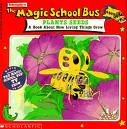
    The Magic School Bus Plants Seeds written by Joanna Cole and illustrated by Bruce Degen tells the story of Ms. Frizzle’s class planting their own garden. All the students are working together to make their garden as beautiful as they can, because photographers are coming to take pictures of their garden and they believe they are going to become famous. Phoebe was one student who was not as excited as the rest. She is new to this school and she had left her beautiful plant at her old school. Ms. Frizzle was not worried because she knew that Phoebe’s plant was only a quick field trip away. So, away the students went on their field trip to get Phoebe’s flower. The students all piled onto the bus, and before they knew it they were on their way, except they were flying. The bus had turned into a  little ladybug flying down onto one of Phoebe’s plants. As the story goes on the students get to explore the plant, and even go inside! They learn where their beautiful plants come from, and how they grow. By the end of the story, Phobe and her class made it back to school just in time for the photographers to take pictures of their garden, and Phoebe’s old teacher was waiting for her with a pot of her beautiful flowers to add her garden at her new school!

    Curriculum Connections

    This is a great book to read aloud to your class. I would reccommend reading this book to a lower elementary grade when introducing plants and seeds. The students in this book use their process skills to learn where our beautiful plants come from and how plants grow. This book will teach students how to use their senses to observe differences in physical properties, such as the plants and seeds. (1.1) I think this would be a great book to have in your classroom for read alouds or for students to observe the pictures. The students in the book talk about what they are learning as the story goes on, and this will show my students how they are using their process skills to learn about plants.

    Additional Resources

    Science in School Here is a website for teachers to go and learn about the basic process skills to teach to students. There are age specific activities, and appropriate lessons.

    Plant Life Cycle This is an interactive website for children to go on and learn about plant life cycle. The children can put their processing skills to the test at this website. There are video clips and parts of plants you can click on to learn more about it. Overall, this is a great website teachers can use in their classroom when children are learning about plant life cycle and incorporate processing skills along the way.

    Scientific Process Skills This is a detailed explanation on what scientific process skills consists of and how to teach it. It is focused on the kindergarden level and explains what should be taught and how to go about doing so. You can find great information at this website that you can bring into your own classroom.

    Book: The Magic School Bus Plants Seeds
    Author: Joanna Cole
    Illustrator: Bruce Degen
    Publisher: Scholastic Inc.
    Publication Date: 1995
    Pages: 28
    Grade Range: K-5
    ISBN: 0-590-22296-1


  • Teaching Economics with Children’s Literature: Agatha’s Feather Bed: Not Just Another Wild Goose Story

    deedyagathasfeatherbed2.jpg

     ”Everything comes from something,
    Nothing comes from nothing.
    Just like paper comes from trees,
    And glass comes from sand,
    An answer comes from a question.
    All you have to do is ask.”

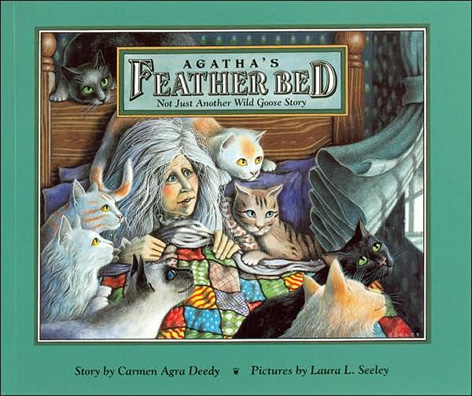
    In Agatha’s Feather Bed: Not Just Another Wild Goose Story written by Carmen Agra Deedy, pictures by Laura L. Seeley this was Agatha’s verse she would recite to the children of Manhattan when they came into her weaving shop wanting to know where her beautiful fabrics came from. Perhaps, little old Agatha forgets her own advice when one cold night she gets a loud bang at her window during her sleep by six angry, cold, naked geese. They want their feathers back that are inside Agatha’s brand new feather bed that are keeping her so warm. Agatha had worked hard to earn that bed, and wasn’t willing to give it up. Instead, Agatha tells the geese to come back to her in three days, and for the next three days Agatha didn’t waste one minute. She closed her shop to the public and starting working. On the third night the geese showed up just as they had agreed, and as they came into Agatha’s bedroom they saw six white, fleecy coats. They were so surprised and thankful. They then looked at Agatha and saw what their coats were made of, Agatha’s hair. They all giggled and on their way out the geese reminded Agatha, “lucky for you and me, hair grows back…just like feathers.”

    Curriculum Connections

    Agatha’s Feather Bed is a great book to use to introduce many of the economic sections of the Virginia Standards of Learning. It explains that everything comes from something, how people are producers of goods and services, and encourages children to ask questions. It also is a great way to introduce the use of barter in the exchange for goods and services (VA Standards of Learning 2.8). Agatha uses her hair to make the fleecy coats, and the geese gave up their feather for the feather bed. They both decided it was a good trade in the end, because they both got something they wanted. This story teaches a good lesson to students, while telling a humorous story. I would recommend using this book as a read aloud in the lower elementary grade levels.

    Additional Resources
    Ten Little Pennies– Here is a website with a catchy song that will get children to sing about trade and money. There are other great song options on the main page of this website that will go along with any economic theme.

     Lemonade for Sale– The Federal Reserve Bank of Richmond has a website with economic lesson plans, and I found this Lemonade for Sale lesson plan that goes along with the theme of my book. It is a lesson plan teaching children the concepts of producer, consumer, and productive resources. This lesson plan is very interactive with the children and allows them to decide on their own to classify their resources as natural, capital resources, or human resources.

    Kids learn market trade– “Pittsburg-area fourth graders present their product at SIFE’s Just Imagine Nation.” A fourth grade class learns about the market economy of four regions of the U.S. Students are divided into teams representing the four regions of the U.S. and work together to come up with a product that is unique to their region. I am very happy I found this website, because this is a great idea that I hope to use in my classroom one day.

    Book: Agatha’s Feather Bed: Not Just Another Wild Goose Story
    Author: Carmen Agra Deedy
    Illustrator: Laura L. Seeley
    Publisher: Peachtree Publishers, LTD.
    Publication Date: 1991
    Pages: 28
    Grade Range: 1-3
    ISBN: 1-56145-096-0

  • Teaching Ancient Civilizations with Children’s Literature: Exploring Ancient Rome with Elaine Landau

    517exdbovel.jpg

    “Hang on! You are going on a trip to ancient Rome! There are many things to see and do. Watch the gladiators fight in the Colosseum. Go shopping at the Forum for a toga or gold jewelry. Visit the Pantheon and learn about Roman gods. And do not forget to pull up a couch and have a traditional Roman feast! In Exploring Ancient Rome with Elaine Landau, author Elaine Landau and her dog, Max, take you back in time to show you the people and places that made up the center of civilization.”

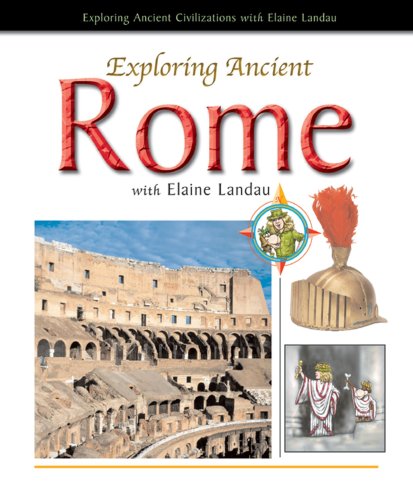
    The book starts out with a letter to the fellow explorers from the tour guides, Elaine and Max the dog. It tells the explorers some of the places they will visit, and how they will feel somewhat at home in Rome. The journey will cover everything from government and laws to housing and food.  There are also lots of paintings and photographs of Rome to help the students visualize these places.

    Curriculum Connections

    Exploring Ancient Rome with Elaine Landua is a great book to use in your third grade classroom. In the opening letter to the fellow explorers, Elaine explains to the students how they will be able to relate a lot of what they see on their journey to their modern day world. For example, “If you had math homework this week, you probably used numbers. The ancient Romans influenced our number system. It is not hard to find a clock with Roman numerals. Ancient Rome’s architecture, engineering, and art also affected our culture.”

    If I were to use this book in my classroom, I would allow the students to read and look at the book up close. There are many great pictures the children would love to look at. Then, after the students have looked through the book, tell the students they will be the tour guides for another group, and have them pick out their five favorite parts and write about them. This is a great way to get the students involved, and also make sure they are understanding the material.

    Virginia Standards of Learning 3.1

    Additional Resources:

    • Ancient Rome This is a great website for older students to go on their own and explore all areas of the Roman lifestyle.

    • Life in Rome Here is a place where students can go and learn about daily life in Rome. This gives the students a chance to see what Roman life is like.

    • Ancient Rome Videos I think videos are a excellent way to bring all your lessons to life. This website has great videos of ancient Rome.

    Book: Exploring Ancient Rome with Elaine Landau
    Author: Elaine Landau
    Illustrator: David Paveloinis, Kristin McCarthy
    Publisher: Enslow Publishers, Inc.
    Publication Date: 2005
    Pages: 48
    Grade Range: 3-5
    ISBN: 0-7660-2337-0


  • Teaching Civics with Children’s Literature: Too Many Tamales

    images3.jpg

    Too Many Tamales by Gary Soto and illustrated by Ed Martinezis a story about a little girl named Maria, who is helping her mother and father cook tamales for their Christmas party.  It begins with Maria and the mother kneading the masa, and Maria being very proud of herself for helping her mother cook.
    “She felt grown-up, wearing her mother’s apron. Her mother has even let her wear lipstick and perfume.”
    As they were kneading Maria’s mother placed her diamond ring on the kitchen counter. Without her permission, Maria wears her mother’s ring and then later loses it while making tamales. Once their family starts arriving, Maria is so excited to see her cousins, she forgets about the ring.  They run upstairs and start cutting out pictures from newspapers and magazines of all the presents they want for Christmas. As Maria cuts out a picture of a pearl necklace she thinks, “The ring!” Needless to say, all the cousins eat their fair share of tamales in search for the ring.  They have no luck, so Maria is forced to tell her mother what happened. She is very upset and scared to go to her mother, but she knew what she had to do.  Maria’s mother, wearing the ring, knew exactly what Maria was about to tell her.  She already knew Maria had learned her lesson from wearing her ring, so without punishment, Maria’s mother let her know that is was OK. The story ends with the entire family cooking a second batch of tamales for their family Christmas party.

    Curriculum Connections:

    This book is a great example of authority and power.  It allows you to introduce authority and power as vocabulary words in your classroom.  Maria knew she had done wrong by losing her mother’s ring, and was forced to tell her what happen.  Even though Maria’s mother had the ring, she knew by not letting Maria know that she would learn her lesson. The mother is the one with the power and authority, she is the one who sets the rules for their house. When using this book in a classroom, you can explain to your students why certain rules are made, and how they are there to protect you. Maria’s mother has a set of rules for her house to protect their property and themselves. By using this book in your classroom, it allows your students to see an at-home situation that they can relate to.  The class discussion about power and authority in their homes could then lead into a discussion about power and authority at school. As the teacher you explain to the students who has the authority at school (i.e. principal, vice-principal, and teachers). This allows the students to connect the story to their own classroom and school. (SOLs K.8, 1.10)

    Additional Resources:
    Too Many Tamales activities This website has it all! It has activities, lesson plans, unit plans, all using this book. You can find plenty of great ideas here.

    3rd Grade Unit Plan Even though I recommended this book be used in kindergarten and first grade, here is a website that allows you to bring this book into the third grade. There are great activities in this website that allow the students to use their thinking and reasoning skills.

    Civic Responsibility and Education Here you will find an article written by Chak Sopheap. This is his reflection after visiting an elementary school in Japan.


    Author: Gary Soto
    Illustrator: Ed Martinez
    Publisher: G. P. Putnam’s Sons
    Publication Date: 1993
    Grade Range: K-1
    ISBN: 0-399-22146-8


  • Teaching Geography with Children’s Literature: Geography From A to Z

    images1.jpg 

    “Do you know the differance between plateau and a plain? Between a knoll and an atoll? Have you ever wondered what a badland is? Or an isthmus? Or a gulch? The answers are all here! From the highest mountain peak to the deepest ocean trench.”

    Geography From A to Z written by Jack Knowlton, pictures by Harriett Barton, is a great picture glossary for young readers.  In this book, you will find a glossary of geographic terms, definitions, and bright colored pictures for each letter of the alphabet. This is a perfect book for introducing our geographic world to our young readers. This book not only gives definitions, but also examples that will help the children be able to relate the content information to their outside world.

    “Archipelago- a group of islands clustered together in an open expanse of sea or ocean. The Philippine Islands are a large archipelago.”

    Curriculum Connections:

    This book would be suitable for any age, but I would use it for teaching in the second or third grade. Some of the terms might be a little advanced for first graders.  However, I would recommend having this book in any teacher’s classroom library.  When using it to teach a lesson, it is a great reference book.  It has many definitions and descriptions of the earth’s features.  Using this book would be an exciting way to introduce a lesson on bodies of water, (i.e. stream, river, swamp, and pond) or even the earth’s zones (i.e. tropical, temperate, and polar zones). These are just a few examples of ways you could incorporate this book into your curriculum.  It is a fantastic book with great pictures and definitions.
    Virginia Standards of Learning: Geography: 1.4a, 1.6, 2.5, 3.5a, 3.5b

    Additional Resources:

    • Geography for Kids This is an interactive website for kids to learn more about the world around them.  It has online chapters with tons of information, and it also has online games that allow the kids to interact with the website and information.
    • Remembering Continents and Oceans All children love to sing, especially in elementary school. So here is a website with two songs to sing which will help students remember their continents and oceans.
    • Geography A to Z lessons This website is a valuable resource to find worksheets and activities for students learning about geography. These activities will assist students with geography skills, while having fun at the same time!

    Book: Geography from A to Z
    Author:
    Jack Knowlton
    Illustrator: Harriett Barton
    Publisher: Harper Collins Publishers
    Publication Date: 1988
    Pages: 47
    Grade Range: First-Fifth Grade
    ISBN: 978-0-06-446099-6