Author: Kevin Kelleher

  • Google Spends a Bundle on Ads — But Why?

    Three years ago, a survey found Google to be the world’s best-known brand, topping Microsoft, GE and others. It was an impressive achievement not just because Google wasn’t even a decade old but because it did so little advertising. So why has Google been spending nearly $2 billion over the past year to strengthen its brand?

    Google, the company that has redefined advertising in the 21st century, is itself becoming a major advertiser in traditional media. Remember the “Parisian Love” ad that ran during the Super Bowl (a $3 million piece of TV real estate)? Or how Eric Schmidt, in tweeting about the ad spot, joked that “hell has frozen over”? Then there was the Chrome ad on the NYTimes.com, as well as other print ads in magazines and newspapers around the world.

    But when hell freezes over, you have to wonder why. Yes, Google launched new products like the Nexus One (to disappointing sales); and yes, its brand takes a hit with every perceived violation of its don’t-be-evil ethic. It also wants to let people know about new twists on search ads like remarketing. But does a company with a two-thirds share of the search market really need to beef up its marketing budget?

    Google’s marketing costs have long been around 8 percent of its revenue. Last year, sales and marketing (excluding stock-based compensation) totaled $1.8 billion. Yet in the first quarter of this year, it spent another $553 million, a 47 percent increase over the same period a year ago. Granted, the beginning of 2009 was a bad time to be spending on anything, but that 47 percent rise is more than twice Google’s revenue growth rate.

    The question of why Google is buying so many ads was on the minds of analysts during the company’s earnings call this week. When a Bank of America analyst asked about it, a Google executive responded that it was driven by return on investment. Which is a silly answer: All advertising is directed at a return on investment. That’s like saying you’re going into business to make a profit.

    What’s more, marketing an ad-driven company has an absurd Ponzi scheme logic to it, a kind of media usury where ad revenue is spun out of ad revenue. Just stop and think about Schmidt’s Super Bowl ad tweet: Here was the CEO of an online ad giant advertising a TV advertisement. If it gets any more meta than that, our heads could explode.

    But, as another analyst pointed out on the call, Google is facing long-term threats from social sites like Facebook, where major advertisers like eBay are spending more of their own ad budgets. Jeff Huber, a SVP of engineering, responded by saying that online advertising is growing so fast it’s not a zero-sum game. That’s true for now, but it won’t be for long. Google, of course, has had a number of failed initiatives in social media. And mobile search is not only a clear priority for Google, it’s a fledgling market up for grabs, perhaps by Google’s newest rival in web advertising, Apple.

    Google’s sudden interest in buying expensive ads in visible advertising spots may suggest that the company is bracing for a period when its core market matures and growth slows. Coded into those rising marketing numbers is a slight but growing concern about what life will be like in middle age.

    Still, at the end of the day, I doubt there can be much return on investment for Google to advertise its search engine and its ad model. Does anyone with web access need to know what Google is, or what it does? If so, I suggest they Google “Google.” Ow — once again, my head hurts.

    Related content from GigaOM Pro (sub req’d):

    Why the FTC Should Approve the Google-AdMob Deal

  • Why Playing Games With Consumers Won’t Work

    We all love good, provocative speeches that makes you feel like you’re looking at things in a new way, which is why Jesse Schell’s ambitious speech at the Dice 2010 Summit – about the future of gaming, networked sensors and marketing embedded in our daily lives – is still reverberating around the web several weeks on. I discovered it after Om called it the most mind-blowing thing he’d seen in a long time. Mathew later expounded on its themes in a thoughtful way. Others raved about it, calling it “astounding” and “Gibsonian” (as in William Gibson).

    My reaction was different. I watched it not as a designer or advertiser but as a consumer, and when it was over I was overcome with a wave of depression. Somehow I’d hoped the future would be less dystopian than what Schell laid out — in particular the notion of games as a marketing tool to corral consumers into desired behaviors. Apparently, I’m not alone. A clip of the last 10 minutes of his speech was recently posted on YouTube under the banner “Most Disturbing Presentation Ever: Our Tech Nightmare.” From there it spread to Hacker News via a blog hosted by IEEE Spectrum, which said:

    Schell’s apparent goal is not to scare his audience. He’s way beyond that. His attitude is that, given how close we already are in theory to experiencing life as a game, it’s clearly something that’s going to happen and we better make sure it gets done right. But, sorry Schell. While you may not have wanted to, you scared me and a whole bunch of other people.

    But if the early enthusiasm that greeted Schell’s vision was over-enthusiastic, this new wave of alarm is also overdone. There may be a future for Foursquare-like startups that can create compelling game-like features in apps. But marketing is an entirely different matter. Marketers and advertisers are the eternal gate-crashers in the world of content. The best ads have always been the rare ones that engage consumers intelligently. The worst ads have taken a cynical approach, viewing consumers as so many behavioral buttons to be pushed.

    Schell is probably right that there’s a home for video game designers in marketing and that behavior-detecting sensors will grow ubiquitous in time (just as behavior tracking on the web is nearly ubiquitous today). But the old-fashioned distinction between good ads and bad ads remains the same, and will be played out again on a larger scale as new technology takes marketing to a broader, and potentially more intimate, platform.

    So if marketing companies are excited about using emerging technologies to play new games with consumers, they should think twice. The rewards may be greater, but the task will be much trickier. Consumers, after all, have only so much time and attention for games. It is already difficult enough to make any game engaging. Keeping up with frequent-flier programs, credit card reward programs, and so on can be tiring after a while.

    Now imaging that the new rewards-based game your company developed has to compete not just with those, but hundreds of other new marketing games targeted at an overtaxed audience. Just this week, New York City tried to induce citizens into good behavior with the most basic of rewards — cold hard cash — but it failed.

    Eventually, the consumer appetite for games will reach a saturation point, and these campaigns will be seen as just another cynical ploy to manipulate us into spending money. We like games because they offer a needed respite, even an escape, from the grind of everyday life. But if life becomes a game, where’s the respite? The escape becomes the very thing we wanted to escape in the first place.

    Image courtesy of Mike_fleming from Flickr.

  • Why Apple and Google Need Each Other

    In the world of technology, drama is a valuable commodity. Disruptive change may happen in the minutiae of software code or the gradual execution of a business plan, but we see its effects in the dramatic narratives of companies rising and falling, or getting locked in combat with each other. Which is why the rivalry between Google and Apple is such a compelling story.

    It’s so tempting to get drawn into the ego battles between Steve Jobs and the Google triumvirate while placing bets on who will win that it’s easy to forget a deeper truth about this rivalry: Google and Apple need each other.

    They both have a deep desire to stake out claims on the mobile web, but the mobile web is in a nascent stage. In order to develop, it needs to have both rigid structure and a sometimes reckless creativity. Structure is necessary to provide a strong foundation and a set of standards everyone can understand. And creativity is essential to bringing the innovative potential of the mobile web into full bloom.

    This dichotomy was present when the Internet began to develop in the early 90s. Many people who came online then did so through America Online’s walled gardens, a safe little enclave where consumers and content providers alike could create the rules of a new medium. Then the web itself took off and sites like Yahoo and GeoCities offered a much more creative environment to explore what else could be done.

    Now it’s happening again, only with Apple and Google. Apple’s stern and unforgiving approach to the iPhone offers the structure this new medium needs to succeed. Cupertino’s control-freak tendencies stretch from enforcing adherence to ever-changing app guidelines to banishing plastic screen protectors from its retail stores.

    Google’s approach is nearly the opposite, much more open and free-wheeling. Its Android OS, based on the Linux kernel, has so many versions available the company is struggling to consolidate them. The Android Market is such an unregulated affair that it’s hard for anyone to count the number of apps on sale.

    Google’s culture has built into it a tolerance for the failures that come with creative experiments. Its 70-20-10 rule seems rooted on that spirit of tolerance — how many companies require employees to spend time on something that may never fly? — and Google has floated so many failed ideas it’s hard to keep track of them all. Apple, by contrast, starts with an instinctive idea of how consumers will experience its products and fits everything, even the ecosystem of apps that extends beyond its corporate walls, into making it work.

    It’s in the tension between these two companies and their respective cultures that the mobile web is being forged. But as America Online found out, the walls eventually come down as consumers grow more comfortable with the new medium and desert the walled garden. That would suggest the balance will tip in favor of Google.

    But I would be surprised if Apple isn’t anticipating this evolution. Right now, iPhone owners are experiencing the mobile web through the 150,000 or so apps it offers through the App Store. But Apple has also backed HTML5, which allows a smartphone browser to have rich app-like features without requiring any new software to be downloaded. Just as people stopped downloading AOL’s software and switched to browsers, we may well abandon most of the apps on our phones today.

    Both companies will continue to play a major role on the mobile web, but I doubt either will ever gain the upper hand. This dramatic tension between Apple and Google may be around for a long time. So executives at both might as well get used to it.

    Image courtesy of Wikimedia Commons.

    Related content from GigaOM Pro (sub req’d):

    With The iPad, Apple Takes Google To the Mat

  • The Spark That Could Ignite Web M&A

    Six months ago, it looked like mergers and acquisitions were heating up again. Om thought it was good news for startups, while I fretted about companies being pressured to make deals that didn’t make strategic sense. I needn’t have worried. After the usual end-of-year lull, deals are starting to be made again.

    And no sector is riper for deal-making than tech, especially those companies active on the web. Not only has the economy been stable for nearly a year, but web companies that survived have emerged with leaner operations and more cash on hand. Perhaps more importantly, the web has evolved to a point where mergers are starting to make strategic sense.

    Here’s why: Over the past several years, web content has developed something of a split personality. Part of it is driven by information, navigated by search and static in nature. The other part is driven by conversation, accessed through discovery and protean in essence. This distinction has been around for some time, and discussed at length on this site, but it’s becoming more and more of an acute reality, especially when it comes to big web companies.

    The dichotomy is becoming clearer in data as well, as evidenced by a report from Hitwise this week comparing the downstream news traffic of two sites, Google News and Facebook. The 10 sites that Google News drives traffic to have next to no overlap with the sites to which Facebook members are linking. Only CNN.com is on both lists. And while print media dominates Google News’s list, People is the only print-oriented publication on the Facebook list.

    It’s also clear that the conversational web isn’t going to make the informational web irrelevant. Rather, they complete each other in a Jerry Maguire kind of way. So marrying the informational web to the conversational web is appealing to companies. It means greater mindshare among their users — and therefore more opportunities to serve them ads or coax them into premium subscriptions. It means higher profits if they can combine the two without a corresponding increase in operating costs. And it means a more integrated, seamless experience of the web — instead of its fragmented nature today, with people jumping from site to site.

    But the catch is, people like the web fragmented. They get nervous when a single company promises them that unified, seamless experience. That’s why Google has launched social network (Orkut, FriendConnect) after social network (Wave, Buzz) without gaining solid traction. Buzz won terrific reviews on its launch, but there’s just something troubling about letting Google – or any one company – stalk all of our online behaviors.

    And that leaves Google with little choice but to buy its way into that Maguire-ish state of completion that it so craves. Of course, many companies crave such a state. To that end, speculation that Microsoft might make a play for Twitter has been around for some time, though the issue was inflamed by comments made by Steve Ballmer this week. Just ask Yahoo how hard it is to say no to Ballmer.

    All it will take is one big deal to start a wave of web mergers. It might not even come from Google or Microsoft. Facebook understands the need to extend its reach into the informational web – a key reason for its Facebook Connect alliances with companies like Yahoo. A merger with Yahoo would present its own share of problems for Facebook, but it would turn the company — overnight — into a formidable web giant. Not to mention the fact that it would an alternative to the IPO that the company seems to be dreading.

    Image courtesy of Mykl Roventine on Flickr.

  • The Rise of the Web Introvert

    Over the past several years, the web has been kind to extroverts. Social networks have offered a new platform for people to broadcast their thoughts, connect with each other and expand their contacts in the online realm. The social web has even ushered in a new kind of extroversion, in which people who might be shy or uneasy in traditional social settings can express themselves online.

    Much less noticeable is another trend: the rise of the web introvert. But while some web introverts might be introverted in the classic sense — that is, uncomfortable in social settings — many of them aren’t shy at all. They are simply averse to having a public presence on the web. And in time, they are going to present a problem for social sites like Facebook and Twitter, whose potential growth will be limited unless they can successfully court them.

    Web introversion isn’t a question of technophobia or security concerns. Anyone who has tried to build out their online networks on Facebook knows that there are a lot of people they know in real life that they can’t friend online. Many people who have been involved in technology for years — or who are entirely comfortable shopping at Amazon, paying bills online, buying songs from iTunes — will have nothing to do with social networks. Others see it as a chore necessary for their jobs. Still others have accounts languishing on all the major social networks.

    If you ask a web introvert why he or she isn’t into social networks, the response often comes down to a matter of trust – or rather, a lack of it. It’s frustrating enough that each social network has its own etiquette to master, but many people are loathe to make the effort because of the unpleasant reality that there is no such thing as privacy on the web.

    And typically, the more that web introverts understand the nature of the web, the less willing they are to expose themselves on it. For while you might start off thinking you own your tweets, you really don’t. And if you don’t want your Facebook information open to the public, you need to follow closely that site’s constant privacy changes. Moreover, regardless of the site, a casual comment that, in an offline conversation would be forgotten, is preserved for years on the web — and could come back to haunt you.

    For extroverts, this is all just part of navigating the social web. But enough people are uncomfortable with social networks that it’s going to become a barrier to growth in the coming years. For now, Facebook’s growth is continuing simply because there are more and more extroverts signing up. And Twitter is still in the stage of experimenting with ways to make money.

    Eventually growth rates will slow and these companies will see web introverts as an alienated part of the market that they need to court. Each introvert, after all, is a lost opportunity for revenue. But it may be that these characteristics are so inherent in the social web that such people simply can’t be courted.

    Image courtesy of Flickr user creatingkoan.

  • Books Are Becoming Fringe Media

    I just finished a book — Richard Price’s excellent “Lush Life” — hardly a noteworthy feat except it’s the first book I’ve read cover to cover in several months. It languished for years on my reading list, which has itself grown longer by the week. In fact, of all the books I’ve read in my life, a shockingly small percentage have been read in the past several years.

    This has a lot to do with the people who write, publish and sell books. The big threat to Amazon’s Kindle isn’t people reading e-books on the iPad or the Nook. It’s that books are becoming fringe media.

    That’s not to say that books are dying. They’ll always be around, and Amazon can count on a loyal audience for Kindles for some time. Kindle owners say they’re reading more books, although they remain a small portion of the population. But notably, according to an informal survey of Kindle devotees, 59 percent of people who buy the e-readers are over 55. Meanwhile, as a NEA study pointed out two years ago, people under 25 were already doing most of their reading on the web, with only 7 minutes a day devoted to books.

    Since that NEA report appeared, the shift in our attention to the web from books has intensified. Just in the past month, I’ve heard several friends — some whose careers are dedicated to writing books — say they are reading fewer of them, if they read them at all. The main culprit that they cite is the web. Whether published in ink or pixels, books are facing tough competition from updates, posts, and a blizzard of free, brief and ephemeral writings that distract eyeballs from the task of digesting 300 pages of text.

    Book publishers may be hoping the iPad and other tablets will solve this problem, but I think such devices are only going to make things worse. Electronic books may have a place on the iPad’s home screen, but they will be battling for attention against dozens of other web apps: games, news, social feeds and so on. In the end, not being a multifunction tablet may be the virtue that saves the Kindle: It’s a refuge from the distractions of the web, a quiet garden walled off from the web except to download a book.

    Like other media, books will change to adapt to the new readers, and I think this means less non-fiction. Even before the web, all business books — and the majority of non-fiction books — struck me as 1,000-word pamphlets puffed out to book length with heroic amounts of filler. So if some books are forced to condense to keep our attention, so much the better.

    As for fiction, there will always be an audience for people who know how to tell good stories. According to Nielsen BookScan, sales of non-fiction books fell 7 percent in 2009, while adult fiction rose 3 percent. There may well be a home for fiction in a world where the web takes up an ever larger portion of our mind share, but novels — like  books and e-readers in general — will have to fight their way back from the fringe.

    Related content from GigaOM Pro (sub req’d):

    The Price of e-Book Progress

  • Google the 21st Century Conglomerate? Bad Idea

    In “The President’s Analyst” — a great relic of 60s paranoia — James Coburn plays a doctor plagued by spies working with the film’s villain TPC, a sprawling tech conglomerate obsessed with collecting information. It’s amusing today to think that TPC — aka The Phone Company — was patterned after AT&T. It’s a little less funny to realize that our era’s TPC is Google.

    Unlike some, I don’t believe Google is a villain. And it doesn’t employ spies because it doesn’t have to — Google knows more about our emails, chats, web surfing and phone messages than we would ourselves care to remember. But its obsessive desire to organize information and our access to it is turning the company into a 21st century conglomerate. And whether you consider that a good thing or a bad thing for web users, it’s going to be a big problem for Google.

    In the past few months, Google has been pushing into new industries that no one expected it to be in even a year ago. Most notably, it began offering the Nexus One, moving into the business of selling (and supporting) hardware devices, and now it’s sticking a formidable toe into the broadband access business with its fiber-to-home experiment. Those efforts resemble Google’s move to build and maintain a massive, stealth data network — at the time, a radical one for a search company.

    All, of course, were aimed at the same goal: improving the way we access and experience the web. But that simple goal — summarized in Google’s longtime mission “to organize the world’s information” — is leading to a complex corporate structure that may not benefit Google in the long run. Every time Google takes on one of these ambitious plans, it adds another ball to those it’s already juggling. And even the most gifted executives can juggle only so many projects at once.

    Google’s history of expansion is a mixed one, complete with more than its share of abandoned experiments. The $102 million purchase of dMarc in 2006 presaged an expansion into radio advertising that Google later decided wasn’t worth it. With Buzz, the company is trying once again to draw an audience in social media — a longtime goal never quite achieved with Orkut, Base or Wave. But none of those were as expensive as the Nexus One and broadband initiatives could be if they fail.

    Google’s growth is turning partners like Apple and Motorola into rivals, and potentially enemies. The company’s strongest years of growth occurred during times of little friction with other companies, save Microsoft. And when other big companies are less likely to work with you or even to work against you, it becomes a distraction to achieving the company vision.

    What’s more, the new initiatives are costly. Analysts have worried about how much a Nexus One could hurt profits if Google decides to eat some of the subsidies often necessary with mobile phones. Now, they are concerned that the broadband network experiment could be another cash-burner. Google has never made profit margins a paramount concern, but if investors yell in protest and the stock falls (along with the value of employee options), that’s another big distraction.

    A conglomerate with tentacles in myriad industries is not necessarily a good thing. It’s an inordinately tough act to pull off: GE has done it, but it took decades of work. And for Google it will mean giving up the culture of Internet innovation that made it a success in the first place. Conglomerates pour their innovation into management and process — that is, into improving what exists — not necessarily into creating what will be.

    If Google insists on straddling multiple industries, it faces a choice: It can spend its energies holding the sprawling empire together, or it can focus on shaping the web. But it can’t do both with any success for very long.

    Image courtesy of Wikimedia Commons.

    Related content from GigaOM Pro (sub req’d):

    Google Buzz’s True Home Is in the Enterprise

  • Why Is PayPal Still So Hard to Find on Mobile Devices?

    Seven months isn’t a long time for most companies, but it’s practically an era in itself on the hyperkinetic mobile web. Since last July, Motorola has launched the Droid and Google its Nexus One. Tens of thousands of new apps have been created — Apple even finally unveiled its iPad, which could potentially rewrite the rules for mobile apps entirely.

    One thing that hasn’t changed, however, is PayPal’s visibility on mobile devices. Last July, PayPal opened a beta of its open platform so that developers could embed the payment system in their applications. In November, it went further, staging a developers conference to officially open the platform and setting up the X.com site for APIs and documentation.

    If the timing felt a bit slow, the strategy was sound. As AuctionBytes noted, “PayPal believes payments for services is a bigger opportunity than e-commerce.” The Times’ Bits blog painted a clear picture of what it could mean:

    PayPal imagines a future in which cash is obsolete, as are wallets. We will buy movie tickets by touching a movie poster on the street and order drinks from a touchscreen embedded in the bar.

    It’s a nice vision. But in the months since, PayPal hasn’t really left much of a footprint in mobile apps. I’m still paying for movie tickets mostly with cash, and the Fandango app I downloaded asks me for my credit card number, not my PayPal account. PayPal is now an option in the iTunes App Store, but few people who entered a credit card number in iTunes years ago will bother to go back and change their settings in order to use it. In short, PayPal is very much on mobile devices, but pretty much invisible.

    Instead, the buzz in mobile payments in recent months has been centered on Square, whose little white dongle turns an iPhone or iPod touch into a credit and debit card reader. Square is clearly a threat to point-of-sale companies like VeriFone, but by making plastic cards even more useful on the mobile web, it could be a big obstacle to PayPal as well. You can swipe plastic through a Square reader, but not your PayPal account.

    PayPal has been at once a success story and a company that hasn’t quite lived up to its potential. Its revenue has grown 45 percent in the past two years, while eBay’s main marketplace business has seen revenue fall 1 percent. But PayPal has never really disrupted credit and debit cards in e-commerce. And outside of eBay, it hasn’t become a default payment method on other sites, notably Amazon.

    The web is full of consumer complaints about PayPal, but my experience with the service over several years have always been positive. Even so, most of my purchases at Amazon or other e-commerce sites use debit card payments that bypass PayPal. It’s just a pattern I fell into and haven’t felt a need to change.

    That pattern will be even more deadly on mobile e-commerce. Smartphones like the iPhone and the Droid – along with the most popular apps — resonate because of their simple interfaces. They are designed to eliminate tiresome choices. No one wants to choose whether to pay by credit card or PayPal each time they make a mobile payment. And that is PayPal’s challenge — not simply to be an option on the mobile web, but to be the default.

    Related content from GigaOM Pro (sub req’d):

    Why 2010 Still Won’t Be the Year of Mobile Advertising

  • What Rupert Murdoch Still Doesn’t Get About the Internet

    Rupert Murdoch knows who’s winning the war between big media and the Internet. Unsurprisingly, it’s Rupert Murdoch. “Without content, the ever-larger and flatter screens, the tablets, the e-readers and the increasingly sophisticated mobile phones would be lifeless,” he proclaimed when News Corp. posted unexpectedly strong fiscal 2010 second-quarter earnings. “Devices and platforms are proliferating but this clever technology is merely an empty vessel without any great content.”

    Murdoch danced a lively jig for investors as he bragged about his company’s ability to thrive in the media tumult caused by the Internet. I’m not buying it. News Corp. may be getting a big lift from “Avatar” right now, but like any big media company, it still has a lot of learning, experimenting and failure to do before it can really start to monetize the web. The arrival of the iPad and other tablet devices may, in time, make that easier. But first they will make it much harder by speeding up the process of adaptation.

    The most difficult thing about the disruption facing the media industry hasn’t been the certain sense that business models are changing — it’s that nobody is sure how they’re changing. But one important idea is starting to become clear: Content isn’t a product anymore, it’s a service. Because for consumers, content is less and less a thing they buy and more a thing they experience.

    The notion emerged a couple of years ago, with the likes of Kevin Kelly alleging that the Internet is essentially a copy machine and asking what can be sold that isn’t easily copied. Others took it even further, to the notion of content as a service. Over at his O’Reilly blog, Andrew Savikas wrote:

    Whether they realize it or not, media companies are in the service business, not the content business. Look at iTunes: if people paid for content, then it would follow that better content would cost more money. But every song costs the same. Why would people pay the same price for goods of (often vastly) different quality? Because they’re not paying for the goods they’re paying Apple for the service of providing a selection of convenient options easy to pay for and easy to download.

    It’s no accident that Apple has been thriving in this chaos. And it’s no surprise that the iPad was designed to enhance the experience of web media in ways that are more immersive and intuitive than either laptops or smartphones. In fact, the iPad seems to be built on the blunt assertion that content is now something to be experienced rather than possessed. Selling content — whether it’s news, music, books or something else — as a product on a tablet is setting yourself up for disappointment.

    This evolution in content is clearer in music, which was the first to feel significant disruption from the Internet. Twenty years ago, buying music meant purchasing a CD after you heard a song on commercial radio (or, for the adventurous, college radio) or read a review in a magazine. Today, music is becoming an experience that begins with discovery sites like Pandora or social network sites like Twitter and end up in a cloud-based service like Spotify or Grooveshark. Significantly, these companies are startups and not traditional media giants.

    In short, the old media giants need to think like startups: That is, look at the iPad with the eyes of any other app developer and imagine what it can do that hasn’t been done before. How will a tablet change the experience of books, news, music, and so on? And why will we consumers be willing to pay for that new experience? These are the questions to start with, rather than asking how to shovel the same old content products onto devices that radically transform what content is.

    Murdoch is right that those devices are lifeless without content, but he neglects to mention that it’s a symbiotic relationship. “Content is not just king, it is the emperor of all things electronic!” he crowed. Maybe, but this emperor is wearing the service uniform of a burger flipper. When do we get fries with that content?

    Image courtesy of World Economic Forum on Flickr.

    Related content from GigaOM Pro:

    This article also appeared on BusinessWeek.com.

  • Admit It, Microsoft: You Suck at the Web

    Microsoft is many things, but one thing it’s not is a successful web company. And it’s time Redmond faced up to that.

    For 15 years, Microsoft has tried time and again to become a major player on the web. It started by integrating an AOL-like dial-up content service in Windows 95. It shifted to a Yahoo-like web portal model three years later. In the search era, it designed search engine after search engine, culminating in an awkward bid to buy Yahoo that felt more like a divorce than a proposed merger. Despite having the most popular browser, however, Microsoft has never really monetized the web in a significant way.

    And what does it have to show for all its effort? Years of losses. Since 2002, when Microsoft began breaking out MSN and online services as a separate category, the division has seen aggregate revenue of $20 billion but a total operating loss of nearly $7 billion. In the past 18 months, the losses in proportion to revenue have only grown larger. Microsoft now spends nearly two dollars on its online businesses for every dollar it makes in revenue. Major points for trying, but it’s time to call a failure a failure.

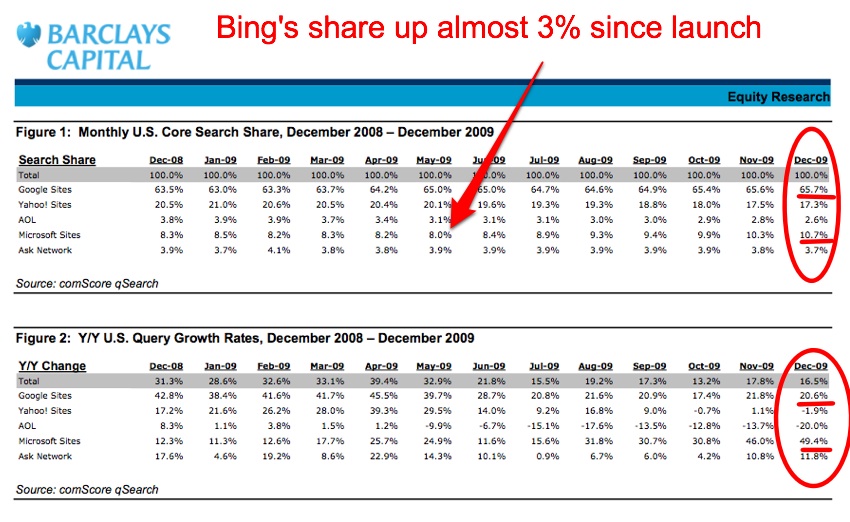
    But what about Bing? Hasn’t Microsoft’s latest search engine been growing market share for seven straight months? Yes, it has: Bing’s search share grew to reach nearly 11 percent in January from 8 percent in May 2009, the month before Bing was launched. But look where it’s stolen its search business from — AOL and Bing’s own partner, Yahoo. Meanwhile, Google’s market share during that period inched up to 66 percent. Unless Bing can start eating away at Google’s share, its prospects for growth are limited.

    And Google’s big challenge isn’t Bing, it’s the evolution of the web from a primarily search-oriented media to one driven by social dynamics and discovery. The time to start chipping away at Google’s dominance of the search market was five or 10 years ago. Now is the time to be hitting at Facebook and Twitter, but if Microsoft has a plan of attack on that front, it’s not evident what it is.

    Does Microsoft not realize that all the spoils of the mobile web are going to the companies that control the front-end interface — that is, the big mobile OS players like Android and iPhone and not the fringe players like Windows Mobile? Maybe. It’s reportedly trying to make Bing the default search engine for the iPhone, but that move may be temporary, if it happens at all. Delay is costly. It released a Bing search app for the iPhone last December — more than six months after Bing debuted for PC browsers — and after a Google app had already been a staple on the iPhone for nearly two years. As of this week, the Google app remains the top reference app in the App Store. Bing trails in the seventh spot.

    Which is too bad because in some small but interesting ways Bing is actually an innovative search engine. But Microsoft’s only choice appears to be to keep spending money and creating bigger losses. So there are lots of expensive deals, with Yahoo, with Twitter, with Verizon and maybe with Apple. Indeed, rather than letting its online offerings grow organically, Microsoft is forced to pay rent to companies that have more of a knack for monetizing the online world.

    After 15 years, the evidence is pretty clear. The web is just not a part of Microsoft’s DNA. The quarterly results it released this week showed that Microsoft is still surprisingly good at what it does best: selling operating systems and software programs for PCs. There is a long-lived if diminishing market for that business. What Microsoft is not and may well never be is a web company. Mabye it’s time the company sold off its online division to a company that is just that – like Yahoo.

  • Will Amazon Be the New Wal-Mart?

    What goes up, they say, must come down. But there are exceptions, such as Amazon’s stock. Despite persistent complaints that it’s too expensive, the company consistently manages to defy them with surprisingly strong growth. And as Amazon pulls out of the worst recession in decades, it’s capable of reaching the level of scale that until now has only been seen by one retailer: Wal-Mart.

    Indeed, Amazon already dominates e-commerce, and it’s on track to capturing a share of the entire retail market that would give it the kind of overweening influence Wal-Mart already holds over suppliers, consumers and by extension, its competitors. One can only hope it will be more benevolent.

    First, a quick recap of Amazon’s history with investors is necessary. Bulls and bears have argued bitterly for the past decade about Amazon’s valuation. Bears say standard accounting metrics show it’s a screaming sell; bulls maintain its value isn’t best reflected in those conventional metrics. The bears appear to have the more rational case, but they have been wrong year after year. Amazon, it seems, just isn’t coming down to earth. Its price-to-earnings ratio has averaged 54 over the past five years, more than double that of the Dow. It currently stands at 71.

    Amazon's five-year Price-Earnings ratio (Courtesy of BigCharts.com)

    And analysts, in trying to explain why the stock consistently defies gravity, are coming up with some theories that are of interest even to non-investors. The latest comes from Jim Friedland, an analyst at Cowen & Co., who believes that Amazon “can eventually achieve a Wal-Mart-like share of the U.S. retail market.”

    Amazon has a 0.3 percent share of the U.S. retail market, compared to Wal-Mart’s 7.7 percent share. But Amazon already has an 8 percent share of the U.S. media retail category, which includes books and music, and could control a similar chunk of categories like electronics, toys, sporting goods, groceries and health and beauty. As Friedland noted:

    In 1984, when Wal-Mart was 22 years old, the company had a 0.3% share of the U.S. retail market, which is equivalent to Amazon’s U.S. retail share today at 15 years old. Over the next 25 years, Wal-Mart’s revenue increased at a 19% CAGR [compound annual growth rate]. We are projecting a 25-year revenue CAGR of 8% for Amazon. If Amazon’s long-term trajectory is similar to Wal-Mart’s historical growth, the shares are significantly undervalued.

    It’s important to note that his bullish view isn’t shared by everyone. Certain investors are short Amazon shares — some 13 million of them — due to their belief that it will all come crashing down someday. But Amazon’s focus on a smooth customer experience, coupled with its longtime obsession with offering low costs, is a proposition that few can match. Barring any huge surprises, a Wal-Mart-like market share seems likely. That’s bad news for retailers, whether online or off, but something to which few consumers would object.

    Wal-Mart’s expected 2009 revenue of $409 billion is equal to 2.8 percent of the U.S. gross domestic product, the first company to come close to the 3 percent mark since General Motors did a half century ago. Amazon’s 2009 revenue is less than one seventeenth of Wal-Mart’s. So it has quite a ways to catch up.

    But the market, at least as far as Friedland is concerned, is saying Amazon can do just that — grow much closer to, if not quite as big as, Wal-Mart. Then again, one thing we’ve learned recently is that the market isn’t always right.

  • eBay’s Turnaround Is in Jeopardy — What Now?

    What happens when your turnaround takes an about-face? eBay CEO John Donahoe may find out the answer to that question if he isn’t careful. Although Donahoe has been implementing a lot of changes aimed at driving new business in the company’s core marketplace division, it’s looking like he needs to come up with some additional ways to bring consumers and sellers back to the site.

    Next Wednesday, eBay is expected to report its financial results for the last three months of 2009, which includes the holiday season. The results aren’t likely to be as bad as a year ago — when Donahoe had to apologize to investors for a disappointing performance – but also aren’t likely to be as impressive as you’d expect when a turnaround is working. Analysts are looking for an incremental rise in both revenue and profit.

    Perhaps eBay’s efforts to repair its business have been too focused on impressing investors. True, eBay’s stock is up 67 percent in the past year. But the company isn’t doing well with either consumers or buyers — who, unlike investors, actually contribute to its revenue. When Piper Jaffray asked consumers last month which site had the best shopping experience, only 13 percent said eBay, down from 27 percent in March 2009. Another 65 percent said Amazon was the best, up from a prior 36 percent.

    Amazon is also appealing to eBay’s key customers, the PowerSellers. When JP Morgan surveyed them, 54 percent had a negative opinion of eBay, while 69 percent viewed Amazon positively. Even worse, PowerSellers sold 56 percent of their goods on eBay last year, down from 65 percent in 2008. In short, all that tinkering with eBay’s marketplace isn’t reversing the flow of buyers and sellers from eBay to Amazon.

    So what’s it going to take to return an allure to eBay’s site? There aren’t a lot of appealing options. But it could start by reaching out to its most vocal critics. The comments section of many articles and blog posts concerning eBay (including some here) blossom with angry rants from disenchanted, often alienated eBay sellers.

    eBay’s stance has long been to dismiss them as a vocal minority, which worked for a while. But the web is a mighty bullhorn amplifying the complaints of the disenchanted — whether you agree with their complaints or not. After a while it taints the brand in the eyes of others, as companies that have set up fire brigades to extinguish complaints on Twitter have learned all too well.

    To win back more consumers, eBay can also go head-to-head with Amazon at its own game: heavy discounting. Part of the appeal of the auction-driven commerce that eBay has moved away from was that it held the promise of a bargain price. Now that eBay is pushing the fixed-price format, many consumers don’t see much of a difference between eBay and Amazon — except that Amazon has a stronger image as a trusted clearinghouse for low-priced goods.

    Often, many sellers offer the same item on eBay with no difference in their buy-it-now prices. eBay could encourage deeper discounts by placing them higher in search results or in featured listings. The company could also renew its image as a low-cost e-tailer with commercials that are more focused and less baffling that its “IT” campaign.

    Of course, going up against Amazon on discounts isn’t easy, as Wal-Mart well knows. And a discount strategy could disappoint the same investors that eBay has been working so hard to impress. But if the company continues to lose market share to Amazon, it will have a bigger problem than irate shareholders. It will have a failed turnaround.

    In-post image courtesy of Wikimedia Commons

  • Google, the Internet and Civil Disobedience As a Business Strategy

    Everyone, it seemed, had a strong reaction to Google’s decision this week to stop censoring its search results on Google.cn. Some were impressed with its moral stance; some found it to be too little, too late; and still others viewed it as a cynical move.

    Maybe I’ve been writing about the business world for too long, but my first thought was -– hmm, Google has turned civil disobedience into a business strategy.

    To be clear, civil disobedience is substantially different for a company than it is for individual citizens. Google will never face the triumvirate risks that many people who defy oppressive governments do:  jail, torture, death. Instead, Google will likely have to shut down its offices in China, a move that could cost them hundreds of millions of dollars in revenue this year alone.

    But judging from some of the ideas that shaped Thoreau’s use of the term back in the 1840s — the refusal to resign consciences to governments or to become agents of injustice –- Google is in fact acting out of civil disobedience. It’s certainly not the first company to do so; those that voluntarily divested from South Africa and other countries with appalling policies were doing the same. But Google is the first company I can think of to act on such a large scale.

    Does that mean Google is acting from self-interest or altruism? My guess is both, but I’ll let that debate simmer on other web pages. I’m willing to accept that Sergey Brin is doing what he believes is right. But Google is a corporation, not a person, and its interests and motives are by definition much more complex.

    Whether to practice civil disobedience is less and less of a marginal issue for companies in a global economy. The question of whether to practice it is an especially pertinent one for Internet companies to ask now –- if for no other reason than the fact that the Internet is an ideal platform for supporting protests. Back in 1998, Stefan Wray wrote an essay on electronic civil disobedience in which he foresaw how the Internet and civil disobedience would be closely enmeshed, noting that:

    While it may be partially true…that participation in street actions has become increasingly meaningless and futile and that future resistance must become primarily nomadic, electronic, and cyberspacial, it is doubtful that physical street actions, involving real people on the ground, will end any time soon. What is more likely is that we will see electronic civil disobedience continue to be phased in as a component of or as a complement to traditional civil disobedience.

    Call it cynical or practical, but Google, whose business is done entirely on the Internet, recognizes that evolution. Google is forced to choose sides in a battle that has been unfolding for some time – China vs. the Internet – and the side it’s chosen will win in the long run. The risks, though, lie in how long it will take for that victory to arrive, and what it will cost Google in the meantime.

    Related GigaOM Pro Research:

    Is Google’s China Problem a Groundswell of the Closed Internet?

    Photo by Chuck Taylor via Flickr.

  • How the Internet Changed Writing in the 2000s

    In a famous passage from Ulysses, James Joyce recapitulates the development of the English language in 45 pages — from the archaic and formal (“Deshil Holles Eamus”) to the conversationally casual (“Pflaap! Pflaap! Blaze on”). Over the past decade, as more people have spent more time writing on the Internet, that same evolution has not only continued, it feels like it’s accelerated.

    With so much discussion about how the Internet is changing journalism and media, there’s surprisingly little said about how writing itself has transformed. But it has changed in a dramatic if subtle way.

    Nine years ago, I remember being one of 100 or so journalists gathered to listen to a veteran writer speak. I don’t remember the topic, just that when he asked how many of us enjoy writing, I was surprised that only a few hands went up. Today, so much of the typical day is taken up with writing emails, tweets, updates, text messages, chat sessions, blog posts and the occasional longer form writing. And few complain how onerous it all is.

    On balance, all of that practice is making online writing better. Which is not to say that all online writing is good. Much of it’s terrible – see the average YouTube comment for an example of how bad it can be. But it’s been said that excellent writing is a matter of good thinking – if you’ve got the thinking part down, that’s most of the battle. And many of the thoughtful people I know are producing some great stuff on the web.

    The Internet isn’t just prompting us to write more, its open structure pressures us to write in a way that’s at once more concise and flexible. One problem newspapers and magazines never could fix is that articles are assigned arbitrary lengths. Pay writers per word and they’ll write as many as they can. Assign a 12,000-word story and you’ll get just that, even if 1,000 are all that’s necessary.

    On the web it’s different. Back in 1997, Jakob Nielsen looked at how people read web content (basically, they scan it) and argued web writing should

    • highlight keywords (often using hypertext links)
    • use straight, clear headlines and subheads
    • deliver one idea per paragraph
    • cut word count to half that of conventional writing
    • employ bulleted lists.

    Many web writers, whether they’ve read Nielsen’s advice or not, use these practices because readers respond to them. The impulse to scan is a good thing because readers’ impatience inspires economy among writers.

    At the same time, people are mastering more kinds of writing. Other technologies that grew more popular this decade required a different mode of expression: Instant messaging invited a breezy, fast-thinking tone; blog comments (again, the thoughtful ones) sharpened our debate skills; Twitter enforced even more economy onto our words. In all of these, we were nudged toward something all writers aspire to: a strong, distinct voice.

    Having a clear voice has grown more important on the web, where writers worry about brand-building, news sites grow interactive and blog posts resemble conversations. Some don’t regard texting and chat as writing, while others argue that they’re killing longer and more formal prose. Both notions are wrong. The informal writing we do on the web doesn’t supplant formal writing, it complements and influences it — and is influenced in return.

    Not all of the Internet’s effects on writing have been positive. Many bloggers tailor headlines and posts so that they’ll surface at the top of search results, making them at once easier to find and less enjoyable to read. And this decade, a lot of other bloggers mistook a strong writing voice for caustic irreverence. But most eventually learned that writing with snark is like cooking with salt — a little goes a long way.

    On the other hand, concerns about the Internet hurting writing feel overblown. Some educators worry that the Internet is making teenagers way too casual in their writing, so that they never learn more formal composition. I disagree. The best way to learn good writing is to write a lot.

    Besides, language is always evolving, and a more conversational English isn’t a bad thing. “Writing, when properly managed…is but a different name for conversation.” Laurence Sterne wrote that in Tristram Shandy 250 years ago. Thanks to the Internet, it’s more true now than ever.

    Image courtesy of Wikimedia Commons


    GridRouter by SmartSynch: The communications hub for the Smart Grid

  • Enough Waiting — It’s Time for Amazon to Buy Netflix

    Like an old sports injury, the rumor of Amazon buying Netflix seems to flare up once every few months. It happened again this week when a Reuters reporter tweeted about its impact on stock-options trading, and the meme gained traction when other blogs ran with it.

    The recurring rumors have always proven false. Because if anyone isn’t taking them seriously, it’s Amazon. The online retailer’s chronic allergy to sales taxes has kept it from a deal that makes sense in many other ways. But things are changing, and it may well be that now is the best time for Amazon to buy Netflix. In short, Amazon may be forced to collect sales taxes in a year or two, and by that time the chance to buy Netflix may have passed.AMZN vs NFLX in 2009

    The benefits of a merger are clear. The companies are simpatico: Earnings and revenue growth rates are comparable; and corporate cultures are similar — innovative and centered on a positive consumer experience. Amazon finally gets an online-video business that consumers flock to. As Netflix moves from DVDs by mail to video over IP, it can tap into Amazon’s vast computing platform. And integrating Netflix recommendations with IMDB’s inelegant but indispensable movie database could produce the premier search-and-discovery engine for film lovers.

    There are a few reasons why Amazon may not be interested in buying Netflix. It’s not in the habit of making big acquisitions. Its higher-profile purchases in recent years — Zappos, Abebooks, Audible.com — have tended to be priced below $1 billion. Netflix’s market cap is more than $3.1 billion (driven higher this week thanks to those rumors). Netflix is also highly valued, trading at 31 times its recent earnings. So while Amazon would be unlikely to pay cash, it could use its own overvalued stock (81 times recent earnings) as currency.

    But the big factor keeping Amazon from moving toward a Netflix deal is the question of sales taxes. Amazon has skillfully dodged sales taxes in most states by arguing that it’s the consumer’s responsibility to report them, not Amazon’s (of course, few consumers do). Netflix charges a sales tax for an odd reason. Businesses must collect a use in any state they have a physical presence, and every state has decided that the very DVDs that Netflix rents out constitute a “physical presence.”

    So buying Netflix would expose Amazon to charging sales taxes in all states, eliminating a cost-advantage that has helped it grow market share. But the days of sidestepping sales taxes may be numbered for Amazon. New York passed a law requiring the company to collect sales taxes from its residents, a move that Amazon is fighting in courts. Other states, famished for new revenue, may follow. Congress may even take up the issue; if so, brick-and-mortar retailers losing share to Amazon would be smart to lobby for its passage.

    As the online video industry evolves, Netflix can help Amazon in new ways. First, it can offer it a proven subscription-based model, which many consumers prefer to Amazon’s standard pay-per-view model. (Why pay Amazon for a movie when it’s in your Netflix queue?) And if reports that Apple is considering a subscription-based video service prove to be true, Amazon will be much better positioned with Netflix in its fold.

    And while the Kindle remains popular, it’s inevitable that some company will start selling an e-reader of similar quality that also offers streaming video. A future-generation Kindle that can not only seamlessly download books but also stream Netflix’s 17,000 Watch Instantly films and TV programs could offer Amazon an edge that others would find hard to match for a while.

    Meanwhile, the clock is ticking. The last time the Amazon-Netflix rumors surfaced in July, Netflix was valued at $2.4 billion. And there’s always the chance that another cash-rich company could make a play for Netflix first: Microsoft to integrate it further with the Xbox, Apple to empower iTunes in streaming video, Comcast to build a stronghold on the web.

    Buying Netflix would hurt Amazon in the short term because of the sales-tax issue. But by waiting too long, Amazon stands to be hurt in the long term.


    GridRouter by SmartSynch: The communications hub for the Smart Grid