Author: Larry Seltzer

  • BlackBerry Boosts BBOS, BES, BBM

    A year ago, at his first BlackBerry Live, according to BlackBerry President and CEO Thorsten Heins, many people told him that it would be his — and the company’s — last. As Heins went on to say, they were wrong.

    Here at BlackBerry Live 2013 in Orlando the company had an upbeat story and lots of news.

    While many are still skeptical of the company’s prospects, it’s hard to deny that the company has executed well in the last 12 months, recovering from widespread disdain to the release of several well-regarded products and a profitable quarter. In that first quarter of this year they sold a million BlackBerry Z10s and 5 million older BlackBerry devices.

    The news highlights from the company include:

    • BlackBerry Messenger (BBM), the company’s messaging platform, will be available for iOS and Android this summer. BBM is a significant service outside the US where it is widely used for free messaging, and is a major selling point for the company there. They claim 60 million users worldwide.
    • BBM Channels turn BBM into a social network more on par with Facebook and Twitter. Celebrities and companies, and ordinary users, can create a channel and BBM users can subscribe to it. BBM Channels is now in beta and will be available for older BlackBerries as well.
    • BlackBerry OS 10.1 will start releasing this week. US carriers should have it by the end of the month and the Q10, available in the US in early June, will ship with it. BBOS 10.1 includes improvements in the BlackBerry Hub (the central messaging app for the OS), personalized notifications for contacts and accounts, click-to-call from an email or BBM message and better cursor control.
    • BlackBerry Enterprise Server (BES) 10.1 is now available for download. It adds the ability to run on the same physical server as BES 5. (BES 10 can only manage BB10 devices so organizations with older BlackBerries have to run an older BES as well.)
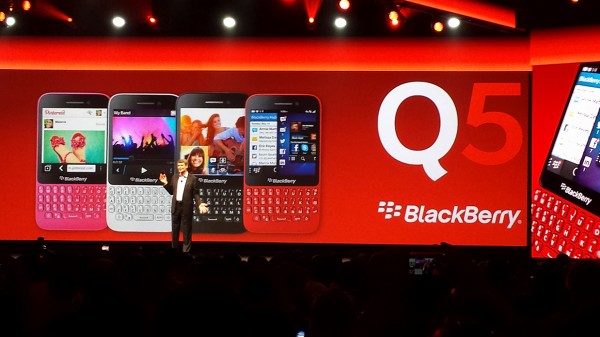
    • The BlackBerry Q5 is a new phone with a physical keyboard designed for emerging markets. It will be available in black, red, white and pink.
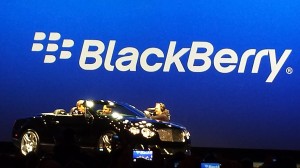
    The foundation of BB10 is QNX, a popular embedded OS which BlackBerry bought. One of the themes here at BlackBerry Live is automotive computing, as the company takes integration in the other direction, putting BlackBerry technologies into cars. They brought a “stock Bentley” to the stage with a BlackBerry console including BBM videoconferencing.

    Among the celebrities launching a BBM Channel will be BlackBerry’s Global Creative Director Alicia Keys. Keys spoke today mostly about the popularity of BlackBerry among women (56 percent of BlackBerry users are women) and the company’s commitment to advancing the role of women in technology. To that end, they announced today the BlackBerry Scholars Program, which “…will provide full, four-year tuition scholarships to outstanding women globally who are seeking degrees at accredited colleges and universities in the areas of Science, Technology, Engineering and Math (STEM) with a particular interest or aptitude in the area of mobile computing”.

    BlackBerry is under no illusions that BB10 and their other new technologies will catapult them back into market dominance. One ISV partner I spoke to said that Heins told them the company’s goal is to be #3 in the market, which would seem to make Microsoft their main target and a goal which seems achievable. Heins alluded to this in his opening remarks in which he emphasized how their products are “built for mobile,” that they don’t try simply to downsize the desktop experience and have no desktop users to satisfy.
  • You wish you could fail like Microsoft

    The sharks are in the water smelling Microsoft blood. It’s the company’s “New Coke” moment. Windows 8 is too little too late (hey, that rhymes).

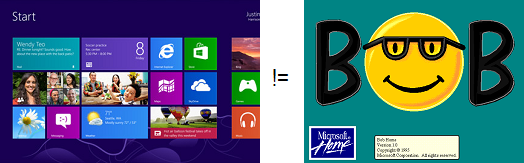
    Over the years Microsoft has had a number of true product failures, genuine losers, but fewer than you’d think. I’d certainly count Microsoft BOB as one of these; BOB was an attempt at a cartoony, fun interface to Windows that was laughed off the market in short order. (Microsoft reps told me at the time that the focus groups loved it.)

    But Windows 8? We should all fail like this. If the government failed like this we’d be running a trillion dollar surplus. Today Microsoft announced sales of more than 100 million Windows 8 licenses. (“This number includes Windows licenses that ship on a new tablet or PC, as well as upgrades to Windows 8.”)

    During last year’s Worldwide Developer Conference, Apple claimed there were 66 million Mac users. I don’t think there are 100 million Windows 8 users, maybe not even 66 million, but surely there are tens of millions by now. That’s a big market and translates to hundreds of millions of revenue for Microsoft.

    The latest NetMarketShare numbers tend to support this view. Windows 8 is already substantially ahead of any one version of OS X and on a trajectory to pass all of them combined before long. These numbers are for desktop operating systems:

    • Windows 7: 44.72%
    • Windows XP: 38.31%
    • Windows Vista: 4.75%
    • Windows 8: 3.82%
    • Mac OS X 10.8: 2.82%
    • Mac OS X 10.6: 1.82%
    • Mac OS X 10.7: 1.78%
    • Linux: 1.21%

    Before you say it, I know NetMarketShare’s numbers are somewhat opaque, but they’re pretty much all there is in the public domain and they roughly make sense to me. The biggest anomaly in the list above is that Linux has 1.21 percent of desktop users. That can’t be true. Another interesting, debatable point: NetMarketShare doesn’t include Windows 8 in the Mobile/Tablet numbers, so anyone using it as a tablet is counted as a desktop user. Microsoft’s convergence of the two uses in one operating system messes with NetMarketShare’s zeitgeist.

    By the way, back to the tablet numbers above: See the number just above Windows 8? That’s the near-universally reviled Windows Vista, still at 4.75 percent, more than Lion and Mountain Lion combined. Two years ago NetMarketShare had Vista at 10.46 percent of desktops. Many hundreds of millions of Vista licenses were sold. Sure, it was a bad version and generated ill-will, but Microsoft made a ton of money from the OS. Any other company would love to have a failure like Windows Vista.

    No doubt there are a lot of mistakes in Windows 8. But is any product that sells in the tens or hundreds of millions a failure? We should all fail this badly.

  • Samsung Galaxy S4 — it’s just a damn phone [review]

    After a year-and-a-half on an iPhone 4S, I’m now on the current cutting-edge of smartphonery: Samsung Galaxy S4. I’ve used the phone for almost 3 days now. It’s good. I’m excited. Are there any ball games on tonight?

    Where was I? Oh yeah, the phone. I’m so excited that I could…do something that excited people do. Honestly, it’s a phone. It’s a very nice phone with some great features, a great physical design and a lot of bling features that I’ll probably never use. I can believe it’s the best of the Android phones, but I haven’t tested all the others.

    Second Choice

    The GS4 was not my first choice. What I really wanted was a Windows Phone, but two problems stopped me: There are still a number of severe gaps in the app ecosystem, which I find surprising at this point. The market share may seem small, but Windows Phone user base is large in absolute numbers. As my colleague Joe Wilcox wrote two days ago, Windows Phone adopters tend to be first-time smartphone buyers, so they haven’t established app preferences. It’s an opportunity for both the big and small companies. And yet, there’s still no Adobe Reader for Windows Phone and the Microsoft PDF reader is a piece of garbage.

    I still might have sucked it up and gone ahead, but the Nokia 920 — clearly the best Windows Phone and one of the best phones of any type has a sealed battery — and I will never again buy a phone with a sealed battery.

    So Android looked like the logical choice, and Samsung the easy decision. The electronics giant’s phones aren’t just popular, they’re highly-regarded and have the richest ecosystem outside of Apple’s. Right around this time the Galaxy S4 became available so I pre-ordered, and AT&T delivered early.

    Unfortunately, when trying to activate last Saturday I ran into a problem: To do so online you need an order number and an activation number. I had no activation number because my online order status was still “preordered”, even though I had the phone for a couple days. Calling support deliverd bad news: they are only available Monday-Friday (even though the webpage says they’re also open on weekends) and support chat was offline. Monday morning I activated GS4 on the phone with customer service, but it took almost half an hour because of the confusion in their systems.

    It’s Huge

    The Galaxy S4 is conspicuously larger than my iPhone 4S (136.6 x 69.8 x 7.9 vs. 115.2 x 58.66 x 9.3 — all mm) and yet lighter (130 vs. 140 grams). The iPhone 5 changed things: it’s almost as tall as the GS4 and much lighter, but as narrow as the 4S.

    But the display differences, at least in specs, are still profound: The GS4’s screen is 130 mm diagonal vs. the iPhone 5’s 100 mm, the GS4 resolution is 1920 x 1080 vs. the iPhone 5’s 1136 x 640 and pixel density is 441 to 326, in favor of the Samsung. Obviously the size difference in screens stands out, but the quality difference? I’m of the opinion that the iPhone 5 meets or exceeds my “as good as I’ll ever be able to discern” standard. I can’t see any quality difference in the GS4, but I’m sure others can (especially after being informed of the specs).

    Beyond the physical phone, Samsung has put a lot of resources into customizing this distribution of Android to distinguish it from others. You’ll never hear them use the word “Android”. It’s all a Samsung product.

    To me, the most impressive and useful distinction is the ability, which Samsung has had for almost a year, to run two apps at the same time on the screen. I expect to use this a lot, even though only a few apps work in this mode. The South Korean company also has better security features for centralized device management than other Android vendors — and for some time — and are increasing that lead, not that any of this applies to my phone.

    Too Much of a Good Thing

    I don’t expect to use most of the new stuff in the GS4. I’ll likely end up disabling all the off-screen gesture stuff (“Air Gestures”). It’s too easy to invoke by accident and works badly in my admittedly-brief testing. The Air Gestures use a sensor at the top of the phone to allow you to:

    • See “important information” quickly when the screen is off.
    • Move around in a document or between images by waving your hand in front of the screen without touching it. (This is the best example of a feature easy to invoke accidentally.)
    • Accept a call by waving your hand in front of the sensor.
    • A related feature called Air View lets you preview certain content, like the names of contacts from their speed dial number, by hovering your finger over them.

    Finally, there is Smart Screen, which is probably the most publicized feature of Galaxy S4. The sensor and camera look at your eyes to determine what part of the screen you’re looking at and use that to scroll the content as appropriate. I really did try this and couldn’t get it working. Maybe I could with some more effort, but what I can’t get myself to do is care. A friend who has tested it is more hopeful.

    All the conventional Android stuff like widgets is there, too, and all the apps. So far I think probably made the decision, but I’m not excited like the people on the Samsung TV commercials. It’s just a phone, and the thrill is gone.