Author: Laura

  • Teaching Earth Science with Children’s Literature: Oh Say Can You Say What’s the Weather Today?

    Oh Say Can You Say What’s the Weather Today?

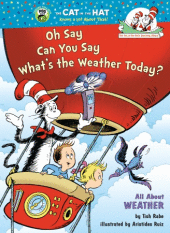
    Oh Say Can You Say What’s the Weather Today? written by Tish Rabe and illustrated by Aristides Ruiz is another educational and entertaining addition to the Cat in the Hat’s Learning Library.  The Cat uses silly rhymes in Dr. Seuss style to introduce complex weather phenomena and the instruments that are used to measure and predict weather.  The rhyming text and illustrations simplify the complexity of the vocabulary and terminology.  “First stop is the top of Mount Karakakoo, where they study the weather.  (That’s all that they do!)”  They learn about thermometers. anemometers, wind vanes, and folklore weather predictors like “[f]rogs croak a lot more when it’s going to rain.”  Next kids learn about cloud formations, rain, snow,heat and cold, humidity, thunderstorms, hurricanes, and tornadoes.    Each term is briefly explained with occasional supporting explanations and drawings.  And in the end, the Cat leaves no question about the importance of weather.  “You see, weather keeps changing but one thing we know.  It makes life exciting wherever you go.”   A glossary is included at the end end of the book.

    Curriculum Connections

    This book is a fun  introduction to the terminology necessary to understand the basic types, changes, and patterns of weather (2.6) and the tools used to measure and predict weather conditions and phenomena (4.6).  None of the concepts are explained in depth, but the rhymes are crisp and interesting and the book effectively covers a lot of terminology in the Cat in the Hat’s familiar, simple, and entertaining style.  Used at the beginning of a unit, the book is a wonderful way to engage students in the concepts of weather.

    Additional Resources

    • Making Rain – This website includes an activity for teacher’s using Oh Say Can You Say What’s the Weather Today that reinforces the lesson on rain and the water cycle with a tea kettle and a large metal lid.
    • What is Weather Lesson Plan – This lesson plan for lower elementary introduces key weather terminology using Oh Say Can You Say What’s the Weather Today and weather pictures.
    • The Weather Channel Kids – This site includes a broad range of activities and information for kids ranging from an interactive weather forecasting tool that allows you to build your own forecast, to information about weather jobs, a glossary, games, and videos about weather phenomena.
    • Bulletin Board Theme Ideas – This pdf includes a number of ideas for weather related bulletin boards for upper elementary classrooms.

    Book: Oh Say Can You Say What’s the Weather Today?
    Author: Tish Rabe
    Illustrator: Aristides Ruiz
    Publisher: Random House
    Publication Date: 2004
    Pages:
    48
    Grade Range: PreK-3
    ISBN: 0375922768
  • Teaching Life Science with Children’s Literature: Who Lives in An Alligator Hole?

    Who Lives in an Alligator Hole

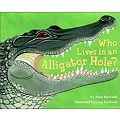
    “What do you know about alligators?”  After reading the nonfiction picture book, Who Lives in an Alligator Hole? written by Anne Rockwell and illustrated by Lizzy Rockwell, readers will have learned facts about alligators, their history, wetland habitat, and their impact on the unique ecosystem they inhabit.  During the dry season in Florida’s wetlands, alligators create gator holes by digging in damp muck and thrashing about to shove the thick muck away.  “Soon a wide hole fills with water a few feet deep.  Then a lot starts to happen in the gator hole,”  as numerous species of animals are drawn to the watering hole. The author explains that scientists consider alligators to be a “keystone species” because of their importance to the other plants and animals in their habitat.  Next the author traces the dramatic impact that humans have had on the American Alligator who came close to extinction thirty years ago and what has been done to save them.  Today, “[t]he American alligator is one of the world’s most successful stories of a species saved from extinction just in time”.  Readers are asked to think of ways to save the Chinese alligator who continues to be endangered.  The illustrations are simple and work well to support the text.  The book ends with an activity designed to help students understand why other animals are dependent on the alligator hole for water and a page of “Gator Facts” that don’t fit elsewhere in the story.  This book is yet another successful introduction to basic science concepts from the Let’s-Read-and-Find-Out About Science Series.

    Curriculum Connections

    Like most of the books in the Let’s-Read-and-Find-Out About Science series, this book addresses several themes from the standard elementary science curriculum.  The book is best used to teach living systems and the interdependence of living organisms with their living and nonliving surroundings and the ways that habitats change over time (2.5, 3.5, and 4.5), particularly in water-related environments (3.6, 3.9, and 6.7d).  But the book can also be used to teach about the impact that natural events and human influences can have on a species or habitat (K.9a, 3.10a-b, and 6.9d).

    Additional Resources

    • American Alligator – National Geographic Kids– This site includes a number of facts and supporting information about the American Alligator and its habitat, video footage of the reptile in his natural setting, and a map of the areas where he lives.
    • Endangered Species Program – Kids Can Help – This site for kids from the U.S. Fish and Wildlife Service includes a number of ideas for kids to help conserve rare, threatened and endangered species and their habitats.
    • Lesson Plan on Endangered Species – This lesson plan is a good extension activity to use when talking about the impact of human intervention on ecosystems and endangered species. It could even be adapted to the Chinese Alligator mentioned in the book.
    • Mini-Ecosystems Lesson Plan – This lesson plan is written with a third grade classroom in mind.  Students make small-scale environments and describe the interactions between living and nonliving things in their environments.

    Book: Who Lives in an Alligator Hole?
    Author: Anne Rockwell
    Illustrator: Lizzy Rockwell
    Publisher: Collins
    Publication Date: 2006
    Pages: 40
    Grade Range: PreK-3
    ISBN: 006445200X

  • Teaching Physical Science with Children’s Literature: Wow! Said the Owl

    Wow! Said the Owl

    There is no shortage of books about colors, but Tim Hopgood has written and illustrated a particularly satisfying story with Wow! Said the Owl.  One curious little owl takes a long nap at night (”instead of staying awake all night , as little owls are supposed to do”) so that she can stay awake and see the dawn.  Following is page after page of bright colors from the yellow of the sun to the green of the trees to the red of the butterflies and orange flowers. Young children will love the bright collage style illustrations, the simple predictable language, and the cycle of night-to-day-to-night.  Teachers will appreciate the opportunity to teach or reinforce color identification with the color wheel at the end of the book that encourages kids to “Look through the pages [of the book] and see if you can find them.”

    Curriculum Connections

    This book is best suited for the early elementary curriculum when students are learning to make basic observations of objects (K.1a) and the physical properties like color that can be used to describe them (K.4a). Young children will love playing a modified version of “I Spy” using this book for inspiration.  The teacher should model the game by telling children that she/he is going to close his/her eyes and pretend to be the baby owl who has never seen daylight before.  When the teacher opens his or her eyes, he should say “Wow! said the owl…… I see something [color].” and encourage the children to guess what he or she sees.  If children are having difficulty, additional physical properties can be introduced like shape and size to help children guess the object.  After the teacher has modeled the game several times, children can take turns being the baby owl. As a follow up activity, students can take a walk together outside and look for objects with particular colors.

    Additional Resources

    • Caterpillar Circles and Colors -This printable can be used to test color knowledge.  By numbering the circles, teachers can then call out a color and a number and ask students to color the appropriate numbered circle.
    • Owl Coloring Sheet – This printable is an accurate representation of a barn owl and a good way to connect the lesson to a life science lesson as well.
    • Can You Guess the Color? – This song or poem is a wonderful way for young children to make associations between objects and colors.
    • Color Activities – This website includes numerous printables, games, and activities for teachers to use when teaching colors to young children.
    • A Rainbow of Color Activities – This website includes books, printables, songs, games, and lots of other activities for teachers to use when teaching colors to young children.

    Book: Wow! Said the Owl
    Author and Illustrator: Tim Hopgood
    Publisher: Farrar, Straus and Giroux
    Publication Date: 2009
    Pages: 32
    Grade Range: PreK
    ISBN: 0374385181

  • Teaching Process Skills with Children’s Literature: June 29, 1999

    June 29, 1999

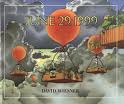
    June 29, 1999, written and illustrated by Caldecott Medalist David Wiesner, chronicles the strange events that occur exactly one month after the story’s young scientist, Holly Evans, launches vegetable seedlings into the sky on seed flats with Acme weather balloons. “Holly intends to study the effects of extraterrestrial conditions on vegetable growth and development.  She expects the seedlings to stay aloft for several weeks before returning to earth.”  What she doesn’t expect is for the skies to fill with giant vegetables one month later.  “Cucumbers circle Kalamazoo. Lima beans loom over Levittown. Artichokes advance on Anchorage.”  The dry report like style of Weisner’s writing, only serves to accentuate the absurdity of his story and the humor in his drawings.  But Holly is puzzled when arugula, eggplant, avocado, and rutabaga all show up on the news; Holly didn’t grow these specimens and can only conclude that the giant specimens are not the result of her experiment.   “More curious than disappointed, Holly asks herself, ‘What happened to my vegetables? And whose broccoli is in my backyard?”   Wiesner answers her question with a surprise twist that children will love on the last two pages of the book.

    Curriculum Connections

    This book is great fun to read and to look at and provides a wonderful opportunity to introduce the scientific investigation, reasoning, and logic to grade school children (K.1, 1.1, 2.1, 3.1, 4.1, 5.1).  But it is perhaps best suited for third grade students who have already been exposed to the scientific method and are beginning to plan and conduct their own investigations or experiments where predictions and observations can be made, questions developed to formulate hypotheses, data gathered, charted, and graphed, and inferences made and conclusions drawn (3.1a, c, g, j).  Wiesner’s book follows Holly’s experiment and the unexpected events of June 29, 1999 without giving anything away too early, allowing students to make their own observations and draw their own conclusions.  Teachers can pause throughout the text to ask questions that reinforce this manner of thinking and encourage students to make their own hypotheses about Holly’s vegetables.

    Additional Resources

    • Predicting Story Outcome – This lesson plan is actually geared toward developing reading analysis skills using Wiesner’s book, but it could easily be shifted to focus on scientific prediction.
    • Science Equipment: Planters – Teachers interested in helping students to conduct their own experiments with plants can use these guidelines to create cheap easily constructed planters in the classroom.
    • Process Skills Lesson Plans – This site includes numerous lesson plans intended to teach a variety of process skills including a number of experiments that focus on the process of scientific investigation.
    • Scientific Method Worksheet – Teachers will love this worksheet that introduces the scientific method to elementary students with simple language and graphics.

    Book: June 29, 1999
    Author and Illustrator: David Wiesner
    Publisher: Sandpiper
    Publication Date:
    1995
    Pages: 32
    Grade Range: PreK-3
    ISBN: 0395727677

  • Teaching Economics with Children’s Literature: Clever Cat

    Clever Cat

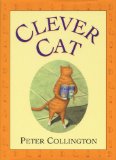
    Have you ever wondered if your dog or cat is smarter than he or she lets on?  Clever Cat, written and illustrated by Peter Collington, takes readers into the mind of the average household pet.  Quite fed up with waiting to be fed each and every day, Tibs (a cat) climbs up on the counter opens a can of cat food and feeds himself to the astonishment of the family who owns him.  Delighted with her very clever cat, Mrs. Ford gives him a key to the house and eventually her cash card. “‘I forgot to pick you up some cat food,’ she said. ‘Do you think you can take out some cash and buy yourself some dinner?’” Before long, Tibs is eating in restaurants, shopping, and going to the movies.  No longer willing to simply provide for the cat’s keep, Mr. and Mrs. Ford take back the cash card and tell Tibs to get a job. “‘We need to talk,’ said Mr. Ford. ‘You’re a very clever cat, but a very expensive one to keep.  You’re going to have to help out with the bills.’” It doesn’t take Tibs long to discover that earning his keep is hard work and not nearly as much fun as playing dumb and waiting to be fed.  Taking his cues from other cats on the street, Tibs forgets how to feed himself as quickly as he learned and eventually Mrs. Ford breaks down and feeds Tibs herself.  A satisfied Tibs curls up in the sun next to the other cats in the neighborhood who wink “at each other as if to say, ‘Finally, a clever cat.’”

    Curriculum Connections

    Clever Cat is a fantastic children’s book  for introducing a number of general principles of economics: economic choice, scarcity, opportunity cost, human resources, and the use of money.  Kindergartners through third graders will appreciate Tibs’ struggle to take control of his own life, his joy in spending money freely, and the painful lesson that nothing in life is free.  Cash cards can feel like magic to children (much the way that Mrs. Ford’s cash card feels to Tibs) but the lesson that the Fords ultimately teach, helps to explain that cash cards are just another form of money that has to be earned and used in exchange for goods and services (2.8).  Teachers can use the book to talk about the choices that Tibs has to make once the Ford’s force him to get a job and relate that to the choices that people make when resources are scarce (K.7, 1.8, 2.9, 3.9).  In addition, Tibs’ short time as a waiter provides an opportunity to talk about human resources and the role that workers play in bringing products and services to consumers (2.7).  The illustrations are a perfect counterpoint to the story and help to build students’ background knowledge about ATM machines, financial transactions for goods and services, and the work and effort involved with holding down a job. While the breadth of the book lends itself to all of the topics above, a lesson that includes all of the above topics would probably be overwhelming for an introductory lesson.  As a result, it is recommended that teachers select one or possibly two of the concepts listed to focus their lesson.

    Additional Resources

    • Teaching Ideas for Opportunity Costs– In addition to purchasing information for an opportunity cost poster and activity pages, this page of Kid’s Econ Posters includes a number of ideas for teaching the concept of opportunity costs to young elementary students.
    • Scarcity and Choice – This site provides good background information for elementary age students about scarcity and choice and relates it to their lives.
    • Opportunity Costs Game– This site provides directions for a very simple game that teachers could introduce to students to support the concept of opportunity costs.  Students win $150 and have to choose which prize or prizes out of a given list they would select with their prize money.  All prizes not selected are the opportunity cost.
    • Reinforcing the Concepts of Scarcity and Choice – This lesson plan asks students to imagine they are boarding the Mayflower for the new world and can take one small suitcase.  What would they pack? Teachers in the upper elementary grades can use this lesson or a variation thereof to reinforce the concepts of scarcity and choice while teaching students about colonization of the United States.

    Book: Clever Cat
    Author: Peter Collington
    Illustrator: Peter Collington
    Publisher: Knopf Books for Young Readers
    Publication Date: 2000
    Pages:
    32
    Grade Range: PreK-3
    ISBN: 0375804773

  • Teaching Ancient Civilizations with Children’s Literature: The Trojan Horse

    the-trojan-horse-image.jpg

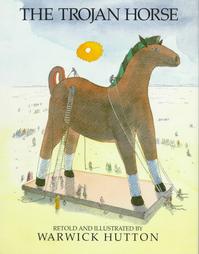
    Warwick Hutton masterfully retells and illustrates the famous legend of  The Trojan Horse. The familiar story is told in child friendly language that provides context to the simple and beautiful  watercolor and pen illustrations.  For those who may be unfamiliar with the 3000 plus year old legend (or need a refresher as I did), Helen of Sparta and Paris, the son of the King of Troy, fall in love and flee to Troy.  The issue at stake is that Helen is already married to the King Menelaus of Sparta.  When the Greeks gather an army and travel to Troy to retrieve Helen and wreak revenge, a ten year war begins between the Greeks and the Trojans.  “Many battles were fought – and there were many brave heroes – but the armies were equally matched.  For weeks, for months, for years, both sides fought, watched, waited, then fought again.”  Imagine the Trojans surprise when the Greeks sail away one morning leaving behind an enormous wooden horse.  Children will delight in learning how the Greeks won the war by tricking the Trojans with the wonderful horse.  In the end, Hutton writes, “[e]veryone had forgotten Paris and Helen, who had started it all.  But there in the city square stood the wooden horse, and over the smoking ruins of Troy its bright painted eyes still gazed.”

    Curriculum Connections

    The ancient Greeks are responsible for a wide variety of contributions to the modern world including: architectural styles, art, legends and myths, many aspects of our democratic government, trial by jury, and the Olympics (3.1)!  Pretty impressive!  The Trojan Horse is an engaging and perhaps familiar story for a read aloud to introduce a unit on the Ancient Greeks.  Teachers can call attention to the geographical features of the Aegean Sea and how water impacted the culture of the Greeks with respect to travel, trade, and war (3.4).  The Mycenae-ans were great seamen, warriors, and traders with a respect for beauty as well as function.  The architecture of the Trojan wall in Hutton’s drawings demonstrates the use of sculpture to enhance a functional object with beauty.  Even the legend itself presents an opportunity to talk about the Greek alphabet and mythology and the ways that this story has been passed down to us today. If used in conjunction with other sources such as the Usborne Book of World History or Every Day Life in the Ancient World, the book can be used to grab the attention and interest of young readers, who may not have as much background knowledge to pull from, in order to share the many contributions of this ancient civilization.

    Additional Resources

    • Greeks at War – Use this file to develop a lesson plan related to the culture and lifestyle of the Greek warriors.  Includes great activities to capture the imagination of transitional readers.
    • Ancient Timeline – This timeline designed for kids can be used to help highlight the “ancient” in Ancient Greece!
    • The Wooden Horse – For striving readers, this site provides a very simplified version of the Trojan Horse that students can read themselves or click to hear the words read to them.
    • Greek Quiz – This could be a great pre-activity to determine what background knowledge (if any) students might have.

    General Information

    • Book: The Trojan Horse
    • Author: Warwick Hutton
    • Illustrator: Warwick Hutton
    • Publisher: Margaret K. McElderry Books
    • Publication Date: 1992
    • Pages: 32
    • Grade Range: K-5
    • ISBN: 0689505426
  • Teaching Civics with Children’s Literature: Shh! We’re Writing the Constitution

    Shh!  We’re Writing the Constitution

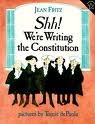
    Shh!  We’re Writing the Constitution, by Jean Fritz and illustrated by Tomie dePaola,  provides an engaging summary of the events during the summer of 1787 through the ratification of the United States Constitution in 1788.  Fritz masterfully explains that, “[a]fter the Revolutionary War most people in America were glad that they were no longer British.  Still, they were not ready to call themselves Americans.”  Using easy to understand text, she walks readers through the reasons that a strong federal government was needed as well as the difficulties that delegates at the Grand Convention faced in drafting a document that would define what that government should look like.  In addition to details about the art of compromise and the final draft of the Constitution itself, Fritz shares gossipy tidbits about the delegates at the convention that humanizes the nation’s Founding Fathers and makes reading about the basis for the U.S. government interesting.  For example, “[Benjamin] Franklin came to the convention in a Chinese sedan chair carried by four prisoners from the Philadelphia jail” and Oliver Ellsworth shook “the hand of a woman who was two thousand years old.”  Readers get a feel for how even once drafted, disagreements continued and the states were slow to ratify the document.  She explains that even Benjamin Franklin “disagreed with some parts… [but] he was convinced that this was the best that they could do.”  Fritz walks readers through the arguments between the Federalists and Anti-Federalists during the almost year before the United States of America officially became a nation with the new framework for government defined by the Constitution.  The book includes the text of the Constitution of the United States for easy reference.

    Curriculum Connections

    Shh! We’re Writing the Constitution is an excellent book for introducing upper elementary school children to the work and effort involved in creating the U.S. Constitution as well as the key components of the Constitution itself.  Teachers can use the book to trace the history of the document’s creation, address the primary political conflicts and differences between the newly sovereign states, explore the structure of U.S. government, and the role of compromise in governance.  Depending on the reading levels of students, the book can be read aloud, in pairs, or individually.  To be most effective, teachers should plan activities that allow students to explore the difficulties in working with others to create a governing framework and to engage directly with primary source documents.

    Virginia Standards of Learning: Virgina Studies – Political Growth and Western Expansion, VS.6a; United States History to 1865 – Skills, USI.1a; United States History to 1865 – Revolution and the New Nation, USI.7a and USI.7b

    Additional Resources

    General Information

  • Teaching Geography with Children’s Literature: I Lost My Tooth in Africa

    i-lost-my-tooth-in-africa-image.jpg

    “My dad says if you lose a tooth in Africa and put it under a gourd, you will get a chicken from the African Tooth Fairy.”

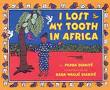
    So begins I Lost My Tooth in Africa, a delightful story written by 12-year-old Penda Diakité and illustrated by her father, Baba Wagué Diakité.  Penda grew up in Portland, Oregon,  but her father was born in Mali.  Every year, Penda and her family travel back to Africa to visit her father’s family in Mali.  Inspired by the true story of her younger sister, Amina, Penda masterfully crafts a suspenseful charming story about losing a loose tooth on a trip to Mali.  The story is full of rich cultural details and subtle information about how location and physical surroundings impact how families live.   Beautiful ceramic-tile illustrations support the story-line and add additional information about the climate, clothing, food, housing, recreation, and community relationships in Mali.  The book also includes a world map depicting the “two days, three planes, and three different continents” required to travel from Portland to Mali.  The book closes with a glossary of Bambara words (the national language of Mali), a recipe for African Onion Sauce, and the words to Grandma N’Na’s Good Night Song. Appropriate for pre-K through third grade, this book is a wonderful way to introduce the influences of location and place on culture.

    Curriculum Connections

    This lively children’s book provides a fantastic opportunity to engage early elementary students in introductory geography and the different ways that location, climate, and physical surroundings affect the way people meet their basic needs: food, clothing, and shelter. By using a relatable experience like losing a tooth, teachers can guide students in a discussion of the differences and similarities between the cultures of this Mali community and the community in which they live as well as the geographical reasons for some of those differences. Specific questions for consideration include:

    ·         Where is Mali?

    ·         What is the climate like in Mali?

    ·         What are the physical surroundings like?

    ·         What types of clothing do the characters wear?

    ·         What kinds of foods do they eat?

    ·         What activities do the children participate in on their trip?

    ·         What animals do they see?

    ·         What types of shelters are in the story?

    ·         How do these details compare with how and where you live?

    Kindergarten Standards of Learning: Geography: K.4; Virginia First Grade Standards of Learning: Geography: 1.6.

    Additional Resources

    • Kameshi Ne Mpuku: An African Game – Children’s games are typically reflective of the environment where they are created.  This lesson plan and accompanying activity helps children to understand the similarities and differences between an African game and those that they might play on the playground at their school as well as the impact that location has on recreation.
    • Political Map of Africa – This map can be used for coloring and identifying the location of Mali as well as the general biomes of the continent.
    • Africa Savanna – This lesson plan highlights key characteristics of the African savanna where Bamako, Mali is located.  Understanding more about the climate, vegetation, and animal life of this part of Africa is important for understanding why the foods, building materials, and clothing in the story might be different from one part of the world to another.

    General Information

    • Book: I Lost My Tooth in Africa
    • Author: Penda Diakité
    • Illustrator: Baba Wagué Diakité
    • Publisher: Scholastic Press
    • Publication Date: 2006
    • Pages: 32
    • Grade Range: PreK-3
    • ISBN: 0439662265