Author: Lisa Witzler

  • A more cooperative divorce

    Adapted from “Negotiating a More Civil Divorce,” first published in the Negotiation newsletter.

    In the United States, lawyers who recognize the benefits of collaborative negotiation are sometimes stymied by vengeful clients and ruthless opposing counsel.  Many attorneys put up with a contentious settlement process in which litigation is a threat.

    Yet some U.S. lawyers have begun to adopt new tools for helping their clients negotiate disputes, particularly those involving divorce and child custody, more civilly: collaborative law and cooperative law. A process that involves mutual-gains negotiation can be especially beneficial for divorcing parents, who have a strong shared interest in their children’s future. New research by professor John Lande of the University of Missouri School of Law reveals the value of these new approaches.

    Collaborative law. In the early 1990s, the collaborative-law movement sprang up with the goal of giving disputants the best of both worlds: a lawyer’s advocacy and legal know-how combined with the problem-solving orientation of mediation.

    Now common in many states, the process begins when each disputant hires a collaborative lawyer and signs a disqualification agreement stating that he will hire a different lawyer if the decision is made to take the case to court. The prospect of having to hire new lawyers is designed to commit disputants to the negotiation process. It also eliminates the conflict of interest faced by lawyers who could gain more financially from a long litigation process than from a quick settlement.

    Disputants also agree in advance to disclose all information relevant to the case, to treat each other with respect, to jointly hire experts (such as psychologists in child-custody cases), and to address each other’s needs. In turn, their lawyers promise to serve as negotiators, not litigators, and to try to keep the process honest, respectful, and productive. Working together, the clients and their lawyers engage in a series of “four-way” meetings aimed at finding creative solutions that meet both parties’ interests.

    Cooperative law. For many people, hiring new attorneys to litigate after a collaborative effort falls apart is financially unfeasible. Disputants may pour time and money into a failing collaborative negotiation simply because they feel they’ve invested too much to quit. In addition, some lawyers resist the idea of “abandoning” their clients if negotiation fails.

    Cooperative law, which has taken hold in a small number of states, does away with the disqualification component of collaborative law—both parties reserve the right to litigate with the same counsel if the negotiation fails—but retains its other key features, including an emphasis on mutual-gains negotiation.

    Beyond divorce? Lande proposes extending the collaborative and cooperative approaches beyond the family law arena. These processes could be tailored to virtually any dispute where civility and trust are possible, according to Lande, including probate, employment, medical, debt collection, and commercial practice. Whenever parties express willingness to rise above any anger or hurt feelings in search of a resolution that satisfies both sides, one of these new processes may be a wise choice.


  • Should you be nasty or nice?

    Adapted from “Honey or Vinegar?”, first published in the Negotiation newsletter.

    Who brings out the best in us: someone nice or someone nasty? According to a recent study by Gerben A. van Kleef and colleagues of the University of Amsterdam, we may be more generous toward angry people than toward happy people.

    In the first two experiments of the study, participants were told they were taking part in a computer-mediated negotiation in which they couldn’t see their opponent. In fact, each participant dealt solely with a preprogrammed computer. Some participants were also given secret information about how their counterparts were “feeling.” When people believed that the other side was feeling privately angry, they didn’t bargain as hard themselves, apparently sensing that the other side was close to the limit.

    In the final experiment, participants received expressions of either anger or happiness directly from their counterpart in addition to the secret information about how their counterpart was feeling. Here, participants again were cautious, conceding the most when dealing with a counterpart they believed to be inwardly angry, even when that counterpart sent cheerful messages. Perhaps participants felt they were dealing with a ticking time bomb.

    By contrast, participants ignored expressions of anger when they believed their counterpart was privately satisfied with the process. Such behavior appeared to participants to be standard bluffing.

    Surprisingly, however, participants were not cowed by counterparts they felt were consistently angry, both inwardly and outwardly. In those cases, participants responded with hardball tactics of their own.

    Real-life negotiators can learn lessons from this study. You might think that brooding like a method actor will intimidate others into making concessions, but doing so could backfire if your counterpart sees through your act. And when you sense that others may be steaming inside, swallow your fear-don’t try to appease them by overcompensating on concessions.

  • Heading off deception

    Adapted from “Negotiators Lie,” by Maurice E. Schweitzer (professor, University of Pennsylvania), first published in the Negotiation newsletter.

    In all types of negotiations and across all phases of the process, people can sometimes misrepresent or fail to tell the truth. Individual negotiators lie with the hope of improving their own outcomes. When negotiating his salary with the Cranbury, N.J.–based pharmaceutical marketing firm Carter-Wallace in 1997, Robert Bonczek misrepresented his prior title and salary at DuPont. Once Carter-Wallace detected the deception, it withdrew its offer. Sometimes entire teams of negotiators lie [or was this just a bluff?]. In the union-management negotiations between the United Autoworkers Union (UAW) and Textron that began in 1994, Textron’s management team misrepresented its intention of hiring nonunion workers. As a result, the UAW agreed to a contract that it later regretted accepting.
    Given the challenges of detecting deception at the bargaining table, what can you do to protect yourself from being taken for a ride? Here are three proven tactics for heading off and defusing lies at the bargaining table:
    1. Develop a relationship. Before negotiations begin, form a relationship with your counterpart by spending time together and sharing information. Take a potential business partner to a sporting event or out to dinner and try to get a sense of her character. The deeper the relationship, the more likely your counterpart will be to treat you like a friend (and the less likely she will be to deceive you) rather than like a passing acquaintance when you negotiate.
    2. Meet in person. To curtail deception, many negotiation scholars, including Leigh Thompson of Northwestern University, advocate meeting in person rather than communicating by phone or e-mail. The most useful cues for detecting deception are visual; therefore, meeting in person makes relevant cues more available. Even when we miss these cues, meeting face-to-face can curtail the risk of being deceived and yield important benefits. Potential deceivers are less likely to lie in face-to-face meetings because the perceived likelihood of being detected and the costs of self-regulation—concealing a smile, for instance—are higher.
    3. Ask plenty of questions—and listen actively. Before talks begin, identify key questions and guarantees that you’ll need from the other side. During negotiations, a deceptive counterpart may pretend not to hear a question or may answer a different question altogether. If so, keep probing; when dealing with a deceiver, you must be willing to repeat yourself. Note that most people (as well as the law) make distinctions between lies of commission—misleading others actively through overt statements—and lies of omission, or passive forms of deception. We tend to be much more comfortable avoiding a question or failing to correct a mistaken impression than we are actively misstating the truth. An entrepreneur may be happy to let you assume that this quarter’s numbers are just as great as last quarter’s were. But when you press him on the issue, he may become willing to reveal the actual state of affairs.

  • Understand your counterpart’s incentives

    Adapted from “View Your Counterpart as an Agent,” first published in the Negotiation newsletter.

    Looking for yet another way to build your power at the negotiating table? Examine the incentives of your counterpart—and then consider whether they align with those of the group she represents.
    In most business negotiations, notes Harvard professor Guhan Subramanian, your counterpart is acting as her organization’s rep¬resentative, or agent (just as you’re acting as your organization’s agent). Her interests are thus unlikely to be perfectly aligned with those of her organization. A sales representative may be rewarded based solely on the sales volume she generates, yet her organization likely has other concerns, such as the quality of her decisions and her ability to manage relationships.
    You can enhance your power by probing such agency issues. Subra¬manian recommends that you ask yourself questions such as these before you negotiate:

    • How is the negotiator across the table compensated?
    • How long has she worked for her organization?
    • What are her long-term career goals?

    By differentiating your counterpart’s interests from those of her orga¬nization, you could find opportunities to enhance your power. If you learn that your counterpart is desperate to close a deal and move on to the next one, for instance, she may be willing to take a lower price than she has claimed.

  • First, know thyself

    Adapted from “Self-Analysis and Negotiation,” first published in the Negotiation newsletter.

    “Separate the people from the problem,” advises the bestselling negotiation text “Getting to Yes”. That’s certainly good counsel when tempers flare and bargaining descends into ego battles, but it’s a mistake to ignore the psychological crosscurrents in negotiation. Unless they are addressed, a deal may never be reached.
    Expert mediator Christopher Moore says his biggest professional challenge is often “changing the psychological relationship” between parties. In the same vein, Robert Baruch Bush and Joseph Folger say dispute resolution can hinge on getting each party to “consider the other’s situation or self from the other’s perspective.”
    In most negotiations, we don’t have the luxury of a wise and trusted third party to help us understand each other’s motivations and view the situation in a more balanced light. However, say Stuart Twemlow and Frank Sacco, astute laypersons can spot certain dysfunctional psychodynamics.
    One is the fundamental attribution error—the tendency to regard (and respond to) other people’s behavior as if it reflected only their personality and values, when what they do and say may actually be triggered by circumstance.
    A second is self-serving enactment, the tendency to treat others in a way that serves your own need for self-esteem and power.
    Finally, those who fall prey to self-fulfilling enactment have been painted into a corner. If someone treats you as if you’re hostile, you may unintentionally fulfill this expectation.
    To build the common ground necessary to reach agreement, negotiators may first need to resolve their interpersonal issues. Recognizing and working to overcome adverse psychological dynamics can break the cycle of mistrust and pessimism.

  • The India-Pakistan Peace Initiative: The Role of GEO TV Network

    The India-Pakistan Peace Initiative: The Role of GEO TV Network

    with

    Mir Ibrahim Rahman, CEO, GEO TV Network

    Date: March 9, 2010

    Time: 4-6 PM

    Where: CGIS Building, Weatherhead Center for International Affairs,

    1737 Cambridge Street, Room N-262, Cambridge MA

    Contact Chair: Donna Hicks ([email protected]).

    Speaker Bio

    Mir Ibrahim Rahman (MIR), CEO of GEO TV Network, has been at the helm of affairs of Pakistan’s fastest growing and most popular media brand for over 8 years. A former Goldman Sachs investment banker, specializing in media and telecom, Mir has overseen the launch and growth of GEO from a
    5 member operation out of a hotel to a 2,500+ strong South-Asian content producer and broadcaster with 10 channels globally. GEO’s mission is to create an enabling platform for thinking and questioning in Pakistan.

    The New York Times confirms that “GEO has changed the media landscape” of the country. Mir graduated Summa Cum Laude with Honors from Babson College in Economics, Finance and Entrepreneurship in 2000 and co founded GEO when he was just 25. His alma mater has dubbed MIR the “Robin Hood of Information” for Pakistan, helping bring ground-breaking consciousness to social political discourse. Mir is the youngest member of Young President’s Organization in Pakistan, Charter member of The Indus Entrepreneur and Director of Mir Khalil ur Rahman Foundation. Mir and his wife, Sheena, are currently taking a study leave together at Harvard for their Masters in Political Administration and Education respectively.

    About the Herbert C. Kelman Seminar Series

    The 2009-2010 Herbert C. Kelman Seminar on International Conflict Analysis and Resolution series is sponsored by the Program on Negotiation, the Nieman Foundation for Journalism, the Joan Shorenstein Center on the Press, Politics, and Public Policy, The Weatherhead Center for International Affairs, and the MIT-Harvard Public Disputes Program, as well as Boston area members of the Alliance for Peacebuilding. The theme for this year’s Kelman Seminar is “Reconciliation: Coming together after the shooting stops”

  • Alternative Dispute Resolution in the Federal Government: What’s up at the Federal Energy Regulatory Commission and elsewhere?

    The PON Dispute Resolution Forum and the Harvard Negotiation and Mediation Clinical Program Present:

    Alternative Dispute Resolution in the Federal Government:

    What’s up at the Federal Energy Regulatory Commission and elsewhere?

    with

    Deborah Osborne,

    Group Manager, Dispute Resolution Service, Federal Energy Regulatory Commission

    Thursday, March 4, 2010

    8:00AM Breakfast

    8:30AM Talk

    Pound Hall, Room 335, Harvard Law School Campus

    How are ADR principles applied in a federal government setting? What are hot topics facing federal ADR practitioners today? How do the Obama Administration’s memoranda on open and collaborative governance impact the work of ADR practitioners to foster better communication and collaboration? Hear more about these broad topics of interest and, more specifically, about one federal agency ADR unit’s first decade of operation preventing and resolving energy conflicts. This event will be hosted in partnership with the Harvard Negotiation and Mediation Clinical Program.

    Speaker Bio

    Deborah is certified in mediation from Pepperdine University’s Straus Institute for Dispute Resolution. She has taken negotiation and advanced negotiation courses at the Program on Negotiation at Harvard Law School, and commercial mediation from Northern Virginia Mediation Service. She holds graduate and undergraduate degrees in Anthropology from the George Washington University and Temple University, respectively

    Deborah has mediated well over 100 cases involving two and multi-party interests, many leading to multimillion dollar energy settlements and cost-savings to all involved. She has over 250 hours of conflict resolution training and voluntarily mediates cases in Virginia’s General District Courts in Alexandria.

    She is grateful to be involved in an ongoing partnership study on energy ADR with the Harvard Negotiation and Mediation Clinical Program.

  • Bargaining with the Devil

    Professor Robert Mnookin, Chair of the Program on Negotiation at Harvard Law School, published an article for the Foreign Policy online magazine this week based on his new book, “Bargaining with the Devil:  When to Negotiate, When to Fight.” The article discusses how President Obama should deal with the evils he is confronted with.

    Click here to read the full article.

  • Give at work

    Adapted from “Pitch Your Offer—and Close the Deal,” by Deepak Malhotra and Max H. Bazerman (professors, Harvard Business School), first published in the Negotiation newsletter.

    When you’re having trouble persuading someone, you might be tempted to sweeten the pot with hefty financial incentives. Before doing so, consider whether there are cheaper ways of gaining compliance.
    A national trade association for construction subcontractors learned this lesson during a survey of its membership. The association was aware that target audiences of market research are notoriously reluctant to respond to surveys. Hoping to find the key to increasing response rates, they worked with researchers Jeannine James, president of the American Research Company, in Fairfax, Va., and Richard Bolstein, a professor at George Mason University, to test the power of providing financial incentives for filling out the survey.
    The association sent the questionnaire without a financial incentive to one randomly chosen subgroup of members. Of this group, 20.7% returned a completed questionnaire. The association promised to pay a second group of members $50 for completing and returning the questionnaire. This time, 23.3% of members responded—an insignificant increase. A third group of members was sent a single dollar bill with the questionnaire (and no other incentive). A surprising 40.7% of members from this group returned completed questionnaires.
    The behavior of these respondents violates the predictions of standard economic theories. Not only was the $1 “incentive” considerably lower than the $50 incentive, it wasn’t an incentive at all—it was a guaranteed payment regardless of whether the member complied with the request. It appears that recipients felt obliged to comply precisely because the dollar was not an incentive but rather a unilateral concession, or gift, to be reciprocated.
    Even a token concession may be sufficient to induce compliance with your request. Here are a few low-cost “gifts” you might give in your next negotiation:

    • Agree to meet at a time or location that’s more convenient for the other side than it is for you (such as his office rather than yours).
    • Arrive at talks with enough doughnuts and coffee to share with your counterpart.
    • Begin substantive discussions by agreeing to a small request made by the other side.

    Note that your counterpart is more likely to feel compelled to reciprocate in substantive ways if you make your concession salient—for example, by making sure he knows that you’ve agreed to his preferred location despite its inconvenience for you.

  • The power of stereotypes

    Adapted from “Cultural Caveats,” first published in the Negotiation newsletter.

    As professor Cheryl Rivers of Queensland University of Technology in Brisbane, Australia, points out in a recent literature review, seasoned negotiators often hear stories about the unethical behaviors of people of other nationalities. Perhaps the toughest problems arise surrounding what Rivers calls “ethically ambiguous” negotiation tactics. Ambiguity can lead us to reach sinister conclusions about the motives of our counterparts, particularly when we lack a solid understanding of an opponent’s culture.
    Rivers summarizes a variety of cultural differences in negotiation. For example, Asians are more likely to view cultivating a relationship with a negotiating counterpart through expensive gifts, entertainment, or personal favors as more ethically appropriate than would Americans or Canadians. Similarly, she notes that although Mexicans have higher standards than Americans about what is ethically appropriate, necessity is more likely to lead Mexicans to violate these standards.
    Like any differences between groups, these cultural differences are small, on average. Nonetheless, we tend to overuse the stereotypes that arise from these small differences, and these stereotypes block us from noting important individuating information. Thus, we too often act as if the person on the other side of the table represents the cultural stereotype we’re expecting. From her statements and behaviors, we seek confirmatory information to back up these stereotypes. Perhaps most problematic, when a counterpart uses ethically ambiguous negotiation tactics, we adopt sinister explanations for her motives.
    When it comes to negotiating behavior, more variance often exists within cultures than between them. Negotiators should seek out information about individual and cultural differences. However, negotiators are more likely to assume that people from other cultures are behaving unethically than they are to realize that standards of ethical behavior vary. Therefore, don’t jump to harsh conclusions about the other side’s motives when more benevolent explanations for their behavior are possible.

  • Don’t fight City Hall

    Adapted from “Tired of Fighting City Hall? Negotiate Instead,” first published in the Negotiation newsletter.

    No matter what organization you work for or where you choose to live, sooner or later you’ll find yourself facing off with a government official or agency. Here are a few examples:

    • You apply for a permit from your local zoning board to build an addition on your house. The board asks to meet with you to discuss modifications to your proposal.
    • Your organization tries to set up an office to deliver relief aid in a third-world country but runs into opposition from local officials in the host country.
    • You hammer out an agreement to sell your company’s software to a private defense contractor, only to discover that the deal must be approved by the federal government.

    Though officials may claim otherwise, they often have a certain amount of discretion when interpreting laws and making decisions, writes Tufts University professor Jeswald W. Salacuse in his book Seven Secrets for Negotiating with Government (Amacom, 2008). Here are three of the power tools that Salacuse recommends you use to influence the decisions of government officials in your favor:
    1. The power of precedent. Government negotiators have a strong motivation to demonstrate that they treat the public fairly. To protect themselves from allegations of
    impropriety, they follow rules and regulations closely. But what happens when you’re negotiating issues for which no hard-and-fast rules exist? Cite an established precedent,
    and give government employees the protection they require.
    Salacuse himself did just that when negotiating an agreement with the Sudanese Ministry of Foreign Affairs in the mid-1970s to allow the Ford Foundation to operate in that country. Talks proceeded nicely until Salacuse asked his negotiating partner to grant the foundation tax and customs exemptions. The diplomat hesitated, unsure whether such a concession would be wise or even legal. He perked up, however, when Salacuse mentioned that such exemptions were part of the Ford Foundation’s country agreement with Egypt. Ultimately, they drafted an agreement for Sudan that followed the tax and customs provisions of the Egyptian document word for word.
    2. The power of “No surprises.” During a luncheon with active and retired government officials, Salacuse asked one of them to share the most important element of a successful government negotiation. “No surprises!” said the official. The others nodded in agreement.
    Why do government officials have such an aversion to being surprised? Because surprises, such as community opposition to a proposed shopping mall or a lawsuit from the developer’s competitors, can threaten their political power.
    At all costs, avoid surprising government negotiators or taking actions that make them fear such surprises, warns Salacuse. Before negotiating, educate yourself about the political climate surrounding your proposal. Once talks begin, inform officials about the positive and negative consequences of an agreement. If public opposition is likely, work with officials to address community concerns.
    3. The power of relationships. In any negotiation, talks proceed more smoothly and successfully when parties have a strong working relationship. This is especially true when cultural differences exist, as is often the case in negotiations between government officials and corporate executives, according to Salacuse. How can you build strong relationships with government officials? First, encourage them to talk about their culture. Second, build bridges by identifying similarities between the two sides. When you share information about yourself, you forge connections that reach beyond formal titles.

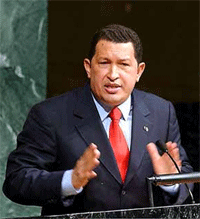
  • Understanding Chavez

    “Understanding Chavez”

    with

    Boris Munoz, Editor in Chief, Exceso Magazine and Nieman Fellow

    and

    Leonardo Vivas, Fellow at the Carr Center for Human Rights at the Kennedy School of Government.

    Date: February 23, 2010

    Time: 4-6 PM

    Where: CGIS Building, Weatherhead Center for International Affairs,

    1737 Cambridge Street, Third Floor, N-354*, Cambridge MA

    Contact Chair: Donna Hicks ([email protected]).

    *Please note the location of this seminar is different from the normal room.

    Speaker Bios

    Boris Muñoz is a fellow at the Nieman Foundation for Journalism at Harvard.

    He is a Venezuelan journalist and Ph.D in Hispanic American Literature.  Author of several books, including La ley de la calle (The Law of the Streets), testimonios de jóvenes protagonistas de la violencia en Caracas (Fundarte,1995) and Despachos del imperio (Dispatches from the Empire) (Random House 2008), and co-editor  with Silvia Spitta of Más allá de la ciudad letrada. Crónicas y espacios urbanos (Beyond the Lettered City) (University of Pittsburg Press, 2003). In 2000 he received the Fellowship of the Humanities Institute at Dartmouth College and the First Accésit of the Premio Internacional de Periodismo Fernando Lázaro Carreter in Madrid. He was and Editor-in-Chief of Nueva Sociedad and Editorial Director of Exceso magazine. He contributes regularly to Gatopardo magazine, and Prodavinci.com.

    Professor Leonardo Vivas is a fellow at the Carr Center for Human Rights.

    Prof. Vivas has been a member of the institute for two years. He is a Sociologist from Central University in his native Venezuela. He has published two books about Venezuela’s political crises and co-edited another about grass roots management. In the US, Leonardo has been a fellow and associate researcher at the Weatherhead Center for International Affairs at Harvard University. He is also founder and Executive Director of Latin Roots, an organization dedicated to improving the understanding of Latino Culture and helping Latino students achieve better educational records in an attempts to further the positive integration of Latino culture into society. He has been a Lecturer at Tufts University, where he has taught a course about the Chavez Era in Venezuela and is now lecturing at University of Massachusetts Lowell. He is also devoted to advocating for democracy in Venezuela, mainly through the Boston-based organization VENERED. Prof. Vivas has also published several articles at the Fletcher Forum of World Affairs about Venezuela and is finishing a forthcoming book provisionally titled, “The Republican Monarch, Venezuela’s Journey away from Democracy.”

    About the Herbert C. Kelman Seminar Series

    The 2009-2010 Herbert C. Kelman Seminar on International Conflict Analysis and Resolution series is sponsored by the Program on Negotiation, the Nieman Foundation for Journalism, the Joan Shorenstein Center on the Press, Politics, and Public Policy, The Weatherhead Center for International Affairs, and the MIT-Harvard Public Disputes Program, as well as Boston area members of the Alliance for Peacebuilding. The theme for this year’s Kelman Seminar is “Reconciliation: Coming together after the shooting stops”

  • Caught in the middle

    Adapted from “When You’re Stuck in the Middle,” by Susan Hackley (Managing Director, Program on Negotiation), first published in the Negotiation newsletter.

    At a company in a Midwestern city, employees were divided into two camps: those loyal to the founder and his vision of a mom-and-pop business with a dozen regional stores, and those aligned with the CEO, who hoped to open one hundred or more stores nationwide. Employees from the two groups rarely visited one another’s offices and avoided collaborating. One group even ate lunch at a different time than the other.

    Ray, a midlevel assistant manager, wanted to do something about the ongoing conflict. Relatively new to the company, he felt no strong allegiance to either side and sensed that the divisions were harming the company and making it difficult for him to do his job. Though he had no official role or mandate, Ray decided to take action. The problem was, he had no idea where to begin.

    Many of us have been bystanders to a conflict that causes us real harm. In his book The Third Side: Why We Fight and How We Can Stop (Penguin Books, 2000), anthropologist William Ury gives advice to those stuck in the middle of a difficult conflict. For would-be negotiators who don’t want to engage directly in conflict—for reasons such as fear or lack of knowledge, resources, or authority—the role of the third side provides an alternative.

    Become a problem-solving negotiator. “Many people look at conflict and think, ‘It’s not my job to fix that problem,’ or ‘I feel helpless when faced with conflict,’” says Ury. “We think of conflicts as having two sides in opposition. In reality, the community often plays an important role.” This community—which might be made up of neighbors, friends, relatives, bystanders, and others—is what Ury calls the third side. Third parties can “facilitate the prevention and resolution of conflict,” and “together they can be a more powerful force than a leader acting alone,” he says.

    Ury observed people in societies around the world who took on responsibility to help prevent, contain, or resolve conflict. In The Third Side, he describes 10 roles that bystanders can play in helping to bring about peace in their organizations or communities:

    1. The provider helps people meet their needs, share ideas and resources, and feel protected.

    2. The teacher gives lessons in tolerance and joint problem-solving skills.

    3. The bridge builder forges relationships, fosters dialogue, and helps develop joint projects.

    4. The mediator brings parties to the table and helps reconcile conflicting interests.

    5. The arbiter determines disputed rights and promotes justice.

    6. The equalizer helps build a collaborative democracy.

    7. The healer repairs injured relationships.

    8. The witness calls attention to early warning signs and escalation.

    9. The referee establishes rules for fighting and helps strengthen defenses.

    10. The peacekeeper enforces the peace and preempts violence.

    The problem-solving negotiator helps alleviate conflict by taking on one or more of the 10 bystander roles that best meet her interests and suit her negotiation style. Of course, no one person should expect to perform strongly in each of these roles. “It can be empowering to know that there’s a role that you can play that will fit with your negotiating style,” says Ury. “We’re all affected by conflict, and knowing that there’s a role for you can make you feel less helpless.”

  • How status conscious are you?

    Adapted from “Status Anxiety,” by Iris Bohnet (professor, Harvard Kennedy School), first published in the Negotiation newsletter.

    Sometimes in negotiation, we’re forced to deal not only with the issues on the table but also with concerns about status. One famous instance took place in the late 1980s, when Robert Campeau, head of the Campeau Corporation, tried to acquire Federated Department Stores, the parent company of the prestigious department store Bloomingdale’s. A bidding war over Bloomingdale’s escalated between Campeau and R.H. Macy. Campeau won with an irrationally high offer—and had to declare bankruptcy shortly thereafter.

    In his book Going for Broke: How Robert Campeau Bankrupted the Retail Industry, Jolted the Junk Bond Market, and Brought the Booming 80s to a Crashing Halt (Beard Books, 2000), John Rothchild suggests that status concerns drove Campeau’s desire to break into the retail industry and beat R.H. Macy at any cost.
    Like it or not, concerns about status pervade negotiations. Most people are less likely to accept a job offer, even one that would be a substantial improvement on a current job, if it is worse than an offer made to a peer. The desire to achieve better outcomes than others—from friends and coworkers to competitors—can cause you to leave value on the table.

    Too often, negotiators make implicit comparisons with others and then fail to understand why the other side finds certain demands offensive. In times of economic decline, we’re all especially vulnerable to making unrealistic social comparisons. Before and during your negotiation, think about who you’ve chosen as a reference group against which you measure yourself. Did you select the group purely to enhance your own status, or did you try to make a more appropriate comparison? Be honest with yourself. Are you reaching for the stars, making agreement virtually impossible, or are you accurately assessing your odds of having an offer accepted?

    It’s also important to consider who or what your negotiating opponent has chosen as a reference group. In all likelihood, she chose favorable comparisons, which may cause her to be overly optimistic about what she can achieve. If so, try to help her adjust her aspirations and work with her to agree on reasonable comparisons.

    It often helps to have a “middle man” who can provide negotiators with accurate comparisons. This is one of the important roles that agents play. While home sellers’ agents tend to choose somewhat pricier comparable properties than do buyers’ agents, they usually have enough experience to know that an overly optimistic assessment will not help a client reach a satisfactory deal.

  • Pick the right pace

    Adapted from “Hurry Up and Wait,” first published in the Negotiation newsletter.

    Negotiators operate at different speeds. Suppose that one bargainer is impatient, gritting her teeth and thinking, “Cut to the chase, for Pete’s sake!” Feeling pressured, the other person wants to say, “Easy on the coffee, pal! Let’s give this the time it deserves.”

    According to a study by professor Karen J. Jansen of Pennsylvania State University’s Smeal College of Business and Amy L. Kristof-Brown of the Tippie College of Business at the University of Iowa, this different sense of pacing will lead both parties to experience psychological strain. Being out of sync will likely dampen their willingness to be helpful. Even if they do reach agreement, they may feel less satisfied with the process than if their feelings about time were harmonized.

    Having a compatible sense of timing may be especially important in negotiations that take place in teams. The researchers surveyed more than 400 employees of a highly unionized furniture plant. They identified individual time preferences and looked at the composition of different work groups, and then analyzed people’s self-reported job stress and satisfaction.

    As expected, “hurriedness” increased feelings of stress, yet it reduced job satisfaction only when some members of the group were out of sync with others. Even people who would ideally prefer a slow pace still maintained a high level of satisfaction as long as everyone else in the group marched to the same drummer. But when some people felt rushed by others, frustration on both sides shattered cohesion.

    The study suggests two important lessons for negotiators, whether dealing with colleagues or external parties. First, if you are a new arrival in an existing group, you likely will be more aware of other people’s habitual rhythms than they themselves will be. Thus, it may be your responsibility to adjust. Second, rushed individuals feel more strain than those who are slowed by others. Impatience may gnaw at you when the other party seems to be going around in circles. Pressuring them, however, may not be in your interest, as it could slow their decision making even further.

  • PON Professor Mnookin’s New Book Highlighted in NY Times

    Professor Robert Mnookin’s “Bargaining with the Devil:  When to Negotiate, When to Fight,” was highlighted in Richard Bernstein’s New York Times article, “Is it Time to Engage the Taliban?“  Published yesterday, Bernstein uses Professor Mnookin’s most recent book as a framework to discuss whether now is the time for the Obama administration to negotiate with the Taliban regarding Osama bin Laden’s extradition.

  • PON Professor Jeswald Salacuse Publishes New Book

    Professor Jeswald Salacuse recently published a new book, The Law of Investment Treaties.  Professor Salacuse is a member of PON’s Executive Committee and experienced in international negotiation, international business transactions, leadership, and law and development.  The Law of Investment Treaties explains the nature, history, and significance of investment treaties and their impact on international investors and investments, as well as on governments that are parties to them.  Additionally, there is an entire chapter devoted to international dispute settlement, including many of the themes PON is known for.

  • CANCELED: Wednesday’s Event, Oil and Conflict

    Tonight’s event with Peter Maas and Ed Kashi has been postponed due to inclement weather.  The rescheduled date will be announced as soon possible.

    About the event:

    Join us for a discussion and media presentation of the role oil plays in global conflict.

    Peter Maass, New York Times Magazine writer and author of Crude World: The Violent Twilight of Oil, will discuss the power of oil to fan the flames of existing problems and harm countries that possess large quantities of it. His work has taken him to Iraq, Saudi Arabia, Russia, Nigeria, Venezuela, and Kuwait.

    Renowned photographer Ed Kashi will share his photographs and multimedia work on the Niger Delta, focusing on issues of oil, development, environmental and economic destruction, sustainability, and our own unavoidable connections to these dynamics.

    DATE & LOCATION TBA

    This event is co-sponsored by:
    The Program on Negotiation at Harvard Law School
    The Nieman Foundation for Journalism
    The Shorenstein Center on the Press, Politics, and Public Policy

    Refreshments will be served.

  • Prof. Robert Mnookin Featured on Harvard Law School’s Website Homepage

    Professor Robert Mnookin, Chair of the Program on Negotiation at Harvard Law School is featured on the Harvard Law School website homepage this week.  Click here to see the article.

    Prof. Mnookin was interviewed about his newly released book, “Bargaining with the Devil”.

    Click on the picture below to watch a clip of the interview online.

    Visit www.bargainingwiththedevil.com for even more information about the book.

  • When we expect too much

    Adapted from “Great Expectations,” by Max H. Bazerman (professor, Harvard Business School), first published in the Negotiation newsletter.

    How often have you heard a friend or colleague refer to a contract as being “in the bag,” only to find out later that the deal didn’t go through? There always turns out to be a good reason a negotiation fell apart. Yet the fact remains that most negotiators are overconfident about their chances of reaching agreement. A common cognitive bias, overconfidence causes us to have unrealistically high expectations of success, in negotiation and in many other aspects of life.

    Major league baseball offers a graphic example of overconfidence in action. When a baseball team and a player disagree about compensation, a system exists that calls for the player and owner to submit final offers to an arbitrator. In final-offer arbitration, the arbitrator is required to weigh the offers and accept one position or the other; compromise is not allowed. For both owner and player, the goal is to come slightly closer than the opposition to the arbitrator’s perception of the appropriate compensation package.

    Researchers Margaret Neale and Max H. Bazerman asked negotiators in a simulated final-offer arbitration to estimate the probability that an arbitrator would accept their offer. Because the arbitrator had to accept one of two offers in its entirety, the overall probability that a particular offer would be accepted was 50%. On average, negotiators estimated that their final offers had a 68% chance of being chosen by the arbitrator. They believed their offers were 18% more likely to be accepted than could actually be true. Such overconfidence diminishes incentives to compromise and often leads to disappointment at the bargaining table.

    Objectivity is the key to reducing overconfidence. In arbitration, for example, the more objective your assessment of the opponent’s offer and the position of the arbitrator, the better equipped you’ll be to use this information strategically. Here are three ways to improve your objectivity and your negotiation performance:

    1. Embrace uncertainty. As your objectivity increases, so will your uncertainty about your probability of success. Smart negotiators accept uncertainty as an integral part of decision making. By acknowledging your own uncertainty about the future and about the other side’s position, you’ll become more willing to propose and accept the type of compromises that lead to mutually beneficial agreements.
    2. Enlist a third party. When you’re preparing for an important negotiation, seek out an objective critique of your plans from a disinterested adviser. You can hire a professional consultant, speak off the record with a colleague at another firm, or seek help from a friend whom you trust to be blunt and honest. Whether you’re paying the third party for his advice or not, it’s essential that he has no stake in your success.
    3. Itemize your errors. Before any negotiation, seek out data that could lead you to revise your plans. Research the other party’s position, as well as people who have been in your shoes in the recent past. Don’t just look on the bright side—account for potential strikes against you as well. By facing up to your bargaining weaknesses, you’ll increase your odds of proposing an offer that’s acceptable to the other side. Once talks are under way, it will be much harder to update overconfident beliefs.