Author: Marc Herman

  • Haiti: Why All The Stories About Orphans?

    A month after a seven-point earthquake destroyed much of southern Haiti, the fate of children, and particularly orphans, has become the main story in many corners. But Haitian voices on the topic have been few.

    In this long video report posted at Telegraph21, recorded in the days immediately following the quake, managers of two Haitian orphanages speak to the issue in two drastically different ways. At minute 2:30, the manager of an orphanage in an unnamed location in Haiti expresses frustration at the sudden interest in Haitian children, where before there was less concern. Inquiries from foreign families seeking to adopt have become daily. “I don't even reply,” she says. “Everybody listen, I don't want to receive post-catastrophe requests.”

    A counterpart identified as Ledice, however, who cares for sixty children in a different facility, calls for relocating kids faster, and cites a lack of government services to approve adoptions, even those underway before the disaster. “Now it's a humanitarian cause,”  she says. “Let's take the kids. We'll see the papers later.”

    Much of the recent focus on kids, both mainstream and not, comes from the widely-publicized case of an American church group arrested last week while trying to bring thirty-three kids from Haiti to the Dominican Republic. But a broader debate  is also underway.

    Conducive, a group blog that frequently debates international adoption, notes that previous rushes to adopt children out of crisis went awry:

    Removing children during times of disaster is not new. We saw this with Operation Babylift after the Vietnam War, where the American government hurriedly removed almost 3,000 children from their homeland during the Fall of Saigon in 1975. Lawsuits between birth parents and adopted parents tied up U.S. courts for years. Birth parents claimed they never consented to the adoption, and adoptive parents claimed the adoption was legitimate. Critical adoption theorists are seeing parallels with the current rushed adoption of Haitian children.

    In a post titled Orphans, Orphans, Orphans!, ResistRacism is more specific:

    How many prospective adoptive parents have been trained in cross cultural and transracial adoption issues?  (The same parent referenced above [in the post] wonders about black hair care.  Now that she’s receiving the child.  Do you think she thought about other issues of race and culture?)  (Don’t even get me started about trauma issues.  That’s too big to even cover.  But I’m of the opinion that the average individual isn’t equipped to handle extensive trauma in a child.)

    Why aren’t agencies soliciting prospective parents of Haitian descent?  Folks with experience treating trauma?

    The same post suggests a more creative solution.

    Here’s a radical thought:  If some of those “orphans” were relinquished for adoption because their parents could not keep them, how about we airlift entire families from Haiti to the U.S.?  If you’re seriously talking about the welfare of the child, isn’t it best for the family to remain together? But that wouldn’t serve the needs of those other families. You know, those good families who wish to save the orphans.

    Renewed attention to Haiti's Restavec (sometimes Restavek) system has also become an issue. In a post from before the quake, Repeating Islands says the system, “through which parents unable to support their children send them to live with more affluent relatives or strangers for whom they receive food, shelter and education in return for work” has become tantamount to slavery. She quotes a United Nations investigator who visited Haiti last year to investigate the Restivek issue, saying

    …Although placement with children with other family members has long been a practice in Haiti, nowadays ‘paid recruiters scour the country looking for children to traffic both within and outside Haiti. This practice is a severe violation of the most fundamental rights of the child.'

    Most international agencies involved in crisis childcare have, in the past two weeks, stated opposition to rapid adoptions in Haiti. The International Committee of the Red Cross, in a statement presented as an interview with one of its child protection officers, said it believed efforts to connect children with family members in Haiti should receive priority, and adoption a last resort.

    …In situations where a child is evacuated, there are clear procedures to follow: the child should be accompanied by a relative or someone who knows them, if possible; the details of the child must be registered and their family must know where the child is taken to and by whom. Unfortunately some children were evacuated in haste without all their details being recorded.

    Aid groups including Save the Children, World Vision and the Red Cross Disaster Fund (which is separate from the International Committee), issued a joint statement also opposing evacuations and adoptions. So did UNICEF.

    So what's the controversy? The case of the children stopped at the border involved a Protestant church adoption group, some of which have advocated international adoption as a means of spreading their own religious views. Other evangelist Christian blogs are more careful. Christianity Today, “A Magazine of Evangelical Conviction” opposed quick international adoptions:

    In the initial months after an incident like this, we don't want to move children away from the area where family members are searching for them. After the Southeast Asian tsunami in 2004, there were many small kids virtually unidentifiable, and yet a very high percentage of those children, thanks to DNA testing and other methods, were eventually returned to family members.
  • Haiti: Wired Money May Help Rebuild Before Aid

    With phone lines being restored in Haiti, money sent from families abroad “by wire” is again arriving, and helping reconstruction even where international aid has not arrived. Remittances from family members living abroad represented at least thirty percent of Haiti's Gross National Product before the January 12 earthquake.

    The two largest Haitian communities outside Haiti are those in the Dominican Republic and the United States. Between 400 thousand and 600 thousand Haitian citizens call each of the neighboring nations home. Another 80-100 thousand live in other Caribbean nations or in France. This chart from the Inter-American Development bank, based on a 2006 study, claims that Haitians living in the United States sent nearly $1.9 billion home annually.

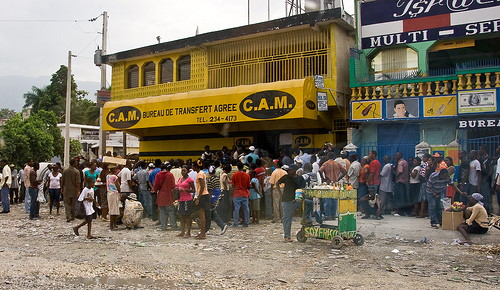
    The collapse of telephone service and, in some cases the buildings that housed banks and remittance offices, had temporarily cut off that money. But this week long lines were visible outside money transfer offices, such as this CAM office in Carrefour, southeast of Port au Prince, photographed by GV's Georgia Poppelwell.

    Remittances return

    Though the capital has received the bulk of media attention, it's not necessarily where the money sent by family members abroad will arrive. The International Association of Money Transfer Networks, an industry association which represents companies that carry electronic money transfers, says that about half the funds wired to Haiti from the US, the largest source of remittances, is sent to rural areas. That's significant because those areas are also seeing an increase in population, as people displaced by the quake go to live with family and friends in hometowns and less-damaged areas.

    Dilip Ratha, a World Bank economist, argues at the bank's blog that remittances could hold a more important role with the emergency extension of “temporary protected” immigration status (”TPS) to as many as 200 thousand Haitians living in the US.

    If the TPS resulted in a 20 percent increase in the average remittance per migrant, we would expect an additional $360 million remittance flows to Haiti in 2010! What is more, if the TPS were to be extended once beyond the currently stipulated 18 months – the extension is almost certain to happen, judging by the history of extensions of the TPS for El Salvador, Honduras, Nicaragua, Somalia and Sudan – additional fund flows to Haiti would exceed a billion dollar over three years. That would be a billion dollar of financial help coupled with goodwill and advice, tailored to the needs of the recipient. Financial help in the form of remittances from family members abroad is always the first to arrive in times of distress. Remittances to Haiti this year will surge, as they have done whenever and wherever there has been a crisis or natural disaster

  • Haiti: Shelter Coming Both Too Slow and Too Fast

    Talk is already turning to reconstruction in Haiti. Architecture for Humanity, a “non-profit design services firm” that specializes in post-disaster reconstruction, has released some general concept notes. Writing at the firm’s website, Cameron Sinclair, an architect and the group’s founder, referenced controversies following Hurricane Katrina in the United States:

    I remember vividly well-known news personalities standing on the rubble of homes in the lower ninth [New Orleans’ Lower Ninth Ward, a neighborhood] proclaiming that ‘this time next year we will see families back home.' Some well-meaning NGOs, who usually have little building experience, are even worse — ‘we'll have 25,000 Haitians back home if you donate today.' In reality, here is what it really looks like:

    • Pre-Planning Assessments and Damage Analysis (underway, will run for a year)
    • Establish Community Resource Center and Reconstruction Studio (Week 6 to Month 3)
    • Sorting Out Land Tenure and Building Ownership (Month 6 to Year 5)
    • Transitional Shelters, Health Clinics and Community Structures (Month 6 to Year 2)
    • Schools, Hospitals and Civic Structures (Month 9 to Year 3)
    • Permanent Housing (Year 1 to Year 5)

    Early reports on the damage pointed mostly to lax building standards in Haiti. At the Earth Institute's State of the Planet blog, the focus was on bad construction:

    Much of the rubble seen in the terrible videos we are now appallingly used to is composed of chunks of cement – and just cement. This is the style so typical of poorer parts of the world. Just cement is not enough; columns and walls should be built with high quality cement, with the right amount of sand, and sewn through with steel reinforcing bars – rebar. That’s what gives them strength. Next time you look at a video or a still image of damaged buildings in Haiti, look for rebar. I haven’t seen any yet.

    But Adolphe Saint-Louis, a 49 year-old quake survivor interviewed in Port au Prince by New American Media, describes something more complicated than iffy concrete. Her home was built as a series of additions, — and with rebar, she says — to keep extended family under one roof, and share building costs in the family. Making the building expandable served an important function, but proved catastrophic when the structure failed.

    Maybe your child marries and they need a place to be for them and their husband. You can build just a room on the roof of your house and put a tin roof on it. Then when you have more money you can add more rooms or finish the entire floor and create a new roof for the building. That is what we did at my house. We added some rooms and a new roof to our house. There was a place for my nephew to live in the front and a large room for my daughter and her husband in the back. The way we had done it, it was so pleasant. We put many plants and flowers in pots around the side of the staircase outside because my daughter loves nature very much. She was so happy when she saw the place that we made for her. But when the earthquake came, we lost everything….The floors of the houses fell, one on top of the other.

    She claimed the expansion system included re-enforcement:

    In Haiti, when you want to add to your home, you build on top of the roof, which is concrete held up by pillars or strong walls on the floor below. A mason builds new walls of concrete blocks to make a room or to enclose the entire area to add a new floor to the house. Some blocks have holes to allow the air to circulate and if the mason is talented he will use the blocks to make a pretty pattern or type of decorative window. The weight-bearing blocks are always solid and they have metal rebar running through the middle to support the structure of the house. When the addition is finished, the mason will leave the rebar exposed so that another floor can be added later if it is needed.

    A Canadian nutritionist living in Haiti, Ellen in Haiti, describes checking in on a friend — identified only as M — who had just bought a house built with stone rather than concrete. The older design had also failed:

    This house is made of rocks filled in with mud/clay and covered with something like cement or plaster, the way they were made before concrete blocks took hold in Haiti.  The rocks in one wall all tumbled out, leaving the house uninhabitable. The family is living in their cooking lean-to, which has never had the luxury of four walls.  Their possessions are all bundled up under the thatch roof, where they will be susceptible to rain and bad weather.