Author: Marcus Carab

  • The Christian Science Monitor’s Bold (And Successful) Experiments

    Reader cram points us to a paidContent post by John Yemma, the editor of The Christian Science Monitor, in which he makes a lot of great points about digital strategies for news publishing.


    A year ago, we ceased publishing the daily, 100-year-old Christian Science Monitor newspaper and launched a weekly magazine to complement our website, on which we doubled down by reorienting our newsroom to be web-first. Our web traffic climbed from 6 million page views last April to 13 million in February. Our print circulation rose from 43,000 to 77,000 in the same period.

    This is the sort of bold move that might be the last hope for some struggling publications, and it’s also an example of CwF+RtB. Magazines still hold value to readers as an attractive physical item in a way that newspapers don’t—by connecting with fans online and then giving them a better reason to buy the print product, CSM increased the readership of both.

    Those who defend newspapers out of nostalgia often cite the relaxing Sunday newspaper as a reason the medium should survive, but what they fail to realize is that there’s no reason that experience has to die along with the cheap daily rag. If there is genuine demand for it, publishers will supply it, and smart publications will shift their focus to improve that aspect of their product, just like CSM did.

    Yemma also warns against putting too much stock in “digital razzle dazzle”: multimedia for multimedia’s sake, deployed with little or no thought given to its purpose or effectiveness. The editorial and design aspects of print news have been evolving for decades; digital news must go back to first premises.


    The multimedia debate needs a new question: How are we using technology to create a more relevant product? We’re not going to “save” media by out-featuring each other. We can and will re-cement media by using the technology to deliver the experience consumers want most: intelligent, meaningful news that’s accessible where they are in the moment.

    Hopefully it isn’t too blasphemous to say: amen to that!

    Permalink | Comments | Email This Story


  • Are Publishers Putting Too Much Stock In The iPad, Or Are They Just Doing It Wrong?

    Jim Lillicotch points us to a post by MediaPost blogger Steve Smith, who was surprised by his 18-year-old daughter’s immediate dismissal of the iPad. It may be, as he speculates, an omen of the device’s future in general, but he also makes some points specifically related to the publishing industry that are worth highlighting.


    “I need a keyboard. Even my phone has that.” It is really all about input for her, and her focus on interactivity underscores a glaring limitation of the iPad. It is primarily a media consumption device, not an interactive device. Publishers think of digital merely as a delivery vehicle, but users think of digital as a communications and interactive platform. After a life of leaning in, why would she want to lean back and consume content just to make media companies’ business models work for them?

    Smith lists several drawbacks to touch-screen tablet input that probably haven’t occurred to those who, like me, have never gotten the chance to use one. I still think that with the right interface and after some design iterations, iPads (and other tablets) will be excellent interactive devices, but Smith is dead right in his assessment of how publishers view them. The iPad magazine demos that some have shown off are compelling and cool, but they are mostly one-way media. This is exacerbated by the obsession with native apps, which Smith notes are much less likely to explode on the iPad the way they did on the iPhone:


    Unlike the iPhone, where an app can clearly trump a mobile Web site experience, the iPad makes full Web browsing much more viable. Early audience research I have seen suggests that for even those interested in the iPad, Web browsing and email are rated far above app downloads as the device’s main attraction. And so, publisher apps will be competing with their own Web sites.

    This is a point we’ve made before: everything in these fancy magazine apps can be replicated in the browser (there is one small problem to do with scrolling that remains, but even that has nearly been solved). Publishers should be working to ensure that their product—whether it’s books, magazines or newspapers—is available on every platform with minimum hassle, instead of building closed apps that frustratingly trap the user. Nobody is loyal to one publication anymore, and nobody wants a dozen different news and magazine apps littering their tablet or smartphone—they want to browse the web the way they always have. It’s time for publishers to stop trying to alter user behaviour, and start learning from it.

    Permalink | Comments | Email This Story


  • Wishful Thinking And Misinterpreting Surveys Won’t Save The News Business

    Renan Borelli points us to Atlantic Business staff editor Derek Thompson’s recent defense of news paywalls, coming in the form of a series of posts responding to the Pew Research Center’s State of the News Media report, and also to a January Harris poll of online adults and their news reading habits. Thompson argues that the numbers in the latter “weren’t so bad”, but his reasoning makes very little sense.


    “43% of those surveyed read the newspaper [online or offline] regularly, and 23% said they were willing to pay a fee to continue reading. That means even before the dawning of the Age of the Paywall, more than 50% of regular newspaper readers said they would pay for online news. As for the other 60% of respondents: who cares? They’re hardly reading newspapers online anyway.”

    This is a surprising attitude for a business expert, and one that would certainly be foreign to a newspaper publisher. 43% reading daily means a lot of room to grow volume and frequency of readership, especially when you consider that 72% said they read at least once a week, and 81% at least once a month. It would be foolish to disregard that audience. Besides, 50% (a shakily extrapolated estimate to begin with) is hardly a good reader retention rate, and Thompson ignores the clearest message of the survey: less than a quarter of online adults would consider paying a monthly fee for news, and only four per cent said they would pay more than $10. Moreover, “how much would you pay” surveys are notoriously unreliable.

    Thompson also makes the curious argument that people have demonstrated their willingness to pay for news online by paying for internet access to reach that news. This is irrelevant and confuses value with price: yes, by making online news one of the reasons they pay for internet access, people have shown that they value it. But this demand doesn’t set a price, it creates a market—one that is highly competitive on the supply side and will always offer free alternatives. The simple fact that a market exists does not say anything about the best pricing strategy within it.

    These poorly thought out arguments come from the first post, which Thompson admits was rushed because he wanted his “opening salvo to get out fresh and early”. The second post looks at the Pew report’s breakdown of online ad spending by format, which shows the expected dominance of search advertising, followed by display ads—where newspapers get most of their online revenue—in a distant second place.

    Based on this, Thompson seems to take it as granted that advertising can never pay the bills for online news, so paywalls and “other exciting ideas” are the future. He makes no mention of increased spending overall or growth in the display ad sector, of news gaining a foothold in other ad categories, of increasing the efficacy and value of advertising, or of going after brand new markets—all missed opportunities on the road to a walled garden.

    In his third post, which discusses some of the “other exciting ideas” mentioned in the Pew report, Thompson finally starts to make a bit of sense. He is skeptical of micropayments, seems ambivalent about microaccounting (basically micropayments billed monthly), and he scoffs along with everyone else at the idea of blocking Google. Conversely, he is enthusiastic about improving targeted ads and curious about the possibility of newspapers gathering more demographic information from their online readerships. Unfortunately, he still seems to think that WSJ-style paywall models are the best strategy for the immediate future.

    Perhaps the most common mistake that paywall supporters make is forgetting that people haven’t paid for the news in 180 years. Newspaper readers used to pay for paper, ink, trucks and delivery boys—and often barely paid enough to cover that bill. Now they pay for internet connections instead. Then and now, the reader only pays for access—advertising always has and will continue to pay for everything else.

    Permalink | Comments | Email This Story


  • Google To Newspapers: Experiment, Experiment, Experiment

    The Google Public Policy Blog recently posted a summary of a speech by Chief Economist Hal Varian on newspaper economics. Alongside the we-are-not-your-enemy message that Google is hoping newspapers will someday listen to, it contains useful insights on the challenge of succeeding as an established print publication in the digital world. Varian suggests a few potential courses of action, but the real value of the piece is that it highlights the obstacles in a way that can be tackled by experienced insiders—especially marketers and salespeople, which newspapers employ in abundance but often fail to set free on experimental strategies.

    One of the first things Varian establishes is the volume and value of online news readers, and then he looks at the difficulties of turning that value into revenue. The numbers may be discouraging for newspapers, but they could also become the basis of several important short- and long-term goals in an online strategy:


    “Visitors to online newspaper sites don’t spend a lot of time there. The average amount of time looking at online news is about 70 seconds a day, while the average amount of time spent reading the physical newspaper is about 25 minutes a day. Not surprisingly, advertisers are willing to pay more for their share of readers’ attention during that 25 minutes of offline reading than during the 70 seconds of online reading. So even though online advertising has grown rapidly in the last five years, it appears that somewhat less than 5% of newspapers’ ad revenue comes from their internet editions, according to the most recent Newspaper Association of America data.

    There’s a reason for the relatively short time readers spend on online news: a disproportionate amount of online news reading occurs during working hours. The good news is that newspapers can now reach readers at work, which was difficult prior to the internet. The bad news is that readers don’t have a lot of time to devote to news when they are supposed to be working. Online news reading is predominately a labor time activity while offline news reading is primarily a leisure time activity.”

    Varian talks about the need to increase leisure involvement with online news, and in the full speech, he lists ways this might be done: leveraging new technologies like smartphones and tablets, developing more engaging formats for journalism (like Google Living Stories, which recently went open source), and creating multimedia experiences.

    These are all important ideas, but to some extent, they miss an opportunity by focusing on ways to get people reading at home instead of work: namely, don’t at-work readers have value too?

    For a long time, newspapers have used “business purchasing influence” as a prominent reader statistic in media kits. But we now live in a world where business purchasing influence is a much more distributed thing, hardly limited to managers and IT folk: employees at every level in every field make use of online services to expedite their work. Web services subvert the top-down model of corporate IT, allowing workers to seek out the tools that work best for them. These services usually have freemium models, with prices that suit small departmental budgets, and since there’s no software installation there’s no need to involve IT staff.

    Think web lockers (plenty of companies still have laughably low email attachment limits). Think Flash-based presentation tools (graphics departments hate PowerPoint). These are bottom-up business services: a few employees get free accounts, a few more get on board, and before you know it a whole department is more than happy to pay a monthly fee for such a useful tool. These are the companies that want to reach people at work, during those 70 seconds they spend reading a news story while wondering how to transfer a 50-megabyte PDF.

    There are some other excellent parts of Varian’s post, including a look at the goldmine vertical markets which have traditionally sustained newspapers: automotive, travel, home & garden and the like (he oddly fails to mention real estate, which is a biggie). These are the same verticals that sustain Google’s search advertising—the problem is that the end market is now specialty sites, not news publications. Though Varian doesn’t discuss the possibilities, this is an area where newspapers still have a chance: they should be leveraging their community respect while partnering with specialty purchase sites through advertising and affiliate programs, ensuring that they continue to be an important link in the chain. TechCrunch recently reported on a Forrester Research study that estimates that web-influenced offline sales in the U.S. (purchases where the consumer made their decision online then went to a retail store) are worth nearly a trillion dollars, and news websites should absolutely be a part of that.

    It’s well worth reading Varian’s post in full, but in the end, his core piece of advice is what counts:


    “In my view, the best thing that newspapers can do now is experiment, experiment, experiment. There are huge cost savings associated with online news. Roughly 50% of the cost of producing a physical newspaper is in printing and distribution, with only about 15% of total costs being editorial. Newspapers could save a lot of money if the primary access to news was via the internet.”

    That really is the core of it. Newspapers must experiment with new ways to report the news, new ways to engage their readers and new ways to get advertisers on board, while embracing the fact that their readers are switching to a medium that costs them less. There are over 70-million Americans reading news online—if newspapers can’t turn those eyeballs into money, someone else will.

    Permalink | Comments | Email This Story


  • Want To Link To Royal Mail? You Better Not Be In A Hurry

    If you ever read terms of use pages for websites, you know that they are mostly boilerplate. Unfortunately whatever template all these businesses seem to be sharing makes some ridiculous assertions, perhaps the worst of which is a provision against hyperlinking to the site without written permission.

    Of course, to anyone who understands the internet at all, that term is clearly unenforceable. But these standardized terms show up all over the place, so I had always assumed that it was a bit of vestigial legal jargon, and that most businesses weren’t even aware of it. UK blogger Malcolm Coles discovered otherwise when he obeyed the terms on the Royal Mail website and requested written permission to link to a page. This initiated a bureaucratic farce that lasted for four months with no resolution.


    To get your licence posted to you:

    • You have to write a letter to find out the right web address for the application form.
    • The letter back gives you a web address
    • The web address tells you to email.
    • When you email they don’t reply.
    • But they do give you the option to, er, write in again.

    That’s right: the post office in the UK wants you to send them a letter and an email before you link to their website — and even then they never get around to giving you permission. Oh, and the page Coles wanted to link to? It was Royal Mail’s business start-up services, which he was trying to promote for free.

    Permalink | Comments | Email This Story


  • Ten Good Reasons To Buy: The Newspaper Edition

    Recently, Mike posted a concise list of Ten Good Reasons to Buy – one of two essential elements in the Connect with Fans + Reason to Buy strategy that he has been observing and helping to define for some time. These reasons were brainstormed at Midem 2009, so they focus on the music business – but CwF+RtB has potential in all sorts of industries (Techdirt itself employs it).

    So, with the New York Times going metered and rejecting a proposed membership model that would have been much more CwF+RtB-ish, I thought it might be worth looking at Mike’s list from the perspective of newspaper publishing. Though some of the ideas are more suited to musicians, it still qualifies as Ten Good Reasons to Buy.

    (It should be stated from the outset that I believe advertising will continue to be the primary source of revenue for newspapers, and that I think paywalls and meters are doomed to fail. See my recent post here on Techdirt and my extensive ramblings on good.is for more on why. That being said, if newspapers use CwF+RtB in truly innovative ways, they might just turn the whole industry on its head. Stranger things have happened.)

    “1. Access: Access to the actual content creators is a real scarcity and one that can often be used to make money in ways that make fans quite happy.”

    Sometimes newspapers do this backwards. When fundraisers and events and the like seek media sponsors, newspapers will request a hosting spot for one of their writers or editors as a condition for the sponsorship. In other words, the content creators buy access to the fans.

    This isn’t always how it goes though – it depends on the event in question and the profile of the staff. In some cases the newspaper seeks sponsorship for their talent, and throws in event appearances and panel discussions to sweeten the deal. But in all cases, the main purpose of the whole shebang is to sell more subscriptions.

    There might be a lot more opportunities here. Why just panels and events? What about workshops, custom reports and analysis, even one-on-one attention? The thing to remember here is that the fans in question, or at least the most profitable ones, are business fans. Businesspeople read newspapers because the information and expertise has direct and immediate value to them. Connect finance writers with traders, legal writers with law firms, tech writers with software developers – with some creativity, there could be money to be made.

    I can think of some ideas outside the business sphere too, but I have gone on for too long already and I’m only on Reason #1.

    “2. Attention: One of the most important scarcities in the digital age. Attention is incredibly scarce, and if you’ve got it, you can do a lot with it.”

    This one is simple: active, vibrant comment sections where writers, columnists and editors regularly participate. Many newspapers see some of the trash that inevitably turns up in every comment section and go sour on the whole affair, allowing their columnists to shutter their comments when they should be requiring them (and paying them if necessary) to get involved. They will quickly realize that online communities become self-moderating once rational, intelligent debate is established and readers know they have the writers’ attention.

    So far this isn’t a reason to buy – at least not for the readers themselves. Advertisers are another story. An engaged community of readers is worth a lot more than the impressions they bring to a website – savvy advertisers will want their ideas, not just their eyes. See Techdirt’s IT Innovation blog for a prime example of this.

    “3. Authenticity: This one also includes ‘trust.’ The ability to be authentic carries tremendous weight and is quite scarce at times. But if you can provide something that is authentic and valuable, it’s often a very strong reason to buy.”

    Authenticity is what everyone already touts as the strength of newspapers and the reason that people will consent to pay for their content. But newspapers are far from perfect, and in a world where transparency is becoming as important as trust, their reticence about sources and methods is starting to seem old-fashioned. If newspapers continue to resist the linking culture, and continue to leave out details that could easily be added in appendices and footnotes online where space is unlimited, they risk being left behind. Moreover, if big names leak too much talent to more innovative startups, they could quickly lose authenticity (and surely someone will say they’ve jumped the shark.)

    So I guess what I’m saying is: yes, without authenticity none of these other RtBs matter in the slightest – so dont go sacrificing it now.

    “4. Exclusivity: Many people value having something that very few (or perhaps no) others have.”

    This is essentially what has allowed the WSJ paywall to succeed where so many others have failed. At the business level, and especially in finance, exclusive information has significant value, and the paywall created a certain sense of exclusivity. Ultimately the flimsiness of that exclusivity could be what brings it down – but what about something truly exclusive? Custom news aggregators for businesses have been showing some success – what about exclusive news aggregators managed by a team of the newspaper’s respected editors? That’s just one idea of many.

    Outside the business world this is a tougher nut to crack. Financial news gets more valuable with exclusivity, but most news is the opposite: a big portion of its value comes from sharing it. Nonetheless, there may be certain forms of exclusivity that avid readers will pay for. It will come down to individual newspapers knowing their strengths and their audiences, and seeing ways to offer them something they want. If anyone has any creative ideas, I’d love to hear them.

    “5. (New) Creation: The ability to create something new is a scarcity. This often confuses people, because a digital good once created is no longer scarce — but the ability to create it is still very much a scarcity.”

    Most newspapers understand that gathering information and creating content is what they do, so there’s not much to say here. Newspapers that are drastically cutting back reporting staff and ramping up the wire content should remember that, while distributed reporting makes a lot of sense in many situations, every publication needs to continue creating something new that has value, or all is lost.


    “6. Tangibility: The granddad of scarcities: physical products.

    News on paper is the core physical product at the moment, but that’s not going to be around forever. I suspect that some newspapers will transform into news magazines, since the market for glossy, full-colour formats with good photography and long-form journalism will likely outlive the market for cheap newsprint broadsheets. A nice physical product has always been important to magazines, and people are willing to pay for it; newspapers are designed to be as cheap and disposable as possible, which is why the internet renders them obsolete. This shift to a magazine format might actually make sense for some newspapers, if they can establish a role for themselves as what Devin Coldewey calls the delayed media.

    All that being said, the money from selling the physical product has never carried the weight of newspapers or magazines, and it’s certainly not going to start now.

    In terms of other physical products, I don’t see any reason why newspapers couldn’t sell more merchandise, though I’m not sure how to go about it in a way that would bring in significant revenue. Lots of newspapers sell things like photo prints and keepsake copies, but so far it hasn’t proven to be that lucrative. On the other hand, those initiatives are often old and mechanical, and some may not have had fresh marketing treatment in years – who knows what they might be overlooking?

    And if all else fails, the New York Times can just become an authorized Apple retailer.

    “7. Time (saving or making): People will pay if you can save them time (or give them extra time in some manner).”

    Time is especially valuable in business. As far as saving time goes, there might be a market for rapid fact-sheets and summarized reports that supplement the newspaper’s core editorial. Though difficult to sell by themselves, if combined with some level of exclusivity this could be a great revenue stream: customized reports, similar to the aggregator model I mentioned earlier. Some business publications do sell reports, but more often than not these are of the annual reference tome variety, a format that today is about as useful as a phone book. If there is money to be made, it will come from more rapid and direct business services.

    “8. Convenience: If you make things more convenient, many people will buy, even if free options are available. That’s one reason why iTunes has done so well.”

    This is what a lot of people in the industry are banking on with the iPad and other tablets, but if they seriously believe the iTunes store will work for newspapers just like it does for music and movies, they are in for a rude awakening. Apple is selling music to people who are used to paying much more for CDs, and they still face stiff competition and had to remove DRM to satisfy their customers. Newspapers have an audience that is accustomed to getting the news for free, sharing it openly on social networks, blogging about it, linking to it and generally enjoying it without restriction. Moreover, while the digital alternatives to iTunes for music and movies are torrents or peer-to-peer programs, the alternatives to iTunes for newspapers will be countless news websites that are equally convenient and which stay free to soak up all the advertising revenue. Very few people, if any, are loyal to a newspaper the way legions of fans are loyal to a favourite recording artist. Convenience is still an important part of delivering the news, but that’s because readers already expect it.

    It should be noted separately that the concept of Convenience also ties in with the custom business services I propose under Time and Exclusivity.

    “9. Belonging: Never underestimate just how important a sense of belonging to a group or a tribe is – and being able to provide that in an authentic manner can be a true scarcity.”

    A sense of belonging stems from the attention I discussed earlier. I talked a lot about comment sections, but those aren’t the only form of audience engagement: Twitter is an extremely valuable tool, and I’ve often wondered if good old fashioned forums might have some potential on news websites.

    But I think the real goldmine could be participatory journalism: there are a lot of citizens out there who want to get involved in the reporting process, and the concept is gaining steam, with YouTube and CNN getting on board, among others. So, why aren’t there more people out there training citizen journalists? I bet newspapers, especially at the community level, would have an easy time finding groups and clubs that would pay for reporting workshops and seminars. Or they could try something like the PPF Group in the Czech Republic: opening hyperlocal newspaper-cafés where editorial staff will interact with the public (and partnering with Google in the process.)

    And yes, I know that’s an NYT link. It’s ironic on two levels.

    “10. Patronage: Definitely depends on the situation, but there are some people who just want to support an artist, no matter what. And that presents a scarcity.”

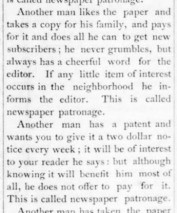
    Out of curiosity I searched “newspaper patronage”, and I found this highly amusing editorial in an 1878 edition of a New Brunswick newspaper from the Google News archives (don’t you just hate the way Google is destroying our culture?).
    Picture

    “Many long and weary years have forced the conviction upon us that newspaper patronage is a word of many definitions, and that a great majority of mankind are either ignorant of the correct definition, or are dishonest in a strict Biblical sense of the word. Newspaper patronage is composed of as many colors as the rainbow, and is as changeable as a chameleon.”

    Several comic caricatures of different types of newspaper patrons follow, and then:

    “Now isn’t newspaper patronage a curious thing? And in that great day when the gentleman in black gets his dues, as he surely will, how many of the patrons enumerated above will fall to his share? Now it will be seen that while certain kinds of patronage are the very life and existence of a newspaper, there are other kinds of patronage that are more destructive than deadly night shade.”

    I suspect the same will prove true today.

    Permalink | Comments | Email This Story


  • Flexible Or Paradoxical? Why The NY Times’ Plan Is Inherently Self-Limiting

    The New York Times has followed up on their initial coverage of the choice to go metered with a column by David Carr discussing the move. It’s worth reading, and though there are a lot of points he makes that I can’t really speak to, there’s one section that I think highlights the flaw in the plan:


    “The decision announced Wednesday morning represents a hedge, an operating model that puts maximum flexibility in the hands of the leadership of the newspaper. As the digital czar Martin Nisenholtz said over and over in a meeting about the decision on Tuesday, “the idea is to maximize revenue” with an eye toward the cyclical state of the advertising business. With Times Select, The New York Times lost eyeballs at precisely the time when sheer tonnage of readers became the defining metric in advertising. By building a metered system, the executives have installed a dial on the huge, heaving content machine of The New York Times. Access can be gradually ramped up or down depending on macro trends in the market. Given the dynamic state of the advertising business and how quickly things change on the Web, not so dumb when you think about it.”

    Sounds great, right? Except that where they see flexibility, I see conflict. They’ve saddled themselves with two opposing business models: the old one, where the audience is the product and the advertisers are the customers, and the new one, where news is the product and the audience is the customer. The “dial” is going to become a tug-of-war between an advertising team that wants more eyeballs to sell and a subscription team that wants more walled-up content to sell. It will be virtually impossible to make business decisions that are good for both sides, and by trying to have the best of both worlds they may end up with no growth for either.

    One could argue that this conflict has always existed in news organizations, but it’s never been as charged as it’s about to become at the Times. In the past, readers were readers, and increasing circulation was always the number one goal. But a newspaper that sacrifices casual readers, challenges the loyalty of dedicated readers and reduces its value to advertisers, all in one fell swoop, and succeeds? I’ll believe it when I see it.

    Permalink | Comments | Email This Story