Author: Megan Treacy

  • Device mimics leeches, ejects plug when gadget is done charging

    Leeches drink blood until they’re full and then fall off of their host, but our plugged-in gadgets keep drinking electricity even once they’re fully charged.  The Outlet Regulator changes this by ejecting the plug from the electricity source once the gadget is done charging, turning vampire electronics into leeches.

    Designed by Conor Klein, a student at Rhode Island School of Design, this device solves a dilemma faced in every home.  We all want to prevent frivolous energy use by leaving gadgets plugged in too long, but it’s almost impossible to unplug your devices at the exact point they’re done charging.  The Outlet Regulator takes care of that for you as demonstrated in the video above.

    The product works by using a timer circuit and electromechanics to eject its plug which disconnects your device from the wall outlet, stopping electricity consumption.

    This is an example of a design where you think, “How has no one thought of this before?”  It’s such an obvious solution and could easily be adopted by everyone.  Hopefully we’ll see this product on shelves soon.  My only qualm is this:  Why must these things alway involve blood?

    via Engadget
  • Heat-resistant algae could help threatened coral

    coral-algae

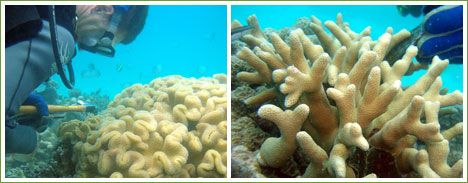
    Warmer ocean temperatures pose a serious threat to corals around the world.  Warmer waters typically kill the brown or green algae that a reef depends on for food, leading to bleaching and death of the reefs, but Penn State scientists have found some algae are not affected by rising temperatures, buying their coral partners some time.

    Heat-resistant algae have been found in the Andaman Sea in the Indian Ocean as well as in spots in the Caribbean Sea and Pacific Ocean.  Scientists aren’t sure if the resilient algae can save corals — the algae may not be able to be imported to coral reefs where it doesn’t naturally occur and there are other things threatening coral, including rising ocean acidification, pollution and bottom-trawling fishing.  Considering all of that, the algae may be just a temporary life-preserver.

    But some scientists think warmer waters may encourage the growth of these algae, benefiting the reefs they occupy over the long-term.  Continued research will be needed, but this discovery does offer a glimmer of hope for the world’s coral.

    via Dot Earth

  • Truck retrofits could cut fuel use by 3.4 billion gallons a year

    truck-retro

    The Lawrence Livermore National Laboratory (LLNL) and Navistar are testing drag-reducing devices that could cut big rig fuel use by 12 percent, or 3.4 billion gallons a year.  The devices would fit into the areas of the truck that produce the most drag, making it more aerodynamic and reducing the energy needed to propel the truck.

    At highway speeds, semi-trucks use more than half of the energy from their engine overcoming drag.  With these devices placed at crucial points like the trailer base, underbody and the space between the tractor and trailer, the drag is significantly reduced.  The fuel savings amount to a reduction of 36 million tons of CO2 emissions a year — the same as four 1-GW power plants — and a cost savings of $10 billion a year for the U.S. trucking industry.

    The LLNL’s devices, along with other commercially-available ones, are being tested at NASA’s Ames Research Center in the world’s largest wind tunnel where researchers hope to coax even greater fuel efficiency through the large-scale testing.  Trucks could be retrofitted with the devices in as little as three years.

    via GreenBiz


  • Arctic permafrost has retreated 80 miles in 50 years

    permafrost-line

    Scientists at Université Laval in Quebec have been tracking the movement of permafrost in the area and have found it’s receding at an alarming rate.

    Aerial photos of the James Bay region between the 51st and 53rd parallels taken in 1957 were compared to those taken in 2004 and 2005.  The photos showed the permafrost line (recognizable by distinct oval-shaped land elevations that form over permafrost) had retreated 80 miles and was deteriorating as far north as the 55th parallel.

    The James Bay area makes up the southernmost part of Hudson Bay.  Warming temperatures — a rise of as much as 3 to 4 degrees in recent decades — are causing tundra disappearance in the area as well.

    via Yale e360

  • Reservations for Nissan Leaf starting in April; still no price tag

    nissan-leaf

    Nissan will begin taking reservations for the Nissan Leaf in April, actual orders can be placed in August and cars will be delivered by the end of the year.  But a big question still looms — how much will it cost?

    You can reserve a Leaf for a $100 refundable fee, but as for the actual cost of the EV, the company has only said that it will be competitively priced with similar-sized vehicles, but that allows for a decent price range.

    Even with the mystery, the car has picked up quite a bit of momentum lately.  Nissan just finished a nationwide tour with the vehicle, drumming up publicity and securing partnerships with 18 launch cities that will install charging stations and get EV-ready in time for the car’s release.  The company also received a $1.4 billion loan from the DOE this month to begin manufacturing the car and its batteries at a plant in Smyrna, TN.

    via CNET


  • Flexible silicon solar cells use 99% less material

    flex-silicon

    Researchers have found a way to make flexible silicon solar cells using only 1 percent of the material used in conventional solar cells.

    The cells are made of micron-sized silicon wires that are encased in a flexible polymer that can be rolled or bent. The researchers at Cal Tech who developed the cells eventually see them being used in clothing, but, for now, the cells could create cheaper and easier-to-install solar panels.

    Large consumer electronic companies like Sharp have experimented with organic thin-film solar cells, which are flexible, but they’re less efficient than those made with silicon. This breakthrough is the latest in a recent crop of studies combining the efficiency of silicon (about 15 to 20 percent efficiency) with the flexibility of the organic thin-film cells, but this one has the distinction of using only 1/100th of the amount of silicon per cell as a traditional silicon wafer.

    An added bonus to this type of solar cell is that existing manufacturing technology could be used to make them, further helping to keep cost down.

    via CNET


  • Highly efficient CO2-capturing crystals

    co2-crystals

    Scientists at UCLA have developed synthetic crystals that trap gasses like a smart sponge.  The crystals are highly selective, allowing them to achieve a 400% improvement in CO2 capture over current technologies.

    The crystals are three-dimensional and code information in the same manner as DNA.  While not as sophisticated as DNA, the developers consider it a significant advancement in chemistry and materials science.

    The scientists hope the technology could be used to capture CO2 from both large sources like power plants, and smaller ones like vehicle tailpipes and smaller factories.  The material could also potentially be used to convert CO2 into a fuel.

    Ideally, these highly efficient crystals could be used for CO2 capture in lots of different settings while we try to transition to cleaner technologies.

    via Treehugger

  • Street lamps powered by garbage

    compost-lamp

    A cool new design concept marries composting with clean energy:  garbage-powered street lamps.  The Gaon Street Light from designer Haneum Lee keeps food waste out of landfills while keeping streets illuminated.

    The street lamp features a garbage bin at its base where food products can be deposited.  The waste is then composted and the methane from the waste powers the lamp at the top.

    There would need to be controls in place to make sure that only food waste made it into the compost bin.  If that were worked out, it would be a nice idea for city parks or other areas where people take their food outside.  The design gets us thinking about what all could be powered by our waste and that’s a success in itself.

    via Inhabitat

  • IBM creates high-efficiency natural solar cell

    ibm-solar

    IBM has created a high-efficiency solar cell made from abundant materials.  The cell achieves 9.6 percent efficiency, which is 40 percent higher than other attempts at natural solar cells.

    The cell is made from copper, tin zinc, sulfur and sellenium opposed.  Solar cells have been created with greater efficiency but they made with costly or rare materials that could hold back the technology.

    IBM isn’t planning on manufacturing this technology itself though. It will be licensing the intellectual property related to the research to other companies who want to develop it.  A full report on this breakthrough is in this week’s Advanced Materials.

    via GoodCleanTech

  • North America’s greenest building?

    cirs

    The University of British Columbia is claiming the title of North America’s greenest building for its impressive $37 million Center for Interactive Research on Sustainability (CIRS), currently under construction and to be completed in 2011.  What makes this building the greenest?

    According to UBC, it will be a net energy producer with fuel cells, a solar PV array, solar hot water heaters, ground source heat pumps and a biomass co-generation system on site.  The building will collect, store and use rainwater and stormwater, so that it’s not only providing its own electricity needs, but all of its water needs as well.

    CIRS will be a testing ground for sustainable building technologies and all activity, including energy use and human behavior within the building, will be logged.  It will also host simulations and performances to educate the public on sustainability as part of its Group Decision Environment Theatre.

    Sounds pretty amazing to me, but we’ll have to see how it stacks up when it’s completed to know if it’s truly the “greenest.”

    via Ecofriend

  • Energy Star for data centers launching in June

    data-center

    Starting in June of this year, data center operators can apply for Energy Star status.  The new rating system will score data centers based on PUE, or power unit efficiency, on a scale of 1 – 100.

    The operators will use an online tool that allows them to enter information on energy use and operations to calculate their PUE.  The PUE determines efficiency based on the total power used by the data center, divided by the amount that reaches the IT equipment, not the cooling systems or inefficient power supplies.

    That information is then compared to peer performance and based on that a data center is given a score.  A score of 50 is average, while a score of 75 or higher means that the center is in the top 25 percent for efficiency and eligible for the Energy Star label.  The  operator can then have the EPA audit their data center to confirm performance and award the label.

    The rating system currently doesn’t factor in whether a center uses free cooling or its level of redundancy, but the EPA analyzed over 100 data centers and found that the rating system still accurately scored performance without weighting those variables.  Even so, the EPA will make changes to the system if the need arises.

    via PC World


  • New bill would create 10 million solar roofs in 10 years

    10-mil-solar-roof

    A really exciting new bill was introduced to Congress last week by Bernie Sanders of Vermont.  The bill lays out a plan to install 10 million solar roofs and 200,000 solar water heaters over the next 10 years through tax rebates and incentives.  The installations would equal 30 GW of clean energy or the equivalent of 30 nuclear power plants.

    The “10 Million Solar Roofs and 10 Million Gallons of Solar Hot Water Act” would build on the success of state incentive programs like those in California and New Jersey and also the rising popularity of distributed solar projects.  The bill would provide tax rebates of up to half the cost of new systems and would make sure the receivers of the incentives also know how to make their buildings as efficient as possible.

    Sanders sees the bill costing between $2 and $3 billion a year, but with the outcome of 30 GW of new energy at the end of 10 years, it’s actually a very cost effective plan.  The plan would also create jobs and, as Sanders says, “the more photovoltaics we use, the more will be built; the more that are built, the cheaper it becomes.”

    All I can say is I love this bill.  Oh Congress, please say you love it too.

    via Treehugger


  • Chicago area gets wind-powered EV charging station

    chi-wind

    The Windy City area is capitalizing on its most famous attribute with a new wind-powered electric vehicle charging station.  Located in Highland Park, 30 miles outside of the city, the charging station uses electricity generated by Illinois wind farms for law firm Emalfarb Swan & Bain.

    The charging station is the second in the country and the first in the continental U.S. to be powered by wind.  The other station is located in Maui, Hawaii.

    The charge port was installed by Carbon Day Automotive, a distributor of the EV-charging leader Coulomb Technologies.  Carbon Day has also created a Solar Charge-Port that not only juices up EVs, but also collects, filters and recycles storm water through a greywater filtration system for irrigation use.

    via Green Car Advisor


  • Federal climate change agency being formed

    noaa

    A new federal agency charged with reporting on climate change is being formed.  The National Oceanic and Atmospheric Administration (NOAA) will set up the Climate Service using members of the National Weather Service and other NOAA offices.

    Climate operations have been spread out among NOAA offices, but with more and more requests pouring in for information concerning climate change, officials decided to combine those efforts into one main office.  The Climate Service will be headquartered in Washington, D.C., with six regional directors elsewhere in the country.

    The agency will still have to be approved by congressional committee, but if it clears all necessary hurdles, it should be up and running by the end of the year.

    via Huffington Post

  • Vote for your favorite greener gadget

    greener-gadg-comp

    It’s that time of year again!  The Greener Gadgets Design Competition has started and 18 cool, eco-friendly gadget ideas are waiting for your votes.

    This year is the third year for the competition and the Greener Gadgets Conference, which is being held on February 25 in New York City, and I must say, this is the best crop of designs yet. 

    Some of the highlights include a kinetic-energy-harvesting rocking horse that fuels flashlights or nightlights called Rocco, a USB-outfitted, wall-mounted charger that is powered by indoor light called the Illumi Charger and a system of turbine-run highway lighting that would be powered by the air turbulence from passing cars.

    Your votes will narrow down the pool to a handful of finalists that will be judged at the conference.  You have until February 12 to cast your vote for the best and most revolutionary idea.  Click here to vote and learn more about the conference.

  • Smaller, distributed solar projects are gaining momentum

    distrib-solar

    While the BLM is facing a virtual clog of large, desert-based solar project proposals, smaller, distributed solar projects are popping up at an impressive rate.  In just the past few weeks, 1,300 MW worth of these projects have been announced or approved, which could equal about the same energy output of a big nuclear power plant.

    The larger, more ambitious solar power plans have many environmental and land-use hurdles to clear, while these smaller plans, set to occupy commercial and residential rooftops, areas near electrical substations and urban areas, don’t have the same obstacles in their way.  Also, the smaller projects are cheaper, meaning more utilities can afford to implement them as they’re scrambling to meet renewable energy mandates.

    Arno Harris, the CEO of Recurrent Energy, a company that has signed a contract with Southern California Edison for 50 MW of small-scale solar, summed it up like this:

    “Distributed solar is faster on permitting, on environmental issues and interconnection to the grid.  It offers a safety valve for utilities who don’t want to put all their eggs in one basket.”

    The projects, anywhere from 50 to 500 MW each, are mainly concentrated in California, though New York Power Authority is planning 100 MW installation around the state as well.

    via Green Inc.

  • A safe way to dispose of BPA-containing plastics

    bpa-fungi

    The media coverage of the health dangers of BPA has really reached a fever-pitch these days and, thanks to that coverage, many companies are removing it from their products.  While that is wonderful, there are still many BPA-containing plastics out there and 2.7 million tons of it being made every year.  How do we make sure all that plastic is disposed of safely?

    Scientists have come up with a way that they believe decomposes polycarbonate plastic without releasing BPA.  The scientists, Mukesh Doble and Trishul Artham, pretreated polycarbonate with ultraviolet light and heat and then exposed it to three types of fungi known for their pollutant remidiation abilities.

    After 12 months, the pretreated plastic had substantially decomposed without releasing any BPA, while the control plastic that was not pretreated before being exposed to the fungi showed almost no decomposition.

    via Science Daily


  • Italy to plug in idling cruise ships

    italy-cruise

    Italian port cities are planning to connect large ships like cruise liners to the grid while they’re berthed to cut fuel consumption and potentially slash carbon dioxide emissions by 30 percent and nitrogen oxides and particulate pollution by more than 95 percent.

    Venice, Paolo Costa, La Spezia, and Lorenzo Forcieri are all expected to install new equipment to allow the ships to plug in to shore-side electricity.  Other cities around the world are experimenting with the same idea, including Los Angeles and Goteborg, Sweden, hoping to eliminate the fuel needs and emissions of onboard generators.

    The Italian electricity utility Enel foresees large reductions in pollution and fuel consumption from the practice, but since so far only a few ships are compatible with on-shore electricity, we won’t know the full benefits until ports and ships are equipped and the generators are turned off.

    via Green Inc.

  • Rubber material harvests energy from small movements

    pzt-rubber

    A new material developed by researchers at Princeton and Caltech is capable of harvesting energy from the simplest of movements like walking or breathing.  This new rubber chip made of PZT (lead zirconate titanate) nano-ribbons could eventually power small portable electronic devices like cell phones.

    The PZT is embedded in silicone rubber sheets that produce electricity when flexed or other pressure is applied.  The scientists who developed the chip see them being inserted into shoes or even within the body to continually harness power for our portable devices.

    Before that freaks you out too much, the scientists envision the chips being placed next to the lungs to utilize breathing motions for powering pacemakers.  Pacemaker users wouldn’t have to undergo surgery to replace batteries since their breathing would be a constant source of energy.

    The reason this particular material stands out compared to all of the other piezoelectric materials out there is that it’s far more efficient.  According to the researchers, PZT can convert 80 percent of mechanical energy applied to it into electric energy, which is 100 times more efficient than quartz.  That efficiency allows it to harness such small movements like breathing and opens up a much greater range of possibilities for its use.

    via CNET


  • Federal government will cut its GHG emissions 28% by 2020

    fed-gov-ghg

    Many of us were disappointed by the State of the Union address Wednesday night.  Sure the president stressed the importance of a climate bill and clean energy development, but he also committed to pursuing more nuclear energy, new offshore oil drilling, and “clean” coal.

    That makes today’s announcement that the Federal Government will reduce its greenhouse gas emissions by 28 percent by 2020 very welcome news.  The largest energy consumer in the U.S. will cut its emissions by making gains in efficiency and using more renewable energy.  The government spent $24.5 billion on electricity and fuel in 2008 alone and hopes to save $8 to $11 billion over the next decade through this initiative.

    Each agency had to submit a 2020 emission reduction target from their 2008 baseline and the 28 percent reduction goal is an aggregate of those reports.  The Office of Management and Budget will validate and score each agency’s plan and annual progress will by reported online to the public.

    You can check out some of the emission cutting projects that are underway here.

    via White House release