Author: melissa

  • Teaching Economics with Children’s Literature: What is Money?

    money-cover.jpg

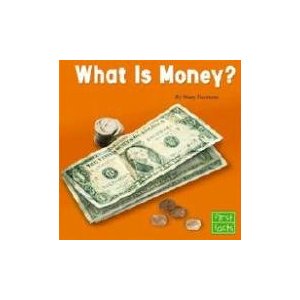
    What is money? written by Mary Firestone and illustrated by Enoch Peterson is an easy to read book about why money is used, currencies of the world and how bills and coins are made.  If explains to us that without money, people have to barter or trade so money makes it easier to get what you want.  We learn that buying is like trading and that people trade their time and skills for money and then trade money for things.  The book is written in a kid friendly manner, has great real pictures and includes fun facts on many of the pages.    There is a hands on activity at the end of the book as well as a glossary, a couple of additional book suggestions and directions for how to find safe, fun internet sites related to this book.

    Curriculum Connections:

    This book would be perfect to use in the introduction of money.  It could be used with younger kids to explain that people work to earn money to buy things they want (Va SOL K.7 b) as well as slightly older kids to distinguish between the use of barter and the use of money in exchange for goods and services (Va SOL 2.8).  This would be a good book to have in the classroom as a resource and could probably be read by second graders.

    Additional Resources:

    Visit Dollar the Dragon to learn more about banks, checks, savings, atms, and more.

    The FDIC learning bank is a website for students, teachers and parents to learn about the FDIC with your tour guide, Carmen Cents, the pig.

    Donut Dinero is a lesson plan which includes bartering activities.

    Needs and Wants provides background information as well as activities.

    General Information:
    Book: What is Money?
    Author: Mary Firestone
    Illustrator: Enoch Peterson
    Publisher: First Fact Books
    Publication Date: 2004
    Pages: 24
    Grade Range: K-3
    ISBN: 9780736826426
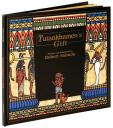


  • Teaching Ancient Civilizations with Children’s Literature: Tutankhamen’s Gift

    tuts-gift.jpg

    Tutankhamen’s Gift, written and illustrated by Robert Sabuda, is the story of a young boy named Tutankamen.  Tutankamen, a small, frail boy who did not excel at physical activities, was a member of the royal family of the great Egyptian pharaoh Amenhotep III.  The story tells of Tutankamen going to school, playing and watching his father’s craftsmen build temples to glorify the many gods that he and the Egyptians worshiped.  When Amenhotep III died, the pharaoh’s eldest son, Amenhotep IV, assumed his father’s power.  Unfortunately he was not like his father and was not liked by the people.  When Tutankamen’s brother, Amenhotep IV, mysteriously died, the small, meek 10 year old, Tutankamen, became pharaoh.  Tutankamen ”ruled over the people..with kindness and a true heart until the end of his days”.

    Curriculum Connections:

    This book would be an interesting introduction to Ancient Egypt.  It discusses the pharaohs, the temples, and the many gods they worshiped.  It mentions the Nile River, the children’s education and some of the people’s customs.  It combines simple text with artwork true to the historical period in which Tutankamen lived.  (Va SOL SOL 2.1 and 2.4a).

    Additional Resources:

    Ancient Egypt: About the Nile a video clip about the Nile River and the ancient Egyptians.

    Pharaoh: Lord of the Two Lands is a site that includes a story, artwork to explore, and a challenge.

    Build your own scale model of the Great Pyramid.

    General Information:
    Book: Tuthankhamen’s Gift
    Author: Robert Sabuda
    Illustrator: Robert Sabuda
    Publisher: Macmillan Publishing Company
    Publication Date: 1988
    Pages: 32
    Grade Range: 2-4
    ISBN: 9780689318184

  • Teaching Civics with Children’s Literature: A Lesson for Martin Luther King, Jr.

    picture-of-a-lesson-for-mlk-jr.JPG

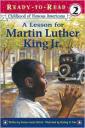
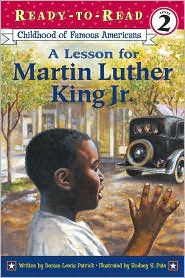
    A Lesson for Martin Luther King, Jr, written by Denise Lewis Patrick and illustrated by Rodney S. Pate tells the story of young Martin as a second grader.  Martin returns home from his first day of school very excited.  He and his best friend Bobby were going to different schools and he wanted to share his excitement with him.  Throughout this short book, Martin is disappointed that Bobby doesn’t have time to play with him anymore.  Bobby finally explains to Martin that they can’t play anymore because Martin is colored and Bobby is white.  “Papa says colored and white can’t mix.”  Martin doesn’t understand and after his father tries to explain to him, Martin asks “Can’t I change the rules?  Can’t I change people’s minds?”  Martin’s father smiles and he answers “yes, you can.” The book ends with “I will try, Daddy,” Martin said.  “I will try.”

    The last page includes a timeline of his life.

    Curriculum Connections:

    This book could be used to  introduce Martin Luther King, Jr to young students.  It could be used to explain to young students why we celebrate Martin Luther King, Jr day (Va SOL K.1) as well as to help explain to students the contributions that he made that helped to improve the lives of other Americans (Va SOL 2.11 and 3.11 b)

    Additional Resources:

    Freedom, Freedom, Let It Ring is an easy song for your students to learn and is sung to the tune of Twinkle, Twinkle, Little Star.

    Writing Prompts for Martin Luther King, Jr. Day lists several ideas to get your students writing.

    Martin Luther King, Jr: A Clothesline Timeline  is a fun lesson plan and activity used to depict the events in the life of MLK, Jr.

    General Information:

    Book: A Lesson for Martin Luther King, Jr.
    Author: Denise Lewis Patrick
    Illustrator: Rodney S. Pate
    Publisher: Alladdin Paperbacks
    Publication Date: 2003
    Pages: 31
    Grade Rabge: K-3
    ISBN: 9780689853982

  • Teaching Geography with Children’s Literature: Giant Steps

    giant-steps.jpg

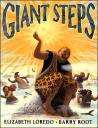
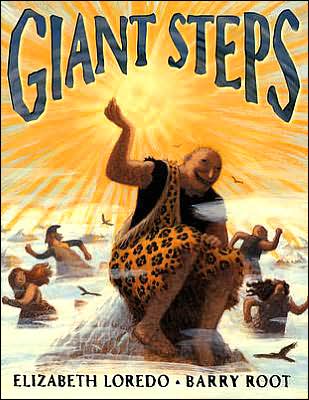
    Giant Steps, written by Elizabeth Loredo and illustrated by Barry Root, uses cardinal directions to tell the story of five giants playing hide and go seek.   While the unlucky fifth giant counts, the other four giants take giant steps that lead to the four corners of the globe.  They run north, nouth, east and west until the fifth giant call FREEZE!  When he sees another giant running, he grabs the sun and throws it at the giant.  Unfortunately that fifth giant is unlucky, misses and is it again.  “And that’s a lucky thing for those giants to the north, south, east and west.  On account of he’s the only giant that can COUNT.”

    Curriculum Connections:

    This book would be a fun resource to use in geography to introduce map skills and cardinal directions (VA SOL 1.4 b).  A map of the United States could be displayed.  The teacher could point out Virginia and explain where it is in relation to others states (VA SOL 1.4 c).  This would be a good time to introduce the compass rose to the class.   Using the map, the students could try to determine where the giants may have ended up by running north, south, east and west.

    Additional Resources:

    •  Treasure Hunt is a fun activity for students.  They would be asked to hide an object and then create a treasure map that leads to the object and includes a compass rose and a map key.
    • Mystery State is a worksheet that shows the state of Virginia.  Students are asked to use a map of the USA to determine which state is shown then complete information at the bottom of the sheet pertaining to that state.

    General Information:

    Book: Giant Steps
    Author: Elizabeth Loredo
    Illustrator:
    Barry Root
    Publisher:
    G. P. Putnam’s Sons
    Publication Date: 2004
    Pages:
    32
    Grade Range:
    K – 3
    ISBN:
    9780399234910

  • Teaching Earth Science with Children’s Literature: The Sun: Our Nearest Star

    the-sun-cover.jpg


    Introduction and Summary:

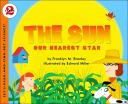
    The Sun: Our Nearest Star, written by Franklyn M. Branley and illustrated by Edward Miller does a wonderful job explaining our daytime star, the sun.  The book includes a beautifully illustrated analogy of the size of the sun compared to the size of the earth as a beach ball compared to a pea.  The book explains how far away the sun is by how long it would take a space ship to travel to the sun compared to the moon and how long it takes light to reach the earth from the sun compared to the light from the other stars.

    We learn from the book, that “without the sun,  earth would be cold and dark.  No Plants would grow, no animals, no bugs, birds or flowers.  Nothing could live here.  The sun keeps us alive.”  There is an introduction to solar energy and then we are left with the fact that the sun has warmed our planet for millions of years and will continue to for many more millions of years.

    The book is filled with vibrant illustrations that help to the relay the scientific concepts presented by Branley and includes two activities to help students find out more about the sun.

    Curriculum Connections:

    The Sun: Our Nearest Star would be great to use as an introduction to the solar system.  It could be used to begin teaching the relationship between the sun and the earth and all that the sun provides for us such as light, warmth, plants and animals for food and solar energy. Students will realize that the sun keeps us alive.  SOL 1.6 (a), 3.11 (a) (b),

    Additional Resources:

    Lesson Plan: The Sun: Our Local Star includes a reading comprehension passage and questions.

    The Sun  is an interactive website that includes links to vocabulary, a song about the sun and a question from the information provided.

    Star Stuff First Grade  is a collection of lesson plans related to the Virginia SOLs.

    Tour the Planets card game.

    General Information:

    Book: The Sun: Our Nearest Star
    Author: Franklyn Branley
    Illustrator: Edward Miller
    Publisher: HarperCollins
    Publication Date: 2002
    Pages:  25
    Grade Range: K – 3
    ISBN: 9780060285340

  • Teaching Life Science with Children’s Literature: Are You a Ladybug?

     ladybug-cover.jpg

     Summary and Introduction:

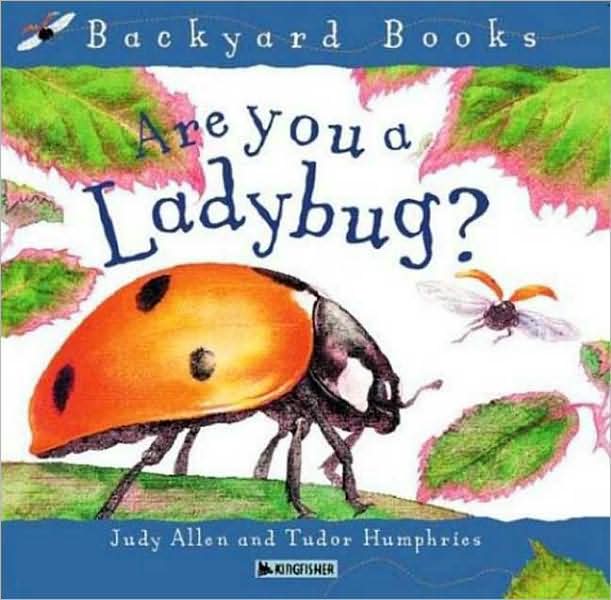
    Are you a ladybug? written by Judy Allen and illustrated by Tudor Humphries takes us through the life cycle of a ladybug.  Allen begins by showing us what a ladybug’s parents look like.  She then goes on to tell us that the mother lays eggs, the babies inside grow and then brake out.  At this point they may wonder if they are ladybugs because they don’t look anything like a ladybug.

    The babies are not the same shape or color as their parents.  As time goes on, the babies eat and grow.  Their skin becomes tight, it cracks and they wriggle out of it.  They do this over and over again until they finally emerge as the same shape as a lady bug but very pale and with no spots.  “Slowly, slowly, slowly, your color grows stronger.  Your black dots appear.  Congratulations, you’re a ladybug!”

    Curriculum Connections:

    This book would be a fun resource to use when introducing life cycles to students and for teaching students that not all babies resemble their parents when they are born.  Many children know that butterflies start out as caterpillars and that frogs start out as tadpoles but I bet that most of them don’t know that a ladybug doesn’t start out as a ladybug.  It would be interesting to show pictures of a few baby insects (including a ladybug) and animals to the class and ask what they will grow up to be before reading this book.    SOL K.7 c & d and 2.4 a

    Additional resources:

    This  lifecycle page contains the pages to create the lifecyle of a ladybug book.

    This  sequencing page contains a useful assessment activity.

    This butterfly lifecycle mobile looks like a fun craft.  It shows the complete metamorphosis of a butterfly from egg to larva (caterpillar) to pupa to adult (the butterfly).

    General Information:

    Book: Are you a ladybug?
    Author: Judy Allen
    Illustrator: Tudor Humphries
    Publisher: Kingfisher
    Publication Date: 2000
    Pages: 31
    Grade Range: K – 2
    ISBN: 9780753452417


  • Teaching Physical Science with Children’s Literature: Forces Make Things Move

    forces-cover.jpg

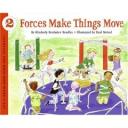
    Forces Make Things Move by Kimberly Brubaker Bradley and Illustrated by Paul Meisel takes a concept that can be difficult to understand and explains it on a child’s level.  The pushing and stopping of a toy car is used to explain force.  Bradley explains that it takes a lot of force to move heavy objects such as a real car or a couch and just a little bit of force to move objects such as a leaves or papers that don’t weigh very much.

    She then explains friction and gravity, two types of forces.  She relates both of these forces again to the toy car.  There is a really cute page that shows us what Earth would be like without gravity.  The spilled milk fell to the ceiling rather than the floor.  The cat is on the ceiling licking the spilled milk.  Food, utensils and even the pet dog are floating around in the kitchen. There is even an experiment at the end of the book to find out more about friction.

    Curriculum Connections
    Although the book is suggested for 1st – 3rd grade, force seems to be a difficult concept to understand.  This book would be a great introduction to force at the 4th grade level.  SOL 4.2 B & C.

    Additional Resources

    • Battleship online game: Sink your opponent’s ship by answering questions correctly.  A review of essential knowledge relating to the fourth grade science unit on “Force, Motion and Energy.”
    • A hands on lesson plan: May the Force be With You will help students understand that the greater the mass of an object, the greater the force needed to change its motion.
    • The Gravity Company: A book for grades 1-3 about a town that is turned upside down when its gravity machine is turned off.

    Book:  Forces Make Things Move
    Author: Kimberly Brubaker Bradley
    Illustrator: Paul Meisel
    Publisher: Harper Collins
    Publication Date: 2005
    Pages: 33 pages
    Grade Range: 1-4
    ISBN: 9780060289072

  • unwelcome christmas gift….

    Hi everyone.
    My husband was diagnosed 2 days ago with type 1 diabetes. He is 35 years old and has been displaying many symptoms of the disease. He has lost over 50 pounds in the last 6 months without trying and his overall health has not been great recently. His blood sugar reading was at 520 when we went to the Drs. Needless to say, it has been a crazy few days and it all seems very sureal. Between Drs and shots and finger pricking and phone calls and researching on the internet…. His brother was also diagnosed as an adult (age 26) so we have seen what lies ahead. Trying to feel positive and greatful it wasn’t something worse, but feeling a bit overwhelmed, too.