Author: Michael Giberson

  • Smart meter vs. standard meter (with photos!)

    Michael Giberson

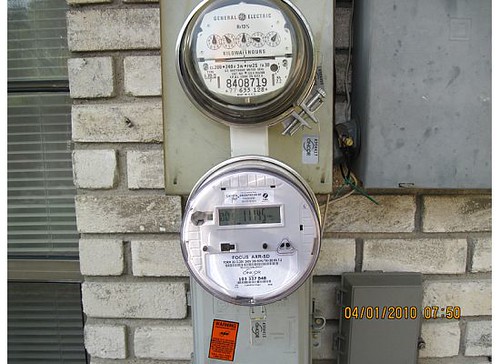
    Oncor has been testing smart meters in part by monitoring several several homes with side-by-side smart meter/standard meter pairs.  (See week four results from Killeen, Texas; week four results from Temple, Texas; week four results from the DFW area will be posted tomorrow, April 7, assuming Oncor sticks with their schedule.)  So far it looks like the smart meters and standard meters are keeping it close, with most of the meters no more than 4 or 5 kwh’s apart after four weeks.

    One pair of meters in the Temple test is reported at 12 kwh’s apart, a difference of about $1.60 on a monthly bill, but the older meter is the one with the higher reading.

    What? You don’t trust Oncor? Well they are posting photos online each week from the side-by-side meters. (Which won’t convince any skeptics, but will serve to document the historical moment.  Years from now some digital artist will be inspired to remix these images into a work of art.)

    T12_April_1_2010

  • South Africa hotel price gouging study

    Michael Giberson

    International accounting firm Grant Thornton has surveyed 2,500 hotel and other properties in South Africa and concluded that about half of the properties will not be charging a premium rate during the upcoming World Cup.  In some cities, however, a majority of properties were raising rates, sometimes significantly. (Another summary: “Fifty three percent of Durban accommodation establishments were planning to charge more than 50 percent above their peak season rates for the World Cup, a survey into price gouging has found.  This is the second highest in the country after Gauteng with 65 percent, the survey commissioned by South African Tourism has revealed.”)

    Tourism, hotel associations, and government officials in South Africa have put significant effort into trying to persuade property owners not to raise rates dramatically.  But demand will be extraordinarily high for a few weeks this summer and the supply available to meet that peak demand will be around for years.  It seems odd to encourage property owners not to adjust prices to reflect the extraordinary demands associated with World Cup.

    At least in the South African case the anti-price gouging effort is rooted in persuasion rather than force.  Unlike, say, in several states of the United States, where the state government may impose potentially substantial fines, or in Venezuela or Sri Lanka, where government troops have conducted raids on businesses with prices violating government policy.

    It also seems odd that this topic gets discussed under the category of “price gouging.”  Prototypically, price gouging involves sharp price increases on necessary goods during emergencies.  While hotels are frequently targets of price gouging allegations, typically it is when victims of a hurricane or other natural disaster find themselves charged higher-than-usual rates.

    No emergency is driving consumers to seek housing in South Africa during the World Cup. Hundreds of millions of people worldwide will watch the World Cup on television, me parochially rooting for CONCACAF teams included. Maybe that explains why I’m not particularly concerned about the fans that are wealthy enough and committed enough to fly into South Africa for a few games. Whatever might be said about the benefits of restraining price increases, it this cases the potential “victims” are incurring the hazard.

  • I cringe when I see Hayek’s knowledge problem wielded as a rhetorical club

    Michael Giberson

    The knowledge problem made the newspaper today – that’s Hayek’s concept of the knowledge problem, not the KP blog that Lynne and I operate.  But since we appreciate the significance of Hayek’s insight on the mobilization of knowledge, it seems appropriate to draw attention to Glenn Reynold’s op-ed, “Progressives can’t get past the Knowledge Problem,” appearing today in the Washington Examiner.

    In his “The Use of Knowledge In Society,” Hayek explained that information about supply and demand, scarcity and abundance, wants and needs exists in no single place in any economy. The economy is simply too large and complicated for such information to be gathered together.

    Any economic planner who attempts to do so will wind up hopelessly uninformed and behind the times, reacting to economic changes in a clumsy, too-late fashion and then being forced to react again to fix the problems that the previous mistakes created, leading to new problems, and so on.

    Market mechanisms, like pricing, do a better job than planners because they incorporate what everyone knows indirectly through signals like price, without central planning.
    Thus, no matter how deceptively simple and appealing command economy programs are, they are sure to trip up their operators, because the operators can’t possibly be smart enough to make them work.

    Hayek’s insight into economics and regulation is often called “The Knowledge Problem” ….

    Reynolds is giving us a simplified version of Hayek’s view (which isn’t surprising since he’s writing an op-ed for a newspaper), but mostly avoids the cartoon version that sometimes shows up in editorializing about government and the economy.  Hayek is clear in the article that his point is a comparative one: decentralized economic activity does a better job than centrally managed economic activity because it does a better job of mobilizing the knowledge relevant to the decisions that need to be made.  Reynolds gets the point right, “Market mechanisms … do a better job.”  Not perfect, just better.

    Hayek says that the issue isn’t one of planning vs. not planning, but rather a question of who does the planning: “whether planning is to be done centrally, by one authority for the whole economic system, or is to be divided among many individuals.”  Both central planners and de-central planners (i.e., individual business people) will make mistakes, but there is very good reason to believe that the aggregated errors of decentralized decision makers will be smaller than the errors of a centralized decision maker.

    Hayek allows that there are different kinds of knowledge and likely different kinds of organizations or processes that would be appropriate to putting the different kinds of knowledge to best use.  Hayek’s main point in his article is that the most important knowledge with respect to economic activity is the knowledge of particular circumstances of time and place (that is to say, what resources can be found to address particular needs, what terms govern access to those resources, and which combination of resources is likely to bring about the most desired outcome).  This kind of knowledge exists in a widely dispersed and fragmented state and may not even be revealed except in cases in which people are placed in a position in which they must choose between alternatives.  As such, this kind of information is not readily rolled up into statistical summaries for easy and appropriate centralized decision making.

    While Reynolds does a pretty good job of simplifying Hayek without being too simple-minded, I cringe a bit to see the knowledge problem wielded as a rhetorical club to beat upon policy proposals that the editorialist doesn’t like. Relative to, say, outright nationalization of health care services, I’d conclude that “Obamacare” preserves a lot of decentralized decision making.  Reynolds doesn’t seem to notice this not-so-subtle point.

    Certainly relative to the status quo, the health care law centralizes decision making and is appropriately made subject to this Hayekian critique.  But I don’t think Hayek’s insights can quite do all of the anti-big government work that Reynolds wants. While political and intellectual elites have mostly given up the enthusiasm for outright socialism that was common when Hayek wrote his article in 1945, government is bigger and more intrusive now then it was then.  Nonetheless, big government has not collapsed under the burden of these knowledge problems; it grows, mostly with public support or at least apathy.

    Opponents of Obamacare don’t need a theory that says centralized decision making always fails (and by the end of Reynold’s article we are to this cartoon version of Hayek).  Rather, such opponents need a theory that explains when government action works and when it doesn’t, and then make the case that Obamacare falls into this latter category.  Hayek’s insights into the fundamental value of decentralized economic decision making are obviously useful but not sufficient to make this case.

    NOTE: Hayek’s “The Use of Knowledge in Society,” published in the American Economic Review in 1945, is available online at the Library of Economics and Liberty.

  • “Hybrid Vehicles Only”

    Michael Giberson

    This sign puzzles me.

    I assume it is intended as pro-hybrid, pro-energy conservation signal.

    But the parking space designated is not particularly convenient to the store, so if it is pro-hybrid effort, it is tepid support at best.  Usually there are more convenient parking spaces available, and I’ve never seen a car parked in the spot, hybrid or not.

    I also assume this is a private effort on the part of the shopping center owner, and if it makes the owner feel good then who am I to object?

    But just in case the idea might spread, I feel compelled to point out that these technology-based resource allocation devices are inefficient ways to pursue policy goals.

    [Near 50th and Indiana Ave., Lubbock, Texas.]

  • “Energy Storage in the New York Electricity Markets”

    Michael Giberson

    The New York Independent System Operator has release a report, “Energy Storage in the New York Electricity Markets” (March 2010). The report offers an overview of existing grid-connected energy storage in New York, recent developments, and potential for further changes in the next several years. It is a good basic discussion of energy storage issues as seen from the point of view of the transmission system operator.

    What I found most interesting was their discussion of the power market design changes needed to accommodate flywheel and battery-based energy storage systems:

    The original NYISO wholesale market was designed when traditional resources, such as pumped storage and fossil fuel generation units, submitted bids for both energy and ancillary services including regulation. In the past few years, new technologies have become available that make energy storage more efficient and economical. This class of devices has an energy capacity limitation that precludes them from taking part in the energy market and thus would not fit into NYISO market model without market design modifications. Consistent with its mission to evolve the markets, the NYISO in collaboration with stakeholders participating in its shared governance process, crafted a market enhancement that will allow Limited Energy Storage Resources to participate in the NYISO Regulation markets.

    To provide them access to the market, a new type of Regulation Service provider was defined: a Limited Energy Storage Resource (“LESR”). A LESR is characterized by its ability to provide continuous six-second changes in output coupled with its inability to sustain continuous operation at maximum energy withdrawal or maximum energy injection for an hour. LESRs are limited to providing Regulation Service in the NYISO markets.

    Sometimes accommodations made to let new technologies work in the market is pejoratively cast as special treatment or favoritism. The NYISO gets the tone just right: the existing market design was constructed around the then existing set of technologies; new technologies don’t always fit into the existing way of doing things and it is appropriate to change. For example, when the NYISO market was designed all providers of regulation service also were energy market participants and no one worried too much about the way rules for regulation service payments were tied up with energy supply requirements and energy supply payment systems.

    While market design changes are an inherent and expected part the system, that doesn’t make them simple or non-controversial. An examination of the development of LESR rules in NYISO might provide an instructive case study of the market design process.

  • Texas PUC has plan to test smart meters

    Michael Giberson

    Following up on earlier mention of consumer concerns over the accuracy of smart meters, yesterday the Texas PUC approved a plan for testing smart meters. The Fort Worth Star-Telegram reports:

    The Texas Public Utility Commission unveiled a detailed plan Thursday for independent testing of smart meters, the same day Oncor Electric Delivery acknowledged that errors by meter readers produced a substantial number of overbillings.

    While contending that new digital meters are accurate and exceptionally cold weather was the overwhelmingly predominant cause for soaring electric bills in recent months, Oncor spokesman Chris Schein said there were “1,827 instances of human error” related to Oncor’s installation of 780,000 smart meters.

    In areas where smart meters have been installed, some consumers have blamed them for big jumps in their power bills.

    Errors typically occurred when a meter reader misread the number on an old meter or a made an error writing the number, Schein said. As a result of dial systems on the old meters, “almost all” the errors resulted in customers being overbilled rather than underbilled, he said.

    The average refund to overbilled customers will be about $127, he said.

    I don’t quite get this last explanation, “As a result of dial systems on the old meters, ‘almost all’ the errors resulted in customers being overbilled rather than underbilled.” Why would there be a bias in errors?

    With just 1,827 out of 708,000 meter reads in error, we’re talking about a less than 0.2 percent error rate. Not bad for a human-managed reading, recording, and retyping based system.

  • Elinor Ostrom interview

    Michael Giberson

    YES! magazine presents an interview with Elinor Ostrom, “The Woman Who Just Might Save the Planet and Our Pocketbooks.” The sub-head teaser – “What if our economy was not built on competition?” – is a little over-heated. Nothing in Ostrom work, so far as I know, is opposed to competition. Rather, in the work for which she is now famous, she’s all about understanding cooperation in the face of common pool resource problems. But don’t let the framing of the article put you off if you are looking for an easy and very brief introduction to Ostrom and her ideas.

    Other interviews with Ostrom, for those who want more:

    HT to Marginal Revolution for the YES! magazine link.

  • The vast electrical sponge provided by V2G technology

    Michael Giberson

    In the realm of more-enthusiasm-but-no-more-analysis for vehicle-to-grid (V2G) technology, Fereidoon Shioshansi at the EU Energy Policy Blog asks, “Will V2G Evolve Into A Great Electrical Sponge?“  He asks the question, and it is an excellent question to ask, but he doesn’t answer it.

    Instead we get a little taste of claims made by researchers based on a pilot project – “the extra costs of making an EV battery V2G compatible could be as little as $1,500 while the potential reward may be as high as $3,000 per annum through a ‘load-balancing contract’ with a grid operator” – and follow those claims with the usual rather unconstrained imagination of exciting possibilities.

    Actually, Shioshansi is better than many commentators on V2G because he at least realizes that there is more than just an electrical cord necessary to connect an the electric car and the vast power grid in need of load balancing services:

    Additionally, the owner must reach an agreement with the grid operator – most likely through an aggregator and/or intermediary – to provide a reasonable revenue stream for the car owner while offering tangible storage and balancing service to the grid operator. These are formidable but not insurmountable challenges.

    “Not insurmountable” is technically correct, but a casual stroll through history offers some perspective.  It took a literal act of Congress to get much third party access to the transmission grid (namely, the Energy Policy Act of 1992), and then it was several years before final rules governing third party access were issued by FERC.  It typically takes a supportive state law or regulation for local distribution companies to become very interested in helping consumers attached distributed energy sources to the local grid, and while energy policy folks have been talking about these issues for decades most places don’t have much in the way of effective state policies supporting distributed energy resources.  The physical proof-of-concept type issues are being solved, thanks in large part to the efforts of talented researchers at the University of Delaware and elsewhere, but the associated contractual/policy/institutional issues are far from being resolved.

    In order to manage the safety and reliable operations of the grid, grid operators like to have some control over devices connected to the grid. V2G asks us to imagine a world in which consumers are attaching to the grid at times and points of convenience to the consumer, and then have the grid operator pay the consumer for some limited access to the battery capabilities of the electric vehicle for the uncertain amount of time the vehicle remains connected.  And advocates of these ideas ask us to believe, simultaneously, that electric vehicles with V2G technology will be available in large enough numbers to make it worth the trouble of someone to overcome all of these challenges, and yet not available in large enough numbers to overwhelm the electric system’s demand for load balancing service.

    I haven’t done the analysis, but I can state with fairly high confidence that the demand for load balancing service is not perfectly elastic at the $5 – $10 day rates obtained by the three test cars in the University of Delaware/PJM pilot project.

    So while Shioshansi asks a great question, his conclusion is an appropriately tempered “V2G technology may prove to be a welcomed blessing.” (Emphasis added.)  Hedging claims is probably wise in this space.

  • Crude oil prices in 2008: Was the spike a bubble?

    Michael Giberson

    In the physical world, spikes and bubbles are quite different things that don’t generally get mistaken for one another.  Curiously, in economic metaphor, the same phenomena can be called a spike and a bubble.  Argument among economists continues on the issue of whether the oil price spike in 2008 was or wasn’t a bubble.

    A few weeks ago Paul Krugman dismissed the idea that the 2008 run up in oil prices was a bubble, and suggested that high oil prices “are largely caused by fundamentals.” In a May 2008 op-ed Krugman also argued against the bubble claim, claiming that if speculators were to  blame there would be tell-tale signs like the accumulation of excess inventories.

    Amy Myers Jaffe responded at the Baker Energy Institute Forum blog:

    The problem with Krugman’s logic is that he was in factual error. Oil inventories were indeed increasing as prices were going up, and by a large amount, especially if you add in what we in the industry call “oil at sea” which refers to a build up of the number of large tankers of oil floating offshore or slow steaming to markets that lack sufficient demand for that supply.

    Right around the time that Krugman declared that there was no oil bubble, Energy Intelligence Group was reporting that oil inventories in the industrialized countries had risen by 1.2 million barrels per day in April 2008, which put them well above the five-year average. In a telling sign of how limited on-land oil-storage space was at the time, Iran had to commission ten very large crude oil carriers (VLCCs) to hold its unsold oil afloat off its coast, a practice not seen since 1989, when oil prices were collapsing.

    The problem with Jaffe’s response is that it ignores long established oil industry patterns. High prices or low prices, the industry tends to build inventory in the first four months of the year and draw down those inventories during the next five or six months. (For example: U.S. Energy Information Administration on oil stocks: “World oil stocks follow a seasonal pattern in which they are typically drawn down rapidly in the middle of the winter and re-built rapidly in the spring…”)

    Jaffe needs inventories to accumulate in excess of normal industry practices to sustain her argument.  Her claim that inventories in April 2008 were “well above the five-year average” is ambiguous; was April 2008 inventory above the five-year average for that time of year or just above the average level for every month of the previous five years?  It makes a difference because it is ordinary for April to have higher inventories than any other month, and only relevant to the case if April 2008 was extraordinarily high.

    I don’t have the Energy Intelligence Group data at hand, and I don’t find other world inventory data readily available.  U.S. inventory data from the EIA shows the typical pattern of inventory accumulation in the spring and draw down over the summer.  Early 2008 does show slightly higher inventories (less than 2% higher) relative to the average inventory for the same week of the year over the prior five years.  On the other hand, early 2008 also showed slightly lower inventories (less than 2% lower) relative to the average inventory for the same week of the year over the prior 20 years.  The inventory build up in early 2008 doesn’t seem so far off typical industry practices to justify bubble claims.

    Admittedly, crude oil inventory is the U.S. is only a part of a bigger picture. If you have better data to share, I’d be interested.

    The Iran anecdote that Jaffe tossed into here story seems to be the result of temporary and idiosyncratic conditions, so probably not revealing on the larger issue.  On May 2, 2008, Bloomberg reported:

    Iran, OPEC’s second-largest oil producer, more than doubled the amount stored in tankers idling in the Persian Gulf, sending ship prices higher as demand for some of its crude fell, people familiar with the situation said….

    While oil rose to a record $119.93 a barrel on April 28, Iran has a glut of its sulfur-rich crude as refineries that can process the fuel shut down for maintenance. The discount on Iranian Heavy crude compared with Oman and Dubai petroleum has more than doubled since the start of the year, according to data compiled by Bloomberg.

    “There’s not much demand for heavier crudes such as those from Iran,” said Anthony Nunan, assistant general manager for risk management at Mitsubishi Corp. in Tokyo. “It’s the peak of the refinery maintenance season in Asia, and Iran also sells oil to Europe and the Mediterranean, where some refineries are having turnarounds,” or seasonal shutdowns for repairs, he said.

    I’m not claiming Krugman is right; I generally don’t read Krugman and particularly don’t rely on his opinions on energy market issues. I’m also not claiming that Jaffe is wrong.  What I am claiming is that Jaffe simply doesn’t offer sufficient backing for her argument.

  • God and mammon both teach fairness

    Michael Giberson

    In a study encompassing several distinct populations, Joseph Henrich and collaborators conclude that both participation in markets and belief in a world religion promote fairness norms that facilitate emergence of large-scale societies.  The study was described in a recent issue of The Economist:

    For the evolutionarily minded, the existence of fairness is a puzzle. What biological advantage accrues to those who behave in a trusting and co-operative way with unrelated individuals? And when those encounters are one-off events with strangers it is even harder to explain why humans do not choose to behave selfishly. The standard answer is that people are born with an innate social psychology that is calibrated to the lives of their ancestors in the small-scale societies of the Palaeolithic. Fairness, in other words, is an evolutionary hangover from a time when most human relationships were with relatives with whom one shared a genetic interest and who it was generally, therefore, pointless to cheat.

    The problem with this idea is that the concept of fairness varies a lot, depending on which society it happens to come from—something that does not sit well with the idea that it is an evolved psychological tool. Another suggestion, then, is that fairness is a social construct that emerged recently in response to cultural changes such as the development of trade. It may also, some suggest, be bound up with the rise of organised religion.

    Joseph Henrich at the University of British Columbia and his colleagues wanted to test these conflicting hypotheses. They reasoned that if notions of fairness are, indeed, calibrated to the Palaeolithic, then any variation from place to place should be random. If such notions are cultural artefacts, though, they will vary systematically with some aspect of society….

    The results back a cultural explanation of fairness—or, at least, of the variable levels of fairness found in different societies. … People living in communities that lack market integration display relatively little concern with fairness or with punishing unfairness in transactions. Notions of fairness increase steadily as societies achieve greater market integration. People from better-integrated societies are also more likely to punish those who do not play fair, even when this is costly to themselves….

    Dr Henrich also, however, found that the sense of fairness in a society was linked to the degree of its participation in a world religion. Participation in such religion led to offers in the dictator game that were up to 10 percentage points higher than those of non-participants.

    World religions such as Christianity, with their moral codes, their omniscient, judgmental gods and their beliefs in heaven and hell, might indeed be expected to enforce notions of fairness on their participants, so this observation makes sense. From an economic point of view, therefore, such judgmental religions are actually a progressive force. That might explain why many societies that have embraced them have been so successful, and thus why such beliefs become world religions in the first place.

    So there you have it: both belief in world religions and participation in markets seem to be associated with fairness.

    The Henrich et al. study was published as “Markets, Religion, Community Size, and the Evolution of Fairness and Punishment,” Science (March 19, 2010).  As summarized in the abstract:

    Large-scale societies in which strangers regularly engage in mutually beneficial transactions are puzzling. The evolutionary mechanisms associated with kinship and reciprocity, which underpin much of primate sociality, do not readily extend to large unrelated groups. Theory suggests that the evolution of such societies may have required norms and institutions that sustain fairness in ephemeral exchanges. If that is true, then engagement in larger-scale institutions, such as markets and world religions, should be associated with greater fairness, and larger communities should punish unfairness more. Using three behavioral experiments administered across 15 diverse populations, we show that market integration (measured as the percentage of purchased calories) positively covaries with fairness while community size positively covaries with punishment. Participation in a world religion is associated with fairness, although not across all measures. These results suggest that modern prosociality is not solely the product of an innate psychology, but also reflects norms and institutions that have emerged over the course of human history.

    If you have questions about how the study was conducted, how they measured market integration and fairness, etc., check out the extensive supplemental information also posted at the Science website.

  • High bills lead couple to file smart meter lawsuit against Oncor

    Michael Giberson

    Elizabeth Souder, the Dallas Morning News, reports on a lawsuit filed against Dallas-based wires utility Oncor claiming fraud and negligence associated with the company’s installation of smart meters.  The lawsuit can be viewed at the newly established website www.oncorlawsuit.com.  The suit seeks class action status on behalf “all consumers in Oncor’s service area who have experienced significant increases in their electric bill since the installation of a “Smart” Meter system.”

    Somewhat simplified, the lawsuit tells the story of a couple who say that their electric bills increased dramatically after Oncor installed a smart meter (reportedly from $400-$700 a month before, to as much as $1800 month after), the couple engaged in several attempts to get Oncor to disclose what was wrong with the meter and came away unhappy.

    Other that the “post hoc, ergo propter hoc” argument and complaints about Oncor’s customer service, there isn’t much in the way of evidence in the lawsuit. I guess that is what the discovery procedure is for.  Admittedly, I don’t know the underlying facts; I’m just reacting to the appearance of a lack of merit in the lawsuit.

    Maybe the message here is to install smart meters at the end of winter and the end of summer (adjusting as appropriate for local conditions).  That way, the first smart meter bills are likely to be lower than the last “dumb meter” bills. If consumers are going to leap to conclusions based on a too little data (and we will), you may as well have them leap to a conclusion in your favor.

    HT to the Texas Energy and Environment Blog.

  • Georgia bill would add useful flexibility to price gouging law

    Michael Giberson

    A bill passed by the Georgia state senate would add some helpful flexibility to the state’s anti-price gouging law.  The primary purpose of the bill would be to allow the state to limit the range of items for which the price gouging rules will be enforced based upon the nature of the emergency.  For example, if a storm mostly damaged windows and roofs, the price gouging rule might be enforced on plywood and hotel rooms, but not on ice and gasoline.  Another part of the bill would allow gasoline retailers to raise the price of retail gasoline to reflect the cost of replenishing the store’s supplies rather than linking allowed retail prices to the historical cost of the gasoline sold. Currently the state allows “replacement cost pricing” for plywood during declared emergencies, but gasoline price increases were evaluated with reference to pre-emergency historical cost.

    I’d rather see the state repeal its price gouging laws altogether.  The laws probably create more costs than benefits, and can lead businesses to shut down during emergencies rather than risk violating anti-price gouging laws.

    From the Atlanta Constitution-Journal, “Bill allows gas price increase in emergency“:

    Less than two years after hurricanes brought a run on gas, the state Senate has passed legislation letting station owners charge much higher prices as soon as an emergency is declared.

    Officials with the Governor’s Office of Consumer Affairs worry the measure, if it becomes law in its current form, would make it tough to prosecute a gas station for price gouging.

    “I think it would be very difficult to determine that price gouging had occurred,” said Bill Cloud, spokesman for the office. “I don’t know that we would have confidence in saying that, as the bill exists right now, we would be able to define, or describe or enforce price gouging as it relates to petroleum products.”

    The bill was originally meant to give the governor more flexibility in deciding which products would fall under gouging laws during an emergency. For instance, if an emergency involved damage to homes but not a disruption in the flow of gas, gouging laws could apply to plywood or building materials and not fuel.

    However the bill, which was backed by Gov. Sonny Perdue, was rewritten by the Senate Agriculture and Consumer Affairs Committee to allow stations, in an emergency, to charge for gas what they decide it will cost to replenish the fuel they have on site.

    Meanwhile, one committee of the Connecticut state assembly unanimously approved a bill which offers a “mathematical definition that the state would use to identify gas station price gouging subsequent to natural disasters.”

    “In the past, gas dealers have had trouble knowing what constitutes an emergency and what the definition of gouging is,” [State Rep. Jim] Shapiro said. “So the current provisions against gouging have been tough to enforce. This new anti-gouging provision clarifies the rules to provide consumers and businesses information to act accordingly when there is problems.”

    Clarity in the law is usually a good thing – in order to comply with the law, businesses need to be able to tell what level of price increase will constitute a violation of the law.  But, as an industry spokesman stated, “the devil is in the details.”

    In this case the bill declares it will not be a violation of the price gouging law if a retailer’s average margin during the “abnormal market disruption” is no higher than the maximum margin during the 90-day period prior to the beginning of the market disruption.  Because the definition is in terms of changing margin rather than changing prices, it may allow retail prices to track changing wholesale costs.  However, the bill fails to clarify whether the relevant rack price is the historical rack price paid at the time of the initial wholesale gasoline purchase, or a contemporaneous rack price at which replacement fuel could be acquired. The historical cost method would restrain price increases and hamper market adjustment more, the contemporaneous rack price method would restrain price increases and hamper market adjustment less.

    Once again, probably an improvement over the existing state of affairs, but I’d rather see Connecticut repeal its price gouging laws altogether, too. As with Georgia, the Connecticut law probably creates more costs than benefits.

  • Incentives for efficient use of storage in electric power systems

    Michael Giberson

    In the most recent Energy Journal, Ramteem Sioshonsi has an article examining the welfare effects of the incentives to use energy storage in electric power systems. (“Welfare Impacts of Electricity Storage and the Implications of Ownership Structure,” See volume 31:2 here.) He considers the incentives faced by consumers, generators, and merchant energy storage owners (companies lacking consumer or generator affiliates).

    His theoretical analysis demonstrates:

    [W]elfare-maximizing storage use benefits consumers while reducing producer profits, [and therefore] will result in consumers and producers having vastly different incentives to use storage from one another and from merchant storage owners.  This is because the three different agent types will use storage to maximize their net payoffs. In the case of consumers this would consist of the sum of arbitrage value and consumer surplus change, whereas producers would maximize the sum of generation and arbitrage profits.  Merchant storage operators, on the other hand, will maximize arbitrage profits only.  Because consumer surplus is enhanced by welfare-maximizing storage use, and since consumers that own storage would not consider the impact of storage use on generator profits, they will tend to have an incentive to overuse storage.  Conversely, because storage use reduces producer profits, generators will have an incentive to underuse storage.

    A numerical analysis based loosely on ERCOT system characteristics in 2005 provides further elaboration of the model.

    Our numerical example showed that for most reasonable storage device efficiencies merchant ownership of storage is welfare-maximizing compared to the alternatives of consumer or generator ownership….  When storage assets can be divided amongst agent types the socially optimal allocation of storage favors merchants, although some consumer ownership of storage can be beneficial since their overuse of storage can compensate for underuse by merchants.

    Sioshonsi observes that as the number of storage operators increases, overall use of storage capability approaches the social welfare maximizing outcome.  This is, of course, the familiar effect of competition in markets on welfare.

    Reading this paper I couldn’t help but think of the Tres Amigas proposal, which I think would be the first merchant energy storage project of any significant size if built. (Am I overlooking any large grid-connected merchant energy storage projects?)  While this article was far from an analysis of the welfare consequences of building the Tres Amigas project, it does suggest that the project’s storage capability would offer substantial public benefits.

    Sioshonsi only considers use of energy storage to buy and sell energy, but grid-connected energy storage can also be used to provide transmission support services (generally called “ancillary services”).  When energy storage gets built as a transmission-system component and factored into regulated transmission rates, regulations tend to prevent that energy storage from being used for energy price arbitrage.  So, “transmission-system” energy storage assets will be underused relative to the public interest.  But markets for ancillary services are incomplete, meaning merchant incentives to supply ancillary services may also be underdeveloped.  Most of the regional, integrated power markets (i.e. RTOs) have substantially improved their ancillary services markets over the past several years, and the way forward here is to continue to improve ancillary services markets.

    ASIDE: Sioshonsi also notes that an integrated utility with consumer loads and its own generation assets may inherently favor the socially optimum welfare use of storage assets, “since these entities would be concerned with both producer and consumer surplus.”  However, this expansive claim is just an add-on remark in the conclusion not examined in the body of the paper.  Suffice to say that if the interests of integrated utilities were always aligned with both producer and consumer surplus, we could dispense with both restructuring and regulation and let consumers live in the warm embrace of unregulated, integrated monopoly power companies.

  • Power exchange regimes in Europe

    Michael Giberson

    At the EU Energy Policy Blog, Leonardo Meeus discusses the current organization of power exchanges in Europe. Meeus describes both private merchant exchanges and state regulated exchanges and notes the differing incentives of the two types, focusing on the effects on efficient cross-border exchange.

    Meeus’s post draws from his recent working paper, “Why (and How) to regulate Power Exchanges in the EU market integration context.”

  • Ohio cities to end natural gas purchasing initiative

    Michael Giberson

    Via Tim Haab at Environmental Economics, a news story from The Columbus Dispatch reporting that five Columbus suburbs were ending a program in which the communities bought gas on behalf of residents that didn’t opt for another supplier.

    “There’s really not a need for government to be in it,” said Dana McDaniel, Dublin’s assistant city manager, who announced the decision yesterday.

    In May, The Dispatch reported that the group’s prices were often higher than those of Columbia Gas of Ohio, the regulated utility. The fixed price was set each year and stayed the same for 12 months, while Columbia’s price changed every month.

    Some residents had voiced concerns that the group’s fixed-rate prices were too high and that the opt-out system for enrollment was confusing.

    One of those residents, Barbara Drobnick of Gahanna, withdrew from the program in December after finding out that she had been automatically enrolled. Yesterday, she said she was pleased to hear the program was being discontinued.

    “I like that they’ll be doing what cities are supposed to do, rather than making deals with private companies on my behalf,” she said.

    More:

    Since the consortium began in 2005, its price was higher than Columbia’s in 43 out of 63 months, according to a Dispatch analysis of pricing and consumption data. Customers who had the city group plan that entire time and had average gas usage would have paid nearly $800 more than if they had gone with the utility.

    It is a bit unfair, as McDaniel said later in the article, to compare the 12-month fixed rate price in the program to monthly variable price deals offered by Columbia.  A fairer comparison would look at what other 12-month fixed rate plans were offering at the same time the five-city group renegotiated each next year’s rate.

    But I tend to agree with the McDaniel’s line quoted above, “There’s really not a need for government to be in it.”

  • More on Smart Meter Texas

    Michael Giberson

    From the Houston Chronicle, “Smart meter power usage data isn’t so current“:

    A Web site touted this week as providing near real-time power use information to electricity customers with new smart meters actually delays the information by up to two days, CenterPoint Energy has acknowledged.

    … The company said Monday the site would give consumers with smart meters information about their power usage in 15-minute intervals so they could make better choices about how much power they use.

    Not mentioned in the news releases from the company and state regulators was that the 15-minute incremental information can take as long as 48 hours to hit the Web site.

    Apparently the timeliness issue was discussed in the regulatory process that preceded roll-out of the system.  Retail electric providers favored real-time data, but “transmission companies like CenterPoint argued that consumers wouldn’t really need the data any sooner than the following day.”

    I’m of about three opinions about this issue.  The article quotes the CEO of an energy management company as saying “2- to 3-day-old data … is all but useless.”  I agree, more or less.  The data isn’t useless – an interested homeowner or business manager could still learn quite a bit from examining 15-minute interval data from a few days earlier – but the delay does sap the immediacy from the system and makes it harder to put the information to use.

    On the other hand, being able to access 2-day old data on power consumption at the 15-minute interval level is light-years ahead of the situation that most consumers find themselves in.  Currently I get an electric bill that reports a “previous [meter] read” and a “current [meter] read.”  No explicit dates are attached to the two bits of information, but I’m guessing the first number is from about 5 weeks before the billing date and the second one from about 1 week prior to the billing date.  This kind of meter data is “all but useless;” interval data from a few days ago would be super fantastic.

    Almost no smart grid benefits will emerge directly from Smart Meter Texas, but that is okay.  It is only a taste of the possibilities, not the full smart grid smorgasbord.  This system is not “the end,” it is one beginning.

  • Allocating property rights to wind and solar resources

    Michael Giberson

    Troy Rule, a law professor at the University of Missouri, has a pair of articles applying Calabresi and Melamed’s “Cathedral Model” to rights in wind resources and solar resources.  As Rule notes, the law remains unsettled on these resource issues, but the potential for conflict increases as these resources become more frequently exploited.  I like Rule’s article because it brings an explicitly “law and economics” focus to this question of property rights and resource development.  (Links follow below.)

    The cathedral model was offered by Calabresi and Melamed in 1972 as a way of organizing legal thinking about property and liability issues in a unified manner.  As summarized by Rule in the wind rights article, using the common example of pollution, the model provides four possible rules for allocating rights between a potential upstream “polluter” and a downstream “victim”:

    RULE ONE: The victims are entitled to be free from pollution and their entitlement is protected by a property rule (an injunction against the polluter);

    RULE TWO: The victims are entitled to be free from pollution and their entitlement is protected by a liability rule (the victims can force the polluter to pay them compensatory damages);

    RULE THREE: The polluter is entitled to pollute and its entitlement is protected by a property rule (the victims have no legal or equitable right to stop the pollution); and

    RULE FOUR: The polluter is entitled to pollute and its entitlement is protected by a liability rule (the victims can purchase an injunction to stop the pollution by paying the polluter’s costs of stopping the pollution).

    A particular contribution of the Cababresi and Melamed article was the explication of the “Rule Four” possibility, an option which had not been much noticed in legal practice or scholarship up to that point. In the case of Rule’s wind rights article and solar rights article, he argues that Rule Four is the way to go.  For example, a downwind landowner should have the right to, in effect, buy a “non interference” easement from the upwind landowner.

    As a practical matter, existing markets are solving the problem without much specific law.  For the most part lenders won’t lend money for a wind turbine that isn’t protected by an adequate buffer to protect the “supply” of wind.  This buffer can be from property owned by the same landowner leasing land to the wind project or it can be an easement negotiated with a neighboring landowner.  Of course this sort of lending market discipline doesn’t impinge on self-funded projects, and may lead to two neighboring landowners devoting too much land to a buffer area when coordinated development could have allowed them to devote less to the buffer.  Rule’s rule is intended to clarify just where the boundaries of neighbors rights and responsibilities are.

    Curiously, Rule’s analysis proceeds as if the designation of “upwind developer” and “downwind developer” were stable when actually such designations will literally shift with the changing of the wind (unlike, say, upstream and downstream along a river, since rivers rarely change direction). So far as I recall, Rule didn’t worry about this point. Yet, I think the dynamic element here only complicates the analysis for wind without fundamentally upsetting the principles being advocated.

    LINKS:

    Troy Rule, “A Downwind View of the Cathedral: Using Rule Four to Allocate Wind Rights,” San Diego Law Review, (2009).

    ABSTRACT: The rapid pace of U.S. wind energy development is generating a growing number of conflicts over competing wind rights. The “wake” of a commercial wind turbine creates turbulence and unsteady wind flow that can reduce the productivity of other wind turbines situated downwind. Existing law is unclear as to whether a landowner who installs a wind turbine on its property is liable for the lost productivity of a downwind neighbor’s turbine resulting from such wake effects. Legal uncertainty as to how competing wind rights are shared among neighbors can induce wind energy developers to abandon otherwise lucrative turbine sites situated near property lines, thus forfeiting valuable wind resources. This paper applies Calabresi and Melamed’s familiar “Cathedral” model to determine which rule regime would best promote the efficient allocation of competing wind rights while maintaining consistency with existing law. Surprisingly, the Cathedral model’s infamous and rarely-applied “Rule Four” seems best-suited for addressing these conflicts.

    Troy Rule, “Shadows on the Cathedral: Solar Access Laws in a Different Light,” University of Illinois Law Review, (2010).

    ABSTRACT: Unprecedented growth in rooftop solar energy development is drawing increased attention to the issue of solar access. To operate effectively, solar panels require un-shaded access to the sun’s rays during peak sunlight hours. Some landowners are reluctant to invest in rooftop solar panels because they fear that a neighbor will erect a structure or grow a tree on nearby property that shades their panels. Existing statutory approaches to protecting solar access for such landowners vary widely across jurisdictions, and some approaches ignore the airspace rights of neighbors. Which rule regime for solar access protection best promotes the efficient allocation of scarce airspace, within the constraints of existing law? This Article applies Calabresi and Melamed’s “Cathedral” framework of property rules and liability rules to compare and analyze existing solar access laws and to evaluate a model solar access statute recently drafted under funding from the US Department of Energy. Surprisingly, the Article concludes that a statute implementing the Cathedral model’s seldom-used “Rule Four” is best suited for addressing solar access conflicts.

    Guido Calabresi & A. Douglas Melamed, “Property Rules, Liability Rules, and Inalienability. One View of the Cathedral,” Harvard Law Review, (1972).

  • Responding to consumer concerns over smart meters

    Michael Giberson

    Smart meters have run into a bit of consumer resistance.  Some of us – no doubt crazed by the energy-econ-techno-lust possibilities – imagined that smart meters would be greeted by consumers with smiles and good cheer, and just maybe a tear or two of gratitude trickling down the consumers’ cheeks as they thank their electric utility for helping them out of the analog meter stone age.  At least according to various media reports, this scene has not been common (i.e. Consumer frustration grows over ’smart’ meter bills; It’s come to this: Citizens against smart meters; PG&E customer revolt may threaten rollout of Obama’s smart grid (“Obama’s smart grid”? Huh??); etc.).

    One response has been the recent formation of the Smart Grid Consumer Collaborative, a non-profit group aimed at understanding consumer concerns and finding ways to address the concerns.

    In Texas, power distribution utilities Oncor, CenterPoint, and AEP Texas have joined with smart grid device and data management companies in a more direct response: a website at www.smartmetertexas.com intended to give consumers with the new meters easy access to basic information on their power consumption.  The thinking is, apparently, that helping consumers get a taste of the “information age” possibilities will aid consumer acceptance.

    (HT NewsWatch: Energy and Texas Energy and Environment Blog)

  • Pandora lived

    Michael Giberson

    We’ve raved about Pandora here a number of times (KP search for “Pandora”). The New York Times recently reported on the surprising fact of Pandora: unlike a lot of other internet music startups, it survived. In fact, lately the company has prospered and is talking about going public.

    It turns out that the Pandora iPhone app (which I raved about here) was part of what has sealed Pandora’s success.

  • Tres Amigas gets half a loaf from FERC, tips on gaining other half

    Michael Giberson

    On March 18, the Federal Energy Regulatory Commission acted on the Tres Amigas project’s two regulatory requests submitted last October.  Tres Amigas has proposed to link the large scale power interconnections covering the eastern and western halves of the United States with the ERCOT interconnection in Texas.  The New Mexico-based project would facilitate trading power among the interconnections and aid development of electric power generation resources in all three areas.

    In docket ER10-396-000, FERC granted the project’s request for negotiated rate authority subject to conditions intended “to ensure that the goals of open access are protected and that rates for transmission service on the Project remain just and reasonable by limiting Applicant’s ability to withhold the Project’s capacity from the market.”  Haven’t read the order yet, but when I have the chance I’ll let you know if I see something interesting.

    In docket EL10-22-000, Tres Amigas requested the Commission agree not to assume federal jurisdiction over the parts of the ERCOT interconnection currently regulated by Texas just because the Tres Amigas project would allow ERCOT market participants to join in interstate commerce.  FERC concluded that the information submitted by Tres Amigas did not warrant a blanket disclaimer of jurisdiction and so denied the request. However, the Commission offered suggestions on how Tres Amigas may go about securing the jurisdictional assurance it wants without the Commission implicitly endorsing the various justifications the project offered in the company’s filing.

    MORE: The FERC press release contains more information, and see Chairman Jon Wellinghoff’s statement, Commission Marc Spitzer’s statement, and Commissioner John Norris’s statement.  Mostly these statements say: we like innovative transmission infrastructure projects like this one, we support them as we can, we couldn’t quite swallow the jurisdictional request as presented, but that doesn’t mean we don’t like these kinds of projects.

    The Wall Street Journal summarized the ruling, “Power Grid Connection Wins First Approval.” Bloomberg reports, “FERC Slows Tres Amigas Plan to Link U.S. Power Grids.”