Author: Mike “Mish” Shedlock

  • Will Miami Declare Bankruptcy And Start A Nationwide Trend?

    Miami

    I keep waiting for some large city to take initiative and declare bankruptcy to escape onerous burden of public pensions. Perhaps Miami is that city.

    NBC Miami reports Miami Budget Begging for Bankruptcy

    Please click on the above link to see a very interesting video. The video is not embeddable.

    Partial Transcript

    The city of Miami is in such financial dire straits that commissioner Marc Sarnoff is using the “B” word, bankruptcy.

    “We are not the only city, municipality to be going through this. It looks like Los Angeles sometime next week or the week after will be going bankrupt. It looks like there will be 30 more cities following suit.”

    Increases in public worker salaries is one of the main reasons why the budget is so tight. The average salary for a Miami city employee is $76,000. The average salary for a Miami city resident is $29,000.

    Employee pensions are choking the budget too. In 2000, pension payouts cost taxpayers $16 million. In 2009 that number spiked up to $70 million.

    Should the city go into bankruptcy, the commissioners and their politics would no longer be in charge of city finances, the judge would be.

    [Sarnoff] “You no longer have 5 people making political solutions. You now have one person who is looking after the best interest of the taxpayer of the city of Miami, without any politics getting into his or her way.”

    The Judge could order union contracts be renegotiated. He or she could decide what creditors get paid or not get paid.

    ….

    Commissioner Sarnoff offers 3 options to avoid bankruptcy.

    1. Renegotiate those union contracts

    2. Layoff about 800 city workers

    3. Raise your property taxes

    In this economic climate that last option is not likely at all

    …..

    I see no indication Los Angeles is about to declare bankruptcy anytime soon as Sarnoff suggests. However, it is perfectly clear that Los Angeles is indeed in pathetic shape and bankruptcy is the best option.

    The same applies to Houston and many other large cities as well. I look forward to the day one of these big cities finally tells their public unions where to go.

    All it takes is one big city to start the ball rolling.

    New Jersey Careening `Toward Becoming Greece’ as Costs Rise

    Inquiring minds are reading New Jersey Careening `Toward Becoming Greece’ as Costs Rise, Christie Says

    New Jersey Governor Chris Christie said the state is “careening our way toward becoming Greece” and can’t afford the cost of benefits and pensions for current workers.

    The governor, speaking today to members of the Manhattan Institute, said his state must reduce its tax burden and control government spending. He has proposed a constitutional amendment to cap growth in property taxes, the main source of funding for schools and towns, at 2.5 percent a year.

    “Higher taxes are not going to solve the problem,” said Christie, a Republican who took office Jan. 19. “We’ve got to change the course.”

    New Jersey, like Greece, has a high proportion of public workers who have been entitled to benefits such as free health insurance that outstrip taxpayers’ ability to pay for them, Christie said. In the past decade the state added 11,000 public- sector jobs as it lost more than 120,000 private positions, he said.

    Politicians in New Jersey have bowed to public unions for too long, failing to cut teacher benefits and enacting civil- service laws that have tied governments’ hands in trimming workforces, Christie said. Over the last decade, municipal spending has grown by 69 percent, and property taxes have climbed by 70 percent, according to the governor’s office.

    The average New Jersey household paid $7,281 in property taxes last year, the highest rate in the nation, according to the state Department of Community Affairs.

    Senate Budget Committee Chairman Paul Sarlo, a Democrat from Wood-Ridge, proves he is mathematically challenged and unfit for office by stating “The governor’s spending cuts may lead to property-tax increases of as much as 8 percent next year”.

    I salute Chris Christie. We desperately need more governors to follow his lead. I also salute commissioner Marc Sarnoff. Bankruptcy is the only option that makes any sense for Miami.

    Read more at Mish’s Global Economic Trend Analysis –>

    Join the conversation about this story »

  • Insanity In Australia: ING Says Thanks to Capital Appreciation, Paying Principal on Mortgage Loans is Unnecessary

    Myths that home prices rise forever and interest rates stay low forever are alive and well in Australia. Please consider this amazing story of corporate insanity as described in the Sunday Telegraph – Revealed: The home loan that could save you a fortune.

    ING Direct, Australia’s fifth largest lender, is preparing to sell loans that have no fixed term and no requirement to repay any capital along the way.

    At current rates, the interest-only loans would cut repayments on a $300,000 mortgage by $5000 a year.

    “People are needlessly being denied the chance to buy a property while prices spiral rapidly out of their reach” ING Direct CEO Don Koch said. “There is an urgent need to provide more affordable options and borrowers should be able to choose whether they want to repay the capital, or not.”

    Mr Koch wants to position the bank as a “mortgage partner for life”, with borrowers carrying the same interest-only loan from property to property for as long as they wish, accumulating equity from rising house prices as they go.

    Then, as they near retirement, they could sell their property for a big enough profit to pay off the original loan and buy a smaller place outright, leaving them mortgage-free. Or, they could keep the mortgage going and repay the original capital from their estate, after death.

    Banks already offer interest-only loans, but borrowers often are allowed to keep them only for five to 10 years. Then they must start paying the capital.

    But ING says this preoccupation with paying off the loan is unnecessary.

    “There is no economic reason for banks to insist on regular capital repayment,” Mr Koch said. “It just makes the loan more expensive for the borrower.

    Financial comparison website InfoChoice CEO Shaun Cornelius said the move was a welcome innovation: “Depending on the size of the loan, it could add hundreds of thousands of dollars to a borrower’s cash flow over their lifetime.”

    Economic Idiocy

    Koch’s proposal, seconded by CEO Shaun Cornelius of InfoChoice, is economic idiocy at its finest. No one “saves” anything by not paying down mortgages, the money is simply spent (most likely wasted) elsewhere. Moreover, home prices do not perpetually go up.

    The US housing market has without a doubt proven both statements.

    Ask any homeowner in the US who is headed for retirement and severely underwater on their home what they think of Koch’s hypothesis.

    With so many underwater mortgages, only a complete fool think estates would be in a position to repay the original capital from their estate, after death, especially in countries where the bubble has not yet popped, such as Australia, Canada, and China.

    Of all the proposals to keep the housing bubble alive in Australia, especially in light of what has happened in the US, this idea from ING needs to go straight to the top of the idiotic ideas list.

    ING Direct CEO Don Koch is testament to the idea “there is always the greater idiot who never learns a thing from history, who instead proposes to do something that the market has recently proven preposterous.”

    Simple Questions

    By the way Mr. Koch, I have a few simple questions for you:

    Are you aware of what interest rates were in the 1970’s and 1980’s?

    “What happens when interest rates rise, perhaps even double, and your borrowers struggle to make even the interest payments?”

    Alternatively, “Are you dumb enough to offer low rates forever?”

    Either way. Mr. Koch, you and your banks are screwed, and it should not take a genius to figure that out.

    This guest post previously appeared at the author’s blog, Global Economic Analysis >

    Join the conversation about this story »
  • New Oregon Study Says Even Economic Rebound Can’t Save State, As Decade Of Budget Deficits Is Coming

    A study conducted by Oregon Governor Ted Kulongoski shows that Oregon will not be bailed out by a rebounding economy, assuming of course the economy rebounds at all.

    Please consider New report says Oregon faces decade of budget deficits

    Oregon risks 10 years of crushing, multibillion-dollar budget shortfalls unless it immediately puts the brakes on spending and starts offering fewer services, cautions a new report released Thursday.

    This is no attack by anti-tax or anti-government factions. The warning comes from Gov. Ted Kulongoski’s “reset Cabinet,” a group of trusted advisers he appointed to assess the state’s long-term fiscal outlook and suggest changes.

    “We find that Oregon faces a decade of deficits, during which we cannot expect to be bailed out by a rebounding economy or a more generous federal government,” the report, says. If state spending is allowed to grow at its current rate, it goes on to say, “lawmakers and voters will find themselves again and again between the rock and the hard place of cutting services or raising taxes.”

    Why Oregon Must Reset State Government

    Inquiring minds are investigating an Update from the Governor’s Reset Cabinet

    We conclude that the state will face a decade of deficits if it tries to sustain the type and scope of services it now provides. Business-as-usual budgets will no longer suffice. Current services, as currently structured, will be unsustainable.

    We must rethink and refocus our priorities, move from short-term budgeting to long-term planning and develop smarter ways to meet our responsibilities in the challenging years ahead.

    In that process, we must reaffirm our common goals and judge what we are doing now and what we propose to change by well defined measures of success. In the end, we must be willing to adopt new ways to organize and deliver services, control costs and get the best value for our tax dollars.

    Revenue growth is expected to resume as the economy recovers and should make up for the loss of one-time funds that sustain the current budget. The most likely scenario is that Oregon will have approximately the same level of general fund resources to work with in the next biennium (2011-13) as it has in the current biennium.

    But increasing costs, needs and demands will drive the expenditure side of the budget far beyond its resources. When compared to the cost of maintaining the current level of services, the state faces a shortfall of more than two billion dollars, or 13 percent of its next budget – a shortfall that persists at that

    two billion dollar level in budget projections through 2019.

    As a result, we find that Oregon faces a decade of deficits, during which we cannot expect to be bailed out by a rebounding economy or a more generous federal government. In fact, trends in both categories could make our fiscal future even more challenging. It is important to recognize that Oregon is not alone. Most states face similar challenges. Some are beginning to talk about “reset initiatives” of their own.

    Oregon Overestimates the Recovery, Underestimates What Needs to be Done

    My sense is that states are all overestimating what the recovery will do. That aside, Oregon is a step ahead of others in realizing the recovery alone will not fix the problem.

    The report made no recommendations even though it is crystal clear what needs to happen. For starters, the state needs to kill defined benefit plans for new hires. Next, the state needs to outsource everything possible with the goal of getting rid of all public unions.

    Anything else is just pecking at the fringes of the problem.

    Proposed Pay Freeze in Illinois

    Please consider this editorial opinion in the Rockford Register. Our View: State’s fiscal fix needs to start with real pay freezes

    If Illinois’ elected officials truly are serious about creating a responsible budget, they would freeze the wages of all government employees.

    No raises. No steps or lanes. No cost of living increases. Nothing.

    Instead, the budget that Gov. Pat Quinn has proposed calls for $1.5 billion more in spending with $350 million of that money dedicated to increasing wages for government union employees.

    Some of those raises range from 7 percent to 20 percent — unheard-of amounts in the private sector where most of the taxpayers work.

    The taxpayers in the private sector have been getting their wages cut, their benefits slashed and have seen pensions go the way of the dodo bird.

    Government union workers seem oblivious to the struggles of their private-sector counterparts. Illinois’ unemployment rate is 11.2 percent, higher than the national 9.5 percent.

    Union workers stage rallies that ask for tax increases that would further drain the wallets of taxpayers while providing enough money to keep their jobs and benefits safe.

    Unions have refused to have their contracts renegotiated. They’ve resisted efforts to pay more for health costs. They’ve sued the state to avoid layoffs that would have helped the state save money. They seem to think the tax well is bottomless. …

    Jonathan who lives in Rockford says …

    Mish,

    I live in Rockford, IL. Check out the Rockford Register Star editorial on a proposed wage freeze for state workers.

    Obviously, their solution is tepid, but this is a VERY liberal newspaper.

    If even they are writing things like this about the public employee unions, what you and others are doing is starting to sink in. Keep up the good work.

    Jonathan

    Thanks Jonathan. Union wages and benefits are the number one fiscal issue with states and scores of cities.

    I am doing what I can to inform people what is happening.

    Join the conversation about this story »
  • Why The ‘Second Housing Boom’ Is Nothing But Huckster Hype

    new homes Arizona

    Homebuilder confidence is up again, but the headline does not tell the real story. Please consider Homebuilder confidence at 2-1/2 year high in May:

    The NAHB/Wells Fargo Housing Market index increased three points to 22, the highest since August 2007, the group said in a statement. It was the second straight month of gains in the index. In addition to the tax credit, builders were also cheered by growing evidence that economy’s recovery from the longest and deepest recession since the 1930s was gaining momentum.

    All three subindexes of the Housing Market Index, including a measure of future homebuilding activity, saw decent gains this month.

    “This means builders are more comfortable that the market is truly beginning to recover, and that positive factors for buying a new home are taking the place of tax incentives to generate buyer demand,” said NAHB chief economist David Crowe.

    The current sales conditions gauge rose three points to 23, the highest since July 2007. The sales expectations measure for the next six months also gained three points to 28, the highest in six months. The traffic of prospective buyers index increased three points to 16, the highest since September.

    Traffic is up to 16 and David Crowe is excited? The only thing that remotely looks like it is headed up is “sales expectations” sitting at 28.

    Even still, on the diffusion index, 50 is the break even point.

    Huckster Hype in Las Vegas

    The New York Times reports Building Is Booming in a City of Empty Houses:

    In a plastic tent under a glorious desert sky, Richard Lee preached the gospel of the second chance.

    The chance to make money on the next housing boom “is like it’s never been,” Mr. Lee, a real estate promoter, assured a crowd of agents, investors and bankers. “We’re going to come back like you’ve never seen us before.”

    Home prices in Las Vegas are down by 60 percent from 2006 in one of the steepest descents in modern times. There are 9,517 spanking new houses sitting empty. An additional 5,600 homes were repossessed by lenders in the first three months of this year and could soon be for sale.

    Yet builders here are putting up 1,100 homes, and they are frantically buying lots for even more.

    Brent Anderson, a marketing executive with another Southwest builder, Meritage Homes, said it bought 713 lots in stricken Arizona last year, and was on the verge of starting construction in a new Phoenix community called Lyon’s Gate.

    “We’re building them because we’re selling them,” Mr. Anderson said. “Our customers wouldn’t care if there were 50 homes in an established neighborhood of 1980 or 1990 vintage, all foreclosed, empty and for sale at $10,000 less. They want new. And what are we going to do, let someone else build it?”

    Gospel of Second Chance

    Richard Lee hypes the opportunity to get in on the next real estate boom. An opportunity for who?

    Supposedly everyone wants a new home. Well, today’s new home is tomorrow’s resale. In a sea of empty houses, one year from now, who would be able to sell them and at what price if they needed to move?

    Even if prices have bottomed (in some areas that is likely true), the supply of existing homes will keep a lid on resale prices for a long time to come, possibly a decade.

    There is no second housing boom coming, just local huckster hype scattered in an ocean of empty houses with more foreclosures coming every month.

    Join the conversation about this story »
  • 80 Condo Owners In Redmond, WA Just Voted To Mass Default

    (This is a guest post from the author’s blog.)

    80+ proud owners in the Riverwalk at Redmond Washington condo complex have had enough and are ready to bail, en masse.

    I received news of this event from Matthew who writes …

    Hi Mish

    I am good friends with an owner in the Riverwalk at Redmond condo complex and I also used to rent there, which is how I got wind of this story.

    It turns out the developer sold out the complex, dissolved his LLC, and is living somewhere in the Caribbean. Meanwhile, unit owners are in the hole by as much as 50% of their purchase price, not counting needed repairs of as much as $50,000 per unit.

    There are major defects that require about $4.1 million in renovation work to address underlying ‘envelope’ issues that cause leaks and mold issues in 11 units. The consultants said the exterior on the entire complex had to be replaced.

    The home owners association (HOA) discussed five alternatives.

    1) Sue the developer. Since the developer left the country so there’s no one to sue.

    2) Pay the $4.1 million maintenance with a loan. However, no bank will issue a loan because the HOA fund has a high delinquency rate and not everyone is paying their dues nor are they paying on time.

    3) Make each home owner pay approximately $45,000. Who would be willing to do that when everyone’s mortgage is seriously underwater?

    4) Liquidate the entire complex, forcing everyone into foreclosure.

    5) Opt for Band-Aid fixes. Go into each unit, rip it apart and fix the problem. However, the consultants have said that the damages will eventually spread to all units because the problem is structural. The HOA has gone this route in the past but the problems in 11 units keep coming back.

    Unwarranted Hope and Begging the Mayor for Help

    In a followup email Matthew writes “As of the last HOA meeting they’ve narrowed it down to option 4 and a new option… beg the local government for help. So they’re sending a letter to the Mayor of Redmond”.

    I read the letter but it did not disclose much more that what is shows above. My general comment on the letter is it is a useless waste of time.

    Mayor Marchione would be a fool to do anything more than send his sympathies. Of course there are countless government fools, but in this case 80+ homeowners are nothing compared to the complaints the mayor would get if he helped such a small select group.

    Furthermore, if the mayor were to bail out this complex, there would be 10,000 more requests. The mayor understands this without a doubt, thus there is absolutely no chance the mayor can do anything other than write a nasty letter to the developer. That would be a waste of time and money, while building unwarranted hope.

    Here’s the deal. Under the circumstances presented, it seems foolish to make another mortgage payment or another homeowner’s association payment.

    If you own a unit in that complex, your best choice of action is to consider walking away

    Caution: Before Walking Away Consult An Attorney. There are a lot of potential snags to consider if you go it alone.

    If you live in that complex (or any complex with similar issues), please seek legal help before you waste another cent on dues or mortgage payments.

    By the way, assuming every owner walks, and assuming those loans are widely spread out among lenders, it will be impossible to sell those units. The entire building could be worthless.

    Join the conversation about this story »
  • China’s Much-Vaunted Rebalancing Is A Joke

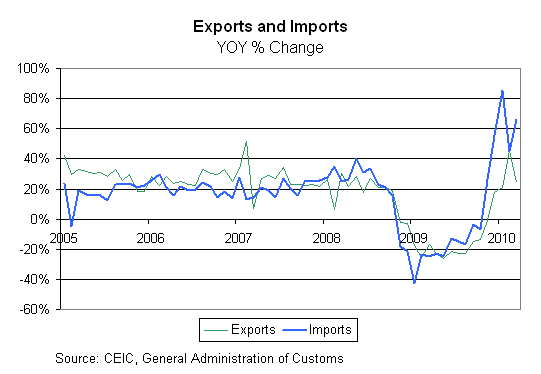
    In March, China’s trade surplus turned into a deficit, prompting some pundits to proclaim that China’s economy was rebalancing. Others pointed to a surge in auto buying as proof consumer demand in China was picking up steam.

    I did not buy either of those arguments, and instead proposed the numbers were indicative of collapse in US demand for Chinese goods coupled with massive surge in Chinese buying of commodities at ever increasing prices.

    Samuel Sherraden, writing for the New America Foundation, makes that case nicely in Why Trade Figures Do Not Prove China Is Rebalancing

    China’s trade surplus declined in the first quarter, and during March the country ran a deficit of $7.2 billion, its first monthly trade deficit since 2004. Contrary to some analyses, this is not proof that the economy has made significant progress toward rebalancing or a reason for the United States to back away from pushing China on yuan appreciation.

    The short-run decline in the trade balance was driven by seasonal effects, a slowdown in China’s export markets, and a surge in raw materials imports – none of which indicate that China is making a transition to an economy driven by greater consumer demand.

    On the contrary, a breakdown of trade figures indicates that although demand has returned, it is largely related to investment-led growth, not to consumer demand.

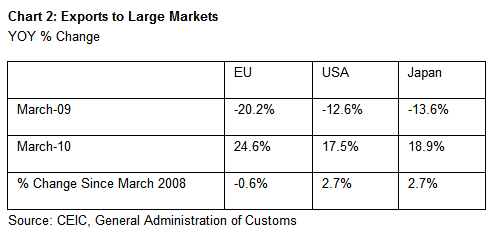
    Weak export growth was a consequence of weak recoveries in the European Union, United States, and Japan, which accounted for 46% of China’s exports in 2008. Even though exports to the EU, US, and Japan increased by 25%, 17%, and 19% YOY in March 2010, these gains barely made up for the decline during the previous year. In other words, exports to China’s major trading partners have remained flat since 2008 (see Chart 2).

    Import Demand Increased

    While export growth remained subdued, import growth has surged. But the increase in imports reflects an intensification of investment-driven growth and demand for commodities and materials, not a move to greater consumer demand.[1] Fixed asset investment grew 25.6% in the first quarter of 2010 compared to the first quarter of 2009. Partly as a result, China imported $27.6 billion more commodities and materials in March 2010 than in March 2009, an increase of 77.1% YOY. This was the major driver of the $25.8 billion decline in the trade balance during the same period.

    Evidence of Consumer Goods Imports?

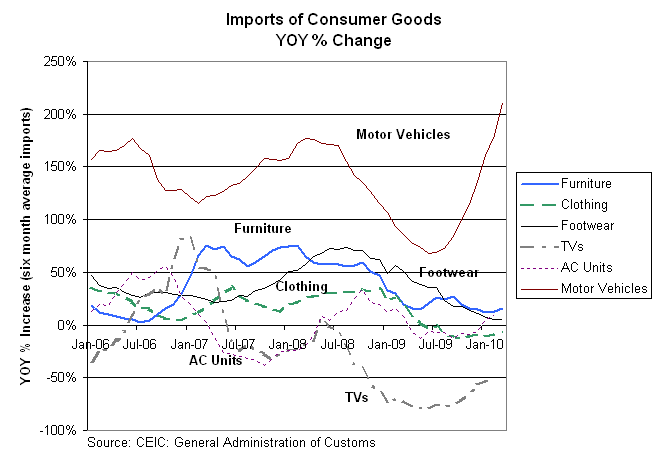
    Motor vehicles imports have soared on the back of strong government subsidies and increased demand, but imports of other consumer goods have not grown as quickly and in some cases have declined. During the last six months (October 2009 – March 2010), motor vehicle imports increased 211% from the same period last year. During the same period, imports of furniture and footwear increased by 15.4% and 5.3%, respectively, but clothing imports declined by 6.9% (see Chart 5). During the six months between September 2009 and February 2010, imports of air conditioners increased 9.0% but imports of televisions declined 54.6% from the same time period last year. In short, with the exception of motor vehicles, imports of consumer goods remained relatively weak, with some areas showing modest gains and others showing losses.

    At first glance, increased imports of motor vehicles would tend to support the argument that China is rebalancing. But on closer examination, one would see that the demand for cars has been driven by a government strategy to develop a strong domestic auto sector, not by a goal of creating a more consumer-oriented economy. Policies to support the auto sector, which included significant subsidies for purchasers and producers of fuel efficient vehicles, were partly responsible for dramatic increases in sales during 2009 and the first quarter of 2010. While some stimulus to the auto sector will expire in 2010, subsidies will continue for gas vehicles with engines smaller than 1.6 liters; “cash for clunkers” rebates in rural areas of up to 18,000 yuan ($2,632); and rebates for “new energy” cars, or fully electric cars, of up to 60,000 yuan ($8,775).

    Conclusion

    China’s trade balance has declined because China’s stimulus program intensified investment-led growth, increasing demand for commodities and capital goods. Based on our analysis, it is not evident that China has made progress toward rebalancing to a more consumer-oriented economy. …

    Excessive bank lending since the beginning of 2009 incentivized stockpiling of commodities and materials and the development of spare capacity. A tightening cycle could force enterprises in China to reduce imports and rely on existing commodity stockpiles and excess capacity to increase exports, leading to a rise in the trade surplus.

    There is a danger, then, that the recent trade figures will temporarily reduce pressure on China to rebalance its economy. Given the likelihood that China’s investment-heavy stimulus will lead to a new surge in China’s net exports, it is even more important that the United States develop a strategy to encourage China to undertake structural reforms to rebalance its economy. Revaluation of the yuan, although no substitute for longer term structural changes, would be a good place to start.

    There are more charts in the article related to Chinese demand for commodities. I encourage everyone to take a closer look.

    Artificial Demand

    The important point, but one that the article did not explicitly make is that China’s demand for commodities is hugely artificial, predicated on round after round of stimulus and outright monetary printing that has also fueled massive property bubbles and speculation.

    So before one can even talk about ways to rebalance, global stimulus needs to stop. Yet, China Business says Another $586 billion “Stimulus” Coming to China.

    Regardless, hoping to balance the US trade deficit with China by pegging the Renminbi (RMB) to some arbitrary level is a fool’s mission as noted in Why Repegging the Yuan and Other Non-Free-Market Solutions to Trade Imbalances With China Will Fail

    The notion the RMB is hugely undervalued is in part predicated on a belief the Chinese economy is a lot better than it is. Indeed, near unanimous opinion suggests the RMB would soar if China floated it.

    Here’s a question to ponder: What would happen if China stopped its stimulus cold turkey, pricked its property bubbles, and allowed the RMB to float freely, and in response the Chinese stock market collapsed, social unrest picked up, and hot money poured out of China?

    Would the RMB soar in those conditions? I rather doubt it. Yet those conditions are what I would expect if China stopped its speculative bubbles.

    The way to find out the true state of affairs is for China to float the RMB, central bankers to allow the market to set rates, and for governments worldwide to stop fiscal madness. That is also the way to rebalance the global economy.

    Unfortunately, central bankers and governments won’t take that set of actions, preferring instead to blame China’s RMB peg for the world’s ills.

    Join the conversation about this story »

  • Does the Global Imbalance Matter Yet? Did Ken Fisher Just Ring the Bell?

    (This is a guest post from the author’s blog.)

    With the Obama administration and most of mainstream media singing the praises of a recovery that is really nothing more than governments around the globe throwing unsustainable amounts of “stimulus” money at various problems, I am wondering when the global imbalances finally start to matter.

    Was today the day?

    Here are some charts to consider.

    Gold Up, Silver and Nonprecious Metals Down

    Energy Sector Down

    Financials Up


    US Dollar, Yen Rally

    European Equities Hammered

    Asian Equities Down, China Leads the Way

    US Equities Down

    Analysis

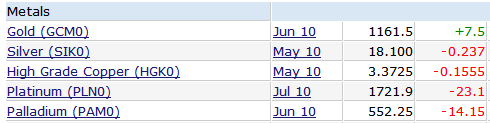
    Today’s action is certainly a flight to safety phenomenon with gold, US treasuries, and the US dollar all rallying strongly with nearly everything else selling off.

    Silver is primarily an industrial metal, while gold is best viewed as money or a currency. Moreover the entire energy complex took a hit.

    Another One Day Wonder?

    Inquiring minds are no doubt asking if this is another one day wonder, buy the dip decline, or the start of something far more serious.

    I do not know nor does anyone else. What I do know is risk is high, risk-reward is skewed to the downside, and if this recovery was real it would show in housing, jobs, and termination of global stimulus plans.

    Instead housing is in the dumps, the official unemployment rate is near 10%, and in spite of massive property bubbles in China, the China Business Newspaper says Another $586 billion “Stimulus” Coming to China.

    Meanwhile, Ken Fisher is a huge fan of emerging markets and tells the bears to “Get In Before It’s Too Late“.

    Get in before it’s too late?!

    Flashback: December 13, 2005: It’s Too Late

    I think it’s too late.
    In fact I know it’s too late.
    How do I know?
    The following Email I received tonight should explain it nicely.
    When you see stuff like this, not only is it too late, it’s way too late.

    Did Ken Fisher just ring the bell?
    Time will tell.

    Join the conversation about this story »

  • Actually, The New Emails Suggest Goldman DID Make Money Betting Against Real Estate

    LloydBlankfein-0909-2

    Goldman Sachs has made the claim it lost money on Abacus.

    In Senior Goldman Executives Approved the Paulson Deal; Goldman’s Spin Dodges the Big Question; “Fabulous Fab” Not Feeling So Fabulous I questioned if that was the case

    Goldman claims it lost money on the deal. I am very skeptical of that claim given all Goldman’s side bets with AIG and others. Besides, who can say where one deal ends and the next begins when one is hedging massive pools of garbage?

    On Saturday, emails noted by the Senate Subcommittee Investigating Financial Crisis Releases Documents on Role of Investment Banks suggest Goldman did not lose money, just as I suggested.

    In one of the e-mails released today, Mr. Blankfein stated that the firm came out ahead in the mortgage crisis by taking short positions. In an e-mail exchange with other top Goldman Sachs executives, Mr. Blankfein wrote: “Of course we didn’t dodge the mortgage mess. We lost money, then made more than we lost because of shorts.”

    In a second e-mail, Goldman Sachs Chief Financial Officer David Viniar, who also will testify on Tuesday, responded to a report on the firm’s trading activities, showing that – in one day – the firm netted over $50 million by taking short positions that increased in valued as the mortgage market cratered. Mr. Viniar wrote: “Tells you what might be happening to people who don’t have the big short.”

    In a third e-mail, Goldman employees discussed the ups and downs of securities that were underwritten and sold by Goldman and tied to mortgages issued by Washington Mutual Bank’s subprime lender, Long Beach Mortgage Company. Reporting the “wipeout” of one Long Beach security and the “imminent” collapse of another as “bad news” that would cost the firm $2.5 million, a Goldman Sachs employee then reported the “good news” – that the failure would bring the firm $5 million from a bet it had placed against the very securities it had assembled and sold.

    In a fourth e-mail, a Goldman Sachs manager reacted to news that the credit rating agencies had downgraded $32 billion in mortgage related securities – causing losses for many investors – by noting that Goldman had bet against them: “Sounds like we will make some serious money.” His colleague responded: “Yes we are well positioned.”

    The above document does not show the exact timing of those emails, perhaps on purpose. No doubt, timing, if appropriate, will be part of Goldman’s defense.

    At best, those emails do not make Goldman look very good. At worst, Goldman will appear to be caught in a lie.

    Regardless of what happens legally, I have a serious problem with a “bank” making 90% of its income trading its own portfolio, and screwing its customers in the process.

    (This is a guest post from Mish’s Global Economic Trend Analysis.)

    Join the conversation about this story »
    See Also:

  • Oh Please, The GM Bailout Was A Failure, And No The Taxpayer Hasn’t Made Money

    (This is a guest post from the author’s blog.)

    GM repaid $6.7 billion in US loans and another $1.4 billion in Canadian government loans. So where does that leave GM? Let’s take a look.

    Please consider Gas in the tank: GM repays $8.1B in gov’t loans:

    Fallen giant General Motors Co. accelerated toward recovery Wednesday, announcing the repayment of $8.1 billion in U.S. and Canadian government loans five years ahead of schedule.

    Much of the improvement comes from GM slashing its debt load and workforce as part of its bankruptcy reorganization last year. But the automaker is a long way from regaining its old blue-chip status: It remains more than 70 percent government-owned and is still losing money — $3.4 billion in last year’s fourth quarter alone. And while its car and truck sales are up so far this year, that’s primarily due to lower-profit sales to car rental companies and other fleet buyers.

    The U.S. government still owns 61 percent of GM. The automaker is counting on a public stock offering to allow the U.S. government to begin recouping its remaining $45.3 billion investment. The Canadian government’s $8.1 billion stake, which equals a 12 percent ownership interest, also could also be unlocked if GM sells shares to the public.

    GM lost $88 billion between 2004, when it last turned a profit, and last year when it declared bankruptcy. It endured years of painful restructuring, closing 14 factories and shedding more than 65,000 blue-collar jobs in the U.S. through buyouts, early retirement offers and layoffs.

    GM received $52 billion from the U.S. government and $9.5 billion from the Canadian and Ontario governments starting in 2008. At first the entire amount of U.S. aid was considered a loan as the government tried to keep GM from going under and pulling the fragile economy into a depression.

    But during bankruptcy, the U.S. government reduced the loan portion to $6.7 billion and converted the rest to company stock. Canadian governments also converted part of their debt to shares, reducing its loan balance to $1.4 billion. The final installments on those loans were repaid Tuesday, comfortably beating a 2015 deadline.

    GM wiped out most of its staggering $95 billion debt in bankruptcy, closing last year with $15.8 billion in debt. As it was reorganized, the United Auto Workers agreed to concessions, including a plan to shift $50 billion in retiree health care costs to a union-run trust. New hires and white-collar workers now don’t get the same rich health benefits.

    GM’s planned stock offering hinges on the company posting a profit. GM posted a $3.4 billion loss for the fourth quarter of 2009, but its operations in Asia, South America and other regions made money.

    GM’s Pension Plan Underfunded by $27 Billion

    Inquiring minds are wondering GM’s Pension: A Ticking Time Bomb for Taxpayers?:

    General Motors Corp. may no longer be the world’s biggest automaker, but it still operates the country’s largest pension fund. The threat to its pension plans has always been an issue, but it took on a new urgency when GM disclosed April 7 that its plans were underfunded by more than $27 billion, with more than half of that being owed to U.S. workers and retirees. Across town, a post- bankrupt Chrysler faces its own pension shortfall. Moreover, a report last week from the Government Accounting Office (GAO) says the pension crisis in the auto industry could create an unprecedented crisis for the federal Pension Benefit Guarantee Corp., a government-sponsored organization to backstop company pensions.

    Could taxpayers really be on the hook for UAW pensions?

    Yes. GM could face a funding crisis in 2013 or 2014 when, under the current projections, the automaker will be required to make more than $12 billion in contributions to its pension funds to keep them solvent, according to the GAO analysis.

    The funding could easily become a serious challenge for the PBGC, which says it is now facing $168 billion in possible plan terminations across a range of companies, many of them auto suppliers. The PBGC is privately funded, but since it was created by an act of Congress and its board of directors consists of the Secretaries of Labor, Commerce and Treasury, it’s possible that the U.S. Government would step in if the agency came up desperately short of funds.

    What happens to GM and Chrysler pensioners if the PBGC takes over the funds?

    The retirees could face dramatic cuts. The PBGC promises a certain level of benefits, but $35 billion of the two automakers’ promised pension benefits fall beyond the PBGC guarantees.

    GM Summary

    • GM is still Government Motors.
    • The US Government converted $45.3 billion in loans to a 70% ownership position.
    • The Canadian Government converted an $8.1 billion stake into 12% ownership.
    • GM lost $3.4 billion in the 4th quarter of 2009.
    • GM still has $15 billion in debt.
    • GM has $27 billion in unfunded pension liabilities.

    Until GM IPOs we will not know an approximation of taxpayer losses. Moreover, those losses do not include the pension time bomb.

    With GM still losing money on top of all those issues why did GM repay TARP? The likely answer is to get out from under TARP restrictions on CEO and executive pay.

    With the Obama administration crowing about the “success” of this bailout, let’s go back to the beginning, to those $45 billion in loans. Had the government not made those loans (now converted to equity), GM would have gone bankrupt just as it did. GM would likely be producing cars just as it is now, taxpayers would not be out $45 billion, and GM would not be Government Motors.

    The bailout was a total and complete failure.

    Join the conversation about this story »

  • Check Out This Cool Interactive Map Of The State Pension Crisis

    According to a report by the American Enterprise Institute, public pensions are underfunded by more than $3 trillion. Following is a state-by-state interactive map I put together from the report. Note: Please give the map a few extra seconds to load.


    Click on any of the circles to select a state and see all of the public pension plans for that state. Illinois is amazingly bad. Click on an ocean or a portion of the map without circles to deselect.

    The interactive map is based on Table 2. Market valued funding ratios and unfunded liabilities on page 42 of An Options Pricing Method for Calculating the Market Price of Public Sector Pension Liabilities by Andrew G. Biggs at the American Enterprise Institute.

    Note: The AEI total and the total on the map are off by a tiny bit. I double checked the map totals against the report and they are correct. Most likely the discrepancy is a rounding error.

    Thanks to Ellie Fields and Ross Perez at Tableau Software for help with the map.

    Public Pension Plans Less Than 30% Funded

    Illinois SERS – 23%
    Indiana Teachers – 26%
    Connecticut SERS – 27%
    Oklahoma Teachers – 27%
    Rhode Island ERS – 29%
    West Virginia Teachers – 29%
    Illinois Universities – 30%
    Kentucky ERS – 30%

    Other Pension Estimates

    The March 15 cover of Barrons talks about The $2 Trillion Hole. However, the body of the article contains estimates of at least $2 trillion and another at $3 trillion.

    Hedge-fund manager Orin Kramer, who is also chairman of the badly underfunded New Jersey retirement system, insists the gap is at least $2 trillion, if assets were recorded at market value and other pension-accounting practices common in Corporate America were adopted.

    Finance professors Robert Novy-Marx at the University of Chicago and Joshua Rauh of Northwestern University asserted in a recent paper that the funding gap for state pension plans alone might exceed $3 trillion, in part because state funds are using an unrealistic long-term annual investment return of 8% to compute the present value of future payments to retirees, as is permitted in government standards for pension-fund accounting.

    California’s $500-Billion Pension Time Bomb

    The L.A. Times is commenting on California’s $500-Billion Pension Time Bomb

    The state of California’s real unfunded pension debt clocks in at more than $500 billion, nearly eight times greater than officially reported.

    That’s the finding from a study released Monday by Stanford University’s public policy program, confirming a recent report with similar, stunning findings from Northwestern University and the University of Chicago.

    To put that number in perspective, it’s almost seven times greater than all the outstanding voter-approved state general obligation bonds in California.

    Stanford Study

    Inquiring minds are digging into the Stanford Study Going For Broke: Reforming California’s Public Employee Pension Systems.

    Adjusting the discount rate used on liabilities to a risk-free rate, we estimate the combined funding shortfall of CalPERS, CalSTRS, and UCRS prior to the 2008/2009 recession at $425.2 billion (see Table 2).

    click on chart for sharper image

    At the time of this writing, the funds have not released more recent financial reports, but due to the previously mentioned $109.7 billion loss the three funds collectively sustained, we estimate the current shortfall at more than half a trillion dollars.

    The American Enterprise Institute report (Click on CA in the interactive map) and the Stanford Study independently arrived at similar values for California pension plan unfunded liabilities.

    Note that the Stanford study has the unfunded liability of CalPERS $239.7 billion, the AEI report has it at $234 billion (labeled as California PERF), while CalPERS claims the unfunded liability is only$38.6 billion

    Similarly, the Stanford study has the unfunded liability of CalSTRS at $156.7, the AEI report has it at $165 Billion (labeled as California Teachers), while CalSTRS claims the unfunded liability is only $16.2 billion.

    Even if Stanford and AEI are off by 50%, the discrepancy is enormous. Whatever the sad state of affairs is, taxpayers are on the hook for the difference.

    The time to stop public defined benefit pension plans was 20 years ago. Unfortunately, it is too late for that now. Nonetheless, it is imperative for states to stop compounding the error by switching to defined contribution plans immediately.

    Mike “Mish” Shedlock
    http://globaleconomicanalysis.blogspot.com
    Click Here To Scroll Thru My Recent Post List

    Join the conversation about this story »

  • Los Angeles Is About To Go Bust

    Los Angeles

    Yesterday I noted L.A. Controller Says City Could Run Out of Cash by May 5

    After raising taxes and fees, again and again and again, the city is broke and Mayor Villaraigosa is blaming the city council for not hiking fees yet again.

    Having run the city into the ground, Villaraigosa calls for shutting down some city departments amid budget crisis

    Los Angeles Mayor Antonio Villaraigosa called Tuesday for all city agencies — except for police, other public safety and revenue-generating departments — to close for two days a week starting April 12 because of the city’s continuing budget crisis.

    “We have to act, and we have to act quickly,” Villaraigosa said at a press conference.

    Villaraigosa’s call comes one day after executives with the city’s Department of Water and Power said they would recommend not sending a promised $73.5-million contribution to the city’s beleaguered treasury because the City Council recently declined to grant a desired electricity rate increase.

    Union contracts and pension benefits are the biggest city problem and Villaraigosa is ignoring police and fire departments, the worst problems of the lot.

    DWP Digging

    I have been doing a bit of digging into where those DWP rate hikes go. Here is an interesting article from way back in July 2008: L.A.’s best jobs: Average utility employee earns $76,949 per year

    As the Los Angeles Department of Water and Power seeks a hefty taxpayer rate hike, a Daily News review of salary data shows the average utility worker makes $76,949 a year – or nearly 20 percent more than the average civilian city worker.

    More than 1,140 of the utility’s employees – or about 13 percent – take home more than $100,000 a year. And General Manager Ron Deaton, who is on medical leave, rakes in $344,624 a year – making him the city’s highest- paid worker.

    DWP salaries are on average higher than city and far higher than private-sector workers’ even as the utility has come under fire for recent power outages and another round of rate hikes: A 9 percent, three-year electric-rate hike and a 6 percent, two-year water-rate hike.

    While DWP workers have long been some of the highest-paid in the city, salaries got even more lucrative two years ago with a five-year contract guaranteeing 16.8 percent raises and up to 28 percent depending on inflation.

    According to a study by Huron Consulting Group earlier this year, the total cost per full-time employee in fiscal 2007 was $142,400 a year including health care, death benefits and disability, workers’ compensation, medical services, employee health benefits and training.

    That’s expected to rise to $151,000 in just five years.

    “The increase in cost per employee is primarily due to wage increases dictated by the union contract,” the study said.

    Meanwhile, even though a city report concluded nearly four years ago that the pay disparity between DWP workers and civilians in some jobs was as much as 55 percent, the Daily News review of current DWP salaries shows the issue has remained unaddressed.

    Bear in mind that is from July 2008. The DWP now wants a 22% hike for businesses and up to a 28% hike for residential customers.

    Amazingly Mayor Villaraigosa has the gall to blame the city council for the budget crisis, for not approving those rate hikes.

    Repeating a snip from the first link …

    Reckless, Irresponsible Spending

    The mayor is now blaming the city council. Instead, Mayor Antonio Villaraigosa ought to look in a mirror to see who is to blame.

    The city is broke because Mayor Villaraigosa led the City down a path of reckless and irresponsible spending says blogger Phil Jennerjahn in Petition to Recall Mayor Antonio Villaraigosa

    Despite record income over the last five years, Mayor Villaraigosa has led the City down a path of reckless and irresponsible spending that would have been avoided by a more professional and logical City Official. In the face of a crushing recession, the Mayor actually accelerated spending and hiring to the point that the City may have to declare BANKRUPTCY before the end of 2010.

    While he is now asking City officials to eliminate 1000 city jobs, the Mayor has selfishly refused to fire a single member of his enormous staff – including 16 Deputy Mayors and 93 personal staff members.

    In 2009, the Mayor offered a 3.9 BILLION dollar contract to the IBEW (Electricians Union) for the potential construction of solar panels. The no-bid contract, awarded without competition to his political supporters, creates the appearance of corruption and collusion, and would have increased costs for citizens of Los Angeles.

    DWP Salary Schedule

    Here is a list by name and title of DWP Salaries.

    Unfortunately the list is from 2007 and severely out of date. I am sure salaries are much higher now.

    The Price Of Power

    Inquiring minds are reading SoCal Connected Investigates The Price of Power

    In the middle of the worst budget crisis in Los Angeles history, one department is thriving without mandatory job cuts, furlough days or loss of the perks they’ve come to enjoy. In fact, thanks to a new contract approved by the L.A. City Council in December, most of its already well-paid workers will get salary increases over the next five years. Which department is it? It’s the Los Angeles Department of Water and Power (DWP) and this week SoCal Connected Anchor Val Zavala looks into how the DWP stays immune from L.A.’s fiscal problems.

    In a rare sit-down interview, Brian D’Arcy, powerful head of the IBEW Local 18 (the union representing 9 out of ten DWP workers) defends the deal, saying the higher salaries paid DWP workers are merely the price of attracting talent in a competitive job sector. Confronted with the complaints of angry ratepayers, he responds that “…generally how they feel is not relevant.”

    According to a former DWP commissioner, some L.A. residents should soon expect their utility bill to exceed their monthly mortgage.

    IBEW Local 18 Head: “How Taxpayers Feel Is Not Relevant”

    Sadly that appears to be the attitude of L.A.’s politically and morally corrupt mayor as well.

    L.A. desperately needs to dump Villaraigosa and elect a mayor and city council willing to stand up to union thugs.

    Better yet, the city should declare bankruptcy immediately and seek to overturn those contracts in court on grounds the bargaining was not in good faith. Clearly, no one was representing the taxpayer.

    Mike “Mish” Shedlock
    http://globaleconomicanalysis.blogspot.com
    Click Here To Scroll Thru My Recent Post List

    Join the conversation about this story »

    See Also:

  • Schwarzenegger Puts Unions In The Crosshairs

    From Mish’s Global Economic Trend Analysis:

    It is extremely rare that I agree with any politician’s budget plans. However, Schwarzenegger’s latest proposals make me want to stand up and salute.

    Please consider Schwarzenegger’s budget plan puts unions in the cross-hairs.

    Gov. Arnold Schwarzenegger has put organized labor squarely in his cross-hairs in 2010, opening a fight that will largely determine the shape of his final year in office.

    Schwarzenegger’s proposals would cut the size of the union workforce, reduce pay, shrink future pensions and roll back job protections won through collective bargaining.

    Continue reading at Mish’s Global Economic Trend Analysis >

    Join the conversation about this story »

    See Also:

  • Police Officer Appalled By How Much Money He Makes, Thinks Government Salaries Are Outrageous

    Police With Machine Gun

    Here is an interesting email from “David” in response to Six-Figure Federal Salary Gravy Train. The response was not what I expected when I first saw the Email. David Writes:

    Hello Mish.

    I read your article about the salaries of government workers compared with the private sector. I am a police officer. I won’t say where, let’s just say it’s one of the most expensive cities.

    I am 29 years old and I make about $130k a year with overtime. Most of the officers make this and some even make $185k a year. A few supervisors in Internal Affairs have made of $200k along with detective sergeants.

    To be honest, I think our salaries are totally out of touch with not only the private sector, but with America. It’s absolutely ridiculous. When I became a police officer we were all making way below what private sector employees made. I took the job knowing I will never be rich but knowing I will have a stable job with benefits.

    Little did I know my union would secure very good contracts at the expense of pillaging the public. This cannot go on. I have studied and read Robert Prechter’s Conquer The Crash book and how he (and you also) say we will have a deflationary collapse. I agree totally.

    I’m just paying off debt while the going is good and have put most of my money in gold (at $800 an ounce). I’ll probably sell that gold soon because it’s getting popular in the media and on the radio. So yes, I just wanted to let you know that these govt/federal/state jobs are ridiculous.

    Continue reading at Mish’s  »

    Join the conversation about this story »

    See Also: