Author: Molly

  • Teaching Earth Science with Children’s Literature: Rain

    rain.jpg

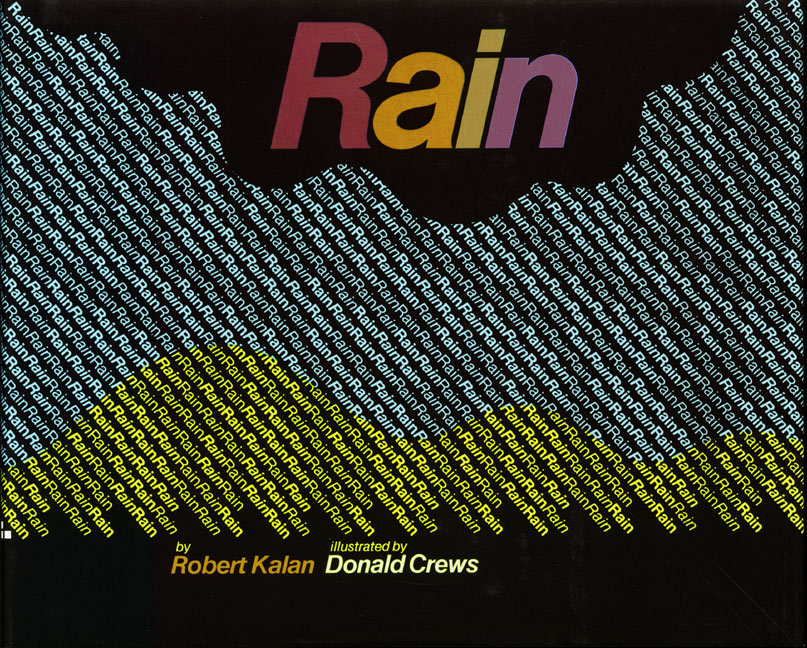
    Rain, written by Robert Kalan and illustrated by Donald Crews, explores what rain looks like in different types of landscapes and in different types of weather. There is “rain on the red car” and “rain on the green trees” and at the end of the book there is a beautiful landscape with a rainbow.  This book simply explains how rain can start all of the sudden and how rain and weather can effect different things in the world like grass, trees, flowers, houses, cars, and the road. This book is also a great example for teaching students their colors. It starts off showing a clear blue sky, then adding a bright sun, then it adds a few clouds, and then it begins to rain. The book has very few words and draws the readers attention to what is happening in the story: the rain!

    Curriculum Connections
    This book is a great introduction to weather observations like watching how, when, and where rain starts, and before that how the sun shines, and how clouds can cover the sun (VA SOL K.8 a).  This is also a nice example of how to show students that rain can help things like plants and flowers grow (VA SOL 1.7 a).

    Additional Resources
    1. Rain Lesson Plan– This website offers a lesson plan about the rain/water cycle.  It also incorporates the Nandi folklore tale “Bringing the Rain.” This site also has a nice craft to make to go along with the water cycle.
    2. Water Cycle– This page is a great printout for older students to complete the water cycle. There is a reading passage to complete fill-in-the-blank parts as well as a picture of the water cycle.
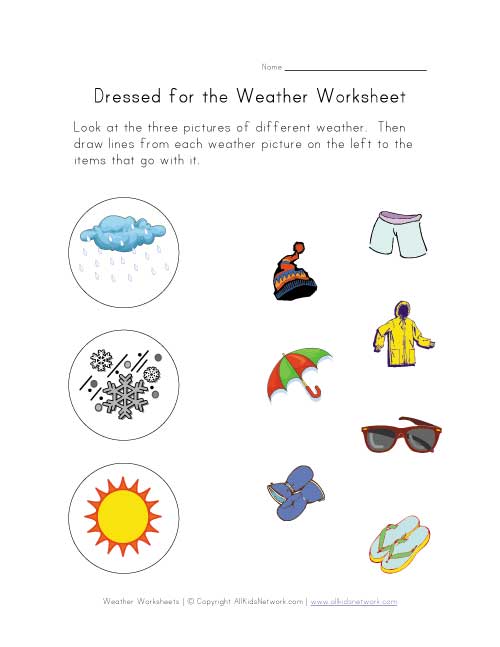
    3. Weather Worksheet– This worksheet is a great idea for younger students who are just learning about weather.  They match the items with the appropriate weather symbol.

    General Information
    Book:
    Rain
    Author: Robert Kalan
    Illustrator: Donald Crews
    Publisher: Harper Collins
    Publication Date: 1991
    Pages: 32
    Grade Range: K-2
    ISBN: 0688104797

  • Teaching Life Science with Children’s Literature: Bugs Are Insects

    bugs.jpg

    Introduction and Summary
    Bugs Are Insects written by Anne Rockwell explains what an insect really is and how to look for them in your own backyard and identify them.  Simply put, “Anything that has six legs and three body parts is an insect.”  The book talks about external and internal skeletons, how some insects have two sets of wings, and they come in all shapes, colors, and sizes. The book also shares with us that “We sometimes call bugs insects. Many people think the two words mean the same thing, but they don’t.”  Insects have different types of jobs like grasshoppers use their legs to make music, bees use their skill to build honeycombs of wax, ants build tunnels, and crickets have long legs to jump.  At the end of the book an index is provided of all the technical names for all of the bugs and insects pictured in the book as well as activities to do to go along with the book. I think the most interesting part of the book is where they explain that a ladybug is not actually a bug, like their name says.  Ladybugs are actually beetles. It also describes and shows that ladybugs have two sets of wings, and that it makes a straight line down the top of the abdomen on a ladybug when the wings are closed. This book provides very basic knowledge about insects and makes it fun!

    Curriculum Connections
    This book would be great at showing students the physical characteristics of bugs and insects including their body shape, what they use to move around (wings, legs etc.), and how many body parts they have (VA SOL 1.5 b).  This book could also be used to show how bugs and insects evolve and change over time, the work they do and how it effects us as humans and our world, and that some insects and bugs resemble their parents (VA SOL 2.4a, 2.5a).

    Additional Resources
    1.
    Bug Food-This website provides a look at how we as humans eat bugs and insects. It tells how everyday normal food that we eat can contain bugs and insects, as well as giving ideas of how to make your own bug food fin the classroom.
    2.Bug and Insect Bingo– This website offers a bug Bingo game to play in class.  You can chose the type of insects you want to include, or mix it with bugs and insects and then talk about which 3 are not insects.
    3. Name That Bug– Name That Bug game gets you guessing what type of bug it could be by descriptions of the bug or insect. They give you four clues to guess what the bug is, and then after guessing it gives you some historical or fun information and facts about the bug or insect.

    General Information
    Book:
    Bugs Are Insects
    Author:Anne Rockwell
    Illustrator:Steve Jenkins
    Publisher:Harper Collins
    Publication Date:2001
    Pages:33
    Grade Range:1st through 3erd
    ISBN: 0064452034

  • Teaching Physical Science with Children’s Literature: Sound and Light

    sound-and-light.JPG

    Introduction and Summary
    Sound and Light by David Glover gives a great overview of what sound and light are and how we use them. This book provides a section for topics like: lightning and thunder, sound waves, feeling sound, making sound, making music, moving sound, bouncing sound, how do you hear?, light waves, light and shade, look in the mirror, amazing mirrors, bending light, how lenses work, how do you see?, and light of many colors.   For example, on the section about bouncing sound they talk about echoes by saying, “Echoes are louder when they hit a hard barrier, like the walls of a tunnel.  Soft materials, like carpets and drapes, absorb or soak up sound.  That’s why you will hear and echo in an empty room but will not in one that is full of furniture.”  For each topic discussed, there are experiments or projects that you can do at home.  There is an experiment that discusses color blindness in some people by using the colored dot “eye-spy” pictures.   This would really interest the children. Overall this is a great book that covers many specific topics and provides easy to read and understand explanations and experiments.

    Curriculum Connections

    Students can learn about sound waves, how they travel, vibrations, how music is made and heard, wavelengths, and overall how sound is transmitted through different materials like rope, straws, rubber bands, and even air (VA SOL 5.2 a,b,c).This book offers easy explanations of how sound waves work, are transmitted, and how we as humans hear them.  The other half of the book discusses light, light waves, light in mirrors, bending light, reflections, and seeing colors through a prism (VA SOL 5.3 a,c).  Again, there are some great experiments to go along with these topics like bending light and making you own rainbow with a mirror and dishwater.

    Additional Resources
    1. Sonic Speed Activity– This activity uses rulers and a paper towel tube to show how lightning and thunder actually occur at the same time even though it does not appear that way to us.  This is a cool experiment and gets students learning about what really happens during a thunderstorm.
    2. History of Sound– This website would be great to provide background knowledge for teachers on the history of sound.  It starts in 1877 when Thomas Edison made the first machine that could record sound and goes until 1990. So, this website does not provide the most recent information (1990-current).
    3. Light Vocabulary– This page offers a light vocabulary crossword puzzle.
    4. Reflecting light– This is a worksheet that deals with reflecting light. It provides and activity for the students to complete and then asks follow up questions.

    General Information
    Book-
    Sound and Light
    Author- David Glover
    Illustrator-Ben White (designer)
    Publisher-Scholastic, INC.
     Publication Date-1993
    Pages-32
     Grade Range- 4th-5th Grade
    ISBN-
    0590487078

  • Teaching Process Skills with Children’s Literature: What’s What?: A Guessing Game

    book.jpg

    Introduction and Summary
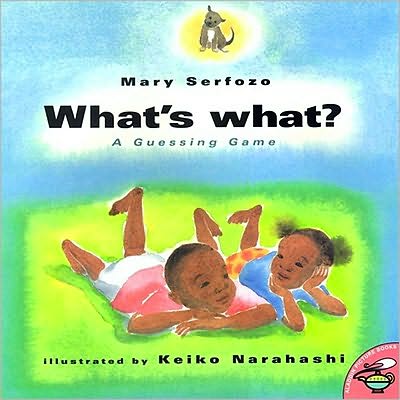
    The book What’s What? A Guessing Game by Mary Serfozo is an interactive book that keeps children guessing.  They need to use their previous knowledge and skills to guess what will come next in the book.  The book starts off with one page asking “What’s hard?” The children then guess what it might be, and the next page says “A sidewalk is hard as a rock or a wall. So look out where you fall!”  There is a picture of a child who was roller-blading and fell down on a sidewalk hurting himself.  This book shows children who have experimented with different things such as things that are hard, soft, warm, cold, dry, wet, long, short, light and dark.  On the wet page, it shows a child going out to play in the rain with a raincoat and galoshes on as he steps in the puddles getting all wet.  What I like about this book is that on each page it depicts children actually doing or participating in activities or experiments as they get a hands on look at some of the topics. At the end of the book, it shows a cute puppy and that the puppy can be all of the things listed above.

    Curriculum Connections
    This book provides a direct representation of some experiments, physical characteristics and attributes, as well as the 5 senses (VA SOL K.1.a and K.2.a,b).  The simple pictures in the book which match to the simple words and sentences make it an appropriate book for younger children (VA SOL K.1.k). The format of the book is in questions and answer format. The book asks a question “What’s warm?” and then before you turn the page, the children have a chance to make predictions about what is warm (VA SOL K.1.g).  This book is very simple and keeps things easy and interesting for the children.

    Additional Resources
    1. Guessing Game Lesson Plan– This is a very short lesson plan idea. It is a great idea for an activity for the first week of school.  It helps to get the children excited about what they will be learning in school. Also, after you read the book, you could use this activity as an introduction to the lesson plan for the day.
    2. 5 Senses Lesson Plan-This page offers a lesson plan idea for learning about the 5 senses. The book touches on all of the five senses and this would be a lesson to bounce off of the senses discussed in the book.
    3. 5 Senses Activity Book-This website offers pages for children to trace and then color.  Each page has one of the 5 senses on it along with an example ( like hearing a a bee buzz by). It would be a good idea to have the children complete all of them and then staple them together to make booklet.

    General Information
    Book:
    What’s What?: A Guessing Game
    Author: Mary Serfozo
    Illustrator: Keiko Narahashi
    Publisher: Simon & Schuster
    Publication Date: 1996
    Pages:28
    Grade Range: K or 1
    ISBN: 0689833229

  • Teaching Economics with Children’s Literature: Market Day

    9780152168209.jpg 

    Introduction and Summary
    Market Day, written and designed by Lois Ehlert, tells the story of a family preparing to take goods they have made and grown to the Market. The story starts off with a child going around to do their daily chores which include feeding the chickens corn, pulling up carrots, packing tomatoes, feeding the rooster, turkey, and goose and loading up the truck. The child reminds us, “Lock the gate tight so they [the animals] won’t get loose.”   The story uses very pretty folk art for the illustrations. The child goes on to say that the reason they go to the market is “to buy and to sell…” The artwork is amazing in this story!

    Curriculum Connections
    This book shows how people have to work to make money. In this book, the whole family helps with planting, growing, and harvesting food as well as making goods to sell at the market for profit. This family sells foods and goods, to make a living in order to buy items for themselves (VA Social Studies SOL 1.7).  This book also shows a great deal of artwork, and could be used to help inspire students to make their own artwork about jobs that people have and how and where they work.

    Additional Resources
    1. Market Day/Spanish Lesson Plan– This lesson plan has a great idea for doing your own Market Day in the classroom. Students will buy and sell goods (fruits, vegetables, and other food items) to each other. While they are doing this, they are also learning the Spanish name for each item and learning about the Open Air Markets that Latin America has.  Great use for buying and selling goods, multiculturialism, and learning about Latin America. This lesson plan has a heavy focus on incorporating Spanish, but it does use the book in the lesson plan.
    2.Consumer and Producer Lesson Plan– The lesson plan provides activities for teaching about consumers and producers. It is very short and simple, but using the book Market Day in the lesson plan to explain and tie in the vocabulary words of “consumer” and “producer” would be beneficial.
    3. Farmer’s Market– This site provides a list of activities and coloring sheets about fruits and vegetables. It also has some songs and recipes. This is more on the level of a Kindergartner, but it could be incorporated with the book. It helps show children what a market would look like where we live, why people use them, and the importance of having a market.

    General Information
    Book:
    Market Day
    Author: Lois Ehlert
    Illustrator: Designed by Lois Ehlert
    Publisher: Voyager Books, Harcourt, Inc.
    Publication Date:2000
    Pages: 36
    Grade Range: K-2nd
    ISBN: 978-0-15-2168209

  • Teaching Ancient Civilizations with Children’s Literature: Ancient History: Questions and Answer

    ancient_history_questions_answers-151×226.jpg

    Ancient History: Questions and Answers by Capella provides a great answer and question format for information about many aspects of ancient civilizations. The book covers Ancient Egypt, India, China, Greece, Rome, Americas, Mesopotamia, Medieval Europs, China, Japan, and the Incas and Aztecs. It has a section for each area and then provides pictures, maps, drawings, and information in a question and answer format. One question for ancient Egypt is “Why is the Nile River known as the lifeline of Egypt?” Then it goes on to explain and gives nice pictures to go along with it. The book focuses the questions for each country on the way of life, food, politics, rulers, cultures, communities, and hobbies. For Ancient Greece the book talks a lot about the Olympics and the playwrighting that people did for fun. For a little history on Ancient China they talk about how the Chinese knew all about tea and that they used it for religious ceremonies but they also ate the tea leaves like vegetables! It is a very interesting books presented in a way that is easy for children to read.

    Curriculum Connections
    This book would be a great addition to the classroom. It certainly does not have all the information a teacher would want about these countries, as it only focuses on a few aspects of each. It would be great for students who want to learn more or for doing reports. It would also be a good introduction to unique things ancient civilizations participated in to grab the students attention. This ties in with the SOL’s learning about map skills and resources of Greece, Rome and China (3.4 (a) (b) (c, 2.4 (a) (b), 3.7, and 3.1). This book would be great for a read-pair-share or KWL.

    Additional Resources
    1. Egyptian Coloring Pages– This site has some coloring pages that really detail what Egyptians wore and how and where they lived.
    2. Children’s Literature Resources– This site provides a whole unit on China. It gives many examples for additional children’s literature to use within a lesson plan. This plan is rather long-winded, but it has some good ideas to learn about the Chinese culture.
    3. Ancient Rome and Greece lesson ideas– This site provides great ideas for the VA SOL 3.1. It gives great examples for teaching about Greece and Rome and their contributions to society.
    4.Rome and Greece– This site provides GREAT pictures and simple words and maps for students.

    General Information
    Book: Ancient History: Questions and Answers
    Author: Capella
    Illustrator: Q2A India and Jane Hawkins
    Publisher: Arcturus Publishing Limited
    Publication Date: 2008
    Pages: 30
    Grade Range: 2-3
    ISBN: 978-1-84837-156-9

  • Teaching Civics With Children’s Literature: Stand Tall Molly Lou Melon

    stand-tall.jpg

    Introduction/Summary

    Stand Tall Molly Lou Melon tells the story of a little girl gets teased a lot by all of her classmates. Author Patty Lovell and illustrator David Catrow write a story of Molly Lou Melon who is teased for her buck teeth, short stature, funny voice, and her clumsiness. Molly Lou Melon learns a great deal from her Grandmother who gives her great advice. The grandmother tells Molly Lou Melon, “Walk as proudly as you can and the world will look up to you.” But, when Molly Lou Melon has to move to a new town, far away from her Grandmother, she has to learn how to handle a situation where one of her new classmates bullies her.  Molly Lou Melon has a different ways of doing things. After she scored the winning touchdown for football at recess and showing her class how to make the biggest snowflake out of paper and scissors, Molly Lou Melon shows her bully, Ronald, how to be a good friend!

    Curriculum Connections

    This book shares a great story of how to be friendly, how to be yourself, and how to honest. It also deals a great deal with bullying. (VA SOL K.8 e) practicing honesty, self-control, and kindness to others;g) participating successfully in group settings AND SOL 1.10 a) focusing on fair-play, exhibiting good sportsmanship, helping others, and treating others with respect; b) recognizing the purpose of rules and practicing self-control; d) taking responsibility for one’s own actions; e) valuing honesty and truthfulness in oneself and others.)

    Additional Resources

    1. Lesson Plan Ideas– This website offers a lesson plan that corresponds with the book to show the uniqueness of each student.
    2. Video– There is a video and a teacher’s guide to go along with it.
    3. Detailed Lesson Plan– This site offers a more detailed lesson plan that incorporates this book as well as others. It provides before and background information for teachers, instructional methods, extensions such as emotion cards and family connections, as well as an assessment plan.

    General Information
    Book: Stand Tall, Molly Lou Melon
    Author: Patty Lovell
    Illustrator: David Catrow
    Publisher: G.P. Putnam’s Sons
    Publication Date: 2001
    Pages: 32
    Grade Range: K-1
    ISBN: 0399234160

  • Teaching Geography with Children’s Literature: Come and ride with us!

     come-and-ride-with-us.jpg

    Introduction and Summary

    Come and ride with us shares a journey to different countries such as Haiti, Canada, Hong Kong, Peru, and a few others and shows children how people in different countries use different types of transportation to get around. This book was put together by Oxfam and illustrated by Annie Kubler and Caroline Formby. A child from each country takes the reader on a journey within their country. For example, we meet Aisha from Egypt. She explains that in Egypt she rides on a donkey who pulls a cart as her transportation around town. She carries clover and hay in the cart for their cattle. Abdul from Bangladesh tells us that they ride on rickshaws which can either be by auto or bicycle.  Pedaling can be very hard work! It is very interesting to see how some of the children get around in countries that do not have cars and automobiles that American children are used to seeing everyday.

    Curriculum Connections

    This book features flaps that show hidden items such as food or cargo that each mode of transportation carries. It can be used in Kindergarten or First Grade. I believe that it fits in more so with First Grade. It shows different modes of transportation, clothing of people in different countries, food, houses of shelter the people live in, and what the children do for fun such as playing sports, fishing, or sledding. In the back of the book there is also a map of the world and it asks you to locate all the different countries in the book. (VA SOL 1.6: The student will describe how location, climate, and physical surroundings affect the way people live, including their food, clothing, shelter, transportation, and recreation.)

    Additional Resources

    1) Additional Activities

    2)  Map Game

    3) Geography Game, Children match countries onto a globe. It is timed and counts points so this can be very challenging.

    General Information

    Book: Come and ride with us!
    Author: Oxfam International
    Illustrators: Annie Kubler and Caroline Formby
    Publisher: Child’s Play International Ltd.
    Publication Date: 1995
    Pages: 16
    Grade Range: K, 1st
    ISBN: 0859537943