Author: Nicholas Laughlin

  • Blogging about the Caribbean’s Repeating Islands

    Lisa Paravisini-Gebert

    Lisa Paravisini-Gebert

    Ivette Romero-Cesareo

    Ivette Romero-Cesareo

    In his already classic 1992 book The Repeating Island, the Cuban writer Antonio Benítez-Rojo set out to chart the cultural and historical complexities of the Caribbean. He argued that within the Caribbean’s “sociocultural fluidity” and “ethnological and linguistic clamour” “one can sense the features of an island that ‘repeats’ itself, unfolding and bifurcating until it reaches all the seas and lands of the earth.”

    When the literary scholars Lisa Paravisini-Gebert and Ivette Romero-Cesareo decided, in early 2009, to start a new blog covering Caribbean literature, arts, and culture, they were inspired not only by the title of Benítez-Rojo’s book, but also by his sense of the Caribbean as an expansive and expanding cultural and mental space not limited by geography. Repeating Islands, launched in March 2009, quickly attracted an audience of Caribbeanist scholars, writers, and artists, and ordinary readers across the Caribbean and further afield.

    Posting several links each day (with occasional commentary), and covering everything from new books and exhibitions to political intrigues and environmental concerns, Repeating Islands is an essential resource for keeping up with cultural developments in the Caribbean and its wide international diaspora. Thanks to the backgrounds, research interests, and multilingual fluency of its authors, the blog transcends the linguistic barriers that can make it difficult to engage with the whole region.

    Romero-Cesareo was born in Manhattan and raised in Puerto Rico, and “has always considered herself to be an islander.” She is professor of Spanish and Director of Latin American Studies at Marist College. Paravisini-Gebert was born and grew up in Puerto Rico, and is now the Randolph Distinguished Professor in the Hispanic Studies department at Vassar College. The two scholars have collaborated in the past, co-editing two books on Caribbean literary and cultural studies.

    Around the time of the blog’s first anniversary, I interviewed them via email, asking them about their motivations for starting Repeating Islands, how the blog intersects with their research interests, and future plans.

    •••

    Nicholas Laughlin: First things first: what promoted you to launch Repeating Islands early last year? Were you inspired by specific existing blogs, or some turn of events?

    Ivette Romero-Cesareo: The mastermind and engine behind Repeating Islands was Lisa, who has had significant experience with blogs from the research standpoint (angle). She had researched and lectured extensively on blogs and their place in the academic sphere. I was unnecessarily suspicious and doubtful about blogs because, for the most part, I saw them as too narrowly focused on individual concerns and, apart from the Huffington Posts of the world, considered them a space for (sometimes) egocentric expression.

    When Lisa proposed that we co-blog on Caribbean arts, literature, and cultural manifestations of various types, I very subtly and eloquently answered, “A blog?! Eeeeeww! Bluuugh!” I was walking home and she had called me on my cell phone; literally, two minutes later, I snapped out of my “Bah, humbug” mood, called her up, and said, “I’ve got a name for the blog!” But, alas, it was not Repeating Islands.

    Lisa Paravisini-Gebert: I was working on a paper called “Blogueros: The Puerto Rican Nation in Cyberspace”, thinking about how blogs can construct communities of readers around shared interests and concerns, when I thought of the possibility of a blog for our community of people interested in pan-Caribbean literature, culture, and the arts. Ivette’s response when I proposed it was hilarious — she seemed horror-stricken, so I suggested she think about it. She called back right away. The inspiration was not so much other blogs — although I am an inveterate reader of blogs — but the absence of a blog that addressed our own specific interests and needs. I was thinking of a blog that someone could read every day like the morning paper and feel sort of up-to-date with what was happening culturally across the region.

    NL: Where does the blog fit into your respective research and teaching careers? Do you have the sense that your students and colleagues are regular readers?

    IRC: We began posting news in March 2009. I was working as a visiting professor at Vassar College and I jokingly said to one of my classes that I was bleary-eyed because I was up for many hours working on the new blog, which has become an obsession of sorts. I immediately noticed that students were very curious and interested in the blog, especially students who love literature and have a curiosity about global cultures. I dare say that, while some of my colleagues were enthusiastic, I was amazed at how resistant to the new blog other scholars were; perhaps they shared my initial distrust of blogs.

    However, I was pleasantly surprised to see that we immediately began receiving high praise and enthusiastic feedback from top scholars and writers; people whose work I have always admired and respected had become regular readers. This praise was the best form of encouragement.

    As for my research and teaching, I can wholeheartedly say that Repeating Islands has been energising in every way. I am a slow writer and a “meandering” researcher, easily getting distracted by tangential information. For one, with the blog, I can use my skills in detouring; in this case, those detours have been fruitful because I run across much more information than I set out to find. On the other hand, the blog ensures that I do some type of writing every day; it has also forced me to develop a faster and more efficient writing style. Of course, my perception of “speed” and “efficiency” is very different from my co-blogger’s view.

    What I enjoy most about blogging for Repeating Islands is that now I am much more informed about the wider Caribbean. Since Lisa and I are both comparative Caribbeanists, this is a very organic to what we research and teach.

    LPG: The blog responds to my academic interests and concerns — but also to a preoccupation about how these concerns connect with politics and ideology across the region. Ironically, this is not a “personal” blog — insofar as we are not emphasising our feelings or offering a lot of personal commentary — but it could not be more “personal” in the sense of how our choices about what to include reflect our specific interests and preoccupations. Who we are shapes the blog — from my own environmental concerns and obsession with Haiti to Ivette’s focus on new artists and the condition of women across the region.

    One of the things that surprised me about the blog, however, is how little one can control who our readers are. I had an implied reader in mind — people interested in keeping abreast of what was happening in pan-Caribbean culture — and that ideal reader remains our target audience. It is surprising, however, that our “regulars” — those people who go directly to our home page — are only about ten per cent of our daily readers. The rest of our readers (a whopping ninety per cent) come to the blog through searches that bring them to new and old posts. Every post out there (and by now we have posted more than three thousand items) can potentially pull in readers at any time. It is wonderfully out of our control. Many of those readers remain with us, becoming part of the group of “home-page regulars” for whom we post daily.

    NL: Repeating Islands has become a sort of clearing-house for news about Caribbean literature, art, music, culture generally, the environment — I personally hear about many events through your blog that I might not otherwise come across. How do you manage to keep up, and keep informed? How much time does it take you every day to keep the blog going?

    IRC: In order to really keep up with as many events as possible and maintain the blog with enough variety, I need to work about four hours a day, something that is very difficult to do in view of our full-time teaching and other academic responsibilities, as well as our personal research and writing. At times, we choose to research information for the blog that is also related to our academic projects, but that is not always possible.

    LPG: I have been fortunate to have a research assistant provided by my institution (Vassar College) to help with the research for the blog. She sends me a list of possible items for the blog every evening, with the links to stories. I choose among them for the daily posts and spend some time searching for appropriate images, which is, I confess, one of my favourite things about the blog. I tend to take less pains about the writing than Ivette does, so on most days I spend about an hour updating the blog posts. I think we balance each other out well in terms of our approach to the blog.

    NL: Have you considered doing a version of the blog in, say, Spanish, since you both have roots in the Hispanophone Caribbean?

    IRC: It would be great to do that if we had more time. However, I believe that our skills are best utilised in making available in English the wealth of information in French and Spanish that does not always get to circulate widely unless it is translated. In my observations, scholars in the Francophone and Hispanophone Caribbean are often bilingual or trilingual for various reasons. Perhaps because of an absence of need or a linguistic imperialism of sorts, this is not always the case with English-speaking scholars.

    I have been at many conferences in Spanish, French, or Portuguese-speaking countries and have always heard English-speaking participants grumble when discussions take place in languages other than English. This has always surprised me. I have never observed the contrary; when Spanish, French, or Portuguese-speaking scholars attend conferences in Anglophone countries, they expect to listen to discussions in English. I can read Papiamento, and Lisa has a strong working knowledge of Creole, so we are able to bring a richer array of posts to our readers. The blogging process has also convinced me that I need to learn Dutch, and I am looking into taking an intensive course; this way, I can truly say that I am contributing to the blog from a pan-Caribbean perspective.

    LPG: I agree with Ivette, in that I think that we can best serve our target audience in English, which has become a bit of a lingua franca throughout the Caribbean. And, to tell you the truth, I don’t know where we would ever find the time. The blog — or more to the point, our loyalty to the readers who come to the blog every day — imposes a daily obligation (for example, we have never missed a day of fresh posts in over a year now), but it is at times a hard commitment to maintain. It would be very difficult to add to those efforts another venture in Spanish.

    NL: Most of your posts are based around a link to a specific article or event. Do you think in the future the blog could evolve into offering more commentary or personal reflections as well, or have you deliberately decided to downplay that kind of content?

    IRC: Yes, the original concept was to gather and make available news that was already circulating. We have had the need more and more often to contribute our own commentary, especially when reviews are not available for new books, exhibitions, carnivals, etc. I think Lisa tends to offer her own observations more often. Recently, she had another wonderful idea that would entail more direct writing from us, but I will let her describe the project.

    LPG: I think that from the beginning we wanted to use the blog to consolidate information and build a community of readers who could catch up on news and information about the region by coming to the blog. That is an easier task than to bring readers together to read your thoughts and commentary. Sometimes, when the news strikes me as absurd, I will provide commentary, a departure I enjoy. I think, however, that the blog will continue to be primarily that, since that seems to be what our readers come to us for.

    Recently, however, we have begun to work on ideas for providing our own content — our own reviews of books, plays, and art, for example, and our own interviews with writers and artists. This is our new project, and we have begun to contact writers and artists to develop these interviews. Readers should begin to see them in a month or so.

    NL: What’s been the most surprising thing about working on the blog?

    IRC: As is always the case with research, I am constantly amazed at how much information is out there and how little time we have to report on all of that. It always feels to me that we are barely scratching the surface. The other surprise has been the exponential growth of our readership. The numbers have really shot up since March 2009, when we began our work on Repeating Islands.

    LPG: I would have to agree with Ivette that it has been the rapid growth in the number of readers. The first time we hit one hundred readers in a day, I wanted to open the Champagne. A year later, that number has multiplied exponentially, and it brings a sense of connection with readers that is very humbling. At first I thought that, since the blog was aimed at readers with academic interests like us, there were maybe at most five hundred people out there who might be interested in the content we offered. I wasn’t quite prepared for thousands of daily readers, with the number continuing to grow from week to week. We are always very touched by the emails we receive from people who have just discovered the blog and write to tell us how much they enjoy it.

    NL: Do you know of other Caribbean or Caribbeanist scholars who blog or otherwise share information and knowledge online? Why do you think more Caribbean academics are not doing this?

    IRC: Yes, there are institutions or individual Caribbean artists, writers, and scholars who have very interesting sites or blogs; and for the most part, we have provided the links on our blog or in our posts. For example, we really miss the Caribbean Review of Books! Usually, the blogs with a Caribbean focus centre on specific genres, geographic or linguistic areas, subject matters, and fields. It is difficult to maintain a very broad perspective and not favor a geographic area — Puerto Rico, for instance!

    LPG: Our blogroll lists the blogs we enjoy checking and reading, as Ivette has commented. There is, to me, an obvious reason why there aren’t more blogs of this kind — they take an enormous amount of time and need to be kept up daily. As an avid reader of blogs, I know how disappointing it is to check your favourite blogs day after day and find no new posts. From the beginning, this was my foremost concern, to make sure that, no matter what, any reader coming to the home page would find at least a couple of new posts every day. (We average seven to eight new posts every day.) This is very hard to do, as we have to anticipate what happens when we travel, when we have other deadlines, when life brings surprises, or when we have a cold.

    It works because there are two of us and we check with each other in advance to make sure that the other can cover when life intervenes. We also may prepare posts in advance when we are travelling. We think of it as facing a daily deadline and knowing that hundreds of people will check the home page first thing in the morning, and there better be something new there. It is quite a challenge.

    NL: What are your favourite blogs and other online resources for Caribbean culture and scholarship?

    IRC: My particular favorites are the blogs, online journals, or sites on the visual arts, such as Art Nexus, Harte, msa Xxperimental Art, El Status, and blogs that raise consciousness about specific causes such as the AIDS/HIV pandemic or poverty, such as the La Ventana.

    LPG: I begin my day checking my favorite blogs, all lined up under “favourites” in my browser. I may start with something like This Is Indexed, Geoffrey Philps’s blog, or Karin Wilson Edmonds’s Yard Edge. I also like to look at the Small Axe blog to see what’s new.

    NL: You mentioned plans to start posting your own reviews. Are there any other future plans for Repeating Islands that you'd like to share?

    LPG: We are very shortly beginning a series of brief interviews with artists (“Five Questions with Repeating Islands”), in which we focus on one particular work by a Caribbean-based or Caribbean-born artist. We are very excited about this, as we think it will help us shed some light on the creative process and bring to readers’ attention the abundance of talent across the region.

    We are also interested in showcasing new writers by posting short pieces or poems accompanied by introductory notes or interviews. We want to make sure, however, that readers coming to us to keep up with cultural and artistic news on the Caribbean continue to find that in the blog, so these new “series” would be scheduled for particular days of the week, so readers can know when these feature will appear and check on those days.

  • Jamaica, Caribbean: Tributes to Rex Nettleford, 1933-2010

    Rex Nettleford, 1933-2010. Photo courtesy the University of the West Indies

    Rex Nettleford, 1933-2010. Photo courtesy the University of the West Indies

    The Jamaican academic, dancer, and choreographer Rex Nettleford — who died on Tuesday 2 February, a day before his 77th birthday — was a cultural and intellectual icon in his home country and across the Caribbean for four decades.

    Nettleford died in Washington, DC, where he had travelled on university business. On 27 January, he suffered a major heart attack at his hotel, and was admitted to George Washington University Hospital. He never regained consciousness, and on 2 February, in accordance with his previously expressed wish, he was taken off life support.

    Born in 1933 in the small town of Falmouth, on Jamaica's north coast, Ralston Milton Nettleford — best known by his nickname Rex — was a Rhodes Scholar, a founder of the celebrated Jamaica National Dance Theatre Company, a cultural advisor to three Jamaican prime ministers, and a member of faculty at the University of the West Indies, where he rose to the position of vice chancellor. His books included pioneering works in Caribbean cultural studies, notably Caribbean Cultural Identity (1978) and Inward Stretch, Outward Reach: A Voice from the Caribbean (1993).

    In a statement made after Nettleford's death, Jamaican prime minister Bruce Golding called him “a quintessential Caribbean man”. The Jamaica Observer remarked in an editorial:

    Jamaicans will remember him for his articulation of their craving to be “smady”, or “smaddification” – to be accepted as somebody with worth and character and not mere hewers of wood and carriers of water in the grand scheme of things.

    Many Jamaicans online echoed these sentiments. The earliest reactions to news of Nettleford's death appeared on Facebook. Others took to Twitter to share their reactions. The Toronto-based Caribbean writer Nalo Hopkinson (@nalohopkinson) remarked: R.I.P. Rex Nettleford. Thank you for being the loud, proud, beautiful genius you were.” Journalist Danyell McNish (@DanyellMcNish) asked: what do you write in a tribute … except that the man was a GENIUS IN EVERY SENSE OF THE WORD?” Artist Oneika Russell (@oneikarussell) called him Jamaica's foremost cultural ambassador”. And Annie Paul (@anniepaul) put it simply: “a great heart”.

    Later, at her blog Active Voice, Paul wrote:

    … the extraordinary thing about T Rex, as i privately thought of him, was that he was both an intellectual and a dancer at once, ingeniously harnessing mind and body.

    She posted a long excerpt from an interview with Nettleford first published in 2006, covering his childhood and early education, and his thoughts on the role of the university in the contemporary Caribbean. Commenting on this post, Fragano Ledgister wrote:

    He deserves to be remembered not just with our good thoughts, but with the sort of sound, engaged scholarship, cultural criticism, and artistic endeavour that were the work of his life.

    At his blog, Miami-based Jamaican writer Geoffrey Philp added:

    As a social critic, his insights have had a profound impact on the political and social development of Jamaica, and it should be remembered that Mr. Nettleford was one of the first to recognize the importance and impact of Rastafari in Jamaica and the Caribbean.

    The National Gallery of Jamaica also paid tribute at its blog, with an excerpt from an important essay Nettleford wrote for a NGJ catalogue in 1979. And Caribbean Blog International reposted an article by Bahamian diplomat Ronald Sanders, who gave a sense of Nettleford's impact on the wider Caribbean region:

    What everyone understands — those who knew him personally and those who didn’t — is that he was a Caribbean champion; a man who fervently believed in the worth of the term, “Caribbean person” and gave it both intellectual meaning and depiction….

    Rex Nettleford simply made Caribbean people more assured of themselves; more comfortable in their skins of whatever colour; and more confident that, despite the fact that they are a transplanted people, they had established a unique cultural identity equal to any in the world.

    Sanders added:

    Nettleford was a dancer and choreographer – two disciplines he personally enjoyed and in which his creativity gave enjoyment to audiences throughout the Caribbean. In these disciplines, he danced to many drums and he was spectacular in his performance. But, it is in the dance to the drums of his Caribbean life that he is a motivating force – Jamaican he was by birth and commitment, but Caribbean he also was by intellectual understanding, cultural recognition, and passionate embrace.

  • Talking to Trinidadian journalist and blogger Andre Bagoo

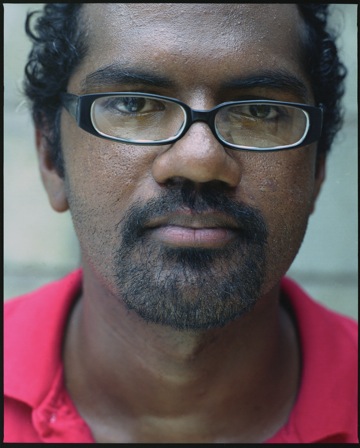
    Journalist, writer, and blogger Andre Bagoo. Photo by Gerard H. Gaskin, used by permission.

    Journalist, writer, and blogger Andre Bagoo. Photo by Gerard H. Gaskin, used by permission.

    Andre Bagoo, 26, is a Trinidadian writer and journalist. Since October 2006 he has been based at the Trinidad and Tobago Newsday, one of the country's three daily newspapers, where he is a specialist writer covering politics, with a sideline in arts and culture. He is also a poet and fiction writer, and has been published in journals such as The Caribbean Review of Books and the Boston Review.

    Bagoo is best known in Trinidad for his fearless, hard-hitting political reporting, which has sometimes brought him into conflict with members of the current government. In November 2009, the Privileges Committee of the Trinidad and Tobago House of Representatives recommended that he be banned from the media gallery of Parliament after finding him guilty of an offence. The Parliamentary session expired before the full House voted on the recommendation, so the ban never took effect, but the Media Association of Trinidad and Tobago denounced the move as “attempted intimidation … of journalists whose reporting may have embarrassed or offended the Government.”

    In addition, Bagoo is a blogger. He started his personal blog, TATTOO, in 2007. There he writes about current affairs, the arts, and sundry matters. In October 2009, he launched a new blog, PLEASURE, devoted to covering “art in all its forms”. It amounts to a one-man cultural journal, posting reviews, essays, interviews, and news on visual art, literature, music, theatre, and film in Trinidad and Tobago and elsewhere.

    I recently interviewed Bagoo via email about the relationship between his blogging and his newspaper writing, the Trinidad and Tobago mainstream media's attitudes to online channels, and the possible role of blogging in ensuring press freedom.

    •••

    Nicholas Laughlin: You started your blog TATTOO in May 2007, and for over two years you posted things like book and film reviews there, in addition to personal reflections. Why did you decide to start a second blog, PLEASURE, in 2009? Did you feel the kinds of things you wanted to write about — the kinds of cultural coverage you'd been doing there — needed a fresh start?

    Andre Bagoo: I wanted to start over, yes: reculer pour mieux sauter. I had been going to all these different arts events and I wanted to create a vehicle that would better reflect the energy I was seeing all around me; so much is going on. With a blog, I thought I could create a space that straddled formal reportage and some informal banter; that created a forum in which I could experiment and have fun, and hopefully share that with readers.

    NL: Do you feel that via PLEASURE you're able to engage in kinds of cultural criticism and commentary that the mainstream media in Trinidad and Tobago otherwise doesn't provide? And if they don't, why is that?

    AB: Small media houses can only do so much with limited resources, especially under the kinds of pressures which they are subjected to these days.

    The issue I have is with the very idea of reportage. With few exceptions, if you look at a good feature in the local papers and a good feature in a foreign newspaper, you will see certain similarities: a strong start, long sound bites, lots of narration, colour, and analysis weaving the piece together into a flowing, coherent whole. After a while you get the sense that if you've read one good feature or interview, you've read them all; there is a style that works and is adhered to, all over the world. If it ain't broke, don't fix it, right?

    The Internet allows you to break free from all that, to be as irreverent or reverent as you want to be; to be informal and to experiment by doing things that, perhaps, do not “work”.

    This is what lies behind certain things on the blog, like the artist interview series. There I aim to answer Foucault's question of not “who” but “what is the writer?”, by giving artists free rein to pretty much say what they please, and to communicate directly with readers without authorial intervention. I don't intervene in these interviews, I just let the artists do all the talking. I think in some cases this has really worked well. In the interviews, we've seen sides to people like the poet Vahni Capildeo and writer Lisa Allen-Agostini that I don't think we would have seen had the format not been as free-rein.

    NL: Were you inspired or influenced by any previously existing blogs?

    AB: A friend introduced me to the website for a punky London publication called The Pix which I quite liked (unfortunately the site has since been taken down and is being redesigned). I also encountered a very simple arts website for the Centre for 3-Dimensional Literature and other arts blogs like Paramaribo SPAN and Town, which really brought home for me the potential of engaging in arts discourse online.

    NL: Have you ever got a lead for a story or a piece of key information from a Trinidadian blogger or other citizen journalist?

    AB: Most certainly, yes. The Internet (with sites like Facebook and Twitter) forms one of the richest sources of tips and information for the modern reporter. If you're serious, you cannot afford to ignore it.

    NL: Very few other professional journalists in Trinidad and Tobago have their own blogs. None of the newspapers has a blog, though one of them uses Twitter to share headlines. Do you think the print media here understand the possibilities and implications of citizen media and online social media in general?

    AB: Blogs require time and resources. Even if their potential as gateways to a global audience/market is really understood, I guess it’s really the short-term bottom line that appears to factors in, unfortunately. Which is fair enough if you're struggling to survive amidst an increasingly challenging environment. It's striking, I think, that all three dailies actually have websites in the first place. And I don't think it's going to be too long before things like news blogs happen. For instance, the journalist Afra Raymond has a very insightful blog on current affairs where he does a lot of explanatory reporting.

    NL: Is it really so striking that in 2010 the three daily papers in Trinidad and Tobago have websites? What's more striking to me is how little use they make of their web presences, how static the sites are.

    AB: Well, yes and no. I guess it's the same as I mentioned above: a question of resources and perceived potential revenue from what is already a relatively small (but growing) online market. In that context, we're lucky there are sites at all! Still it's true, there's a long way to go, and there is a global potential that has not yet been fully tapped into.

    NL: As a professional journalist, you've been subject to what many see as an attempt at official suppression. Do you feel the situation in Trinidad and Tobago regarding press freedom, freedom of expression, etc., is tightening? What role might bloggers, Facebook users, Twitter users and others play in this situation?

    AB: The situation has been tightening for a while now, and through successive government administrations. At the same time, the media is, on the surface, expanding, and therefore, in theory, becoming more of a threat to the powerful. So that journalists in this country are going to inevitably find themselves under attack.

    At the same time bloggers/twitterers et al stand at the gates; they are at the forefront of what is, right now, the ultimate tool for free expression. Look at what happened in the wake of the earthquake in Haiti — the first images we had which really gave us a true idea of the terrifying extent of what had happened and is still happening there spread on Twitter and Facebook. The online community can reach millions. And more importantly, it can escape the machinations of those whose interests are served by silence.

    But this is about to change. The next decade will see bloggers' freedoms come increasingly under fire via tools such as threats of court action. And the Internet itself will become more heavily regulated by the state, and will be further used to increase state-sanctioned invasions of privacy. For now, though, the Internet is the best expression of that semblance of democracy that remains in our societies.

  • Global Voices in Haiti: Our Team on the Ground

    In the wake of the 12 January earthquake that devastated southern Haiti, Global Voices assembled a small team of editors and authors to provide detailed coverage of rescue, relief, and recovery efforts. One of our challenges is the relatively small scale of Haitian citizen media. Very few Haitians currently use online tools to publicly share news or opinions. In the past two weeks, Global Voices has leaned heavily on the social media streams of a handful of regular tweeters and bloggers with access to electricity and Internet connections. We've supplemented this coverage with information from the blogs and Twitter streams of foreign aid workers and NGOs on the ground.

    We at Global Voices believe there is an urgent need to amplify Haitian perspectives on relief and reconstruction efforts. One crucial way is to increase citizen media activity locally in Haiti, thereby making available more news and commentary that may positively affect awareness, interest, conversations, and decisions in the coming months.

    To this end, Global Voices has sent a two-person team to Port-au-Prince, to help support citizen media coverage. GV's managing director Georgia Popplewell and former Francophonia editor Alice Backer have spent the past six days assessing the situation on the ground, making contact with Haitians using citizen media tools, and identifying others with the potential to participate in and enrich the online conversation, given the right resources.

    Both have been issuing regular reports via their personal blogs and Twitter accounts: Georgia at Caribbean Free Radio and @georgiap, Alice at Kiskeácity and @kiskeacity. Georgia is also posting photos at her Flickr account. And we will be using their firsthand reporting to complement Global Voices' coverage of the ongoing online conversation.

    Writing at her blog a few days before leaving for Haiti, Georgia explained:

    I suspect that given the magnitude of the damage—and the magnitude of US involvement in the relief and reconstruction efforts—the Haiti earthquake isn’t going to disappear from the pages of the major media in the way that other stories have. But it’s going to be a different kind of coverage, and one that won’t necessarily highlight local stories.

    Another of our key goals, therefore, is to highlight the need for local voices in the mix and increase the opportunities for communities affected by the earthquake to be heard and understood by those working and reporting on the recovery—a group that includes Haitian institutions and media as well as international agencies. We don’t expect it will be easy: Haiti is a complex place and the damage to the country has been severe.

    Global Voices' work in Haiti is supported by our general support donors and by a humanitarian information grant from Internews. Please visit the Global Voices Haiti Earthquake page for more coverage.

  • Haiti: Security vs. Relief?

    MINUSTAH keeps watch

    A UN vehicle keeps watch in the Carrefour neighbourhood of Port-au-Prince, 26 January, 2010. Photo by Georgia Popplewell, posted at Flickr under a Creative Commons license.

    More than two weeks after the 12 January earthquake in Haiti, official estimates suggest over 100,000 people were killed, 200,000 injured, and 1 million left homeless. (The Haiti Vox blog has posted a partial translation of a government bulletin containing these and other statistics.) Despite an outpouring of aid from many countries around the world, and the presence in Haiti of thousands of relief workers, United Nations peacekeepers, and US troops, media reports suggest that a substantial percentage of affected Haitians in and around Port-au-Prince have still received little or no relief assistance.

    The sheer scale of the disaster is one reason, compounded by severely damaged infrastructure and the earthquake's impact on Haitian government agencies, many of which have lost key staff. But some Haitians online, and others on the ground, are suggesting that exaggerated concerns about security and violence may be hindering relief efforts.

    One outspoken commentator is the musician Richard Morse, who is also the proprietor of the Hotel Oloffson, where many foreign media personnel have been based. Within hours of the earthquake, Morse began posting news and commentary on Twitter (as @RAMhaiti), and the stream of information has continued. On 18 January, he angrily suggested that UN personnel were avoiding certain areas of Port-au-Prince:

    A journalist receiving a ride from a UN vehicle was dropped off at Canape Vert.”We are prohibited from taking to the Oloffson”!!!

    The Oloffson is “RED ZONE” How can the UN help the people of Carrefour Feuille if they are prohibited from coming to the neighborhood!!

    I went to the so called Red Zone on foot with the CBS crew so they could get a close up look at the destruction; smell the bodies

    If the UN can't go to where THE PEOPLE need their help then what are they doing here?

    He added:

    The fact that I haven't seen an international presence in this area tell me that others are following the lead of the UN

    He refers to a system pre-dating the earthquake by several years, in which Port-au-Prince is divided into “red” and “green” zones depending on levels of perceived risk to UN staff and others. Many parts of downtown Port-au-Prince are designated “red” zones, while the more affluent Petionville area to the southeast, for example, is a “green” zone. UN staff are required to have a military escort to enter a “red” zone for any reason, including aid distribution (according to the UN Office for the Coordination of Humanitarian Affairs). Even before the earthquake, some residents of the city believed the zoning system disadvantaged certain neighbourhoods, as a September 2009 CIDA report on the Bel Air area made clear.

    In the subsequent days, Morse has continued to comment on the “red/green” zoning system, alleging it has more to do with politics than security, and is affecting relief efforts:

    RED ZONE either means “poor” or “we don't want our people spending money there” or “we don't like you”

    RED ZONE/GREEN ZONE still seems to be an issue when getting aid to different neighborhoods.

    Eventually GREEN ZONE/RED ZONE in Haiti will becom an embarrassment.It's part of the Haitian politics of MONOPOLIES.Everything goes 2 a few.

    On 22 January, the US-based Democracy Now media organisation posted a video report on their blog, making similar claims. The report quoted Sasha Kramer of the NGO Sustainable Organic Integrated Livelihoods:

    What I’ve been witnessing here is that the aid actually arrived fairly quickly…. As I understand, there’s thousands of tons of food that are available. But the problem that they’re having is distribution of the aid.

    And one of the issues with that is that large aid organizations working in Haiti, because it’s an area that has a State Department warning, there’s a lot of regions in Port-au-Prince that are considered red zones that they’re not able to go into without very high security restrictions. So when the large aid groups circulate around Port-au-Prince, they’re often in sealed vehicles with their windows up….

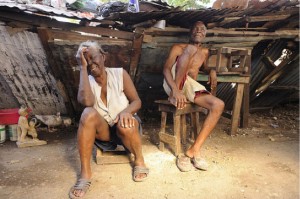
    British photographer Leah Gordon, working with the NGO HelpAge International, posted several photos of elderly Haitians in “red zone” areas of Port-au-Prince in a HelpAge Flickr set.

    haiti elderly gordon

    Janine, 73, and Lemoine, 68, live off Grand Rue, in Port-au-Prince's "red zone". Photographed on 23 January, 2010, by Leah Gordon, and posted at Flickr. Used by permission of the photographer.

    Other accounts suggested that security concerns are also in play in areas outside Port-au-Prince. The website Haiti Analysis posted a report (dated 26 January) by journalist Kim Ives of the weekly newspaper Haiti Liberté, describing a food drop-off in Léogane, near the epicentre of the earthquake:

    Léogane … probably had the most extensive damage of any Haitian city. But earlier that day, the United Nations had announced that it could not bring relief to Léogane until it had established security.

    “I don't know what security they need to establish,” responded Roland St. Fort, 32, another one of the town's neighborhood leaders. “There have been no riots here. The people have been very disciplined. They set up their own security around their outdoor camps.”

    Freelance journalist Ansel Herz, based in Port-au-Prince since September 2009, suggested on his blog Mediahacker (on 19 January) that biased reporting by international media might be fuelling relief workers' fears:

    I have not seen a single incidence of violence. The tent camps through the city, whether in Chanmas or near Delmas, are destitute but totally peaceful…. Tell CNN, the BBC, and other media to stop being alarmist fear-mongers.

    He repeated on Twitter (@mediahacker): Stop pushing this violent criminals idea. Talk to the people, not the police.” Charity worker Troy Livesay (@troylivesay) has also commented several times that he has seen little violence on the streets.

    And on 26 January, two observers gave eyewitness reports via Twitter of a food distribution operation near the ruined National Palace in Port-au-Prince, overseen by UN peacekeepers. Brazilian soldiers throwing tear gas!” announced @karljeanjeune. Radio journalist Carel Pedre (@carelpedre) commented:

    I'm more than pissed! UN are spraying gas in the distribution line!

    #UN, if u're here to help! Do it the right way for God sake!

    But Olivier Dupoux (@olidups) seemed skeptical. I don't think you believe they're doing this because they are bored/testing new gas bombs,” he said.

    A few hours later, Pedre posted video footage on YouTube, where it appeared the peacekeepers were in fact using pepper spray, despite mostly orderly behaviour from people in the distribution queue. He also posted five items of advice to relief organisers:

    Advice #1: Ask each family affected to choose someone to receive the humanitarian Aid.

    U will have less people on the line and you'll be sure that u feed at least 1 family.

    Advice 2: Prepare kits (little bag) of food. Give Away a large bag of rice to one person. It is a waste

    Advice 3: have a group of volunteers to do the packaging and the distribution.

    Advice 4: Distribution must be made at a fixed point on a fixed scheduled.

    Advice 5: You don't have to give away food everyday. Make sure that What U give can feed a family for at least 2 days.

    Global Voices managing director Georgia Popplewell, leading a two-member GV team working on the ground in Haiti, offered some thoughts on her blog to put these reports in perspective:

    As the tear gas story above demonstrates, it’s difficult to verify information. You try to get around as much as you can, but in the end you’ll see only a tiny fraction of the whole, and perhaps understand or read accurately only a fraction of that. But the overriding story is about the distribution of aid: how badly it’s going, how supplies are failing to get to those who need it, and also how difficult the whole exercise is.

  • Haiti: “1+1=3”

    Days seem [waaay] longer, yet this Week went by sooo fast. earthquake has 1+1 =3.

    This comment by @olidups (Olivier Dupoux) on Twitter summarises how many Haitians must feel, more than ten days after the 12 January earthquake that devastated the capital city, Port-au-Prince, and surrounding areas. With rescue efforts winding down (even as two more survivors were pulled from the rubble yesterday), “tent cities” being built to house thousands of now-homeless Haitians, and large-scale relief efforts underway, some are beginning to think about what the near future holds in store, how long reconstruction efforts will take, and what they will look like. Others seem concerned that official announcements from the authorities and media reports don't always add up with the situation they observe on the ground.

    @troylivesay (charity worker Troy Livesay), who previously wondered whether the UN was restricting the movements of US security forces, noted on 21 January that The Marines are patrolling the streets…their curfew must have been extended.” He added:

    Just passed an ambulance from the State of Qatar.The gang's all here.I hope some of these others bypass the bureacracy unlike the US and UN.

    The next morning, he posted a brief eyewitness account of relief efforts:

    Seeing truckloads of food and relief supplies distributing around the city and mobs trying to get at them…UN is providing security.

    The people aren't dangerous – they are desperate. They fear that there won't be enough, because there never has been enough in the past.

    Large crowds around all airport entries/exits-I asked a local why and was told ‘you have to look to see where the manna is falling.

    Livesay also posted photos from one of Port-au-Prince's “tent cities” at his Flickr account. One shot showed men plugging in their mobile phones at a rigged-up charging station.

    On the night of 21 January, @RAMhaiti (musician Richard Morse, who also runs the Hotel Oloffson) described a walk through the centre of Port-au-Prince:

    Took a walk to Champ Mars tonight,saw the tents,the people,the masses upon masses.one house down another house fine.no rhyme or reason

    Palace no more,Culture fine,Finance cracked,DGI(taxes)in a heap.Justice?A heap.More and more people heading to the parks.Foot traffic.

    The Palace of Justice,in a heap.Is that a metaphor?American troops guarding the back of the palace which has no back walls.My 3rd occupation

    He emphasised:

    The Haitian people were so polite as I walked around town w/my daughter.One group of people was yelling over money but all in all,peaceful

    As a well-known public figure in Haiti, issuing a prolific stream of information and commentary on Twitter since the earthquake, Morse has been quoted frequently in the international press. The travel website WorldHum has published an interview with Morse dating back to 2008, in which he says:

    “When journalists stay here, I try and influence the journalists. I didn’t used to. What would happen is journalists would write stories and they’d leave,” he said. “And if the story had no bearing on reality, it would have a big impact on my life. I figured it was best if the journalist had a better idea of what was going on so I would try and lead them in the direction of what’s going on.”

    True to form, Morse (often in reply to Twitter queries) has made some pointed comments about Haitian politics and the administration of relief efforts:

    Which country is now officially heading the UN operation in Haiti? Is it still Brazil or has the US taken over??

    WE needed new leadership in Haiti and perhaps the earthquake has obliged us.The collateral damage, a bit over the top..

    The Haitian Gov./The UN/The Elite Private Sector formed a Gang whose legitimacy was addressed by the Earthquake.Collateral damage ovr th top

    I'm hearing from witnesses that people cheered when the palace went down.That, in and of itself, is a very strong statement

    He also wondered how long Haiti would retain the world's attention:

    I've met journalists from many countries around the world in the last week. The real question;how long will this “be a story”?

    US-based Haitian blogger Wadner Pierre was more explicitly critical of the foreign media:

    I am overwhelmed, frustrated and even angered by what some journalists have written about Haiti since the 12 January earthquake and I cannot believe some of the images I have seen on news channels such as CNN and MSNBC. It's true that some journalists are doing their very best to give a real picture of the situation on the ground in Haiti….

    But the mainstream media, especially in the United States, has focused the attention of their audiences on the fact that Haiti is the poorest country in the Americas and concentrated on the efforts of the US, the richest country in the Americas, to mobilise disaster relief services.

    Pierre also criticised Haitian president René Préval:

    No one, it seems, is quite sure what he is doing. Some people think he is negotiating the country away to the United States. And others don't think that Préval has ever been the one leading the country; rather, they argue that he has always been a puppet of the international community.

    Havana Times posted an open letter from a Guatemalan filmmaker who was in Jacmel at the time of the earthquake, disputing some of the images that have appeared in international TV coverage:

    The media choose the most shocking scenes, the most morbid and most sensational ones, and then they repeat them again and again, gradually creating a completely distorted image of reality.

    Troy Livesay's wife Tara, who blogs at The Livesay [Haiti] Weblog, also expressed frustration with some foreign press:

    I am glad the media has given Haiti some attention and hopefully that makes people CARE and want to GIVE and ACT – but the ones that never leave the airport and report from the tarmac are just in the way and taking up valuable space and adding to the chaos. Plus, I am hearing the story is no longer getting much attention – that it has dropped to the bottom of the news cast – which is sad, because the story has only just begun.

    And Chantal Laurent of The Haitian Blogger was troubled to hear a representative of the World Food Programme say that food distribution in Port-au-Prince had been scaled back because of “the lack of security”. She remarked: “folks on the ground are reporting that they have not witnessed any undue cause for concern over security issues”.

    Meanwhile, others continued to concentrate on the ongoing challenge of getting food, water, and medical care to vast numbers of injured or displaced Haitians. The charity group Pwoje Espwa, based in Les Cayes, reported on its blog that a hundred orphaned children were arriving from Léogâne, and appealed for donations. Gwen Mangine, a charity worker with the Joy in Hope organisation, based in Jacmel, gave an update on relief operations there:

    Over the past 6 days, we’ve accruued a good supply of food and water…. Yesterday we rented a house in an out of town location with a large wall around it and hired security guards. We began moving all of our supplies over to this house yesterday and will today begin the process of getting this out, distributed largely through local churches + organizations.

    She also described a touching moment:

    I am upstairs in my house right now…. Downstairs the radio is blaring (because what kind of Haitian household would you be without a blaring radio) and our kids and staff are all singing along to Ayiti Cheri [a well-known patriotic song].

    For this small moment, life feels normal again.

    And on Thursday night, @tbijou (Thierry Bijou) voiced a practical dilemma many Haitians face every evening, with aftershocks continuing and many standing buildings unstable: 11h18. indoor or outdoor what will it be for tonight?”

    Global Voices' Special Coverage Page on the earthquake in Haiti is here.