On a number of official Chilean government websites, such as the Chile Government [es] or Presidential Photos sites, no document older than March 12, 2010 can be found. Information belonging the previous government is not longer available. For example, the entire photo archive from the governments of Michele Bachelet and Ricardo Lagos are no longer available. The date coincides with the day after that President Sebastián Piñera was inaugurated as Chile's new president.
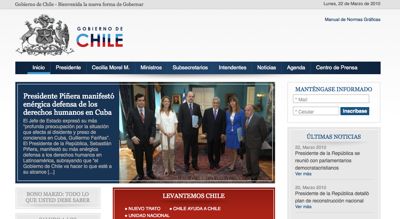
Government of Chile website
A debate ensued on the blogosphere about the meaning and significance of the deletions. Did the officials from the new government update the information or did they deliberately take down any reference to previous governments? Piñera's government is a marked change in Chilean politics, which brings the first right-wing government to take power in 20 years, since the country returned to democracy. With this, some bloggers say that the information should have been kept online since it was financed and belongs to the Chilean people.
Pablo Bello (@pablobello) tweeted:
Nueva administración elimina archivos de fotos de Bachelet y Lagos – así se instala la derecha
Blogger Javier Sajuria believed that there was a chance for bi-partisan cooperation and unity, when Bachelet invited President-elect Piñera to attend the Summit of the Americas. However, this optimism turned to disappointment with the news of the removal of the files. He writes that it was a missed chance to begin the new government in unity and good faith and writes that “history does not begin on March 11 [es]” :
Al sacar esos registros de los sitios, no sólo están haciendo un proceso de limpieza de información, sino que nos están notificando que no están a la altura de las circunstancias. El Gobierno nos está diciendo en la cara que no le importa el legado de las administraciones anteriores y que, en lo que a ellos respecta, Chile comienza el 11 de marzo de 2010.
[…]
Existe la esperanza que esto siga tratándose de un error, pero cada vez son menos. Para el resto de nosotros, sólo nos sirve continuar exigiendo una solución de este tema que, por menor que parezca en estos días atormentados, no será menor el día de mañana, cuando queramos reconstruir nuestra historia. Son estos pequeños actos los que nos hablan de las actitudes del nuevo Gobierno, de la prepotencia con que realizan ciertas acciones y de sus inesperadas consecuencias.
By removing those records from the sites, not only are they going through a process of information cleansing, but they are telling us that they are not up to the circumstances (continuing the policies of previous administrations). The Government is telling us to our faces that it does not care about the legacy of previous administrations and that in their opinion, Chile begins on March 11, 2010.
[…]
There is hope that this is only an error, but more and more there is less hope. For the rest of us, all that is left is to continue to demand a solution to this issue, however unlikely it may seem during these difficult days, it will be more difficult when we want to reconstruct our history. These are small actions that reveal the attitudes of the new Government, of the arrogance with which they carry out certain actions and their unexpected consequences.
Sajuria offers alternatives, such as handing over the files to the Libraries, Archives and Museums Directorate (Dibam), so that they can archive the information. This would allow the public to access the information as needed.
Blogger Luis Ramirez concurs that the cleansing does not appear to be caused by coincidence or over-zealousness, but rather as a political statement [es]:
Me consta que esta desaparición forzada de la historia no fue un “error técnico”. Hablé con dos personas (una del nuevo gobierno y otra del antiguo) que me confirmaron que efectivamente esta situación se produjo.
[…]
No es un tema de racionalidad, es un tema de ser respetuosos y empáticos con esa parte de la nación que no votó por ellos y que son, ni más ni menos, que casi el 50% de la población.
[…]
Para decirlo con toda claridad: una política de eliminación sistemática de la memoria histórica de los anteriores gobiernos, no es compatible con la unidad nacional. No pueden pretender borrarnos.
I know that this forced disappearance of history was not a “technical error.” I spoke with two persons (one from the new government and another from the previous government) that confirmed to me that this situation actually occurred.
[…]
It is not a matter of rationality, but a matter of being respectful and sympathetic to that part of the nation that did not vote for them and they are, neither more nor less than about 50% of the population.
[…]
To put it clearly: a policy of systematic elimination of the historical memory of the previous governments is not compatible with national unity. You cannot try to erase us.
Montserrat Nicholás of the blog Curvas Políticas [es] provides her thoughts on the situation calling it “website burning.”
Así, Piñera (seguramente sin quererlo) inauguró lo que antes solo se conocía como “quema de libros”, y que hoy hemos querido llamar “quema-webs”.
Además de demostrar una falta de buenos modales y de no entender la Presidencia misma como un espacio continuo dentro de la tradición republicana, lo quema-web es altamente nocivo para el acceso a la información y la estampa de la Historia del país.
Entendemos que se quiera exhibir una fuerza resolutiva y se quiera disipar cualquier relación con el gobierno anterior pero borrar contenidos que son creados con fondos públicos (por muy insignificantes que sean) y emitidos desde la Presidencia, no es más que borrar la Historia misma y obstruir el acceso, deliberadamente.
Thus, Piñera (certainly unwittingly) initiated what was previously only known as “book burning ” and what we might call today “website burning.”
In addition to demonstrating a lack of good manners and for not understanding the Presidency as a space of continuity within the Republican tradition, website burning is highly harmful, with regards to the access to information and to the image of the country's history.
We understand that you want to show a resolute force and want to dispel any relationship with the previous government, but deleting content that has been created with public funds (however insignificant they may be) and emitted from the Presidency amounts to nothing more than erasing history itself and deliberately obstructing access.
However, Patagon comments and points out that the information might have just changed locations [es], and that people are getting carried away:
no sea paranóico e infórmele a su amiga que el sitio del “Gobierno de Chile” es para mostrar eso, información referente al gobierno de chile no de “Los Gobiernos de Chile”. Y evidentemente ese sitio no es el lugar idóneo para preservar nuestra historia. Yo me imagino que la administración saliente se encargó de poner la información histórica donde corresponde.
[…]
los gobiernos son quienes administran el estado en un periodo determinado de tiempo, por lo tanto es natural que la Web de un gobierno mantenga solo la información que éste estima importante y en este sentido, eliminar contenidos podría en el peor de los casos ser un error, pero de ninguna manera debiera significar algún tipo de censura.
Don't be paranoid and tell your friend that the site “Government of Chile” is for to show that, information relating to the government of Chile and not of the “governments of Chile.” Evidently that site is the not suitable place to preserve our history. I imagine that the outgoing administration commissioned to place the historical information where it belongs.
The governments are the ones that administer the state for a determined period of time, and it is natural that the website that the government administers should only contain information that they feel is important, and in this sense, eliminating content could be in the worst of cases – an error, but in no way should it mean that it is some type of censorship.
Other commenters like Felipe Zuñiga point out that new governments in other countries [es], like the United States, did not leave the information from previous governments on their new websites when they took office.
Regardless whether the elimination of the content was deliberate, an error, or whether it was relocated to another place, the changes in the website has stirred up debate during a historical transitional period in Chilean politics.
