Author: Om Malik

  • Why Nexus One Will Make Money for Google

    Google, it seems, is having some teething problems with its foray into the topsy-turvy world of mobile handsets. From unhappy partners to unhappy customers, the search giant has been having a rough time with its Nexus One, currently the best Android phone on the market. So much so that GigaOM Pro Mobile curator Colin Gibbs wondered if it was time for Google to kill Nexus One. (Related from GigaOM Pro, sub. required: Google’s Mobile Strategy: Understanding the Nexus One.)

    On the opposite end of the argument are analysts from Citigroup, who think that the device could be a monster hit and sell somewhere between 1 and 3 million units. It would become a massive revenue generator, Citigroup analysts including Internet Mark Mahaney predict. In a research note this morning, he writes:

    Based on its first week sales traction, our review of comparable 1st-year SmartPhone unit sales, and input from CIRA Wireless Handset Analyst Jim Suva, we estimate Nexus One could potentially see between 1MM and 3MM unit sales in 2010, generating between $500MM and $1.6B in incremental revenue (3% to 8% accretive).

    For additional context, we note from Kevin Chang, the CIRA Analyst who covers HTC Corporation, that HTC has build plans for 700,000 Nexus One units in Q1:10 and approximately 1.2MM for H1:10. This would seem to suggest a reasonable Year 1 range of 1MM to 3MM…..based in part on Chang’s analysis, we believe the Nexus One may generate a 10%- 15% operating margin, which implies that 1MM to 3MM Nexus One unit sales could generate between $0.12 and $0.55 in incremental ’10 EPS (0%-2% accretive). Finally, we note that given the relatively low Nexus One margin structure, every 1MM units sold would reduce GOOG’s overall operating margin by 1%.

    And fourth, there is the obvious opportunity for Google to generate a sizeable new revenue stream in terms of handset sales. We offer our estimates later, but as quick comps, we note that the Motorola Droid is expected to sell almost 8MM units in its first year and that both of the iPhone 3G versions sold or are on track to sell well over 10MM units in their respective first years. Hypothetically, 10MM units of a $529 phone would generate $5.3B, which would be very significant for a company that generated approximately $17.4B in net revenue in 2009. Of course, the incremental operating profit would be much less significant, given the relatively much lower margins of handset sales vs. Google’s core business.

    I find these estimates to be way too optimistic. The smartphone market continues to be very dynamic and fluid. The analysis also assumes that Apple and RIM are going to stand still. Other members of the Android ecosystem are going to do their best to keep Google at bay.

    Now I’m not one to argue against Google’s capabilities, but we need to temper our enthusiasm around the Nexus One. Also we have to remember the reality: 20,000 Nexus One handsets were sold during the first week it was available, while Andy Rubin, head of Google’s mobile efforts, said he would be happy if Google sold around 150,000 of them.

    nexusonebythenumbers.gif

    googlephoneteardown.gif

    mobileosmarketshare.gifsmartphoencomparison.gif

    Related GigaOM Pro Research: Google’s Mobile Strategy: Understanding the Nexus One

  • What’s Inside Apple’s Tablet?

    A week from now, Apple is going to announce its latest creation. It’s not clear what it is, exactly, but the speculation is that it will be a new kind of tablet-styled computing device that has more names than the Black Eyed Peas has hit singles. The important question for me, however, is what’s inside this mythical device. Today we have some answers as to its semiconductor innards.

    Earlier this morning, veteran computer industry analyst Ashok Kumar of Northeast Securities in a note to his clients outlined some details. Kumar said that Apple could “ship up to a 1 million units by March and plateau at 400,000-500,000 units per month thereafter.” Now those are some aggressive forecasts — not sure if I entirely buy into them — but if true they could have a material impact on both Apple and its component supplier partners.

    And as you read further down Kumar’s list you will see the most glaring absence is none other than Intel, which has been trying to get its chips designed into future tablet devices.  (Related post: 10 Features That Would Make iPad a Hit.)

    Kumar speculates that the device is going to cost between $600 and $800 and will come with a docking station that will allow the device to be used with a Bluetooth keyboard and mouse. The device is also going to come with wireless connectivity supplied by a carrier partner, most likely Verizon. But let’s focus on the semiconductor components for now. According to Kumar:

    • The core of the application processor is said to be ARM Cortex (8), which Apple licensed from Samsung.
    • Apple is enhancing the core processor with the help of design team from PA Semi, a company Apple bought for roughly $278 million in 2008. Apple has focused on enhancing video and graphic capabilities of the device with its internal semiconductor efforts.
    • Samsung will be the foundry for the application processor and it will also be one of the suppliers of Flash memory to Apple.
    • Qualcomm is said to be supplying the wireless wide area network (WWAN) chip for connectivity to the wireless networks.

    Let me put Kumar’s comments in context.

    For starters, before it was taken out by Apple, PA Semi had designed a very low-power, dual-core ARM chip running at 2 GHz and consuming 5-13 watts. That’s the kind of design expertise you need when building portable Internet devices such as this mythical tablet. And that is precisely the kind of expertise Apple needs, in-house, in order to muck around with ARM-based chips.

    Kumar’s theory is also bolstered by the fact that about year and a half ago, a story in The New York Times pointed out that Apple’s Wei-han Lien, a senior manager with the chip team, was telling folks on LinkedIn that he was busy working on a new ARM processor for what was the next-generation iPhone.

    If you take those two random bits of information, then Kumar’s speculation makes a lot of sense. In addition, an independent source of ours also tells us that Apple has indeed been working with Qualcomm and Verizon. It could very well be that Apple has developed a CDMA version of the iPhone for Verizon.

    Stay tuned! I will be attending the media event, where I’m hoping to see if the mythical tablet does turn into a reality.

    Related GigaOM Pro Content: Is The Age of the Web Tablet Finally Upon Us?

    Photo courtesy of Gizmodo.

  • The iPhone & the Lack of Voice Over 3G: Alternative Theory

    Apple and AT&T have come under continued criticism for not allowing VoIP over today’s 3G mobile broadband connections when using the iPhone. So much so that the matter got the attention of the FCC back in August, leading to explanations  from Apple and Ma Bell.

    A few weeks ago, we had wondered why there were still no VoIP-over-3G connections. More recently, others asked that very question. FCC chairman Julius Genachowski sidestepped the issue during a conversation with Stacey and I earlier this month.

    Now the popular consensus is that AT&T and Apple are a conniving bunch, and are preventing “VoIP over 3G” from taking root. But VoIP industry insiders have come up with an alternative theory — they believe that because the voice-over-3G experience is so bad, it makes sense for Apple, AT&T and others to not even bother with VoIP over 3G.

    Our friend Andy Abramson has tried to make voice calls over 3G data connections via his jailbroken iPhone 3GS and has found the experience truly trying. “3G VoIP is not something I could consistently endorse as it’s not really ready for prime time,” he wrote on his blog.

    Karl Good, Truphone’s director of applications, gives two reasons why his company has reservations about offering VoIP calling over 3G.

    The first is that although a small number of networks, such as AT&T in the US, allow VoIP calling over 3G, this capability has not been approved by most operators, and has not been opened up across all handset manufacturers, such as the iPhone. As of today, iPhone applications that offer VoIP calling over 3G would not be approved by Apple for release into the App Store.

    The second relates to quality. Although it is technically possible to offer VoIP calling over 3G on devices such as the Android, the relatively low bandwidth of 3G compared to Wi-Fi means that those calls are very often of a poor quality.

    Pat Phelan, founder of Cubic Telecom, is of the same opinion and he offers an explanation as to why VoIP over 3G is a bad idea — at least for now:

    • Voice over 3G needs massive compression.
    • 3G speeds aren’t good enough for voice.
    • Latency, as measured by excessive ping times, makes it virtually impossible to have a decent conversation.

    Skype in a recent filing with the FCC said it can run its voice service using small amounts of bandwidth — between 6 kbps and 40 kbps — so it doesn’t choke the network. But given the lack of latency on the network and other related issues, I bet even Skype doesn’t want to push hard to make its voice service work over 3G.

  • The Ultimate Cell Phone Plan Comparison

    Last week, Verizon instituted new pricing plans that discounted its voice plans. Its biggest rival, AT&T, then came out its own cheaper voice offers. The two were simply matching what Sprint and T-Mobile USA have already been selling — cheap voice.

    It’s becoming virtually impossible for an average consumer to keep track of all the various deals on offer. Thankfully, a Good Samaritan from BillShrink has put together a graphical overview of all the cell phone plans. Check it out, especially if you’re in the market for a new cell phone service or want to switch carriers.

  • Rebtel Buying a Part of Talkster

    Rebtel, the Stockholm, Sweden-based VoIP service provider, is buying Free World Dialing, a division of Toronto-based VoIP service provider, Talkster for an undisclosed amount. As part of the agreement, Rebtel will carry all of Talkster’s international traffic over its network. Late last year, Rebtel acquired Gorilla Mobile to expand is business to Asia. The company had switched to a white-label model in 2008 and since then has been trying to find steady growth.

    The company says it has more than 4 million registered customers worldwide, and is adding more than 100,000 new users each month. It has $20 million in sales in 2009 up 75 percent vs. 2008. Rebtel expects to grow at a similar rate in 2010, the company said.

  • LOL: Dilbert Takes on Cloud, SaaS.

    Sometimes you don’t really need words! Dilbert, the great philosopher, takes on Cloud Computing, Software as a Service and everything else! I hope you enjoy his humor, and, with some irony, consider how the workplace of today is changing.

    Dilbert.com

    Related GigaOM Pro Content: Why Hardware-Free Businesses in 2012 Is a Pipe Dream

  • With Icon, Jawbone Launches a Platform

    A few weeks ago I got a chance to catch up with Hosain Rahman, founder and CEO of Aliph, the San Francisco-based company that makes the hot-selling headset, Jawbone. He outlined how and why he wanted to turn his device into a platform for what he described as “the most precious real estate on the human body.” That is the ear, Rahman said.

    myTalkToLife_571w.jpegBy offering optimized apps for this “platform” he can turn what is essentially a dumb device into a smart one. What Aliph has done is essentially bundled an OS on a very tiny chip inside the device and made it capable of receiving “intelligence” on the outside. iphoneBatteryMeter_270w.jpegThis also allows the company to stand out from its competitors, such as Plantronics, who have started to flood the market with Jawbone-inspired headsets.

    The platform, called MyTalk, allows you to do a few things. For instance, if you pair the Jawbone icon with an Apple iPhone, then you get an icon telling you Jawbone’s battery status (as seen here). If you connect the Jawbone via a USB cable and log into the MyTalk web site, you can customize the device by adding audio apps such as Voice Dial, Directory Assistance via 1800Free411, Jott, and Dial2Do. You can also download six different voice personas that let you know incoming caller IDs via speech. It is good to see Aliph attempting new things with the device, though I am not sure how the average user is going to take to this new platform.

    icon_hero_LR.jpg

    MyTalk, which launched today as a private beta, works only with company’s new Jawbone Icon headset. The most diminutive of all Jawbone headsets, the device  seems to be very good at its job — making it possible to have noise-free conversations. Aliph has made some big improvements in its design and ease of use, even as it has shrunk it further. I played around with it for a few minutes, so I have only had limited exposure to the device. It does seem that other gadget-reviewers like it.

    I didn’t really want to review it – mostly because I am more of a plain old wired headset kinda guy, and mostly because talking on bluetooth headsets can easily convince people that you’re a crazy person.

  • Here Comes Dynamic Caller ID

    Flat Planet Phone Co., an Israeli VoIP startup, has developed a new VoIP technology called Dynamic Caller ID that essentially allows you to have multiple caller IDs built on the fly. These caller IDs depend on the local number being dialed. For instance, if you call someone in Orange County, Calif., from New York, the recipient would only see the local number on their handset. The same holds true when making calls to about 50 countries, FPPC claims.

    In the past, you could do the same by buying numbers from Skype or another Internet telephony service in various cities. People could then call you back on those numbers via local calls, and speak to you anywhere on the web. The folks at Flat Planet Phone are making it even simpler.

    Dynamic Caller ID is yet another example of how the Internet is redefining the very notion of location. With the growing popularity of wireless and VoIP services, the idea of voice being tied to a fixed location is as quaint as horse carriages. In a previous post, columnist Dan Berninger said, “Thinking of communication solutions as an extension of the web and implementation as hosting can help break the grip of the telephone myopia reflected in most VoIP business plans.” The development of Dynamic Caller ID is doing just that.

    Photo by Flickr user Matt512

  • Data Revenues Will Push Mobile Biz Past $1 Trillion

    The growing popularity of smartphones and high-speed wireless broadband networks are proving to be two major catalysts for the wireless industry. As a result, expect its revenues to barrel past the $1 trillion-mark by 2013, says Informa Telecom’s & Media, a London-based market research group. That compares to revenues of $208 billion in 2008 and $330 billion in 2009. By 2014, global mobile penetration will hit 92 percent with about 6.7 billion subscribers, the firm predicts.

    Such numbers make clear why the industry is so focused on data. According to Informa’s predictions, nearly 30 percent of the world’s wireless connections are going to be using 3G or higher wireless broadband technologies and by 2014, nearly half of the world’s 6.7 billion mobile users will be using some combination of 3G and 3.5G+ technologies and about 33 percent of the total mobile users will be using 3.5 G+ technologies such as WiMAX and LTE (see related GigaOM Pro research, sub. required: 4G State of the Union).

    To me this is just further proof that wireless broadband is a massive opportunity, of which we have only barely scratched the surface.

    Image courtesy of Flickr user Ed Yourdon

  • Skype to FCC: Keep the Internet Open & Neutral

    Skype, a big proponent of open networks and net neutrality, in a filing today with the Federal Communications Commission argued that net neutrality was “about growing the broadband ecosystem and preserving a borderless, open Internet” and said it would “promote investment, jobs and innovation.”

    The company said that it “welcomes the Commission’s focus on preserving an open Internet and strongly supports the proposed six principles described in the Notice of Proposed Rulemaking (NPRM.)” Earlier, the FCC had come up with a framework pertaining to broadband and wireless networks and issues of network neutrality. The FCC has been seeking responses on sensitive and divisive issues such as reasonable network management.

    Skype’s stance makes sense given that the company needs net neutrality to keep going and growing. In its filing (embedded at the end of the post), Skype argued:

    Evidence suggests that carriers have the incentive and ability to harm innovation in the real-time communications application market, such as that made possible by Skype, either by outright blocking or more subtle forms of discrimination. Because these applications offer consumers additional choice and savings, they should not be delayed, obstructed or throttled by broadband access providers.

    The filing didn’t say anything surprising. We all know that services such as Skype, YouTube and Twitter are the reasons people subscribe to broadband connections, and in order to keep the demand for faster (and more expensive) broadband connections, the technology industry needs to keep creating such applications.

    Interestingly, Skype wants the FCC to keep the mobile broadband networks open, much like fixed-line broadband networks, but it understands the need for some sort of network management when it comes to wireless networks. The company wants the FCC to make sure that VoIP providers like it are allowed to offer their services over all kinds of networks.

    Skype believes that it should never be reasonable for any network operator, including wireless network operators, to block, throttle or degrade particular applications without regard to the network capacity such applications actually are consuming. Not all video applications, or peer-to-peer or VoIP applications, consume the same amount of bandwidth or place the same demands on network capacity. Skype, for example, optimizes its software application to adapt to network congestion and consume very few network resources — between 6 kbps and 40 kbps for a voice call depending on the level of network congestion, which is less than traditional POTS or other popular voice protocols.

    Thus, simply blocking all VoIP applications in response to network congestion is an over broad practice not based on fact and should be viewed as unreasonable. In addition, blocking practices or network management practices that use categories such as “P2P” or “VoIP” are both over- and under-inclusive. Some P2P applications might consume large amounts of network resources, while others, such as Skype, do not. Some VoIP applications include video communications capabilities, while others do not.

    Skype is but one example of a P2P application that both transcends the ‘voice’ category but is respectful of network resource issues and does not consume large amounts of bandwidth. The Commission should therefore reject network management practices that rely on these broad application descriptions because they do not bear any close relationship to actual demands placed on broadband networks.

    In a post earlier this week, Stacey pointed to research by The Public Policy Institute of California that said broadband can boost economic development, but only up to a point. “Whatever positive effects broadband may have on employment growth, it did not result in either higher employment rates or higher pay for residents in areas where broadband expanded in the 1999–2006 period,” the study found.

  • Will Android Pay for Google’s Moves in China?

    British scribe Paul Carr is not one to mince words. For him, Google’s newfound morality around censorship and China is too little, too late. Four years too late, to be precise. And I agree with him — up to a point. Morality has to be absolute; it cannot be used as a tool of convenience. That said, and despite being a born cynic, I’m actually unable to view Google’s decision through the same lens.

    I mean, if as a society we’re all too ready to forgive steroid-enhanced baseball players when they come clean, how is that we can’t give a company a second chance when it finally decides to do the right thing? Moreover, the company is risking a lot of money by adopting what Carr describes as “scorched earth diplomacy” — especially when it comes to Android.

    J.P. Morgan estimates that Google’s move is going to cost it some $600 million in 2010 revenues. UBS puts the sales loss forecast in the $400-$500 million range. Others estimate that it could be even lower — between 1 and 1.5 percent of 2010 revenues. Citibank, meanwhile, believes that nearly 1 percent of Google’s profits are at risk.

    The wide variance in the loss estimates makes clear that no one really knows how big a financial gamble this decision is. And that alone makes it a brave move.

    But while many argue that it isn’t logical for a publicly traded company to take a stance that’s going to hamper its ability to capture the opportunities offered by such a fast-growing Internet market — China currently has 298 million Internet users (and 99.4 million connections) representing just 22 percent of its population — as far as I’m concerned, the biggest impact of Google’s decision will be on its mobile efforts. With more than 638 million wireless users (according to Telegeography), China has already emerged as the world’s largest mobile market. Sales of mobile phones in the country are expected to grow 21 percent this year alone.

    The bottom line is that Google’s decision to take on the Chinese political establishment means that it no longer controls Android’s destiny in China. In theory, Android is open source and as such, handled by the Open Handset Alliance. But in reality, it is closely associated with Google. For starters, the banning of Google.cn would close a marketing channel for Google’s Nexus One device, if and when it was launched in China.

    The country was well on its way to helping Google grow Android. Chinese handset makers such as Huawei and ZTE have been some of the earliest supporters of the upstart OS. China Mobile already sells its own version of an Android-based phone system called OPhone. Motorola is making a big push into the Chinese market with smartphones based on the Android OS. And China-based Lenovo has developed numerous Android-based products, including the LePhone. Any undue pressure from the establishment would mean that most of these companies would have to abandon Android in favor of other mobile operating environments.

    Google’s willingness to risk not only its present (search) but also its future (mobile), shows that as a company it’s willing to go where no Western company has gone before: in China’s face. The next few months will determine whether Carr is being too harsh or I am being too generous in our respective judgments. For now, at least on this one decision, I am on the side of Larry & Sergey.

  • Zillow Wants a Home on Wall Street

    Zillow, a real estate listing service that’s nearing profitability, is also dreaming of going public, though it’s pragmatic enough not to set its sights on doing so for another year. Zillow COO Spencer Rascoff today told Bloomberg that the company was courting Wall Street investors. The question is, why is he talking about it now?

    If you ask me, Zillow is using its IPO dream declaration as a stalking horse for what is a more likely outcome: an acquisition, preferably from someone like Google. Zillow raised $30 million in 2007 at a whopping valuation of $400 million, and bringing the total amount raised in venture funds to $87 million.

    Zillow, along with fellow online real estate listings provider Trulia, are prime acquisition candidates. Google, which was rumored to have made an attempt to buy local search and reviews provider Yelp, seems to be in the market for such vertical search services, especially in light of reports that it was kicking the tires at Trulia as well. Expect one of them to end up in the arms of Google.

    Zillow, Trulia and many other post-2007 startups are in an awkward place: They’re not small enough for a quick merger but aren’t beefy enough to justify their massive valuations. The good news is that Zillow has a full grip on reality, as Rascoff indicated in his chat with Bloomberg.

    Zillow’s newfound optimism stems from a strong showing in 2009. Despite the woes of the real estate industry, the company saw its traffic grow 37 percent (in terms of page views), launched a rentals listings service, and partnered with many U.S. newspapers to provide them with its real estate search. Zillow, with some 5.2 million monthly visitors, is the second-largest real estate listings service behind Move.com, which has close to 6.4 million monthly visitors, according to comScore.

    That said, whether it harbors dreams of an IPO or a sale, Zillow needs to not just repeat but exceed its 2009 performance, when sales rose 65 percent even while online real estate advertising declined $100 million to $7.5 billion. The company is looking to sell more lead-generation advertising, most of it targeting the mortgage lending industry. And Zillow should benefit from any rebound in the housing market, but that might not be enough.

    Image courtesy of Flickr user, The Truth About

  • In the First Week, Google May Have Sold 20,000 Nexus One Phones

    When I spoke with Google’s mobile boss, Andy Rubin, he said that Google would be happy to sell about 150,000 Nexus One devices. That number, he said, would be enough for the Google Phone to get in front of a majority of American phone buyers who might want to take a look at it. Well, let’s just say a fraction of the job might be done. According to Flurry, a San Francisco-based mobile application analytics company, Google may have sold about 20,500 units of the Nexus One, which if you read my review is the best Android phone on the market.

    In the past, Flurry has been fairly accurate in giving guesstimates as to first-week sales, thanks to its relationships with 10,000 app developers. They estimate that the “Nexus One was outsold by Droid by more than 12 times, myTouch 3G by 3 times and iPhone 3GS by a staggering 80 times.” Of course, Google didn’t spend a lot of money on marketing — that isn’t part of the plan — as Rubin explained to me.

    Cannibalization may also be playing a role as the Nexus One competes against the myTouch 3G for any new T-Mobile customer. In effect, sales are now split between the two handsets. And while Google, in an effort to avoid channel conflict with T-Mobile, appears to have set the direct-to-consumer price for the handset at over $500 dollars, the high price point combined with the fact that the handset is only considered an “evolutionary” improvement over previous Android devices, indicates that Google did not take the steps to maximize first week sales. (Flurry Press Release)

    firstweeklaunch.png I think 20,500 Nexus Ones sold might be a tad on the high side, considering Google has been giving away the phone to its employees and has seeded the market with giveaways. Regardless, it will be interesting to see how Google carries on pushing this device in the coming months. The company is experiencing a backlash over customer service issues and more recently about confusion over service cancellation charges.

    Related GigaOM Pro Research:
    Google’s Mobile Strategy: Understanding the Nexus One

  • How Much Will It Cost Google to Exit China?

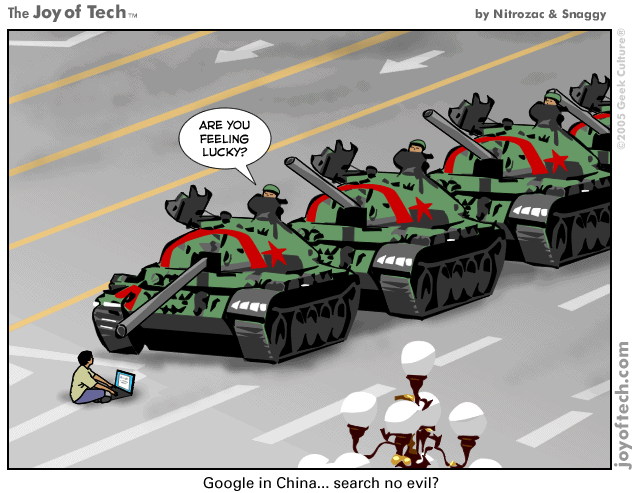
    tiananmen_tank_man_google_china.gif

    Google, earlier today made a bold decision — it stopped censoring results on Google.cn, its Chinese destination. The decision, was a direct consequence of a sophisticated attack on its infrastructure as attempts were made to penetrate Gmail accounts of human rights activists. This will most certainly get the company banned from China and it is going to cost it hundreds of millions of dollars.

    This is not only brave, but a very costly decision. According to estimates by J.P. Morgan, if the Chinese government bans the search giant, then Google could be walking away from about $600 million in 2010 revenues.

    In our current model, we estimate Google will generate ~$600M in revenue from China in 2010. We expect segment margins of the Chinese operations to be in the 15% to 20% range. However, if Google is not allowed to operate in China, beyond the immediate revenue loss, this could potentially have a far-reaching impact on the company’s overall long-term growth rate.

    Of course, this could help Baidu, the Chinese search engine. Fortune magazine’s Stephanie Mehta had talked to Jennifer Li, Baidu’s chief financial officer back in December 2009. According to Li, “Baidu’s market share for search in China was about 77% in the third quarter” and Google “lost share in China, dropping to 17% in the third quarter, from about 19% in the second quarter.”

    A more cynical view would say that perhaps Google is cutting its loses and getting rid of a money-losing unit. I don’t think so — for once Google is sticking to its aspirational goal: do no evil. It is a shame that they were kowtowing to the Chinese government in the first place — but better late than never.

    Image courtesy of Joy of Tech

  • Pandora: Now Playing Everywhere

    Now that Pandora, a next-generation online music streaming service, has turned its first quarterly profit, the Oakland, Calif.-based company is looking at life beyond the web. And by doing so, Pandora is moving to embody what’s being called the device-agnostic Internet.

    “We became profitable for the fourth quarter of 2009, and now we’re shooting for profits for the entire 2010 [period],” Pandora’s chief technology officer, Tom Conrad, told me. The 10-year-old company plans to reach that goal by embedding itself in all sorts of consumer electronics devices that feature an Internet connection. For now Pandora’s ambitions are restricted to within U.S. borders.

    In 2009, Pandora’s U.S. audience of registered users reached 43 million and at present nearly 100 different consumer devices other than computers are streaming the service. In December 2009 alone, 3 million new listeners joined Pandora — of which 2.7 million of them activated the service on a device other than a computer, according to the company.

    Pandora is a perfect showcase for the so-called device-agnostic Internet, itself the result of three major trends:

    1. The marriage of computing and connectivity that can now take place without the shackles of being tethered to a single location. It’s among the biggest disruptive forces of modern times, one that will redefine business models for decades to come.
    2. The pervasiveness of the mobile Internet.
    3. The availability of low-cost, always-on computers (aka smartphones) that allow sophisticated software to conduct complex tasks on the go.

    Pandora got a big boost at the recently concluded CES trade show, where it showed off the fact that its music offering, which combines radio-styled listening to serendipitous recommendations, is now being embedded in everything from thin LED televisions to Blu-ray players to digital frames. I’m among those who bought a Blu-ray player and subsequently signed up for my Pandora account online. I also listen to Pandora on a Sonos system as well and also on my iPod touch and on my BlackBerry. In other words, I see the value of taking my Pandora everywhere.

    As to all the consumer devices that are embedding the service, Conrad said that “the high-volume products are only just hitting the market,” among them devices made by LG, Samsung, Sony, Sanyo, Haier, Divx, Toshiba and Panasonic. But the biggest boost, he said, was going to come from the embedding of Pandora in automobiles. Conrad hinted  about such a move to autos back in early December.

    Ford, Alpine and Pioneer are three companies that are going to be putting Pandora inside their cars and automobile music systems, respectively. The service will piggy-back on 3G wireless connections on the latest generation of cell phones. While Conrad was candid enough to admit that the automobile ecosystem was going to take a little bit of time, for the company, it’s clearly worth the wait. “Nearly 47 percent of radio listening is in the car,” he noted. (Related from GigaOM Pro, subscription req’d: The App Developer’s Guide to Working with Ford Sync and Forget Syncing, Let’s Put Music in the Cloud.)

    As Conrad explained, currently the web accounts for 20 percent of total radio listening, which means that Pandora needs to expand beyond just the browser if it wants to go after “80 percent of the opportunity.” I find it amusing that only a couple of years ago, Pandora was fighting for its life, thanks to the draconian policies of the music industry. Now it is audaciously viewing itself as the future of radio. Terrestrial and satellite radio providers had better watch out. (Related: Pandora Raises $35 million.)

    In the meantime, Pandora has benefited handsomely from the iPhone phenomenon. In just 18 months, mobile (and other connected devices) have risen to account for nearly 30 percent of Pandora’s usage. That’s helped the company offer premium services, which has in turn helped it generate revenues and lately, profits.

    No wonder Conrad and the rest of the Pandora team are thinking about Pandora playing everywhere.

  • The Rise of Connected Devices

    www.mint.jpegThe recently concluded Consumer Electronics Show brought home one simple fact: We will soon be hard-pressed to find consumer electronics that don’t feature a built-in Internet connection. From e-readers to tablets to Blu-ray players, we should be preparing for a connected experience. And consumers electronics makers should be preparing for a boost in sales.

    Especially those of portable entertainment devices, according to In-Stat, a Scottsdale, Ariz.-based research service. Sales of e-readers, navigation systems, digital music players, handheld game consoles and portable media players, which currently total some 400 million, are seen approaching 600 million units by 2013, In-Stat predicts. WiFi-enabled entertainment device shipments are seen rising to 177.3 million in 2013, the research group says, from 108.8 million in 2009.

    To get a sense of our CE obsession, check out this stunning infographic from the folks at the online financial management service provider Mint.

    CESMint

    Infographic courtesy of Personal Budgets from Mint.com.

  • Why GoGo In-flight Wi-Fi Is Garbage

    Earlier this morning, when I got on a plane to visit Orlando, Fla., I thanked my stars when I found out that I was on a Delta flight with GoGo in-flight Wi-Fi. I had to wake up at the ungodly hour of 3 a.m. to get to the airport and as a result was behind on my emails, tweets and blogging. A live connection would allow me to do it all. Once the plane was at cruising altitude, I signed up for the year-old GoGo service via a 30-day pass that cost me $30. Being the first one to sign on, I enjoyed a decent speed for the first 30 minutes or so, at which point the connection became unusable. GoGo became Oh no!

    Why? Because more than two dozen people are sharing what is essentially a 3-megabit connection. I’m getting download speeds of 390 kilobits/second at best, and the upload speeds are even worse. I could handle slow speeds if the latency wasn’t so dismal; in various tests it ranged between 165 milliseconds and 275 milliseconds. I wonder how GoGo is going to offer movie downloads on its pokey little network. The arrival of LTE-based wireless broadband could change everything, of course, but I’m not holding my breath.

    And therein lies the Achilles’ heel of in-flight broadband — for GoGo in particular. As more people start using the service more often, the end-user experience is going to degrade. And because GoGo uses cellular connections for backhaul, it can’t really go faster than the speed of cellular networks, which are notorious for their lack of latency. I think as more and more of our applications start demanding a semblance of “symmetric” broadband, services such as GoGo will start to lose their usefulness.

    OK then — back to reading. This Wi-Fi thing clearly isn’t working out.

  • Will 2010 Finally Be the Year of Location?

    For most of the first decade of the new century, we all talked about the emergence of location-based services. These services, leveraging GPS chips, were going to revolutionize the world. I remember hearing numerous pitches that envisioned Starbucks offering coupons when you walked by the store. But the future, it seemed, was taking its own sweet time, with the LBS dream constantly being deferred. Fast-forward to today — thanks to new services such as Geodelic, Where and FourSquare, we’re beginning to see that mythical future become an actuality. (Related: our posts on Geodelic, Where)

    If 2009 was the year when “geo” became a buzzword and gathered momentum, then 2010 is going to be the year when location-based functionality is going to become commonplace — from mobile apps to consumer devices, even to web services are all going to be geo-enabled. Like me, one man who has been patiently waiting for the future to arrive is Ted Morgan, chief executive of Skyhook Wireless, a Boston-based company that provides location-based service as an infrastructure. His company keeps close tabs on the location ecosystem. (Related: “The Dawning Age of Social Navigation“)

    Last week when we were chatting about the industry, Morgan pointed out that he was “surprised how many people were talking about location.” That’s a polite way to say that location finally got buzzy. Or maybe that’s how it seems to me, given that I have been writing about location for nearly a decade. Morgan pointed out that slowly and surely, location has “become part of the mobile nervous system.” (Related: “State of Location Apps“)

    Agreed! I think that’s why I’m confounded by some of the offerings of startups that have cropped up. Ask any of the mobile industry insiders and they all say that enhanced location and location-related APIs will become core offerings of major platforms — be it iPhone, Android, BlackBerry or the web. Twitter’s decision to buy Mixer Labs, parent company of GeoAPI, is one such example. (Related: “Who Will Foster the Great Location API?)

    Today we “check in” to places, but soon it will become part of the platform, and when that happens we’ll shift focus to applications and services that build upon the concept of checking in. Imagine using the Flixster app in a movie theater, which automatically checks you in when you watch “Avatar” at the IMAX Theater in San Francisco and then offers a 140-character review. Or an UrbanSpoon app that automatically checks you in at the greasy spoon of your choice.

    As Morgan explained — we’re going through a phase in the mobile ecosystem where folks are getting excited about location-specific applications. Eventually, all apps will have location-based functionality built in. For now, it seems all the industry is abuzz about apps such as RedLaser, Foursquare and SCVNGR. Investors are happily investing millions of dollars into location-based services such as Gowalla, Outside.in and Hot Potato. (Related: “Why I Love Foursquare” and “Hot Potato Turns Events Into Social Streams“)

    Morgan, who in the past has been pretty prescient about location-based services, believes 2010 will see the emergence of two major trends that are going to gain traction in years to come:

    • Location-based ads will become mainstream as advertising and the mobile web become location-aware.
    • Brands will start to use location-based apps to drive sales and marketing efforts.

    These two topics were hotly discussed at our Mobilize 09 conference in September. We’ll be keeping you posted about location-related developments as the year unfolds. Both Liz and I are ramping up our coverage of location and mobile apps. If you want to chat with us, drop either one of us an email: om + tips at gigaom dot com or liz + tips at gigaom dot com.

    Paris Aerial View: Photo Courtesy of Naserversiontwo via Flickr.

    Related from GigaOM Pro:

    Free company profiles/analysisAppleGoogleHTCNokia
    For GigaOM Pro subscribers: “Surveying the Mobile App Landscape” (Subscribe to GigaOM Pro for $79 a year.)

  • Winners at the Crunchies: DropBox, Foursquare, Facebook

    Facebook CEO Mark Zuckerberg with Facebook Connect Vitamin Water Bottle

    Facebook and Zynga were among the winners at the Crunchies 2009 awards, held last evening in San Francisco’s Herbst Theater. The third annual award ceremony, co-hosted by TechCrunch, VentureBeat and GigaOM, saw a mix of new and old technology companies share the limelight in front of a sold-out audience.

    Dropbox and Foursquare, two of my favorite applications, won the best Internet application and best mobile application awards, respectively. Spotify was named the best international startup. Animoto won the best design award. Ron Conway of SV Angel was the angel investor of the year. Mark Pinucs of Zynga was named CEO of the year, while Aaron Patzer of Mint was named foun

    4258419203_d29cd55bc0_m.jpeg

    Faisal Galaria of Spotify

    der of the year. Best overall startup/product of the year was Facebook, which won the category third year in a row.  Congratulations to all winners and those who were nominated for various categories. See you all next year. (The complete winners’ list is here.)

    Photo by Scott Beale/Laughing Squid. More photos on my personal blog, OmIs.Me

  • Mathew Ingram Joins GigaOM

    There are some stories that write themselves. This is one of them. About four years ago, I traveled to Toronto to attend the inaugural mesh web conference. There I learned two things: Paul Kedrosky is as funny in person as he on his blog. And Mathew Ingram is one sharp cookie.

    I was introduced to Mathew by his mesh co-founder and fellow tech scribe, Mark Evans. We immediately hit it off for like me, Mathew is an old media guy who believes that the future of the news business is a digital one. A writer/editor for The Globe and Mail in Canada, Mathew at that point had already been writing for more than 15 years.

    He and I are old enough to have both covered the Netscape IPO and to know firsthand what a pain it is to design for IE 4.0 — Mathew through his work on the launch of globeandmail.com and me through helping to kick-start the online version of Forbes. Most importantly, like me, though cautiously optimistic, he’s betting that technology is going to take us to a better place.

    When I was leaving Toronto, he observed that it was time for me to branch out on my own, career-wise. As it turned out, three months later I did just that, launching the GigaOM Network in July 2006. Today I am thrilled to announce that Mathew will join us on GigaOM, writing alongside Stacey, Liz and I. As far as what he’s going to write about, I’ll let him tell you that in his own words.

    Though if you’re at all interested in the evolution of the media, the web, social networks and other such topics then you’ve almost surely read Mathew’s writings already. They are powerful, concise, incisive and crucially, they follow the ethos that we at GigaOM believe in: community first. I have been trying to convince Mathew to come and help us realize our dreams for some time. But his dream was to be the G&M’s online communities editor, to help that publication embrace social media tools such as Twitter and Facebook. So we waited.

    In the past year, not only did he launch the G&M’s groundbreaking Public Policy Wiki, but Mathew wrote for the Nieman Journalism Lab, where he offered up among the most thought-provoking observations on the media industry of anyone in this business. But now our stars have aligned and here he is. You can also follow him on Twitter @mathewi. Please join me in welcoming him to our little world.